
In a season in which Paris Saint-Germain won every available trophy except the FIFA Club World Cup, the question of improvement might seem almost redundant.
This is a team whose domestic dominance has long been established.
Yet, the 5-0 demolition of Inter Milan in the 2024/2025 UEFA Champions League Final signalled a new era of continental authority, and they delivered their first Champions League title.
At the heart of this campaign stood Gianluigi Donnarumma, whose performances throughout the European run rekindled memories of his heroic displays at the European Championship in 2020.
Once questioned, his reputation appeared resurgent; his shot-stopping and command of the area played a big part in PSG’s Champions League campaign.
But in a move that has surprised many, PSG have opted to sign Lucas Chevalier from Lille, who is set to be the new number one.
Is this the result of a contractual impasse, or does it suggest a strategic adjustment?
What does Chevalier bring to the table that Donnarumma, for all his stature and experience, does not?
This player analysis explores the rationale behind Chevalier’s selection as PSG’s new first-choice goalkeeper.
Lucas Chevalier Vs Gianluigi Donnarumma Stats
A comparative glance at data from the 2024/2025 season gives Chevalier the edge over Donnarumma, but with a caveat: Chevalier played 34 games for Lille, while Donnarumma featured in only 23 matches for PSG in Ligue 1.
Chevalier conceded 1.06 goals per game, a marginally lower figure than Donnarumma’s 1.08.
The importance of this difference becomes clear when considering that Chevalier faced 126 shots, nearly double Donnarumma’s 74, over more matches.
The save percentage further separates their performances.
Chevalier posted a 74.6% save rate, while Donnarumma registered 67.6%.
Such a gap, over the course of a full season, can represent many decisive interventions and points won.
This pizza chart shows Lucas Chevalier’s percentile rank across various goalkeeping metrics, distribution, and defensive actions for the 2024/2025 season.
Several areas stand out positively for Chevalier.
He excels in clean sheets (90th percentile), conceded goals per 90 (85th percentile), and save rate (65th percentile), all well above the median of 50.
His passing volume and accuracy are also strong, with passes per 90 (85th percentile), accurate passes (70th), and received passes per 90 (80th).
Lucas Chevalier Pizza Chart
 As shown in a league fixture versus his new club, Chavelier makes a remarkable save by not over-committing to the right side.
When a pass is played across the box, the expectation is for the receiver to shoot across goal.
However, Chevalier is light on his toes and is able to make the save at his near post.
Advanced metrics amplify this story: Chevalier outperformed Donnarumma in Post-Shot Expected Goals (PSxG), PSxG per Shot on Target (PSxG/SoT), and PSxG+/- (goals prevented above expectation).
All in all, Chevalier has had a higher volume of shots and dealt with high-quality chances well.
Goalkeeper Distribution & Build-Up Involvement
If statistics demonstrate Lucas Chevalier’s shot-stopping superiority, tactical and technical details show why he is even more valuable in the modern game.
Today’s goalkeepers are still expected to be shot stoppers, but now more than ever, they’re expected to be the first line of attack as well.
Below is the difference between Chevalier and Donnarumma.
Gianluigi Donnarumma Distribution: Improved, But Question Marks
Donnarumma’s efforts to refine his distribution are there.
He has reduced basic errors, increased his passing accuracy, and generally avoids putting PSG in immediate danger.
However, his passing still leaves much to be desired.
His distribution is better but lacks the tactical nuance required to help PSG evade the press or initiate attacks.
For example, passes to a left-footed centre-back like Willian Pacho sometimes force the receiver to adjust awkwardly, by playing to his feet rather than in front.
This slows progression or causes play to regress.
Against high-pressing opponents, these technical limitations can become triggers for opposition pressure.
This was seen during the Real Madrid comeback in the 2021/2022 UEFA Champions League.
As seen with the equaliser, Presnel Kimpembe plays the ball back to Donnarumma.
The problem is that Donnarumma hasn’t positioned his body properly.
He remains square, with little hip flexibility, and the ball is so close to his feet that it’s difficult for him to adjust.
This makes it almost impossible to play a strong pass to Hakimi or clear the ball long.
With Karim Benzema pressing aggressively and Vinícius Júnior quickly closing the space, Donnarumma has no time to readjust and is caught out.
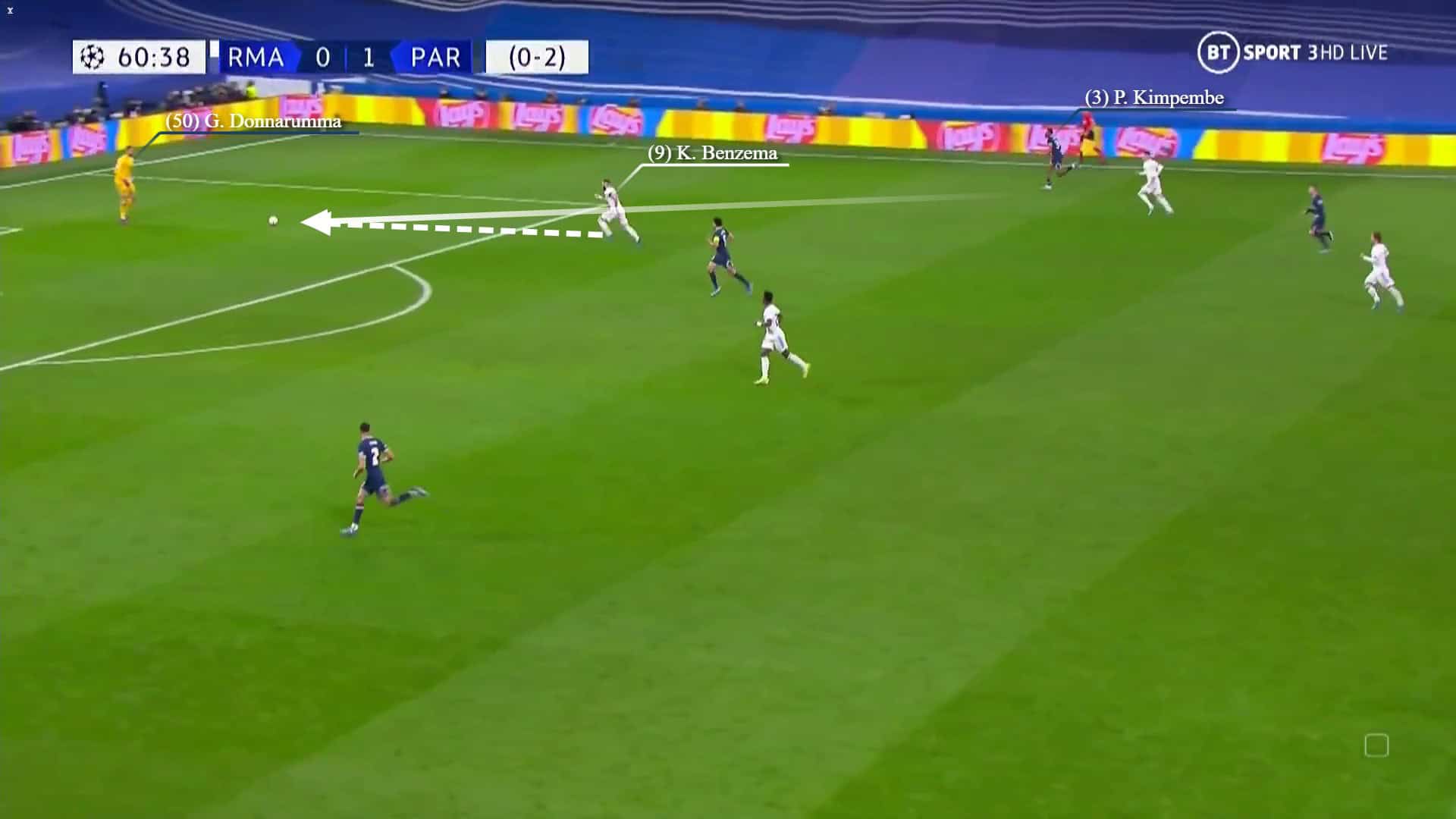
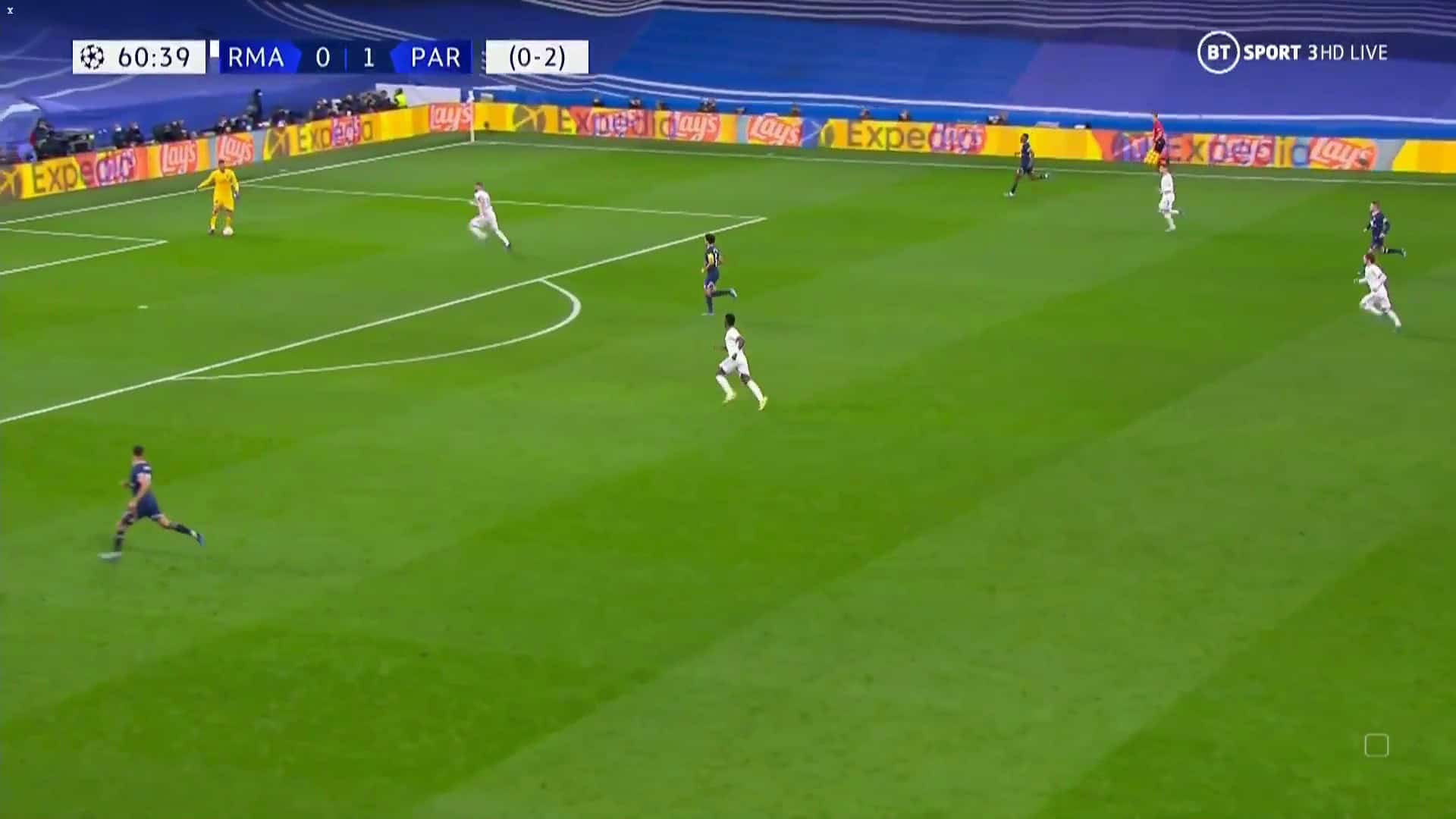
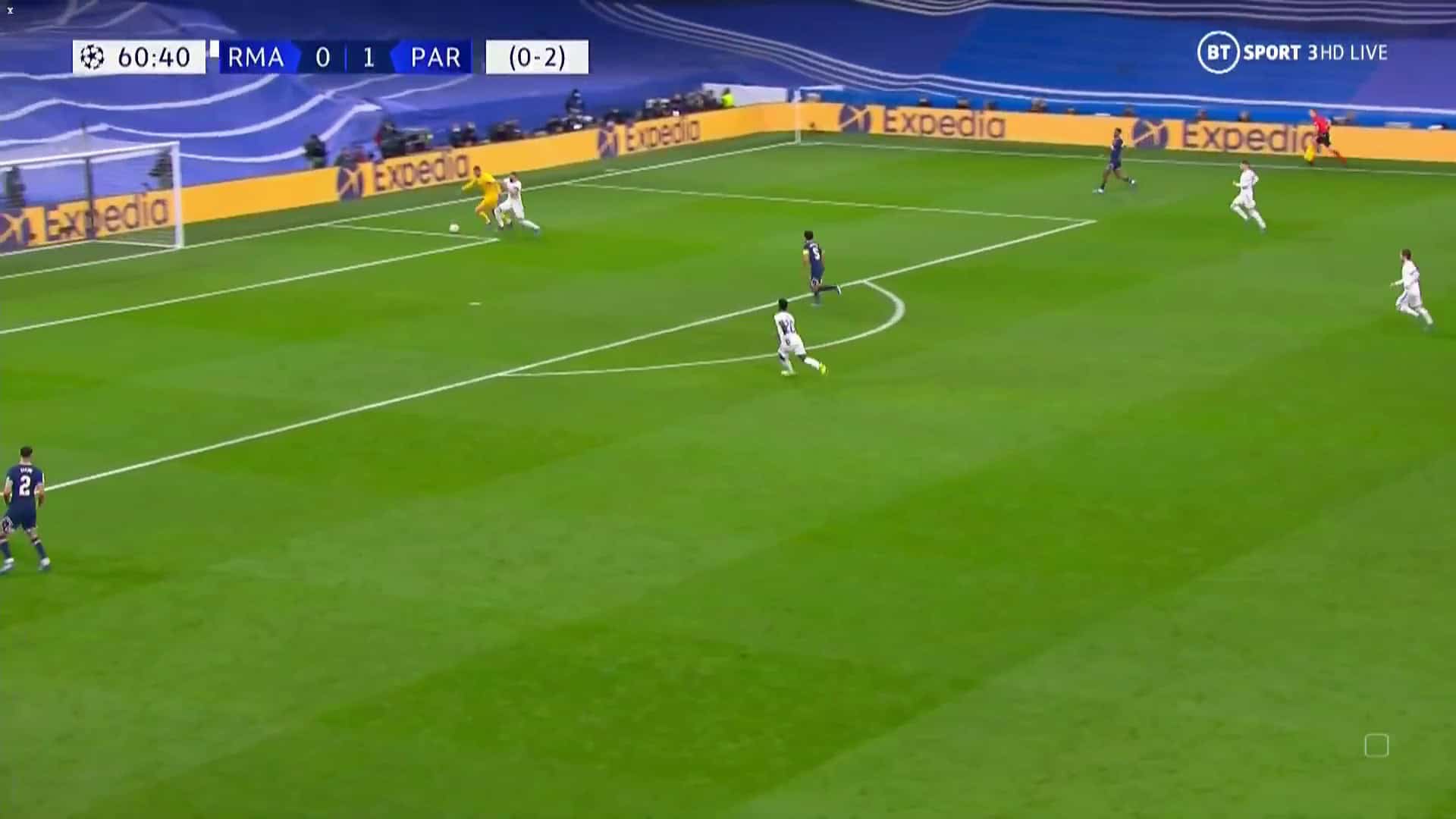
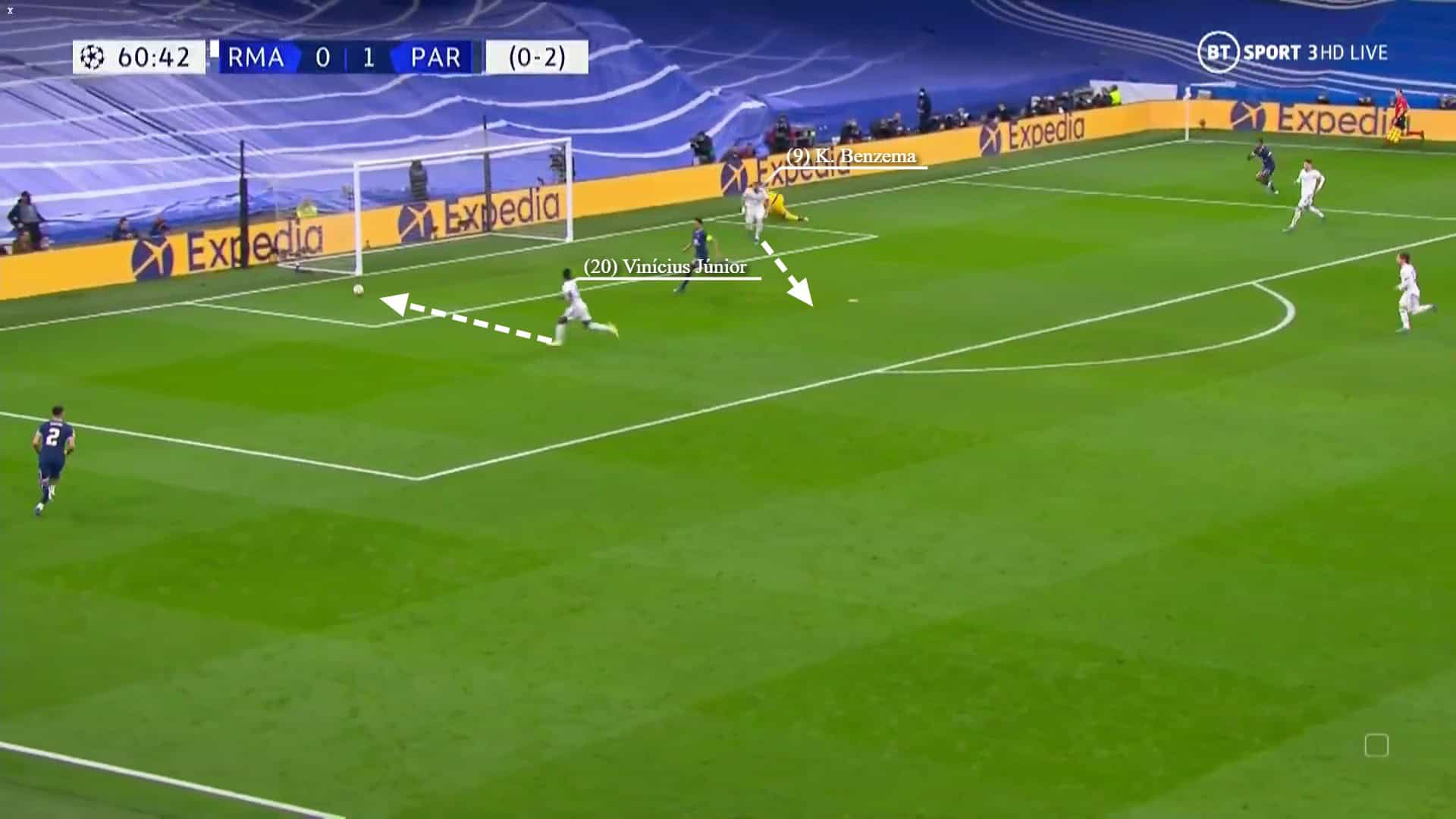
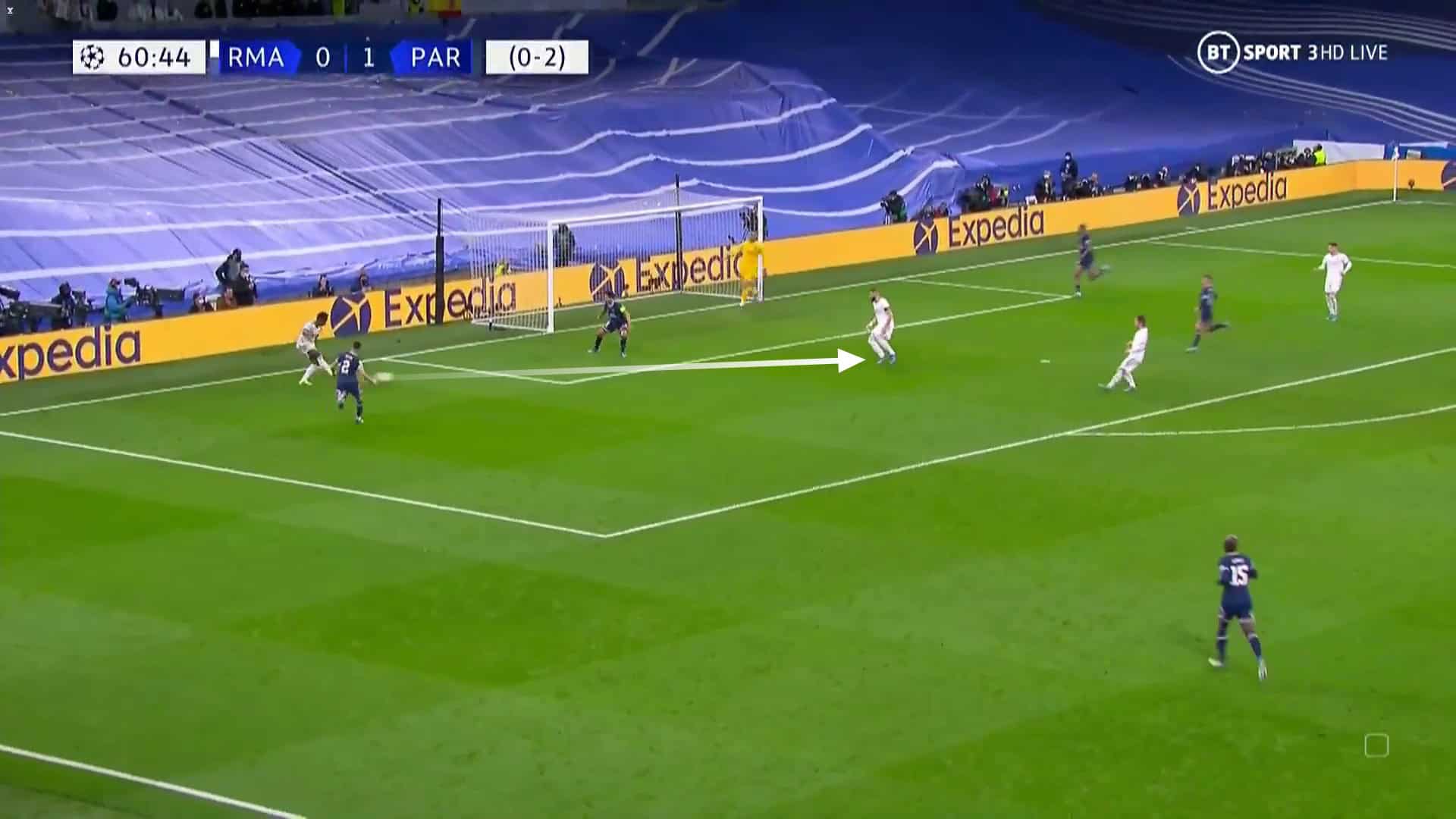
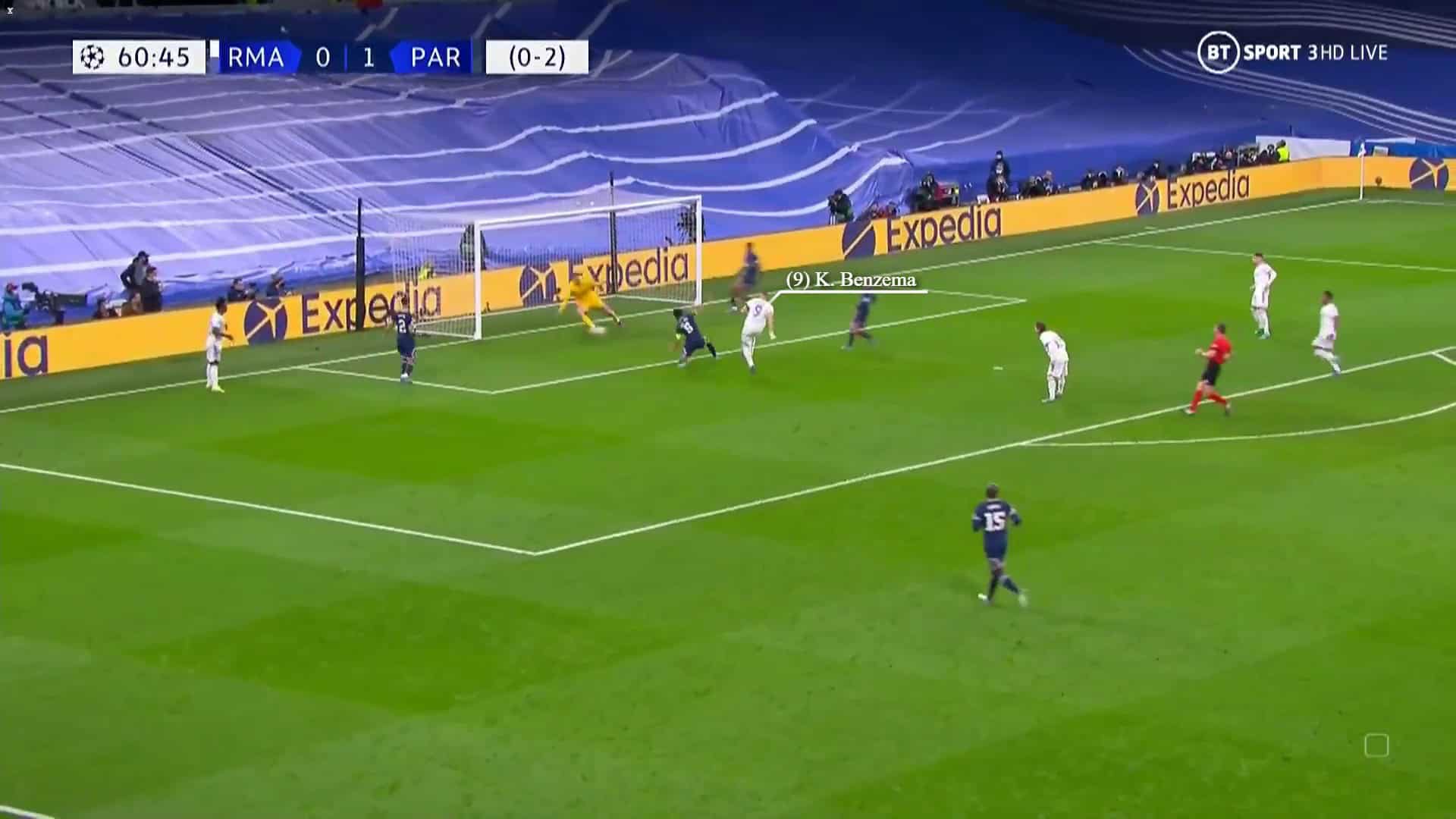 Donnarumma’s indecision under pressure in that match was not an isolated error but a broader limitation in possession.
Lucas Chevalier Proactive Play & Distribution Range
By contrast, Lucas Chevalier’s distribution is much more assured and suited to PSG’s build-up.
He is comfortable with all aspects of modern goalkeeper distribution: accurate short passes under pressure, chipped balls over the initial pressing line, and long balls to wide players.
The variety of pass selection enables PSG to invite pressure and break it with a single pass.
Chevalier’s presence allows PSG to create numerical superiority during build-up.
His reliability in possession allows the centre-backs to spread wider and the midfielders to receive in more advanced positions.
For instance, his chipped passes into wide areas would benefit players like Achraf Hakimi and Nuno Mendes.
These passes allow them to receive the ball higher up the field, bypassing the initial pressing lines.
This is also shown below against Montpellier, where Chevalier is able to skip lines of pressure and attract the opposition with the hope of winning the ball.
However, the pass is weighted perfectly, dragging them out of position and leaving spaces for runners to exploit via second ball, flick.
As a result, they can progress into the middle and final third much more quickly than if PSG had tried to build through the ground to find an opening.
Biomechanical Analysis Of Goalkeeper Distribution Technique
Lucas Chevalier’s success in distribution is due to his body positioning.
His posture during the first phase of distribution remains upright and balanced.
His stance (wide) is optimised for quick responses to pressing cues.
When playing short passes, Chevalier has excellent hip rotation, allowing him to disguise his intentions.
For chipped and long balls, Chevalier generates lift through a controlled follow-through rather than relying on an exaggerated back-swing.
This subtlety enables rapid ball release, making it difficult for opponents to anticipate or intercept passes.
By initiating the motion from the hips, transferring energy through the core, and finishing with a coordinated leg-whip, Chevalier maximises both distance and accuracy.
This is shown against Rennes, where he has the confidence to take a few steps back (despite opposition pressing) and play an excellent long ball to start one more attack.
His body shape shows that he is not lean, and his leg is straight and pointing in the intended direction.
Donnarumma, in contrast, displays less biomechanical refinement in his passing.
His stance under pressure can become too narrow, affecting balance and limiting his passing angles.
There is also a tendency for rigidity in his upper body, which makes his passes easier to read.
These differences knock Les Parisiens‘ ability to play through the press and retain possession under pressure.
Handling Pressure
A key qualitative difference between the two keepers can be found in their psychological profiles.
Lucas Chevalier is praised for his composure under pressure.
His anticipation and decision-making reveal a high level of game intelligence.
Chevalier’s proactive interventions outside the box, his timing as a sweeper, and his risk assessment when distributing can contribute to PSG’s ability to control transitions and resist the press.
Donnarumma’s strength is his last-line shot-stopping, especially in 1-v-1 situations.
His size, reach, and reflexes make him an exceptional barrier.
But the memory of high-profile mistakes, such as the Madrid collapse, are still remembered.
Opponents are increasingly confident when pressing Donnarumma.
While this does not erase his strengths, it introduces a tactical liability in matches where PSG must play from the back against aggressive opposition.
Team Identity & Squad Building: The French Core
Lucas Chevalier’s signing is also a reflection of PSG’s evolving squad-building philosophy.
Under Luís Campos and Luis Enrique, the club is constructing a new French core, as shown by the recruitment of players such as Ousmane Dembélé, Bradley Barcola, Désiré Doué, and Lucas Hernandez, as well as the pursuit of defenders like Ibrahima Konaté.
At just 22, Chevalier already has over 400 professional appearances, making him an ideal symbol of PSG’s commitment to French identity.
Conclusion
The magnitude of this transition is not lost on PSG’s hierarchy.
Donnarumma is among the best goalkeepers in the world.
His contributions to last season’s triumphs were invaluable, and his shot-stopping have won finals.
However, the goalkeeper’s role in possession is increasingly non-negotiable.
Lucas Chevalier, though less globally known, meets these demands more than Donnarumma.
His statistical superiority is complemented by technical, biomechanical, and psychological qualities that fit with PSG’s vision.
Replacing a world-class, established figure with a younger alternative is a gamble.
Nonetheless, the potential reward is a more cohesive and press-resistant PSG.
The decision to back Lucas Chevalier is not only about the present but is a decisive investment in the future of Paris Saint-Germain.
