
It took until the final day of the Premier League season, but Chelsea secured UEFA Champions League football for 2025/2026.
They followed that up with a UEFA Conference League trophy, coming from behind against Real Betis to win dominantly with a 4-1 scoreline.
The Blues‘ path to the 2025 FIFA Club World Cup trophy has opened up, and they now look like strong contenders.
Enzo Maresca has Chelsea in a better position than they had been under Mauricio Pochettino.
The Pep Guardiola disciple still has a long way to go to make Chelsea a genuine Premier League and Champions League contender, but the pieces are there.
One aspect of Chelsea that needs to improve if they are going to compete at the top of the Premier League or go deep in the Champions League is their ability to break down low blocks.
At one point last season, they put together an eight-game winning streak and were competing with Liverpool at the top of the table.
What followed was a string of matches against primarily low-block defending teams, such as Everton, Fulham, and Ipswich Town.
The goals, along with the results, began to dwindle.
As the season progressed, Maresca did not have an answer for how the Blues would effectively and consistently break down teams that would sit very deep and compact against them.
In large part, it was both a tactical and personnel issue.
In this tactical analysis article, we will explore Maresca’s philosophy of unlocking an opponent sitting in a low block and how some of Chelsea’s new signings, like Liam Delap and Jamie Gittens, can help fix these issues.
Enzo Maresca Tactics Vs Low Blocks
Maresca uses the same concepts as Pep Guardiola when it comes to low blocks.
When they build up in a 3-2-5, their main goal is to overload the middle of the pitch, with the wingers or, in some instances, full-backs providing width.
Here is where their problems begin.
Maresca wants to have control and a solid rest defence to maintain possession and counterpress quickly once Chelsea win the ball.
In many aspects, it’s a good strategy because it limits your opponent’s ability to hit you on the counter effectively.
Still, it’s not always the most efficient one if you want to create many high-quality chances—that depends on many factors, including game state, opposition, and personnel.
From the beginning of February until the end of the season, Chelsea held more than 55% possession in nine of their final 14 Premier League matches.
In those nine matches, they averaged 1.14 non-penalty expected goals.
Therefore, possession did not necessarily translate to more chances.
What often happens to Chelsea is that they try to maintain a five-man central overload to force their way through the midfield, but there is simply no space to get through.
See this situation against Ipswich:
 Or this situation against Brighton:
 Or even most recently, this situation against Benfica:
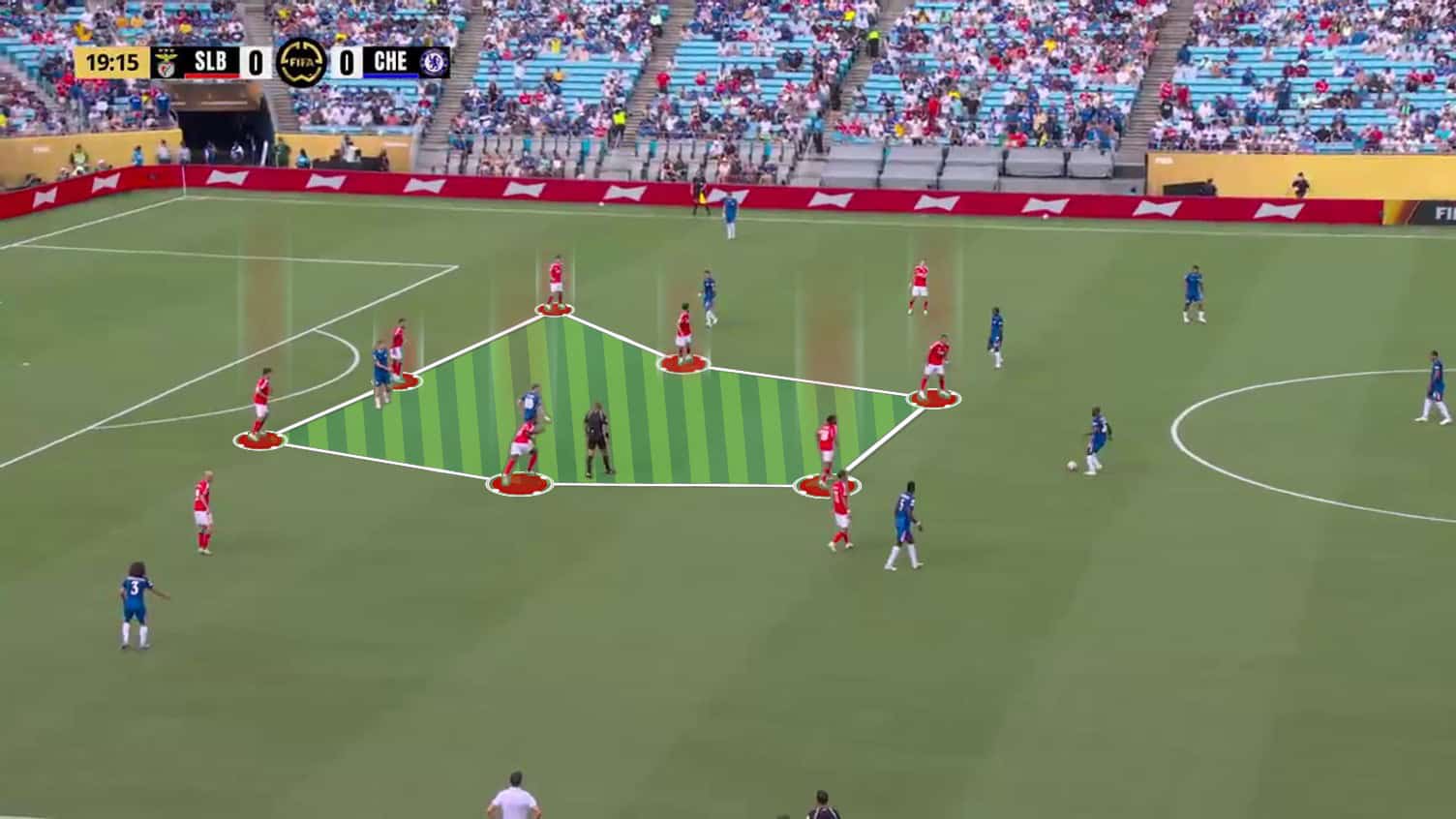 Cole Palmer and Enzo Fernández‘s operation as dual number 10s trying to find space between the lines only works when there is space for them to receive the ball and find a teammate.
What happens when there is consistently no space?
The next option is to play the ball out wide to their wingers, who are consistently 1-on-1 against the opposing full-back.
However, Chelsea’s current wingers are not the type of wingers they need.
Someone like Noni Madueke is a high-volume shooter from the right wing who likes to cut inside to get on his favoured left foot.
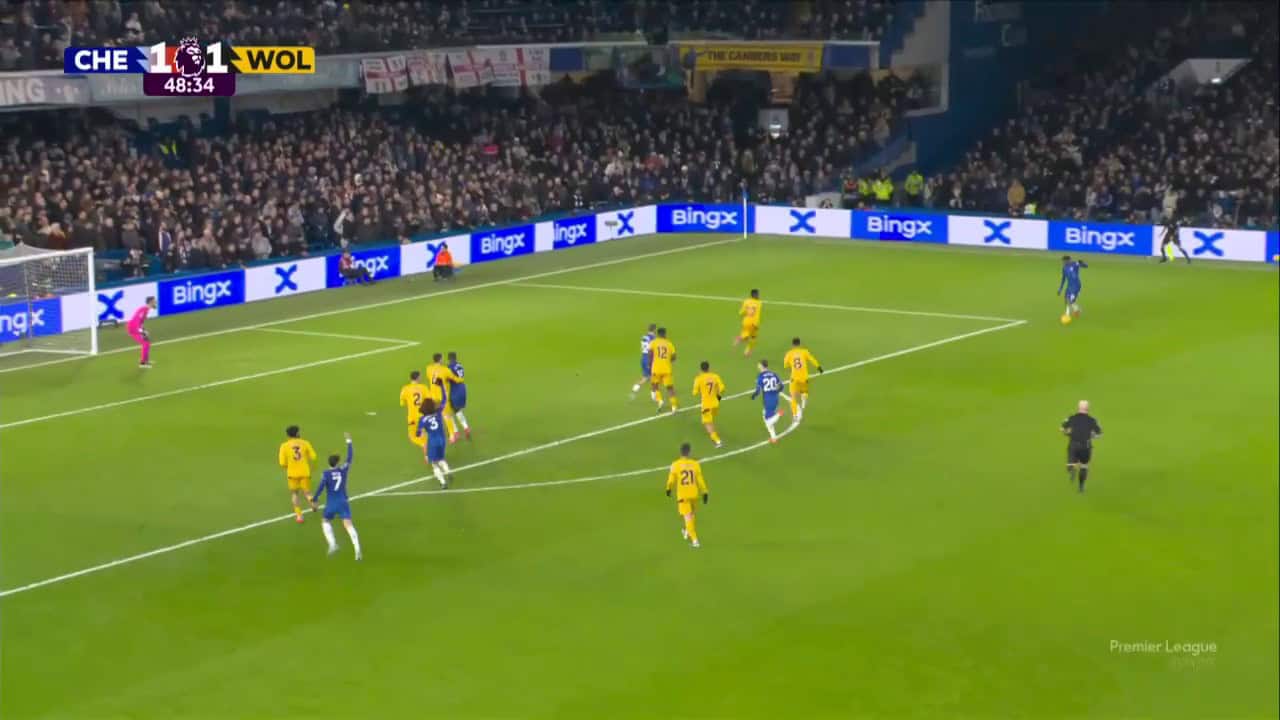
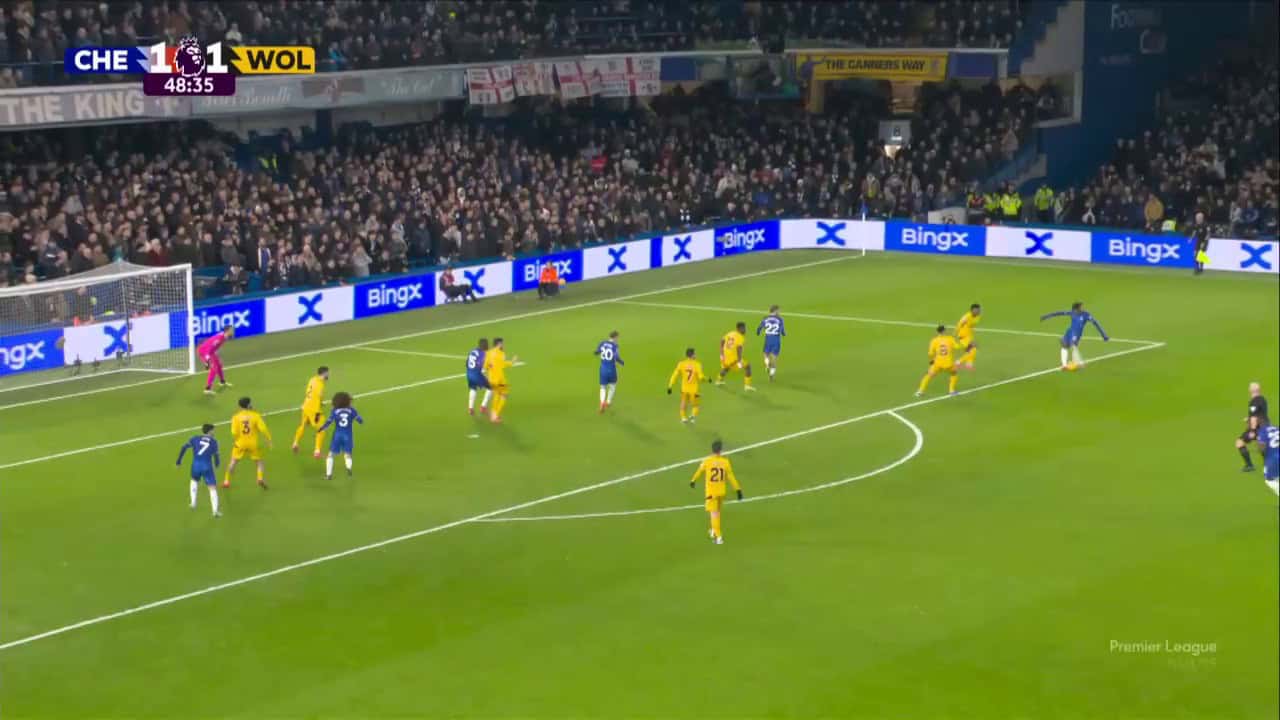 Pedro Neto has been playing out of position at left wing for most of the season and is really the only winger who can beat a defender 1v1, get to the byline and send in a cross to the box.
Neto finished the season fourth in the Premier League with 34 successful open-play crosses.
While Madueke is undoubtedly talented, you’d be surprised to know that he was fourth for shot volume in the Premier League this season, averaging 3.54 shots per 90 minutes.
The problem is that Palmer is also a high-volume shooter, so almost seven shots per 90 minutes are coming from a number 10 and their right winger.
Why is that the case?
Because Chelsea do not have strikers who are legitimate threats in the box against Premier League-quality centre-backs.
Nicolas Jackson is an outstanding transition striker and excels at making runs off the opponent’s backline, but he lacks an aerial threat or physical presence in the box.
In fact, Chelsea had no aerial threats in the box this past season; every single one of their attackers had an aerial duel win rate of less than 50%.
That means when everything breaks down, and Chelsea’s only option is to send in crosses to the box, they have nobody who consistently heads the ball into the back of the net.
In fact, Marc Cucurella was their most dangerous threat in the box.
Chelsea would need to get a numerical advantage to win any ball sent into the box.
Thus, Cucurella would be forced to push forward so they could get 4v3 situations like the one here against Wolves, from which the Spaniard scored.

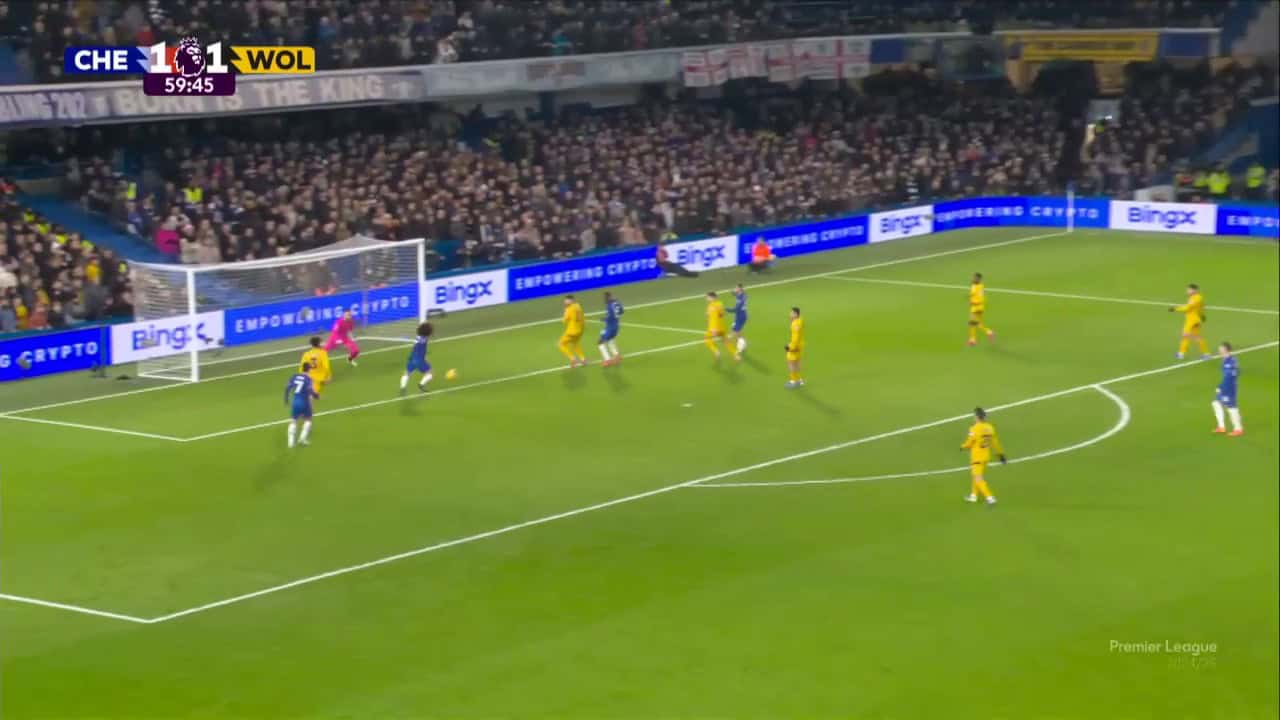
However, these types of scenarios were few and far between, and without the option of effectively sending a cross into the box, Chelsea were more often than not stuck with no way through against good low-block defending teams.
New Chelsea Signings, New Solutions
The mould that Chelsea should be copying is Diego Simeone’s Atlético Madrid.
Their front two are often Julián Alvarez and Antoine Griezmann, who are effective in build-up and are two excellent attackers.
However, they will not consistently get on the end of crosses when everything breaks down.
That is why Atleti signed Alexander Sørloth.
He rarely started and only logged 17.4 90s this season in La Liga.
However, the 6’4” Norwegian scored 20 goals and led Europe’s top five leagues in both goals per 90 (1.15) and xG per 90 (0.97) because he is one of the best aerial threats in world football (98th percentile for aerial duel win rate when compared with other centre-forwards from Europe’s top-five leagues).
Alexander Sørloth At Atletico Madrid 2024/2025
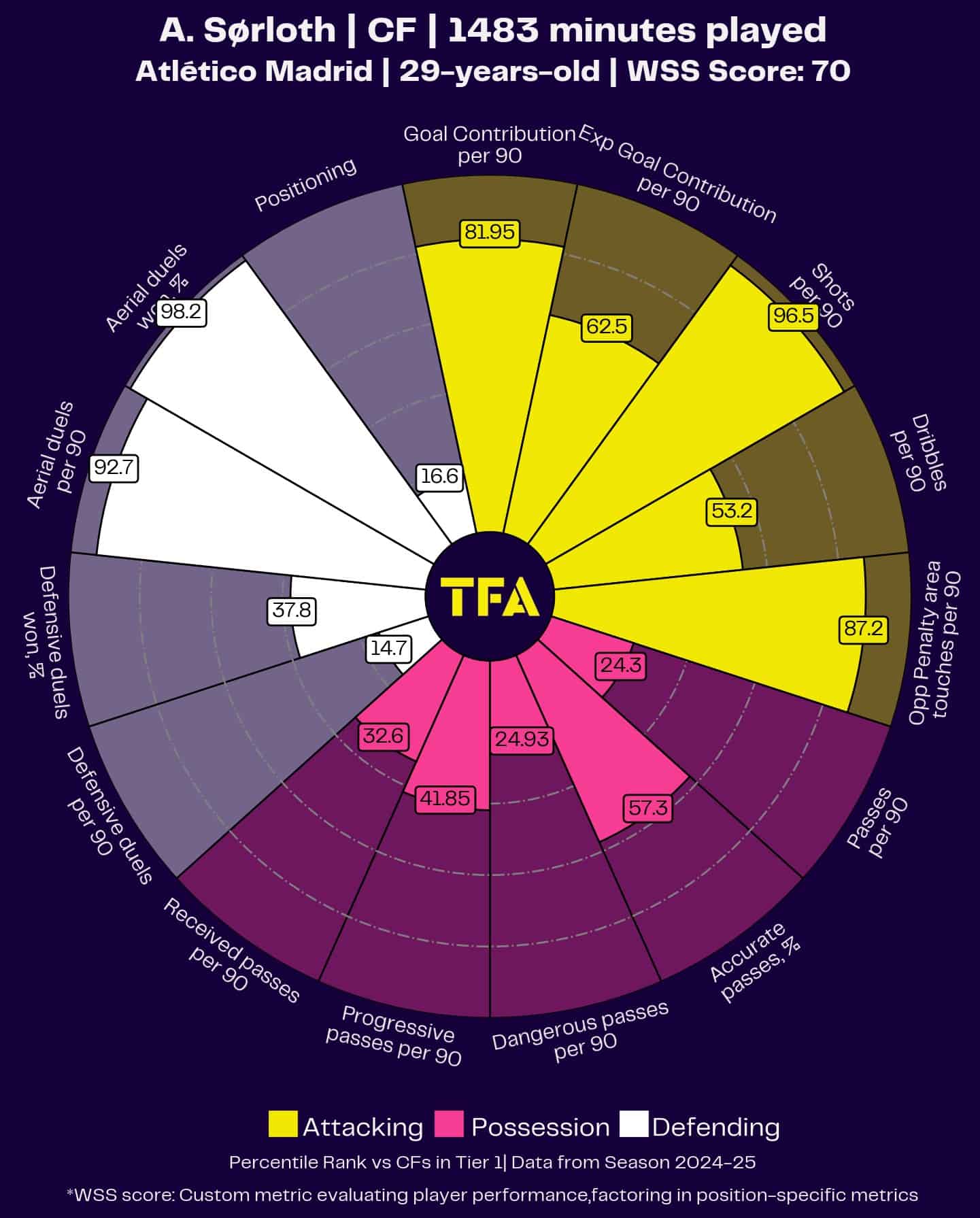
He is the type of striker Chelsea desperately need.
Someone who is perfectly content not starting most matches and can come off the bench to be that significant presence in the box when they struggle to find a way through low blocks.
I think they have found that in Liam Delap.
Liam Delap At Ipswich Town 2024/2025
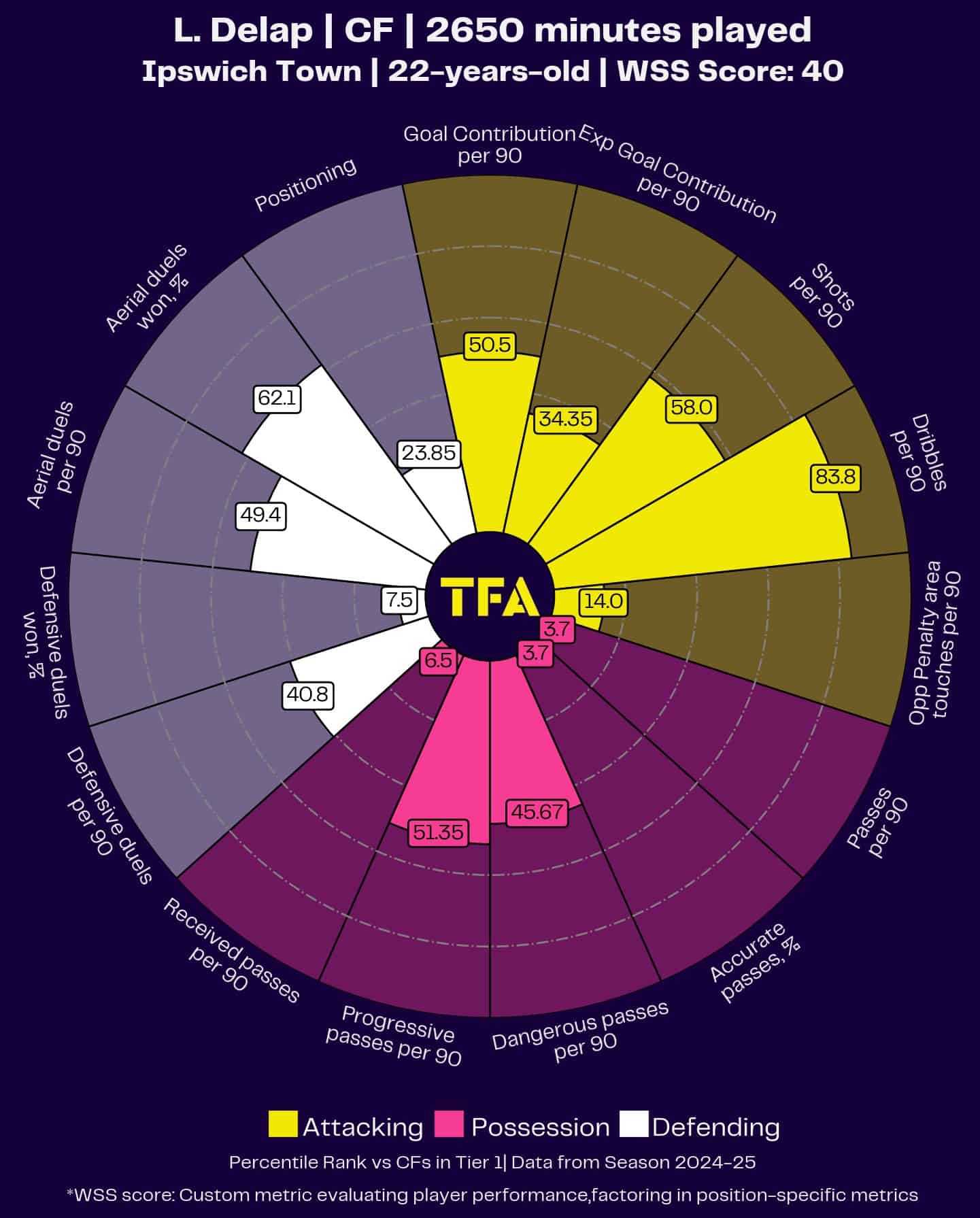
Delap is an old-school traditional number nine who can play with his back to the goal and is incredibly intelligent about his positioning in the box.
He scored 12 goals for Ipswich Town this season.
While his aerial duel win rate would ideally have been higher, the Tractor Boys were often forced to play direct balls to him from goal kicks, which lowered his win rate because it’s very difficult for a striker to win the header in those scenarios.
For example, Chris Wood lost the most aerial duels in the Premier League last season, but scored the most goals from headers, as Nottingham Forest consistently targeted him when they went long from goal kicks.
Delap is also really good at making quick runs off the opponent’s backline.
This is important because Palmer and Fernandez will consistently pull centre-backs with them to create space.
So, having a striker who is good at recognising that will benefit Chelsea greatly.
I would imagine that Neto will be the regular starter at right wing for the upcoming season.
That means Chelsea need a left winger who can specifically beat defenders off the dribble and create chances for his teammates.
They do not need another high-volume shooter like Jadon Sancho, who consistently cuts inside to take a shot from outside the box.
They have found that in Jamie Gittens.
Jamie Gittens At Borussia Dortmund 2024/2025
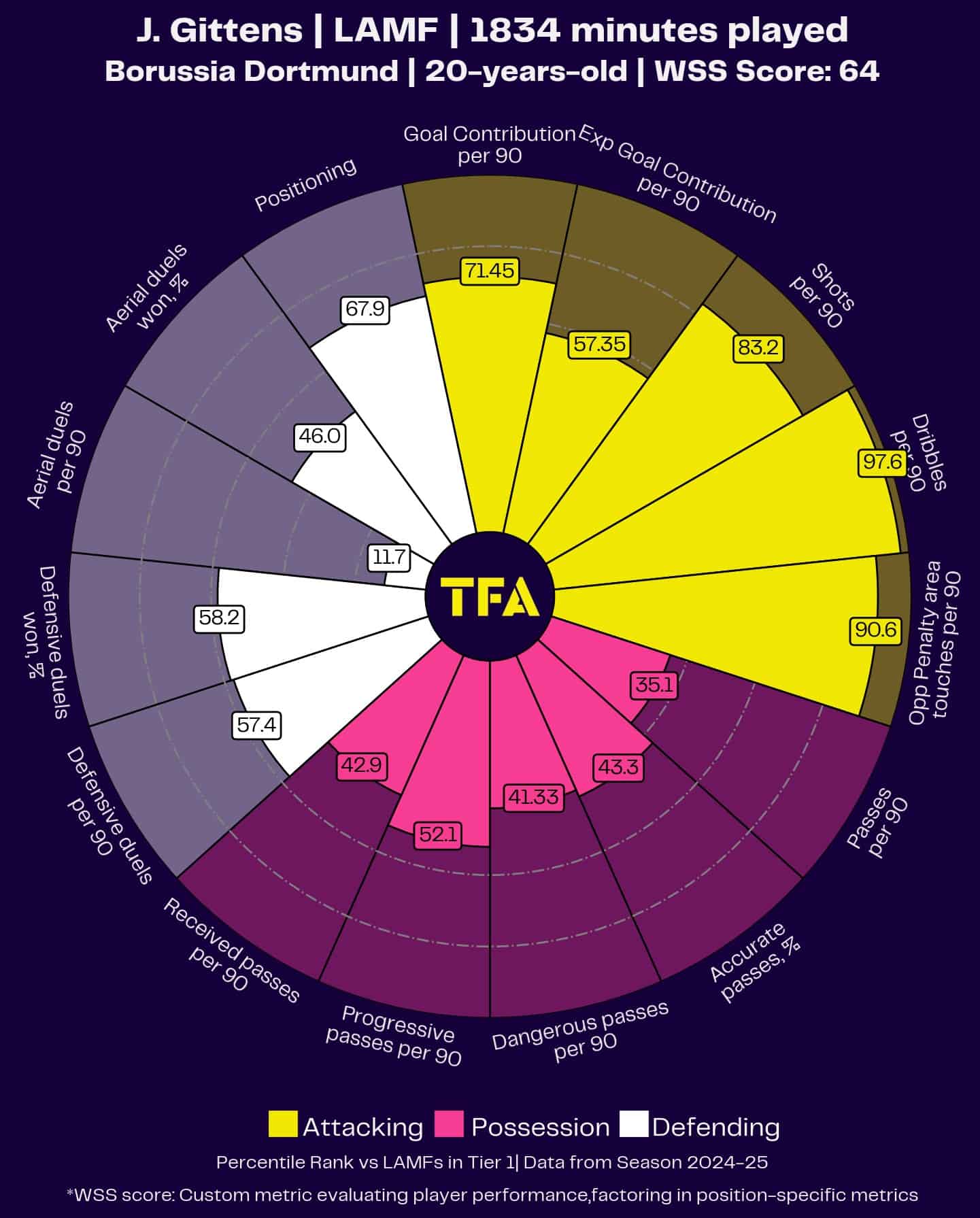
He was one of the best dribblers in Europe’s top five leagues for Borussia Dortmund last season, ranking in the 99th percentile for successful take-ons and in the 91st percentile for progressive carries.
In Maresca’s 3-2-5 system, the left winger needs to be able to beat defenders off the dribble to the byline because there is no overlapping full-back there to support him.
Gittens gives Chelsea this type of option because he is so explosive off the dribble, not only blowing past defenders but also cutting inside.
Conclusion
The signings Chelsea made this summer in Delap and Gittens were astute because they addressed the exact needs they had.
Maresca now has a physical presence and aerial threat in the box that he can call upon when Chelsea struggles to play through the middle.
He also has wingers on both touchlines that are very good at beating defenders off the dribble, so it’s not the end of the world when the ball goes out wide.
We must pause and remember that these issues are not magically resolved with two new signings.
Liam Delap started up top in Chelsea’s Round of 16 Club World Cup match against Benfica, and in regular time, Chelsea created little, with their lone goal coming from a free kick.
While the signings are smart, it may take some time for them to get fully integrated into the squad, but Chelsea’s ability to break down low blocks should certainly improve.
