
Lanús reached the Recopa Sudamericana final with a clear premise: to compete through solidity.
In the first leg against Flamengo, the Argentine side built their advantage not through sustained possession or clear technical superiority, but through a precise, coherent defensive plan executed with enormous collective discipline.
The match offered a clear example of how a well-developed out-of-possession structure can condition a high-level international opponent and reduce their ability to impose themselves.
This tactical analysis focuses on Lanús’ defensive behaviours, understanding defence not as a reactive phase but as an active tool for controlling the game.
Through a well-organised mid-block, constant monitoring and a refined reading of space, the team managed to protect key zones, guide the opponent’s circulation and recover the ball in favourable areas.
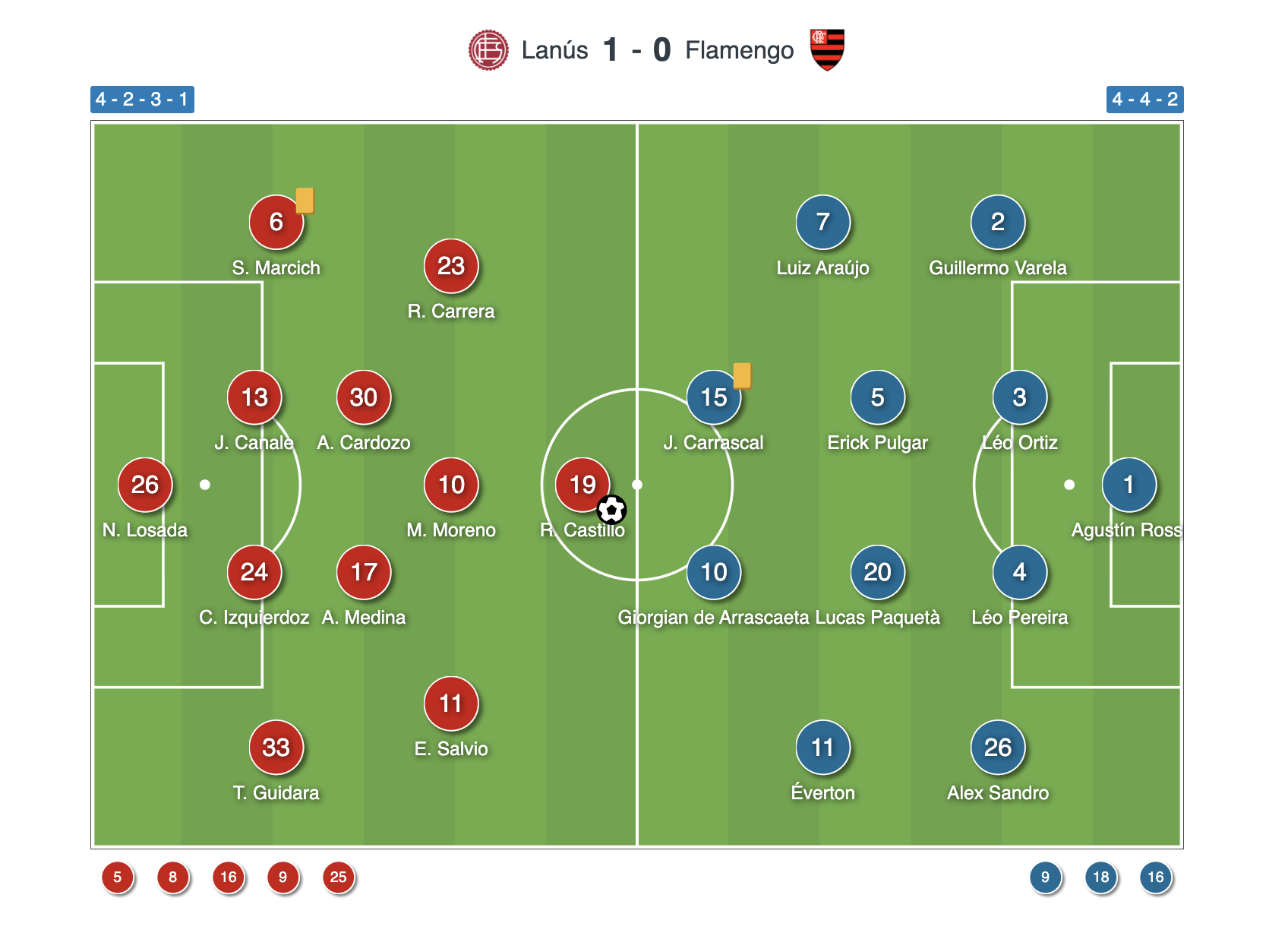
Lanús Vs Flamengo Lineups & Formations
The hosts set up in a 4-4-1-1, with Nahuel Losada in goal behind a back four of Sasha Marcich, Carlos Izquierdoz, José Canale and Tomás Guidara.
In midfield, Agustín Cardozo and Agustín Medina formed the double pivot, with Ramiro Carrera and Eduardo Salvio operating as wide midfielders.
Marcelino Moreno played as a second striker behind centre-forward Rodrigo Castillo, completing a compact and vertically balanced structure.
The visitors were lined up in a 4-2-3-1, but the ball was frequently shifted into a 3-2-2-3 structure.
At the back, Léo Pereira and Léo Ortiz operated as centre-backs, with Alex Sandro and Guillermo Varela as full-backs.
In midfield, Lucas Paquetá partnered Erick Pulgar in the double pivot, while Giorgian de Arrascaeta operated as the central attacking midfielder.
Out wide, Everton held width on one flank, while Luiz Araújo frequently moved inside to complete the attacking square.
Up front, Jorge Carrascal operated as a false nine, dropping into midfield to connect play and disrupt Lanús’ defensive references.
 Lanús Mid-Block
The foundation of Lanús’ plan was a 4-4-2 mid-block, set at a carefully chosen height.
This was neither a passive low block nor a sustained high press, but an intermediate position that allowed the team to protect the central corridor without conceding unnecessary ground.
— Footie Clips (@FootieClips) February 21, 2026
The main objective was clear from the outset: to prevent Flamengo’s centre-backs from finding clean interior passes that could activate the opponent’s attacking structure.
The front two played a fundamental role without the ball.
Rather than pressing aggressively, their behaviour was oriented toward closing passing lanes and guiding Flamengo’s build-up towards the flanks.
The priority was not immediate ball recovery, but orientation: denying interior progressions and forcing Flamengo to initiate attacks in zones where Lanús had prepared collective responses.
Midfielder Monitoring & Second-Line Adjustments
Within this mid-block, monitoring of the opponent’s midfielders was constant.
Lanús quickly identified that much of Flamengo’s fluency depended on their midfielders’ ability to receive facing forward and connect with the attacking midfielders.
To neutralise this, the Argentine side alternated between different control mechanisms.
— Footie Clips (@FootieClips) February 21, 2026
In some sequences, the forwards adjusted their height and body orientation to block direct passes into the holding midfielder.
In others, second-line midfielders stepped forward aggressively to reduce the space behind the front two.
These jumps were neither chaotic nor constant, but situational, well-coordinated and always supported by a compact structure behind them.
The result was a significant reduction in the time and space available to Flamengo’s midfielders.
Clean receptions in the central axis were scarce, and many occurred already under pressure, with the receiver facing their own goal or forced to play backwards.
Compactness As A Guiding Principle
One of Lanús’ greatest achievements was maintaining compactness between the lines throughout the match.
The distance between the midfield line and the defensive line was rarely stretched, even when Flamengo managed to advance a few metres.
This proximity allowed the defensive midfielders to quickly close the space between the lines, while giving the centre-backs room to step forward without excessive risk.
Compactness was not only vertical but also horizontal.
Lanús consistently reduced the space between the full-back and centre-back, making it difficult for opponents to play in the channels and forcing them wide under unfavourable conditions.
Forcing Wide Play & Creating Density On The Flanks
Once Flamengo’s build-up was oriented towards the flanks, Lanús activated another key pillar of their plan: the creation of numerical density in wide areas.
The full-backs adopted a proactive approach, stepping out decisively to engage the wide player.
These jumps were not isolated actions, but were supported by close cover from the interior midfielder and the near-side centre-back.
— Footie Clips (@FootieClips) February 21, 2026
In this way, Lanús managed to match or even outnumber Flamengo on the flanks, preventing comfortable progressive receptions.
Every forward-oriented first touch was met with immediate, intense pressure, forcing return passes, poor control, or long balls without advantage.
This behaviour had a clear effect: Flamengo were able to progress down the flanks in terms of territory, but rarely did so when they had a real advantage.
1v1 situations out wide were scarce and, when they did appear, they were almost always backed by immediate cover.
Controlling The Attacking Midfielders & The False Nine
Another key aspect of Lanús’ defensive plan was controlling the players positioned at the top of Flamengo’s attacking square.
Against mobile attacking midfielders and the false-nine tactic, the Argentine side adjusted their references intelligently.
In many sequences, the double pivot positioned itself optimally to close the space between the lines, prioritising body orientation and distance to the ball.
In others, the centre-backs took on a more proactive role, stepping forward quickly to prevent the attacking midfielders from receiving a pass to the goal.
— Footie Clips (@FootieClips) February 21, 2026
This constant exchange of responsibilities allowed Lanús to control traditionally sensitive spaces.
Receptions between the lines did occur, but rarely under conditions of body advantage or with time to turn.
The Authority Of The Center-Backs
The work of the centre-backs was decisive in sustaining the entire defensive framework.
Both showed excellent judgement in knowing when to switch marks, when to step out and when to delay.
Their ability to defend forward was key in preventing Flamengo from establishing sustained pressure in the attacking half.
In addition, their constant communication with the double pivot allowed reference adjustments without breaking the overall structure.
This understanding was fundamental in neutralising the movements of the false nine and the attacking midfielders, who attempted to drag markers and create space behind the line.
Early Pressure & Prolonged Efforts From The Centre-Forward
Although the mid-block was the dominant structure, Lanús also managed to guide Flamengo’s build-up during early construction phases.
In this regard, the work of the centre-forward was crucial.
— Footie Clips (@FootieClips) February 21, 2026
His effort was not limited to the first pressing action, but included long recovery runs to protect the space behind in situations of numerical inferiority.
This commitment allowed the team to maintain the block’s height even when the first line was bypassed.
Each recovery run by the forward helped restore numerical balance and prevented Flamengo from finding clear advantages.
Conclusion
Lanús built their victory on an active, intelligent and deeply collective defensive performance.
The mid-block, monitoring, compactness and wide orientation were not isolated resources, but components of a coherent plan sustained throughout the match.
Beyond the result, the match offered a clear lesson: when the structure is solid and behaviours are well trained, defence can become a genuine competitive advantage.
