
The date is April 15, 2017, and the venue is El Molinón – Enrique Castro Quini, home of Sporting Gijón, which is hosting league leaders Real Madrid on Matchday 32 of the 2016/17 La Liga season.
The hosts take an early lead, with Duje Cop scoring in the 14th minute, but Isco equalises for Real just three minutes later.
However, Gijón, battling relegation, frustrate the title contenders for the rest of the first half and surge in front again in the 50th minute through Mikel Vesga.
Their lead lasts a mere nine minutes as Alvaro Morata equalises for the visitors.
From thereon, Gijón shows incredible resistance, keeping Madrid at bay to fuel their hopes of survival and also foil their opponents’ hopes of winning the title, with Barcelona hot on the latter’s heels.
However, Isco scored again in the final minute of regulation to hand Real a 3-2 win, keeping them atop the table despite Barcelona winning by the same margin against Real Sociedad.
Gijón, meanwhile, ended the day 18th, five points adrift of safety.
They lost only one of their final six matches (two wins, three draws) but finished four points behind 17th-placed Leganés. Real Madrid ultimately won the La Liga title by three points, two of which came in that last-gasp draw in mid-April.
Nearly seven years on from that day, Gijón remains in Spain’s second tier.
They came close to securing promotion in the 2017/18 season itself after finishing fourth in the league stage, but lost 5-2 to Real Valladolid in the first round of the playoffs.
The team has since finished ninth, 13th, seventh, and 17th twice (in that order) over the last five seasons.
However, there is reason for optimism at the El Molinón this season.
Manager Miguel Ángel Ramírez, hired last January, has guided the club to fifth place in La Liga 2 after 31 matches, just four points behind second-placed Elche and seven adrift of leaders Leganés.
Gijón have the league’s third-best defence (26 goals conceded), only behind the top two.
This is in stark contrast to last season, when they shipped in 48 goals in 42 matches, including 23 in 19 matches under Ramírez.
So, what has been the key to their defensive success this season?
This tactical analysis will examine the statistical improvements Gijón has made since the second half of last season, while also analyzing Ramírez’s tactics.
Miguel Ángel Ramírez Tactics
At 39, Miguel Ángel Ramírez is one of the youngest managers in Europe but already boasts oodles of experience, having been in management since his early 20s.
The Spaniard has no professional playing background and began his career in football as manager of Las Palmas U19, a role he held from 2004 to 2012, according to Transfermarkt.
This was followed by brief stints with Alavés U19 (manager), the ASPIRE Academy (youth coach), and Independiente del Valle (academy manager) until 2019.
In the summer of 2019, Ramírez was promoted to first-team manager at Independiente.
He managed them for 69 matches until December 2020, leading them to 32 wins and the Copa Sudamericana title.
Upon parting ways with the club, he joined Sport Club Internacional in March 2021, but he held the role only for three months.
The club won just 11 of his 24 matches in charge.
In the summer of 2021, Ramírez joined Charlotte FC in the USA’s Major League Soccer ahead of the 2022 season.
However, once again, he lasted just 17 matches, and when he left, Charlotte was 11th out of 14 teams in the Eastern Conference.
Over six months after leaving the MLS side, he was approached by Sporting Gijón in January 2023 and took on the role.
When Ramírez joined the club, they were 15th in La Liga 2.
His first match in charge ended in a 4-0 loss to Valencia and an exit from the Copa del Rey.
Despite a 1-0 win over Real Zaragoza in his first league game in charge, they won just four more of the next 18 to finish 17th in the standings, six points clear of the relegation zone.
Despite that, Gijón chose to stick with him in the summer, and 31 league matches into this season, they have reaped the rewards of that decision.
A statistical look at Gijón’s improvement this season
A glance at Gijón’s performance in key defensive metrics this season shows they have improved as a defensive unit under Miguel Ángel Ramírez’s pre-season coaching.
As the stat pack below shows, they are conceding fewer goals despite allowing more shots because the quality of those chances is lower, as indicated by the drop in on-target percentage.
Their passes per defensive action (PPDA), which we will explore later, has also dropped, while they are making marginally more interceptions and recoveries.
They have become more dominant in the air and slightly more disciplined.

Many of these improvements are also driven by their improvements with the ball.
A comparison of their performance across numerous metrics in this regard shows a similar improvement.
Gijón is averaging more passes per game and per possession, thanks to a higher possession percentage.
Their accuracy has improved across the board, most notably in forward passes, despite an increase in volume—their final-third and progressive passing stand out in particular.
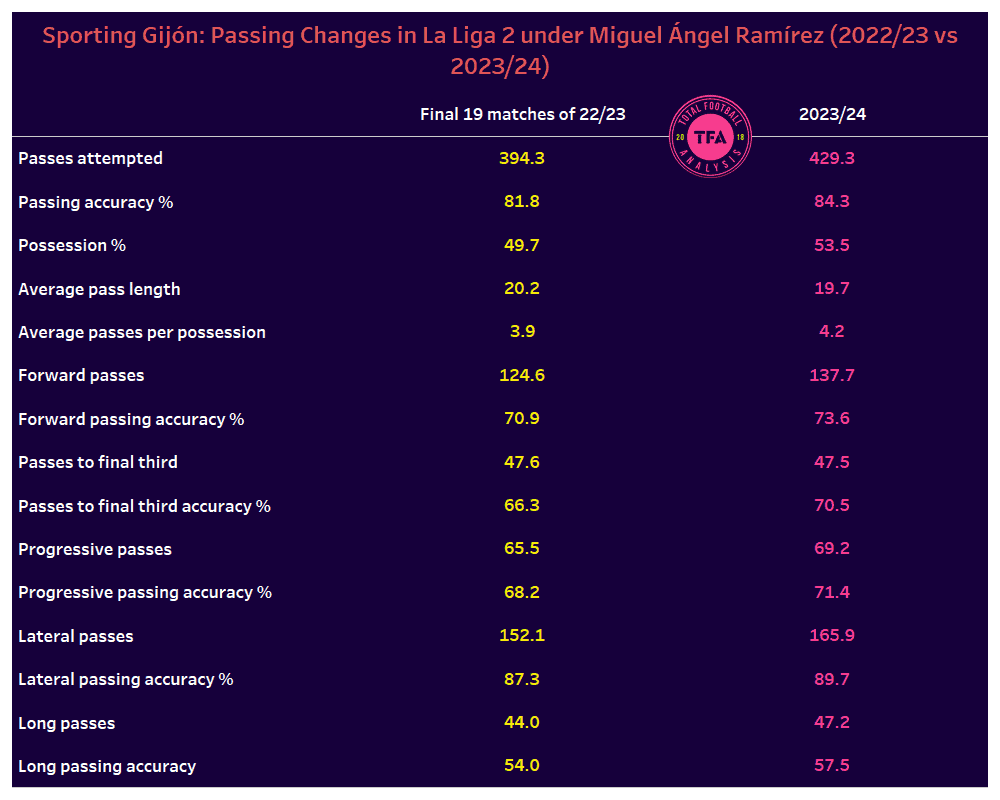
Gijón’s ability to keep the ball more and their improved passing has helped them defend from the front, which is a critical factor in their improvement at the back.
Miguel Ángel Ramírez Formations
Gijón underwent a major squad overhaul last summer, with five players arriving on permanent deals and two on free transfers.
Six players were sold, and one was loaned out.
With those changes coming in, Miguel Ángel Ramírez style of play has largely stuck with a 4-4-2 formation, only occasionally turning to a 3-5-2, 4-2-3-1, or 5-3-2.
Among those signings, Rubén Yáñez has taken over in goal from Iván Cuéllar, who started all of the club’s 19 La Liga 2 matches under Ramírez last term before signing for Mallorca in the summer.
Two other summer arrivals, Róber Pier and Alexandru Pașcanu, have rotated at right back. Both are capable of playing at centre back as well, while Cote has been the preferred option at left back.
The central defence pairing has been varied, with Pier, Pașcanu, Pablo Insua and Carlos Izquierdoz partnering with each other at various points.
Nacho Méndez has been a consistent presence in one of the two central midfield roles, with Christian Rivera, Roque Mesa and Jonathan Varane playing alongside him.
Haissem Hassan has made the right wing his own, while the left flank has seen Gaspar Campos and Fran Villalba feature numerous times.
Upfront, Juan Otero has started 28 of Gijón’s 31 La Liga 2 matches this term.
He has largely had Uros Djurdjevic or Campos for company.
Young winger Dani Queipo has been Ramírez’s most-used substitute this season, coming off the bench 15 times out of 17 total league appearances.
He is followed by Varane (14 off 19), Villalba (13 off 23), and Djurdjevic (12 off 28).
Miguel Ángel Ramírez Defensive Organization
Pressing & Shape
As mentioned earlier, Gijón’s PPDA has dropped quite significantly from the final 19 matches of last season to the first 31 of the ongoing campaign.
Their pressing methods have varied, with Miguel Ángel Ramírez tactics displaying versatility in setting up his tactics to counter the opposition at times, but there have been some overarching trends.
Consider the sequence below from their 1-0 win over Real Oviedo in February.
Gijón don’t aggressively press the opposition defenders, focusing instead on cutting down spaces.
In the first clip, we can see their 4-4-2 in action, with two banks of four supporting the two forwards upfront.
As the ball is circulated forward, one of the midfield four drops into the centre-backs’ channel to provide extra protection in the box.
This gives them numerical superiority in the box when the cross eventually comes in.
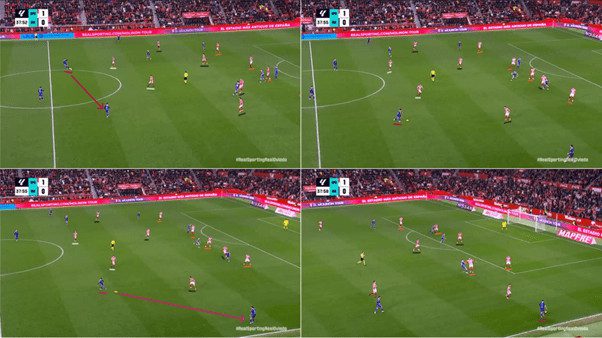
However, their 1-0 defeat to Levante earlier this month provides insights into another aspect of their pressing.
In the sequence below, the focus on closing down spaces becomes clearer, while their tendency to follow the ball also stands out.
This leads them to bait the opposition to try a risky pass, giving them a decent chance of winning the ball back.
In the top-right slide, we see that one of the pressers notices that a Levante centre-back could pass to his midfielder and rushes towards him.
He backs the defender up, making him think twice, and eventually returns the ball to the left-back.
They then work it to the right-sided defender, with Gijón pressing a little more aggressively and bringing in one more player into the half, bringing the total to 5 already there.
Levante ended up playing the ball forward.
On this occasion, the pass is successful, but Gijón will likely believe the odds of them winning the ball back are greater.

Set-Piece Defence
A key aspect of Gijón’s improvement at the back is their defending in both positional play and set pieces.
Their opponents have created shots from only 24.5% of positional attacks and 15.6% of set-pieces.
That number increases in corners (33%), but their defence in these situations suggests they are well-equipped to deal with them.
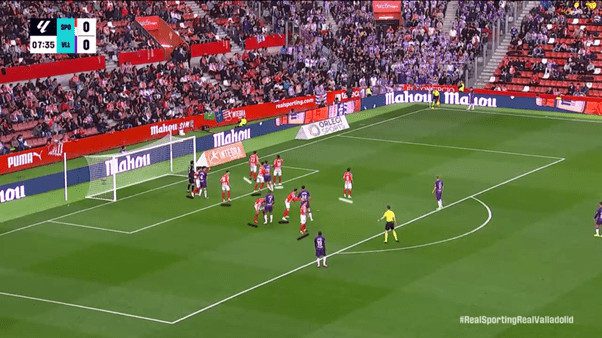
Consider the image below from their 1-1 draw with Real Valladolid.
Gijón deployed a mix of zonal and man marking, with three men patrolling the near post and the area around it (marked in white), and the rest marking various Valladolid players (marked in black).
We see a similar pattern in their match against Alcorcón, who use runners from the edge of the area to attack their corners.
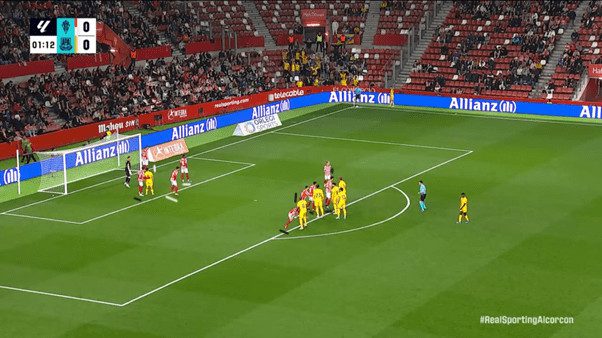
However, Gijón concedes more shots from these situations than others due to their aforementioned focus on the ball.
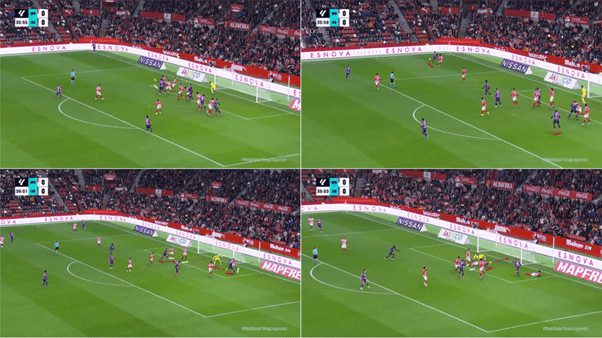
On occasions when they fail to clear the ball sufficiently, they have suffered in the second phase, as a ball-focused approach has often led them to neglect tracking late runners, as in the sequence below from their 1-1 draw with Leganés.
The initial corner is cleared out at the near-post, but the ball back into the box causes problems, and a late run by Sergio González allows him to slide in for a shot.
While the initial effort seems to have been defended well, he then pokes it home while still on the floor.
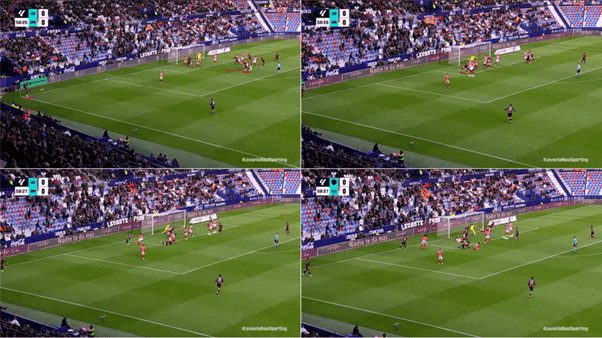
A more straightforward example of this was also seen in their match against Levante, where they failed to track runners twice in the same move.
Here, we first notice a Levante player get a headstart on his marker and make his way to the near post, flicking the ball on.
At the back post, both Gijón defenders fail to spot an opponent ghosting at the back post, and he slides the ball into an empty net completely unchallenged.
Open-Play Defence
Lastly, as a culmination of the points discussed above, Gijón’s defending against opponents in open play has also seen a massive improvement, as indicated by the stats used earlier in this report.
Their compactness, driven by a willingness to track back and their ability to settle into two banks of four quickly, gives oppositions limited space to work within the final third, as in the case below against Alcorcón.
An attacker takes a long ball down well and can then spread the play out to the right.
Even before the move can fully develop, Gijón’s midfielders return to crowd out the space in and around the box, giving their opponents limited avenues to operate.
In the bottom-right tile, we notice that as many as nine Gijón players are in position to deal with a cross into or to the edge of the box.
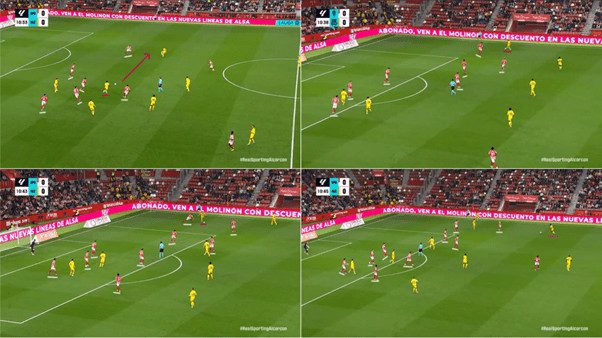
The cross that eventually comes in is rushed and easily cleared by the first man.
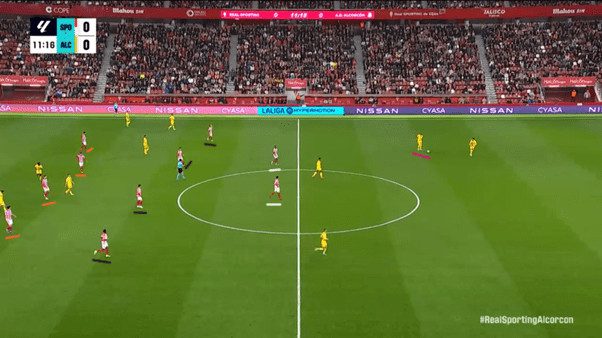
Alcorcón tried twice to get the ball forward, but, as in the case above, Gijón followed the play to the end and shut out almost all the space, leading the former to move the ball back to defence.
As they do so, Ramírez’s men push forward, and we see the familiar 4-4-2 set-up from earlier.
Thus, this is not an easy organisation to get through.
However, in this case, too, we can see how ball-focused the approach is.
While that has multiple pros, the primary con, once again, is tracking runners, an area where Gijón has also struggled in open play.
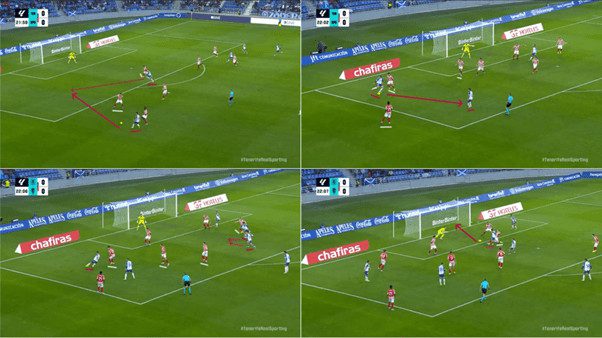
Consider the sequence below from their 2-1 win over Tenerife.
At every step of the move, a section of the defence is caught ball-watching, ultimately leading to a late run into an area of maximum opportunity and an easy finish.
Notice how two of Tenerife’s players could have gotten to the ball unmarked as Ramírez’s side failed to track either of them.
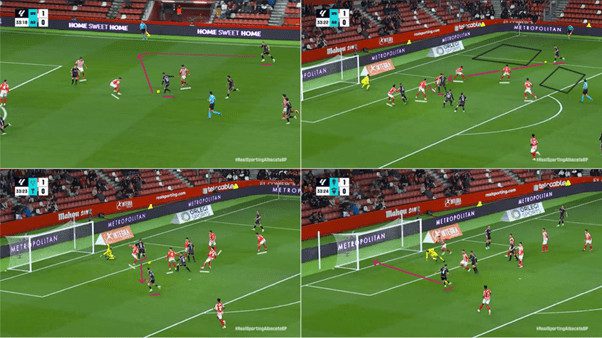
An interesting wrinkle in this phenomenon is the goal below, which they conceded in a 2-1 win over Albacete.
On this occasion, an excellent passing move opened up the defence, and Gijón seemed to go into panic mode.
Unable to decide whether to cover the space or the man on the ball, they do neither sufficiently.
Their initial focus on the ball leaves them unable to track the attacker on the right.
They then look to cover the spaces in the box, which gives the forward all the time and space in the world.
He then passes it to a runner who gets ahead of his defender at the near post.
A flick-on reaches a teammate, who drives the ball into a virtually empty net.
Conclusion
Under Miguel Ángel Ramírez tactics, Sporting Gijón has transformed into one of the best defences in La Liga 2 and is making a serious bid for promotion to the top tier once again.
This season, their defence has been built on a compact, two-pronged line, compensating for their limited pressing from the top.
They have struggled this season with tracking runners, conceding numerous goals in this way from both set-pieces and open play.
However, that is the only blemish on an otherwise solid system that looks set to take them back to La Liga for the first time in seven years.
It is also worth noting that Miguel Ángel Ramírez, despite all his experience, is still young and has plenty of time to perfect his trade.
He is on the right track now, and if he can get Gijón into La Liga, the exposure there could further improve him as a manager.
However, whether that happens or not, the Spaniard is an emerging manager whose development should be closely followed.
