
Spain faced France in the UEFA Women’s Nations League final match and were crowned the first-ever UEFA Women’s Nations League champions after beating Les Bleues with a two-goal margin in a game that took place in Estadio La Cartuja in Seville. Spain succeeded in lifting the trophy following their 3-0 win against the Netherlands in the semi-finals, knowing that they also had to deal with a complicated group-stage draw.
In the end, they successfully got 15 points by winning five games and losing once in League A’s group 4, which was probably the most difficult group, as it includes powerful teams like Sweden, Italy and Switzerland.
On the other hand, despite their inability to resist Spain’s dominance in the final, France were also able to beat a tough team like Germany in the semi-finals after succeeding in topping League A’s Group 2, which includes Austria, Norway and Portugal, having secured 16 points with five wins and one draw.
Nevertheless, they were unable to finish this excellent journey with a win since they faced a more formidable opponent in the final, which proved that France need some more work in order to win consistently at the highest level and be able to beat teams like Spain, England, USWNT, Sweden and other teams like Australia who excluded them from the latest World Cup quarter-finals.
In this tactical analysis article, we will aim at exploring how Spain succeeded in scoring two goals and dominating the game against France while making use of the wings mainly. At the same time, the analysis will mainly shed light on France’s poor performance and what went wrong in their attacking tactics.
Line-ups
Montserrat Tomé, Spain’s head coach, started the match according to the 4-3-3 formation with Cata Coll as a goalkeeper, Ona Batlle as a right-back, Irene Paredes and Laia Codina as centre-backs, Real Madrid’s Olga Carmona García as a left-back, Manchester City’s Laia Aleixandri, Barcelona’s Aitana Bonmatí, and Tigres UANL’s Jenni Hermoso as central midfielders, Athenea del Castillo as a right winger, Mariona Caldentey as a left winger and Salma Paralluelo as a striker.
On the other side, Hervé Renard, France’s head coach, opted for the 4-4-2 formation with Juventus’ goalkeeper Pauline Peyraud Magnin, Élisa De Almeida as a right-back, Maëlle Lakrar and Griedge Mbock Bathy as centre-backs, Sakina Karchaoui as a left-back, Grace Geyoro and Amandine Henry as central midfielders, Kadidiatou Diani as a right winger, Selma Bacha as a left winger, Eugénie Le Sommer as an advanced playmaker who transforms into a second striker at times, and Marie-Antoinette Katoto as the team’s striker.
Spain’s convincing performance and use of the wings
Spain were able to dominate the game against France in this final match despite the pressure that comes with such important games, thanks mainly to their recent experiences when it comes to big occasions (the most recent one being the Women’s World Cup final) and to the remarkable chemistry existing between the players despite the change of the head coach.
Spain kept the same usual formation used in the recent past while changing some names, such as starting the match with Aleixandri instead of Alexia Putellas in midfield and Athenea del Castillo instead of Lucía García. In fact, Spain played with the same line-up used against the Netherlands, with Jenni Hermoso played as a central midfield like during the World Cup and Salma Paralluelo used as an agile striker who moves a lot without the ball and provides a lot of depth to—Spain’s attacks as she often creates space for her teammates, especially those coming from behind.
Although she is not a classic striker who serves as a station and uses crosses well, Paralluelo provides an excellent solution when it comes to dealing with through passes from the wings or the middle, and that’s how Spain used her to reach the box and create danger upfront.
This first goal action already highlights Paralluelo’s unorthodox striker movements and how she retreats to provide a backwards passing option to Carmona while leaving all the space inside the box to Bonmatí who was coming from behind to fill Paralluelo’s spot inside the box and finish the action inside France’s net following a very accurate pass from the left-wing.
 Credits: RTVE
The extensive use of the left-wing and, to a lesser degree, the right one helped Spain a lot in exploiting France’s defensive weaknesses and in penetrating through those sides in order to reach the box more easily and, therefore, create numerous goalscoring chances during this match. But what was decisive against France was the constant advancement and intelligent attacking positioning of both midfielders Hermoso and Bonmatí, which made a lot of difference during every crossing attempt from either wing.
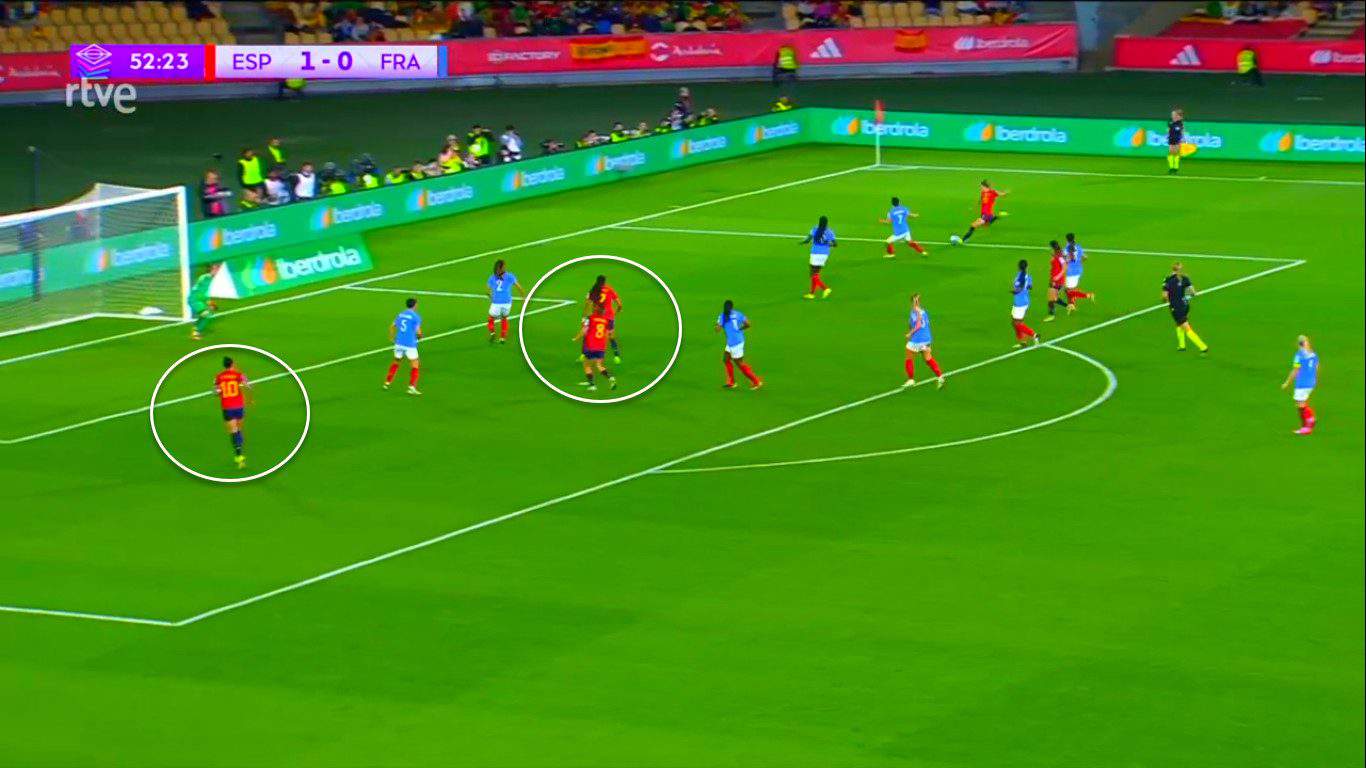
It is not strange at all for a player like Hermoso, who is naturally a striker, to position herself very well inside the box during crosses while she is being played as a central midfielder. This helps Spain a lot during their attacks since it enables them to have an additional striker constantly who eventually finds herself unmarked. The opposing defence usually does not expect her advancement. In this second goal, we see her positioning herself on the far post and providing a key passing solution to her teammate on the right-wing.
But what was even more remarkable and useful in this action, as well as in the first goal action, is Bonmatí’s crucial movements and clinical finishing after getting on the end of crosses that did not seem easy to exploit and needed great first-touch finishes on both goal occasions, which highlights the importance of having midfielders with the calibre of Bonmatí.
 Credits: RTVE
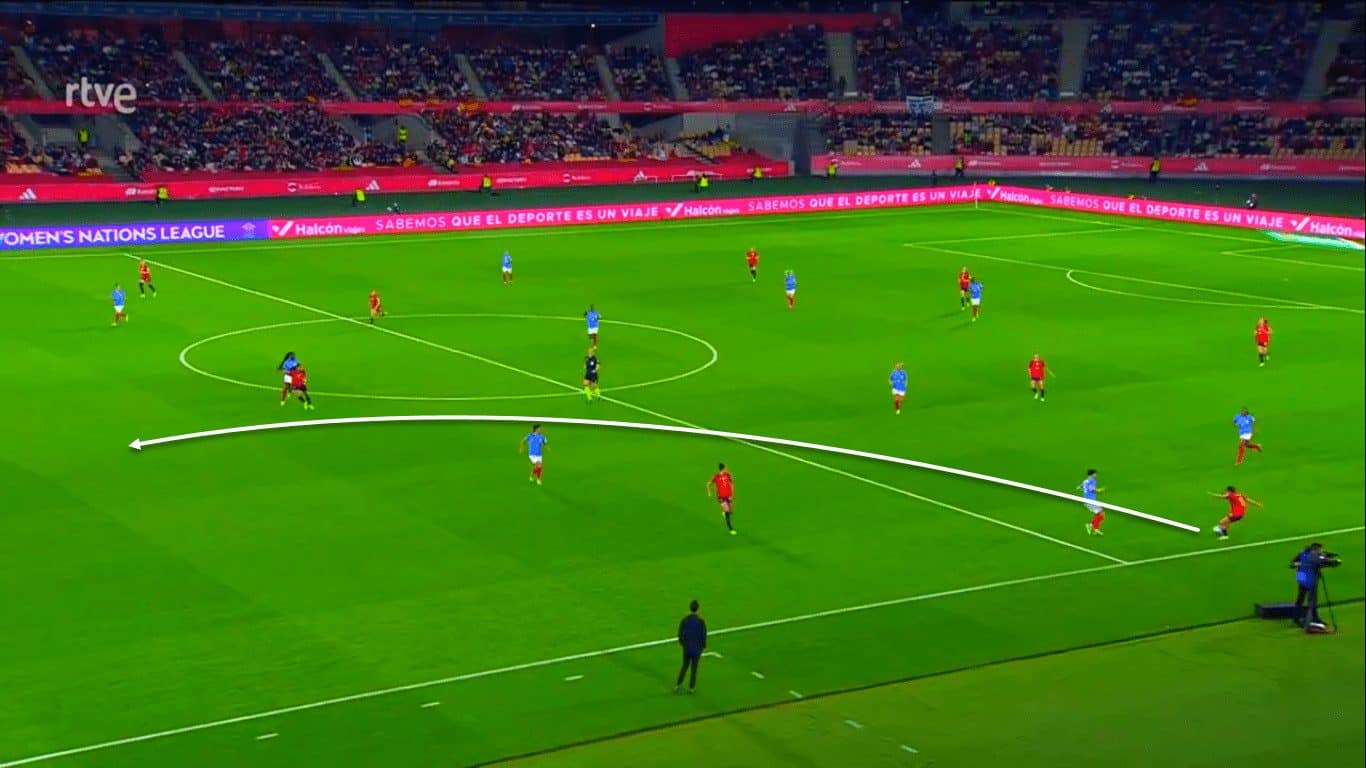
Also, having 60% of possession and making fewer passing errors than France helped La Roja be much more dangerous than their opponent throughout the match, even after scoring the second goal. This action confirms not only Paralluelo’s excellent movements without the ball and anticipations of her opponents’ marking but also Spain’s great reliance on starting most of their attacking actions from the wings and with remarkable accuracy.
This well-timed key pass from Caldentey shows how useful and direct Spain’s actions from the wings can be since there was greatly visible chemistry between both wingers, Paralluelo, Hermoso and Bonmatí. Following the through pass shown below, Paralluelo was able to get to the ball ahead of her direct marker and found herself in front of goal but failed in her first touch, which made it complicated for her to finish the action and get to the ball ahead of the goalkeeper, missing, therefore, a golden chance to finish the game once and for all since the 53rd minute.
 Credits : RTVE
France’s defensive and attacking issues
France’s performance in this match overall was not convincing but rather disappointing for the fans and perhaps for the players themselves since they were not able to cope with Spain’s rhythm and failed to challenge them from an attacking perspective or threaten their goal with concrete chances to get back in the game after falling behind in score.
From a defensive perspective, playing with a high defensive bloc during various actions against quick players like Spain’s wingers and striker was not really a successful choice from Renard since he risked a lot with that choice. The team could have easily conceded one or two other goals if not for the misses of Spain’s players and the few saves of Pauline Peyraud-Magnin.
Moreover, marking, in general, was poor from the French and being unable to mark very dangerous players like Hermoso and Bonmatí can be considered as a tactical failure from Renard and his players in this match since they should have studied their opponent in a more disciplined way to mark the dangerous players tightly and not just focus on marking Paralluelo and leave someone like Hermoso alone inside the box (like in the second goal action).
This marking issue was recurrent throughout the match and did not let France have confidence in their ability to resist or threaten Spain as they were always in danger, especially when they conceded actions from the wings. It is true that Élisa De Almeida and Sakina Karchaoui were both disciplined in defence. However, this was not enough to stop Spain’s attacks in numbers from both wings, as the overlaps executed recurrently kept France in numerical inferiority in key spaces.
That’s why it was necessary for Renard to instruct both midfielders Grace Geyoro and Amandine Henry to lean towards the wings when out of possession in order to prevent the opponent’s numerical superiority. Kadidiatou Diani and Selma Bacha could have done better from a defensive perspective, too, as they had to retreat more often and with more aggressivity on the ball.
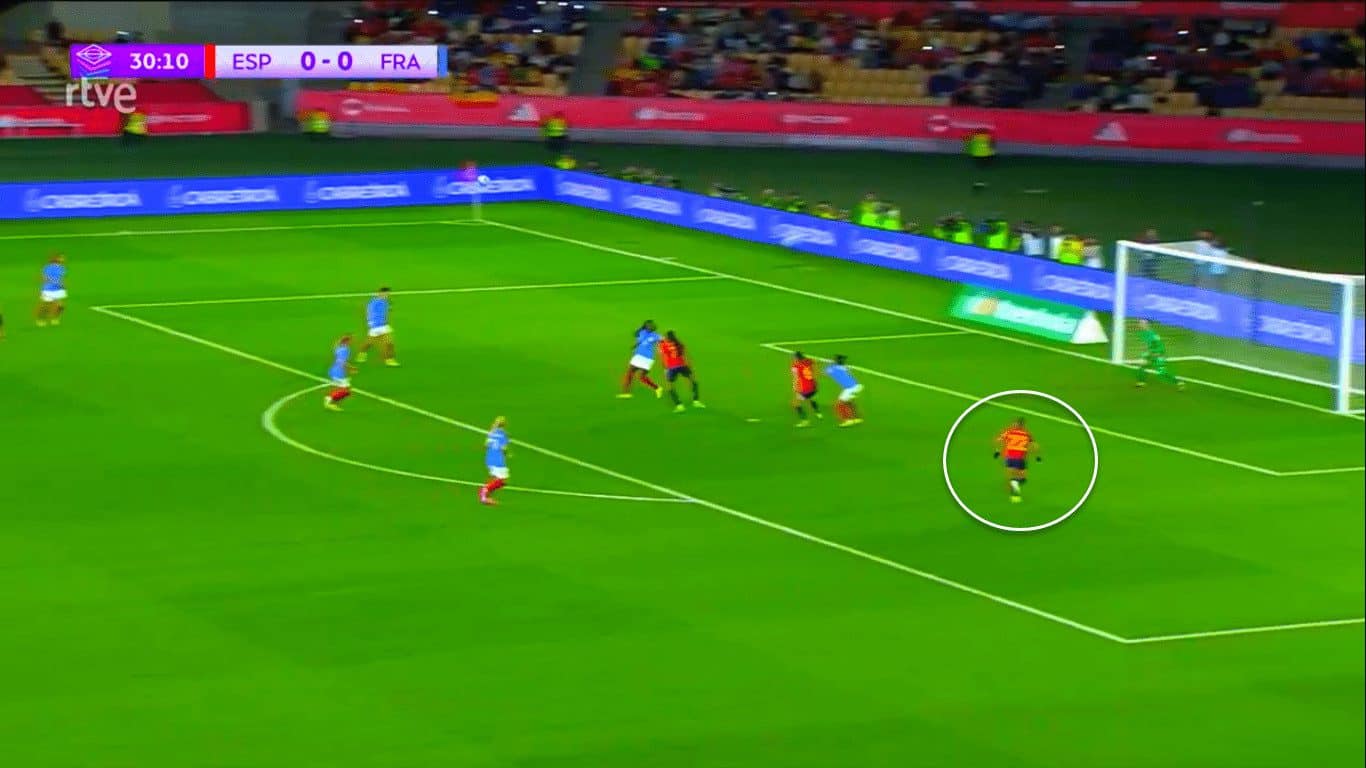
This is one of many examples during which France left a Spanish player unmarked during a dangerous action, knowing that this action took place just a few minutes before Spain’s first goal. This marking issue is also related to a lack of communication and reactivity among the French players.
 Credits : RTVE
From an attacking perspective, the team lacked a lot of their usual references upfront, as they were not able to serve Katoto in the needed way and created very few chances with zero shots on target. This can be explained by Spain’s organised defence and their revision of France’s attacking plans but also by France’s unconvincing performance overall in this regard.
Players like Le Sommer, Diani and Bacha could have certainly done more to create chances, shoot from distance, aim for crosses to Katoto or even try to penetrate towards the box to either win fouls or succeed in disturbing Spain’s defence. All of this did not happen, however, and such attacking performances raise eyebrows regarding the worrying France attacking system.
In fact, Le Sommer could have been used in a more advanced way when things did not look good for France in order to put extra pressure on Spain’s defence and perhaps have more chances to get first to passes going to the box. Yet, Renard’s dealing with the situation was not convincing enough as the attacking changes he made were too late as he included Delphine Cascarino in the 58th minute, and the rest of the changes took place at the 76th minute and concerned Julie Dufour and Amel Majri.
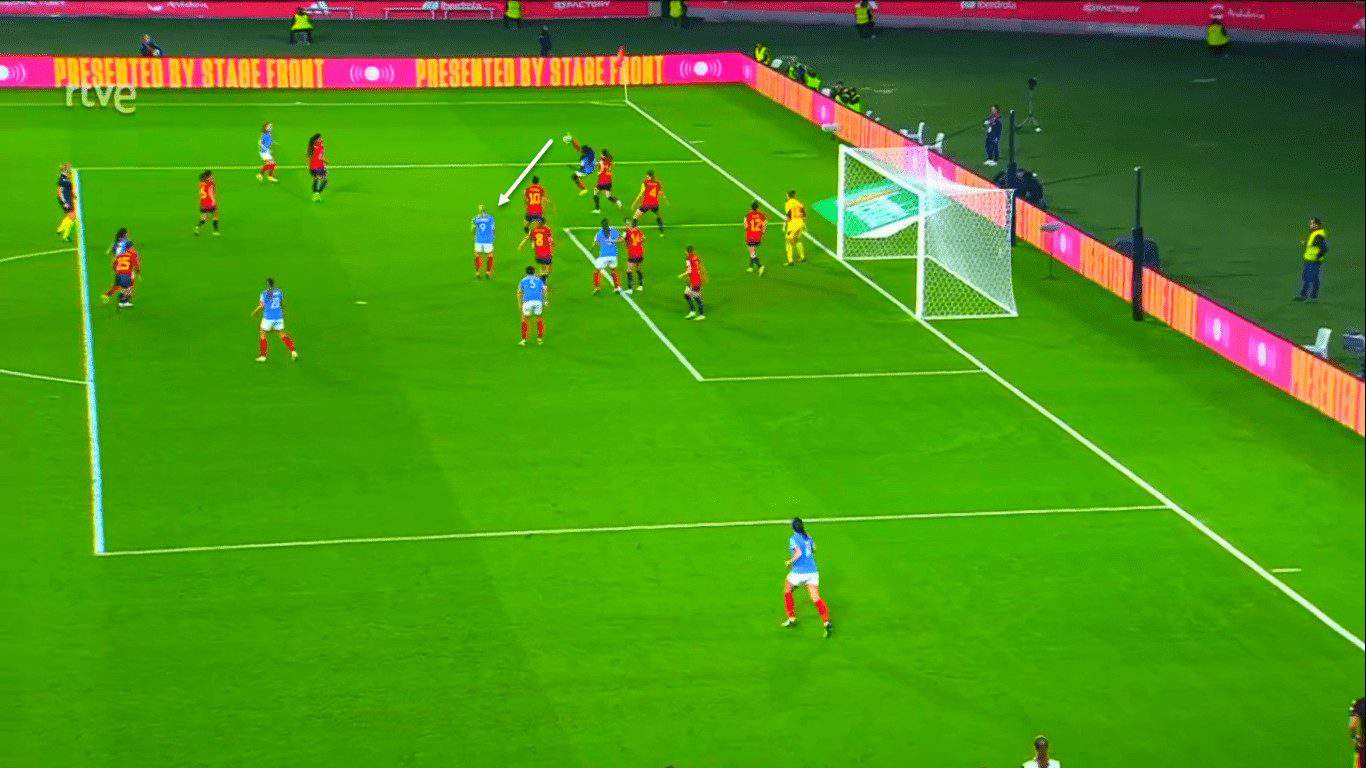
The following picture shows one of France’s few chances that could have been converted into goals, but unfortunately for them, Le Sommer was not able to deal with Katoto’s excellent pass in the needed way and failed to impact the ball with a header that could have been complicated to save by the goalkeeper since numerous players were hiding the view.
 Credits : RTVE
Also, the lack of chemistry and close passing combinations inside the final third made things even more difficult for France as the Spanish were very organised and tried to cut the links between the attacking three and Katoto, as they were successful in doing so at the end of the day.
Conclusion
Spain fully deserved their first-ever win of the UEFA Women’s Nations League following a very convincing final performance led by two Bonmatí goals that put France in trouble. Spain are actually becoming more and more “invincible” and are proving their readiness to the upcoming big tournaments with almost the same group of players.
On the other hand, France will need to address numerous aspects in their game plan, starting from the defensive errors and marking issues to the chance creation problems and, obviously, the finishing ones as well. Although reaching the final was an excellent result for France, their final performance was not convincing enough and showed that France need a lot of work in order to beat teams like Spain in the future.
