
AC Milan beat AS Roma by a narrow margin in round 10 of the 2025/2026 Serie A.
The result saw I Rossoneri overtake I Giallorossi in the league table; both now have 21 points, with Milan ahead on goal difference.
Although Roma had the lion’s share of possession, they were only allowed a single big chance throughout 90 minutes; meanwhile, Milan had six big chances and dominated the game in transition.
Both sides showed intent to attack and defend with numbers.
Through this tactical analysis, we will examine how Massimiliano Allegri’s AC Milan defended against Gian Piero Gasperini’s AS Roma and scored the winning goal.
AC Milan Vs AS Roma Lineups & Formations
Let‘s examine how Massimiliano Allegri and Gian Piero Gasperini deployed their squads.

The hosts, AC Milan, played in a 3-5-2 formation.
Skipper Mike Maignan started in goal behind Koni De Winter (right centre-back), Matteo Gabbia (centre centre-back), and Strahinja Pavlović (left centre-back).
Alexis Saelemaekers (right) and Davide Bartesaghi (left) were the wing-backs, though Zachary Athekame came on for Saelemaekers after the 87th minute.
Luka Modrić started as the pivot, alongside centre-midfielders Samuele Ricci and Youssouf Fofana.
Christopher Nkunku and Rafael Leão played as the two strikers.
They were replaced by Ruben-Loftus Cheek (84′) and Fikayo Tomori (90’+4) respectively.
The visitors, AS Roma, played in a similar 3-4-1-2 formation.
Mile Svilar started between the sticks, behind a back three of Gianluca Mancini (right centre-back), Evan Ndicka (centre centre-back), and Mario Hermoso (left centre-back).
The latter was subbed off for Konstantinos Tsimikas at the 84th minute.
The wing-backs were Zeki Çelik (right) and Wesley França (left). Artem Dovbyk came on for Çelik at the 77th minute.
Captain Bryan Cristante played as the attacking midfielder, alongside centre-midfielders Manu Koné and Neil El Aynaoui.
The latter made way for Lorenzo Pellegrini after 51 minutes.
Paulo Dybala and Matías Soulé played as the strikers.
They were replaced by Tommaso Baldanzi (84′) and Leon Bailey (51′).
AC Milan Attacking Tactics
In this section, we will look at the attacking features of AC Milan’s play.
AC Milan Build-Up & Progression
In the build-up, the Milan back three had an interesting way of positioning themselves.
Unlike a usual back-three setup, here the centre-back (Gabbia) was seen pushing into midfield alongside the pivot (Modrić).
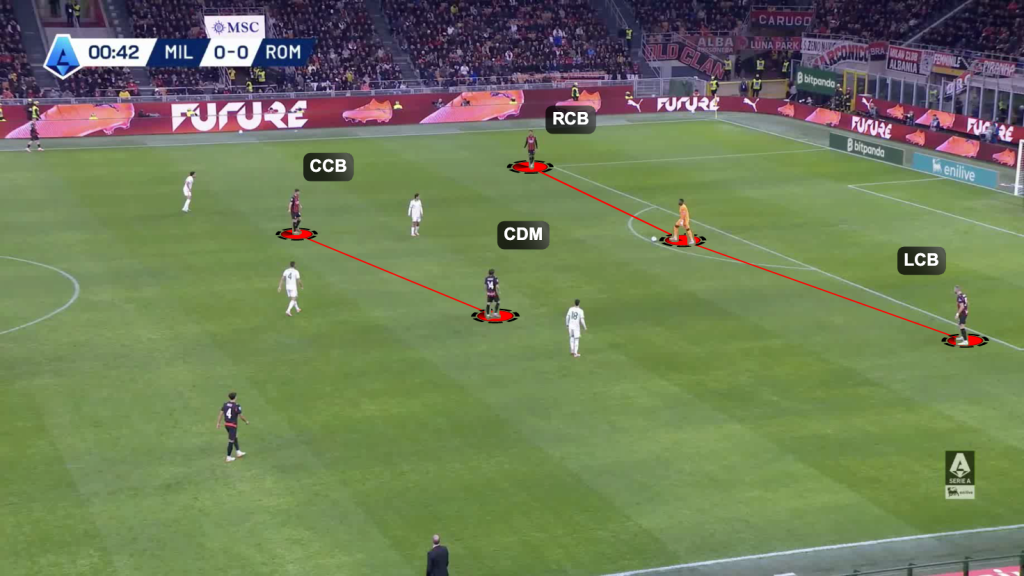
The goalkeeper formed a back three with the right centre-back and the left centre-back.
The example above illustrates the same concept.
The 3-2 structure was consistently noticeable whenever Milan had time and space in the defensive third.
During build-up scenarios, the goalkeeper stayed higher up, and one of the midfielders dropped back.
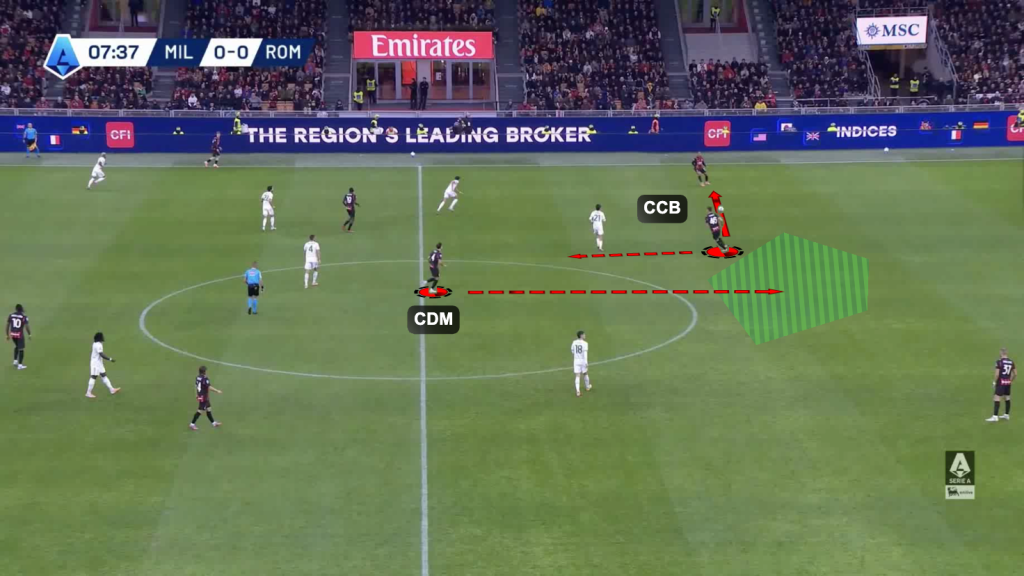
Here is a situation illustrated: Gabbia plays the ball to his right and starts moving up.
Meanwhile, Modrić starts dropping into the space the defender leaves to receive outside the opponent’s structure.
The Croatian dropping deep helped Milan have their moments of calm in the build-up and slow the game down.
The veteran also picked out a few progressive passes into the midfield third.
However, this approach did not fare consistently well for the hosts.
Roma approached their opponents with man orientations in their press.
Thus, it was difficult for the midfielders to receive facing forwards in the majority of these situations.
To deal with this, Modrić moved laterally to drag opponents, thereby opening up passing lanes.
In this example, we can see Modrić being followed by an opponent into his defensive third.
The Croatian moves to open a passing lane to his teammate further up the pitch.
Through these individual actions, Milan managed to progress the ball.
AC Milan Entering The Final Third
AC Milan made progress into the attacking third through either direct play or ball-carrying during positive transition moments.
It was common to see the hosts breaking forward using the pace of Rafael Leão and Christopher Nkunku.
The Portuguese attacker driving in transitional moments was a common sight.
It is also how the goal came.
The attack started from Milan’s penalty area and progressed to the midfield.
Leão peeled wide to the left flank and received the ball to feet and dribbled past his direct opponent.
Pavlović, who had started his run from the box, continued moving more centrally, thereby being on the blindside of the Roma defenders.
When the cut-back came, the Serbian was in enough space to slot it into the net.
Milan were seen exploiting Roma in similar ways throughout the game.
Another example is the left wing-back (Bartesaghi) making an interception in his own half, which he plays on one touch to Leão.
The Italian immediately makes an overlapping run.
During this transition, Roma are in the middle of sliding across to defend.
The wing-back gets space in the penalty area to play a low cross.
In this situation, Fofana gets on the end of the move, occupying the space between Roma’s lines of defence and midfield.
Although, unfortunately, being off-target this time, Milan continued to pose a threat going forward.
Allegri’s side made 38 final third entries, with a good number coming from transition.
In situations when they did not have enough numbers to attack, they got shots away, taking 17 in total.
Here is another example of a positive transition: the gap between the Roma defenders is exploited as a through pass is played in-behind.
By the time Leão gets on the ball and enters the box, the opponents get numbers back.
This keeps him from cutting inside; however, he knocks it down the line and takes a shot with his left foot, winning the hosts a corner.
Milan’s midfielders did not enjoy a lot of possession in the midfield third.
However, their front two caused havoc by receiving between the lines, in wide channels and in behind.
Having the variation available to them kept the opponent guessing.
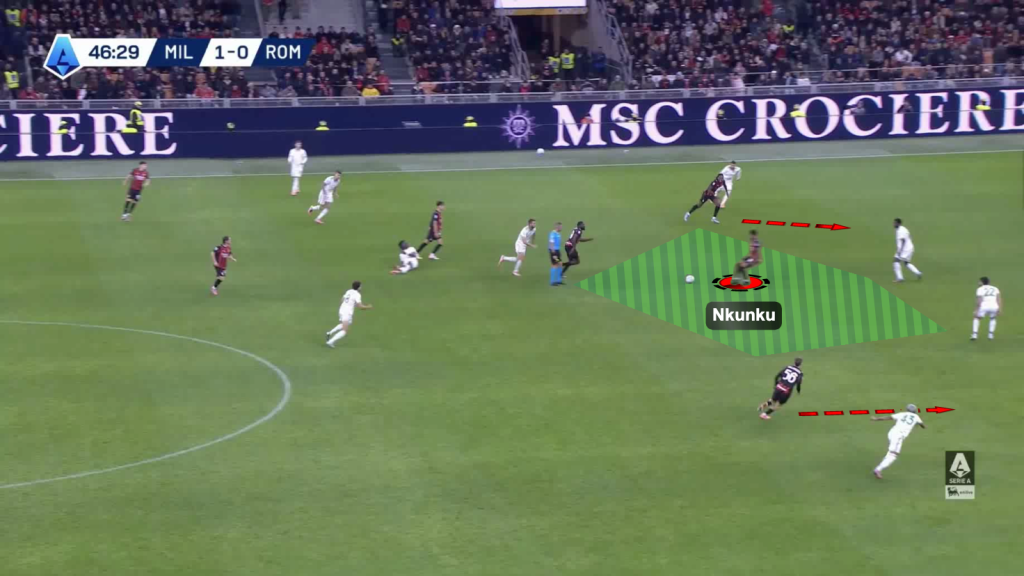
For example, consider the following positive transition moment.
Nkunku receives right in front of the Roma defenders.
Meanwhile, two of his teammates make vertical runs.
This instills trouble for the opponent; the hosts end up getting a shot on target.
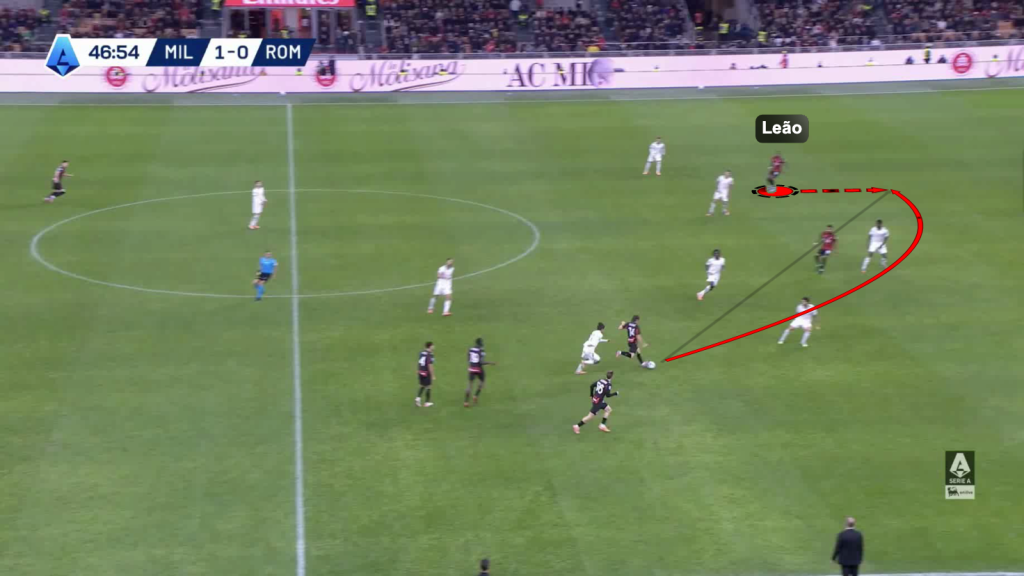
Here is an example of Milan receiving in behind.
As they win possession in the midfield third, the opponent is unorganised.
Modrić is quick to find Leão with a clipped pass.
The Portuguese forward ends up having a shot on target.
Fofana was the most frequent link between the midfield and the attack for I Rossoneri.
He made late runs to add numbers in attack.
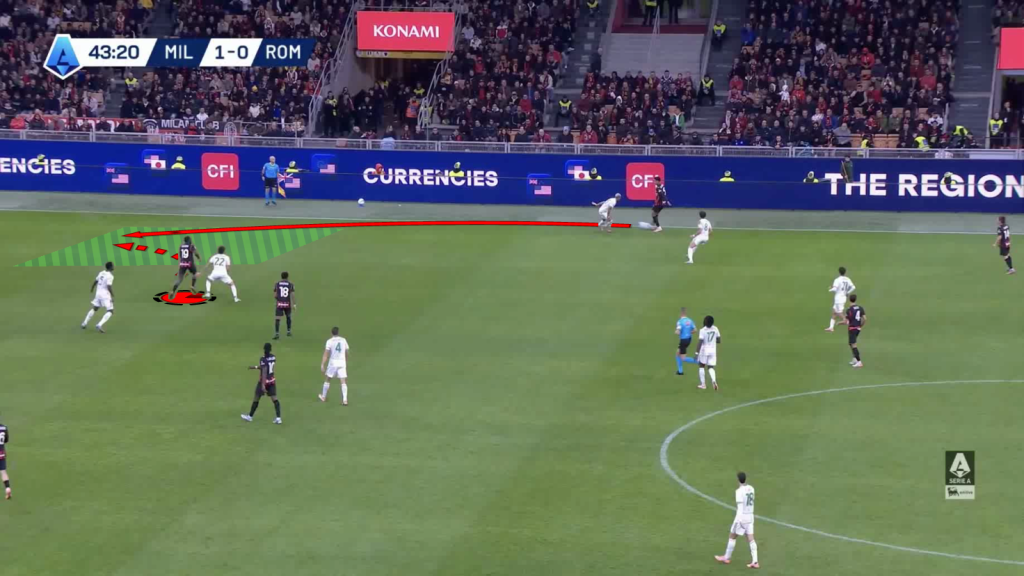
Here is an example of Fofana making a run into the half-space.
Saelemaekers is engaged in a 1-v-1 battle in the wide area.
The Frenchman, making a run into space, helps as he identifies the gap between Roma’s wing-back and centre-back.
His run is met with a pass, which eventually leads to a shot as Fofana cuts it back to Nkunku, arriving late.
Quite often, there were opposite movements from the attackers, which disrupted the opponent’s backline structure.
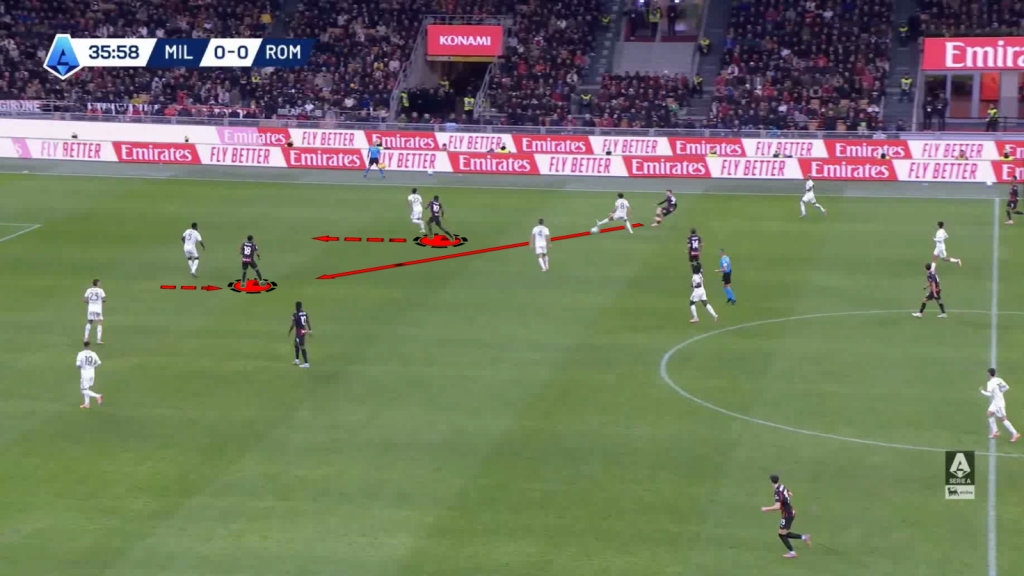
Here, Nkunku gets a pass from the wide area into the central zone.
It is possible with Fofana’s sacrificial run.
The duo move in opposite directions (Fofana runs higher and Nkunku drops deeper).
This dual action opens space in the central zone, right in front of the Roma defenders.
AC Milan Defending Tactics
In this section, we will look at the defensive features of AC Milan’s play.
Defending In The Opponent Half
AC Milan’s usual approach was to stay compact and force the opponents wide.
They pressed high in a few situations when the opponent had static starts.
However, they did not achieve much success in engaging the opponent in their own defensive third.
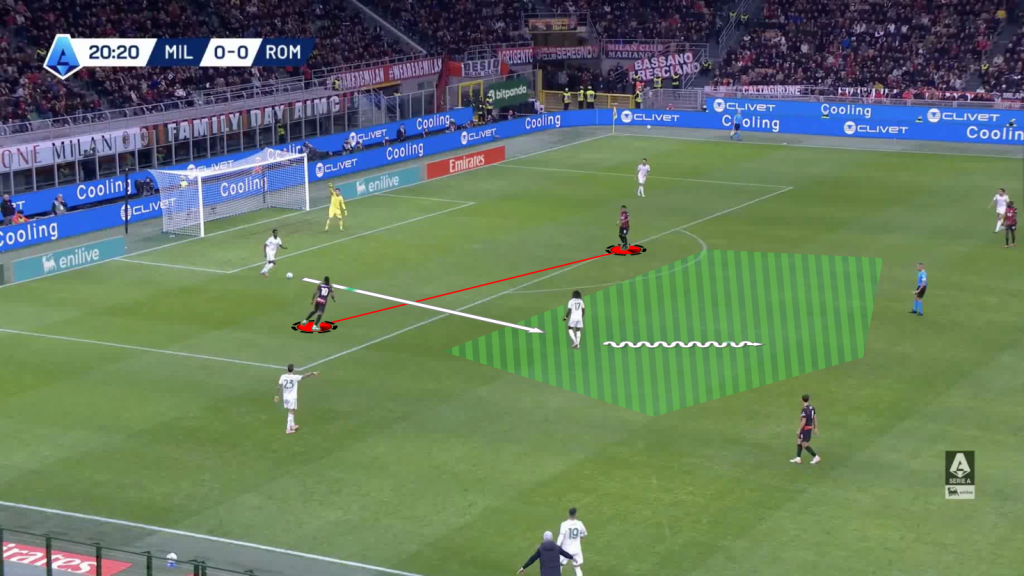
In a few situations, Milan lacked vertical compactness.
Here, both strikers offer the opponent enough space to play a split pass.
Since Milan’s midfield line stays deep, Roma’s pivot gets enough space to receive on the turn.
However, Allegri’s side solved this soon by dropping their structure slightly deeper and shifting more numbers ball-side.
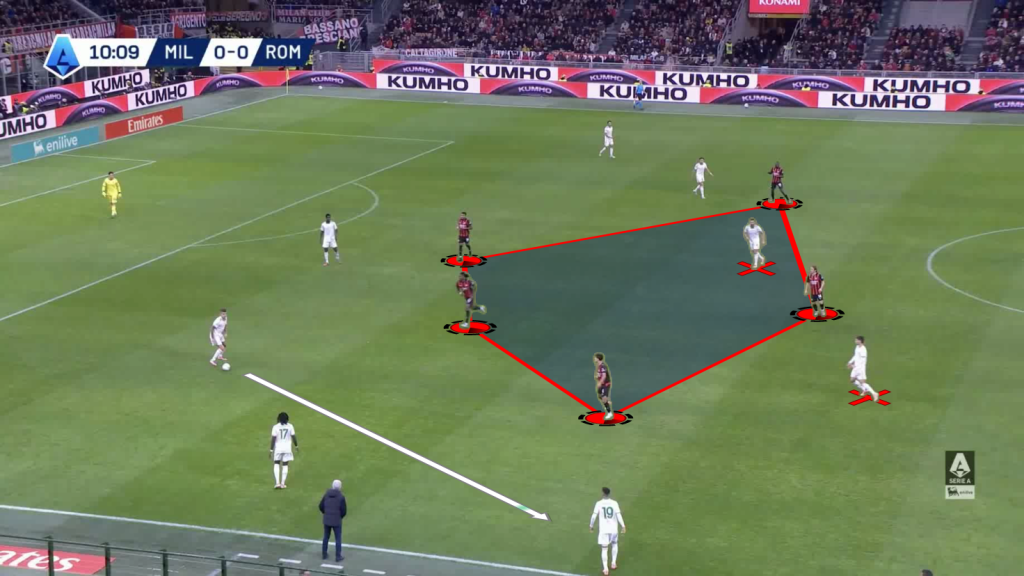
Here is an example: AC Milan are pressing in their opponent’s half by staying in a block, allowing no passes through.
The opponent eventually plays it wide to progress.
Defending In The Midfield Third
When the opponent played it wide and attempted to find inside passes from the flanks, Milan shifted the block across to block any vertical or diagonal passes.
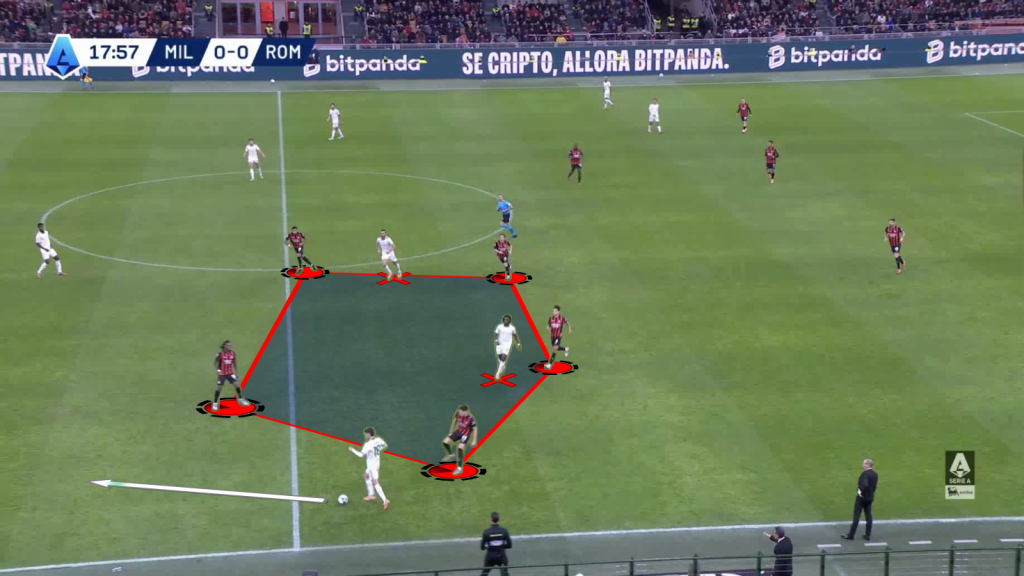
Here, Roma have the ball in the wide area.
The Rossoneri quickly slide across in a block, squeezing the player on the ball.
With no forward or inside options available, he eventually plays it backwards.
Milan’s defensive shape was consistently a 5-3-2 when they were in a mid-block.
When they pushed up, following triggers, the wing-backs stepped up to make it a 3-5-2.
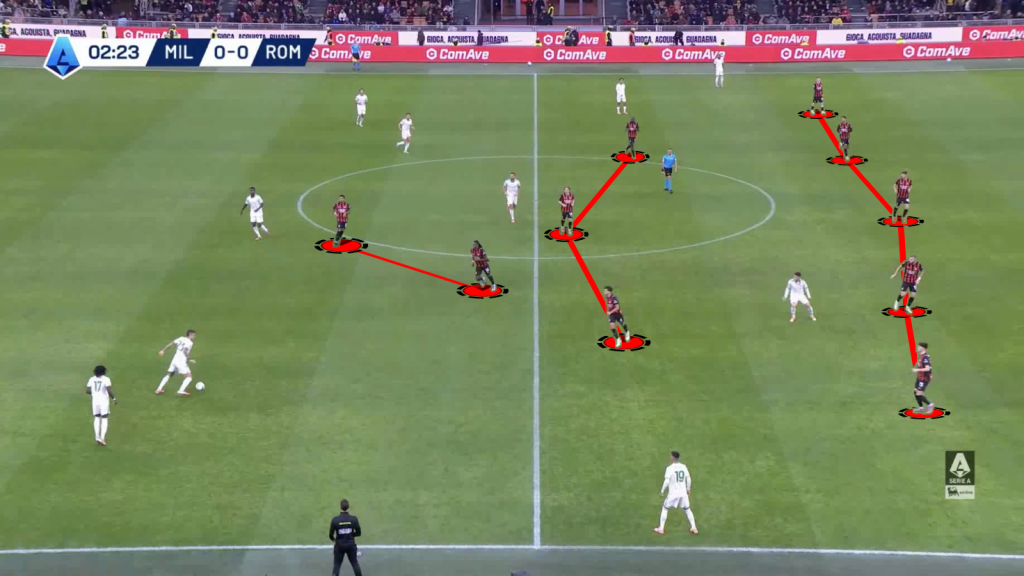
Here, we can see Milan defending in a 5-3-2 shape in a mid-block.
While Modrić stays close to the central players from the opponent team, Fofana and Ricci cut the passing lanes in the half-spaces.
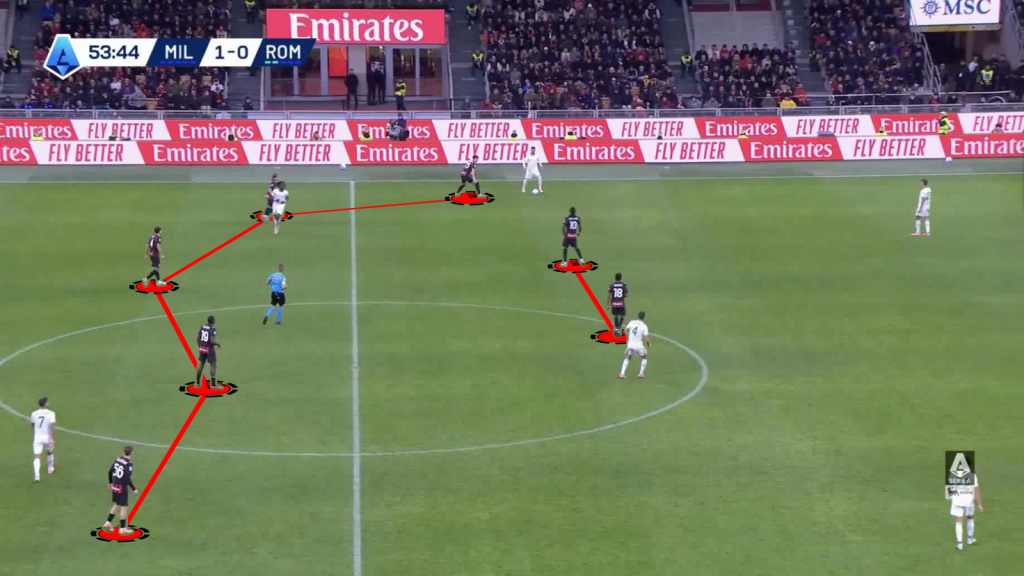
In this situation, Milan are pressing through their wing-backs in a 3-5-2 shape.
Apart from the wing-backs, the centre-backs made sure to jump whenever an opponent attempted to receive between the lines.
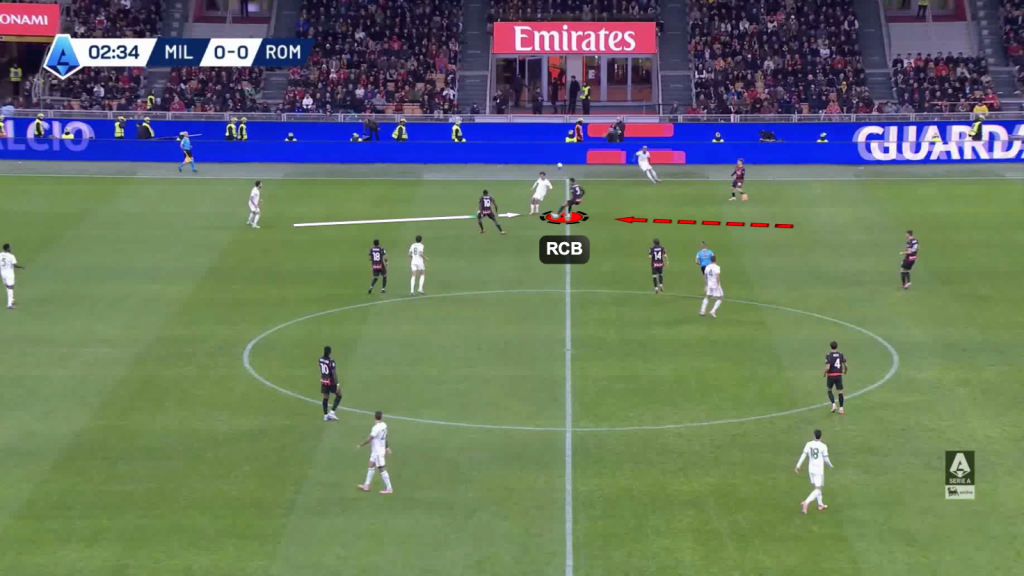
Here, an opponent drops into the midfield third to receive a vertical pass.
The right centre-back (Koni De Winter) quickly jumps to cut out space to turn forward.
The opponent ends up going backwards.
Often, Fofana was seen stepping wide and joining the strikers to cut out passes into the half-space.
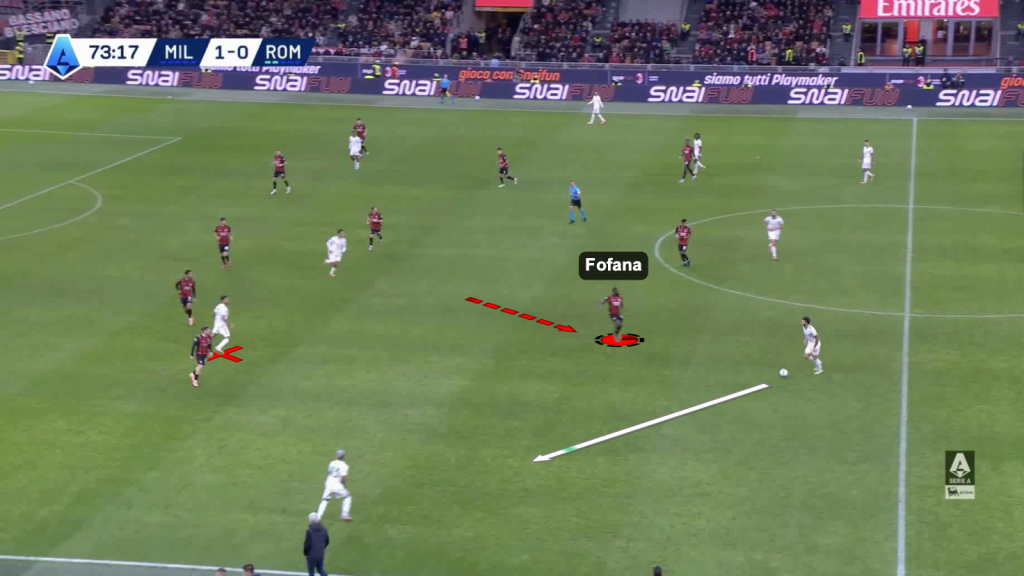
Here, the Frenchman steps out to make it a 5-2-3, cutting the vertical pass in the half-space.
The opponent is forced to play it wide.
Defending In The Defensive Third
Milan showcased horizontal and vertical compactness, dropping into their low-block shape.
In situations when they were stretched out horizontally, they dropped their midfield line to cover any potential gaps.
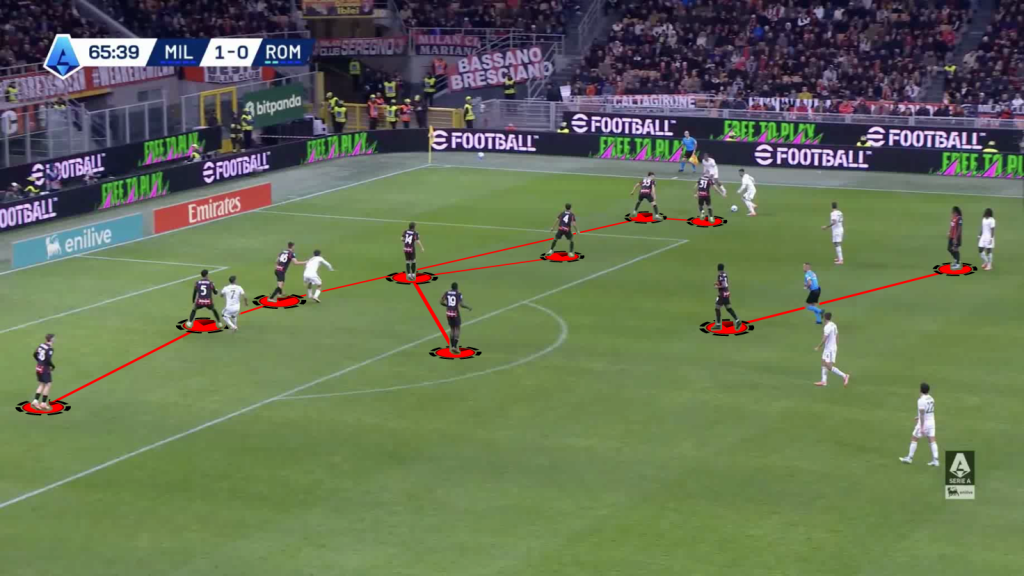
In this scenario, the Rossoneri are in a low block, transitioning into a 5-3-2 formation.
The opponents are in possession in the wide area.
While one of the centre-backs steps out to provide cover for the wing-back, the midfielders tuck in to keep the line intact.
Meanwhile, one of the midfielders also stays in zone 14 to offer balance.
Roma attempted to overload the wide areas to attack down those channels.
However, Milan were proactive in defending with numbers to force the opponents backwards.
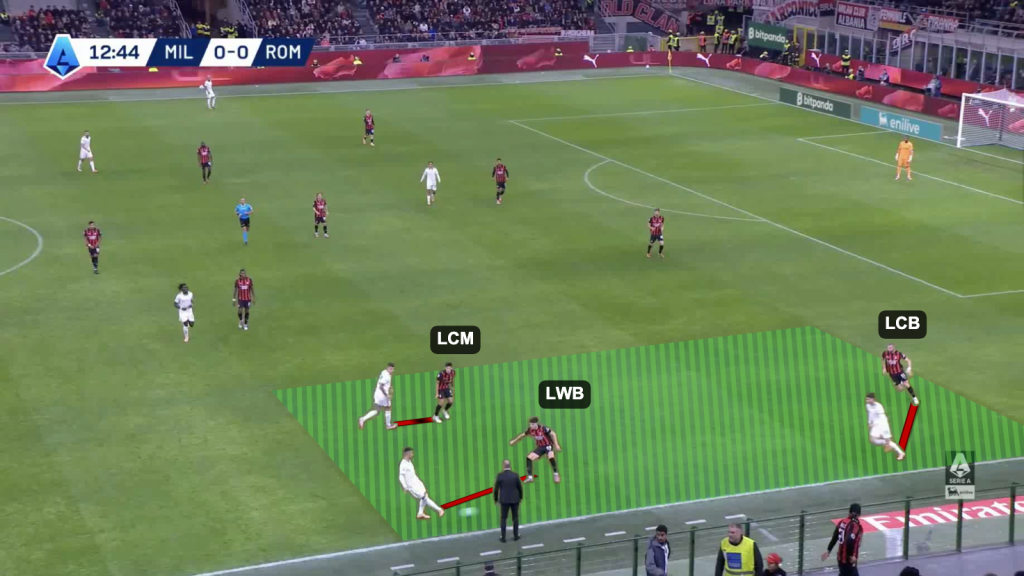
Here is an example: Roma attempt to attack down the wide channel using three players; Milan send numbers out wide to make it a 3-v-3 situation.
Thus, the visitors are forced to go backwards and recycle.
Conclusion
Milan had a minority of the ball possession; however, they managed to pose a threat through quick attacks and positive transition moments.
Players like Christopher Nkunku, Rafael Leão, and Youssouf Fofana made runs and carried the ball with pace, inflicting pain on their opponents.
The Rossoneri created multiple chances through cut-backs and low crosses, with the goal coming from a cut-back as well.
Defensively, Allegri’s side stayed disciplined in either a 5-2-3 or a 3-5-2, depending on the situation in the wide areas.
They defended with a block in the opponent’s half, making sure not to let passes through.
In their own half, they dropped the midfield line close to their back line, covering all the gaps.
