
At the beginning of the 2016/17 season, Portuguese manager Vítor Pereira was sacked as the head coach of Fenerbahçe, with the case being taken to the Court of Arbitration for Sport.
In a statement released by the club, Fenerbahçe’s board cited a change in tactics—a switch to a back three—as one of the overarching factors that led to his sacking:
“At the start of the season, our board talked with Pereira about planning for the season and the tactical system. Then we transferred players with that plan. But Pereira changed the system. He started the Monaco match [in the Champions League qualifying round in 2016] with a 3-5-2 system.”
In the following years, the former FC Porto manager moved to 1860 München, a tenure that unfortunately ended in relegation from 2. Bundesliga.
Pereira then switched to Shanghai SIPG for the next three and a half seasons, winning the Chinese Super League in his debut campaign.
The 53-year-old parted ways with the Chinese club back in December of last year and had been out of work until Turkish giants Fenerbahçe came calling once more.
On July 2 of this past year, Pereira returned to Sarı Kanaryalar (Yellow Canaries).
Immediately, the Portuguese head coach switched to a back three – something rarely seen by one of Turkey’s most successful clubs – and has been successful thus far.
This article will be a tactical analysis of Fenerbahçe’s tactics under their new manager.
It will be an analysis of the tactics used by the experienced coach with a particular focus on Vítor Pereira style of play and use of the back three in each game phase.
Vítor Pereira Formation and personnel
So far, Pereira has won all of his competitive games in charge, as of writing, and Fenerbahçe are joint top of the Süper Lig table after four games.
They have conceded just a single goal in the Turkish league so far.
One of the main reasons for this early success is Pereira’s formations, as the manager has reverted to a back three, which had previously found him in a world of trouble during his first stint in charge back in 2016.
Fenerbahçe deployed a 3-4-2-1/3-4-3 formation in every game this season, but Pereira’s 3-4-2-1 is a very attacking formation.
The two can only be distinguished by the positioning of the wingers.
At times, the wingers will stay wider, creating a 3-4-3 formation, but more often they push inside and play closer to the centre-forward, creating a narrow front three.
Usually, the 53-year-old deploys a 3-4-2-1 formation when Mesut Özil is on the pitch due to the former Arsenal and Real Madrid player’s innate ability to play between the lines.
The back three in this system has been rotated quite a lot this season so far, as has the entire starting XI, but the following image depicts how Fenerbahçe tends to set up in their 3-4-2-1.
Vítor Pereira 3-4-2-1 Formation At Fenerbahçe

Fenerbahçe is a possession-based side under the new head coach, averaging 57.87% ball possession per 90 so far.
Therefore, it is crucial for Pereira that his three starting centre-backs are comfortable on the ball and can progress play to higher areas of the pitch.
The Portuguese coach also applies the concept of overlapping centre-backs to his Fenerbahçe team.
The wide central defenders, typically Attila Szalai on the left and Marcel Tisserand on the right, are tasked with advancing forward quite frequently.
Attila Szalai Heat Map

This heat map belongs to Szalai from all competitive games so far in the 2021/22 campaign at Fenerbahçe.
There is extremely high activity in the halfspaces and on the flanks, as well as in very advanced areas, which shows the attacking style Pereira wants his centre-backs to play.
Both men are already capable of playing in more advanced positions, such as fullbacks or wide midfielders, so this is the perfect role for the pair.
Meanwhile, Kim Min-jae is a very good ball progressor from central areas.
Vítor Pereira Build-up phase
Since Fenerbahçe are a possession-oriented side, Vítor Pereira wants his players to start each attack from the goalkeeper and the centre-backs.
Often, when a team utilises three central defenders, one of the wide centre-backs will move wide and take up an auxiliary fullback position with the wingback on this side pushing high.
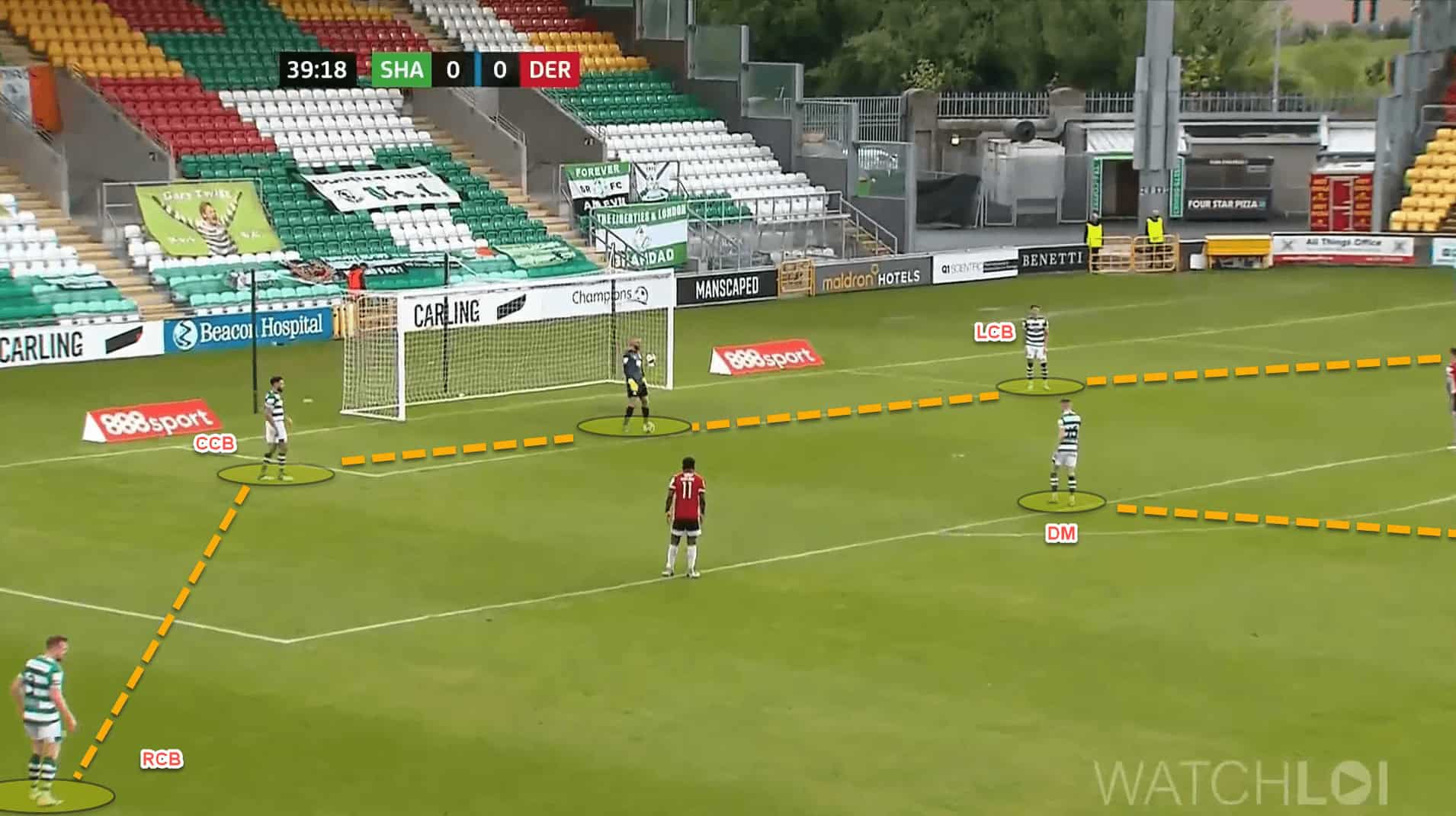
In this example, Shamrock Rovers’ right centre-back has moved over to the flank while the central centre-back and left centre-back split wide to allow the goalkeeper to play in the first line when playing out from the back.
However, Fenerbahçe doesn’t do this under Vítor Pereira’s tactics.
Instead, the central centre-back will push up outside the penalty area, occupying the position that usually a single pivot takes up during this phase, which can also be seen in Shamrock Rovers’ structure in the previous picture.
The two wide centre-backs split very wide, allowing the goalkeeper to act as the central passing option.
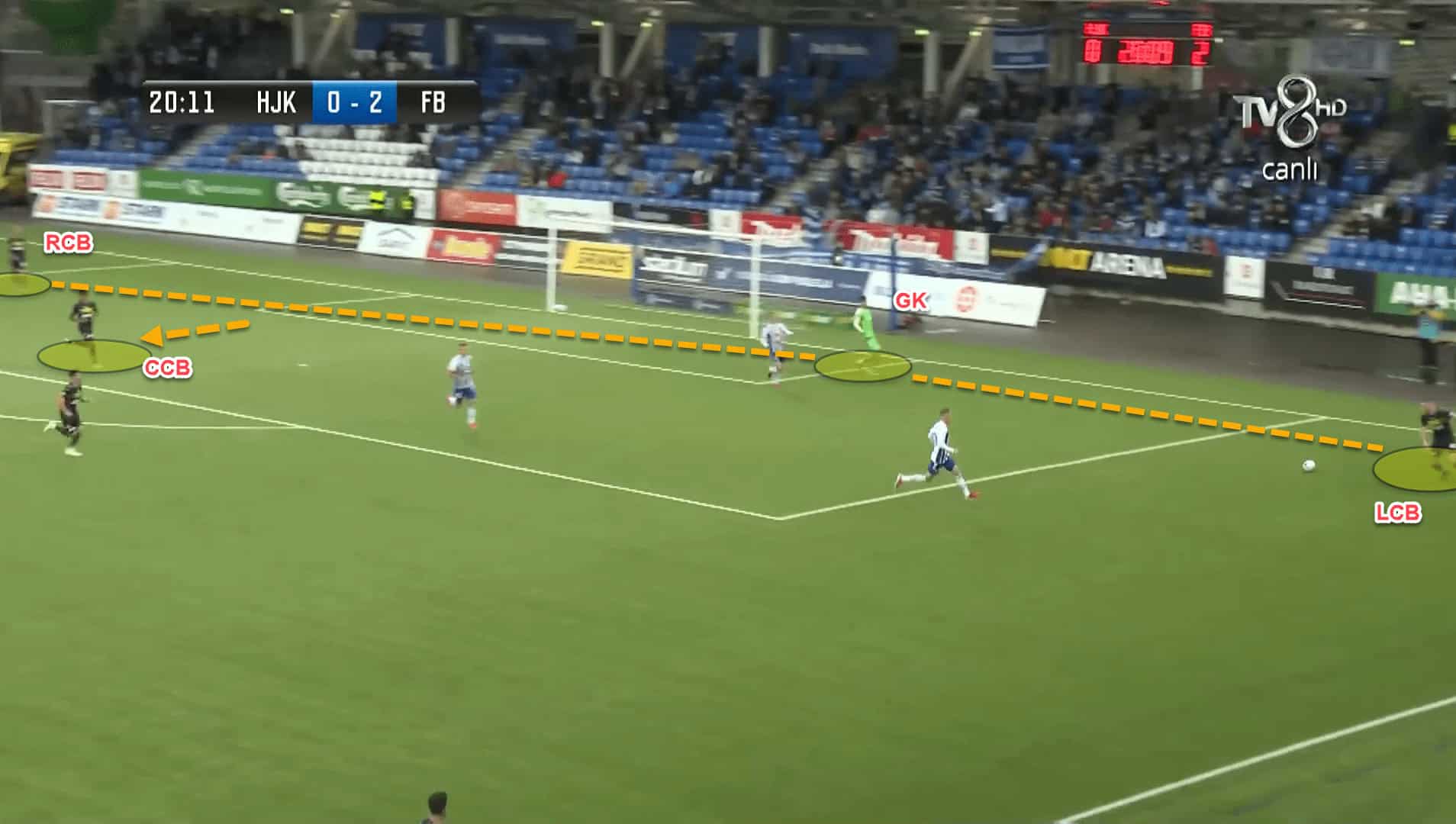
When the central centre-back pushes up to the edge of the area, he forms a double-pivot of sorts with the deepest central midfielder of the actual two-man midfield; in contrast, the other pushes up behind the opposition’s midfield line.
None of the three players stay on the same horizontal or vertical line, allowing for a nice, clean progression upfield through the central areas.
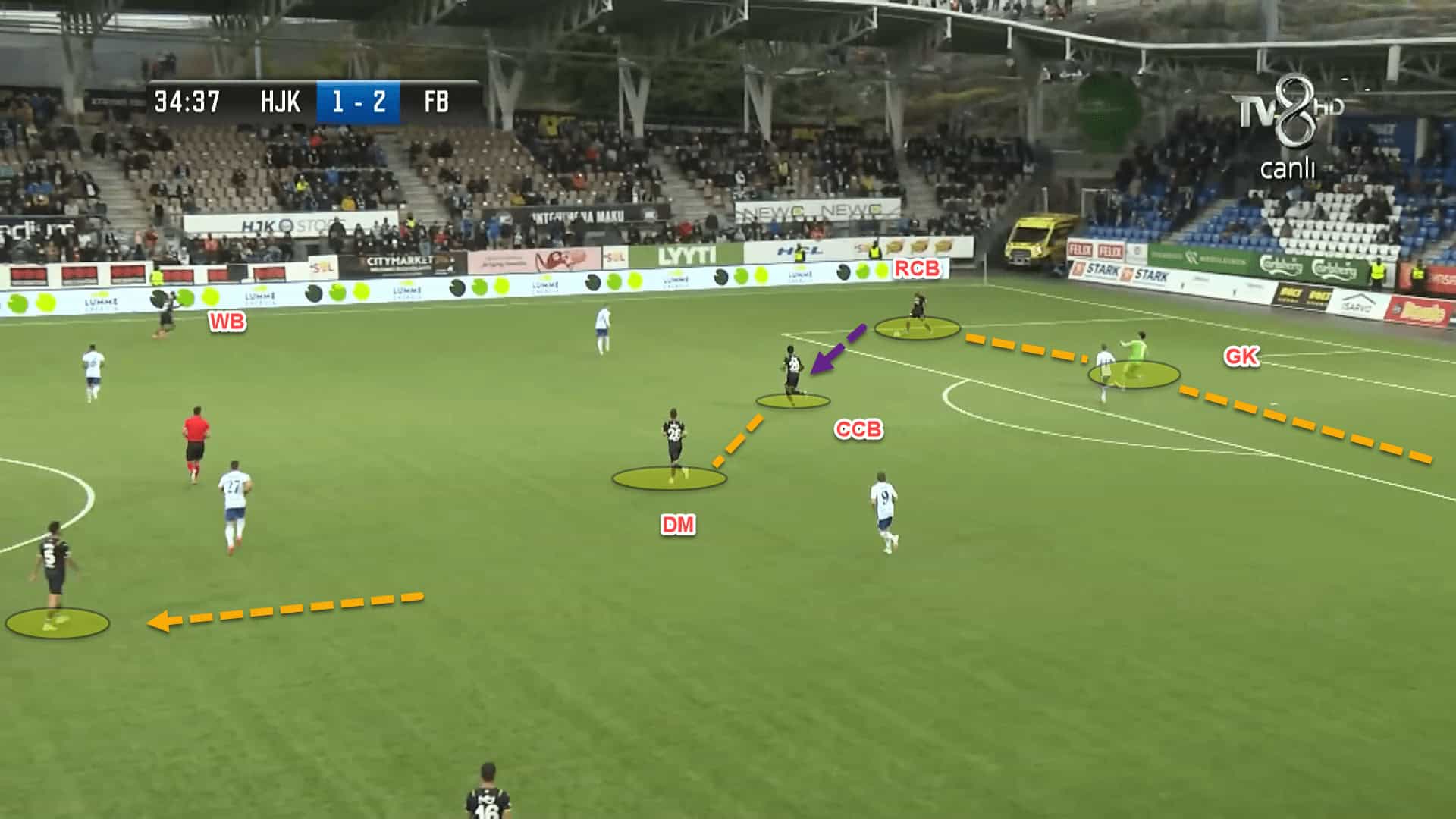
To reiterate a previous point once more, Pereira needs his central centre-back to be comfortable in possession for this very reason.
This player will quite often be tasked with dropping into space behind the opposition’s first line of pressure and receiving on the half-turn to orient himself into a body position where he can drive or play forward with the ball.
Vítor Pereira Progression phase and attacking third
When Fenerbahçe manages to work the ball further up the pitch and reach the middle third, the centre-backs become important once more.
When a team has the ball in the middle third of the field in a structured positional attack against an opponent’s defensive block, it is known as the progression phase.
In this phase, Fenerbahçe’s centre-backs split very wide to cover the width of the pitch.
This is to ensure that players on the flanks have a backwards passing option to recycle possession.
Still, it allows the Turkish giants to have a defender in the wide areas during moments of transition when the ball is lost.
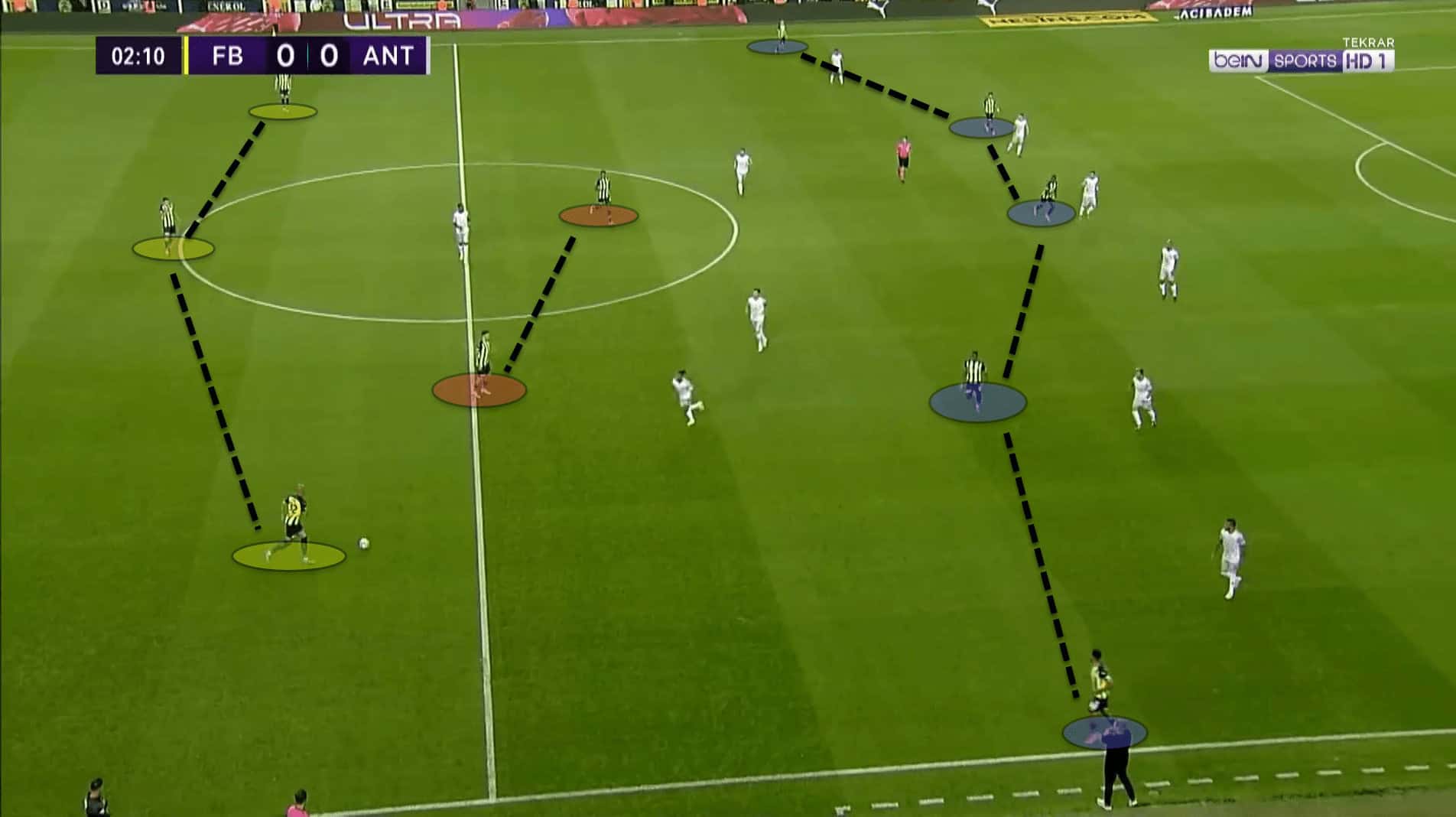
This is how Pereira positions his three centre-backs within the team’s positional 3-2-5 shape in the progression phase.
Apart from taking up positions to nullify any threat of a counterattack and maintain a constant state of alertness and focus, centre-backs are rather purposeless when a team has the ball in the final third.
This mainly applies to teams that utilise two central defenders, but is certainly applicable to three-man backlines as well.
However, Vítor Pereira views his wide defenders as flexible and integral to Fenerbahçe’s attacking play in the final third.
Despite playing with wingers and wingbacks, the Portuguese head coach instructs his wide centre-backs to push high on the flanks and create wide overloads when an opponent is sitting in a deeper defensive block.
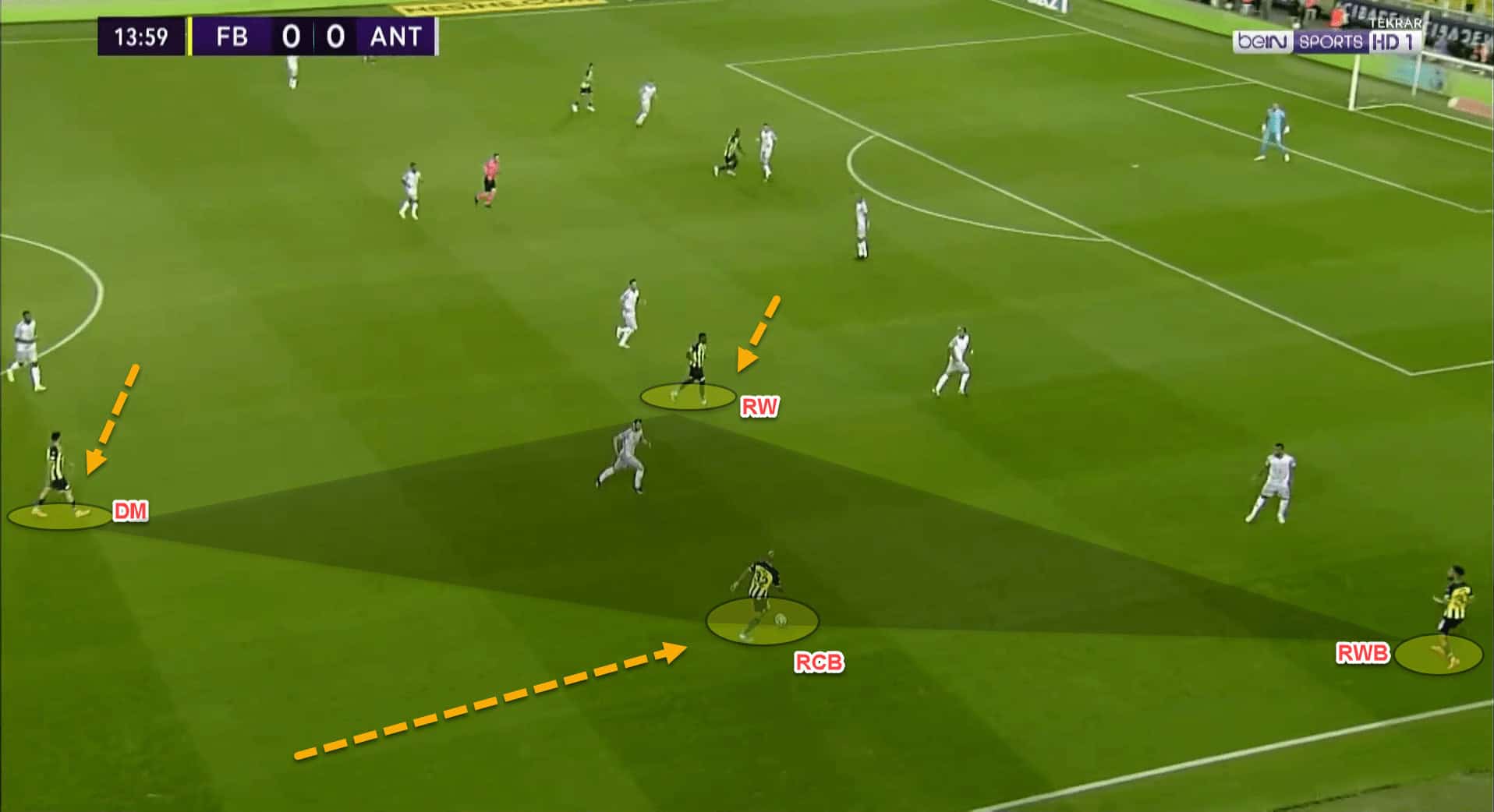
In this sense, they play more as fullbacks than centre-backs and often like to make overlapping runs past the wingback or winger, depending on the situation.
This concept has gained popularity over the past few seasons, particularly since it was introduced to the Premier League a few seasons ago by Chris Wilder’s Sheffield United.
Of course, a centre-back cannot venture forward without defensive cover; otherwise, they will leave an entire flank exposed and ready to be exploited by the opponent on the break.
When Fenerbahçe’s wide defenders venture forward on the flanks or in the halfspaces, the ball-near defensive midfielder will drop back into a deeper position in the space left bare.
In addition, the two other centre-backs push across to reduce the space.
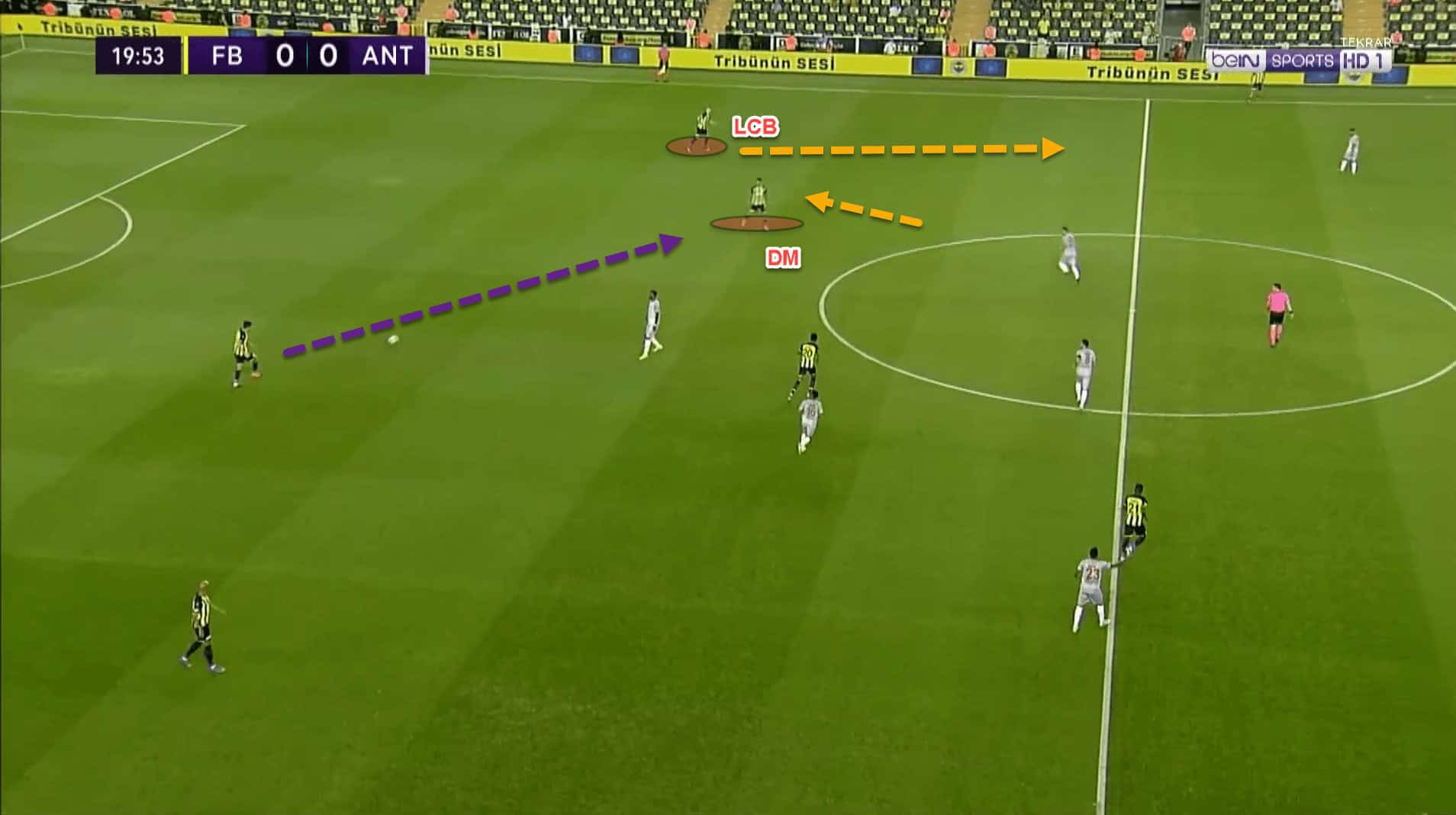
This rotation is vital to the team’s structure and balance.
The wide centre-back cannot venture forward without this cover, or else they will leave a plethora of space to be exploited.
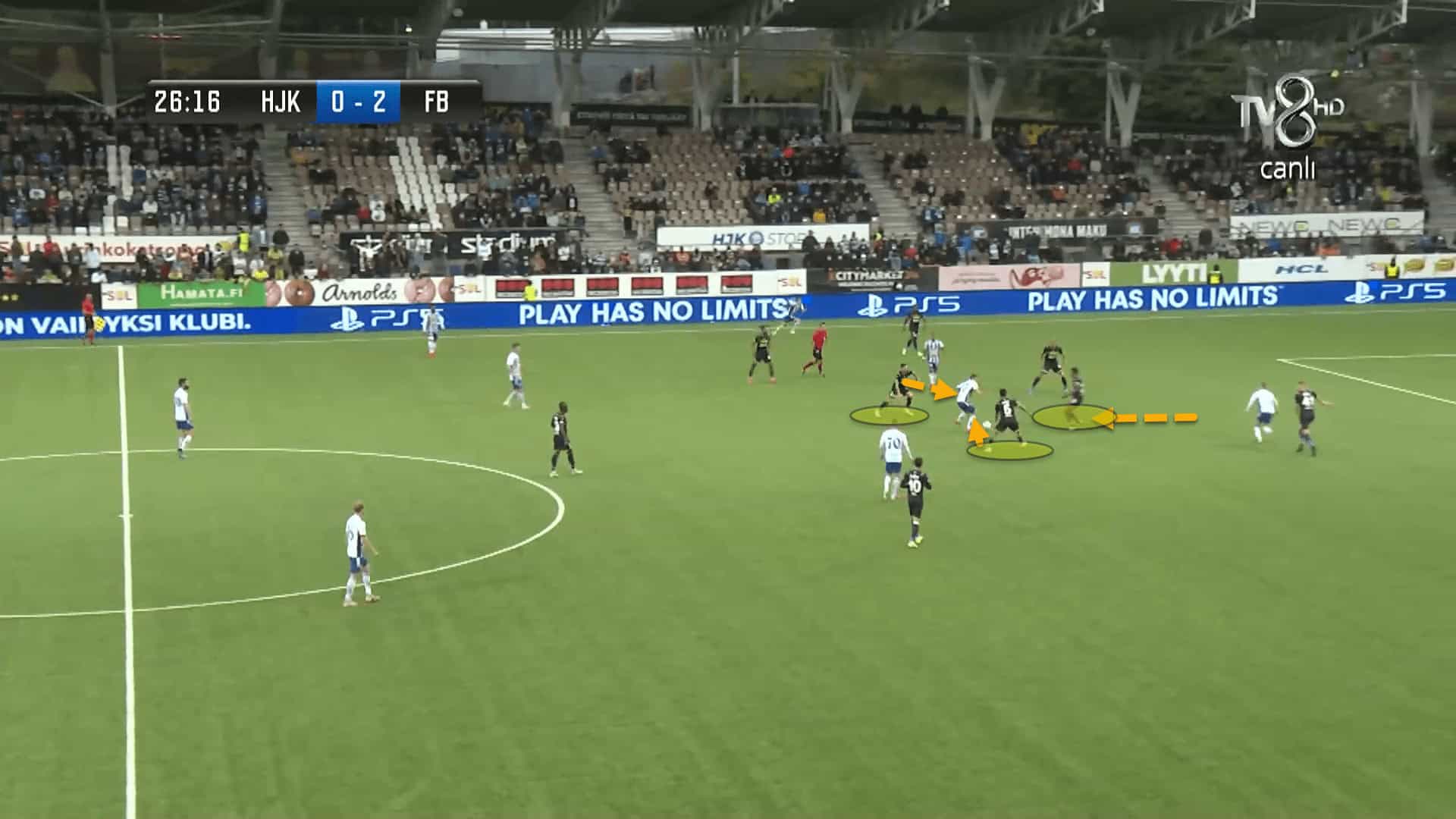
The following scene depicts one of the worst situations Fenerbahçe can find themselves in when a centre-back ventures forward on the flanks to aid creation in the final third, but leaves the structure unbalanced.
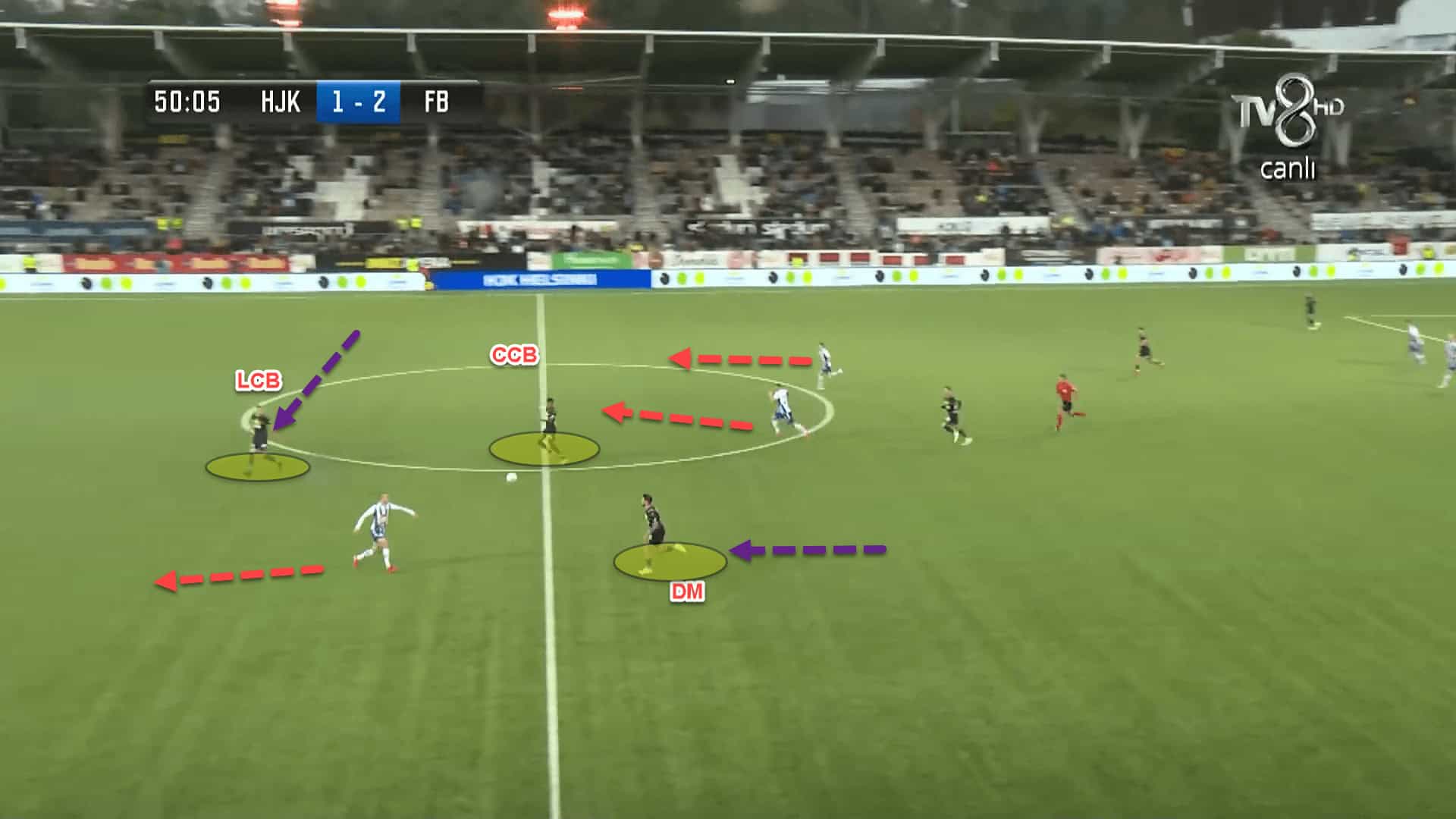
Here, the Yellow Canaries have lost the ball and are in defensive transition mode.
However, the right centre-back is high up the pitch, and they are not set up properly to deal with HJK Helsinki’s counterattack.
The nearest defensive midfielder has not dropped back to cover for the right central defender, and the left centre-back has had to come across to reach the ball carrier, leaving space behind himself to be exploited by two runners from the opposition.
Although using centre-backs in the final third is a productive way to create wide overloads, it is pointless if it comes at the team’s expense on the break and can prove more dangerous than beneficial.
While there are some lackadaisical moments, the players are still adapting to Vítor Pereira’s principles of possession-based play.
Some teething problems will be ironed out with consistent practice.
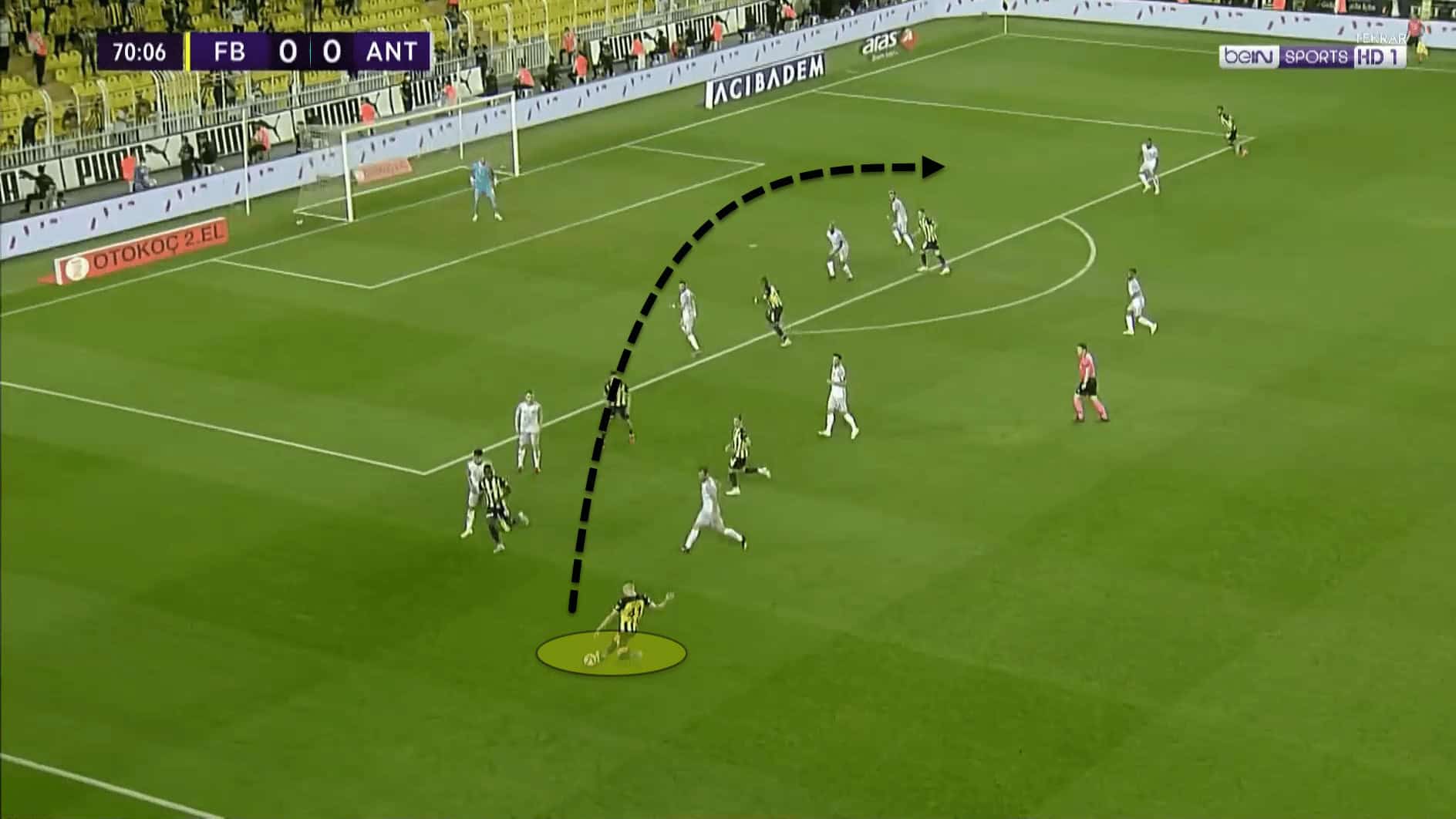
It can be an extremely effective attacking weapon.
Since the wide centre-backs used by Vítor Pereira are comfortable playing in more attacking positions anyway, they provide an extra man who can put high-quality crosses into the box.
Vítor Pereira Defensive phases
When sitting in a low defensive block, Fenerbahçe’s defensive shape switches to a 5-4-1, which is very compact between the lines.
The centre-backs and midfield line must work in unison to prevent the opposition’s advanced players from having time and space between the lines.
When an opponent does manage to receive the ball in this area of Fenerbahçe’s defensive block, the centre-backs come out and close down aggressively to either win the ball back or else to force the player back outside.
Here, the Helsinki player has received the ball between the lines, and Fenerbahçe’s central defender has jumped on him immediately to prevent him from turning on the ball while the defensive midfielders are pressing him also to regain possession.
The keyword for describing the three centre-backs’ roles out of possession is aggression.
Pereira wants them to be aggressive in closing down attacking players and aggressive in closing down space.
The 53-year-old instructs his team to press high when their opponents are playing out from the back.
The Turkish team pushes their double pivot very high, too, using a man-oriented system.
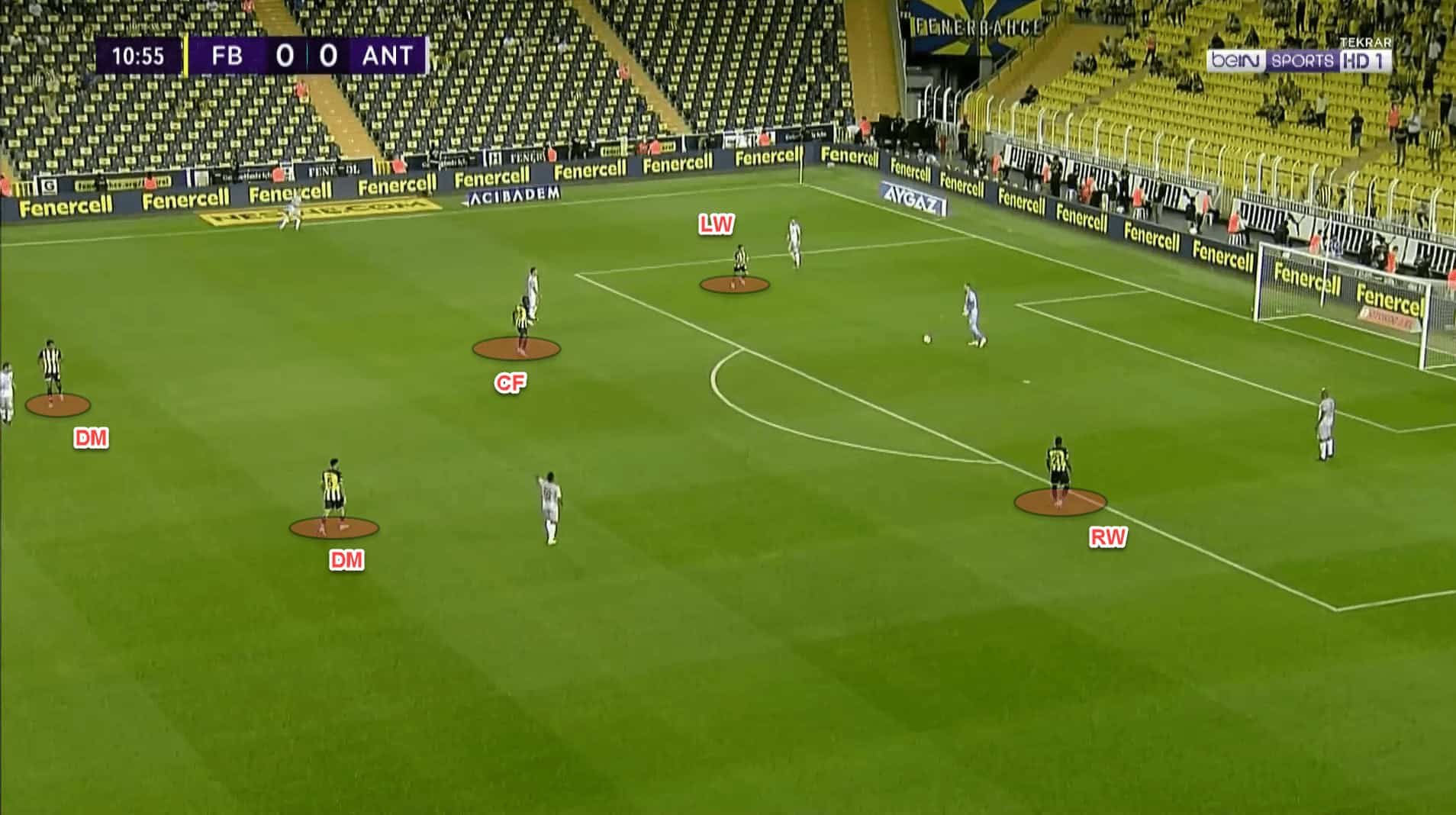
The wingbacks also push relatively high and mark the opposition’s fullbacks because Fenerbahçe’s wingers are very narrow during the high-pressing phase.
The wingers are tasked with pressing the opponent’s centre-backs and goalkeeper whilst the centre-forward drops off onto the deepest pivot player.
The press can be very successful, and so far this season, the Yellow Canaries have boasted a Passes Allowed Per Defensive Action per 90 (PPDA) of just 8.44.
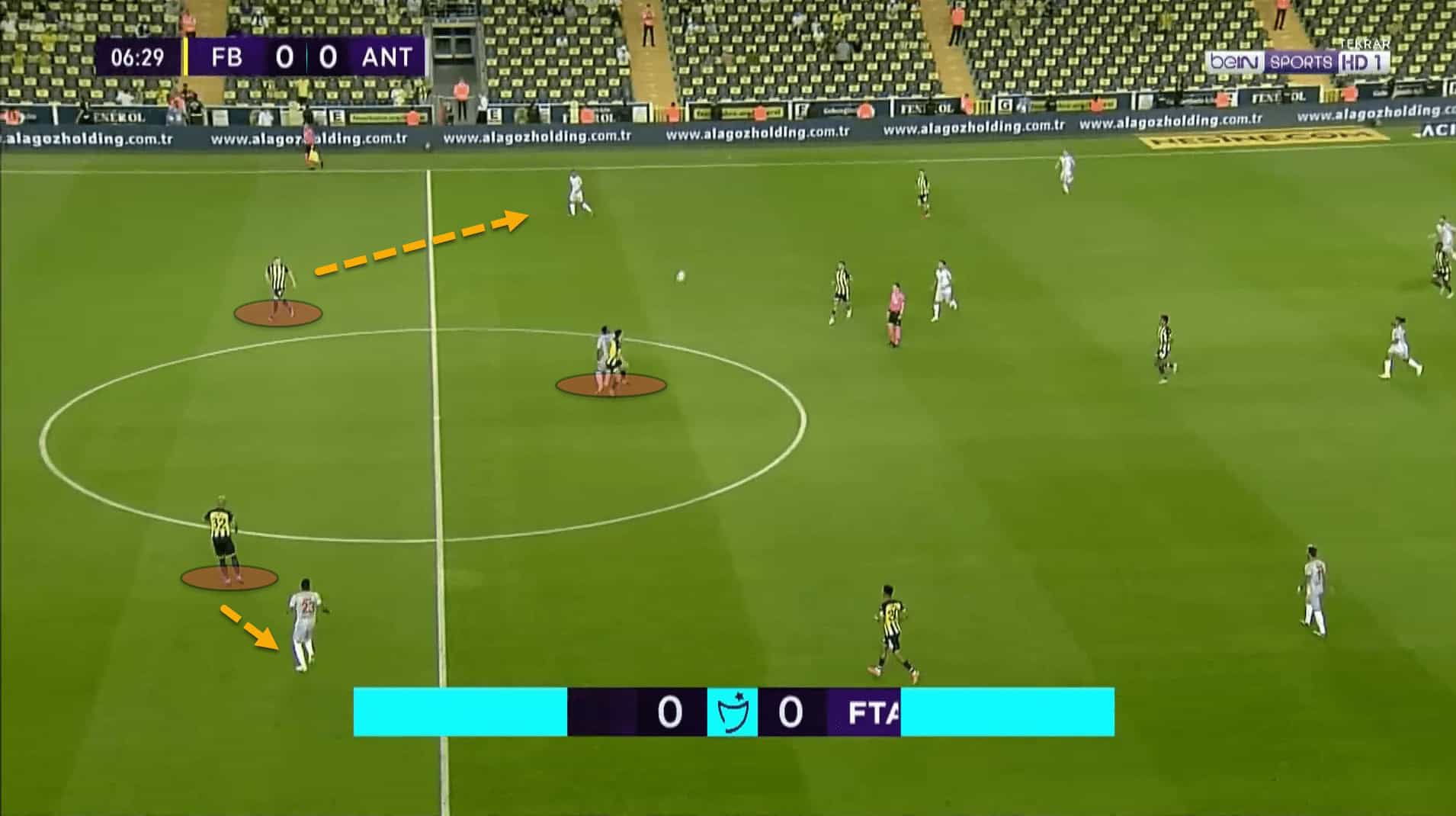
However, the main issue with the pressing structure is that it often leaves the back three exposed and isolated in 1v1 situations against an opponent’s forwards.
This is where aggression comes into play once more.
Vítor Pereira wants his centre-backs to be comfortable in 1v1 duels, which they generally are, and the defenders cannot allow any of the opposition’s forwards to have time on the ball.
Finally, regarding defensive transitions, once again, Pereira wants to see aggression from his defenders, particularly his wide centre-backs, when they bomb forward.
When a wide defender overlaps in the final third, and an attack breaks down, the player does not panic and drops off immediately to make up the ground and get back to his defensive partners.
As discussed previously in this article, if the nearest defensive midfielder has covered for the centre-back who bombs forward, they should be able to remain high up the pitch and help Fenerbahçe counter-press.
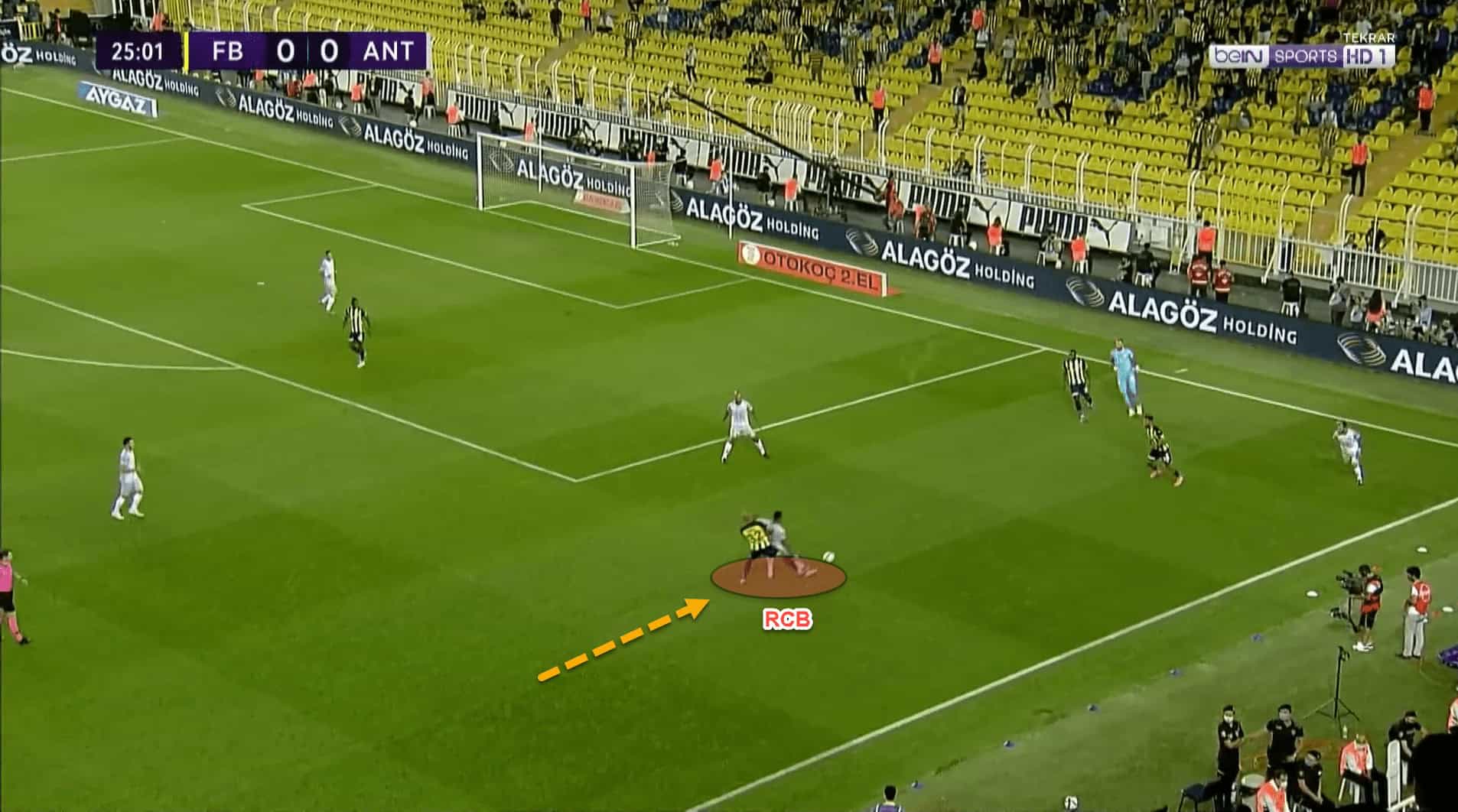
In this image, Fenerbahçe have just lost possession of the ball but have regained it when the right centre-back, Tisserand, pushed up and helped the rest of the forward players counter-press.
Subsequently, Vítor Pereira’s side managed to score by nicking the ball here and eventually shooting into an empty net.
Still, it was controversially chalked off by the referee because Tisserand was deemed too aggressive in his counter-pressing challenge.
Tisserand’s defensive duel map from a recent game against Altay supports the point that wide defenders apply pressure in high areas of the pitch.
Marcel Tisserand Defensive Duels Map

This can be a very efficient way of regaining possession in higher areas, as there is an extra man who would not usually be there.
Conclusion
As far as teams that utilise a back three in and out of possession go, Fenerbahçe are certainly towards the more attacking side of the spectrum and undoubtedly one of the most exciting teams to watch from a tactical perspective.
Vítor Pereira has done a really good job so far, and the Yellow Canaries are expected to be much closer to the top of the table at the end of the season than in the previous campaign.
