RB Leipzig are one of the most controversial clubs in German football history.
Founded in 2009, the club bought itself into the Oberliga, the fifth tier of German football.
From then on, Red Bull invested heavily in the club to get it promoted to the Bundesliga.
RB Leipzig have been playing in the Bundesliga since 2016, and with the money that Red Bull has pumped into the club, they have consistently been in the top six ever since.
The club’s philosophy revolves around finding young players and developing them into superstars and then selling them to the biggest clubs in world football, with players like Naby Keita, Dayot Upamecano, Joško Gvardiol, Dominik Szoboszlai or Dani Olmo playing for Leipzig in the last couple of years and getting sold for a lot of money.
This season, however, was a bit of a disaster for RB Leipzig.
While the start to their Bundesliga campaign was rather encouraging, their performances in the UEFA Champions League were atrocious from the start.
They ended their season in European football early with just three points and seven losses out of eight games in the group stage.
After a bad stint in the league, the club decided to let go of their manager, Marco Rose, and hired Zsolt Löw as a replacement until the end of the season.
Under Löw, things did not improve, and Red Bull Leipzig currently sit in seventh place with just one matchday to go.
They are facing the threat of their first season without European football since getting promoted after getting eliminated in the DFB-Pokal as well.
RB Leipzig are, therefore, looking for a new manager for the upcoming season, and there have been rumours lately about big names like Thierry Henry.
In this analysis, we will examine Leipzig’s needs for a new coach before discussing three interesting candidates and the tactical approach they would bring to the club in the next couple of weeks and months.
Next RB Leipzig Manager: Creating A Team Profile
Creating a profile for RB Leipzig is rather easy.
Not many clubs in world football have an identity as well-defined as Leipzig’s.
The first thing we need to take a look at is the sporting side of things, the tactical identity of RB Leipzig.
Just like every other Red Bull club, Leipzig prioritise a very fast-paced style of football.
When Red Bull decided to get into football, they hired Ralf Rangnick to develop a footballing philosophy, and most of the past managers in Leipzig followed that lead.
Red Bull football values athletic ability in players and is always looking for vertical options in the passing game.
These teams are not afraid of losing the ball; they always try to get in the spaces behind the backline immediately after winning the ball.
Even if they lose the ball, it’s just part of the plan because the counter-press is the key factor in their tactical approach.
A potential manager needs to be able to coach this fast-paced, high-intensity style of play.
The second very important aspect of Red Bull clubs’ culture is their desire to develop young players into stars.
Most of the transfers that come into Leipzig are under 23 years old and have little experience at the top level.
A potential coach needs to be able to quickly motivate these players to perform at their best and help them develop to the best of their ability.
A third thing is more of a personality trait that a new coach needs to bring to Leipzig.
Red Bull clubs are very progressive, work extensively with the latest technology, and are driven to get the best results in every situation.
Therefore, an RB Leipzig coach can’t be too traditional or not driven to work with data and technology.
He needs to be aware that he must deliver results from the start, even with his young squad.
While this may sound intimidating, few clubs offer the potential and support that RB Leipzig provides.
Money will never be an issue for the club.
They are able to sign top talents from around the world and always provide the best support for their coaches and players, with an elite academy and elite technological possibilities.
Therefore, this job will be one of the most coveted this summer.
Matthias Jaissle To RB Leipzig: Destiny Bond?
The first coach we are going to analyze is Matthias Jaissle tactics.
The 37-year-old German is currently coaching Al-Ahli in the Saudi Pro League and is just coming off winning the AFC Champions League against Kawasaki Frontale.
Jaissle was born in the greater Stuttgart area and played in the VfB Stuttgart academy before joining TSG Hoffenheim later, making a couple of Bundesliga appearances for the club.
Unfortunately for Jaissle, his playing career was plagued with injuries, forcing him to finish at just 26 years of age.
The centre-back started his coaching career just months after his retirement as a player, becoming an assistant coach to today’s VfB manager, Sebastian Hoeneß, at the academy of RB Leipzig.
He then followed another former RB Leipzig coach, Alexander Zorniger, to Denmark, where he became an assistant coach at Bröndby IF.
After a successful stint there, Jaissle was brought back by Red Bull, but this time to Salzburg, where he managed the U18 team and the B-team FC Liefering and then was promoted to the first team for the 2021/2022 season.
As this short summary of his career shows, Jaissle did not work with just a couple of very interesting coaches throughout his career.
His entire exposure to the coaching world came through the Red Bull system.
He lives and breathes the philosophy of Rangnick.
This shows in all of his work and even in Saudi Arabia at Al-Ahli.

Here, we can see Jaissle’s men defending after a set-piece.
All of the players show high intensity and are tracking back at full speed, ready to defend against the counterattack.
Jaissle does not just have his team track back; they also want to defend these situations proactively.
The Red Bull counter-press is one of the most integral parts of Jaissle’s tactical approach.
While most players try to regain position behind the ball, the players defending the space behind the backline are already in a position to move forward and defend more aggressively.
Jaissle also likes to play with a high line, condensing the opposing team’s space even further and forcing them to make mistakes.
Here, the two midfielders have a slight misunderstanding, and Jaissle’s defender is able to get in between the two opponents and steal the ball away.
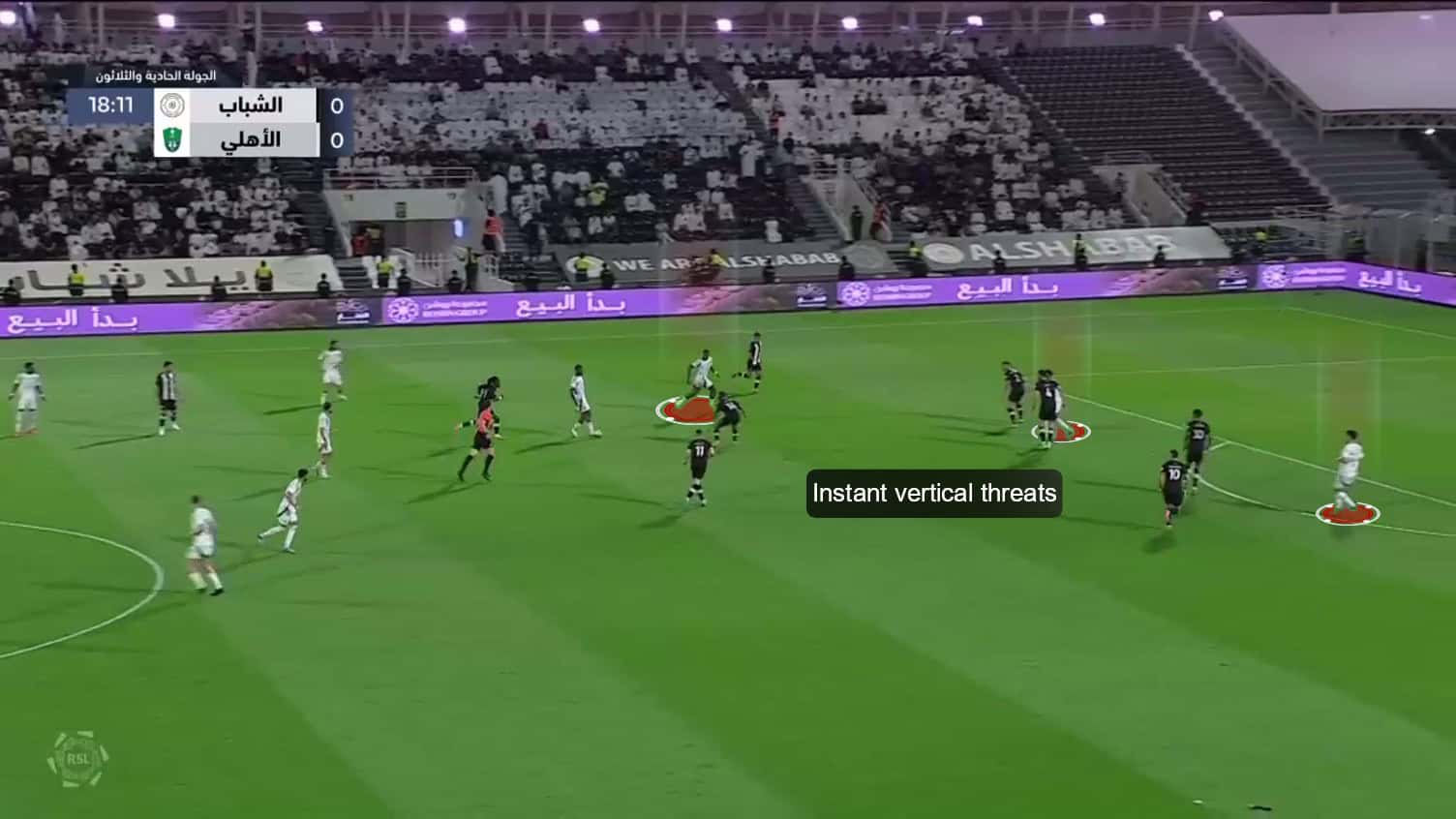
After winning the ball, Jaissle’s team once again quickly switches to attacking mode.
After winning the ball, they move forward into the last line within just a couple of seconds to get behind the forward-moving defenders.
The entire midfield is also moving towards the box, ready to counter-press again if Al-Ahli loses the ball here.
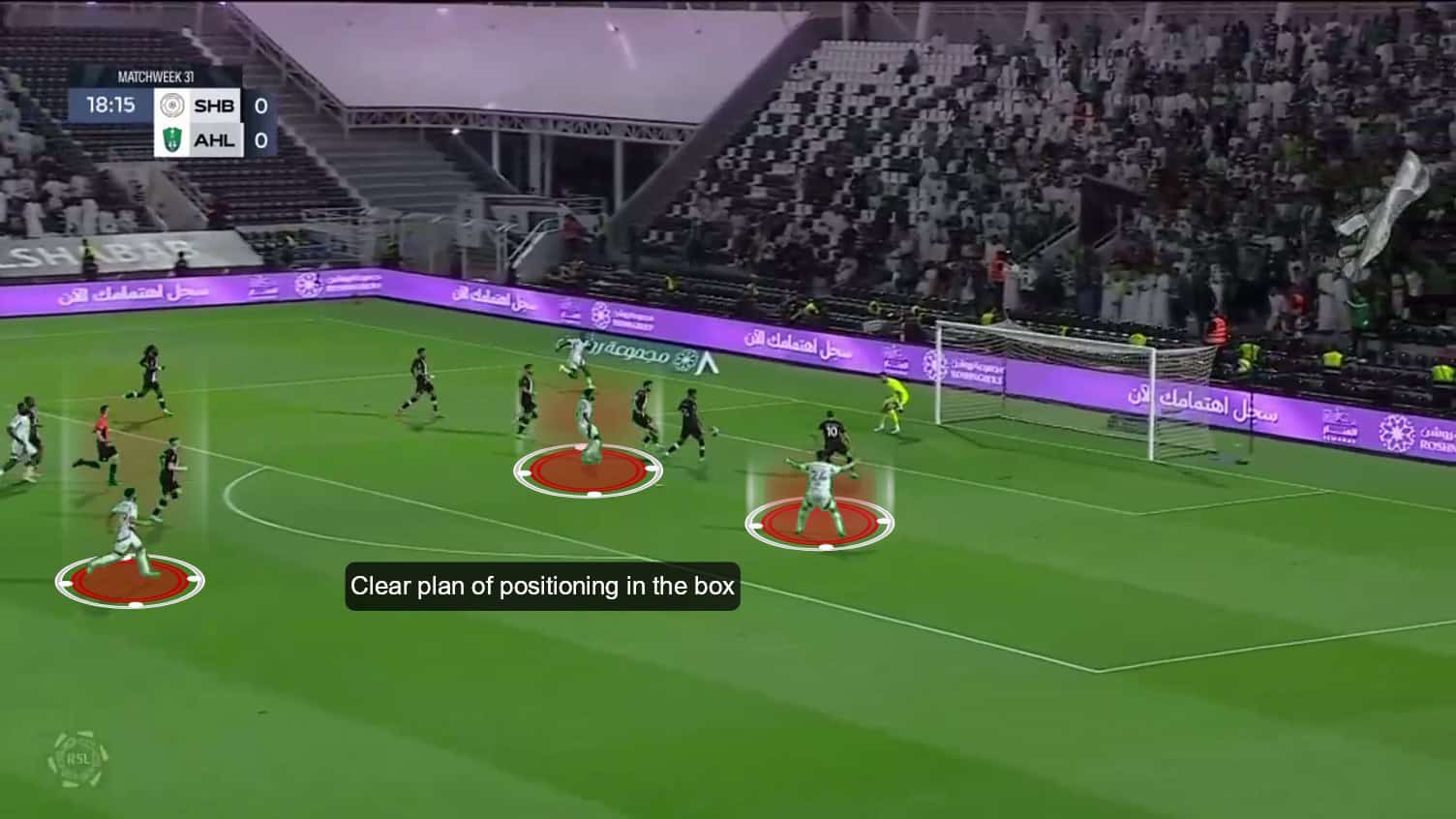
With a bit of luck, the ball ends up on the left side, and the team now has the opportunity for a cross.
Instead of just running towards the six-yard box, both attackers fall into the backs of the defenders and are wide open, with one midfielder covering the open space at the edge of the box.
Unfortunately, the cross is rather bad and easily collected by the goalkeeper here.
Still, the clear principles of Jaissle and his team’s ability to transition between possession and counter-pressing were very obvious here.
For these tactical reasons, a reunion with Jaissle would be exciting for RB Leipzig.
Jaissle is the definition of a Red Bull coach.
He worked for the club’s academy at the start of his career.
At Red Bull Salzburg, he proved himself able to lead a team, develop young players, and deliver results.
At just 37 years of age, Jaissle has more untapped potential as a coach.
The thing that will be in the way is simply money.
Jaissle was very open about taking the Al-Ahli job mere days before his season with RB Salzburg started in 2023 because he received an offer that was too good to pass up.
The German coach still has one year of contract left in the Middle East, and even though there have been rumours about him being replaced after the Champions League win, the club seems not too keen on a coaching change.
Money usually is not a problem for RB Leipzig, but can they keep up with Saudi money?
Probably not, so if Jaissle wants to stay for one more year, they probably don’t have the means necessary to get him to come to Leipzig.
Roger Schmidt To RB Leipzig: Power Football Par Excellence
The second coach we are going to take a look at is Roger Schmidt.
Unlike Jaissle, Schmidt currently does not have a job after being fired by Benfica early in the season.
Schmidt was a decent player during his time, but he never made it out of the high amateur leagues, where he was one of the best players.
After his playing career, Schmidt started getting into coaching, but he also had to start out at the amateur level in western Germany.
After being successful at that level, SC Paderborn hired him in 2011, and Schmidt instantly found success there as well.
He gained 61 points that season, still the second-best season of the team from East-Westphalia to this day in the 2. Bundesliga.
In the summer of 2012, RB Salzburg decided to pay Paderborn €1m to hire Schmidt as their new manager.
Schmidt was also incredibly successful in the Austrian Bundesliga for two years.
His high-paced attacking play style perfectly fits the second-biggest Red Bull club.
After two very good years, Bayer Leverkusen bought Schmidt out of his contract to become their next manager.
This is Schmidt’s only stint in the Bundesliga so far.
After one very good and one decent year, Leverkusen let Schmidt go in his third season.
He has bounced around China, PSV Eindhoven, and Benfica since.
Schmidt also has a Red Bull background like Jaissle’s; it’s not as intense, but the connections are there.
While Schmidt has his own ideas and principles that he likes his team to execute on the pitch, his teams are doing many Red Bull-like things in their games.
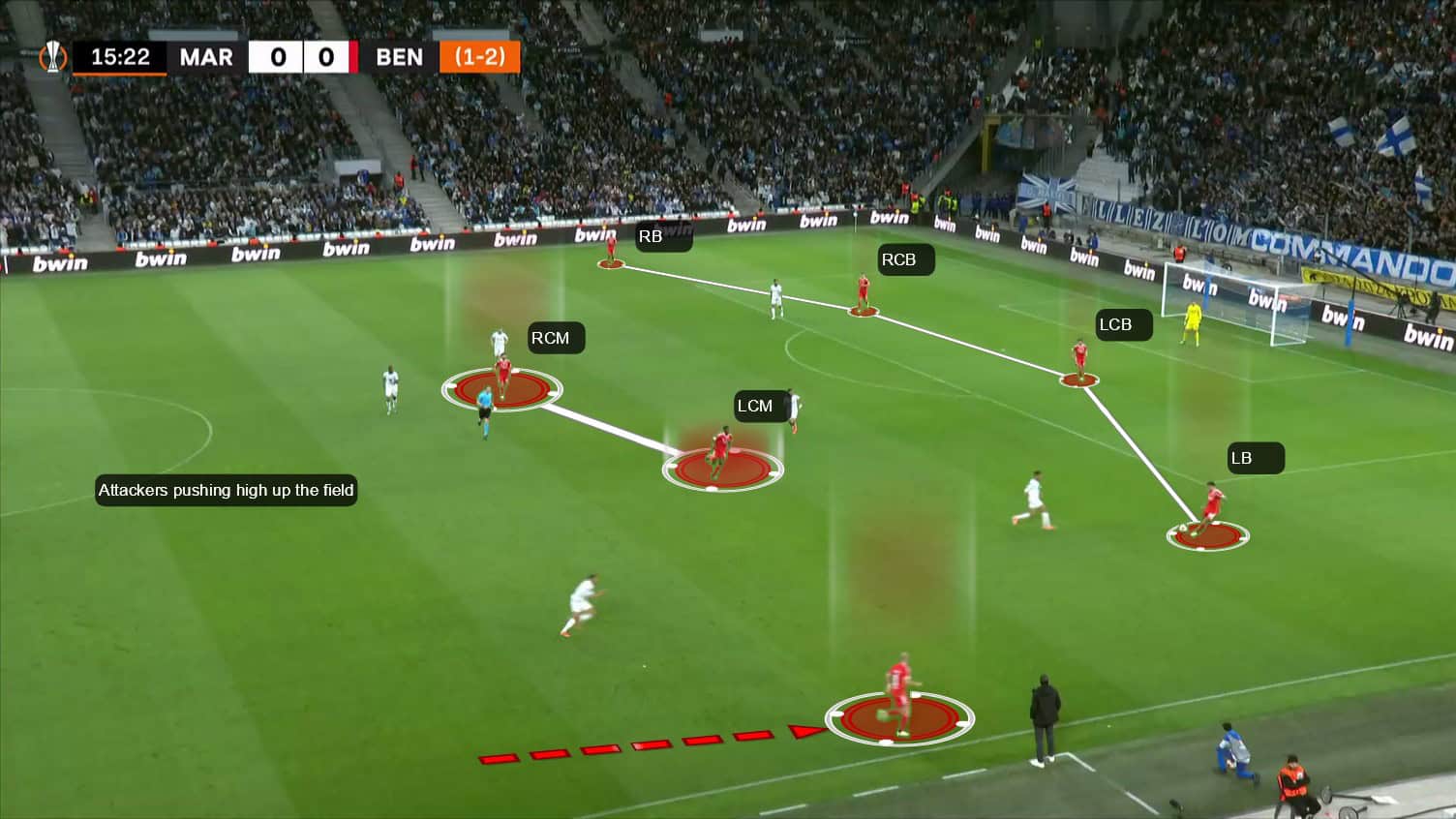
For example, their shape in the build-up phase under Roger Schmidt tactics is very similar to the typical shape that Red Bull teams use.
The picture above shows that the back-four stays in line while building up.
The central midfielders occupy the space in front of the backline, with the near-sided midfielder dropping back a bit, the far-sided midfielder pushing up the field more, and the two outside midfielders pushing into the last line, creating a 4-2-4 shape.
The near-sided winger drops back deep to receive the ball here.
With the other players pushing upfield, Benfica create a lot of space in midfield, allowing them to play through the middle of the park quickly.
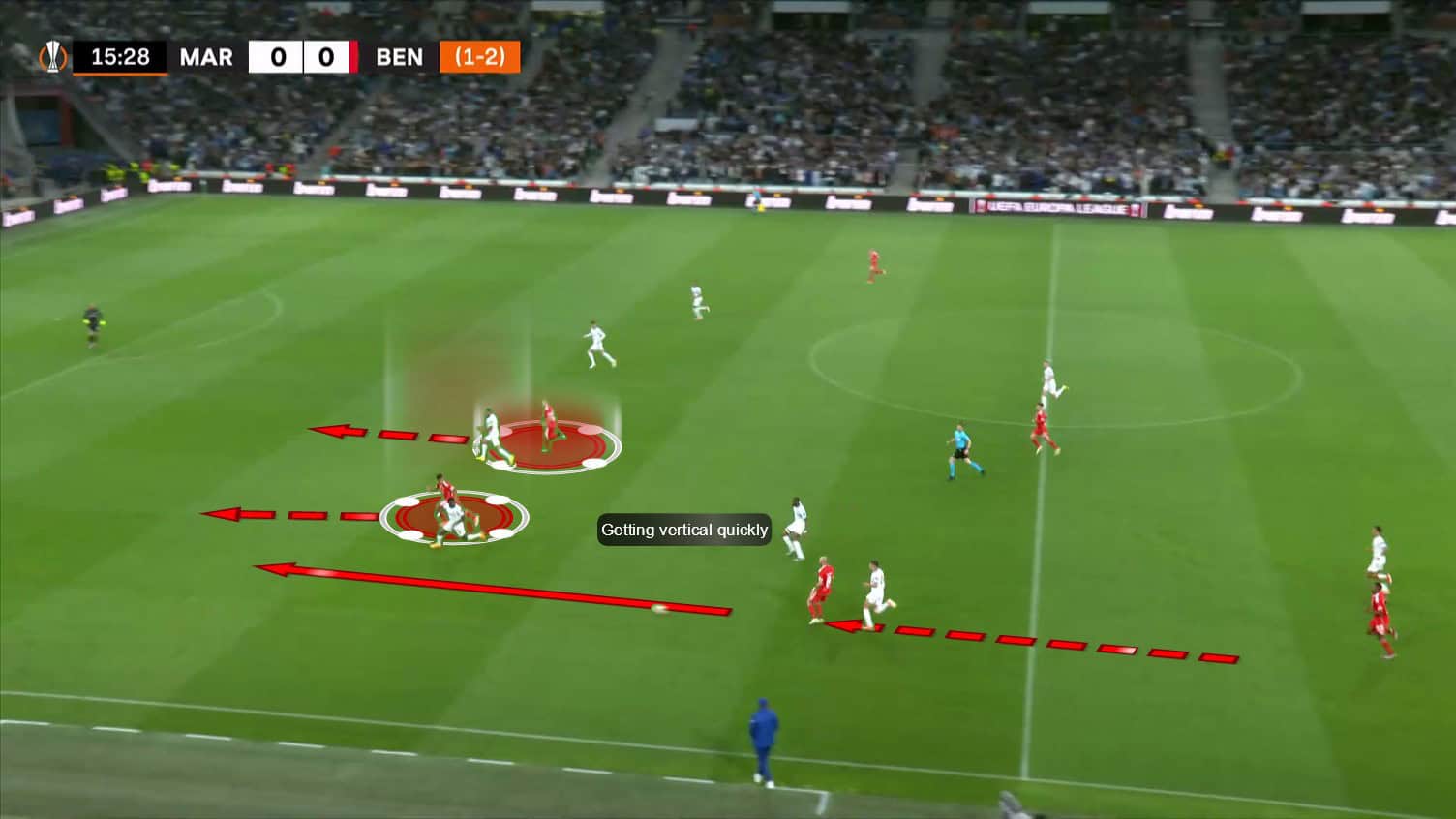
In this situation, Fredrik Aursnes simply gets away from his man with his first touch and dribbles through the midfield.
With the opposing backline pushed back, there is no one left to contest him.
This allows Schmidt’s team to cover a lot of space in just a couple of seconds.
In the attacking line, the two strikers are now instantly looking for runs behind the defensive line, and Aursnes looks for a vertical passing option here and plays the pass down the line towards his striker.
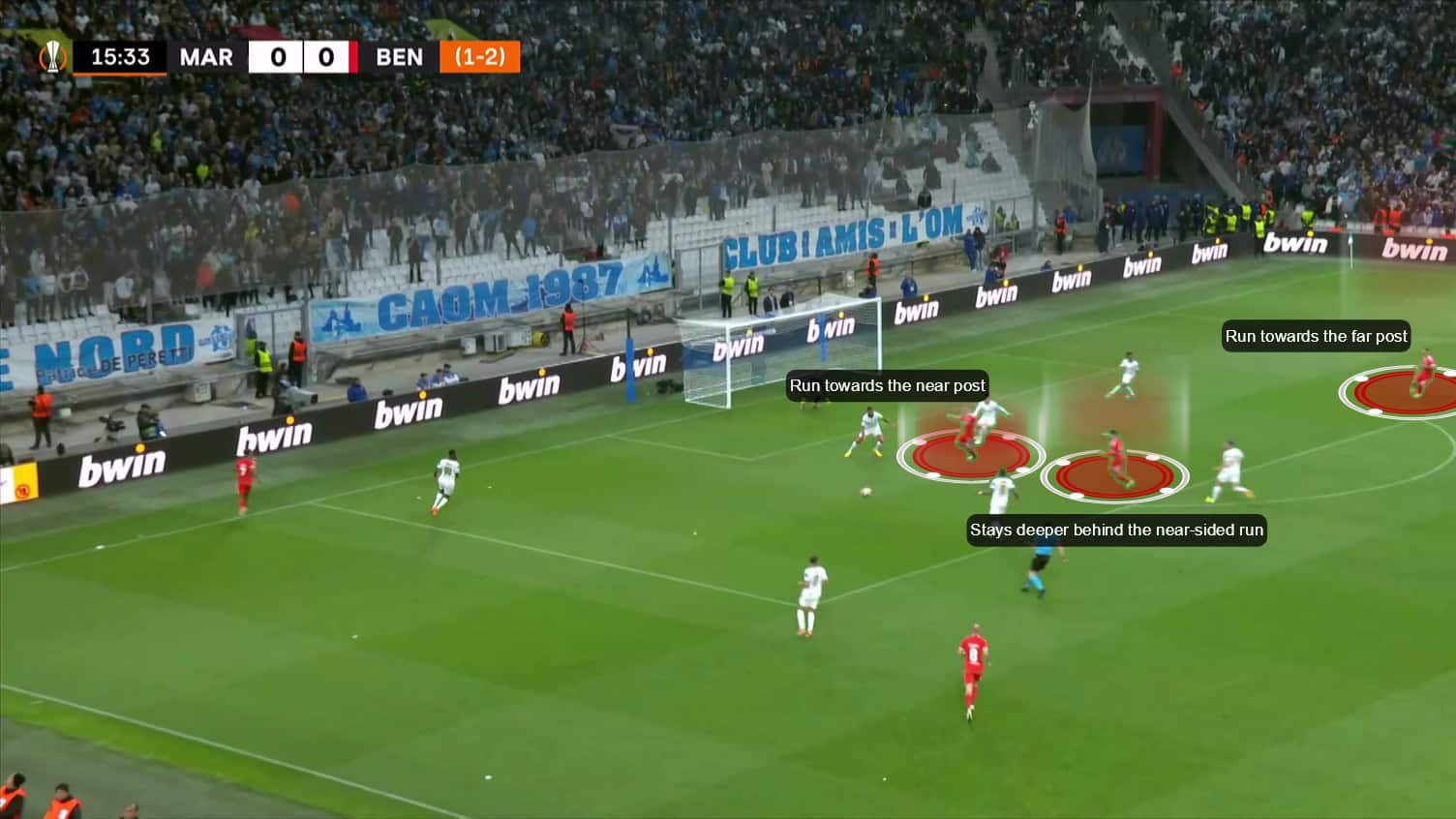
From there on, Schmidt’s men look for a cross and have a very clear structure in their movements, both inside and outside the box.
One attacker immediately moves towards the near post and puts pressure on the centre-backs.
The other attacker is staying in the shadow of the first attacker and then suddenly moves into a deeper position, ready to receive at the edge of the box.
The far-sided winger moves towards the far-sided post and drags out the defensive structure into a wider position.
These situations show Roger Schmidt’s fast-paced attacking style, making him a perfect match for RB Leipzig.
His past with Salzburg has already shown that he is a good fit for their organisational culture and that he can develop young players very well.
Salzburg made the biggest step under Roger Schmidt in their development, and all his teams played very attractive football.
The one thing speaking against Schmidt is his track record of longevity.
The German coach was never successful for more than two years and often started to struggle in his third season at his clubs.
RB Leipzig are looking for a quick fix, though, and I have no doubt that Roger Schmidt coaching style could provide that spark for them.
Ole Werner To RB Leipzig: The Stoic One
At first, my third choice for this article was Alexander Blessin, head coach of FC St. Pauli in the Bundesliga this season.
Still, I thought taking another coach with a Red Bull-influenced past would be rather boring, so we will examine Ole Werner, one of the up-and-coming German managers without a Red Bull background.
The 37-year-old, who originates from northern Germany, was a midfielder in the Holstein Kiel academy but never made the jump into professional football and decided to end his career early, at just 21 years old.
After that, Werner was looking for a worthwhile job; he travelled to Australia and worked as a landscaper there, for example, but in the end, he tried his luck with coaching at his former club in Kiel.
After just a year, he was promoted to assistant manager at the B team and, just months later, was made manager of the U23s in Kiel.
While doing a great job there, Werner was made interim manager for the first team in 2016 and won both of his games.
However, he did not have his Pro-Licence yet and had to go back to the B team.
Three years later, after getting his Pro-Licence, Werner was put in charge of the first team at Holstein Kiel.
It was a success story, with Die Störche finishing third the following season but losing the relegation playoff.
After many departures in the next summer transfer windows and a bad start to the season, Werner decided to leave on his own terms.
Just a couple of weeks later, the coaching gig at the just-relegated Werder Bremen opened up, and Werner took over his second northern club.
After taking over, Werner got Werder promoted in his first season and now just barely missed out on European football for the second season in a row with a club that many people in Germany believed would rather go back to the 2. Bundesliga instead of chasing their old highs.
Ole Werner’s coaching style differs slightly from Jaissle and Schmidt tactics.
In Germany, we usually believe that people from the North are relatively calm, always keep their composure, and rarely show their emotions compared to the rest.
While Werner definitely has some fire in him, you can absolutely see that he is from the North.
These personality traits also show in Ole Werner style of play.
Werner is very calm in his communication.
He values basic principles that are executed well over complicated tactical measures.
He gives his players clear tasks for every game and helps them with orientation in difficult situations that way.
Under Ole Werner tactics, Werder Bremen plays direct football, catering to its strengths and always getting back on track, even when things don’t work out for it.
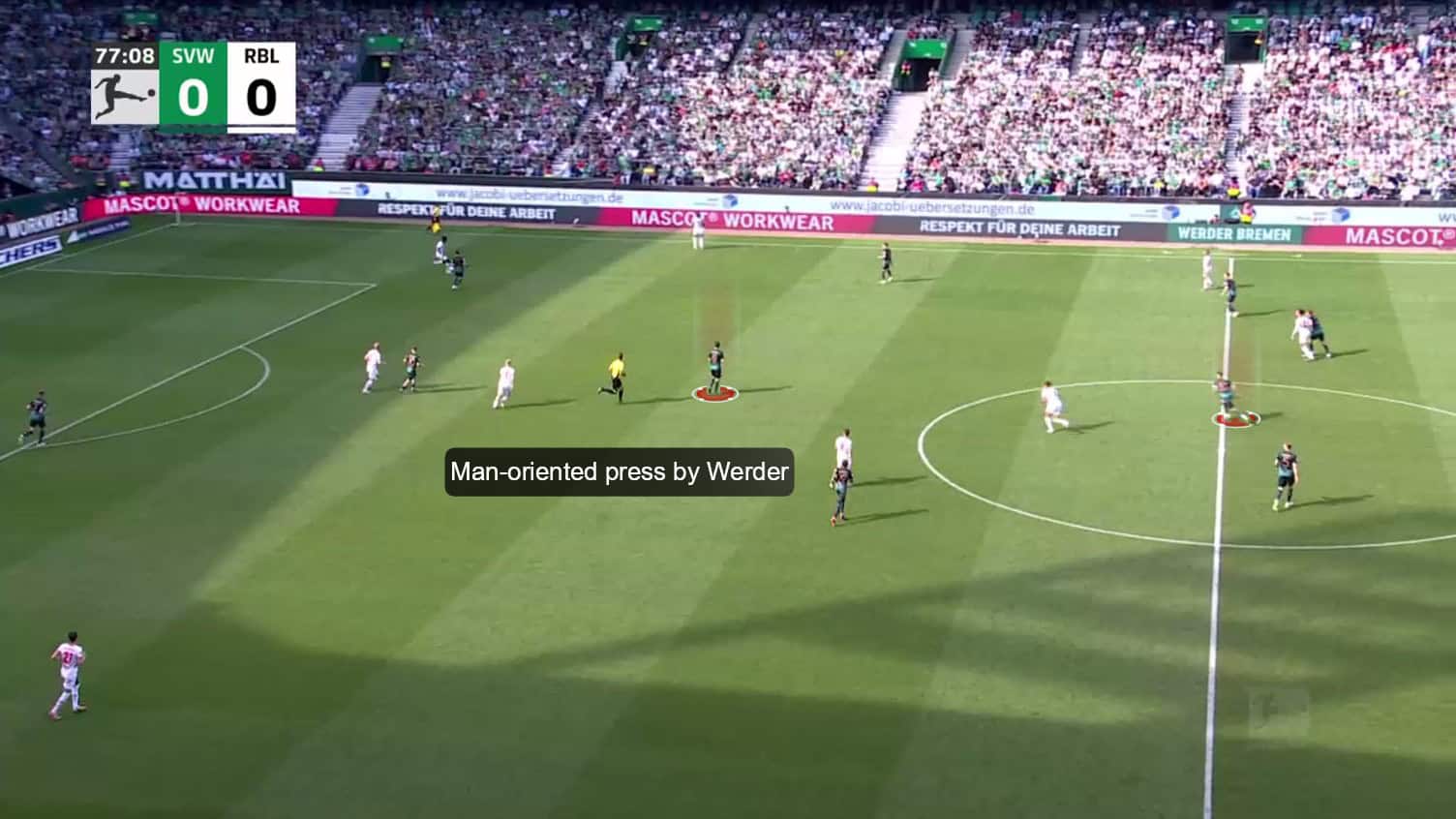
The picture above shows a situation in Werder Bremen’s last game against RB Leipzig.
Werder was dominating the game even though Leipzig obviously has the better squad, and that’s precisely what Werner can provide.
Werder played man coverage over the entire pitch in this game, forcing Leipzig in duels everywhere.
Leipzig tried to respond by trying to drag the two highlighted players out of position.
Still, the positional play that Werner implemented at Werder simply cuts off the created passing option quickly again, forcing a long ball.
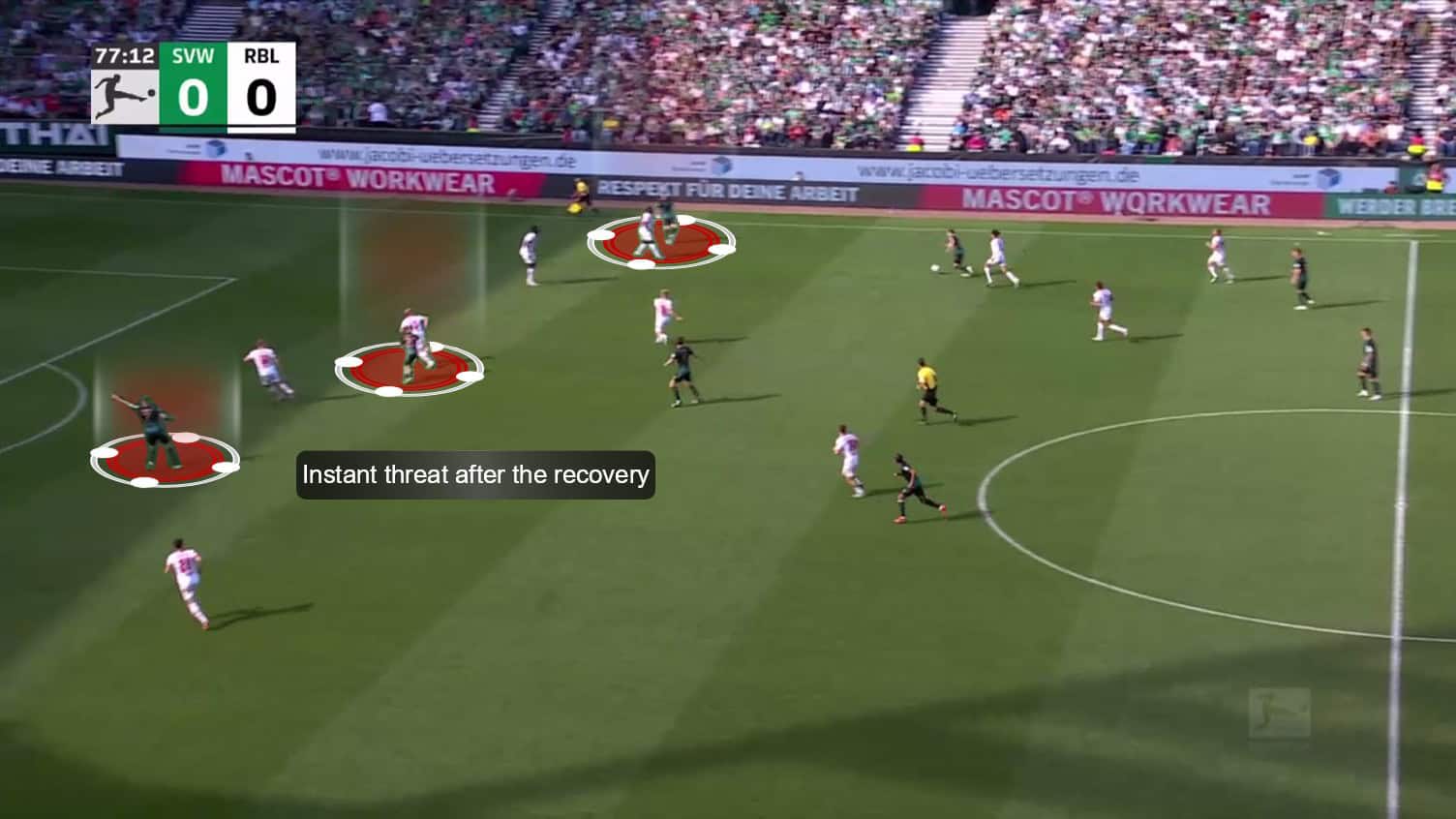
Werder easily picks off the long ball and plays it forward down their right-hand side quickly.
The moment Mitchell Weiser turns towards the goal, Werder’s three players in their last line attack the space behind the defensive line.
The similarity to Roger Schmidt’s counterattacking style is pretty obvious in that picture.
Werder occupies the space behind the defenders and forces them to react, pushing them backwards and allowing Weiser to dribble forward.
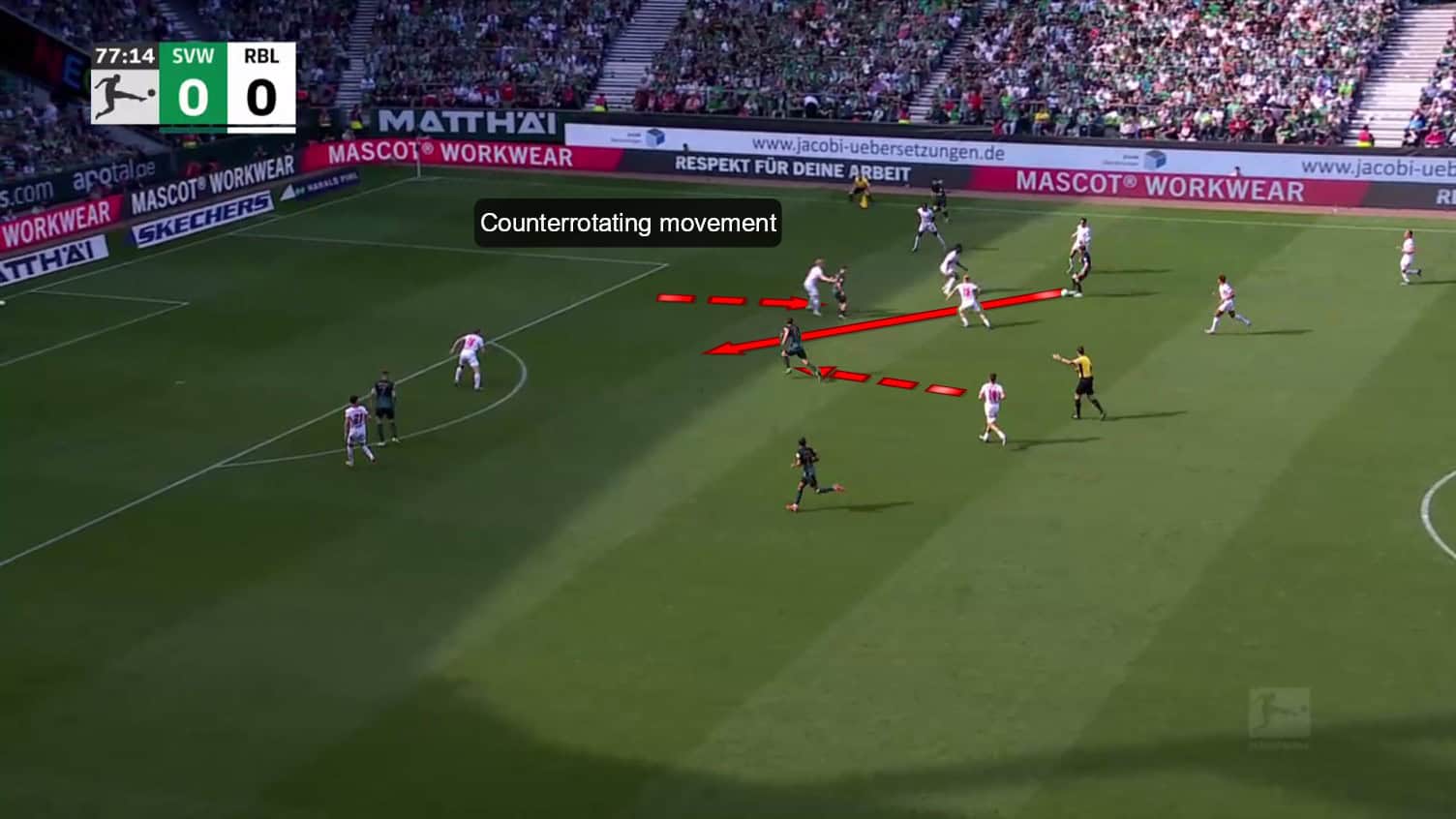
Unlike Schmidt, though, Werner wants his players to look for the pass towards the centre from the outside first and foremost.
Werner regularly has his players move in opposite directions.
Midfielder Jens Stage plays a key role for Werner here with his well-timed runs.
In the situation pictured above, Romano Schmid drops deeper and drags one centre-back out of his position, and Stage makes a run right into that space, and Werder now has a clear path into the box.
While this would be enough, Werner’s men are just playing lovely football right now, so Stage sells another dummy and receives the ball back from his striker just in front of the goal but then misses the big chance created.
Ole Werner’s teams are sharp, direct and successful.
The only critique he faces is his work with young talents, but Werder did not have many elite talents during his tenure, and with the club’s financial burden, Werner needed to guarantee success in the league.
West Ham United striker Niklas Füllkrug once said that every single player at Werder got better when coached by Werner, and who am I to disagree with him?
Werner does not have a Red Bull past, but he is one of the most talented coaches in the Bundesliga right now and already has a lot of experience, which could make him the future of RB Leipzig.
Conclusion
In the end, Rasenballsport Leipzig will need to decide quickly about their future after Saturday’s last matchday of the Bundesliga.
Their season has been a disaster compared to their usual success, and now Xavi Simons wants to leave the club this summer, which adds insult to injury.
Considering the financial benefits, the talented squad, and the club’s overall potential, many managers will be interested in taking over, but Leipzig need to make the right call this summer.
All three of the options provided in this article are good fits for the reasons laid out.
With RB Leipzig currently facing a bit of a cultural crisis, each would be a good fit on a personal level as well as from a tactical perspective.
If I had to choose, I think Matthias Jaissle as the new RB Leipzig manager would be the best choice.
A talented, ambitious coach who lives the entire culture of the club and has had a lot of success in his early coaching career will not come around often, and I think RB Leipzig should do everything in their power to get him.