
There are not many clubs that have been consistently well run despite personnel turnover in Germany over the last couple of years, and for the longest time, SC Paderborn didn’t look like it either.
After their miraculous promotion to the Bundesliga in 2014, the club was relegated twice in a row and found itself in the 3. Liga.
They would have been relegated from professional football if it weren’t for 1860 München losing their licence back then.
But this was the starting point of something special.
With their newly hired coach, Steffen Baumgart, Paderborn turned things around, built a strong squad, and established strong structures on the pitch.
After their promotion back to the second tier, the club was instantly promoted back to the Bundesliga and relegated again immediately.
However, this time, instead of completely giving up, the club managed to establish itself in the top third of the 2. Bundesliga, always a contender in the promotion battle, develops its players well and maintains a stable structure.
Even when they lost key figures to their success, like Steffen Baumgart or sporting director Fabian Wohlgemuth to VfB Stuttgart, they managed to overcome those struggles.
This summer, they once again lost their successful coach to 1. FC Köln. This time Lukas Kwasniok left the club.
Instead of crumpling again, Paderborn made a bold choice, hiring Ralf Kettemann as their new manager.
Kettemann began his coaching career in the amateur tiers of Southern Germany before becoming an academy coach for TSG Hoffenheim and Karlsruher SC, where he coached the U19 Team.
But the 39-year-old never coached at the professional or even senior level, so making him the manager of an ambitious team in the second division seemed rather naive.
Still, Paderborn once again proved everyone wrong, leading the league after 12 matchdays, demonstrating that SC Paderborn is arguably the best-run club in German football at present.
In this tactical analysis, we will examine how Kettemann is building up his team in lines one and two, how they work against the ball, and why they are currently leading the race for promotion to the Bundesliga.
Paderborn Tactics In Possession
Looking at what the team from East-Westphalia (yeah, that’s unfortunately not a joke) does when building up in line one, we have to start with their goalkeeper.
Over the last couple of years, Paderborn have undergone several changes in the goalkeeper position, but they have always valued one thing more than any other team in the league: the ability to play the ball.
It doesn’t matter who coached the team at the time; the goalkeeper was always heavily involved in the build-up.

As we can see, Kettemann continues this tradition, starting his build-up play with his goalkeeper in possession of the ball most of the time.
Another interesting thing about their play in the first line is the way their backline shapes up.
Paderborn usually line up in a 3-4-2-1 formation under their new coach, but when building up from deep in their own half, the right wing-back, Laurin Curda, pushes high up the field, while the right centre-back, Mattes Hansen, pushes out wide.
With skipper Raphael Obermair staying closer to the backline as a right wing-back and the goalkeeper positioning himself in the middle of the centre-backs, this forms a very wide back-four plus one.
Just one more player, the holding midfielder, stays close to the backline, allowing the team to find solutions through a triangle towards the centre-backs if the goalkeeper is pressed.
In the end, Kettemann separates his defenders from the rest of the field by pushing his other players very high up the field.
This creates a 4-v-4 situation in theory, as they are being pressed with man-marking in this scenario, but by involving the goalkeeper, they create a numerical advantage.
In the end, they find the solution through the triangle to find the open man on their right side with ease.
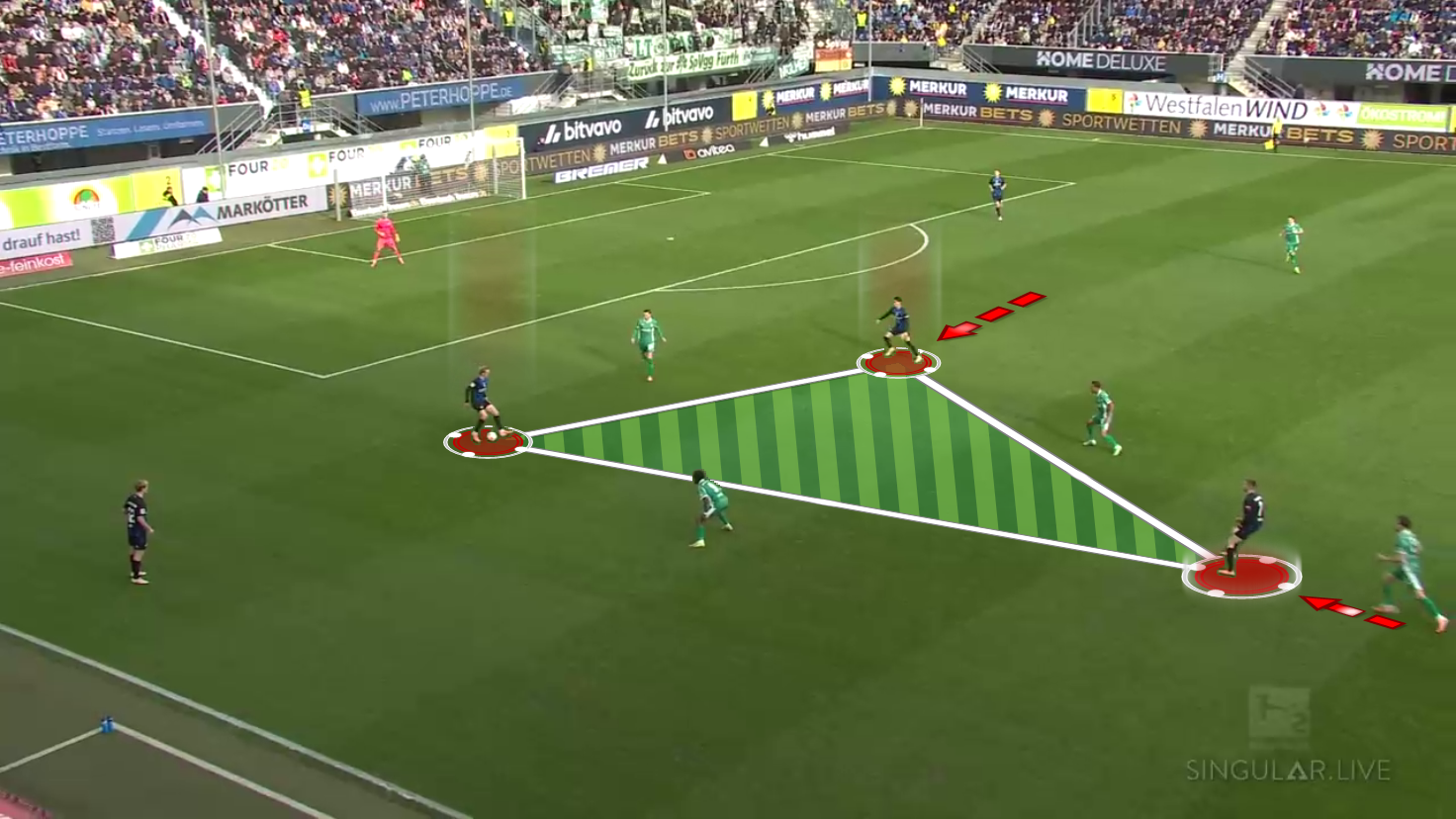
After progressing through the means of carrying the ball forward with their open man, something Kettemann wants his defenders to do, they drop one player out of their attacking line to form an additional triangle.
The holding midfielder now moves out of his very central position to overload the near-side, allowing Paderborn to find more solutions in the passing game.
While only the new triangle is visualised in the picture, there is another possible triangle with Hansen towards the other side, which means that the defending team never really gets an opportunity to anticipate the next pass.
This forms a diamond shape on the wing, but not in the traditional sense; the diamond is initially flat and also very elongated.
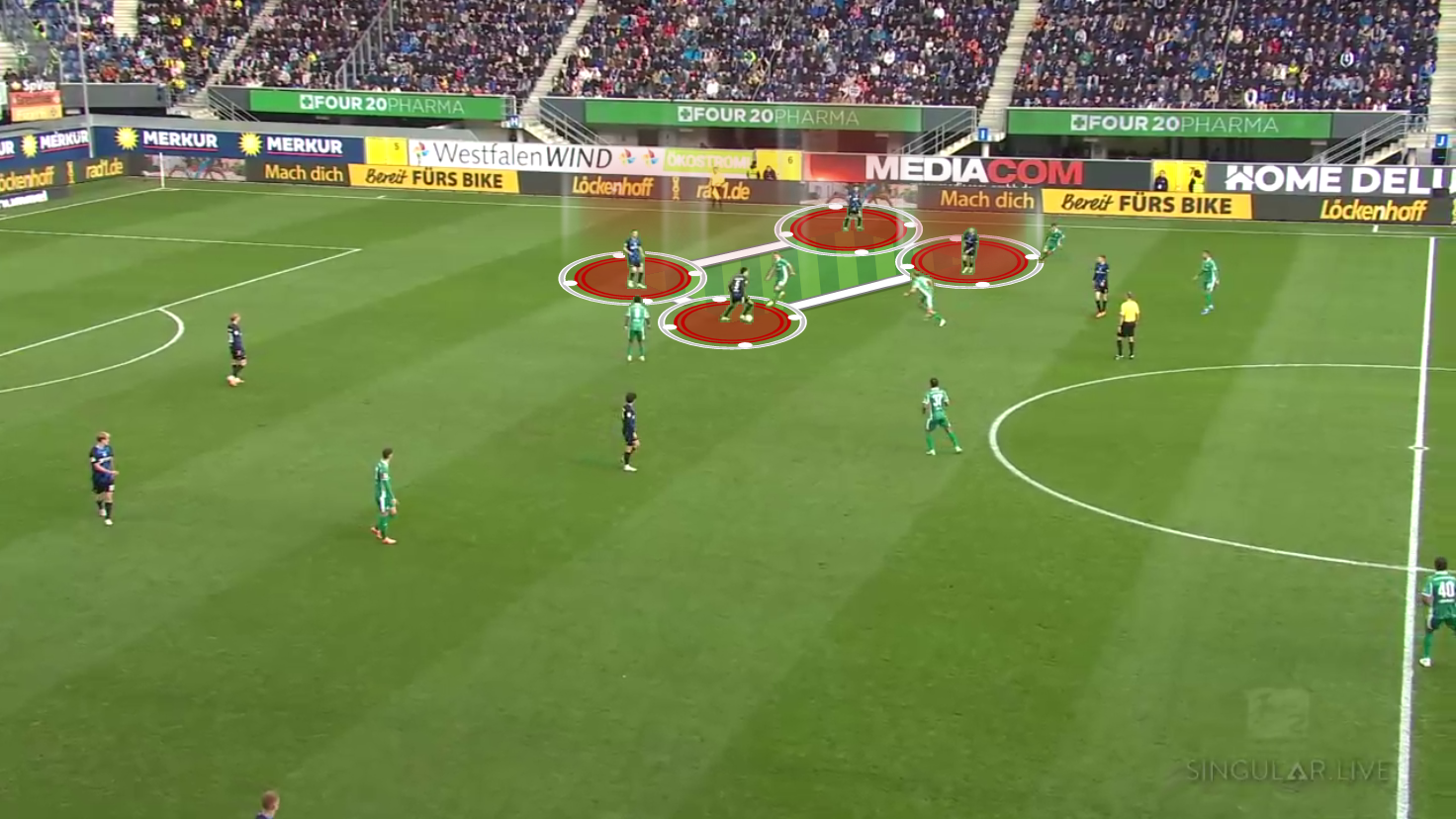
They form these diamonds a lot when they manage to get an open player to move forward with the ball.
The shape of the diamonds is somewhat inconsistent, though, and this can sometimes become a problem for them.
In the picture above, the diamond is incredibly narrow, so they condensed the space for themselves and allowed their opponent to defend forward, something the team struggles with aggressively.
Still, it allows them to find quick solutions in the passing game and play over the players trapped inside the shape, often allowing them to find an open foot somewhere.
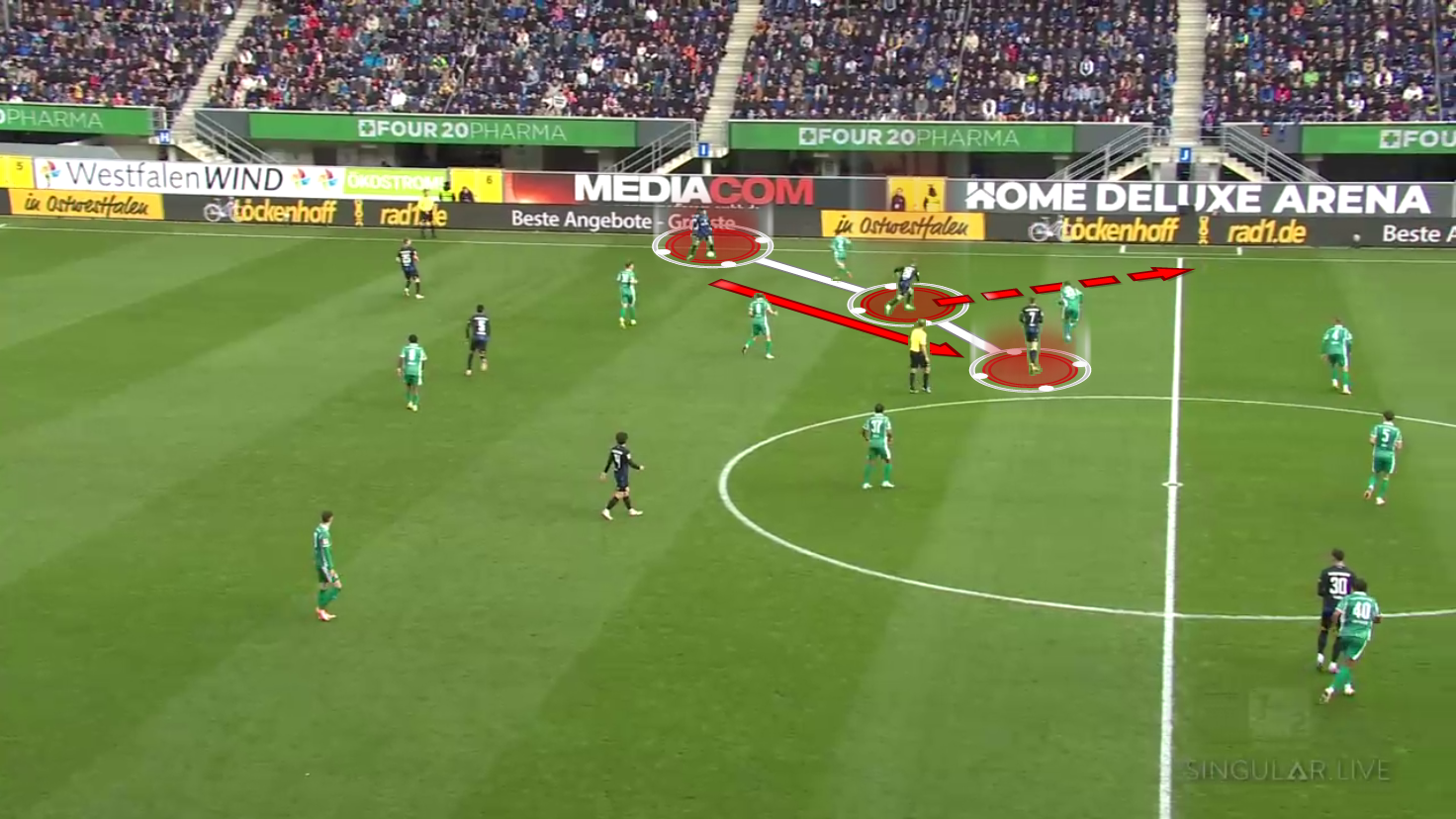
Kettemann’s men end up on the wing with a pass to their full-back rather often, but they have solutions for those situations as well.
Two of the attacking players now drop back, forming a diagonal ladder, a line directed towards the kick-off spot.
From then on, they have multiple possible solutions to escape the pressure.
The one they use the most is rather simple: the nearest player to the ball in the ladder starts a vertical run, while the player behind him drops back slightly.
Because the second player moved right in the shadow of the nearest player, this opens up the passing lane towards him.
With the other player now in a more advanced position, it forms a triangle again, and Paderborn can try to find solutions there.
Kettemann’s team has a rather interesting way of building from the back with a lot of triangles and a lot of carrying the ball into open space, but they also don’t shy away from the long ball.
With many players in their attacking line, they can play it long when the pressure gets to them, and they often manage to hold up the ball or at least recover the second ball with their positional play, which makes them really hard to press, because they can beat you either way.
Paderborn In Line Two
When they are not pressed as high up the field or if they manage to progress the ball further up the pitch, the build-up of Paderborn changes a bit.
Ralf Kettemann has different ideas at that stage of play.
The first really interesting thing is how high and wide he positions his players.
This creates a lot of open space that his team needs to move into to create dynamism.
In Germany, we call this “Weiträumigkeit“.
While this allows his team to create movement and receive the ball in open space, it challenges them to move into the right space at the right time; otherwise, the player with the ball will not have enough passing options, and the pressure will quickly close in on him.
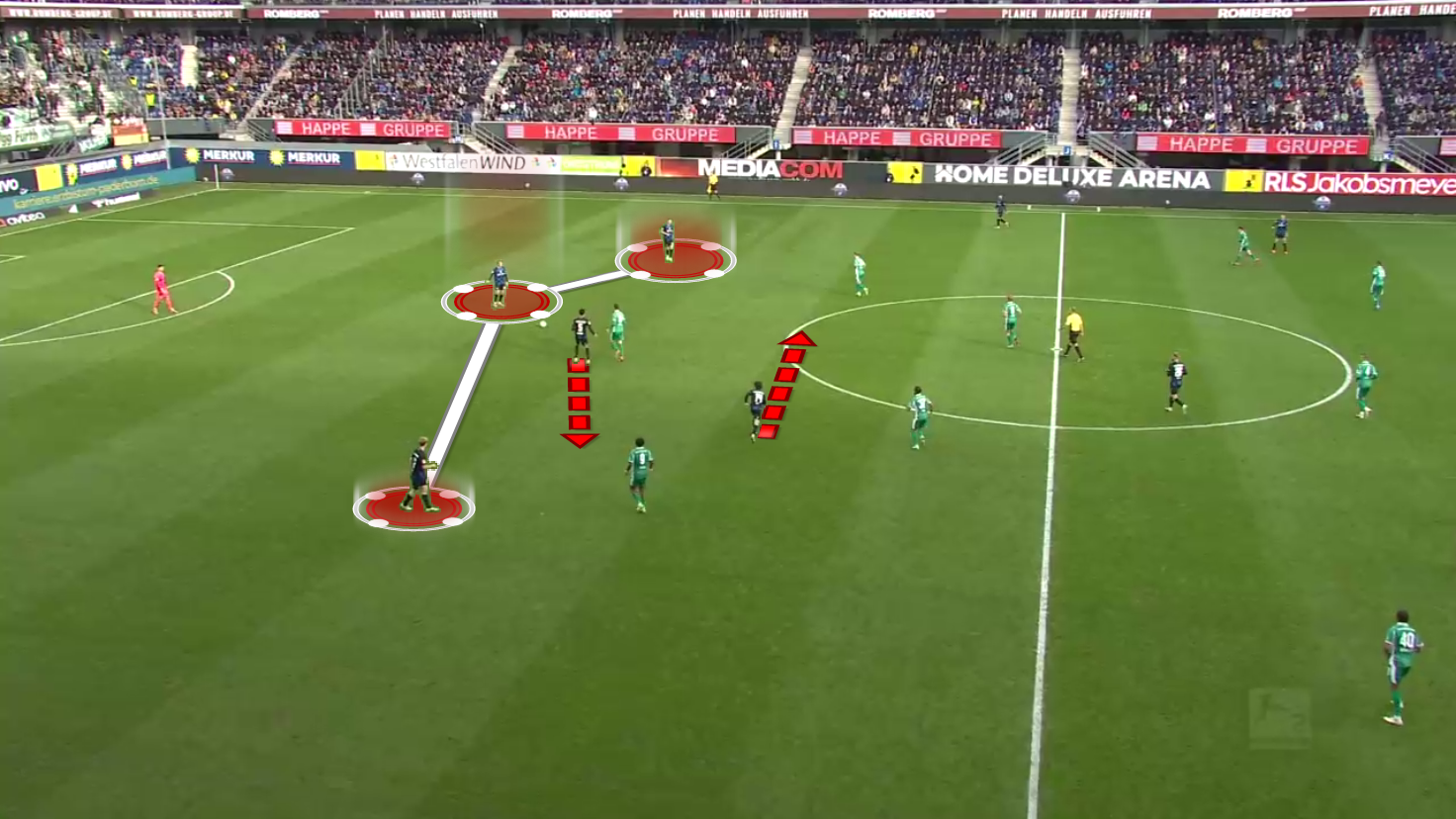
We can see that Kettemann now also prefers to build up with his back-three and does not include the goalkeeper as heavily as he did in line one.
At times, the goalkeeper also pushes up into the second line, but Paderborn are not as aggressive with that compared to teams like Hannover 96.
While the other players are very wide, the back-three is in a rather narrow shape; the outside centre-backs are not on the edge of play, but rather keep the passing distances shorter.
Another interesting thing is the movement of the two central midfielders.
One midfielder is always positioned very close to the backline, while the other moves behind the first line of press of their opponent.
They also move in opposite directions at all times, the holding midfielder decides on his direction and the other midfielder moves in the exact opposite way to receive passes.
While they build with a back three, they often drop an additional player into their backline if they feel the need to make a substitution.
Here, their opponent presses them with three attackers, so by dropping another player into the backline, they create a numerical advantage for themselves.
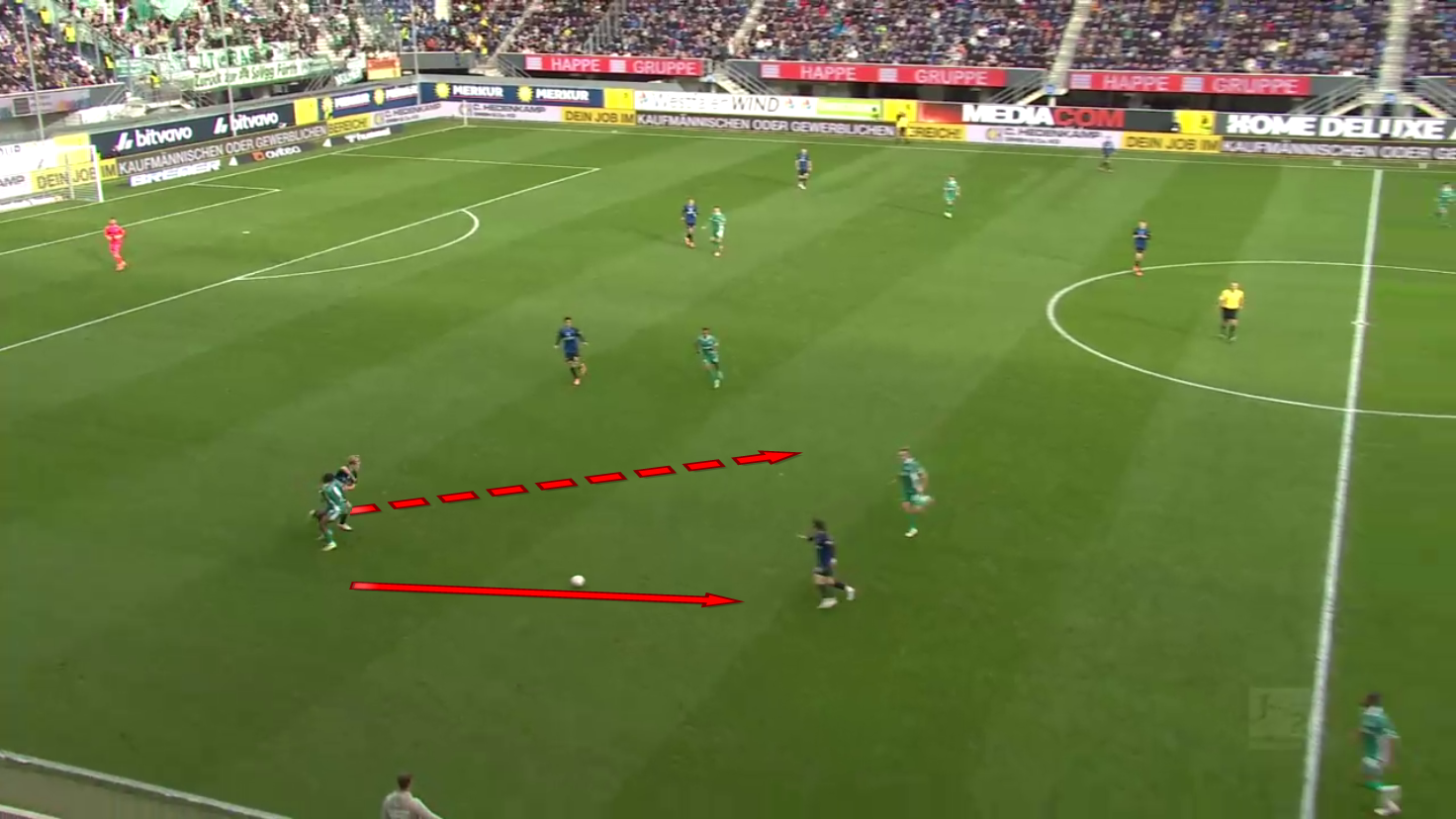
The use of Weiträumigkeit is key for Kettemann’s team in these situations, and they utilise it in various ways.
The first way is pictured above.
When the two outside centre-backs have possession of the ball, they often play it towards one of the central midfielders or to the near-side wingback.
From then on, they don’t just stay in their position or even drop back to receive another pass; they always keep their forward momentum and move forward into the open space.
This allows their teammates to hit them in stride with the next pass, and with their momentum, they often manage to get past their markers in these situations and are able to dribble even further up the pitch, taking advantage of the open space in front of them.
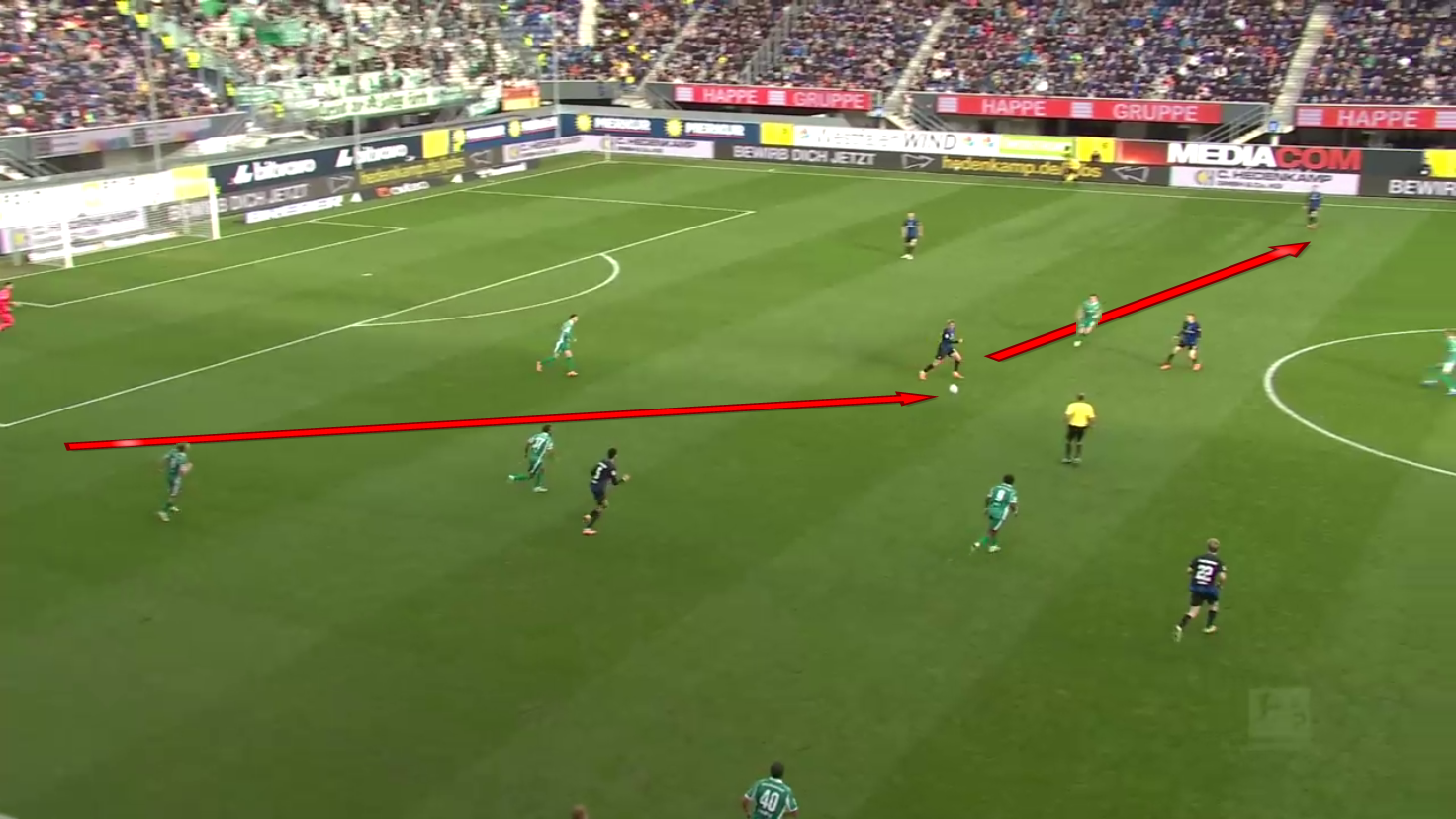
The second way is just as interesting.
Kettemann’s men take a lot of risks in the build-up, but they often get away with it.
In this situation, the central midfielder dribbled backwards towards his own goal, but they once again use the Weiträumigkeit, and the central defender moves forward into the now-vacated space.
This allows the midfielder to play a diagonal pass against the direction of his movement into the central area, something most coaches would absolutely hate.
However, thanks to the positional play opening up that space, Felix Götze has enough room to control the ball and move forward.
Here, he can even switch play to the other side.
It’s really interesting to see how Kettemann and his players open up space and then move into it, creating dynamism in the process.
Working Against The Ball
Against the ball, Paderborn are a rather patient team, always pressing minus one in the first line of pressure and often dropping back into a midfield press; however, they still manage to push up into the first line of press rather frequently.
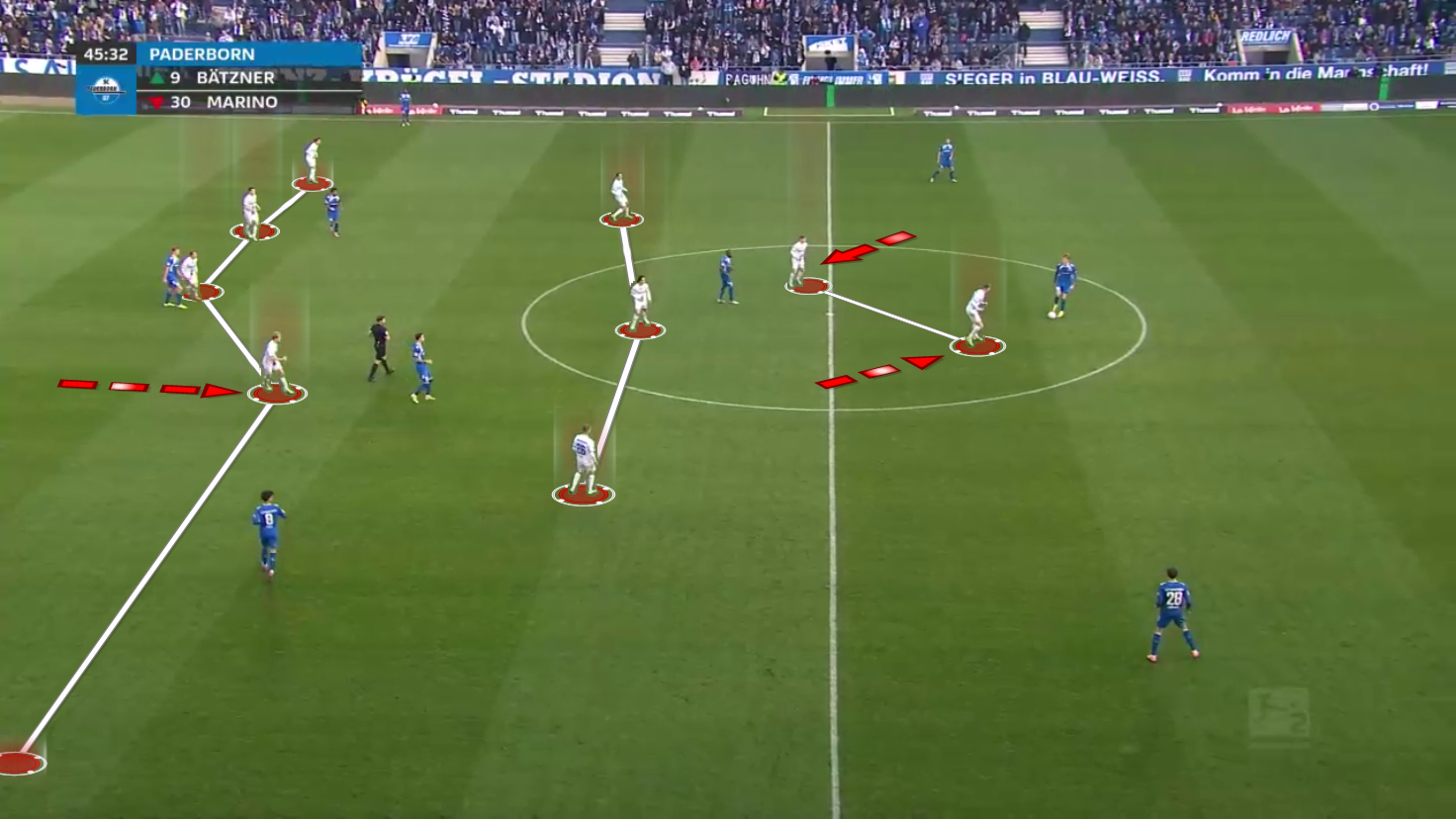
Kettemann drops his two wingbacks into the backline, forming a 5-3-2 shape against the ball, and prioritises closing the centre with this positioning.
The two strikers press when pressing, always closing off the diagonal pass into midfield and applying minimal pressure on the build-up; they rarely commit enough players forward to match the numbers.
They play a very space-oriented game and maintain their shape intact; the space between the lines is often defended by the outside centre-backs stepping up, as shown above.
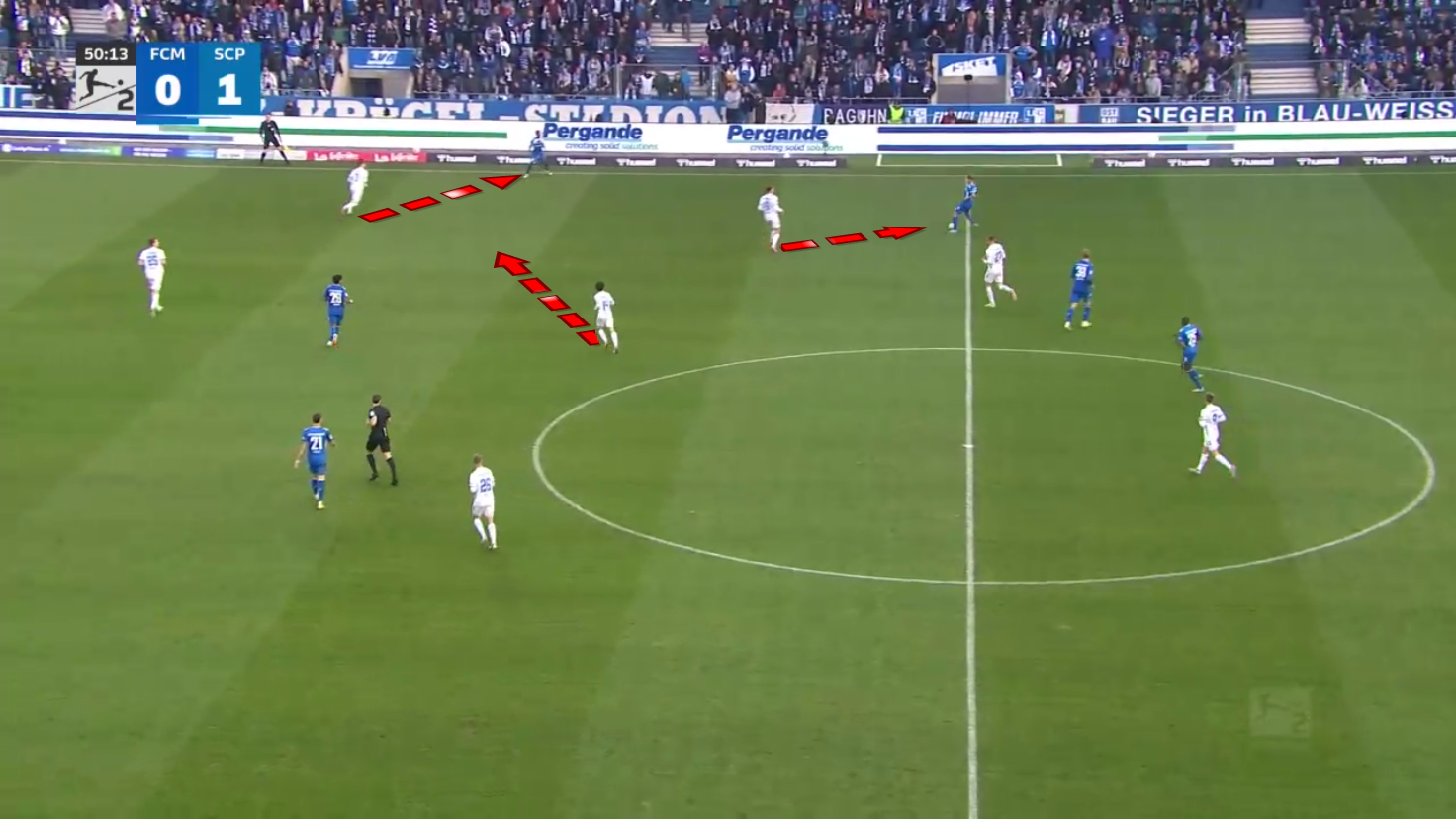
Kettemann’s goal with the press is to get their opponents to play to the wing and then collapse on them there.
They are guiding them towards the outside with their two strikers and then have a very clear pressing zone on the wing, where the near-sided midfielder and wing-back defend forward and apply pressure, while the far-sided midfielder covers the space behind them.
Their defensive approach works really well; they currently have the second-best defense in the league and do not seem to slow down in that regard.
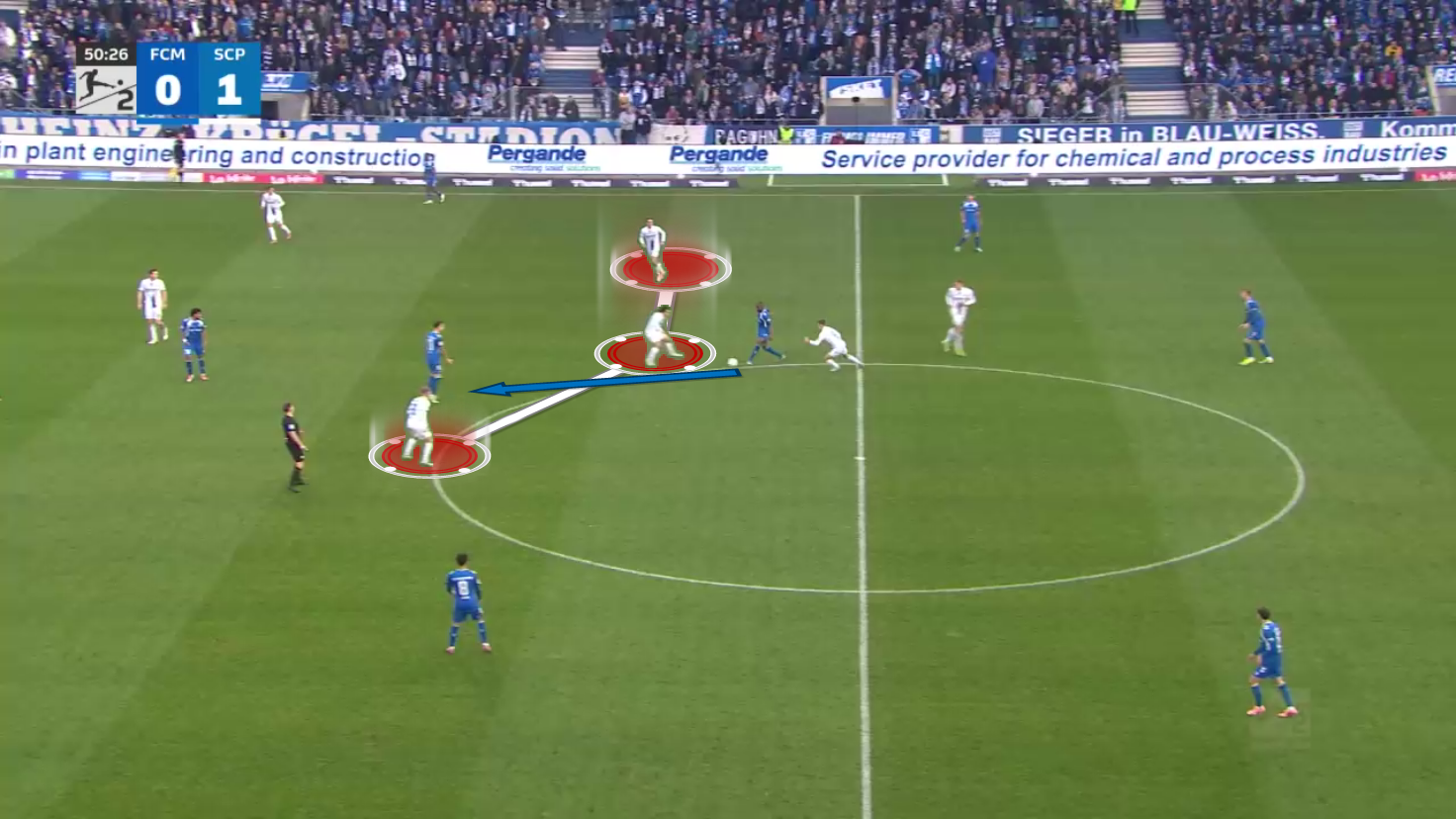
With their focus on keeping their shape intact, they still have one problem, and Magdeburg was able to punish that sometimes.
They are never really able to close the gaps between the midfielders when they get dragged wide.
With the distances between the backline and the midfielders, their opponents are often able to find vertical passing options into the space between the lines.
So, when their strikers fail to close the centre and guide the opponent towards the wing, Paderborn often face numerous line-breaking passes.
So far, no team has been able to exploit this as much to trouble Paderborn, but it is still something to keep an eye on for the upcoming games.
Conclusion
After a successful season, Paderborn lost their head coach and two of their best players to the Bundesliga, but once again, it didn’t really matter.
The club is incredibly well-run, finding great coaches and players in the lower tiers of German football and developing them into a strong team in the 2. Bundesliga.
The entire environment seems to be really good, and Ralf Kettemann once again appears to be a great manager in helping these young players reach their full potential, which is evident on the pitch.
Kettemann’s team executes his ideas exceptionally well, and with their clear plan both with and against the ball, they are currently leading the league, and it is thoroughly deserved.
It will be interesting to see if the young team can maintain its position in the promotion race until the end of the season, but once again, SC Paderborn will finish in a strong position for the club.
