
The 2025 Africa Cup of Nations (AFCON) has reached its dramatic semi-final stage in Morocco, with four of the continent’s elite sides still in contention for the premier African international football crown.
The semi-finalists confirmed are Senegal, Egypt, Morocco, and Nigeria, following thrilling quarter-final ties that showcased both individual brilliance and tactical depth across the tournament.
Senegal edged Mali 1–0 to secure their place, building on a tournament characterised by disciplined defensive work and incisive forward play.
Egypt, the continent’s most successful nation with a record seven AFCON titles, booked their semi-final clash with Senegal by eliminating the defending champions Côte d’Ivoire in a five-goal classic.
Hosts Morocco advanced with a strong 2–0 win over Cameroon, while Nigeria’s Super Eagles overcame Algeria to complete the quartet.
In this AFCON data analysis, we will explore key performance metrics from across AFCON 2025, including passing networks, defensive solidity, and individual player impact, to evaluate how these teams reached the final four and which players have driven their success.
Pressing Patterns Of 2025 AFCON Semi‑Finalists: How They Engineered Their Path
In AFCON 2025, PPDA has emerged as a key metric in analysing pressing intensity and defensive strategy across the continent.
Lower PPDA values indicate proactive ball recovery and high pressing, while higher figures reflect structured defensive setups.
Understanding these dynamics offers insight into how African teams engineer possession, disrupt opponents, and shape match control.
AFCON 2025 Pressing Intensity (PPDA) (Lower PPDA Is Higher Pressing Intensity)
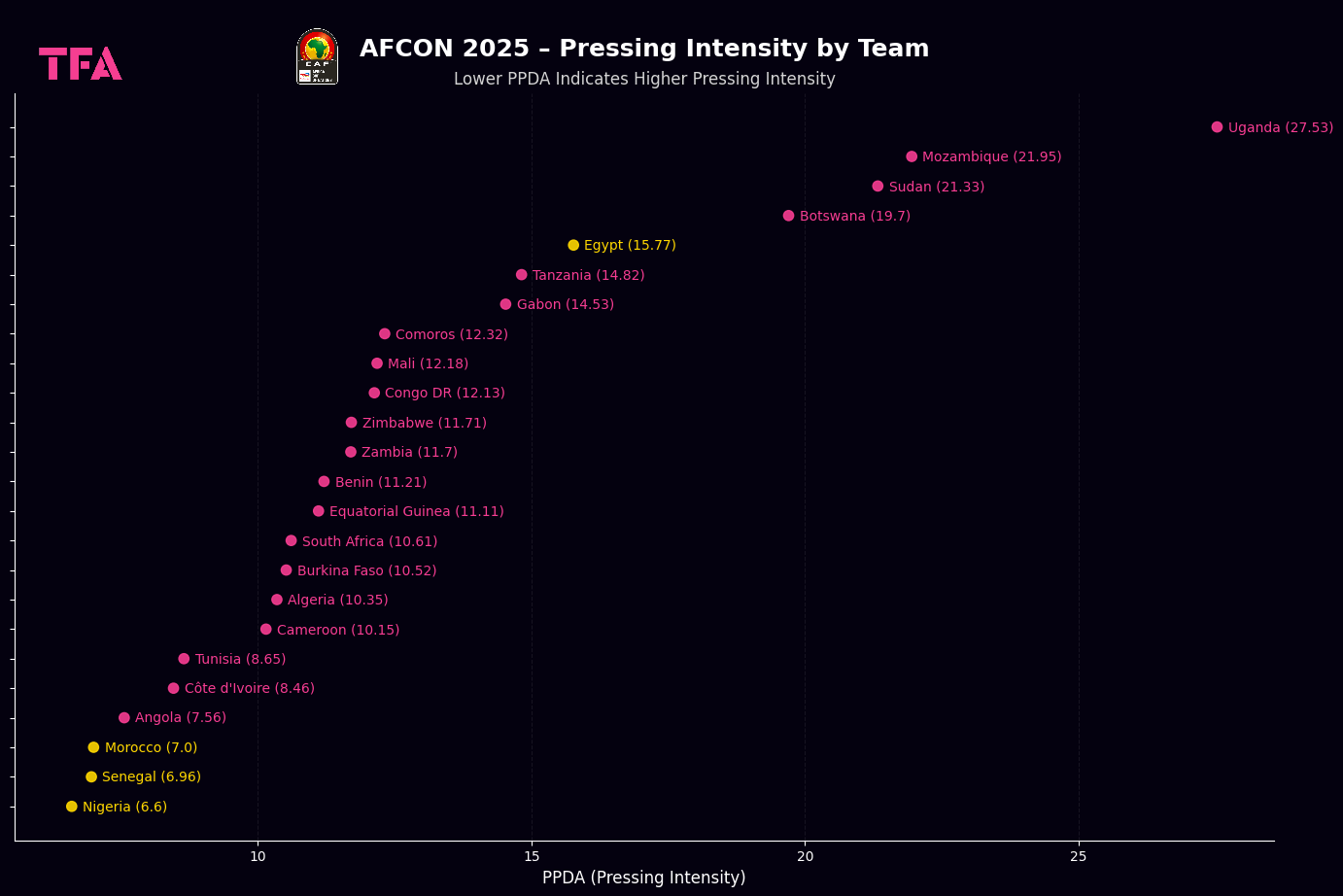
Nigeria’s route to the last four was underpinned by one of the most aggressive pressing systems in the tournament.
With one of the lowest PPDA values (6.6), the Super Eagles constantly hunt the ball high up the pitch, forcing turnovers around the opponent’s build‑up zones and launching swift transitions into attack.
Their forwards and midfielders often initiate coordinated pressures that compress opponents into tight corridors, creating counter‑pressing traps that both disrupt rhythm and generate scoring opportunities.
Senegal have married physicality with tactical pressing triggers, combining disciplined off‑the-ball movement and rapid recovery of possession.
Their approach blends high pressing with controlled possession, letting them force errors in midfield and exploit space behind defensive lines.
The Teranga Lions’ intensity has seen them quickly win back possession and support fluid attacking phases, echoing modern high‑press paradigms where forward runs and defensive duties balance seamlessly.
Hosts Morocco have implemented a high-pressure, possession‑oriented style that suffocates opponents early and retains territorial control.
With a PPDA figure of 7.0, they consistently press the ball in advanced areas, pinning teams deep and limiting time on the ball.
Their collective press frustrates build‑up play, leading to turnovers in dangerous zones.
This proactive defensive intensity, paired with disciplined positional play, underpins their semifinal berth and reflects a blend of pressing with patient ball retention.
Egypt’s tactical identity contrasts sharply with the other three.
With a higher PPDA (15.77), the Pharaohs do not rely on relentless high pressing; instead, they prioritise defensive stability and controlled possession through a five‑man defensive setup that emphasises compactness and structure.
By allowing opponents greater possession, Egypt encourages more predictable build‑up, funnelling play into congested channels where positional discipline and organised pressing moments disrupt attacks.
This approach sacrifices constant ball hunting but enhances defensive balance and allows structured transitions, making their progress to the semi-finals a testament to tactical pragmatism rather than aggressive pressing.
Egypt’s Tactical Defensive Resilience Under Hossam Hassan
Under Hossam Hassan, Egypt’s journey to the AFCON 2025 semi-finals has been built on an outstanding collective defensive effort rather than aggressive pressing.
The Pharaohs sacrifice attacking numbers for structural security, with Mohamed Salah and Omar Marmoush often left as the only advanced outlets while the rest of the side adopt clear defensive responsibilities.
This approach has produced one of the tournament’s most resilient defensive units, reflected in Egypt’s high PPDA and their ability to absorb pressure without losing organisation.
AFCON 2025 Top Defensive Performers Before Semi-Finals
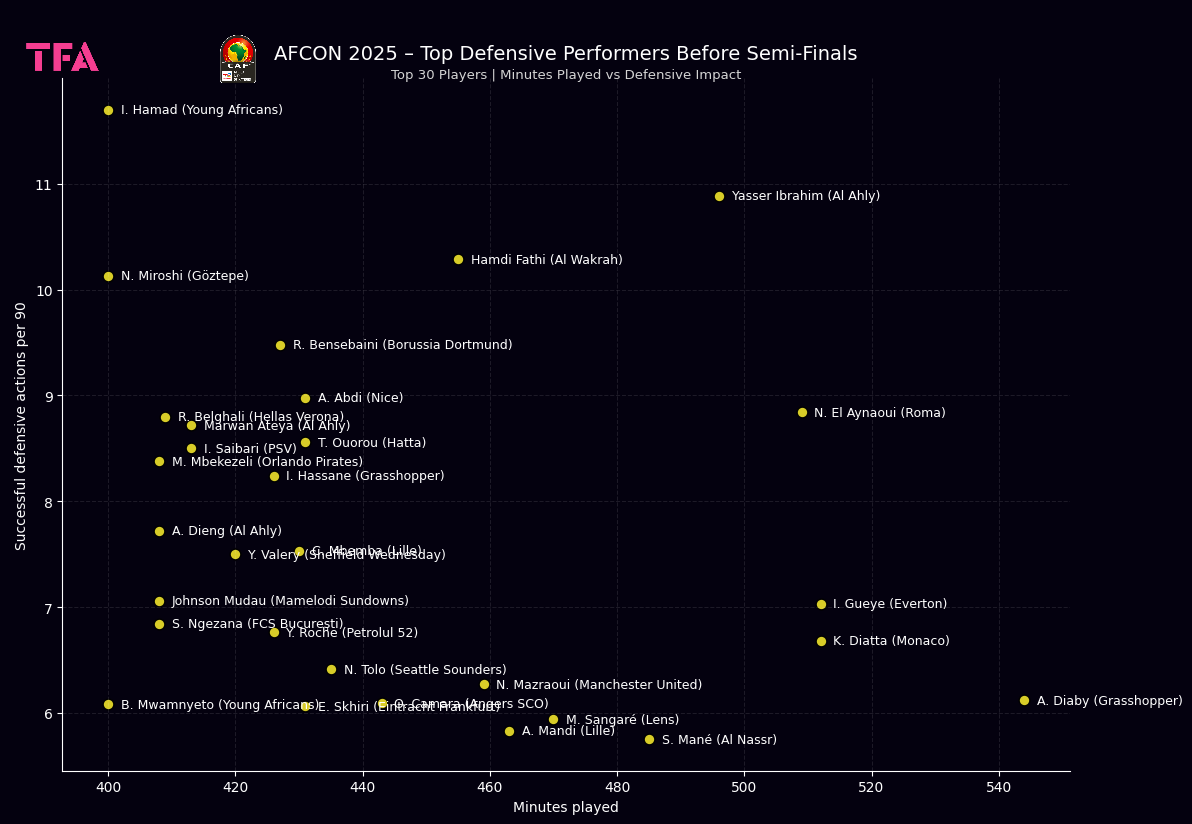
At the heart of this system, Yasser Ibrahim has been pivotal.
Averaging 10.89 successful defensive actions per 90, alongside an excellent 77.8% defensive duel success rate and 4.9 interceptions per 90, he has anchored the backline with authority and anticipation.
Hamdi Fathi has provided tactical flexibility and intensity, recording 10.29 defensive actions per 90 and a high volume of sliding tackles (2.18 per 90), often stepping out of the line to disrupt progression before danger develops.
In midfield, Marwan Attia has acted as the screen, combining positional discipline with nearly seven defensive duels per 90, ensuring central compactness is maintained.
Alongside them, Rami Rabia has added experience, aerial security, and calm decision-making, completing a defensive core that prioritises structure, timing, and collective awareness.
Together, this unit epitomises Egypt’s pragmatic, tournament-ready identity under Hassan.
AFCON 2025 Semi-Final: Morocco vs Nigeria – A Clash Between Africa’s Two Heavyweights
The AFCON 2025 semi-final between Morocco and Nigeria stands as a defining fixture of the tournament, widely regarded as a meeting of the two most complete sides in African football at present.
Beyond reputation, the underlying data reinforces why this contest is viewed as a de facto final before the final.
Morocco vs Nigeria – Attacking, Defensive & Passing Metrics Before the Semi-Final

Nigeria arrive with a clear identity built on aggression and intensity.
Their PPDA of 6.6 is among the lowest in the tournament, highlighting an elite high-pressing structure designed to win the ball early and attack immediately.
That approach has fuelled strong attacking output: 14 goals, 2.8 per match, 15.6 shots per game, and 6.8 on target.
Defensively, the Super Eagles combine pressing with volume, averaging 20.4 tackles and 12.7 interceptions per match, underscoring a physically dominant, proactive defensive model.
Morocco, by contrast, represents control and efficiency.
With a PPDA of 7.0, their pressing intensity is comparable, but more measured and possession-oriented.
The Atlas Lions are less explosive in attack, scoring nine goals at 1.8 per match, but they compensate with exceptional defensive solidity.
Conceding just two goals and keeping three clean sheets, Morocco excels at limiting high-quality chances rather than simply increasing defensive actions.
Statistically and stylistically, this is a collision between Nigeria’s vertical, high-tempo force and Morocco’s structured, suffocating control.
Fine margins in pressing duels, transition moments, and defensive organisation will likely decide a semi-final that truly represents the highest level of modern African international football.
Leading Attacking Performers at AFCON 2025 Before the Semi-Finals
As the 2025 Africa Cup of Nations heads into its semi-final stage, several forwards and creative players from the four remaining sides, Senegal, Egypt, Morocco, and Nigeria, have distinguished themselves as the tournament’s most potent attacking forces, consistently delivering goals and key offensive contributions.
Based on the latest goals and assists data from across the competition, these players have been central to their teams’ progress.
AFCON 2025 Top Attacking Performers Before Semi-Finals
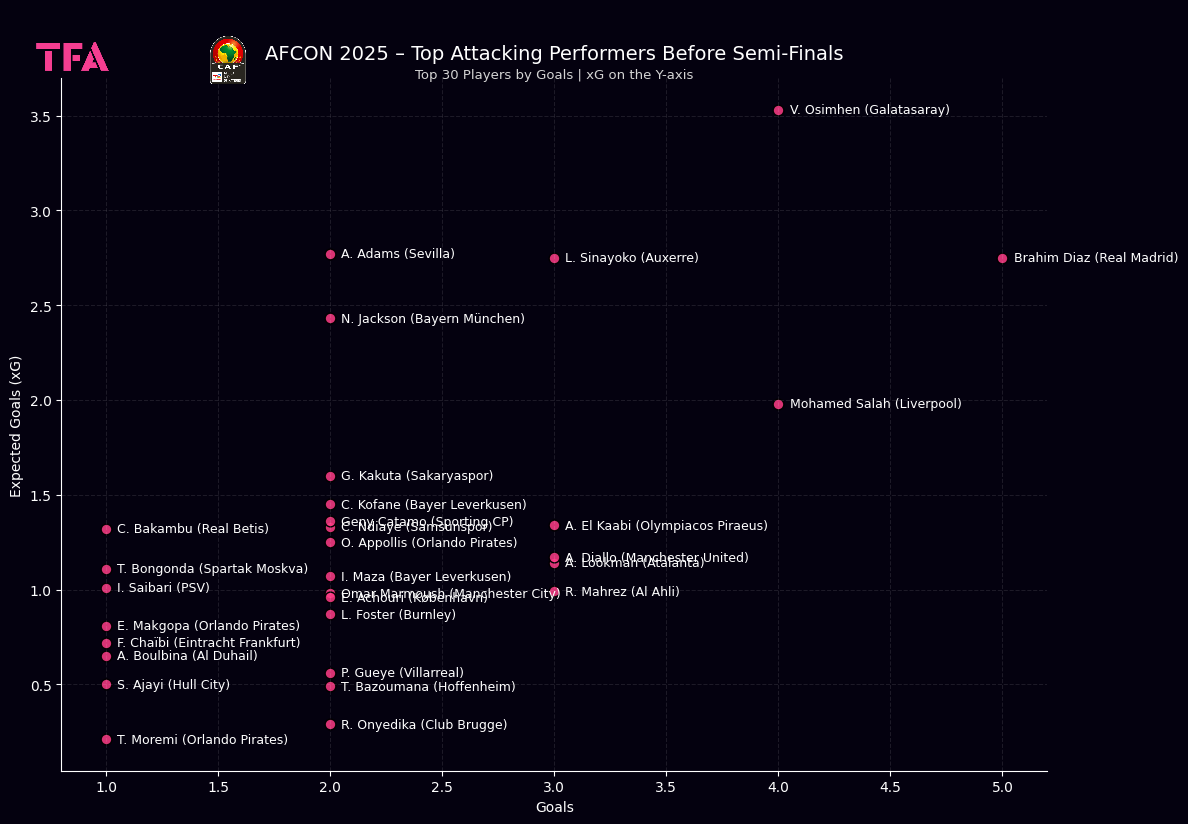
Brahim Díaz (Morocco) has been the standout figure in front of goal, leading the scoring charts with five goals before the semi-finals.
The Real Madrid-linked attacker has combined intelligent movement between the lines with clinical finishing, making him arguably the most dangerous attacking threat in the tournament so far.
For Nigeria, Victor Osimhen has been the main outlet in attack, contributing four goals with his physical presence and sharp instincts in the box, while his teammate Ademola Lookman has also impressed with three goals and the most assists (four) among Super Eagles players, highlighting his direct play and creativity.
Mohamed Salah (Egypt) continues to assert his influence for the Pharaohs, registering four goals and operating as both a leader and primary goal threat despite Egypt’s more defensive setup.
From Senegal, while not topping the goal charts, Sadio Mané has been instrumental in chance creation and tactical forward play, contributing key assists and helping the Teranga Lions unlock defences throughout the tournament.
Together, these attackers exemplify the diverse offensive qualities, from clinical finishing and creativity to tactical intelligence, that have powered the final four teams toward the latter stages of AFCON 2025.
Senegal’s AFCON 2025 Journey & Tactical Outlook vs Egypt
Senegal has enjoyed an impressive run at the Africa Cup of Nations 2025, combining solid defence with a dynamic attack to reach the semi‑finals, where they face Egypt in Tangier.
They topped Group D with commanding performances, including a 3‑0 win over Benin and a comeback from a goal down to beat Sudan 3‑1, showcasing their resilience and control in possession throughout the tournament.
In the quarter‑finals, Senegal edged Mali 1‑0 through Iliman Ndiaye’s decisive strike, demonstrating composure and tactical discipline under pressure.
Senegal AFCON 2025 Radar Before Semi-Final Vs Egypt
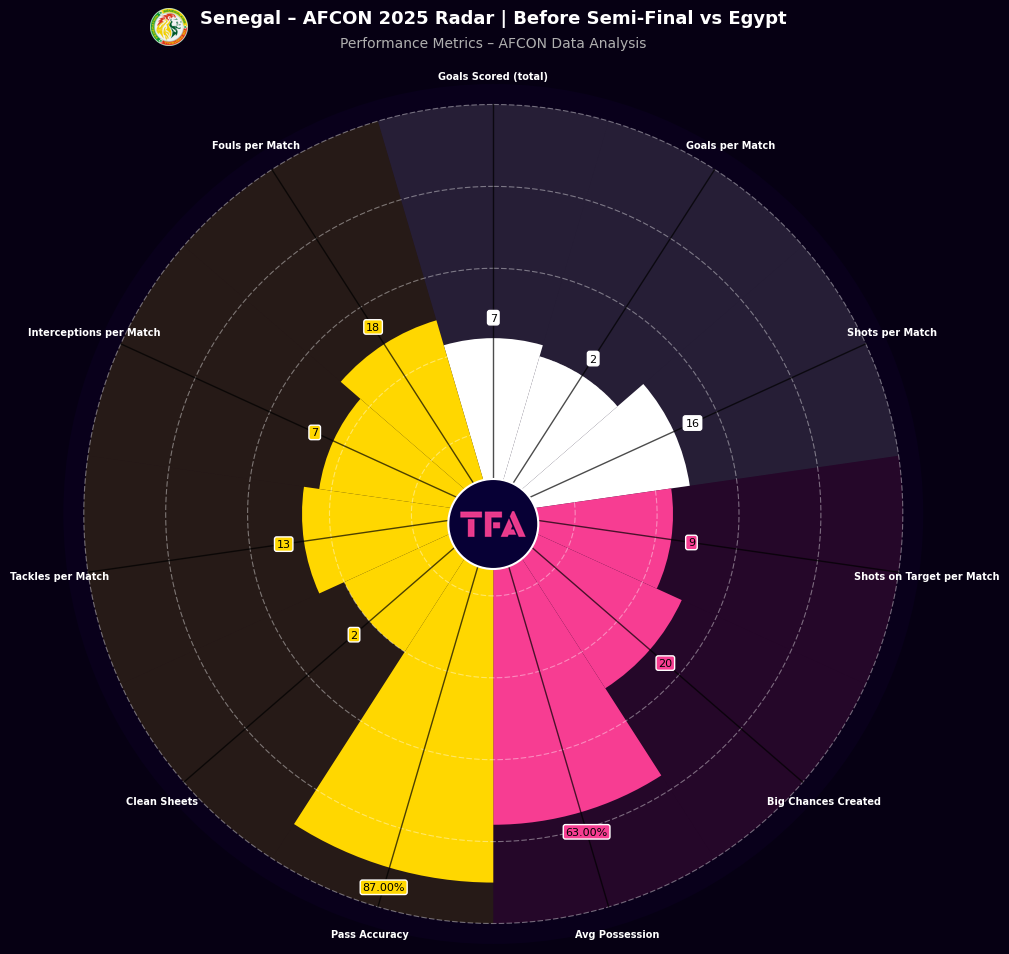
Across their campaign, Senegal has scored 7 goals in total, averaging 2.2 goals per match, with 16.4 shots per game and 8.6 on target, creating 20 big chances, while maintaining 63% average possession and 87% pass accuracy.
Defensively, they have kept two clean sheets, averaging 13.4 tackles and 7 interceptions per match, despite committing 17.8 fouls per game, reflecting a physically intense style.
Facing Egypt, a team capable of defending deep and exploiting counterattacks, Senegal’s approach must balance patience with incisiveness.
Senegal’s midfield control and high possession percentages will be crucial to unlock Egypt’s low block.
They must circulate the ball intelligently, patiently probing for openings rather than forcing rushed attacks.
Quick interchanges in wider areas and late runs into the box can stretch Egypt’s organised defensive lines.
Maintaining a strong defensive shape when possession is lost will limit Egypt’s counter threat, while exploiting set‑pieces and transitions through pacey players can disrupt the Egyptian block.
This tactical flexibility and Senegal’s physicality underline their credentials as serious contenders for the title.
Conclusion
AFCON 2025’s semi-final lineup reflects the tactical evolution and growing depth of elite African international football.
Senegal, Egypt, Morocco, and Nigeria have reached the last four via distinct, equally effective strategic routes, underlined by clear identities in pressing, defensive organisation and attacking execution.
The data illustrate how success at this level is no longer defined by talent alone, but by how well teams balance intensity with structure, and aggression with control.
Nigeria and Morocco represent the tournament’s most proactive pressing models, Senegal combines physical dominance with technical stability, while Egypt’s progression highlights the enduring value of compactness, discipline, and game management.
As the competition enters its decisive phase, fine margins in transition moments, defensive concentration, and individual brilliance will shape the outcome.
Ultimately, these semi-finals offer a compelling snapshot of modern African football, where contrasting tactical philosophies collide at the highest level, and adaptability may prove just as decisive as raw quality.
