
Chema Andrés (190cm/6’3”, 77kg/169lbs) joined VfB Stuttgart from Real Madrid this past summer for a transfer fee of just €3m.
Andrés was a Real Madrid academy product, having joined Los Blancos‘ youth setup from Levante in 2018.
Like many who came through the Galacticos academy before him, such as Juan Mata and Achraf Hakimi, the club deemed it necessary for Andrés to depart in order to take the adequate next steps in his career.
Like Dani Carvajal in 2012, Andrés left the Spanish capital for the Bundesliga.
So far, Andrés’ move to Stuttgart has been an overwhelming success, with the 20-year-old holding midfielder becoming a key member of Die Roten’s starting XI.
This Chema Andrés scout report profiles the exciting Spanish midfielder.
Our football analysis outlines Chema Andrés’ game and pinpoints his key strengths and weaknesses.
With Real Madrid said to be watching the youngster’s performances closely, we will explain why Andrés may again follow in Carvajal’s footsteps and return to Estadio Santiago Bernabéu.
Chema Andrés Stats
The following graphic (Figure 1) shows Chema Andrés’ percentile ranks across several custom-built metrics we created from Wyscout’s raw metrics to help analyse holding midfielders who have played at least 400 minutes in one of Europe’s top five leagues this season.
Based on the data visualised in Figure 1, Chema Andrés profiles as a traditional, pure holding midfielder, not a modern single pivot type.
This would liken him to a Michael Carrick or a late-prime Sergio Busquets, rather than a Rodri or an Aurélien Tchouaméni.
This contrast is most evident in Andrés’ lower scores in press resistance and fouls-to-pressure ratio.
Unlike players such as Joshua Kimmich, Vitinha, or Frenkie de Jong, Andrés doesn’t constantly turn pressure into advantage for his team through ball-carrying or drawing fouls.
Andrés’ strongest scores centre on anticipation, game management, and discipline, both defensively and offensively.
His profile is not built on constant involvement in possession and breaking the press, though he is capable of contributing to his team’s efforts in those areas when required.
Instead, Andrés’ primary duties are to limit opponents’ access to the most valuable areas of the pitch and maintain his team’s collective stability.
Chema Andrés Percentile Ranks 2025/2026
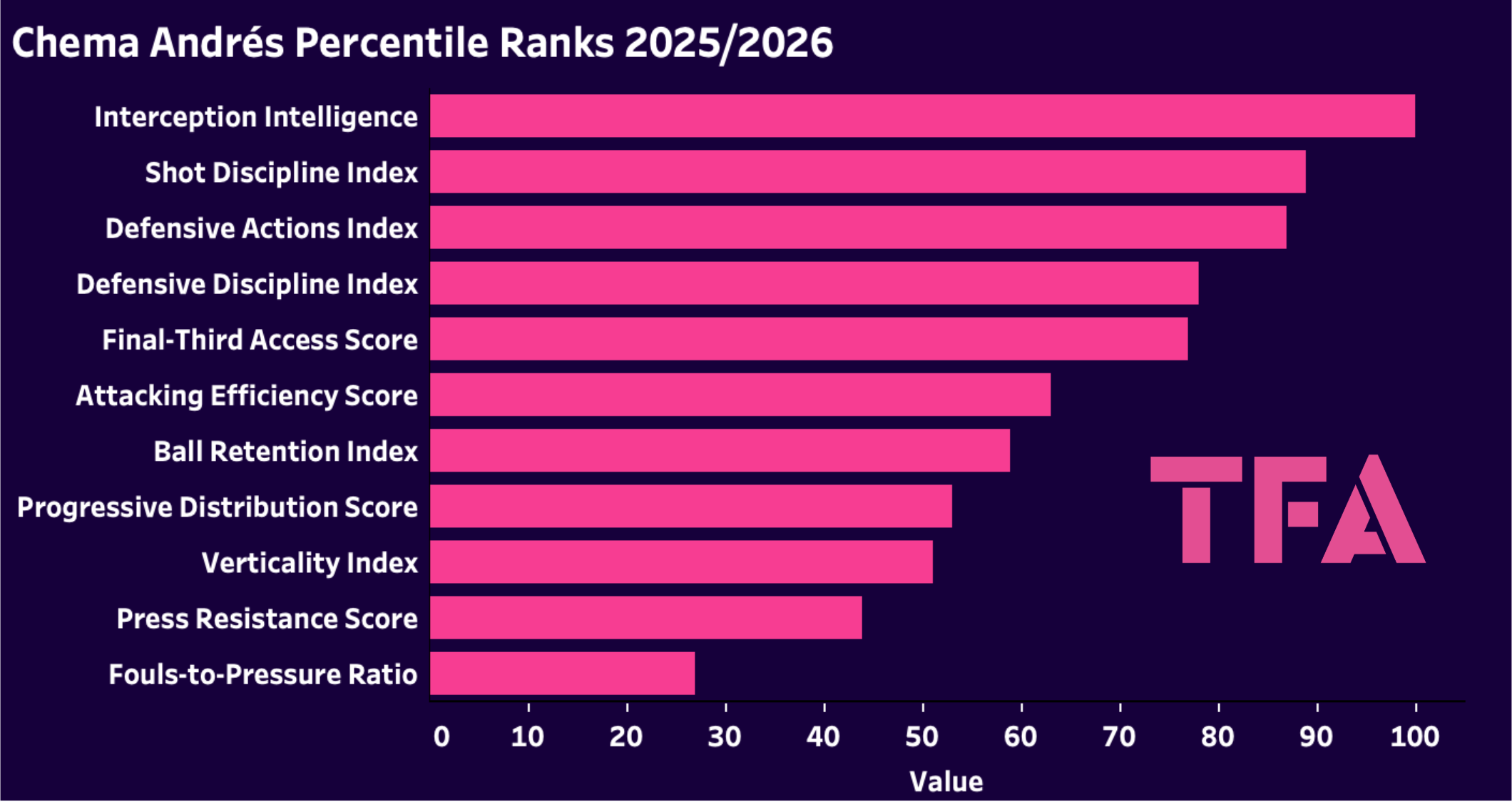
He falls in the very top percentile for ‘Interception Intelligence’, which highlights his ability to read danger early and cut off passing lanes, thus preventing opposition attacks from developing into goalscoring chances.
Paired with his high percentile ranks in ‘Defensive Actions Index’ and ‘Defensive Discipline Index’, this all points to a player who defends with elite timing and awareness.
He diligently patrols the space in front of the backline, both in settled defensive phases and, crucially, in transition, thereby making a significant contribution to his side’s defensive solidity.
In possession, Andrés boasts a strong ‘Final Third Access’ score along with above-average ball retention and attacking efficiency, on top of fairly average verticality and progressive distribution.
All in all, this speaks to a player capable of making a reliable progressive contribution to his side’s play, but not one who constantly looks to break lines and drive his team forward.
He will take opportunities when they come, but probably won’t be his team’s main outlet for ball progression.
Chema Andrés Out Of Possession
As outlined above, Chema Andrés effectively controls space in front of his team’s backline, ensuring the half-spaces and ‘zone 14’ are under his side’s control in settled defensive phases.
The majority of Andrés’ defensive actions are subtle yet crucial.
They don’t typically look ‘fancy,’ but his actions consistently slow the opponent down and deny them opportunities for progression.
In that sense, his biggest out-of-possession strengths lie in his extremely intelligent positioning and spatial awareness.
Furthermore, Andrés’ height gives him a strong advantage in aerial duels, particularly helping his team win balls from goal kicks and defend inside the box.
Andrés won’t get forward much during attacking phases, preferring to hold his position in front of the backline and participate in his team’s rest defence.
The young midfielder reads danger at a level far beyond his age and experience, which makes a particularly noticeable impact during Stuttgart’s defensive transitions.
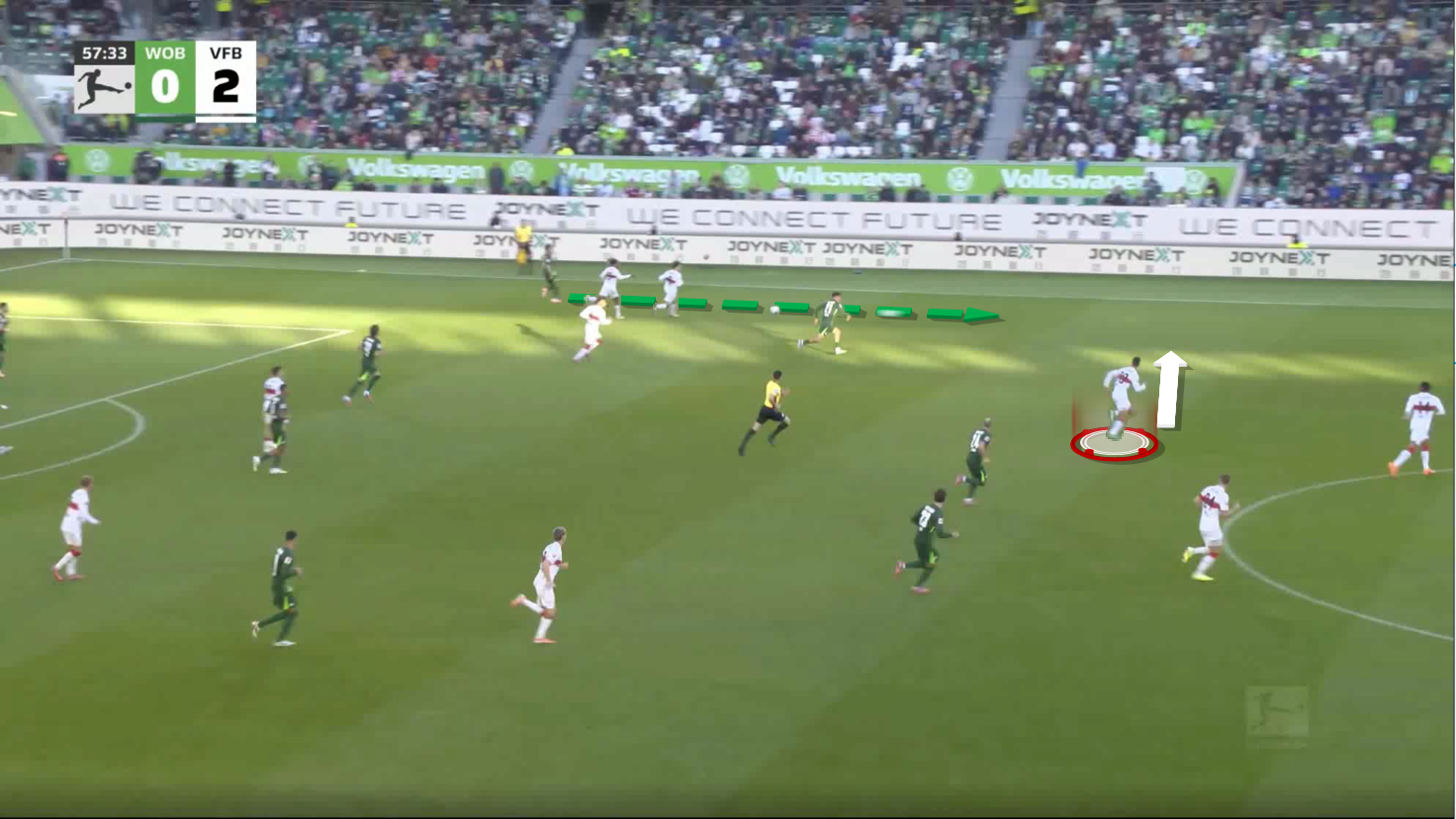
Above, we see Chema Andrés centrally positioned in front of his two centre-backs as the opponent prepares to launch a counterattack.
Andrés moves out from the middle of the park to close down the intended receiver.
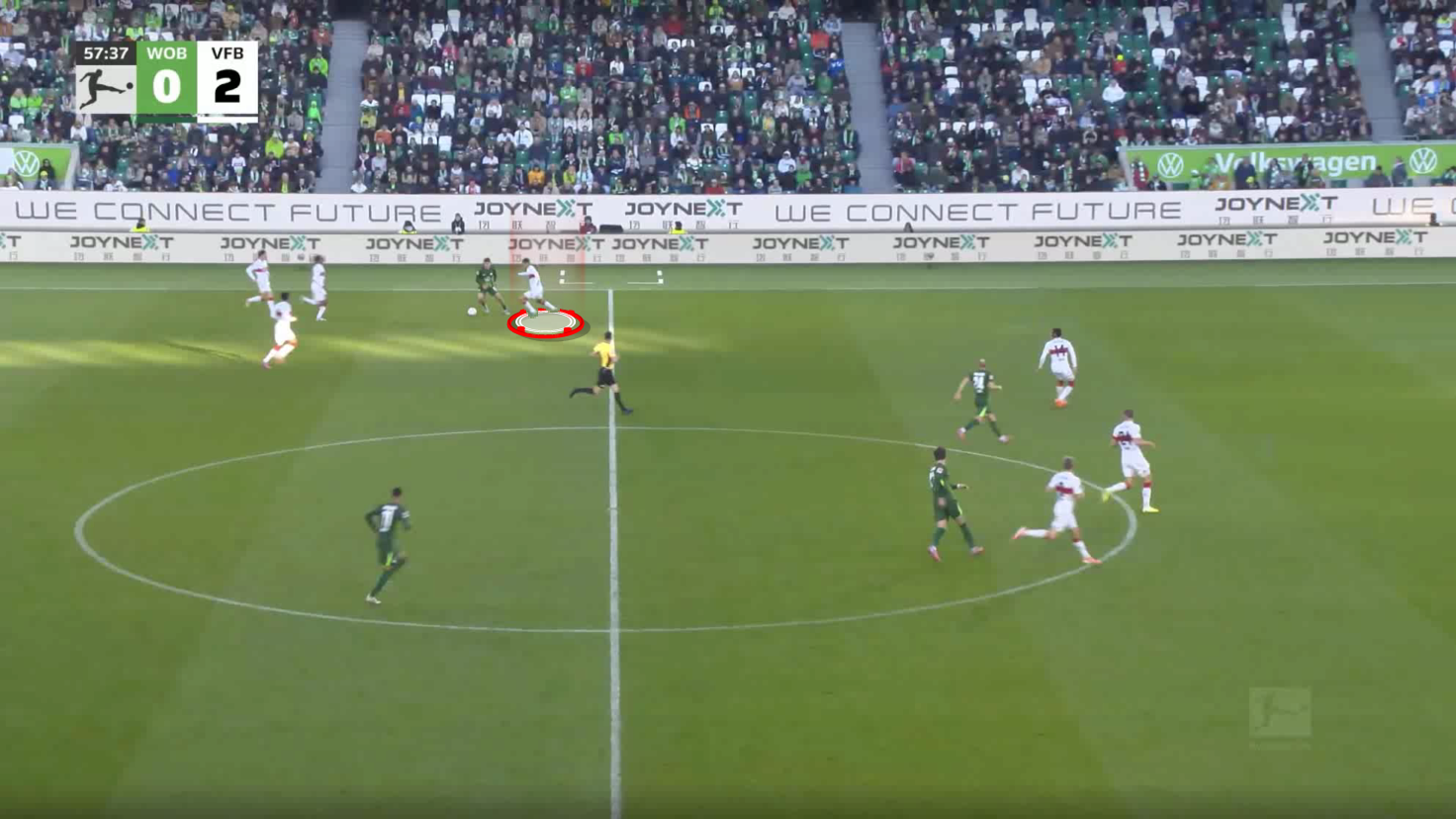
As play progresses into Figure 3, we see that Andrés’s closing down of the receiver effectively slows down the Wolfsburg counterattack.
This buys more Stuttgart players time to get back and strengthen the team’s defensive structure while also applying greater pressure to the ball carrier.
With more Stuttgart bodies around, Andrés feels secure to commit to a challenge that results in regained possession for Stuttgart.
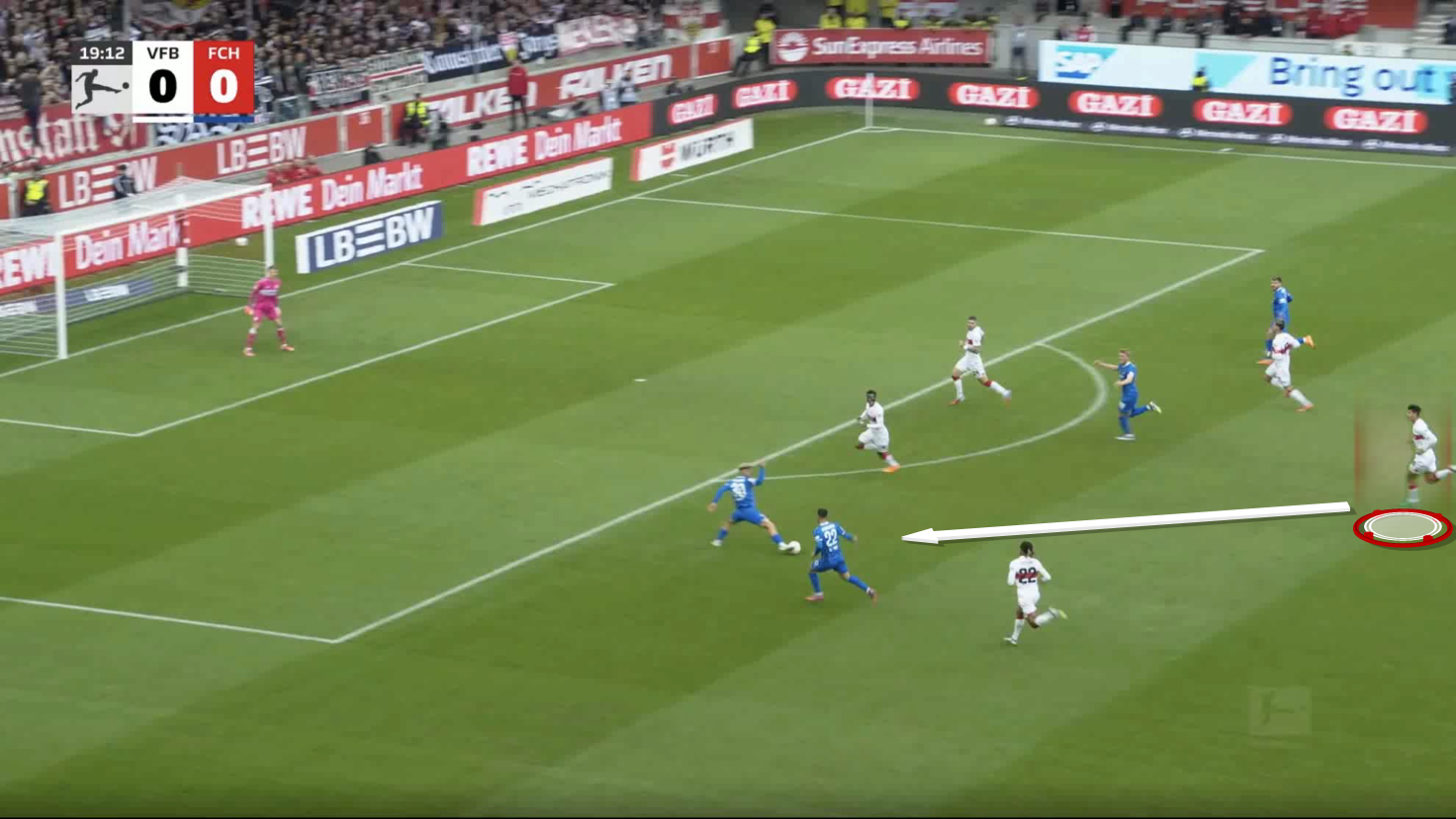
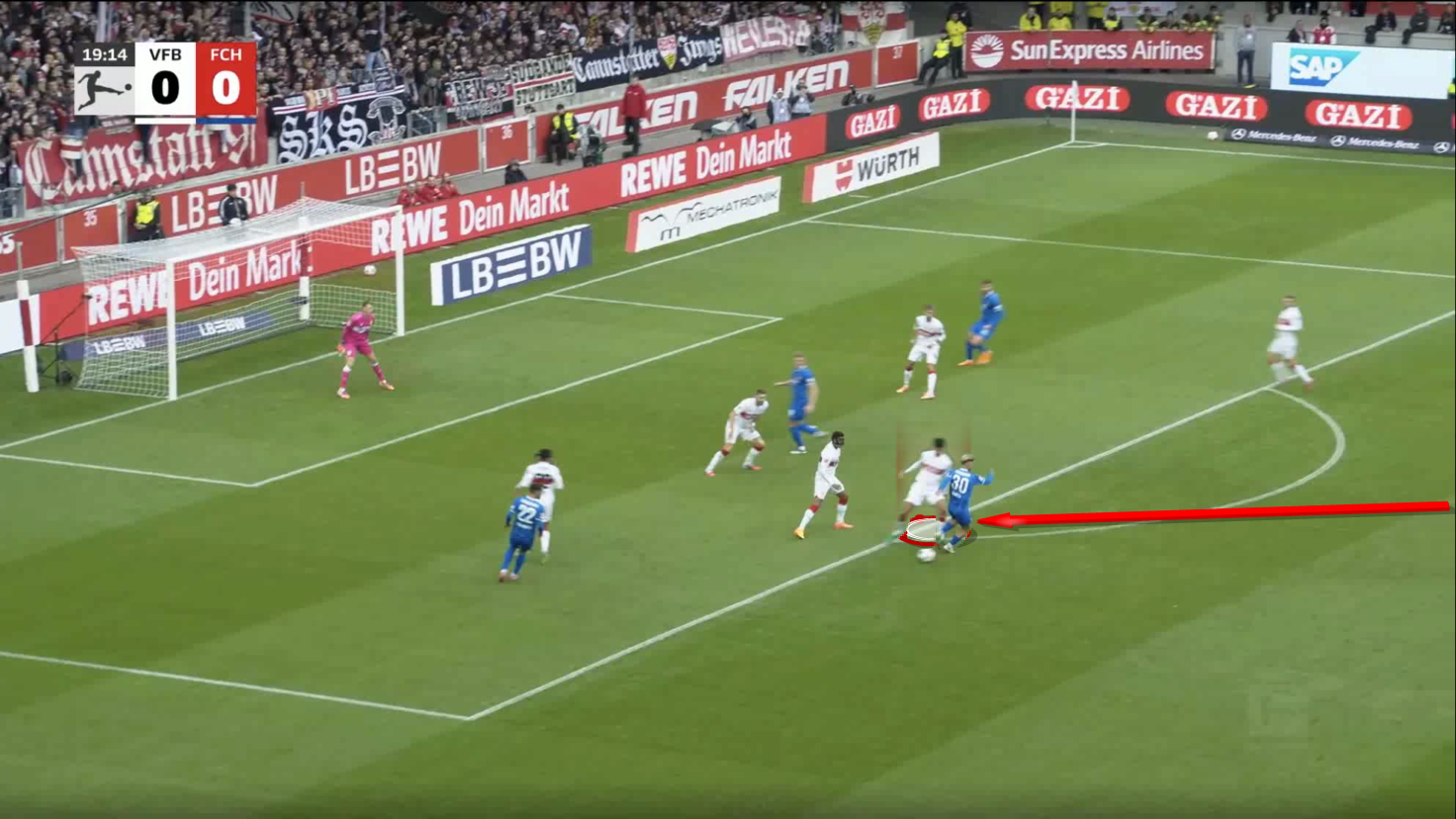
Here in Figure 4, we see an example of the opponent having reached the edge of Stuttgart’s box in transition, giving them a decent chance of getting a shot off from a good location.
Stuttgart’s centre-backs do well to slow the opponent down and force them backwards, buying Chema Andrés time to get back and commit a clutch challenge, which regains possession.
These examples of Chema Andrés’ contributions in defensive transitions do not reflect his overall role in the team’s defensive structure.
Again, the majority of his actions are far more subtle, and the takeaway from this should not be that he’s some all-action N’Golo Kanté-type midfielder.
While he’s more comfortable defending in a settled structure where he can focus on occupying important spaces, he’s quite mobile when required (deceptively so, for his size).
He does make decisive challenges in transitional phases.
Chema Andrés In Possession
Chema Andrés’ in-possession profile is one of economical decision-making in terms of his passing, lending itself to solid retention capability, intelligent game management, and elite progression capabilities when opportunities arise.
As described, he won’t be the team’s main creative vessel and, ultimately, won’t take unnecessary risks to get forward when it may compromise the team’s structure.
Again, these decision-making capabilities point to tactical maturity beyond his years in the game.
Of course, Andrés’ in-possession role will vary depending on game state and, crucially, the opponent.
In his most recent appearance for Stuttgart against Bayern Munich, Andrés had to play quickly, with FC Bayern applying high pressure on the Stuttgart midfielder throughout.
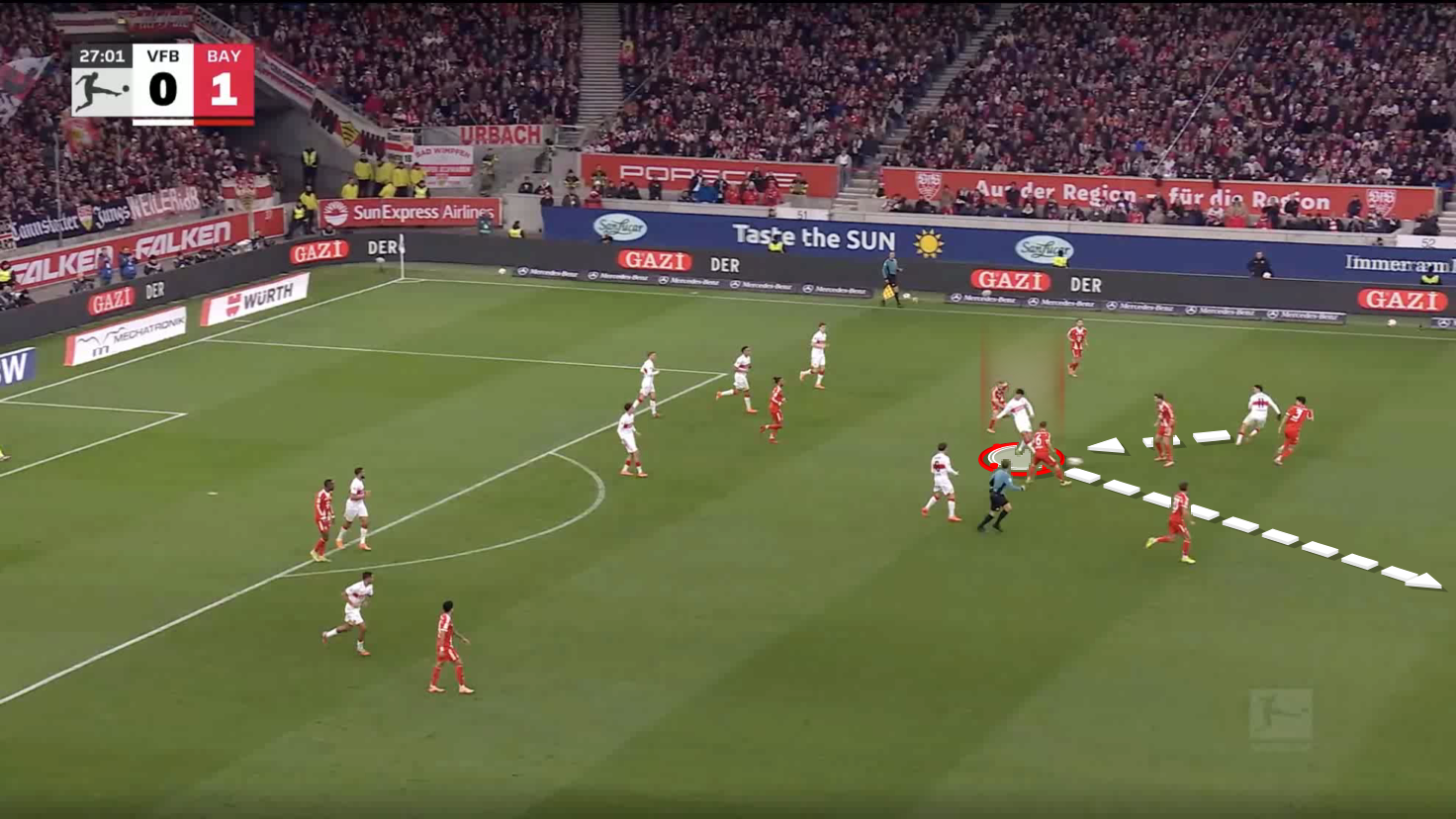
In this game, Chema Andrés’ vision was critical to his team’s in-possession security and counterattacking threat.
He was frequently required to deploy bounce passes out of pressure from deep to get his team moving forward.
As stated before, Andrés isn’t the most press-resistant player and shouldn’t be asked to dribble his way out of these situations or draw fouls.
This example shows how he can escape pressure; he relies on teammates’ movement and those options being there to escape from these situations effectively.
If repeatedly exposed to high pressure like this, he’d likely be in trouble, especially so if good passing options aren’t available.
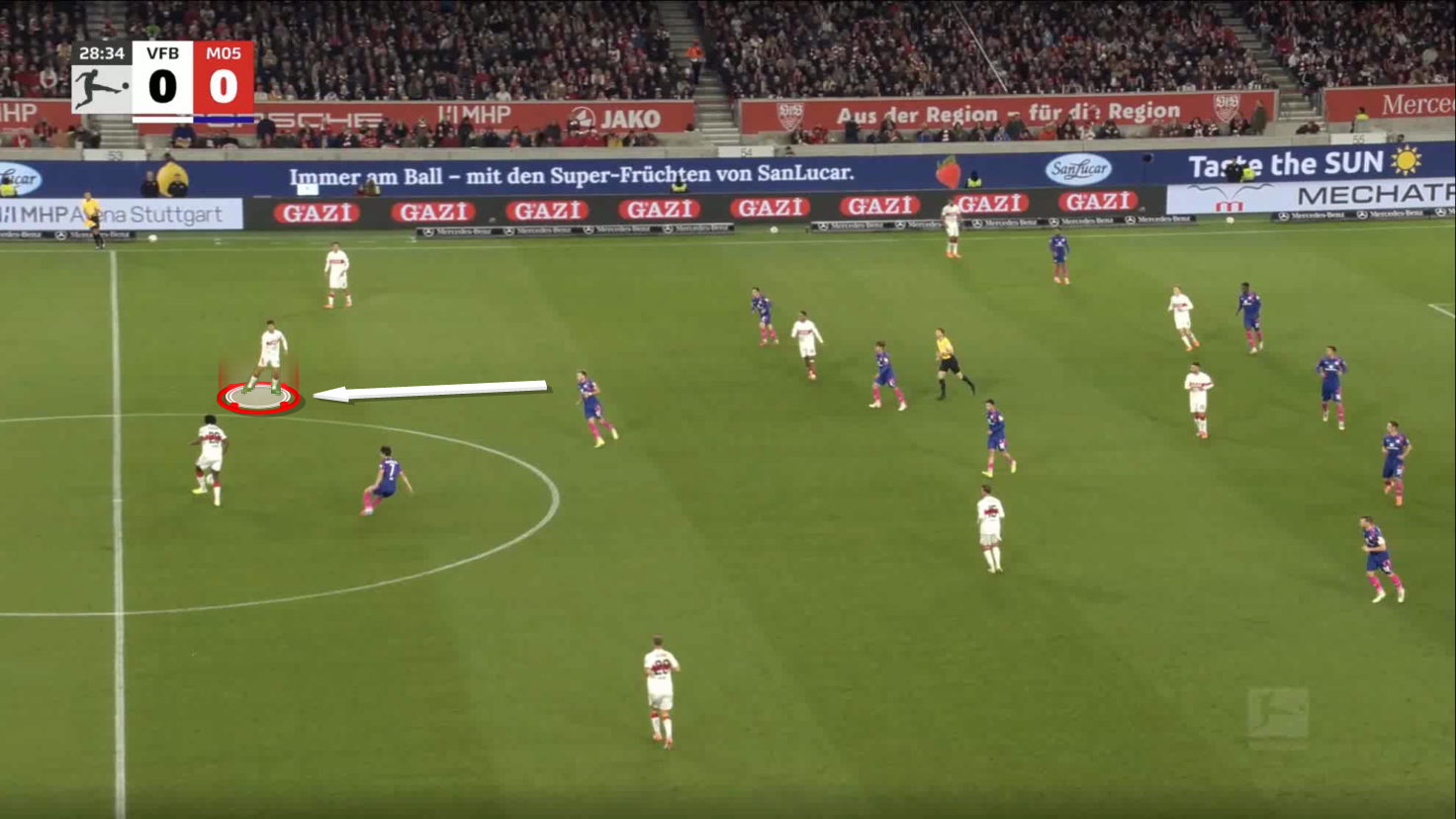
Versus Mainz, Stuttgart had more of the ball, and Andrés was typically afforded more time on the ball.
Against the deeper defence, Andrés dropped off, frequently occupying space between the centre-backs, and spread the ball around the pitch a bit more, orchestrating play from deep.
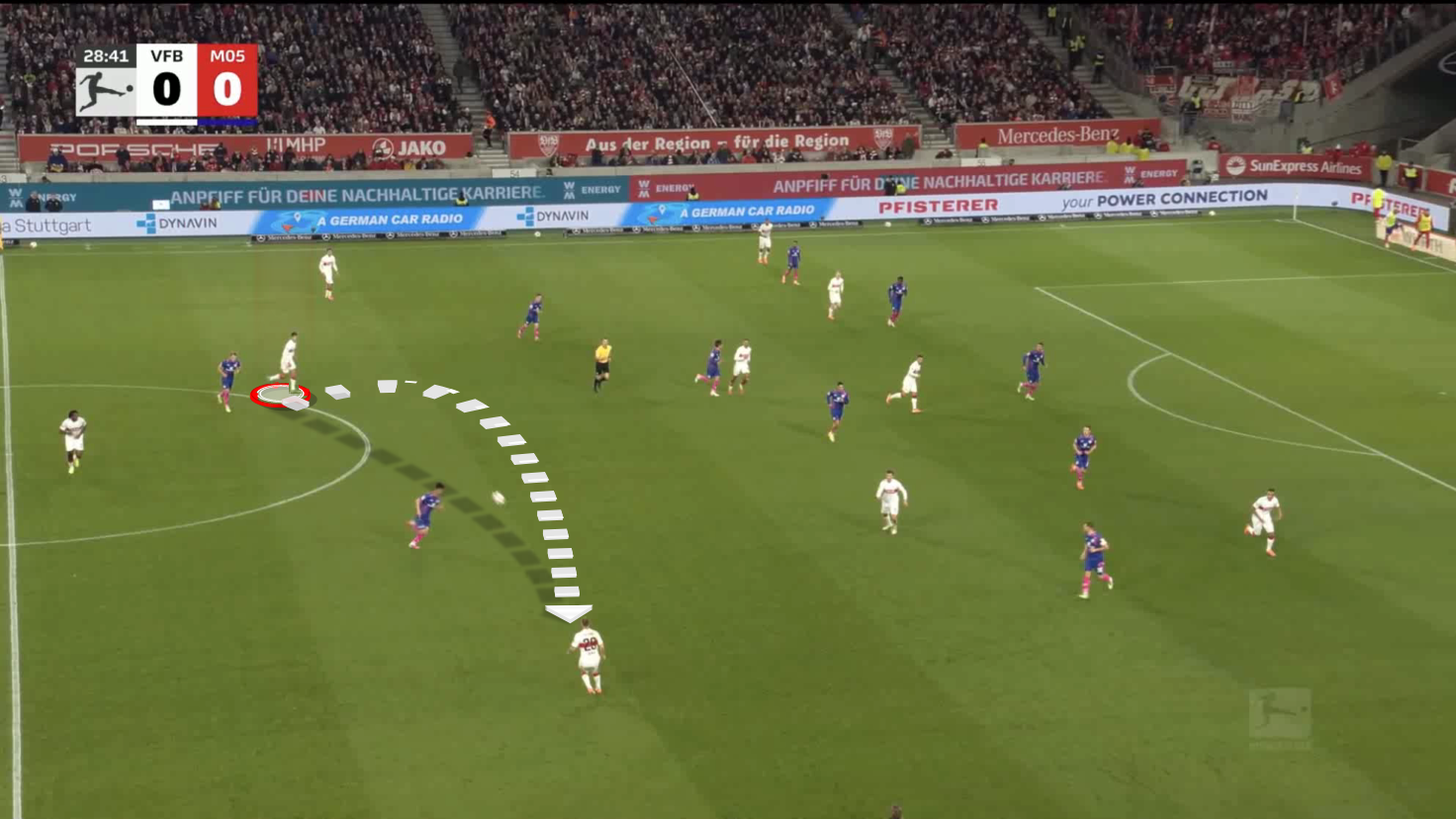
Against Borussia Dortmund, we saw a little bit of both.
Chema Andrés would be put under pressure, but not quite as much as he experienced versus Bayern Munich.
The midfielder typically handled that pressure well, relying on intelligent positioning, size, strength, and technical quality to help his team establish some control and final-third presence against BVB.
Crucially, this example shows how having clear passing options around makes Andrés much more effective than if he had to search for them a little more.
This next video provides an excellent example of what makes Chema Andrés so good at the base of midfield.
Here, the 20-year-old receives under pressure and plays a central role in an extremely quick short-passing sequence for Stuttgart.
The midfielder twice creates space for himself to receive with fast, subtle movement that separates himself from his marker and enables him to participate to the fullest in his team’s ball progression.
In the end, he plays an over-the-top through pass into the box.
This is not his primary role in the midfield but it was the right pass to play in that moment to maintain the momentum of his team’s attack, and this is something Chema Andrés is great at sensing.
He won’t force these kinds of passes when they’re not on, but, equally, the opportunities won’t be lost on him.
Conclusion
In conclusion, Chema Andrés is a very exciting midfield prospect who could play a key role in Real Madrid’s upcoming homegrown youth revolution, if reports are to be believed.
I can imagine him being a player who Xabi Alonso would enjoy working with due to his intelligence as a pure holding midfielder, which is a fairly rare quality for such a young player.
For now, Andrés needs to keep his head down and continue trying to get Stuttgart closer to the Champions League places, as that achievement would only further enhance his desirability to clubs at a higher level, where he currently looks destined to end up.
While Andrés’ role is effective in the right structured environment, it is system-dependent.
He’s most effective with clear passing options made available through a smart structure and intelligent movement.
Chema Andrés offers control and stability rather than dynamism under pressure.
His role in the team’s tactics should reflect that, in order to truly get the best out of him and the players around him.
The ideal midfield partnership features a ball-carrying ‘8’ and a creative ’10’ with intelligent movement.
