
In the Bundesliga, 1. FSV Mainz 05 have had a very weird trajectory in the last couple of seasons.
Between being caught in the relegation battle, historically bad seasons, and European outings, the club has longed for consistency for years.
After a bad start to the season, the team fired Bo Svensson and hired Bo Henriksen as their new coach.
Henriksen is the human version of Danish Dynamite, with a managing style centred on high-intensity counterpressing and an emotional approach to his team.
At first, it worked wonders.
Mainz secured their place in the Bundesliga and even qualified for the UEFA Conference League this past season.
But once again, there is no consistency for the club.
After captain Jonathan Burkardt left the club in the summer for Eintracht Frankfurt, the team struggled and found itself in the relegation battle once again.
With just six points after 12 games, Mainz decided to let go of Henriksen in last place in the Bundesliga table.
Benjamin Hofmann, the manager of their B-team, was appointed interim coach for the game against Borussia Mönchengladbach last Friday, but they also lost.
At the start of this week, the club decided to hire former Union Berlin manager Urs Fischer as its new coach.
In his first game, Fischer drew in the Conference League on Thursday.
The Swiss manager has a very similar playstyle to his predecessors but a much calmer approach.
In this Mainz tactical analysis, we will look at the areas Mainz 05 have struggled in so far this season, the tactical measures Urs Fischer will implement, and whether Mainz have a chance to salvage their season.
Mainz Problems While Building Up
Looking at Mainz’s style of play over the last couple of years, the club has focused on a playstyle centred on high intensity, an aggressive counterpress, and fast-paced counterattacks under every coach they have had in that time.
Henriksen was a coach who preferred that style of play as well, and the team was very successful with it over the course of last season.
Especially striker Burkardt and midfielder Nadiem Amiri were doing incredibly well in that system.
Amiri orchestrated every attack and took on a lot of responsibility with the ball, while Burkardt, with his pace, was always making the right runs and scoring a lot of goals for Mainz.
This also meant that the club refused to build up with short passes, and their weakness now comes back to haunt them.

Mainz have played with a back-three for a long time now, and the squad is designed for it, so it will probably not change under Fischer, who also preferred playing with three centre-backs during his time in Berlin.
Looking at the picture, we can see that as well.
Their problem starts with the positional play of their centre-backs; the left centre-back is not wide enough, so the distance between the defenders is too short.
They often try to set up long balls in these situations; their midfielders don’t necessarily drop back to help the defenders on the ball, and the wing-backs often push inwards when they are far-sided.
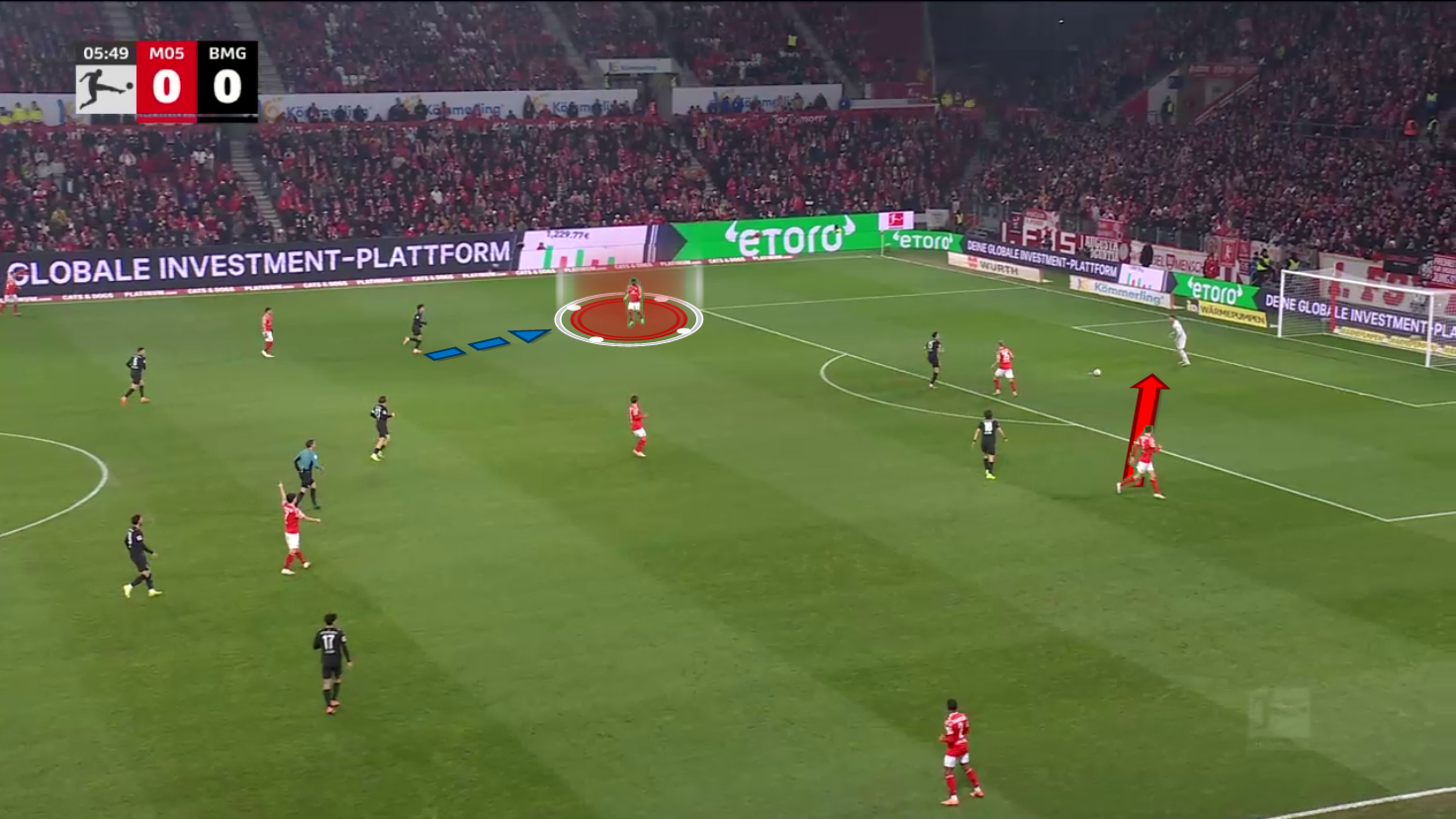
In the end, they heavily struggle with finding passing options against the attacking press.
They often get pressed man-to-man in line one, and they just can’t seem to find solutions to break the first line of press.
Here we can see that the left centre-back is easily pressed because he is not wide enough and therefore cannot dribble forward, so he has to take a backwards touch and pass it back to the goalkeeper.
Gladbach was very well prepared for that, and they knew that only one midfielder would provide some assistance, so they used the coverage shadow of their striker to take away that option.
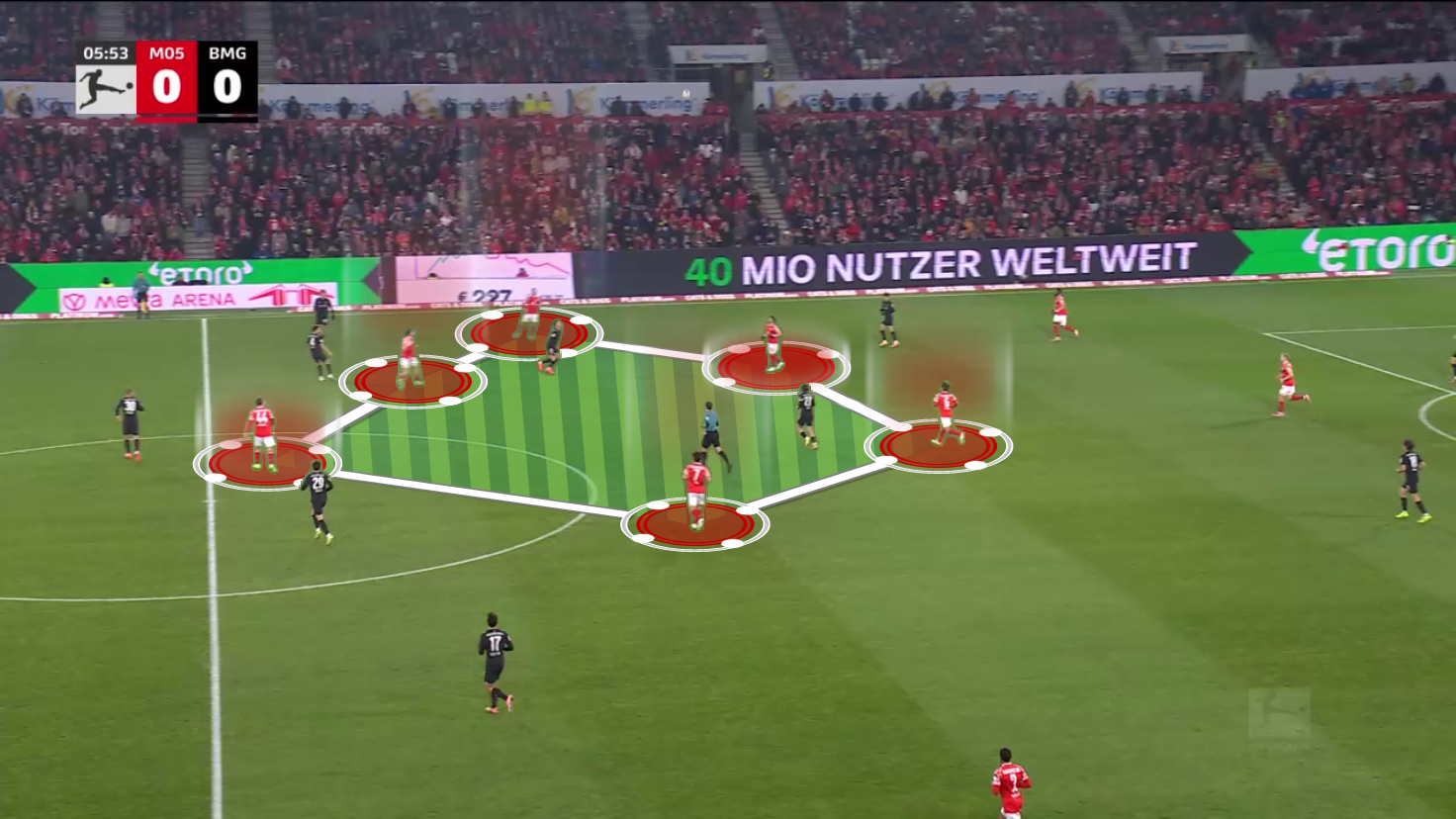
With goalkeeper Robin Zentner not too good with the ball on his feet, he instantly punts the ball down the field in this situation.
Mainz’s positional play is designed to account for the long ball, with the midfielders pushed higher than the opposing attackers and the two players in the half-spaces controlling the central areas of the field by pushing inwards.
The team controls the space to quickly fight for second balls.
This trade-off really costs Mainz in their passing game, and they rarely get out of the attacking press in a controlled way.
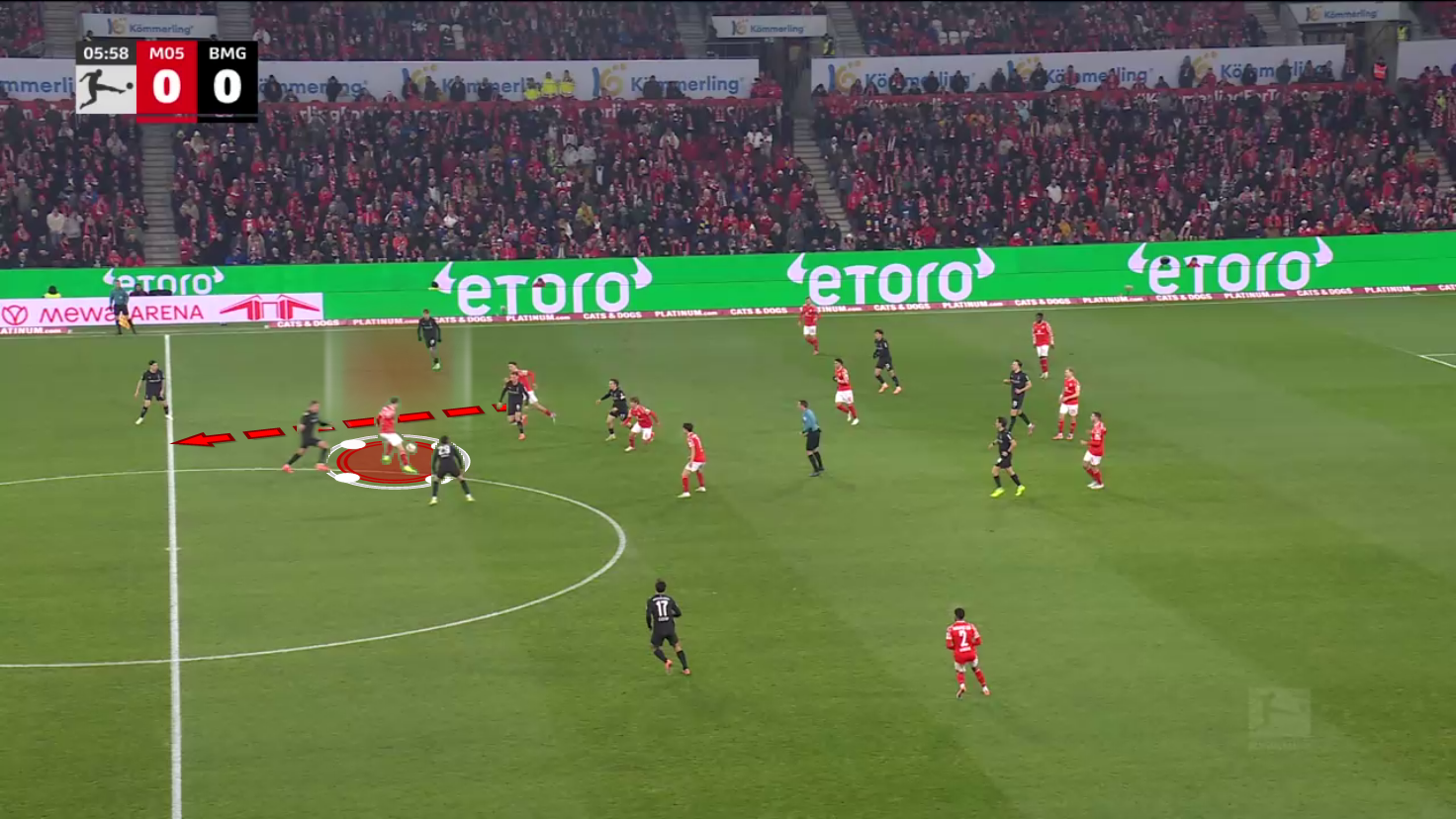
In this situation, they manage to force Gladbach into three aerial duels and manage to win the second ball the moment it comes down.
The problem is that by condensing the space, they also drop their lone striker back into their own half, and the two attacking midfielders are tasked with winning second balls, so Mainz often lacks depth when they have the chance to launch counterattacks.
Last season, Burkardt’s amazing runs made up for that, but without their former captain, the team lost much of its edge in these situations.
Nelson Weiper actually does well in this situation and manages to put his ball in the path of an attacking player.
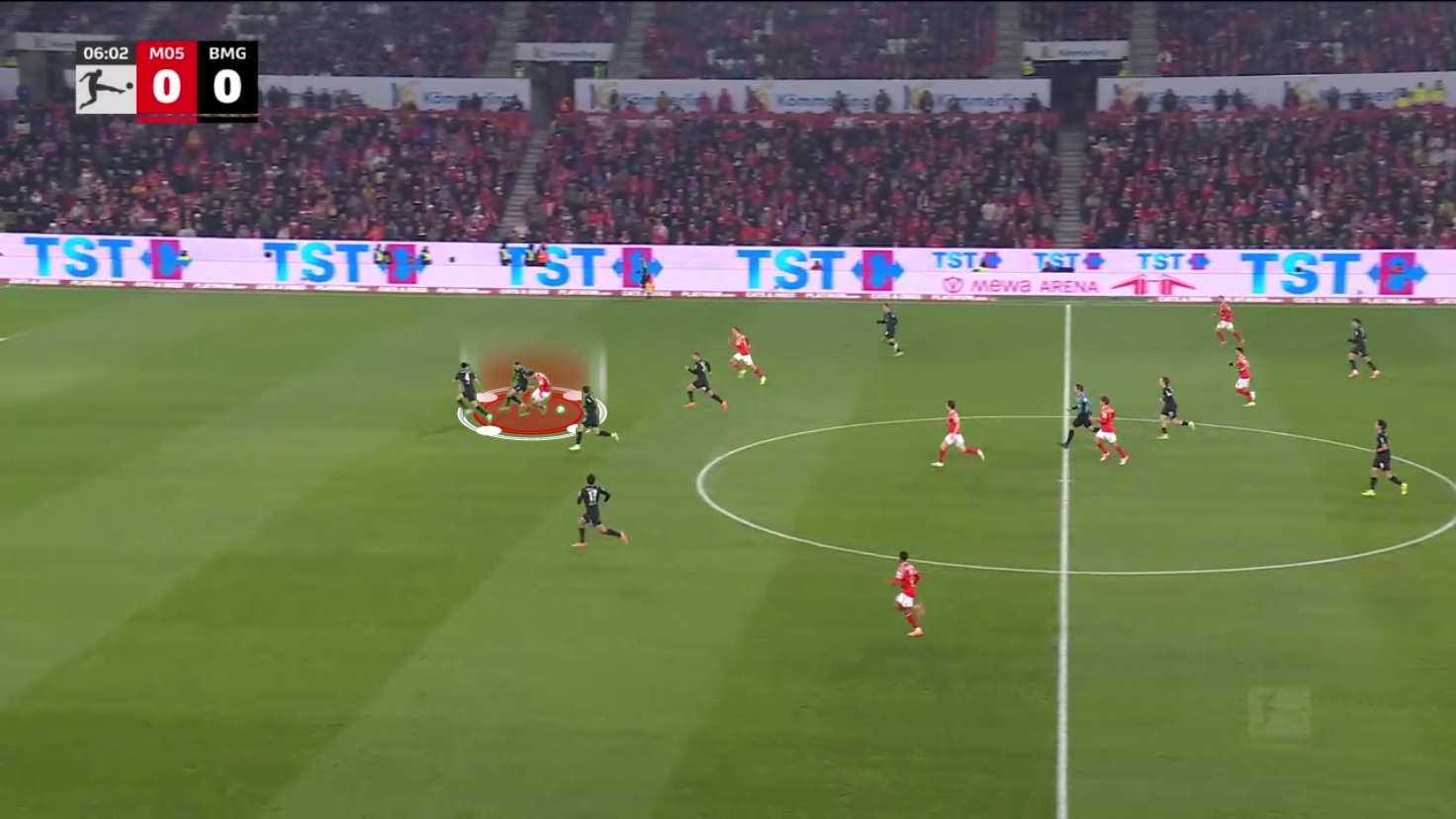
In the end, the team lacks the intensity they had over the course of last season.
As we can see in the picture above, no other players make a run quickly enough to help the attacker on the ball, so Gladbach has an easy job tracking back and defending the counter.
For Urs Fischer, it will be important to restore intensity and determination to Mainz’s identity in counterattacking situations and to provide solutions for his centre-backs in the build-up; otherwise, it will stay rough out there for Mainz.
Mainz Lack Of Tackling
Another huge problem for Mainz is their inability to actually finish off their defensive work.
Over the course of the years, Mainz has carved out a role as a very obnoxious team to play against, with a very physical playstyle and a lot of direct duels in every single game.
Mainz currently ranks second-to-last in the Bundesliga in tackles per game, with only FC Bayern having fewer successful tackles.
The league leaders obviously dominate possession, so they don’t have as many defensive actions.
Especially in the middle and their own third, Mainz has huge problems winning their duels and getting their physicality on the pitch.
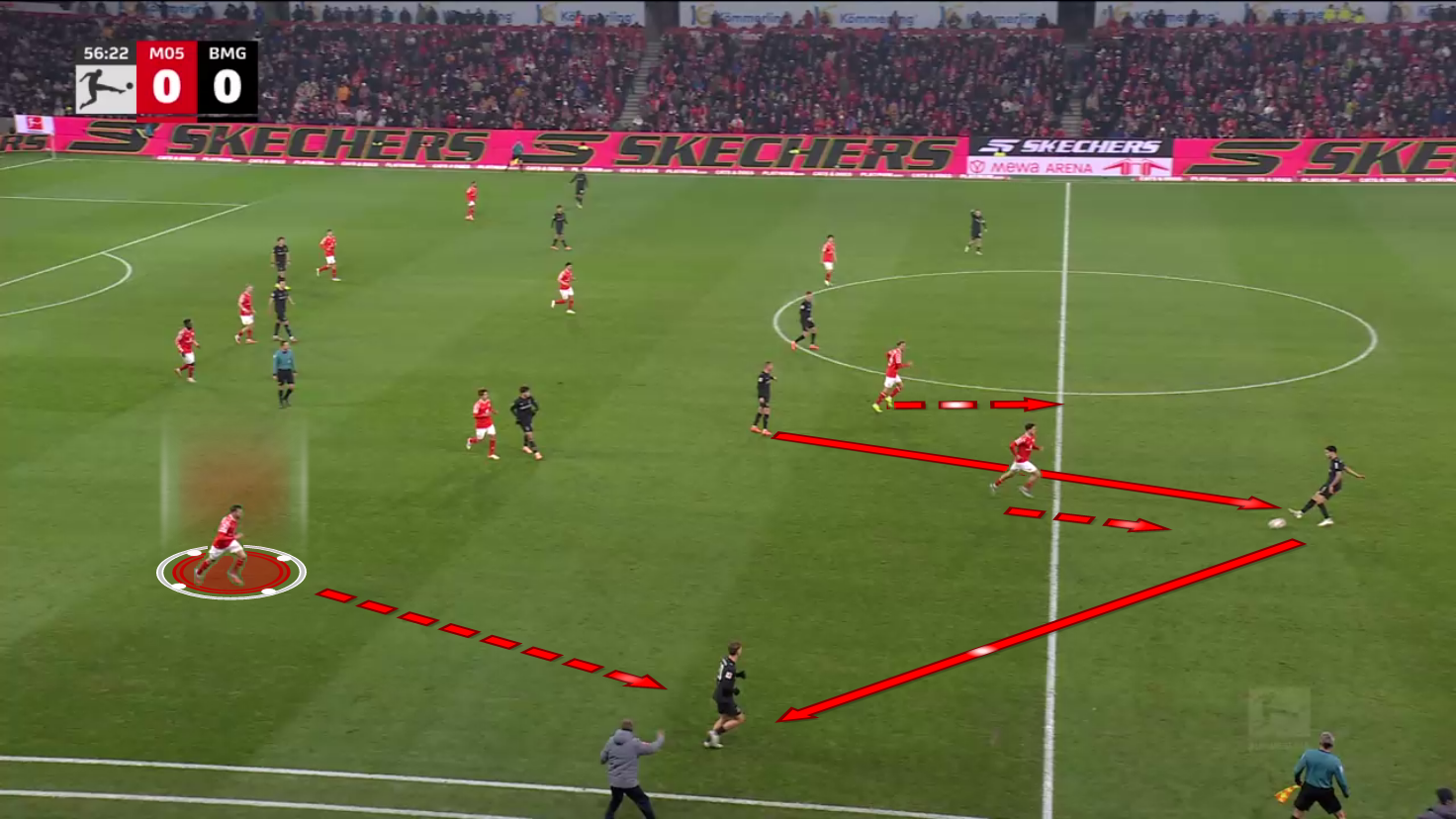
We can see that in the game against Gladbach as well.
In this situation, Gladbach played a backwards pass, and Mainz tried to push forward into their attacking press out of their deep block.
The problem with that is that their right wingback has so much space to cover that he has no chance to actually press his assignment when he receives the ball.
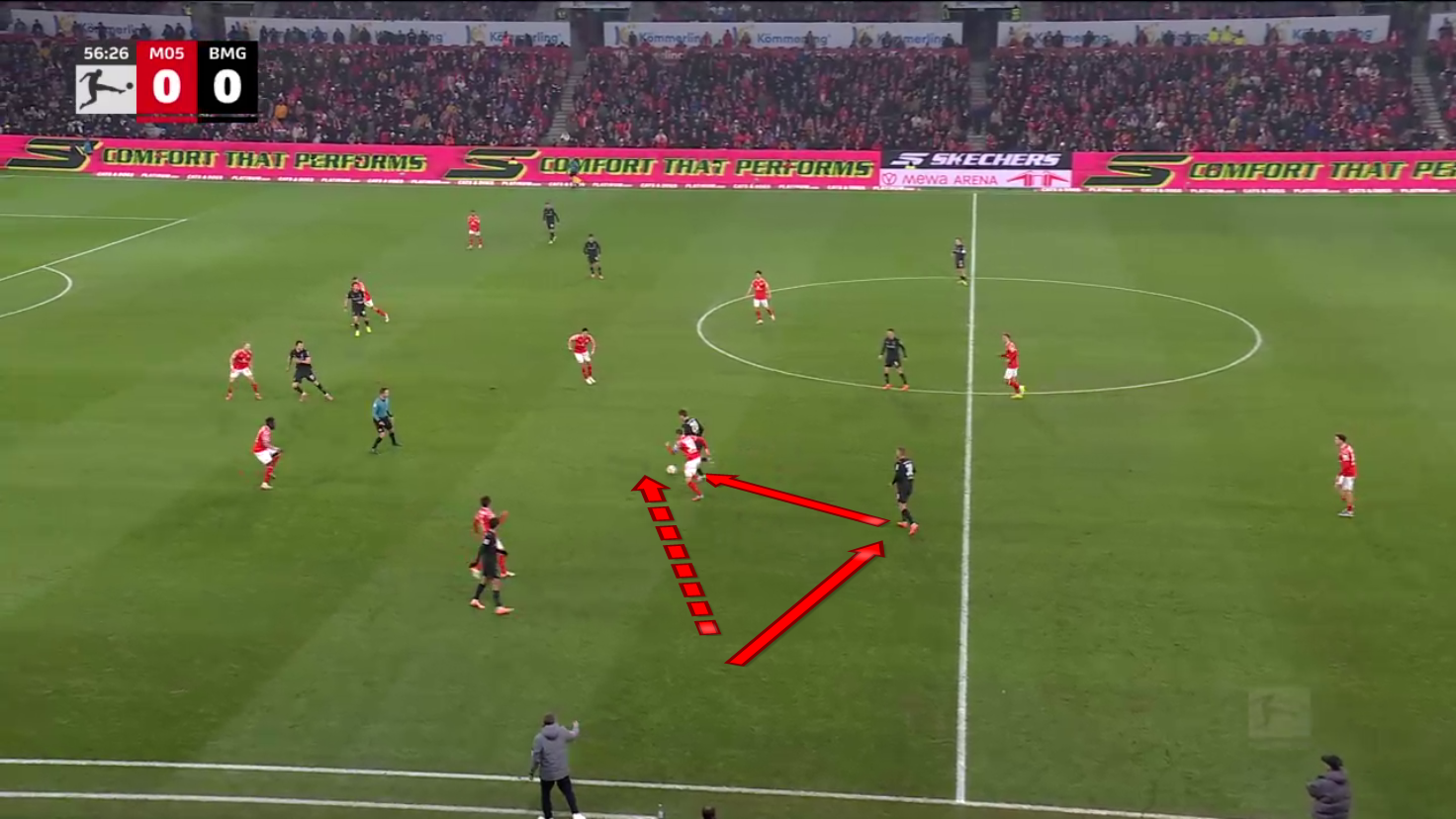
Gladbach now plays a simple one-two, and the right wing-back is pushed inwards.
The long distance left him in a bad position to defend the pass towards the centre, and he had no chance to defend the play and move towards the centre.
Now he can only follow the Gladbach player.
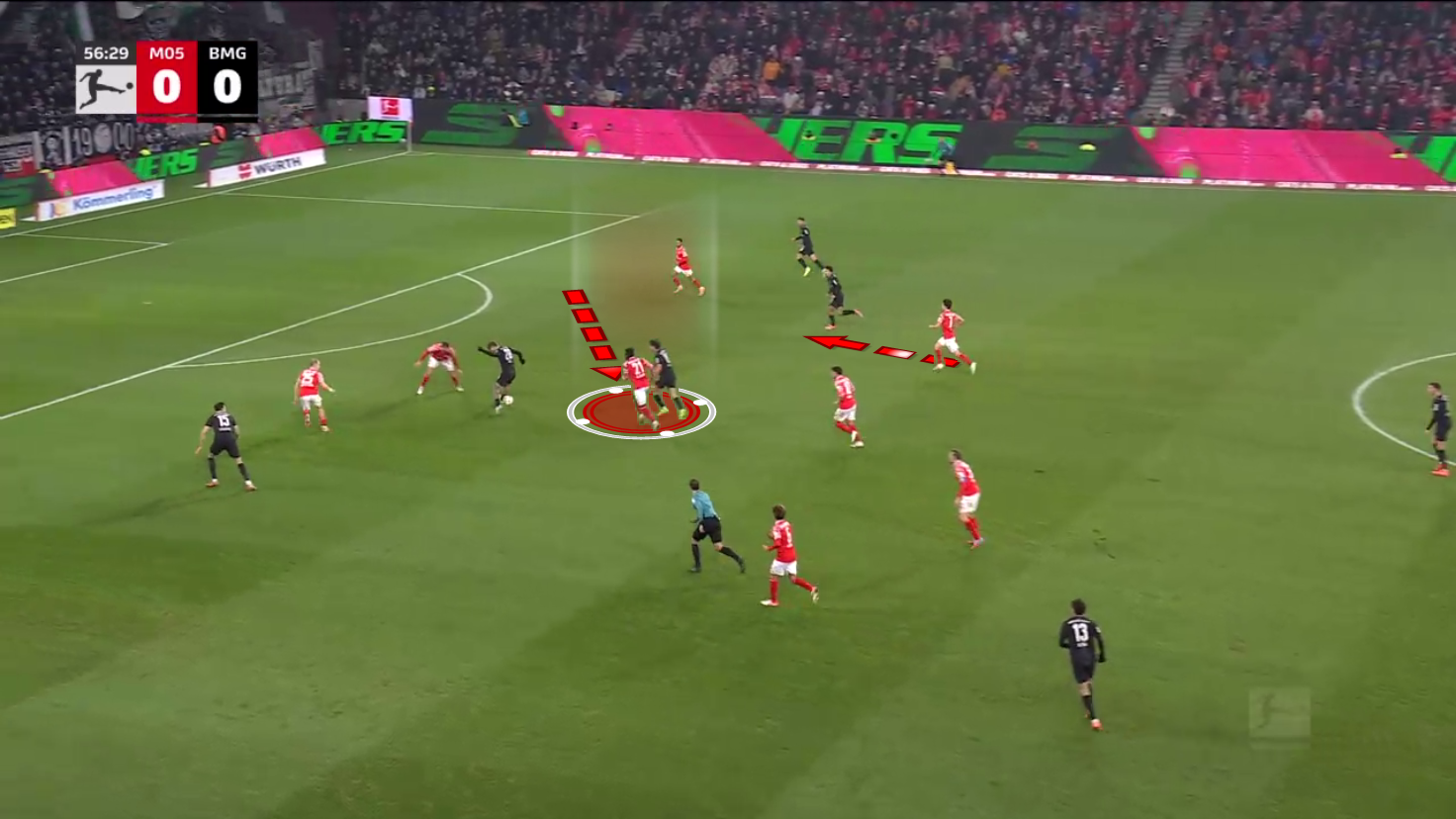
This forces the midfielders to react, but their other assignments create a lot of chaos in defence.
None of the midfielders were quick enough to get into a duel, and this led the dribbler to beat three men easily without actually taking them on, simply by having an advantageous angle on them.
This forces one centre-back to step up into midfield, causing even their last line of defence, their backline, to break apart; there are holes everywhere, and no player actually had a decent chance to win the ball in this entire situation.
Gladbach doesn’t even play the situation well here, but with no actual pressure on the ball at any time, they somehow manage to break into the box.
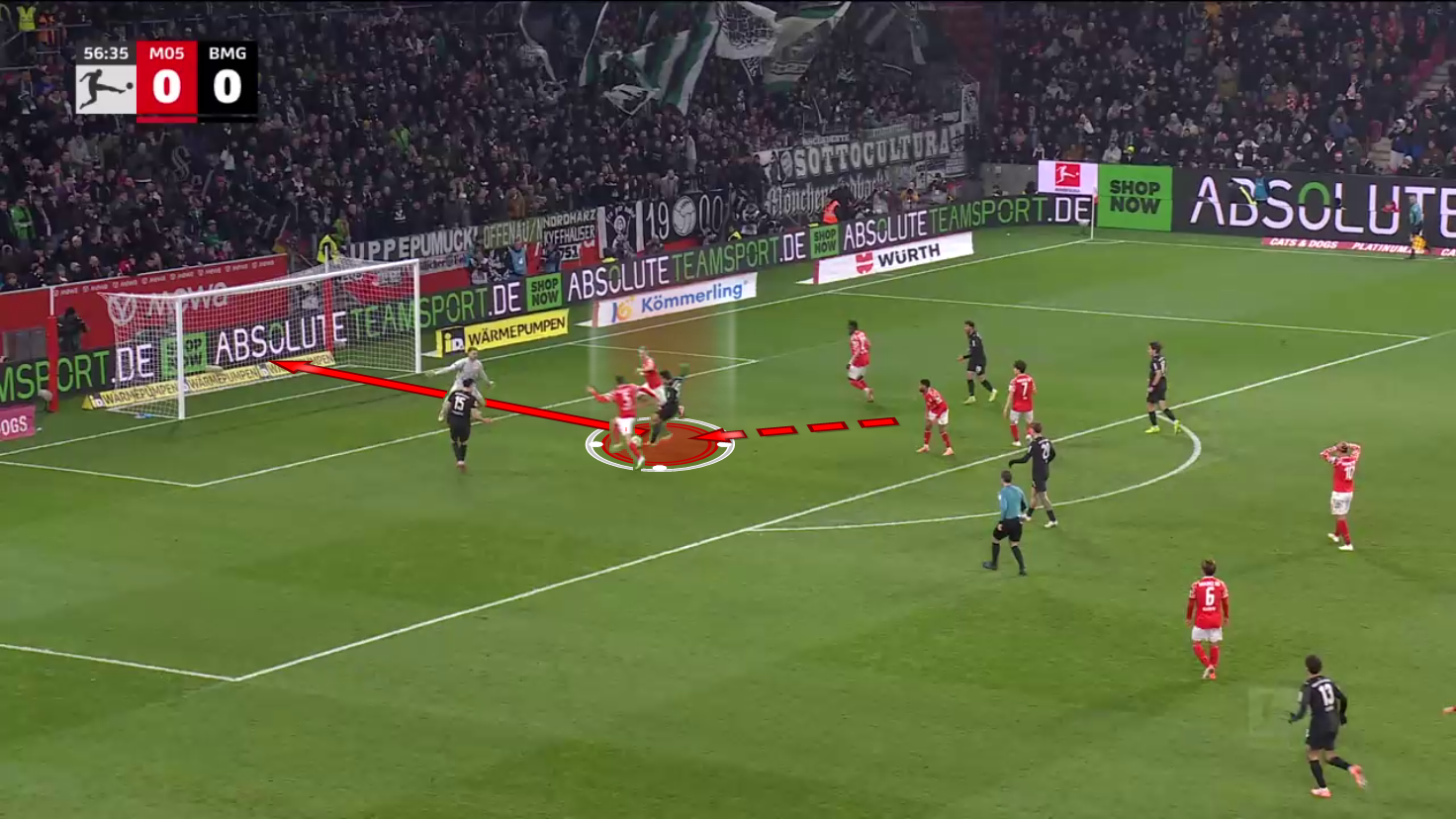
In the end, the ball somehow falls for Jens Castrop in the box, after three more Mainz defenders failed in their attempt to tackle the young Korean midfielder.
Castrop fails to convert the opportunity here, but it still shows one of the things Fischer needs to fix for Mainz.
The team needs to be more compact, limit the distances they need to cover, and start getting into the duels earlier in the midfield and in their own third.
There are a lot of good defenders in that team, but they need to at least get a chance of tackling and not just react to anything their opponent does.
In the end, the opportunity led to a corner and the game-deciding own goal, so Mainz kind of beat itself last Friday.
Mainz Not Executing In The Press
The last area I want to highlight in this piece is Mainz’s attacking press.
The team has been very suffocating in the last season, and while they haven’t been bad in the attacking press this season, they’ve been very hot and cold in their games so far, and it’s cost them about as much as it’s helped them.
They often try to be aggressive with their press.
Still, at the same time, they usually struggle to execute the last couple of details to actually get enough pressure onto their opposing backline to disrupt the build-up enough.
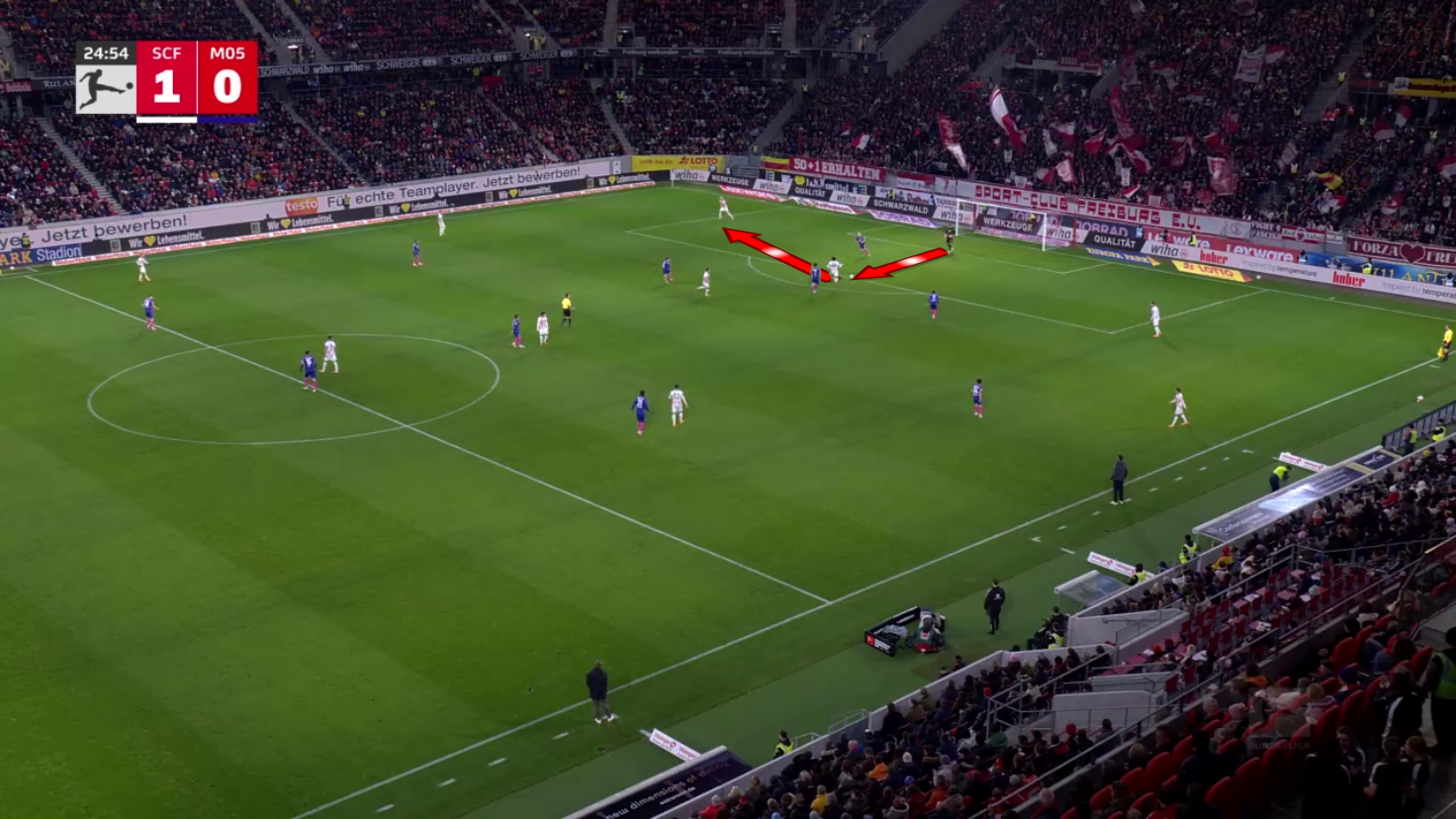
As we can see, Mainz plays a very man-oriented style in their attacking press and tries to put pressure on the build-up as early as possible.
In this case, they even pressed the goalkeeper, but they didn’t really have a plan on who would press the keeper, so it was a bit of a struggle for them too often.
This opens up the far-sided centre-back.
Mainz tried to cut off that side of the field, but Freiburg was easily able to find the open man through the triangle.
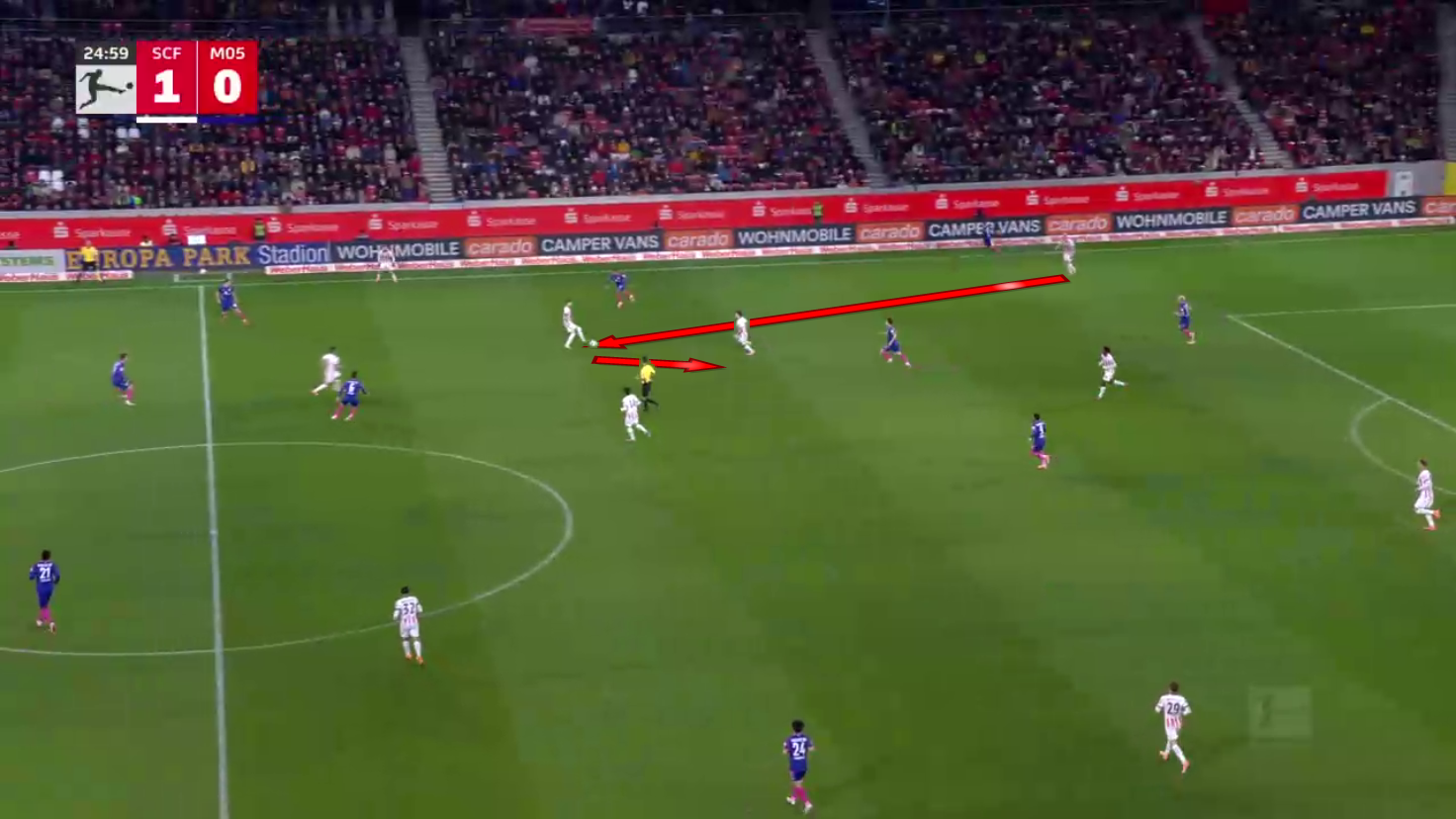
The centre-back started to progress the ball, and then Freiburg dropped one player back out of their attacking line, and the Mainz defenders were not secure enough to follow him into midfield.
This completely broke down their attacking press, allowing Freiburg to play a vertical pass and a lay-off to find space behind the first line of press.
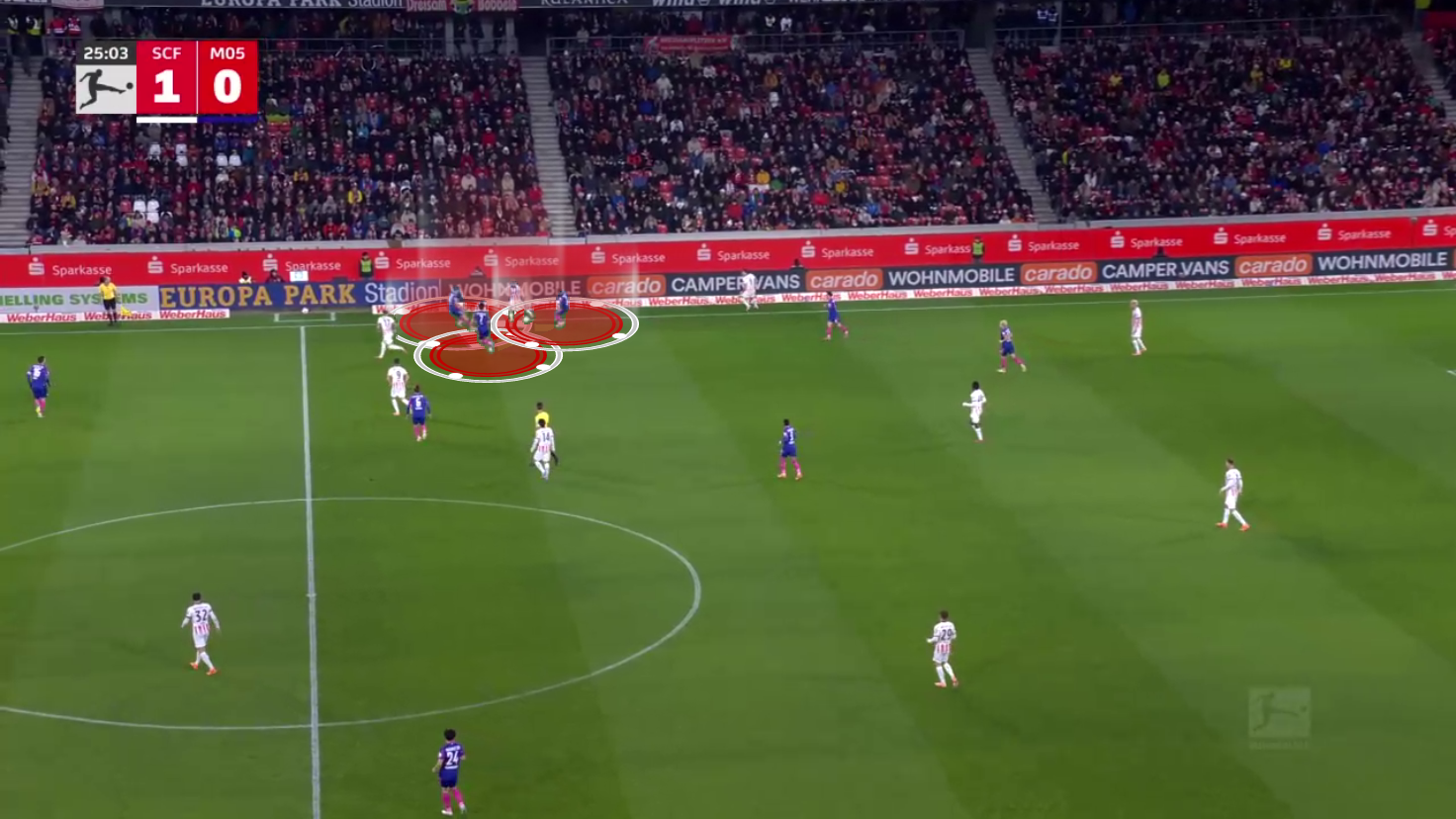
Mainz actually managed to recover rather well and forced a pass towards the sideline.
There, three players were ready to press the Freiburg player, but they, once again, failed to actually make a tackle, and now they really started to struggle.
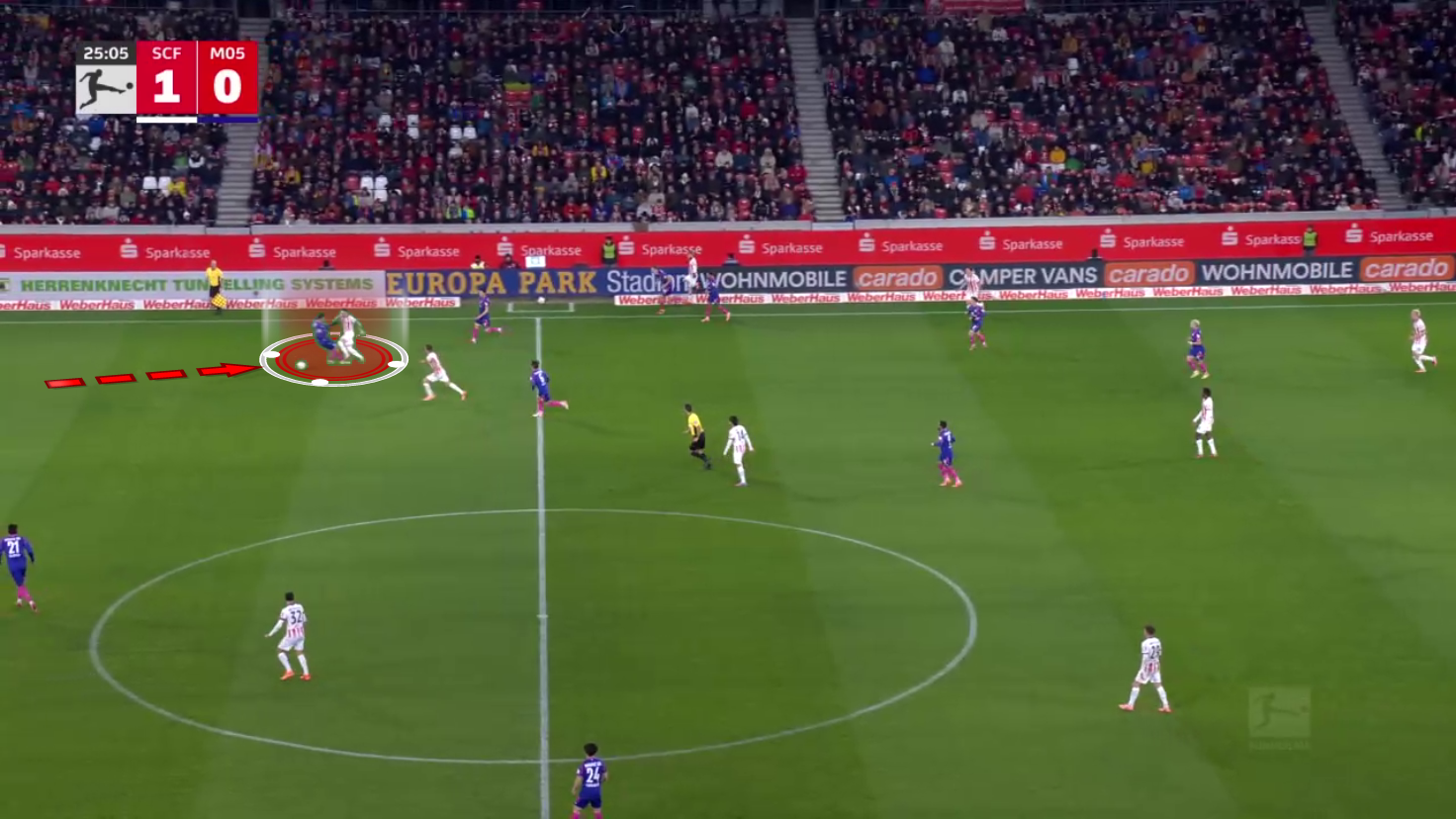
This forced their centre-back to step up as a last-ditch effort to get the ball back.
The timing is completely off; the defender only manages to foul the attacker, but by then the ball is already past him, and the other Freiburg attacker is able to scoop up the pieces.
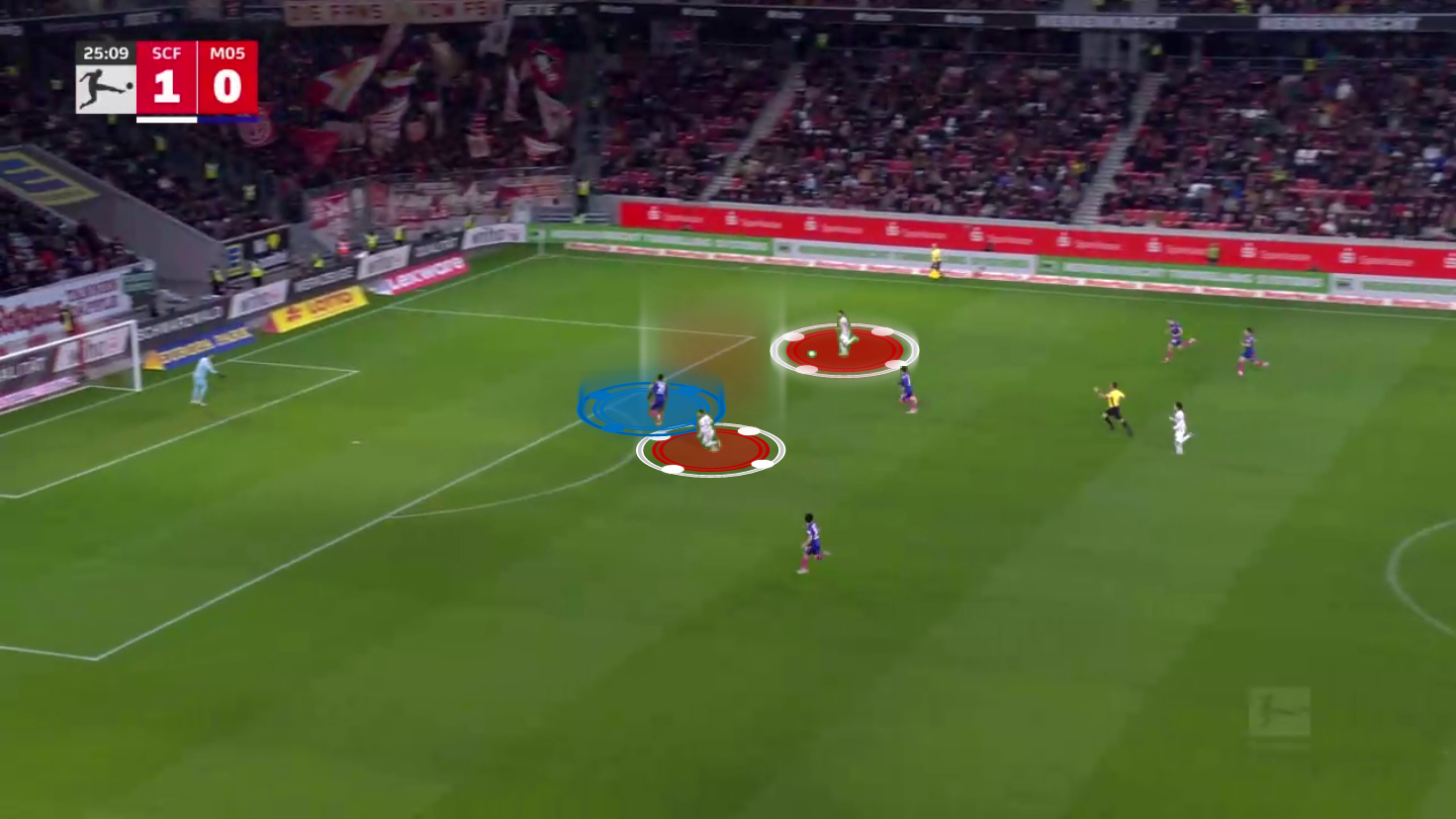
In the end, Mainz had no way to recover anymore.
With how many players they committed forward in their attacking press, the distances they had to cover were just too big.
Freiburg easily squared the ball and doubled their lead in this situation, going the length of the field.
Fischer needs to flesh out the last couple of details in the attacking press to prevent it from breaking down like that.
It fits their aggressive playstyle, but at the moment, with all the negative momentum they are facing, they need to consider dropping the attacking press altogether.
Conclusion
Looking at the season so far, Mainz have been straight-up bad in the majority of their games.
They lack a lot of things, especially in their play with the ball.
Newly appointed Urs Fischer will need to provide more solutions in the passing game for his team if they want to improve ball security.
Fischer will also need to find a way to get their strengths back on the field, especially their intensity and fast-paced counterattacks.
Against the ball, Fische will need to find a way to get Mainz back to being more compact, give his players a chance to bring their physicality back on the field, and allow them to defend in direct duels more often.
While Mainz has been in situations like this before, it looks dire this time, and it will be very interesting to see if Fischer can turn things around.
