


When Atlético Madrid committed £82m in the summer of 2024 to sign Julián Alvarez from Manchester City, there was a collective raising of eyebrows across Europe.
At the Etihad, Alvarez had been seen, somewhat reductively, as Erling Haaland’s backup.
He was viewed as a high-functioning deputy whose minutes were contingent on the Norwegian’s availability, but was also tactically malleable to coexist with him.
The consensus at the time saw Man City as the winners and Atlético as indulgent spenders who paid a premium for a player whose potential was yet to be recognised.
Now, 12 months on, that narrative looks different.
Alvarez has evolved from an expensive rotation piece to the central protagonist in Diego Simeone’s team.
He has combined the industriousness that endeared him to Pep Guardiola with a sharper, more autonomous final third profile.
He has six goals and one assist in his first eight La Liga matches, and he has begun the campaign as one of the league’s most in-form forwards, if not one of the most complete strikers in Europe on current evidence.
This player analysis will examine Alvarez’s technical and tactical strengths and how he has been integrated into Diego Simeone’s new attacking style.
Diego Simeone, the stereotype, & Julián Alvarez Start At Atlético
Before turning fully to Julián Alvarez, it is worth pausing on Diego Simeone’s reputation.
Simeone is familiar to anyone who has followed La Liga over the past decade.
His management style is all about passion, grit, and the capacity to suffer.
The attack is often treated as an afterthought.
The record with centre-forwards/attacking players has fed that stereotype.
There have been successes, with Radamel Falcao’s ruthlessness and Antoine Griezmann’s evolution into an elite scorer standing out, but there are costly misfires.
From Jackson Martínez to Matheus Cunha, and the most contentious case of all in João Félix, a club record arrival who never quite understood what it meant to be a Simeone player.
Alvarez’s first campaign in Madrid has begun to recalibrate that perspective.
Indeed, 37 goal involvements in all competitions is productive, but the deeper value lies in how he stitches together attacking phases.
He blends elements that once made Atlético No. 9s so dangerous.
There is the penalty box movement of Falcao, the associative play and pressing intelligence reminiscent of peak Griezmann, and a willingness to graft that aligns with Simeone’s non-negotiables.
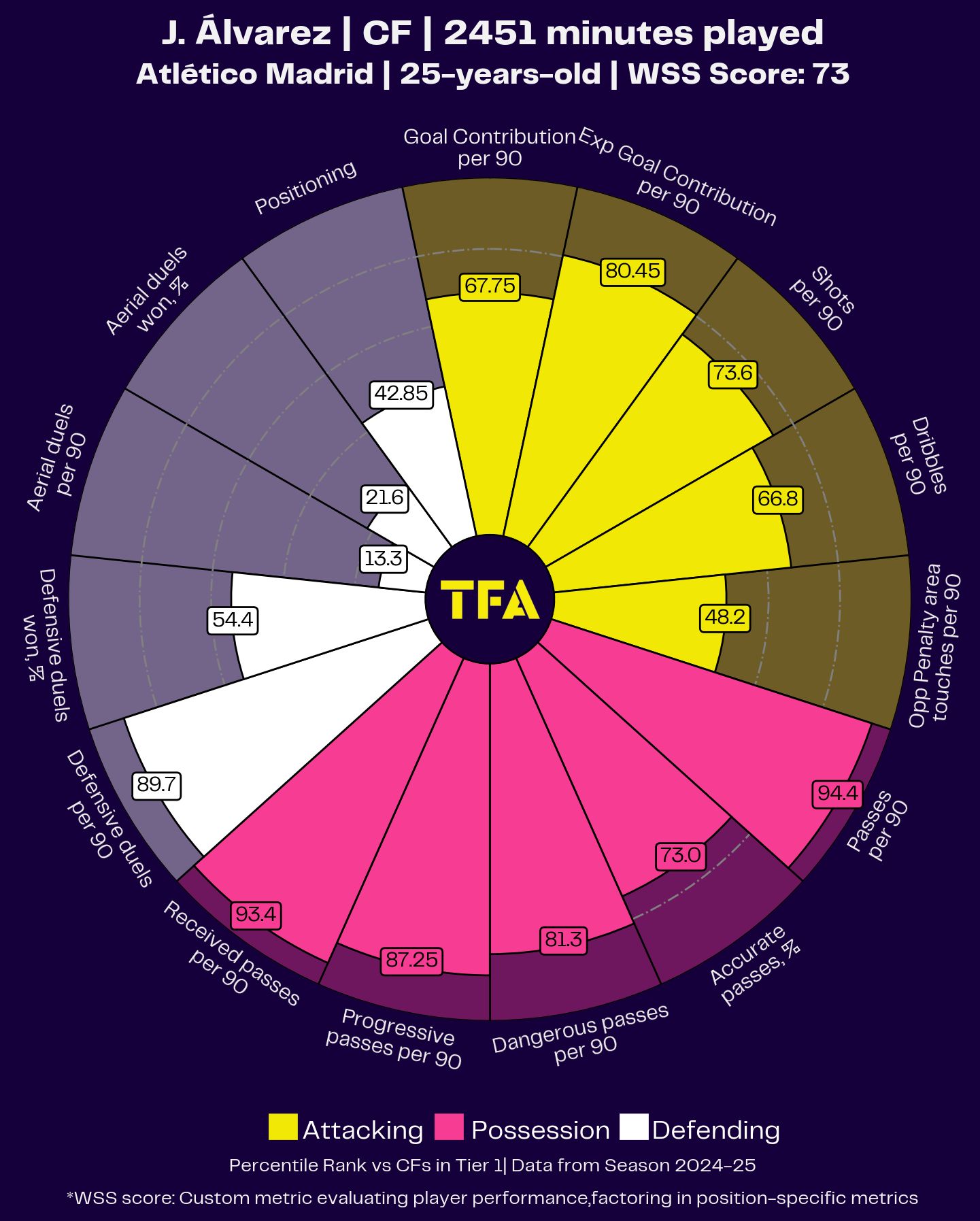
This pizza chart compares Alvarez to centre forwards in his league.
The standout is his possession profile, where he sits well above peers for passes per 90, accurate passes, progressive and dangerous passes, and received passes.
He also scores strongly in attacking outputs, such as expected goal contribution and shots.
Julián Alvarez Stats 2024/2025
Alvarez has added goals and helped the team stay organised.
He also shows that Simeone’s attack is more planned and purposeful than people usually think.
Julián Alvarez Ball Striking & Shot Selection
Julián Alvarez is primarily a centre-forward, with cameos on the left and occasional stints as a second striker.
His calling card is how cleanly and violently he strikes the ball despite his size.
As shown against Rayo Vallecano, a cross is played toward Alvarez, who uses sharp box movement to confuse the centre-back and find space.
He then finishes the first time with his weaker foot, a play that highlights his timing and instinct in crowded areas.
The mechanics are efficient; excellent compact backlift, a firm plant just outside the ball, and a sharp hip snap that lets him generate pace without telegraphing the shot.
He stays over the ball, so drives remain low.
He hits mostly with the top of the laces for velocity and switches to an instep wrap when he is shaping the far post from the inside-left channel.
Much of the power comes from how he prepares the strike with his first touch.
He nudges the ball half a step away from pressure and onto his stronger foot, preloading the angle so the swing can be short and fast.
This makes him dangerous in tight boxes.
He rarely needs a big wind-up, so keepers and blockers get little warning.
He leans into deception, showing the curl and then snapping near the post.
He keeps his head still so the direction is not readable and uses tiny inside-out touches to shift the ball off a defender’s block line.
He is good at manufacturing the half-yard he needs.
He starts on a centre back’s blind shoulder, steps out to see the pass, then cuts back across the line to open a window.
Alvarez’s finishing is helped by clever positioning and timing.
He occupies himself between full-back and centre-back to stay viable for cutbacks and through balls.
When paired with a bigger nine or an inside winger, he often becomes the second touch in the box, which suits his quick, laces through strike.
The output matches the eye test.
Over the last year, he has been a high-accuracy shooter, with 54.7% of his shots on target per 90.
That rate is driven by his smart shot selection from central and inside-left zones and his ability to disguise the finish.
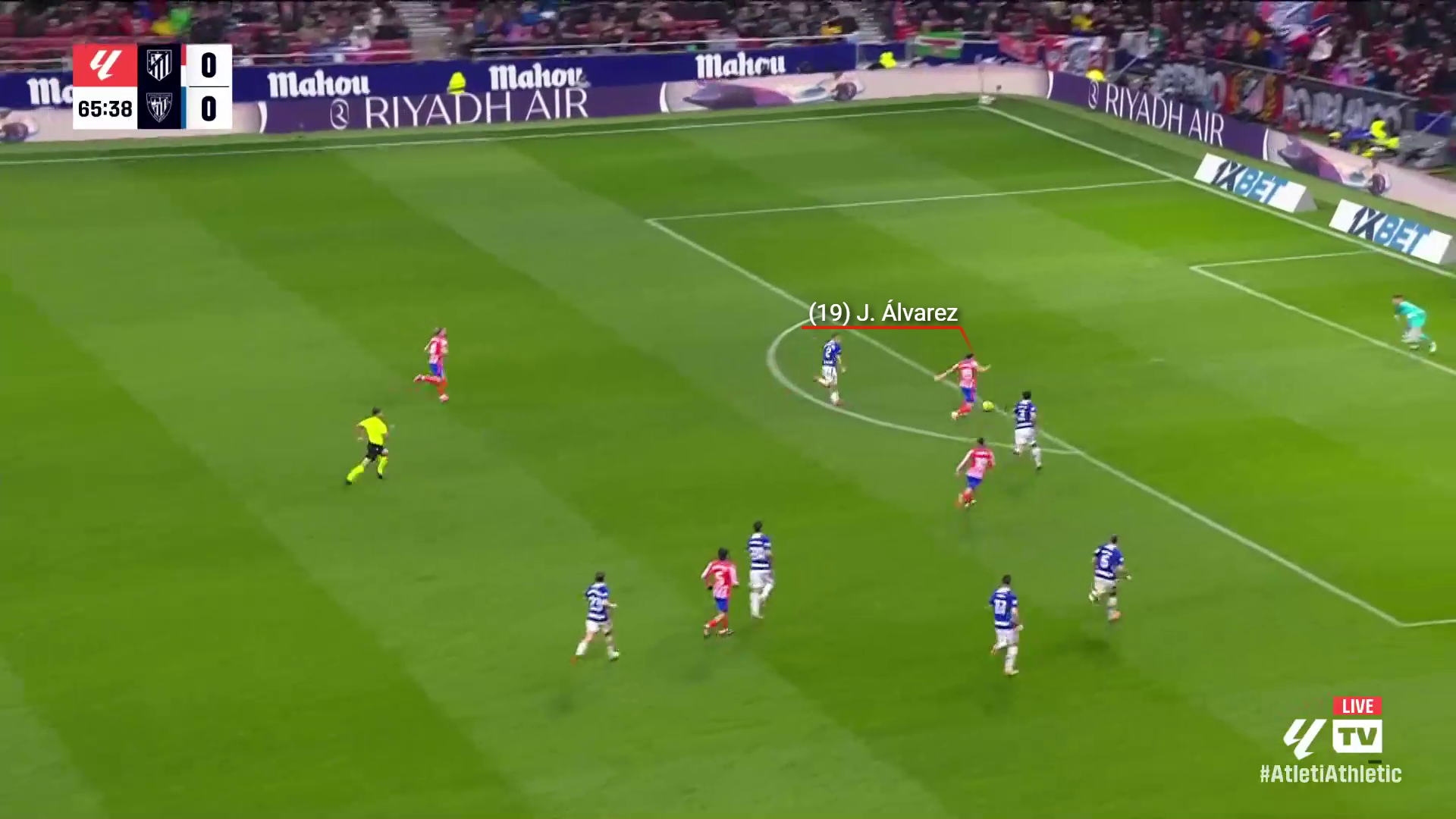
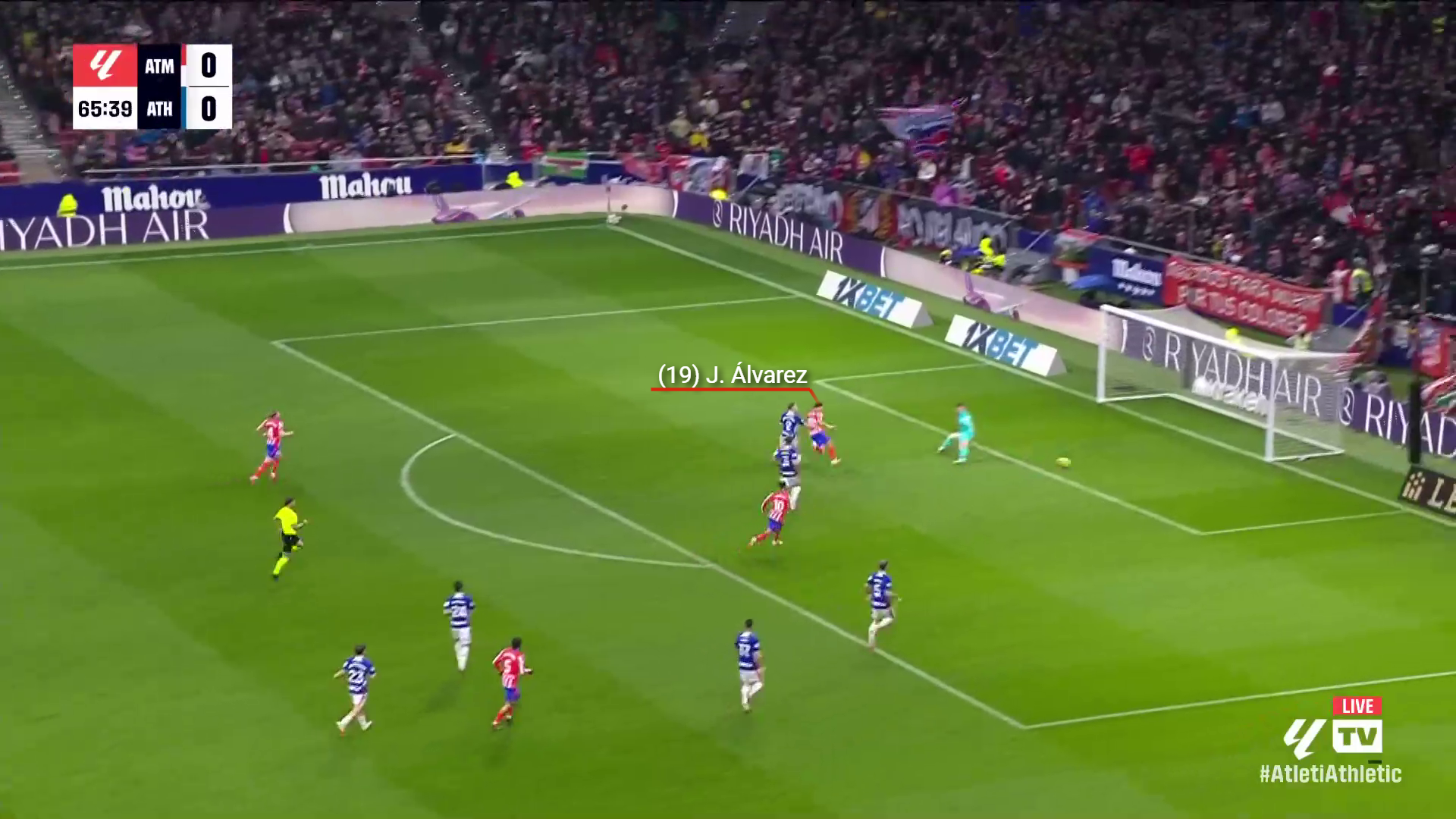
The comparison to Sergio Agüero makes sense in the details, not just stature, but also near-post snap finishes that can beat a keeper with minimal backlift.
Julián Alvarez Work Rate
Julián Alvarez’s out-of-possession work is appreciated under Simeone, and it’s beneficial within collective principles.
He recognises pressing cues such as a backward pass, a heavy touch, or an opponent receiving on the blind side.
Furthermore, he uses explosive acceleration to arrive on the ball carrier while shaping his body to screen the nearest outlet.
He locks the inside lane to force play toward the touchline and into Atlético’s trap zones, where a second or third man can collapse.
As shown in a fixture against Celta Vigo, Julián Alvarez shuts down the opponent on the ball and pressures him into a mistake in their half.
The error overturns possession in a good area, with Atlético players able to push forward and support the attack in the new attacking phase.
He can deny interior progressions and curtail access to the pivot, helping preserve the rest defence behind the ball.
The work rate is relentless, with repeat high-intensity sprints that connect the first and second waves of the press and with the willingness to drop into the midfield line to form a temporary 4-4-2 when the press is bypassed.
He also varies his pressing height based on phase and game state, leading a high press after possession spells.
He initiates counterpressing within seconds of a turnover and regains possession in advanced areas, becoming an attacking platform.
The cumulative effect is pressure errors from defenders and goalkeepers, territory gained, and a team structure that stays compact between lines.
Julián Alvarez Hold Up & Link Up Play
Julián Alvarez functions as a connector in possession, a forward who can both make first contact and then progress the ball.
He holds the ball under pressure with clean first touches into his body, pins centre-backs, and uses his frame to buy a second for midfield runners to run beyond him.
He varies his receiving height, sometimes posting on the last line to fix the near centre-back or dropping in front of them to create a dilemma.
In addition, he then links play with disguised layoffs and wall passes that keep the tempo high and invite third-man runs.
He regularly engineers bounce combinations to release the far eight or full backs on the outside lane, and he is attentive to the timing of the return ball.
The data gives us a glimpse of the completeness of this profile among positional peers.
Alvarez averages 3.82 progressive passes per 90, which speaks to his ability to move the ball through lines.
He complements that with 1.97 carries into the final third per 90, reflecting the capacity to drift laterally, receive between lines, and drive past the first defender when space opens.
He manipulates cover shadows with small double movements, first showing his feet to attract the centre back, then spinning into the half-space to receive on the blind side.
When he drifts wide, he often forms a temporary triangle with the near full-back and midfielder, using a one-two to exit pressure.
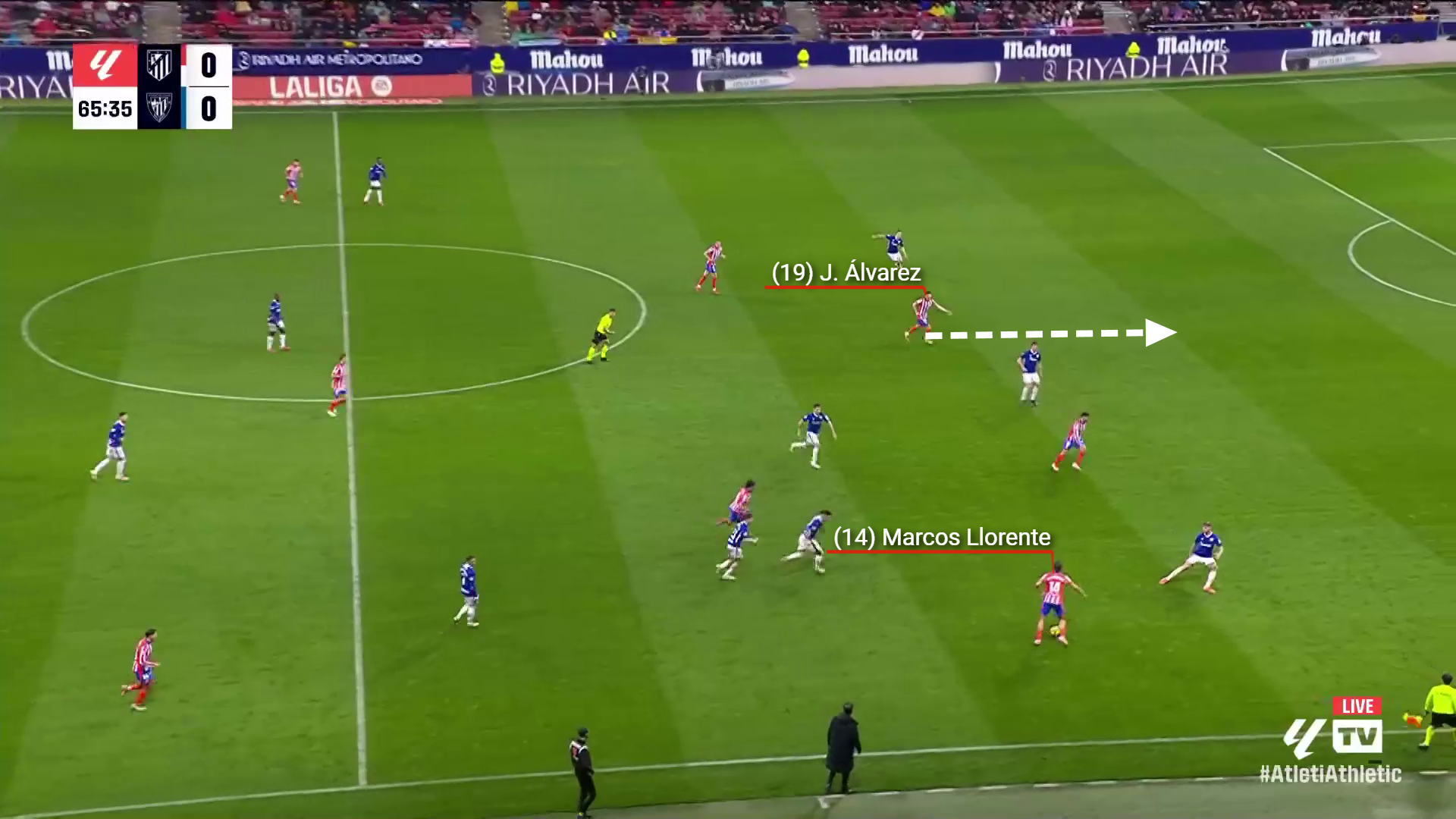
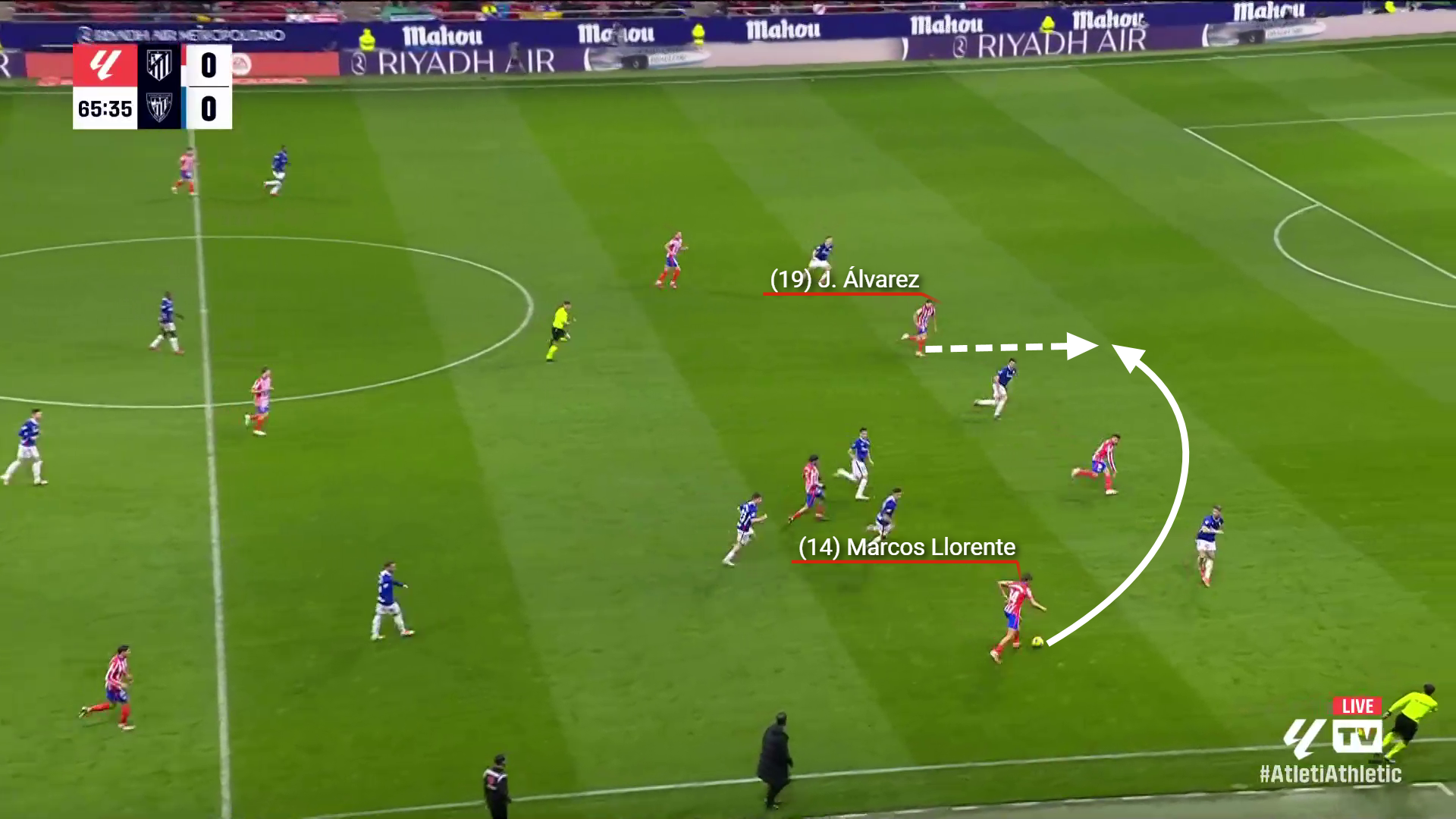
In the video, Julián Alvarez takes the return pass facing away from goal and shields it under pressure.
He holds the ball just long enough to tempt the defender into a challenge, then releases it at the right moment.
A quick set sends the ball wide to Marcos Llorente, who bombs forward into space.
Others can run off him because he sequences actions to trigger them.
For example, cushioning a vertical into the path of the advancing eight while simultaneously screening the holding midfielder or dragging a defender with a decoy sprint to clear the lane for a third man.
He makes the attack less predictable and less static and is the focal point of almost everything threatening Atlético Madrid serves up.
Conclusion
What looked like a gamble now looks like a perfect fit between player and coach.
Julián Alvarez brings goals, smart pressing, and link play, making Atlético’s attack cleaner and more dangerous.
The old idea that Simeone’s teams are not known for their attacking play now feels wrong, with Julián Alvarez at the centre of a clearer plan.
At this point, the £82m fee looks justified, and the real question is how far Atlético can go with him leading the line.

