
Werder Bremen announced the departure of head coach Horst Steffen over the weekend, bringing an abrupt end to the tactical experiment that began with his 2025 summer appointment.
After a run of 10 league matches without a win, a slide that saw the Grün-Weißen perilously close to the relegation zone, the club’s board concluded that the coaching ticket had to change.
Steffen’s tenure was always marked by dual challenges: integrating his footballing ideas and tactical identity into a squad grappling with injuries and inconsistency, while simultaneously delivering results in a highly competitive Bundesliga landscape.
Werder’s patterns of play notably struggled to translate possession into incisive forward action.
The 1–1 draw against Borussia Mönchengladbach, Werder’s 10th game without a victory, underscored the deeper structural issues that the coaching staff were unable to resolve.
The interim stewardship of Raphael Duarte and Christian Groß sets the stage for an internal reset, even as the club searches for a long-term solution.
In this Werder Bremen tactical analysis, we examine the club’s reassessment of tactical direction, squad cohesion, and competitive identity during a season when the margins for survival are thin.
Pre-Christmas: Problems In Line 1 All Around
Considering Horst Steffen’s tenure at Werder Bremen, we must examine two phases in the coaching staff’s approach to games.
Pre-Christmas, Steffen brought his usual approach, which had made him incredibly successful in Elversberg over the last couple of years, to the team and tried to implement a change from a 3-4-2-1 formation to a 4-2-3-1 formation.
Overall, the situation has not been ideal for Steffen; the discrepancy between what he wanted (or was hired to do) and what Werder were doing in the three seasons before was significant, and the squad was not well-suited to the new style of play.
Additions from the transfer market either arrived late or were of no help at all this season.
I don’t think the performances plummeted over the last couple of weeks.
Werder have had some major issues so far this season.
They had some more luck in the first half of the season, and the results were a tad better, but the problems have been there for more than just a month now.
One of the biggest issues is their play when they either faced a high press or had to play with a high press themselves.
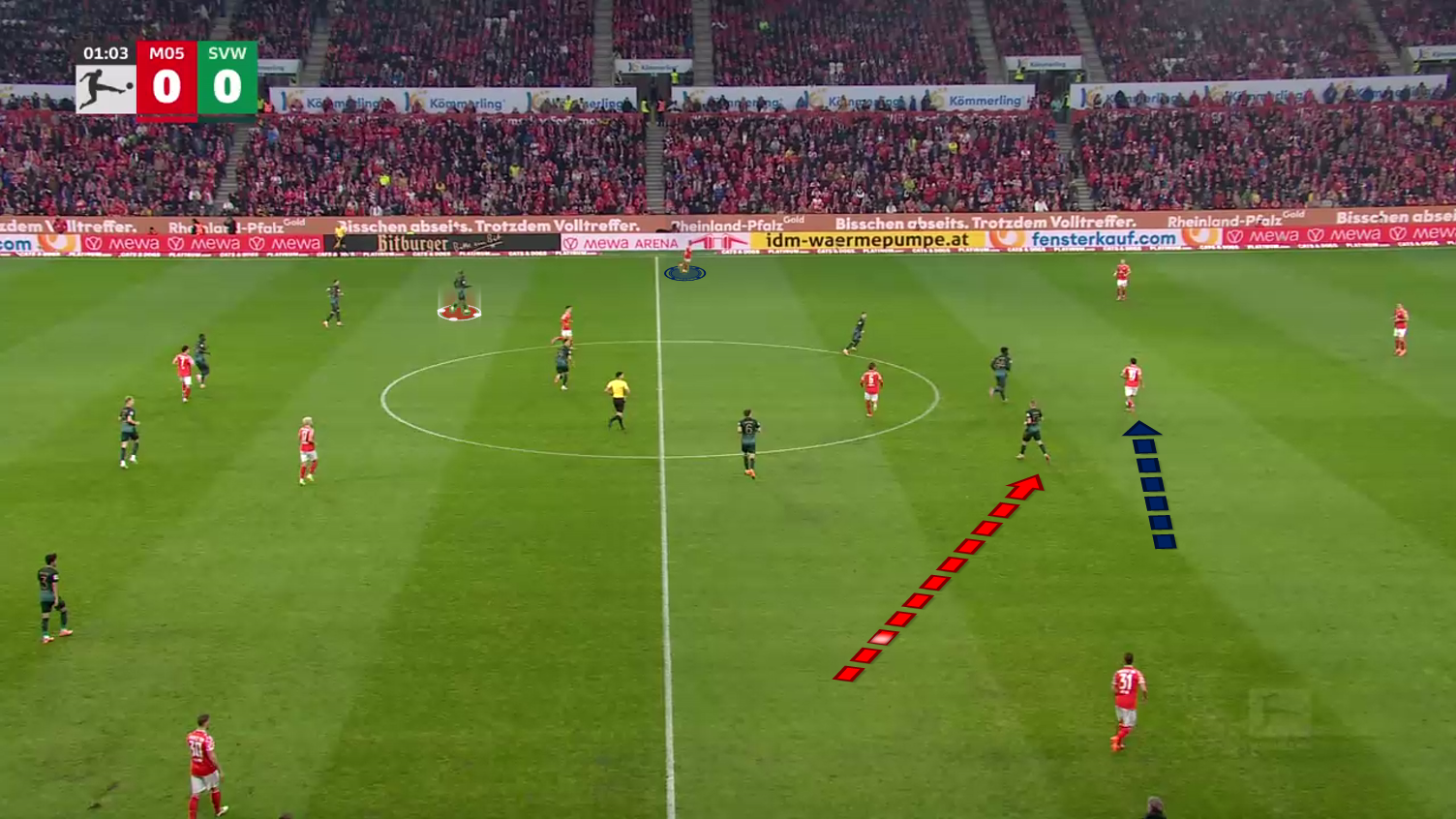
Looking at the way they pressed before Christmas, Steffen tried to implement his collective approach to defending.
The press was very focused on keeping distances close, and players’ orientation was more focused on space and the distance between teammates than on the opposing players.
This caused significant problems for the players: assignments were often unclear, communication was poor, and the attackers had particular difficulties with positioning.
Against Mainz in the first half of the season, these problems became very apparent.
Marco Grüll often pressed towards the inside and heavily followed the midfielders and centre-backs, leaving the right defensive side wide open.
Samuel Mbangula, on the other hand, dropped back too deep and rarely tried to press, so the right wing-back of Mainz was always open, and they were never able to apply pressure on the backline.
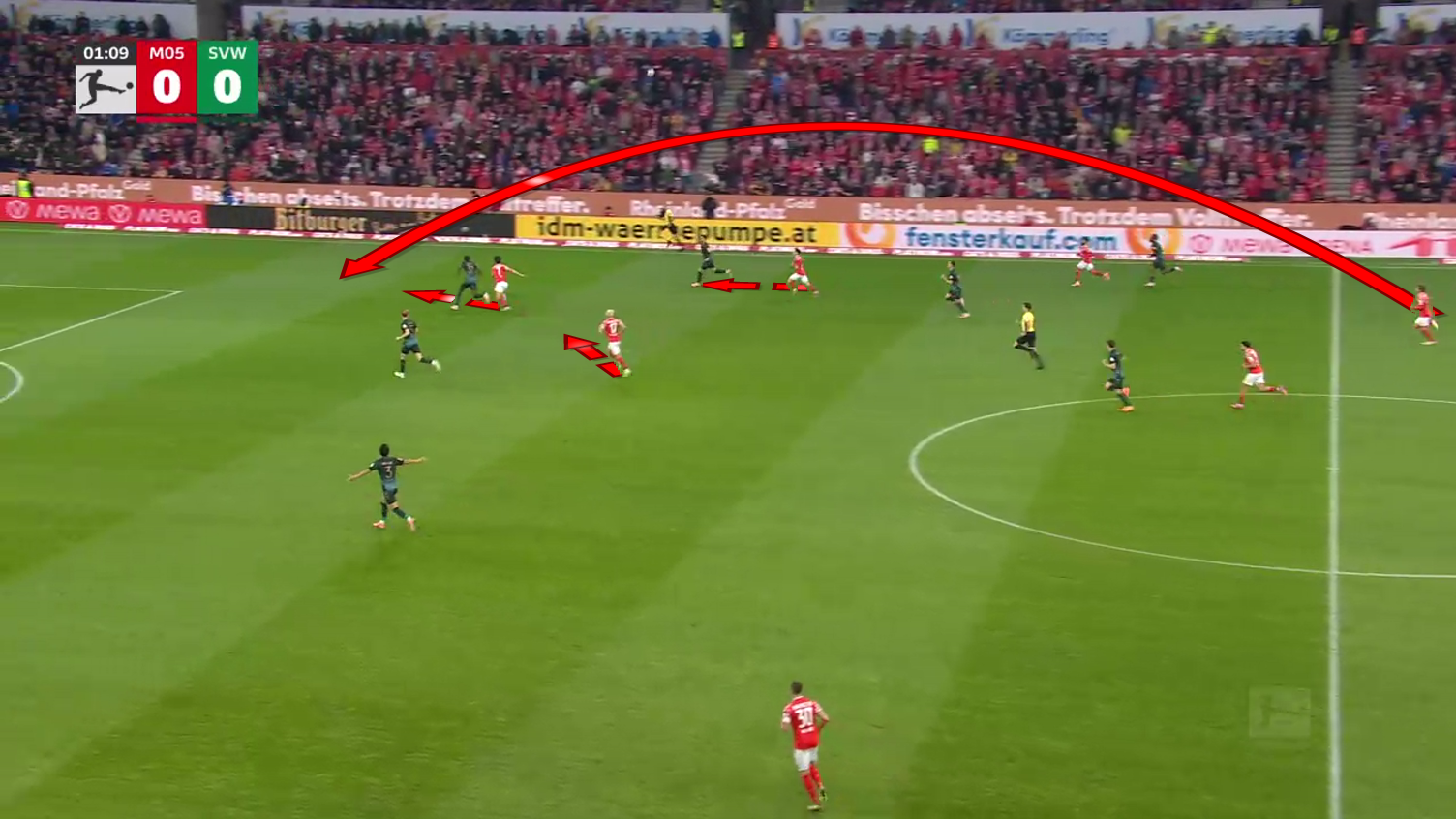 Mainz rarely used that to their advantage; they were arguably the worst team in the Bundesliga at this point, but it ended up with a lot of good long balls over the top of the Werder backline.
While they did not get any pressure, they still committed a lot of players forward in the press and then had huge trouble winning second balls in midfield.
Mbangula’s positioning and lack of defensive intensity were probably more of an individual problem, but overall, the team never really adopted that approach; the press was ineffective, and Werder conceded many goals.
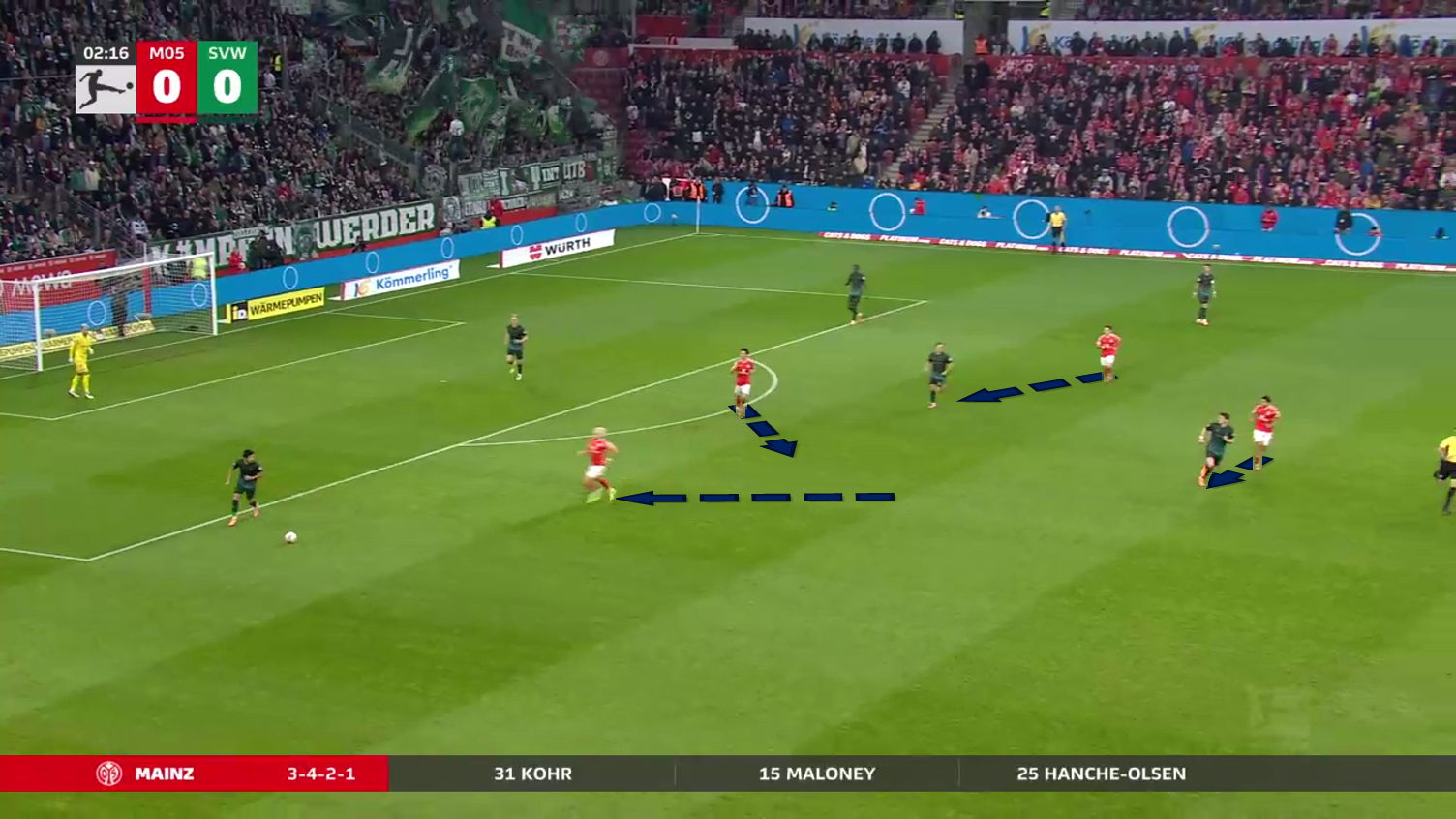
When they were in line 1 themselves and had to build against a high-pressing attacking press, Werder struggled as well.
Overall, the approach was evident; some ideas worked for Werder in the build-up, and at times, their passing game when playing out from the back was effective.
Werder showed some good principles of play in the first half of the season, progressing the ball effectively from the backline to midfield and attack, but often stalled there.
Another issue, in my view, was their analysis of the opposition.
Often, Werder had huge troubles at the start of games; we can see that against Mainz.
While Mainz usually played very man-oriented, against Werder, they surprised Steffen and his staff by playing with one fewer man in the press.
The far-side players pressed hard towards the centre, cutting off the diagonal passing options for the centre-backs and right-back Sugawara.
Werder was forced into a lot of long balls and was never able to get to them; their entire gameplay revolved around short passing, and Mainz just managed to take that away.
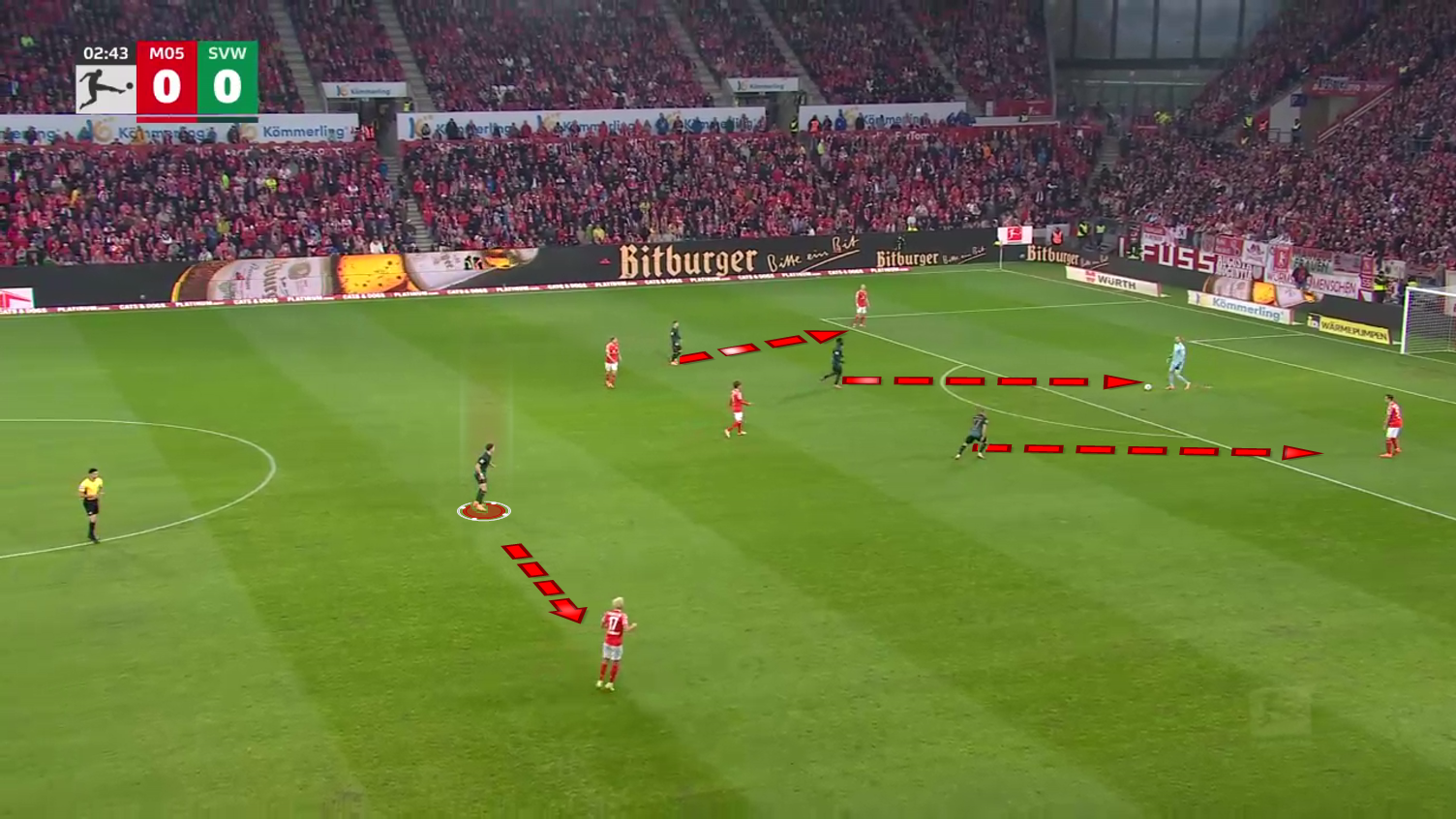
Given the high pressure on Werder, you have to ask yourself what exactly the plan was.
Werder was also down one in those situations, but Werder rarely managed to press anyone; Mainz’s two central midfielders were always wide open, and the entire midfield was completely overrun.
There was no practical way for Werder to achieve a meaningful recovery, and Mainz dominated positional play for second balls, which was the key to the game from the start.
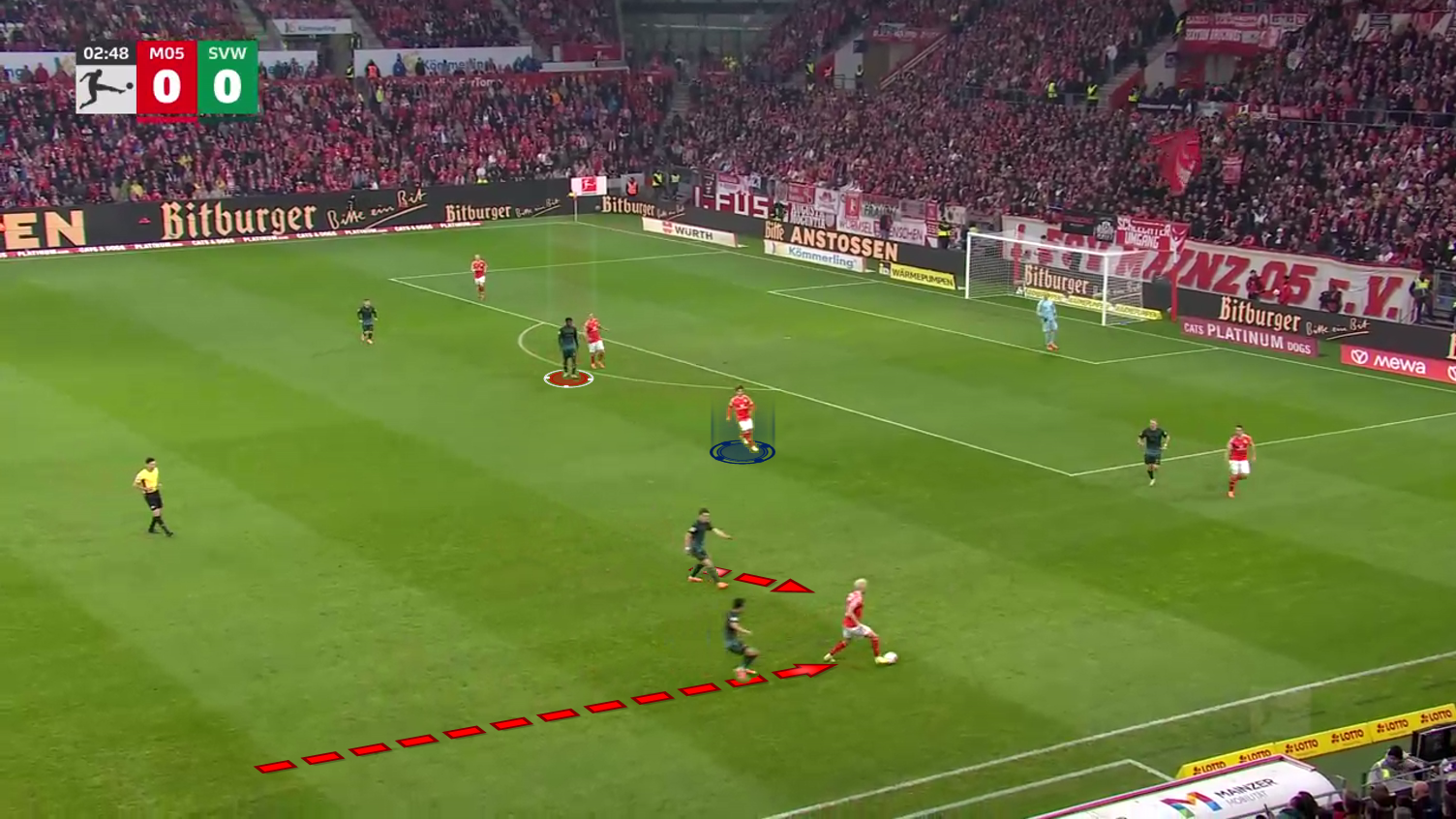
Even when Mainz did bad things on the ball and played themselves into a hole, the entire assignments of Werder just never really made any sense.
Looking at the picture, Jens Stage was covering the player on the wing, but when the ball is played to him, Yukinara Sugawara still makes the long run towards him, ending in two players covering the player on the ball.
With the two wide players completely dropping their intensity, the near-side midfielder was always open for Mainz, and they easily got out of the pressure.
Pre-Christmas: Some Key Principles Working
Still on the ball, especially when they got into line 2, Werder had decent possession phases in pretty much every game.
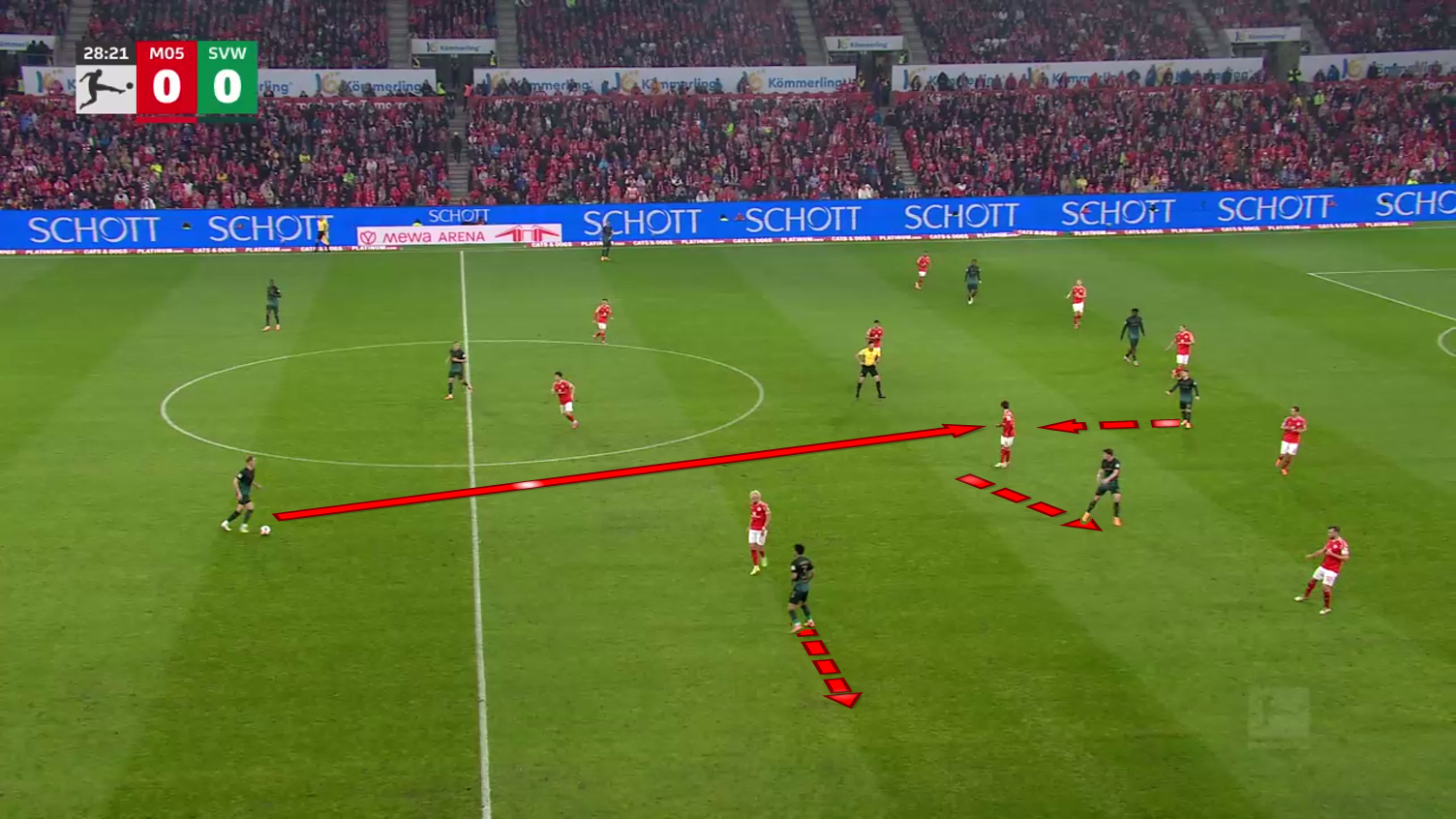
Steffen wants his players to play the ball into the penalty area actively and to control the half-spaces and the centre of the field.
With his 4-2-3-1 formation, Steffen achieved this by pushing his two wingers into the half-spaces, and the attacking midfielder played more like a second striker, with the striker in a very free-roaming role, allowed to go wherever he pleases.
In the situation pictured above, Werder was in control, and Mainz had to fall back into their block.
Sugwara and Stage pushed to the outside, and Romano Schmid dropped back out of the attacking line to receive the vertical pass from his centre-back here.
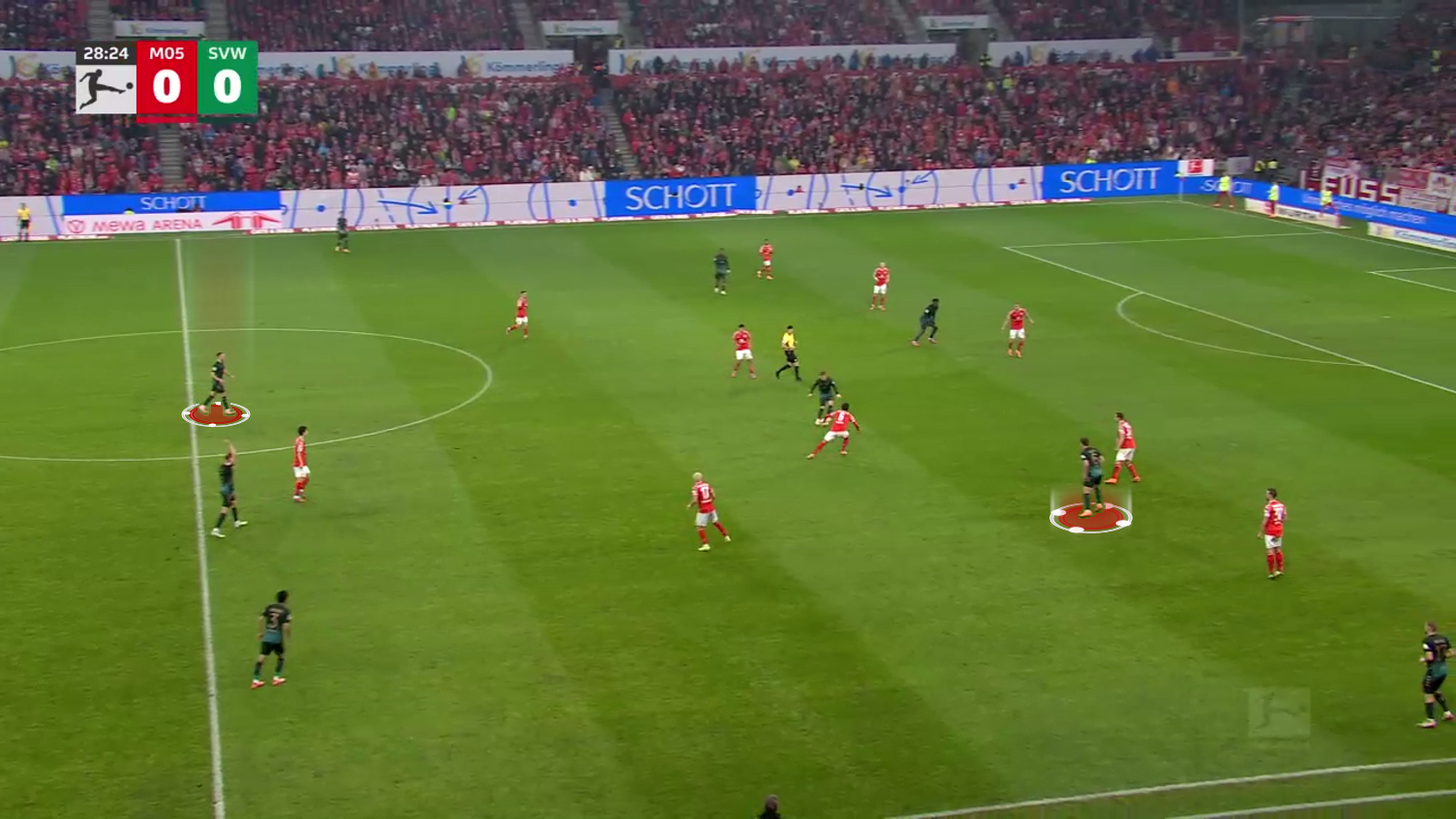
The problem for Werder under Steffen was exactly what happened from that point onwards: they got into midfield well with their passing game, but then stalled.
Steffen usually wants his players to have one option for a lay-off and one option that threatens another vertical pass.
In this case, Senne Lynen should have been the first option and Stage the second.
Looking at the picture, Lynen just dropped too far back to actually receive a lay-off, and Stage positioned himself in a way that he can’t receive the ball anyhow, so that just did not work at all.
A good player would usually have just turned towards the goal here, but Schmid took his first touch backwards; his body position just wasn’t good here.
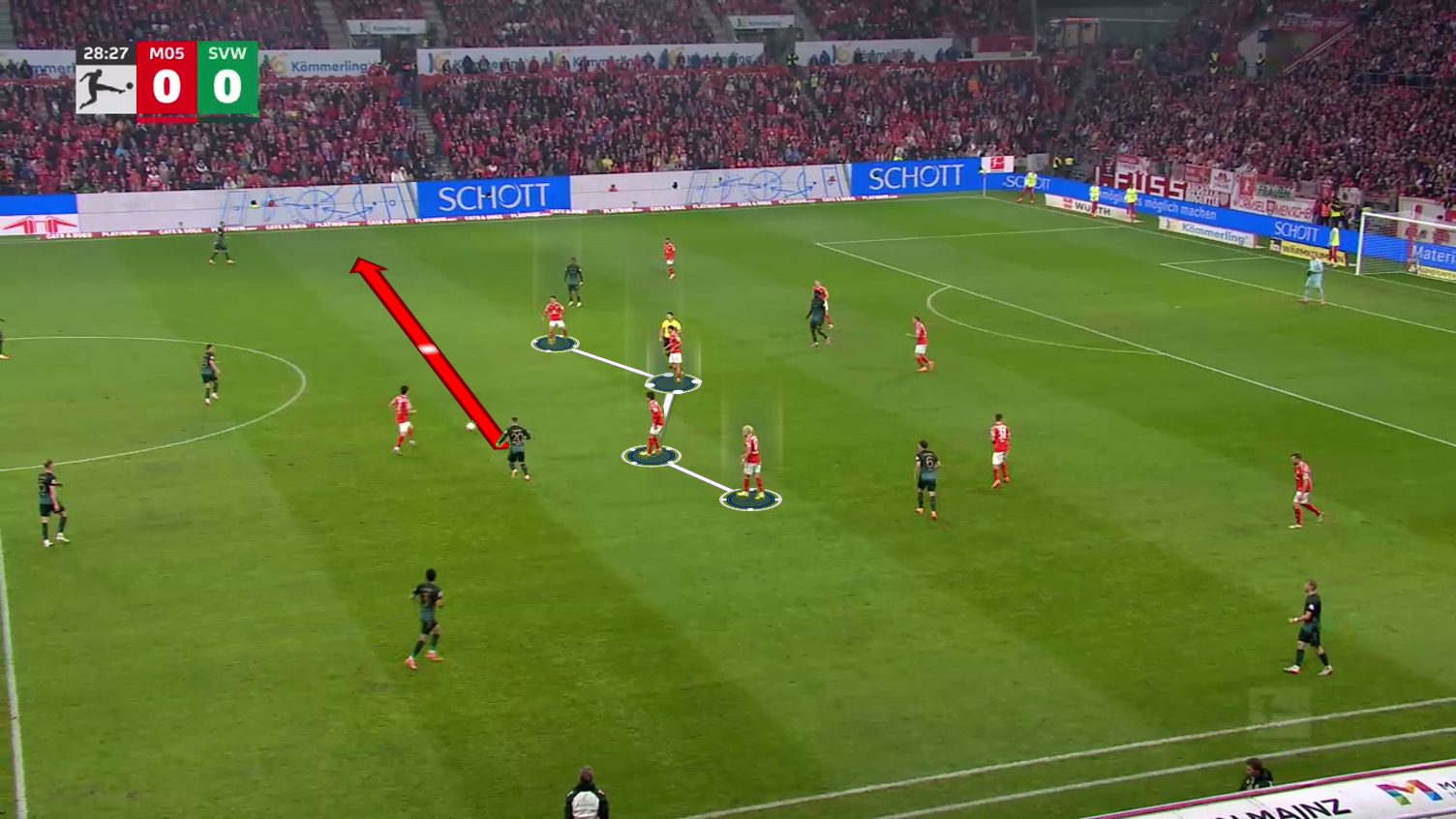
That poor touch allowed Mainz to get their four midfielders back behind the ball, and they now crowded the centre of the field.
Werder were never able to find solutions against teams that crowded those areas, and it took out pretty much all four of their attacking players here.
This forces Werder to play to the outside, and Schmid does well to switch play here.
Werder often found themselves in those situations but rarely used them.
Steffen refused to play around crosses, and it cost Werder.
In the end, Werder stalled in the centre, refused to cross the ball into the box, and ended up with the second-lowest number of non-penalty expected goals in the Bundesliga this season.
It was only a matter of time until it came back to bite them.
Steffen doubled down on those decisions, refusing to use crosses, playing a centre-back as a left-back, and always trying to play through the centre; it just never worked out.
Post-Christmas: Drastic Changes
Just before the short Christmas break, Steffen changed his approach significantly, according to multiple media outlets, after captain Marco Friedl approached the coaching staff on behalf of the team and asked Steffen to play more like the team did under former manager Ole Werner, who departed in the summer.
Steffen adjusted his tactics, starting with the formation, reverting to the 3-4-2-1 his predecessor used.
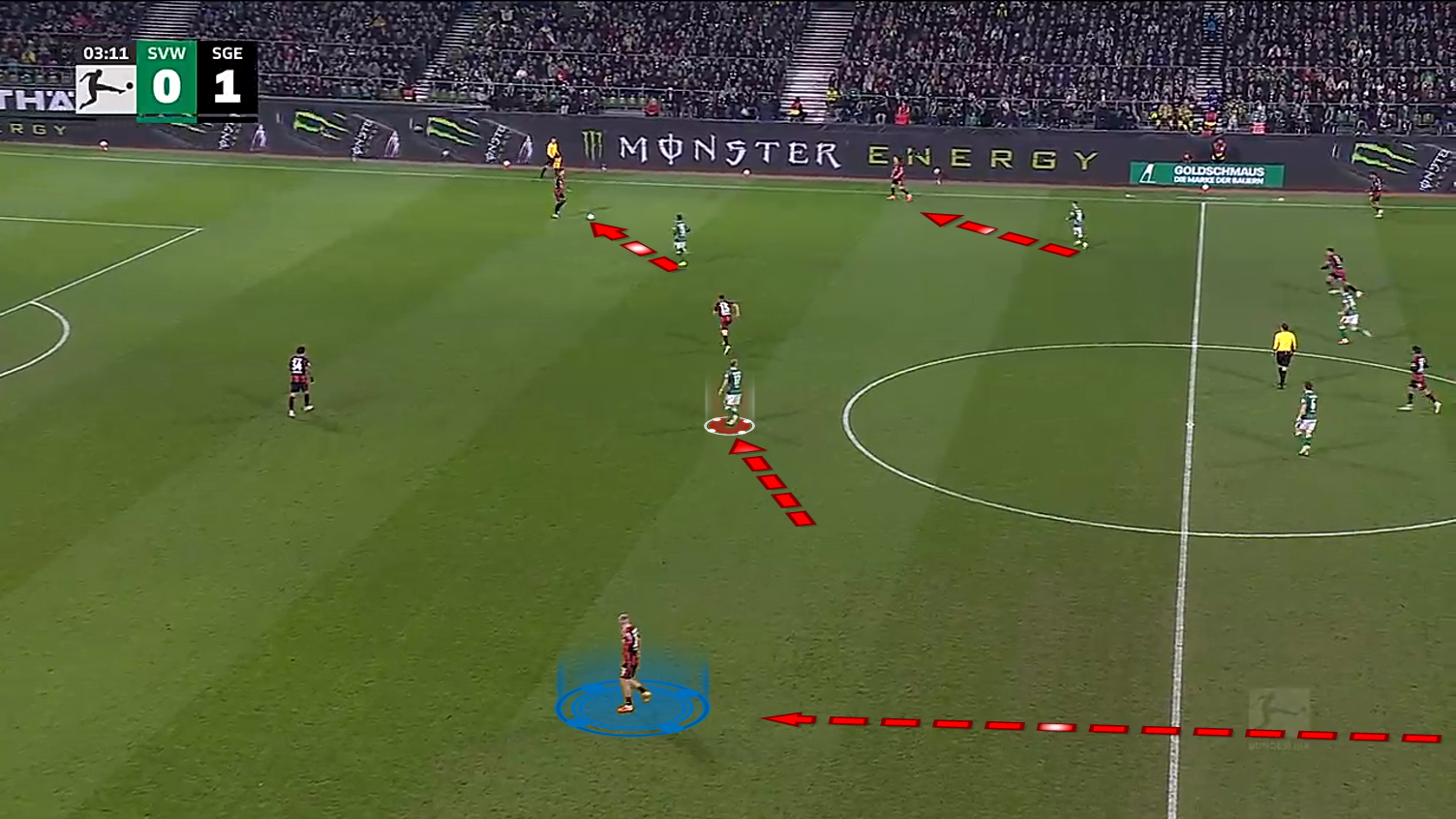
The entire approach drastically changed, especially against the ball.
Steffen now employed a very man-oriented press, which should have ended the orientation and assignment issues his players had before the break.
Looking at the picture, it didn’t really improve things, though.
Werder performed better in the couple of games in 2026 than at the end of last season, especially the heavy home defeat against VfB Stuttgart.
Still, looking at the picture, Grüll had to convert two players now, with one midfielder refusing to step up and prioritising compactness over aggression in the press.
On the left defensive side, the right-back of Eintracht Frankfurt was left wide open because Isaac Schmidt stepped up way too late in that situation.
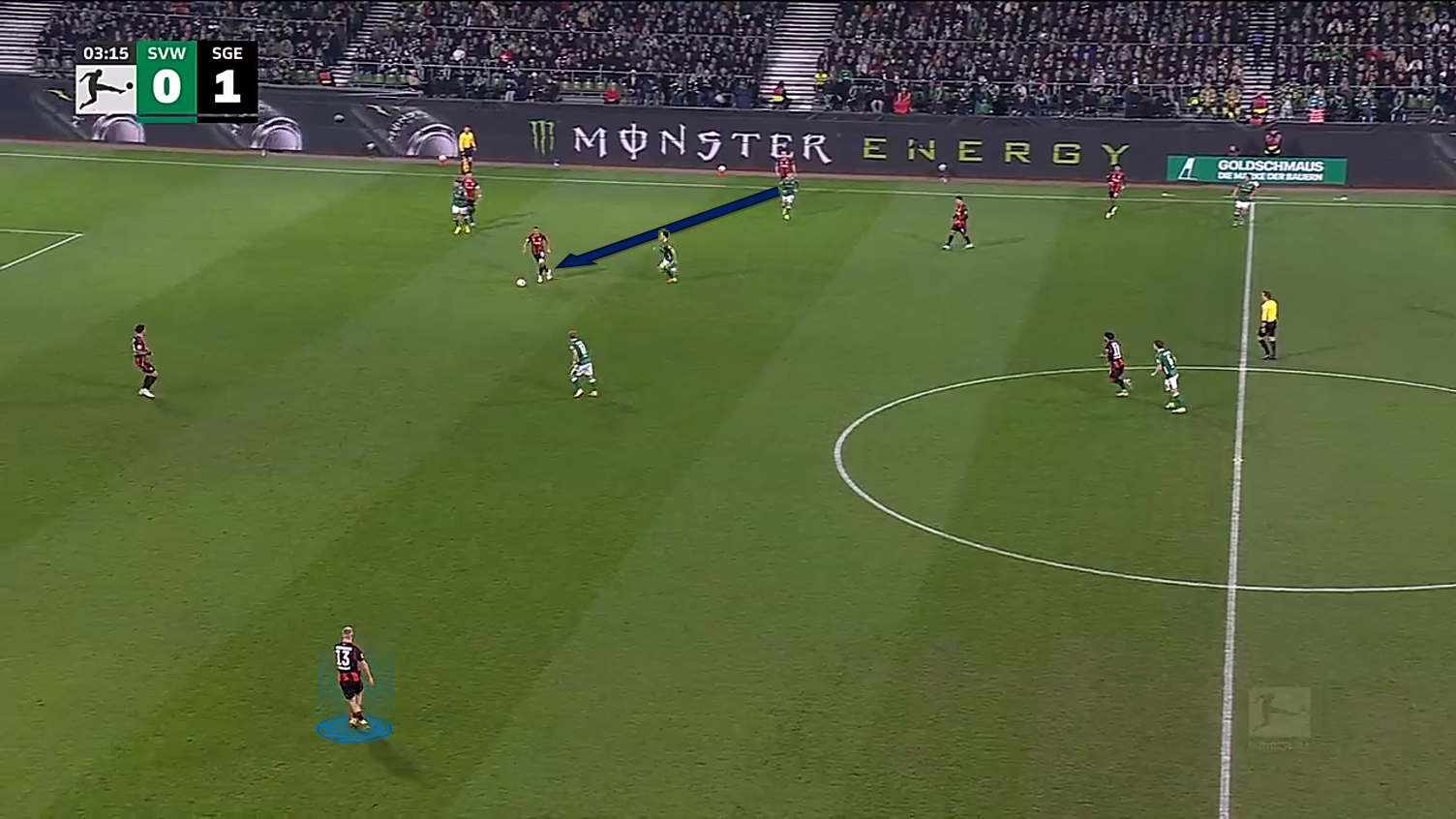
This allowed Frankfurt to relieve pressure in the midfield by switching play through their holding midfielder.
The right-back is still wide open; the centre-backs don’t have enough pressure.
Werder once again tried to press and committed to it, but failed to generate pressure on the backline.
As we can see, Werder was already behind after conceding a goal in the first minute due to a communication breakdown in the press.
Werder looked better, but in key situations, Steffen’s team still lacked intensity and focus, leading to fairly soft goals conceded.
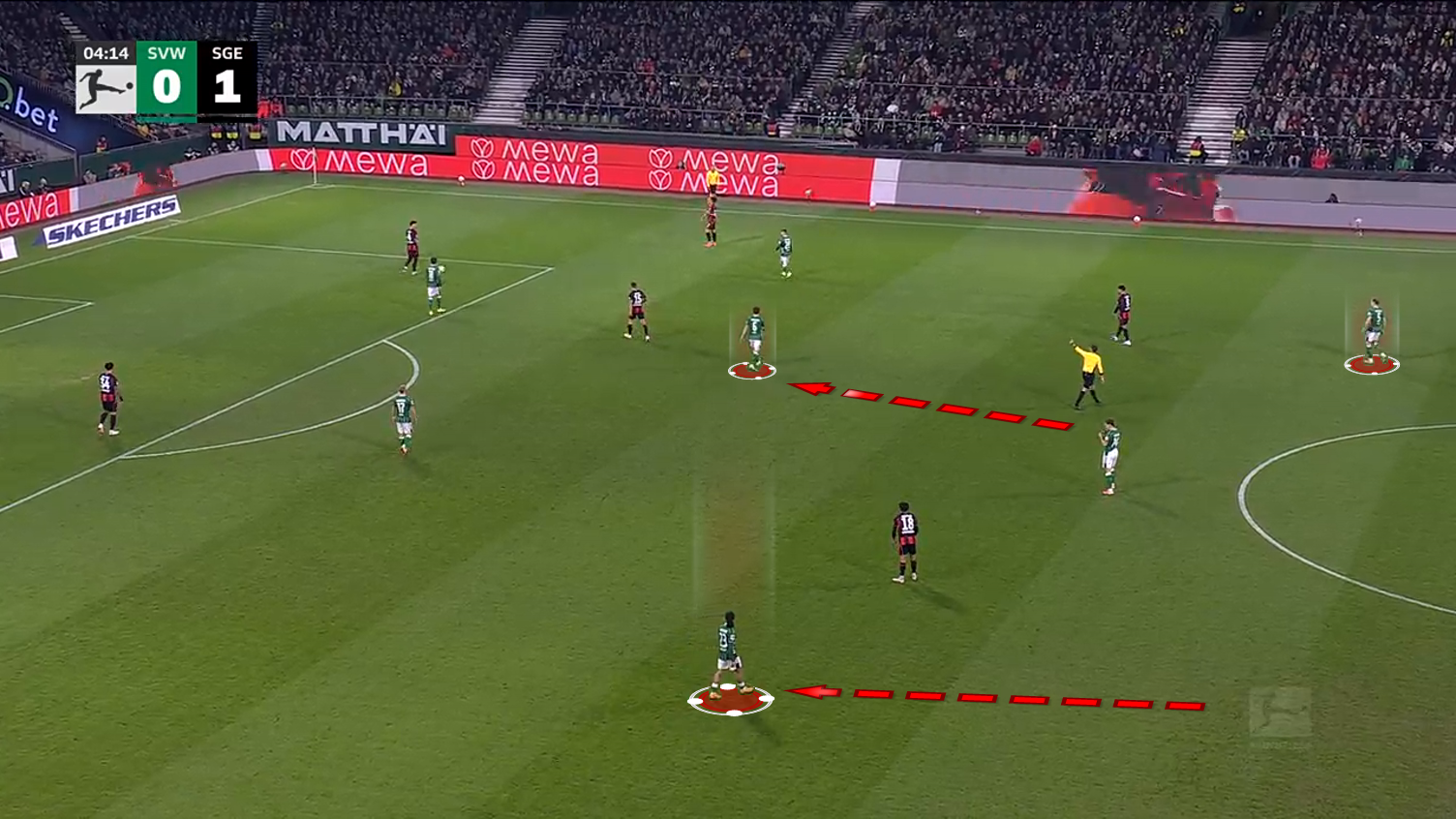 Werder quickly adjusted and pushed Schmidt and Stage a couple of metres forward, but it was already too late, and it’s unfathomable how these simple things became such crucial issues for Werder in the last couple of weeks.
The preparation was better in those games, but suddenly the execution of the most basic tasks became a major struggle for the team, and it cost them.
There have been so many situations you could single out over the course of the last couple of games, like striker Justin Njinmah missing multiple sitters, Mbangula and Karim Coulibaly stopping to defend later in the Frankfurt game and the following equaliser and so on, but in the end, if it happens this often, it’s just a pattern and not a coincidence anymore.
Post-Christmas: A New Way Of Attacking
With their attacking struggles, Horst Steffen also changed the way Werder attacked after the Christmas break, and it worked surprisingly well for the team.
Starting with the game against Borussia Dortmund, Steffen played Justin Njinmah as a striker.
Njinmah is an incredibly fast player who is at his best when you manage to find him on runs in behind the backline, and Steffen centred his game plans around that.
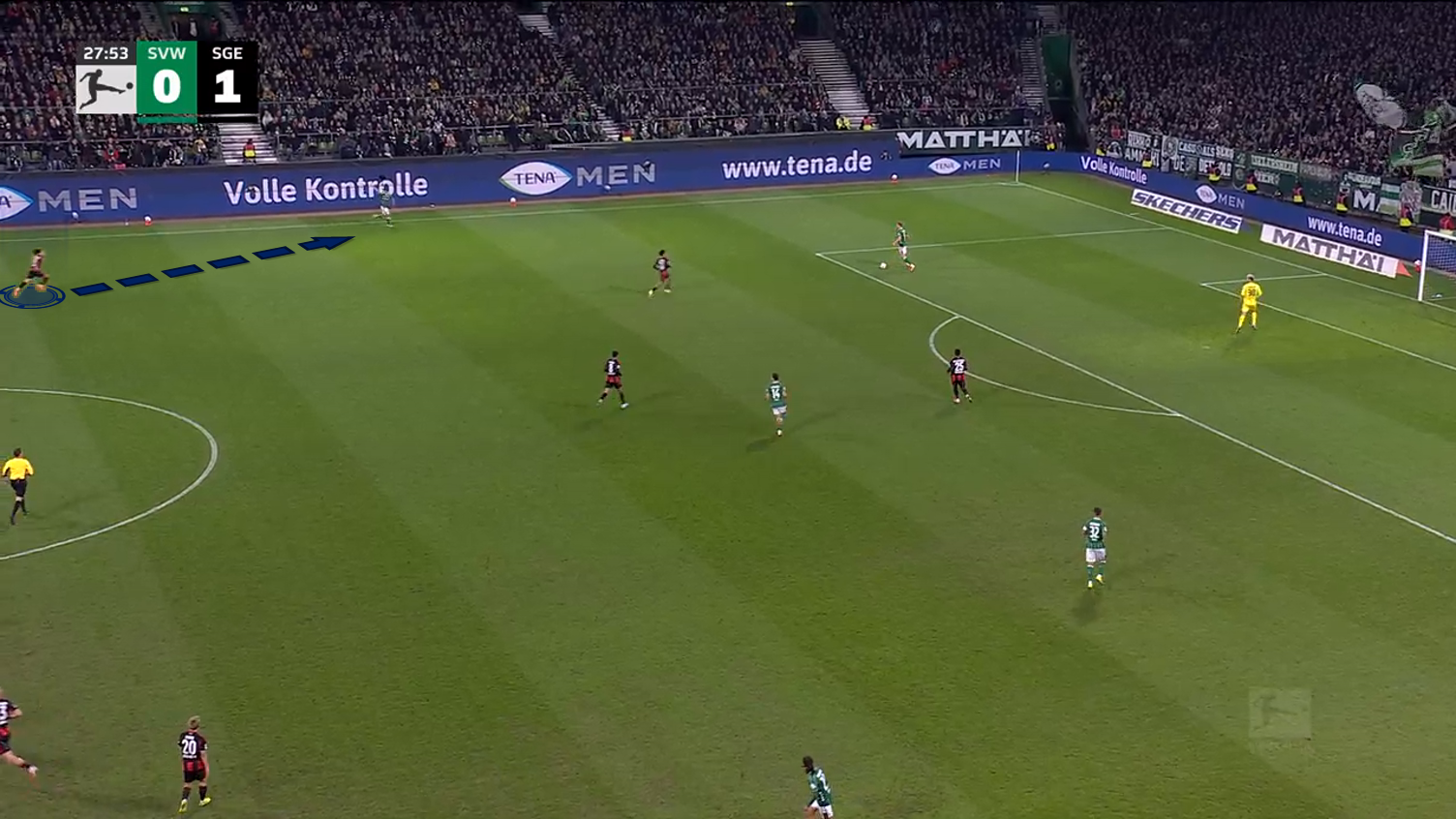
Werder kept the principles of playing out from the back with short passes.
Steffen blended his own ideas with the new way of playing against the ball rather well.
With the ball, Werder still played with a back four, and the coach kept the good build-up going.
Werder tried to attract the press, played short passes until their opponents pushed forward, and then went vertical quickly, looking to find Schmid or Sugawara on the right side most of the time.
Werder’s positional play was wider now; the effective playing space was larger, and the distances for opposing teams increased as well.
Steffen now wanted his players to move into the open spaces dynamically.
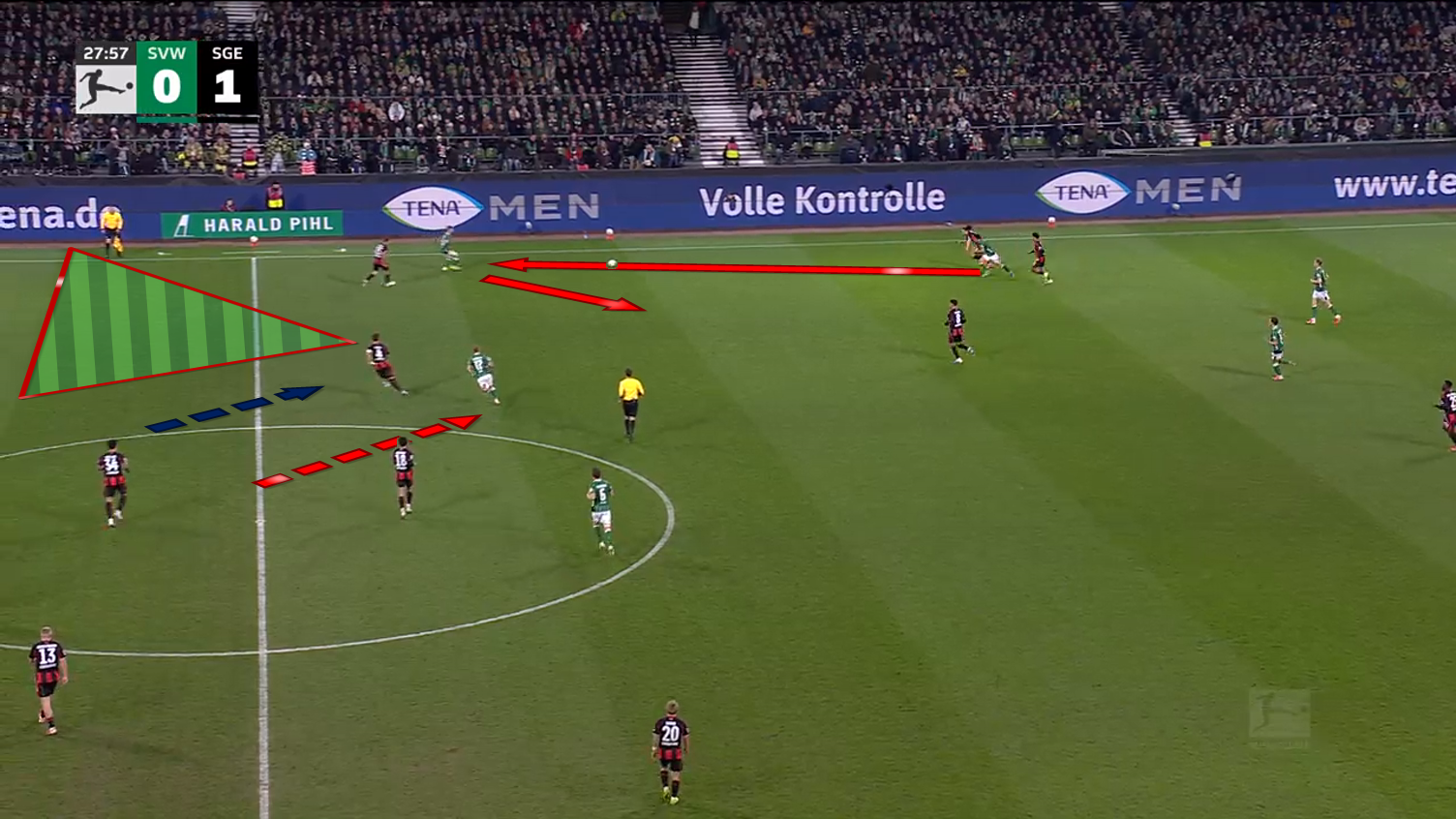
Sugawara receives the ball, and Schmid immediately moves to the wing, into the space that opens up behind the pressing Frankfurt player.
The Japanese right-back plays the vertical pass and follows it diagonally, allowing Schmid to play an easy lay-off and Sugawara to get into the open space with momentum.
In the attacking line, Grüll initially drops into midfield, drawing the backline forward, creating space behind it, and setting up the next move.
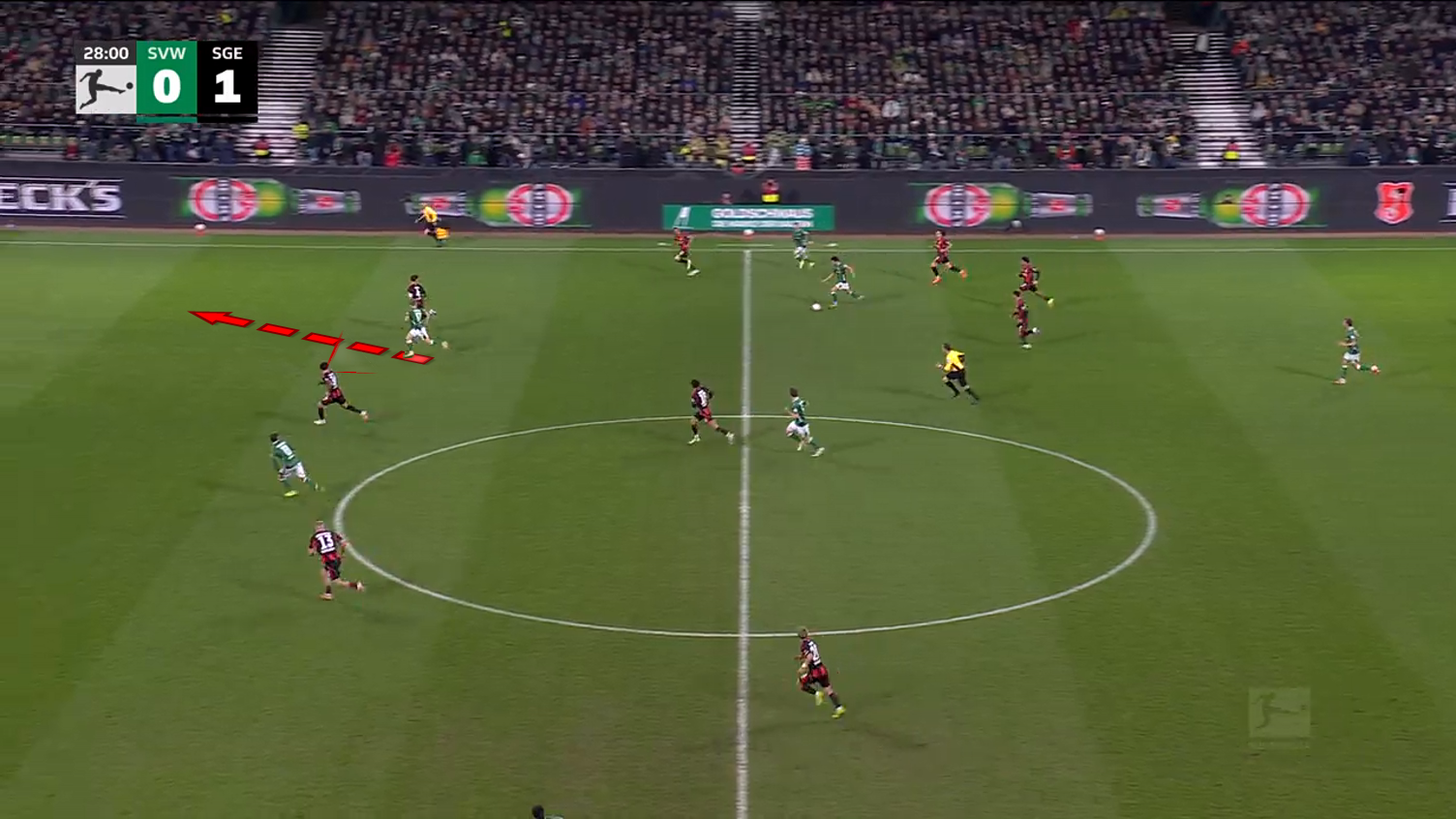
When Sugawara has the ball under control again, both Njinmah and Grüll make fast vertical runs right into the gaps between the defenders.
Now they can use their pace and allow Sugawara to actually threaten a through ball, creating a difficult-to-defend situation.
In the end, the dummy run by Grüll drags the central defender out of his position, and Sugawara can play a diagonal pass into the path of Justin Njinmah, who then scores the equaliser.
Werder created many opportunities for their pacey striker this way, but unfortunately for them, Njinmah wasted most of them, except for the one in this situation.
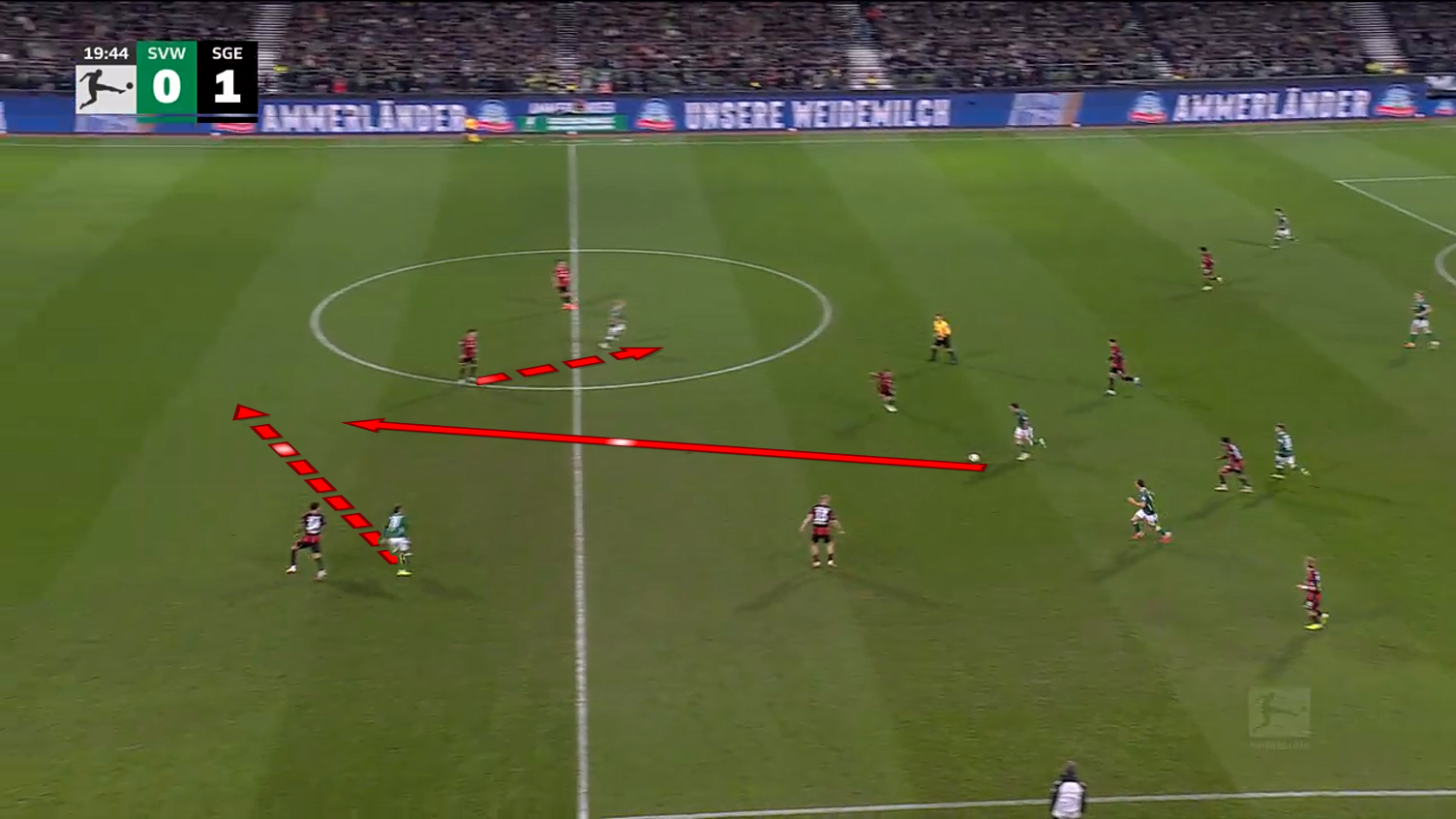
Werder also got more aggressive on the counter, trying to find Njinmah quickly after winning the ball.
Steffen now prioritised getting vertical on the first pass and securing possession after recoveries.
Grüll often made the dirty runs, moving into midfield and stretching the defenders, creating gaps for Njinmah to run into.
Then, the team played passes over the top of the backline or tried to thread through-balls to their striker.
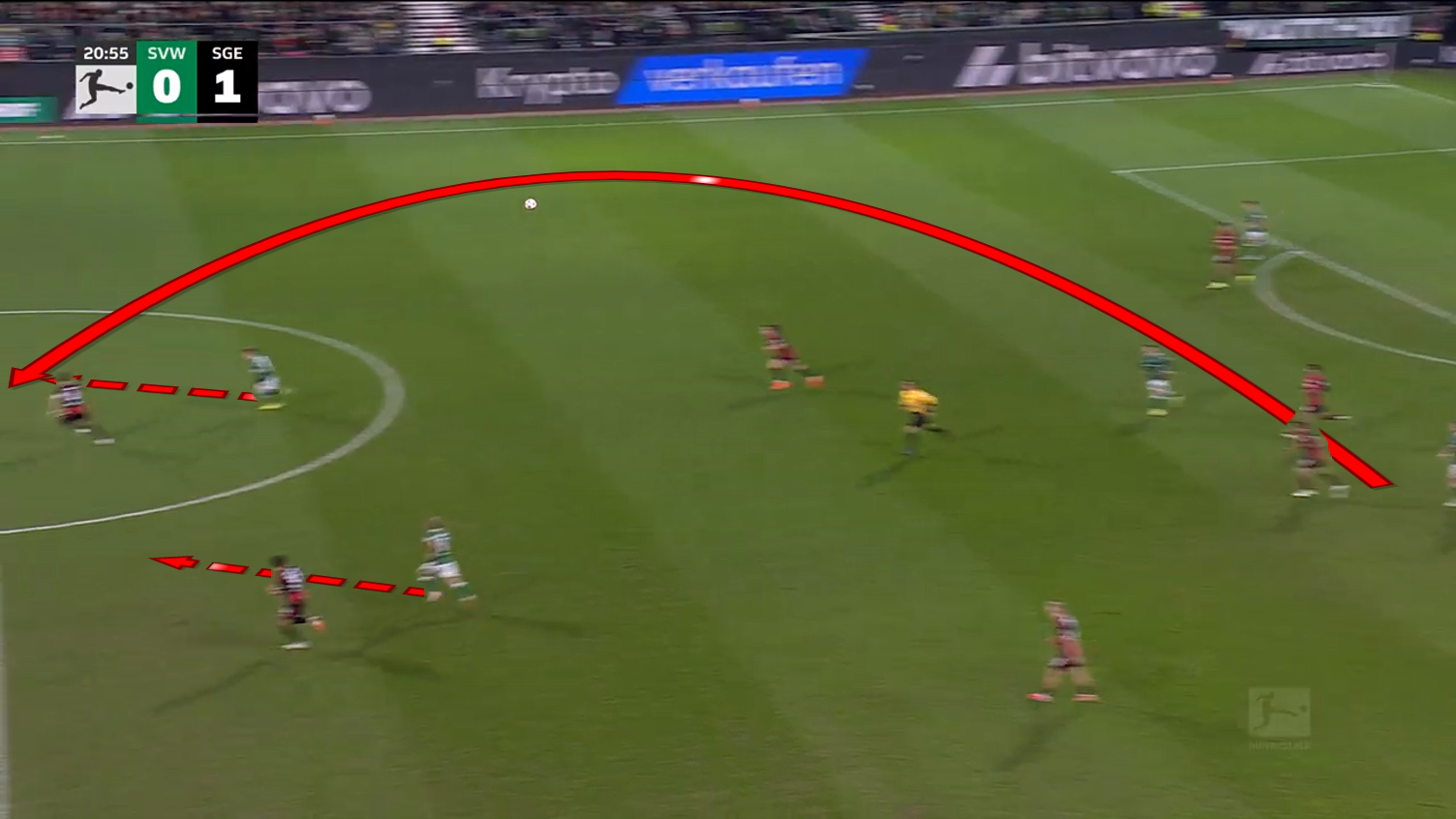
Sometimes, even Grüll made a vertical run, and Werder tried to punt the ball forward, but these situations were often uncontrolled and rarely successful.
Ultimately, despite some adjustments, Werder failed to score in five of their last seven matches; their attacking output simply was not good enough.
The team did not play poorly in those last games, but ultimately it was not good enough to win, and CSO Clemens Fritz was forced to make a change to try to salvage the season and prevent relegation.
As previously stated, the two assistant coaches, Raphael Duarte and Christian Groß, are currently in charge of the team, but Fritz has already made it clear that he intends to bring in a new coach from outside the organisation as soon as possible.
Conclusion
Ultimately, the dismissal of Horst Steffen marks a decisive inflexion point in Werder Bremen’s season, one that reflects less a single failed result than the cumulative erosion of tactical conviction.
Steffen’s tenure was defined by an attempt to instil control through structured possession and positional discipline, yet over time, those principles lost their sharpness under mounting pressure.
What remained was a system that often appeared caught between intent and execution: too conservative to consistently dominate territory, yet too exposed to protect itself during transitional moments.
From a tactical analysis perspective, Bremen’s struggles were not rooted in a lack of ideas but in their incomplete realisation.
Build-up structures frequently stalled against compact blocks, attacking rotations lacked vertical threat, and defensive rest-structures proved vulnerable once possession was lost.
As results deteriorated, the gap between playstyle and output widened, a divergence that ultimately forced the club’s hierarchy to act.
The challenge now lies not merely in appointing a successor, but in defining what Werder Bremen want to be on the pitch.
The interim solution may stabilise performances in the short term, but the broader questions remain unresolved: should Bremen double down on a possession-oriented identity, or pivot toward a more pragmatic, transition-based model suited to their squad profile?
Steffen’s departure closes a chapter that promised long-term development but fell short in immediacy.
What follows will determine whether this reset becomes a foundation for clarity or simply another tactical detour in a season where structural coherence has been in short supply.
