
The volume of attacking talent Brighton & Hove Albion have accumulated in recent windows has left Brajan Gruda pushed out of Fabian Hürzeler’s starting XI.
The right side has been shared and shifted between profiles depending on the opponent and game state, which has made it hard for a young attacker coming off stop-start availability to build rhythm.
Gruda is still only 21 and already a Germany U21 international, but his Brighton spell has also been interrupted by brief injuries and competition from the likes of Yankuba Minteh and, most recently, Diego Gómez.
The loan to RB Leipzig provides greater clarity over his minutes and offers a return to a league he already knows well.
Ole Werner’s sides are typically at their best when they play with fast, vertical progression and immediate counterpressure on a turnover.
His current Leipzig team wants to win the ball in the final third and attack before the opposition can re-group.
That can suit Gruda if the structure keeps him near his favourite pictures, half-space receptions, a defender in front of him, and runners moving ahead of him.
He is at his best when he can receive the ball, turn, and run at defenders with intent.
This Brajan Gruda scout report will focus in detail on Brajan Gruda’s strengths and weaknesses and on how RB Leipzig can get the best out of him to maximise his time away from his parent club.
Brajan Gruda Style Of Play
Brajan Gruda is a left-footed playmaking attacker who can play centrally but tends to start from the right.
He is not necessarily a winger but rather a connector who starts wide and then steps into the half-space to become a second playmaker.
He wants the ball early and under control.
His game is built on many touches and sharp changes of direction, as he can drag defenders out of shape.
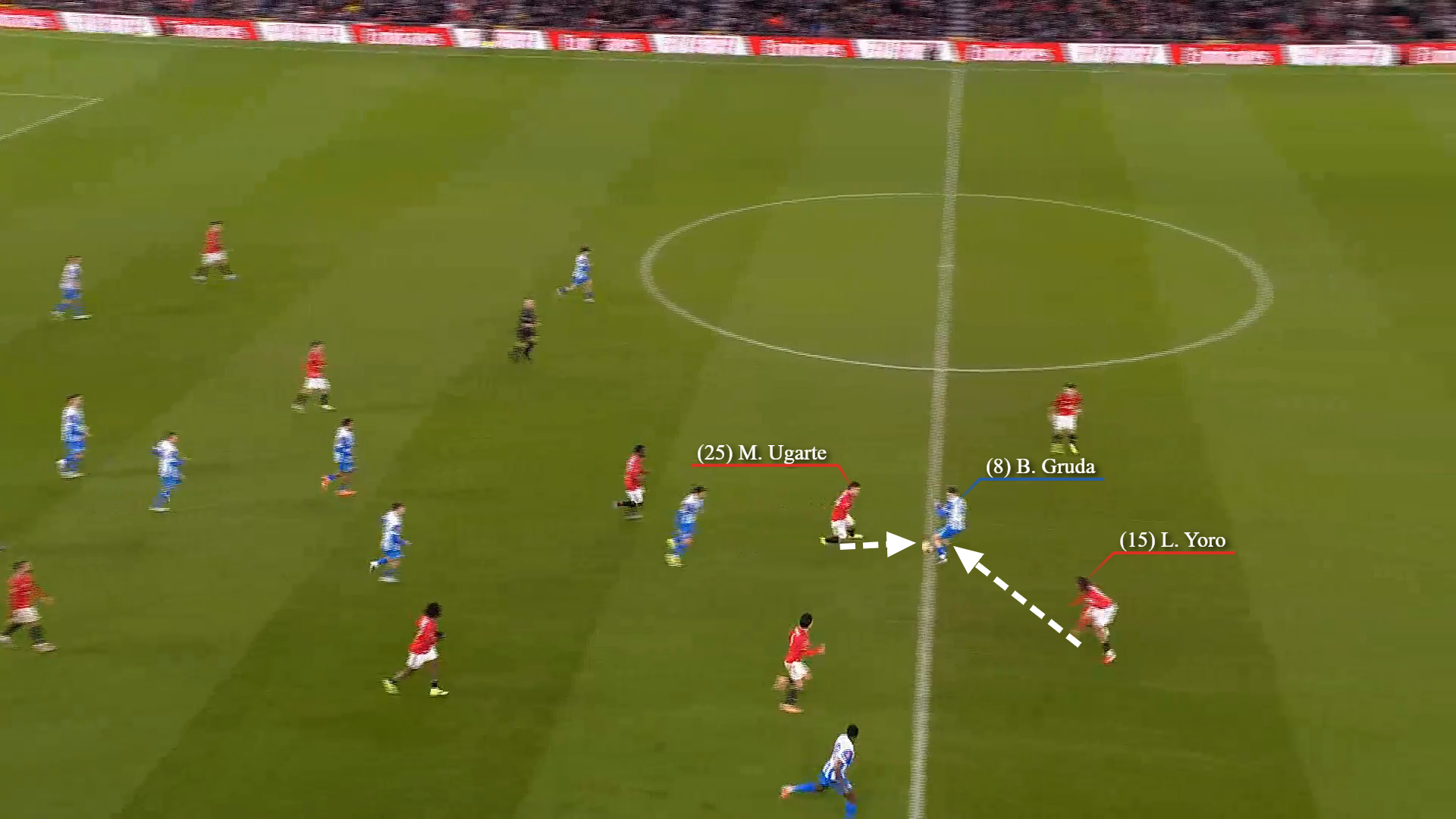
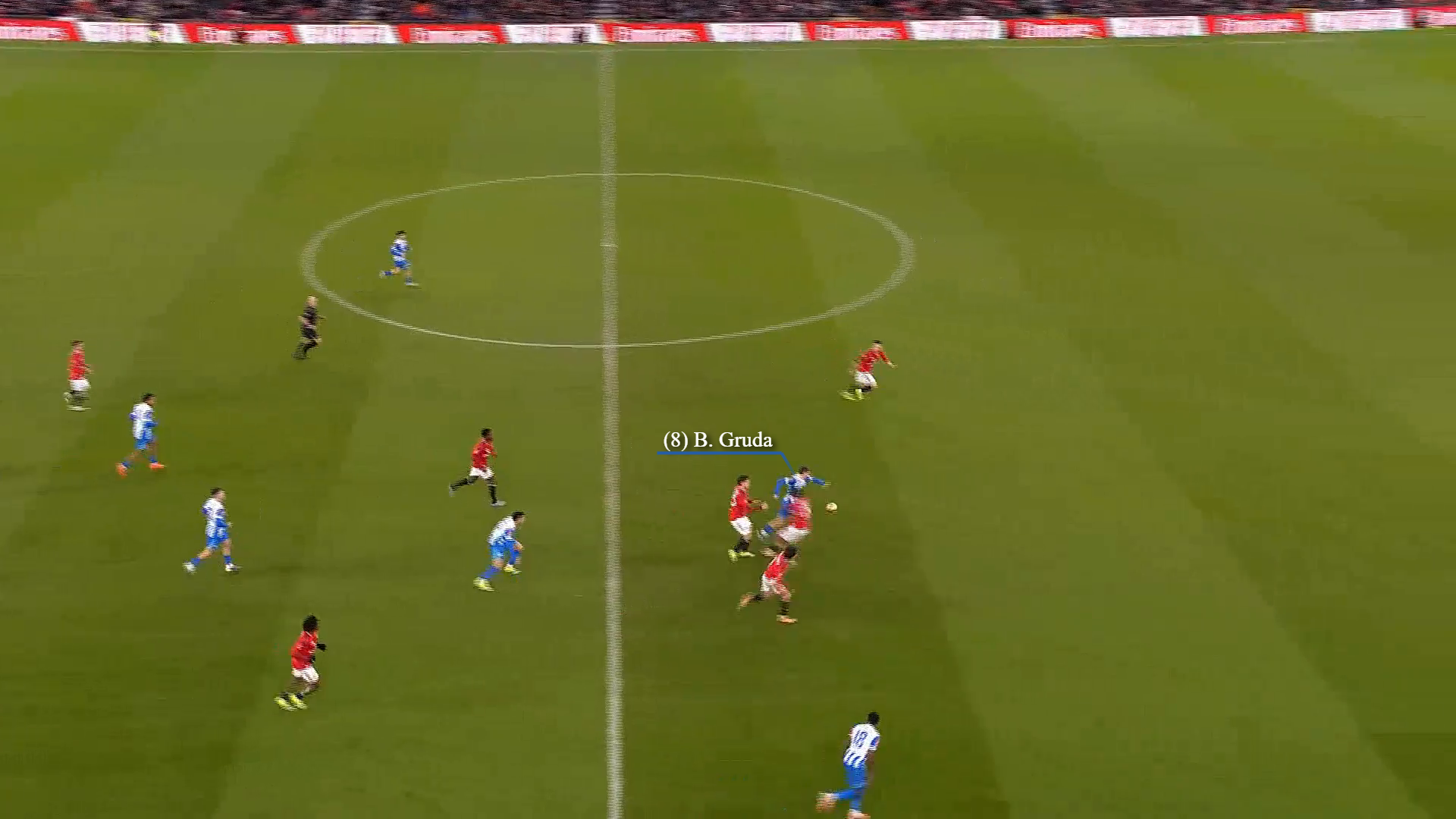
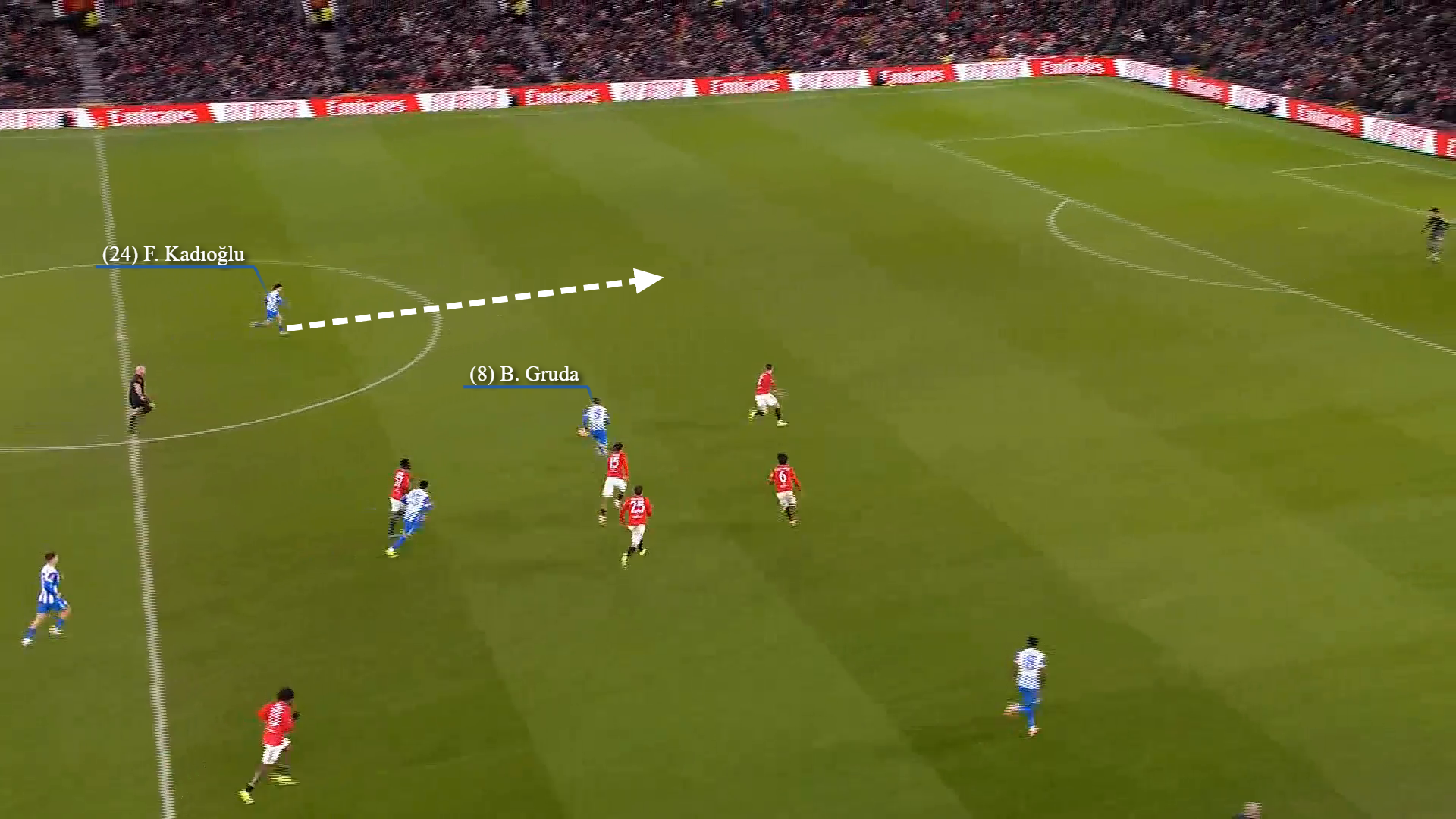
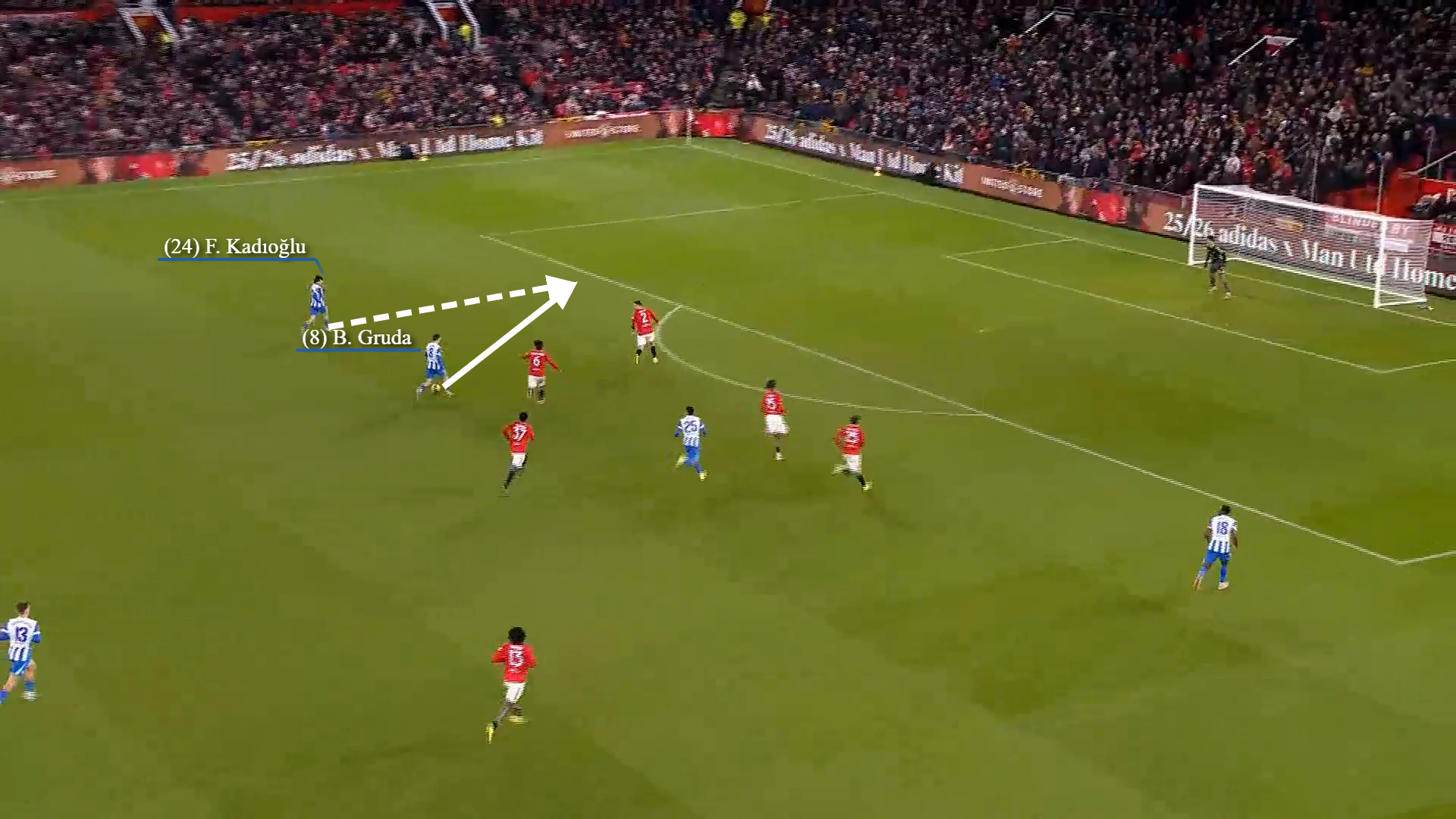
As seen against Manchester United, Gruda is at his best when he gets as many touches on the ball as possible.
It lets him dribble, draw defenders toward him, beat them, and still make the right decision in a 1v1 by dragging the opposition full-back Diogo Dalot out of position.
The technical base is high in tight areas; he manipulates the ball with small contacts, using subtle shifts.
He is a two-way dribbler in the important sense that he can threaten both inside and outside without changing his tempo.
From the right, his left foot gives him natural end actions.
He can shape a shot from distance as soon as a carry opens a lane, which forces defenders to step earlier than they would like.
He can also play passes into the inside channel for runners or deliver the ball towards the far post.
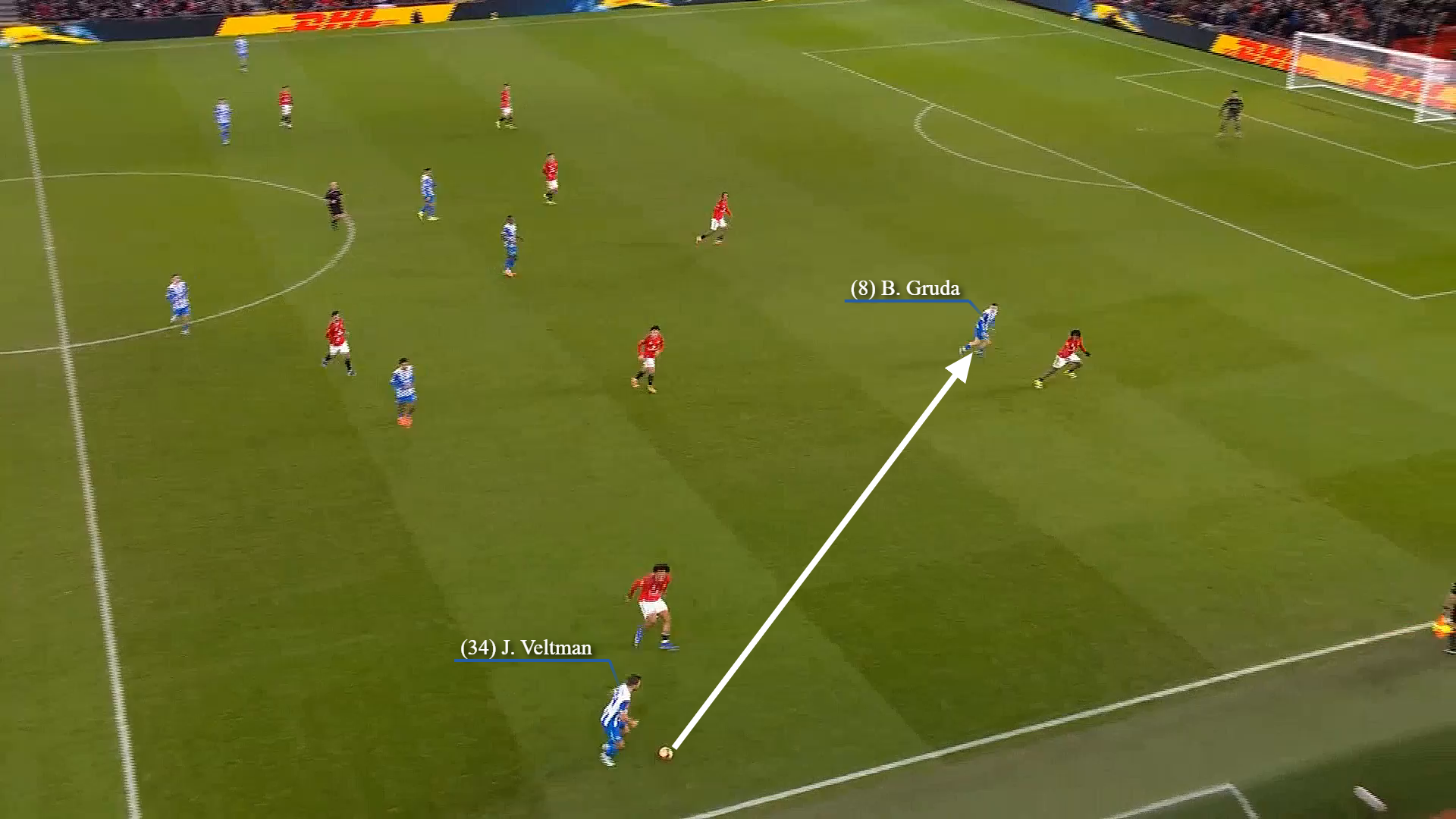
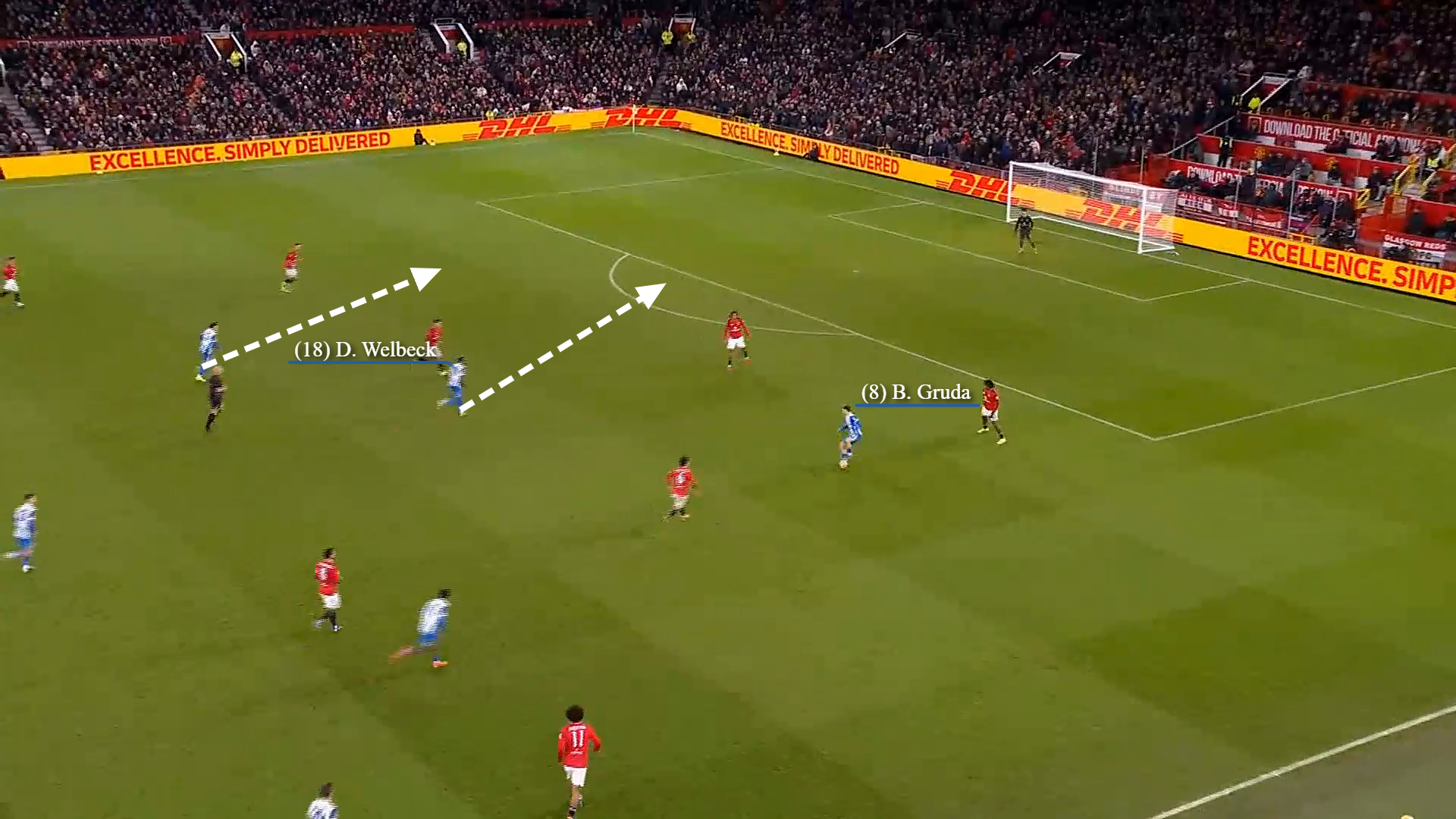
As shown in the images below, Joël Veltman plays a pass into Gruda in the half-space.
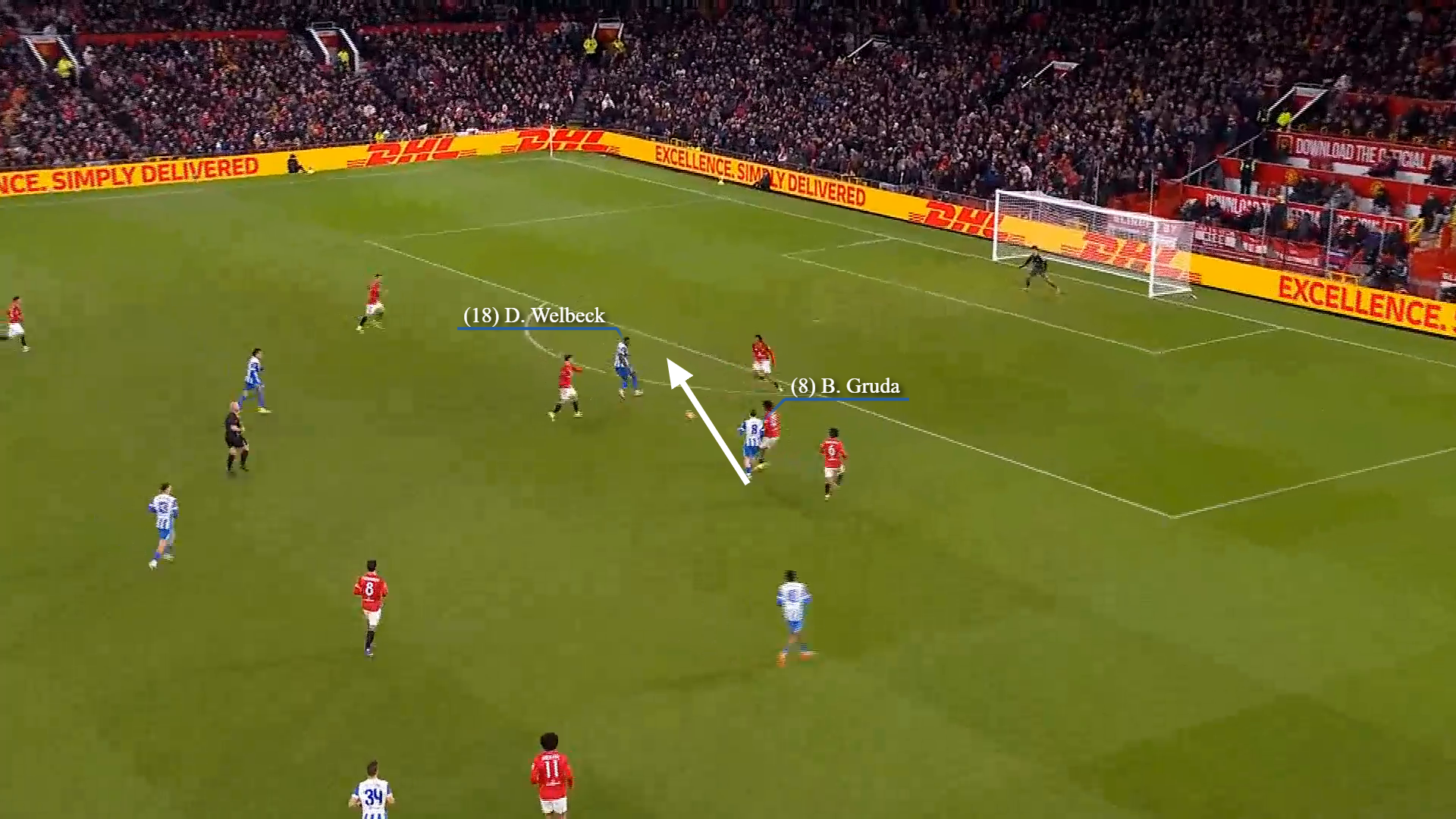
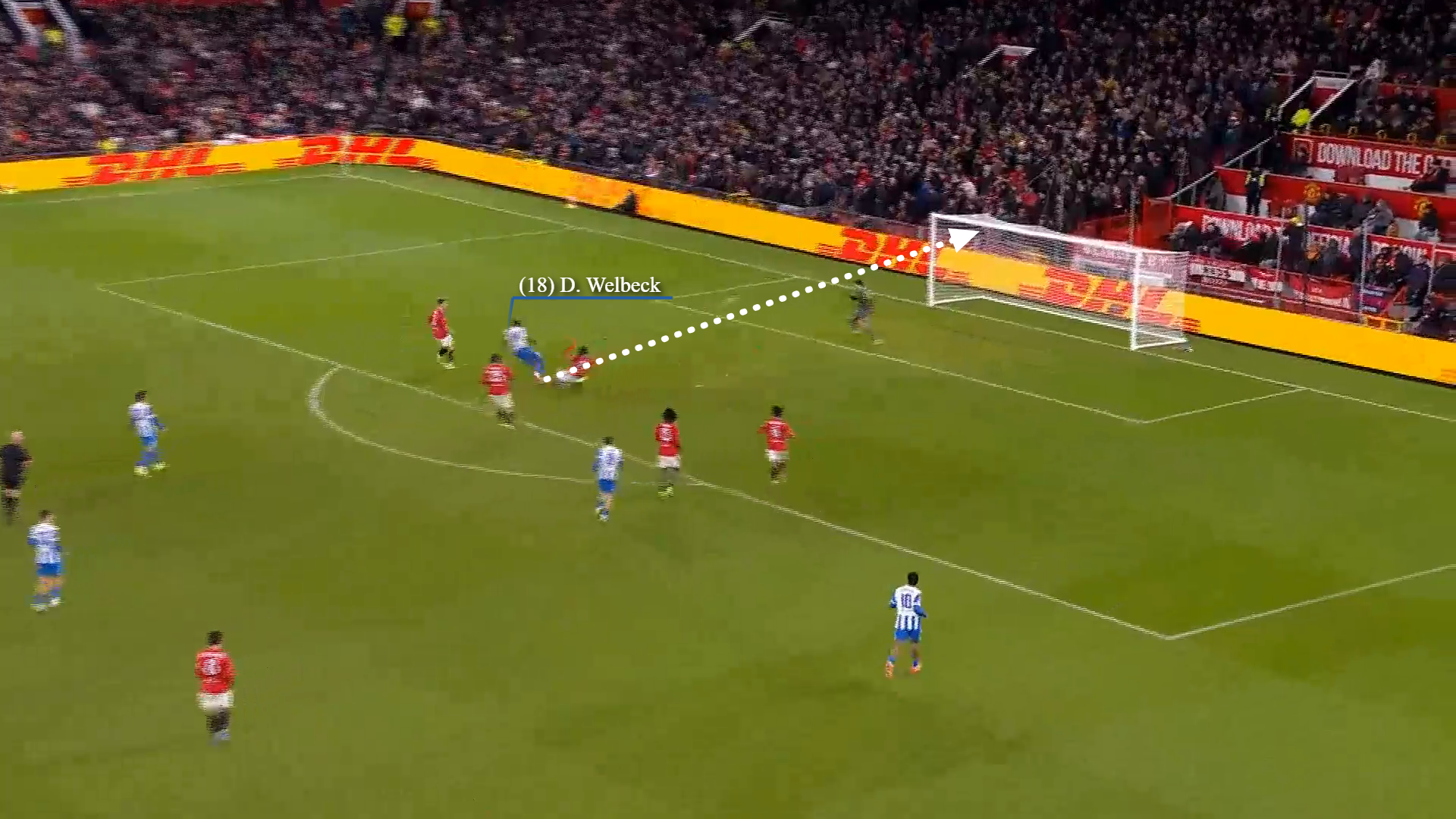
Gruda then turns and drives inside before slipping a perfectly weighted ball into Danny Welbeck’s path.
That detail matters because it gives Welbeck little time to adjust his feet and eliminates the need to take a touch or set himself up.
The pass is far enough in front of him to let it run and finish first time.
Another detail that stands out is how comfortable he is receiving at different heights.
He sometimes comes short to drag a fullback; other times, he holds a higher starting position to pin the line and then drops into the pocket.
What he does best is progressive carrying and dribbling that moves the attack.
He wants the ball at his feet and to beat a man.
As shown against Augsburg, Gruda initially receives on the right.
His first touch and body shape naturally sell the inside dribble, and he follows that cue by squaring up the opposing full back before beating him.
That duel pulls the defender out of position, and it is a moment where an overlapping run would have been a strong option.
Gruda then keeps close control under pressure, manipulating the ball to ride the next challenge and beat the second defender who steps in to try and win it.
That sequence opens space on the left side.
For a dangerous winger like Antonio Nusa, receiving in that area is a threat, but the final pass is played slightly too wide.
Nusa’s body shape was not set to take it on his left foot, which limited his ability to shift into a shooting position and reduced the chance of an attempt on goal.
His chance creation comes from the half-spaces, where distances are shorter, and the options are more dangerous.
A Modern “Wide 10” More Than A Winger
There is also a very modern use of an old profile in him: the second-striker type that has largely been rebranded as a wide 10.
Put Gruda closer to a striker and give him freedom to drift into pockets, and his strengths become more central to the attack.
As shown in the league match against Hamburger SV, Gruda takes up positions close to forwards like Antonio Nusa, allowing them to build combinations through give-and-go exchanges and quick lay-offs.
Here, he receives a cushioned set from Nusa and gets a shot away.
It adds another dimension to the attack and makes Gruda harder to defend.
This is because the opposition does not know whether he will return the ball or turn to shoot, and his presence in the box naturally draws a defender’s attention, creating another threat to track.
Gruda can receive between the lines, turn, and then either shoot or slide runners.
In that zone, defenders do not get the luxury of backing off for long.
A half step is the difference between a blocked lane and a clear one.
The swing factor, as with many ball-dominant creators, is end product consistency.
His value depends on whether the final decision punishes the space he has created.
How Can Ole Werner Get The Best From Brajan Gruda?
Werner can help him most by giving Brajan Gruda a role that allows him to repeat his best actions.
The best fit is a right-sided attacker who comes inside or plays on the right side of midfield.
His best moments come when he receives on the half-turn between the opposition full-back and the nearest midfielder.
And this can be achieved with the likes of Christoph Baumgartner and Xaver Schlager around him.
Also, building a small set of combinations that turn his dribbles into chances.
As seen against Borussia Dortmund, Brajan Gruda (number 10) is developing strong connections with his teammates.
There are plenty of fluid rotations, and his incisive, clipped forward pass helps drive the play on, with Xaver Schlager (number 24) often able to receive it.
Those third-man runs help open up the pitch, and Gruda’s movement and well-weighted passing make it a useful and dangerous weapon.
Leipzig does not need to overcomplicate it.
An aggressive overlap outside him can drag the full back and create the inside lane for Gruda to receive and drive.
An overlapping run from the right side, eight steps ahead of him, can be timed specifically for the moment Gruda attracts a second defender.
The principle is that his dribble draws a reaction, and Leipzig’s movement must be ready before the reaction happens.
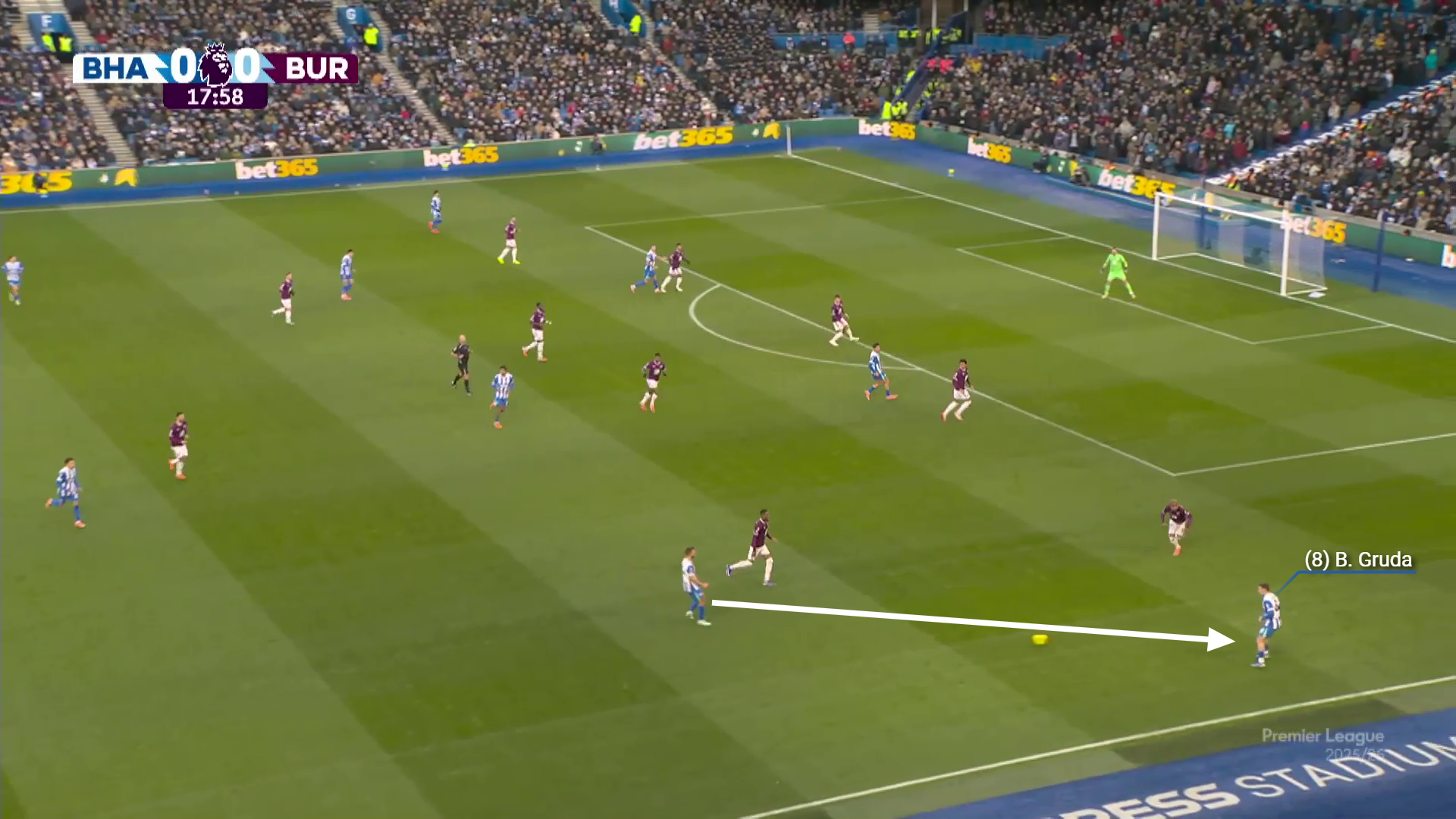
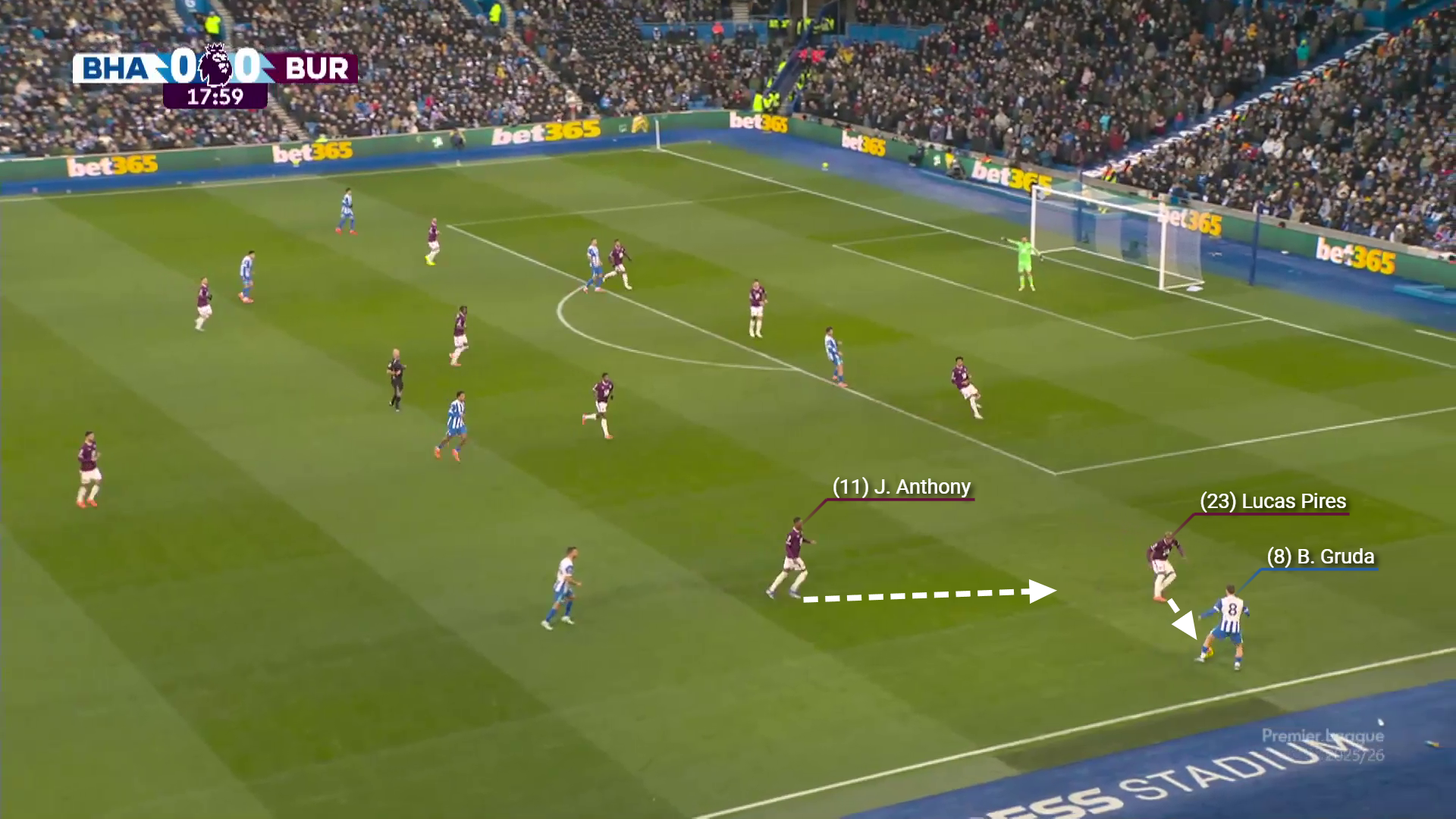
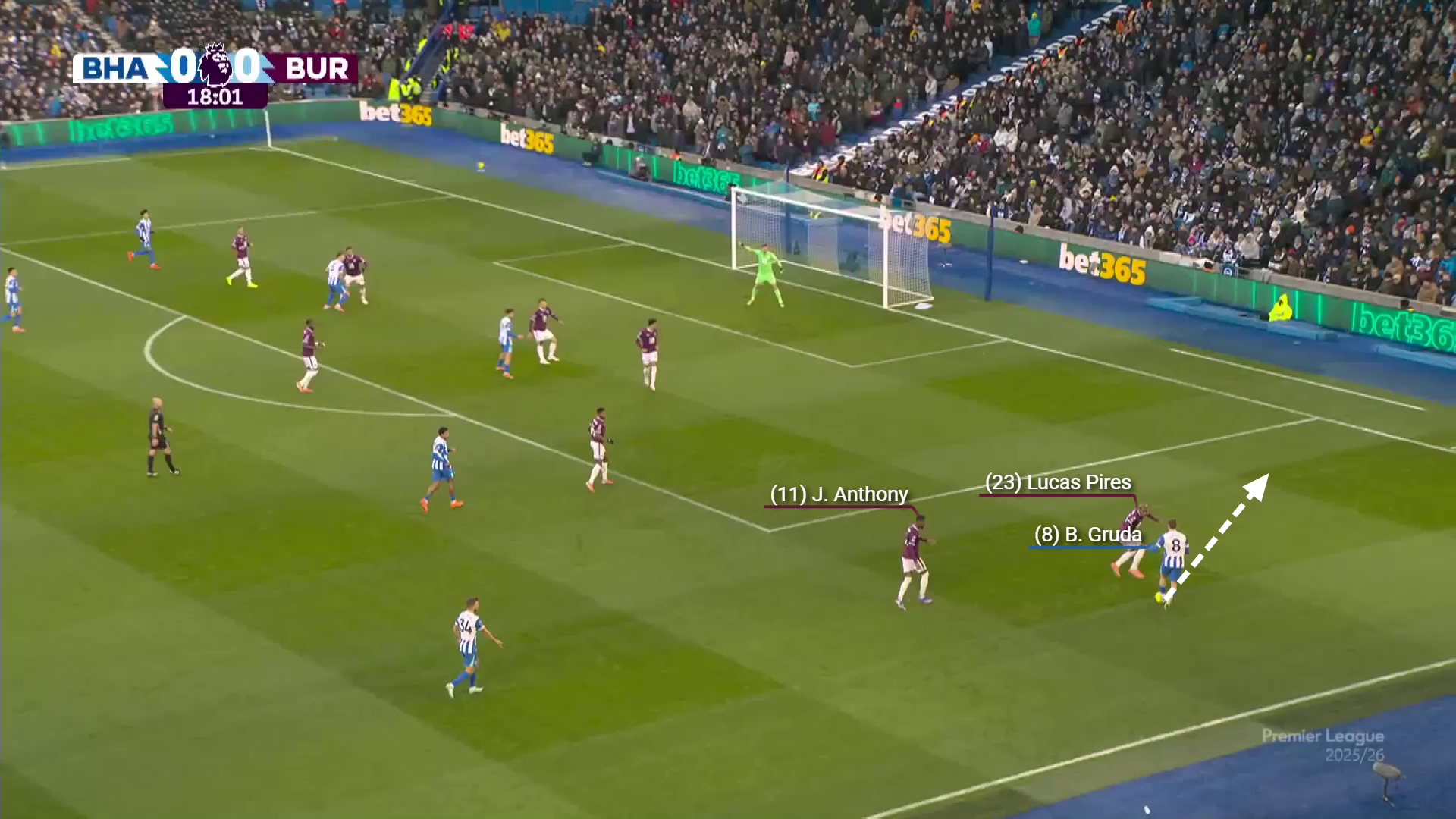
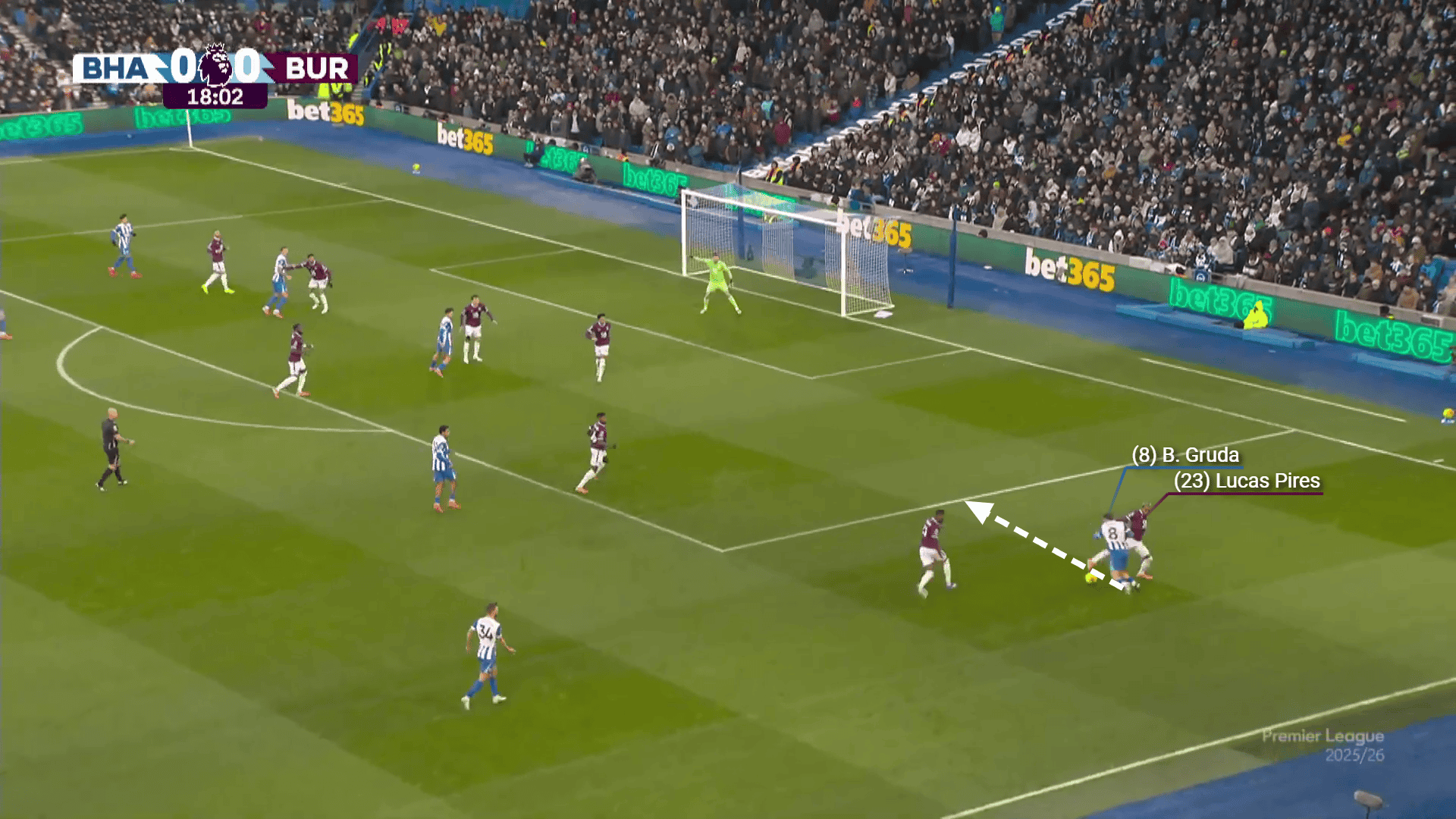
As shown against Burnley, Gruda receives the ball out wide and is initially in a 1v1 with Lucas Pires.
Pires signals for Jaidon Anthony to close the space and prevent Gruda from driving inside.
Gruda stays patient and avoids committing too early, selling the idea that he’ll take it down the line against Pires.
Instead, he recognises that Anthony isn’t disciplined enough in the expected double-team, shifts his speed and direction, bursts through the gap between the two Burnley players, and is brought down for a foul.
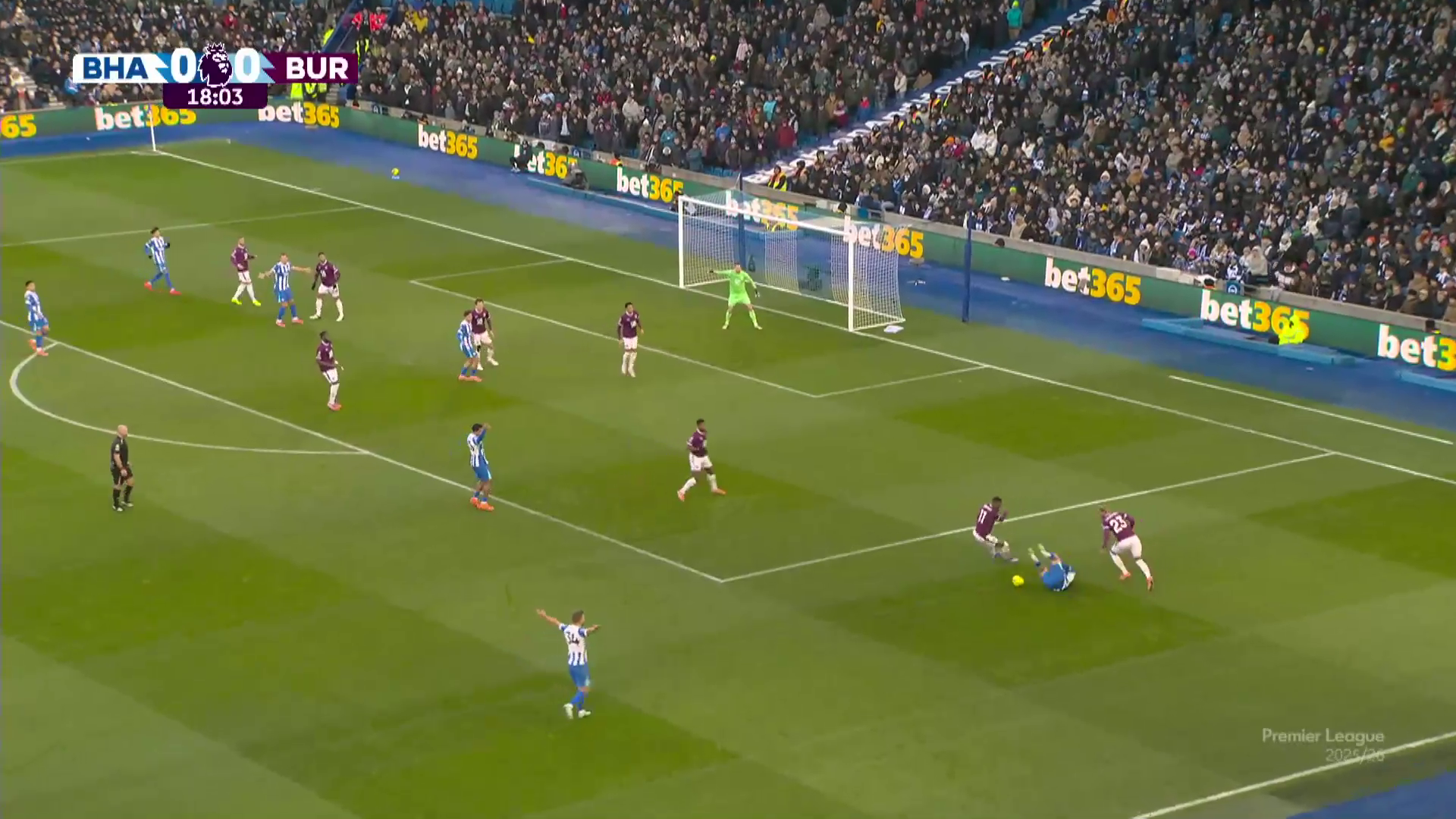
Brajan Gruda is most dangerous when the defender cannot contain him and waits for help.
Brajan Gruda Out Of Possession: Useful If Organised
Out of possession, Brajan Gruda can also fit into a Werner structure.
He can press, especially when asked to jump on a cue with cover behind him rather than sprint in isolation.
The key detail is the approach angle.
Curve the run to show the ball into Leipzig’s intended zone, either inside towards a trap or down the line into a predictable pass.
That turns effort into control and keeps Gruda fresher for attacking phases.
A rounded scouting report also must acknowledge the weaker phases.
Low-touch games can reduce his influence.
If the opponent defends deep and narrow and Leipzig cannot find him between lines, he can drift into searching behaviour, dropping too far just to feel the ball, which can leave the front line without a connector near the box.
Conclusion
A good loan season is what Brajan Gruda needs.
If Werner and Leipzig can keep him receiving in the half-space with runners moving around him, the loan can become the season where Brighton’s forgotten man looks like a featured player again.
Brighton’s right side remains open enough that a productive year in Germany can put him straight back into the conversation, and if the fit still is not there, there will be clubs willing to gamble on the young attacker.
