
RC Strasbourg hosted Olympique Lyonnais in Gameweek 23 of the 2025/2026 Ligue 1 campaign at the Stade de la Meinau.
Neither side dominated possession; however, the hosts were clear leaders in big chances (6-2), total shots (13-4), and touches in the opposition box (21-7), while having fewer final-third entries than their opponents.
Strasbourg felt comfortable with respect to the scoreline for the most part, as they went 2-0 up before Lyon pulled one back.
The contest ended with the hosts’ penalty in the 83rd minute.
In this Strasbourg vs Lyon tactical analysis, we aim to discuss the positive contributions of both sides and propose solutions to improve Lyon’s overall play.
RC Strasbourg Vs Olympique Lyonnais Lineups & Formations
Let us look at how Gary O’Neil and Paulo Fonseca fielded their squads.
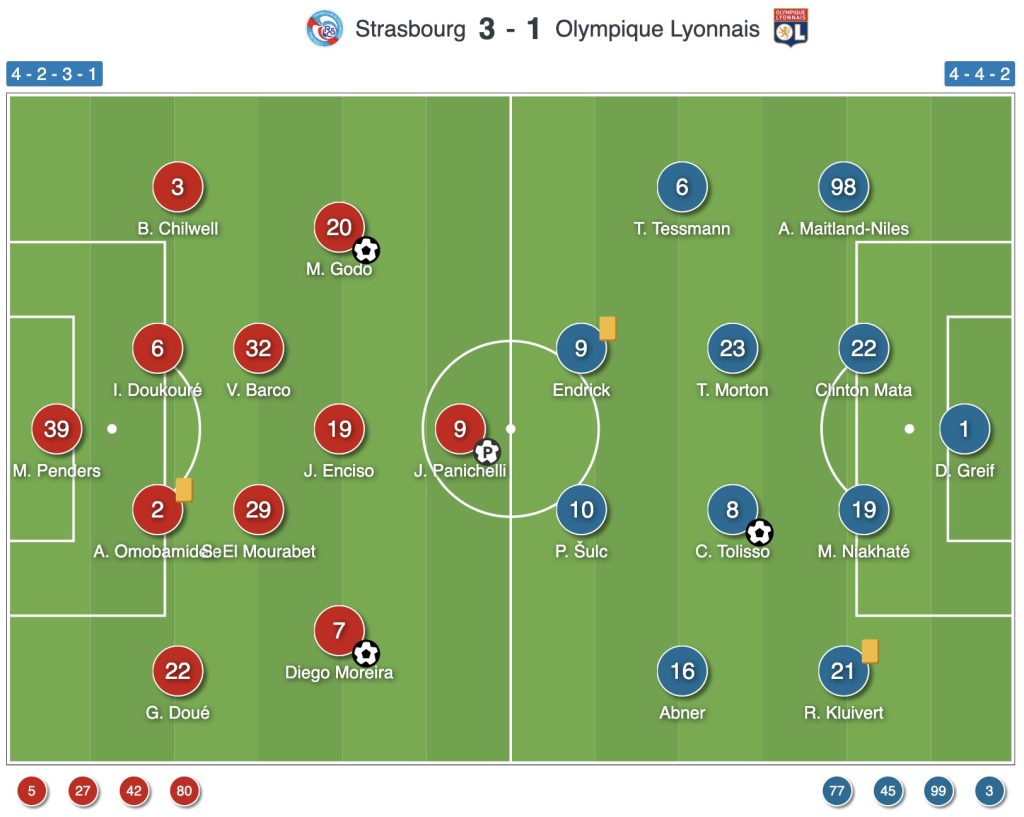
The hosts, Strasbourg, played in a 4-2-3-1 formation.
Mike Penders started in goal, behind a back four of Guéla Doué (right-back), Andrew Omobamidele (right centre-back), skipper Ismael Doukouré (left centre-back), and Ben Chilwell (left-back).
Omobamidele was replaced by Aarón Anselmino (90’).
Samir El Mourabet and Valentín Barco played as the double pivot.
Diego Moreira (right-winger), Julio Enciso (centre-attacking-midfielder), Martial Godo (left-winger), and Joaquin Panichelli (striker) were the front four.
Moreira and Enciso were taken off for Samuel Amo-Ameyaw (90’) and Abdoul Ouattara (85’), respectively.
The visitors, Lyon, played in a 4-4-2 formation.
Dominik Greif started between the sticks.
The back four were Ainsley Maitland-Niles (right-back), Clinton Mata (right centre-back), Moussa Niakhaté (left centre-back), and Ruben Kluivert (left-back).
The latter made way for Nicolás Tagliafico at the 85th minute.
Skipper Corentin Tolisso and Tyler Morton played as the two centre-midfielders.
Rémi Himbert replaced the former after 83 minutes.
Tanner Tessmann (right) and Abner Vinícius (left) played as the wide midfielders.
The former was taken off for Roman Yaremchuk (58’).
Endrick and Pavel Šulc played as the strikers.
The latter was replaced by Noah Nartey after 28 minutes.
Strasbourg Positive Performance
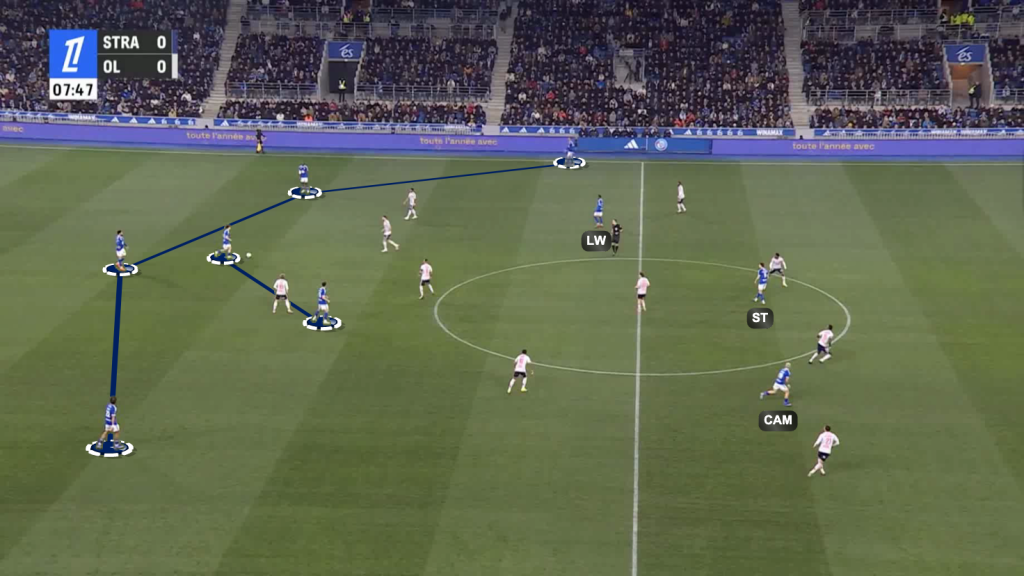 Strasbourg had an asymmetrical build-up, with one of the full-backs staying higher in possession.
This allowed one of the wingers to drift into the half-space as the situation demanded.
One of the pivots stayed deeper, often dropping outside the opponent’s structure to receive; the other pivot stayed higher, at an angle.
However, owing to the opponent’s defensive structure, it became difficult for the hosts to progress down the wide channel.
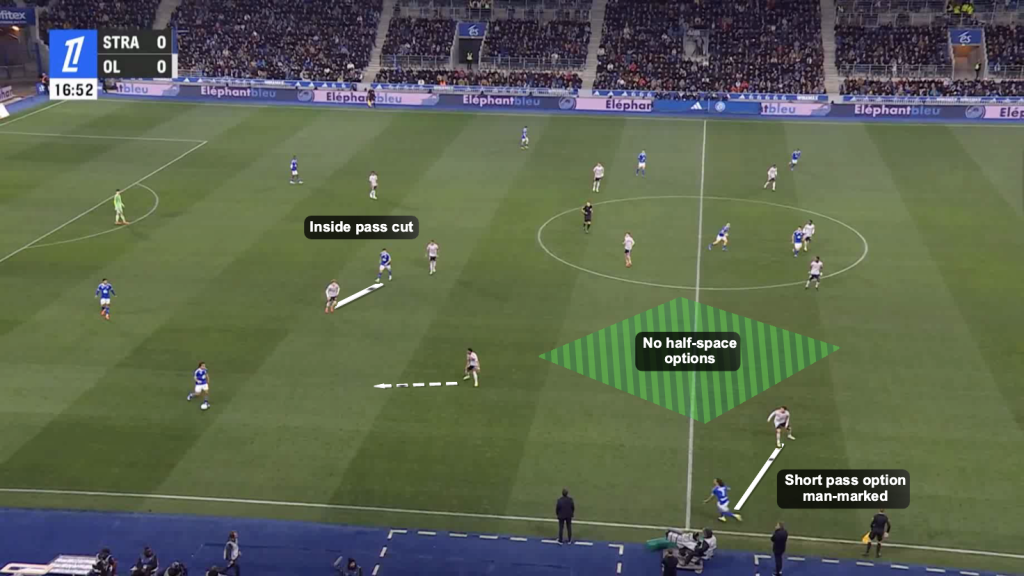
Strasbourg’s central penetration was inconsistent, as the vertical distance between the players was unfavourable to ground passes.
Once the full-back received from the centre-back, no inside pass was available since the lanes were cut out.
Additionally, the frequency of showing for the ball in the half-space was inadequate.
The winger, being closely followed by the opponent full-back, could not receive to feet.
Thus, he had to make runs in-behind to get on the ball, which did not prove effective at holding onto possession.
After receiving more support in the half-space and after injecting more mobility into the first and second phases, Strasbourg saw some success.
With more movement, they created more space, especially when the opponent committed more numbers higher up.
This is also how their opener came to be.
It started from a dynamic build-up situation.
As the centre-back played a vertical pass into the midfield, Strasbourg executed an up-back-through to bypass the first two lines of pressure.
A one-two immediately after that gave the ball-carrier ample space to carry the ball forward.
Within seconds, Strasbourg entered the attacking third.
The final ball came from a well-executed third-man combination, as Moreira played a chipped pass in-behind for Godo’s finish.
Apart from quick progression, the hosts also did well to recognise situations to shift play.
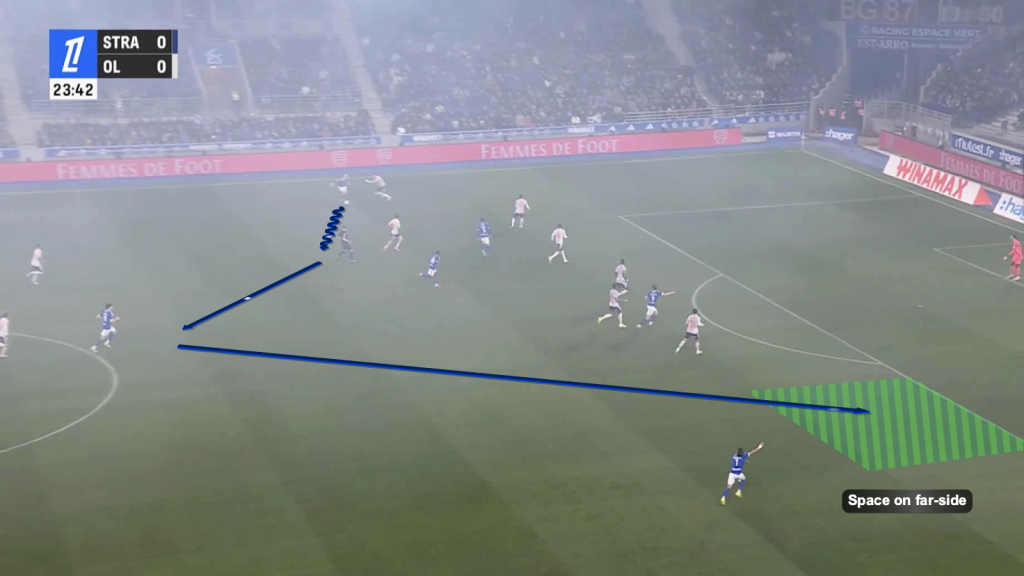
The left-winger realises that the space down the wide channel is scarce.
So, he cuts inside to find the midfielder, who shifts play to find the far-side winger with a lot more time and space.
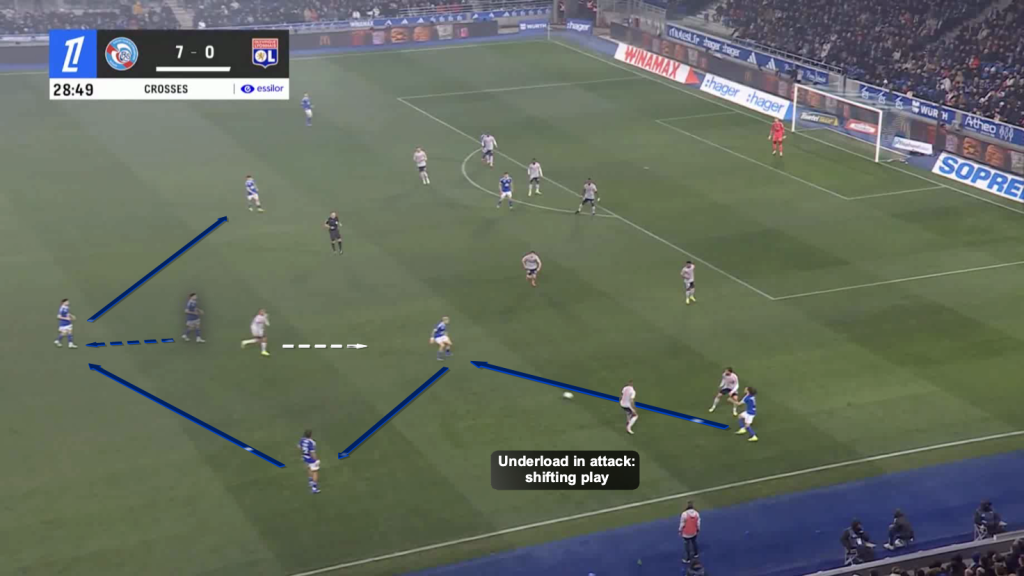
The opponents double up on the right-winger, which he recognises in time.
He finds his teammate in the half-space to execute a backwards in-to-out pass to get the ball out of the tight space.
Strasbourg ended up shifting play with ease.
Although they did not enjoy a lot of ball possession, O’Neil’s side did well to consolidate possession to slow the game down when required.
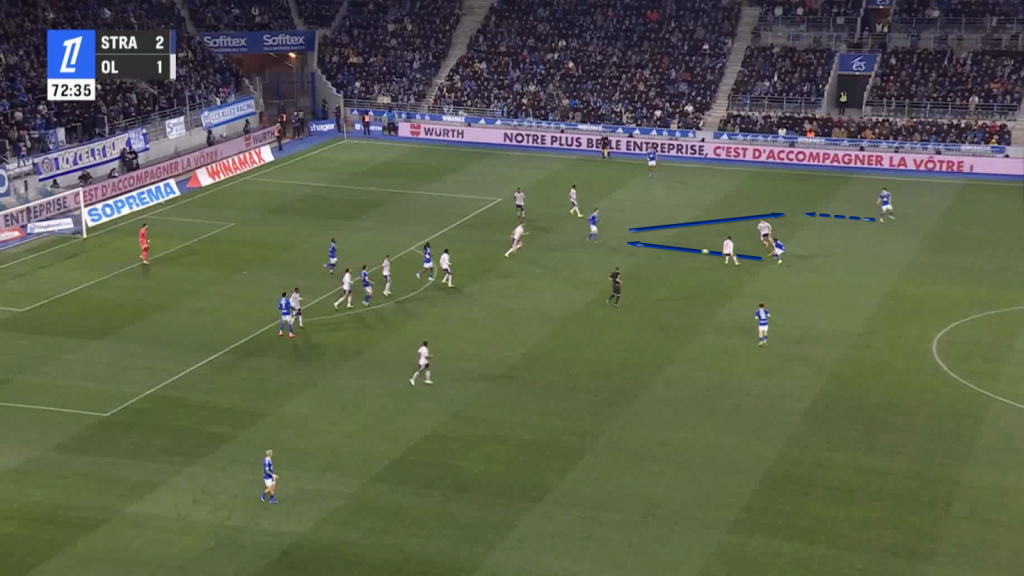
The opponents make a clearance; as Strasbourg wins the second ball, they are quick to find a third-man pass to bypass the immediate pressure.
By playing quick in-to-out passes through the opponent’s structure, they neutralised the pressure and circulated the ball with more control.
Defensively, Strasbourg set up in a mix of 4-4-2 and 4-1-3-2.
When the press was higher, one of the pivots sat deep to make it a 4-1-3-2.
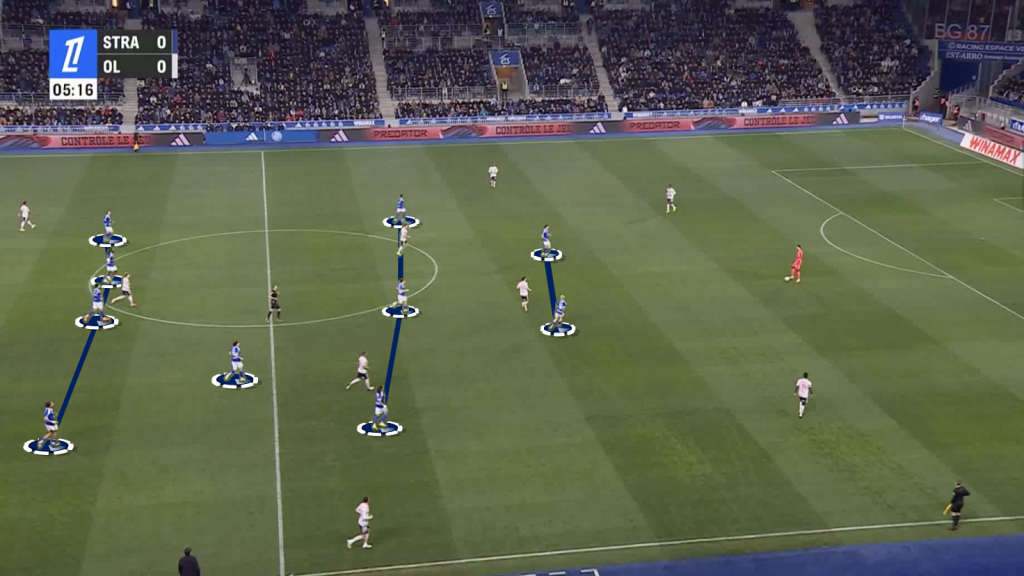
They displayed a compact shape on multiple occasions to force opponents to play wide, after which they would execute a wide squeeze.
This forced Lyon to either play it backwards or risk getting dispossessed.
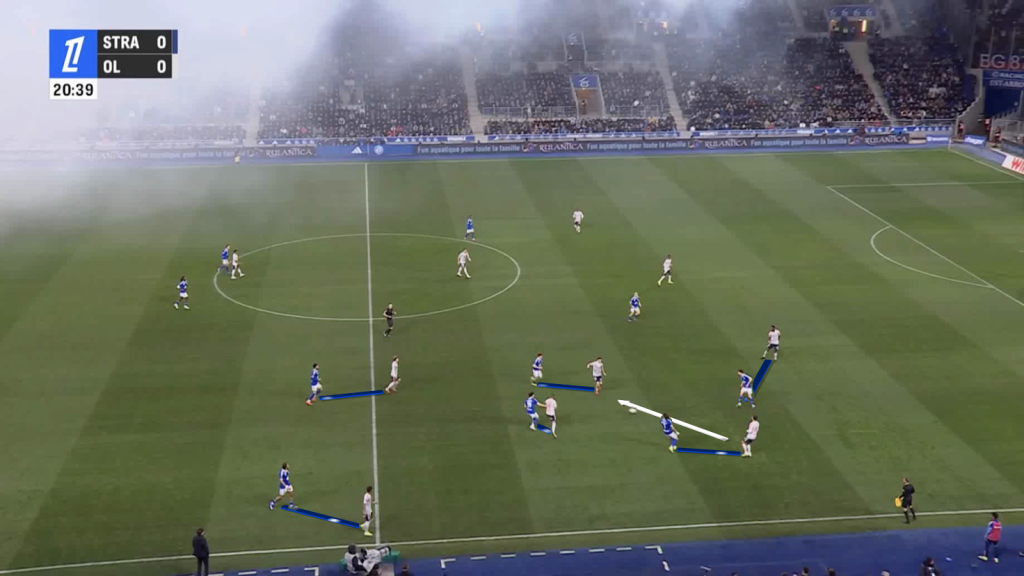
Lyon has the ball on the left flank: Strasbourg commits numbers to squeeze them in the wide area, including the centre-back.
When the pass is played inside the structure, the visitors lose the ball, and the hosts recycle it.
They demonstrated such pressing actions higher up the pitch as well.
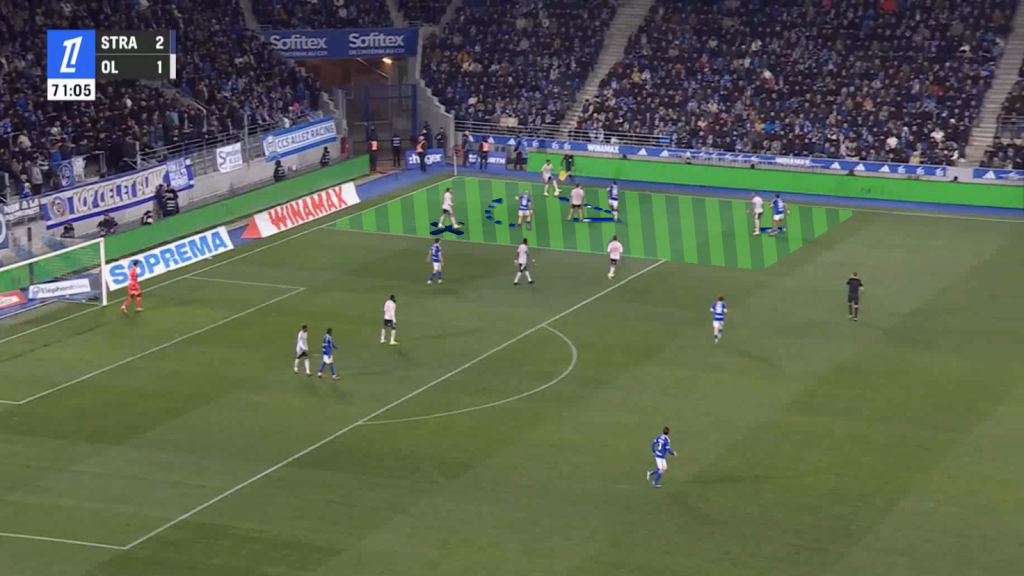
Although it was not the most consistent feature of their defensive display, they forced a fair bit of turnovers from these situations.
Here, Strasbourg has squeezed their opponent in the wide area in the attacking third.
Even though the opponents are in a 4v3 overload, they still lose the ball because there’s no space to find an exit.
Olympique Lyonnais Positive Features
Despite the disappointing final score, Lyon showed some good tactical moments.
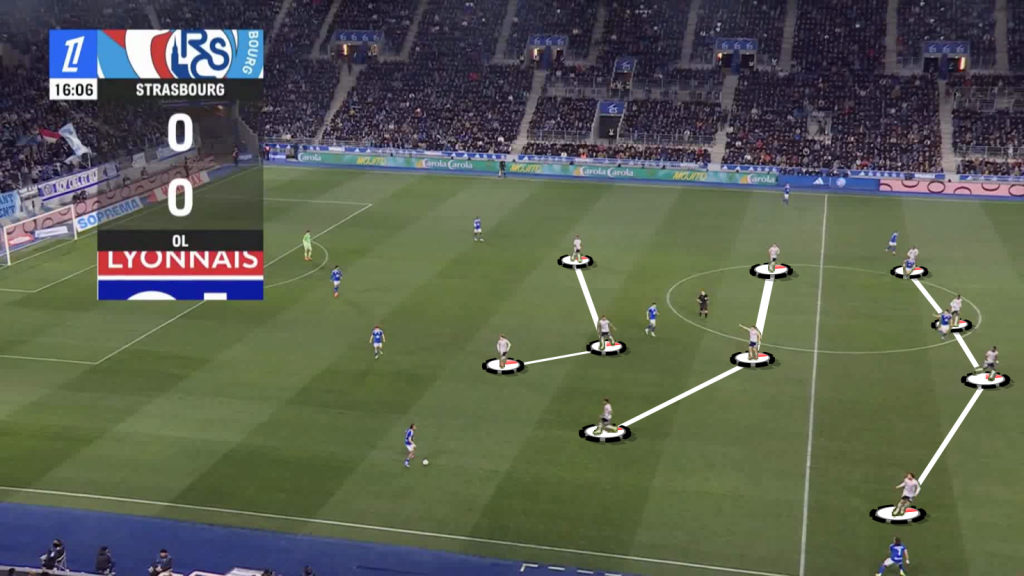
Their 4-3-3 defensive shape was an interesting approach.
The front three stayed compact to force the opponents to play around their structure.
The striker stayed slightly deeper than the wingers and was noticeably close to the opponent’s pivot to prevent central progression.
Meanwhile, the midfield three stayed relatively wide and engaged the opponent full-backs to halt progression in the wide channel.
This caused some problems for Strasbourg during the first 20 minutes.
They also made sure to execute their high press with a similar shape.
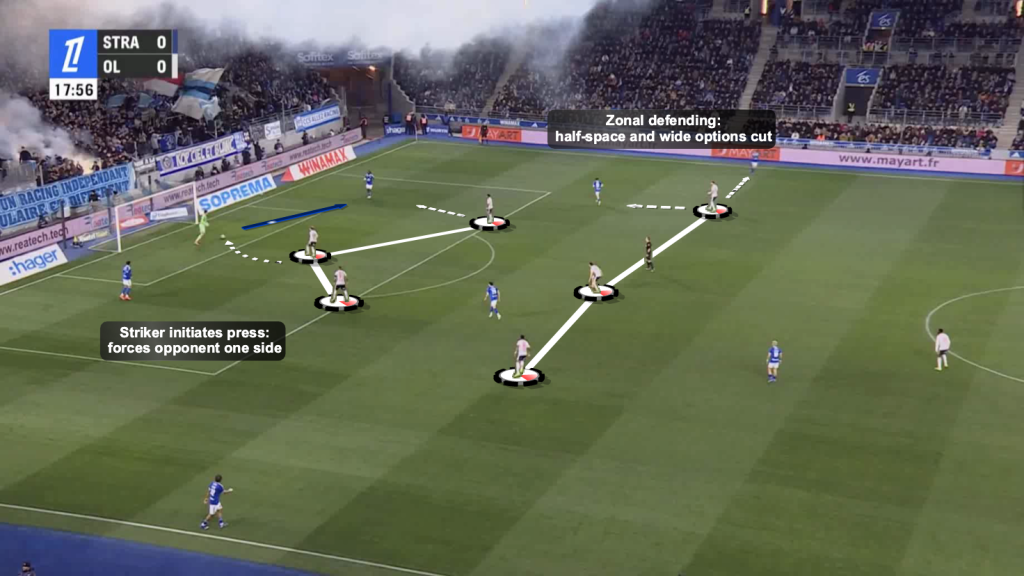
The striker initiated the press, approaching the goalkeeper.
The wingers were tasked with pressing the centre-backs.
The midfield three, once again being wider than the front three, made the second line of press tricky to deal with.
Once the opposition goalkeeper played the ball to the centre-back on one side, the striker would curve his pressing run, cutting the pass back to the goalkeeper.
The ball-side winger pressed the opposition centre-back; meanwhile, the wide midfielder was seen executing zonal marking, positioned halfway between the opposition pivot and full-back.
This left Strasbourg no option but to play long.
Although inconsistent, Lyon saw some success in build-up moments, especially in the first phase.
As Strasbourg attempted to force them wide by keeping a compact shape, there were a few moments when they found progression by playing a simple pass into the wide channel.
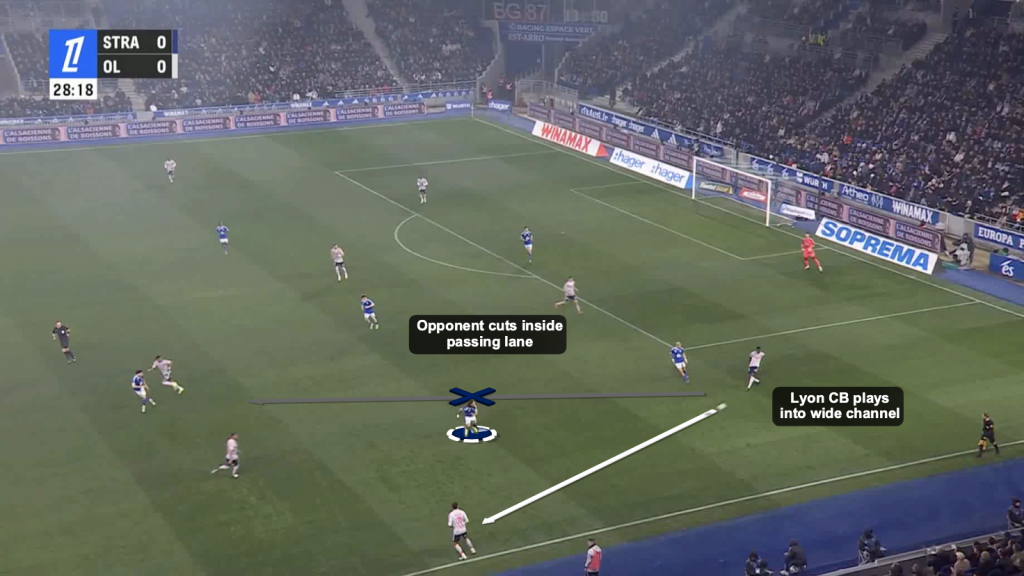
Lyon’s left centre-back receives the ball: Strasbourg’s right-winger attempts to cut the inside passing lane.
This leaves enough space on the outside for the Lyon left-back to carry the ball.
These moments tempted the hosts to overcommit in the wide areas.
Fonseca’s side exploited this occasionally.
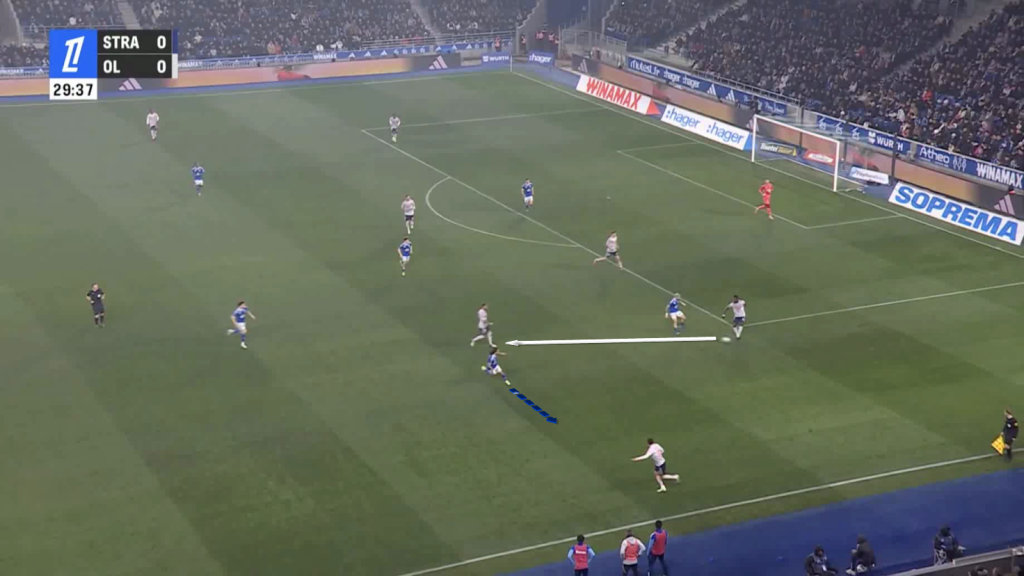
With the same three players involved (Lyon’s left centre-back and left-back, plus Strasbourg’s right-winger), this time, the ball goes inside the structure.
The right-winger steps to cover the outside pass; meanwhile, the left centre-back, who still has a moment to decide, plays a reverse pass to his pivot.
There were situations in which a midfielder dropped outside the structure to add numbers in the build-up.
This also allowed the full-back to push higher, and in turn, make a bigger shape.
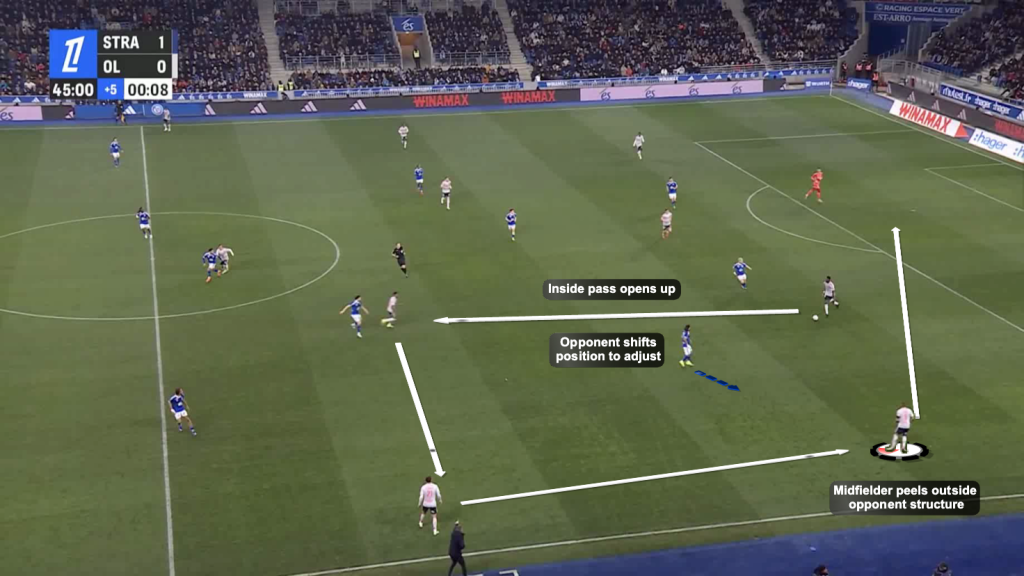
With the midfielder outside the structure, the opposition had to stretch out their first line of press horizontally.
This naturally opened the inside passing lane.
Through this adjustment, Lyon played in-to-out passes to reach the full-back.
If there was more pressure in the wide area, it was safe to move the ball back to the midfielder, who then moved it around the back to shift play.
Lyon enjoyed short stints of comfortable possession through these positional changes.
The eventual action arising from these combinations was a progression from a wide channel.
This is how they scored their solitary goal.
From a dynamic build-up moment, the pivot finds the left centre-back.
Simultaneously, the pivot, who had dropped outside the structure, moves up, dragging an opponent with him.
This opens the passing lane to the left-back; once he plays it vertically in the wide area, six opponents are taken out of the game.
Within seconds, they enter the attacking third and score from a cross.
By virtue of smooth progressive play, the goalscorer faces an unorganised back line and gets enough time to receive the cross and slot it home.
There were also a few moments in the attacking third when Lyon players created space for one another through their mobility.
Lyon wins the second ball right outside Strasbourg’s penalty area.
The player in the half-space passes to the winger and starts moving vertically; this opens a passing lane to zone-14.
A player arrives from there and receives in the half-space on the turn.
Upon turning, he offloads to a teammate more centrally positioned and moves away, dragging a defender in the process.
The end product is a blocked shot that results in a corner.
These moments were scarce for the visitors, which is why they failed to control the game.
Olympique Lyonnais Tactical Solutions
Going deep into their half, Lyon were seen shifting to a 5-4-1.
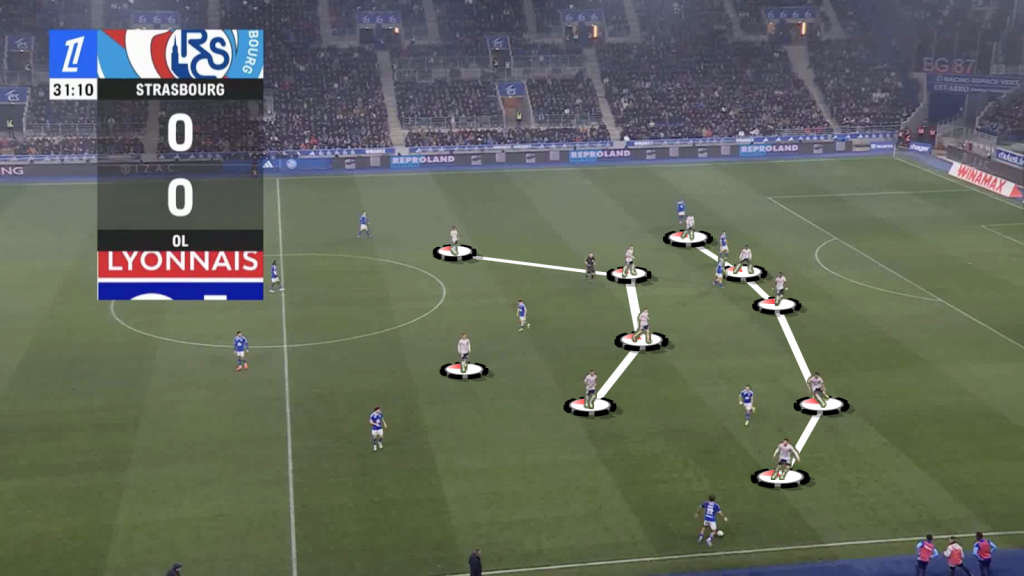
However, there were structural issues with the shape at times.
Although at this moment the shape looks secure and compact, it concedes a chance just moments later.
The striker and the far-side winger need to adjust their positions relative to each other to ensure the central channel is occupied.
Here, the striker being off-centre, and the far-side winger being disconnected, leaves enough space for the Strasbourg midfielder, who plays a chipped pass in-behind for a runner from midfield.
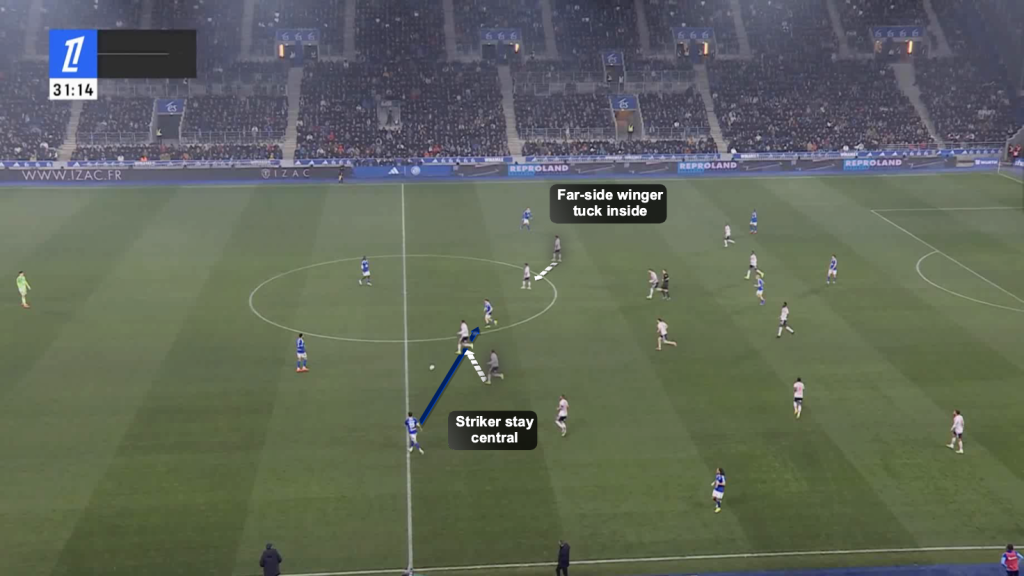
The striker can slide across to cut the inside pass.
The far-side winger tucking in can also help keep the shape intact and force the opponents sideways.
Lyon were also sub-par at consolidating possession and slowing the game down.
Upon receiving in the central channel, the midfielder needs to quickly find the exit pass, as he is under pressure from multiple opponents.
The simplest option is on the same side as the ball came from.
Once he receives with his back foot, the simplest option is to lay it off to the wide area for the arriving centre-back.
However, a lack of awareness here costs them possession.
Lyon were at the precipice of some high-quality chances, but could not create them due to a lack of composure in the attacking third.
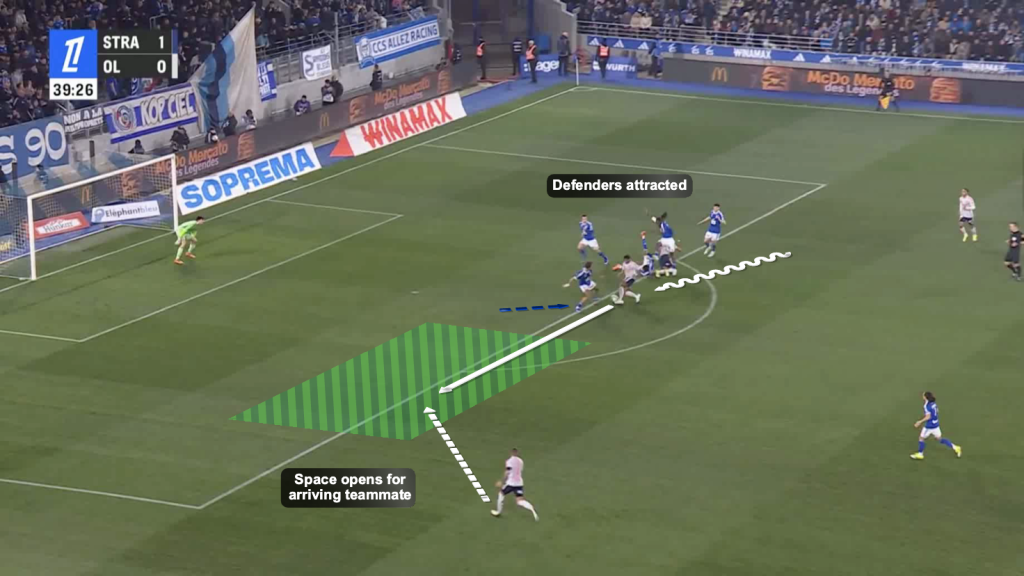
The ball-carrier does a great job dribbling it all the way to zone 14, but gets dispossessed upon complicating the situation.
The simple fix is to lay it off to the arriving teammate holding width.
The ball-carrier has drawn all the defenders in the vicinity with his dribbling, making it straightforward for his teammate.
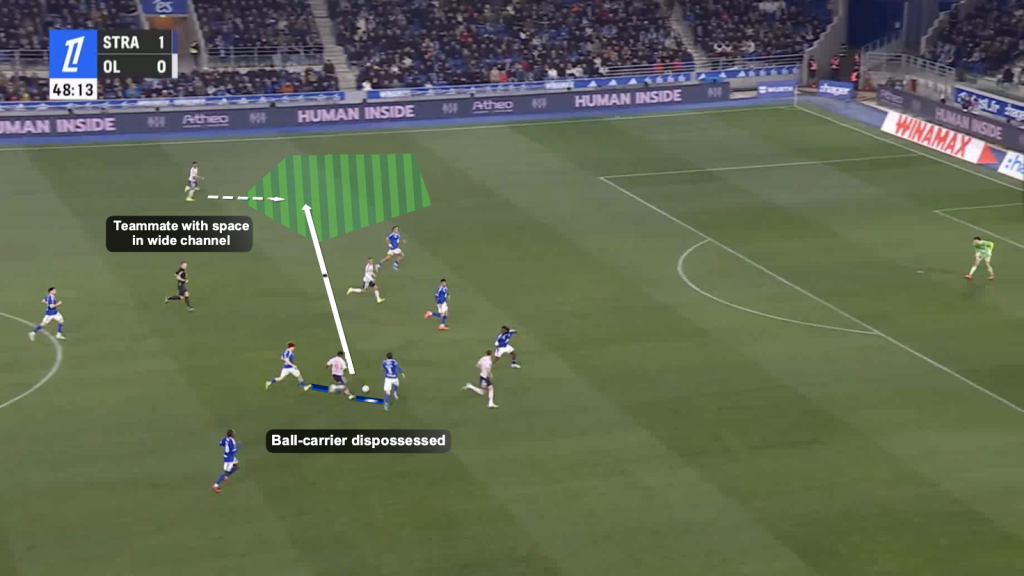
A similar example where the ball-carrier gets dispossessed for holding onto the ball for longer than required.
The teammate in the wide channel is better positioned to operate with the ball.
Conclusion
Strasbourg did not achieve much success in retaining possession in their own half.
They also struggled in finding smooth progression, especially during the first 20 minutes.
Upon reaching the attacking half, they recognised space well and shifted play accordingly.
They also found occasional success by executing passing combinations while being mobile.
Olympique Lyonnais faced similar struggles in the build-up, finding occasional moments of progression, especially by either playing directly wide or by playing in-to-out passes to release their wingers.
Lyon’s defensive structure forced their opponents to play around it; with the front three compact and the striker slightly deeper, the opposition pivot did not get much of the ball inside the structure.
Their wider midfield posed a challenge for opponents in progression.
When their structure was unorganised, the opponents exploited them, especially through the central zone.
With more composure and awareness in moments of consolidation and attacking in the final third, they could have achieved a better result.
