
Paulo Fonseca was appointed by Olympique Lyonnais on the 31st of January, 2025, to improve overall performance and achieve European qualification.
Lyon had played 19 matches at that point and had only one win in their last five showings.
With him on board, they won seven of the next nine games, setting a positive benchmark.
Les Gones ultimately finished sixth in the Ligue 1 table, securing UEFA Europa League qualification.
Out of the 26 games he has managed so far, he has 17 wins, one draw, and eight losses, giving him an overall win percentage of 64.4%, much higher than the previous coach’s (57.1%).
Through this Paulo Fonseca tactical analysis, we are going to shed some light on the situation at Lyon and highlight the aspects in which he has improved his side, especially during the 2025/2026 season.
Olympique Lyonnais 2025 Debacle
Lyon have had their fair share of financial issues in 2025.
The holding company behind them reported massive debt and a drop in TV revenue.
DNCG, France’s football financial oversight body, banned transfers in January and provisionally demoted them to the second division.
After an appeal, their relegation was overturned.
All of these circumstances led to minimal transfer activity in terms of buying.
Meanwhile, they were forced to let go of many of their top players to reduce wage bills and acquire funds, replacing them on a tight budget.
Despite the extreme constraints, Paulo Fonseca and Lyon have had a great start to the season.
In nine matches in all competitions so far, Lyon have seven wins and just two losses.
They have scored 12 goals, conceding just five.
They have seven clean sheets, keeping one in every game they have won so far in all competitions.
Let’s look at how Lyon operate tactically under Paulo Fonseca.
Paulo Fonseca Attacking Tactics At Olympique Lyonnais
In this section, we will look at the attacking features of Lyon’s play.
Build-Up & Ball Progression

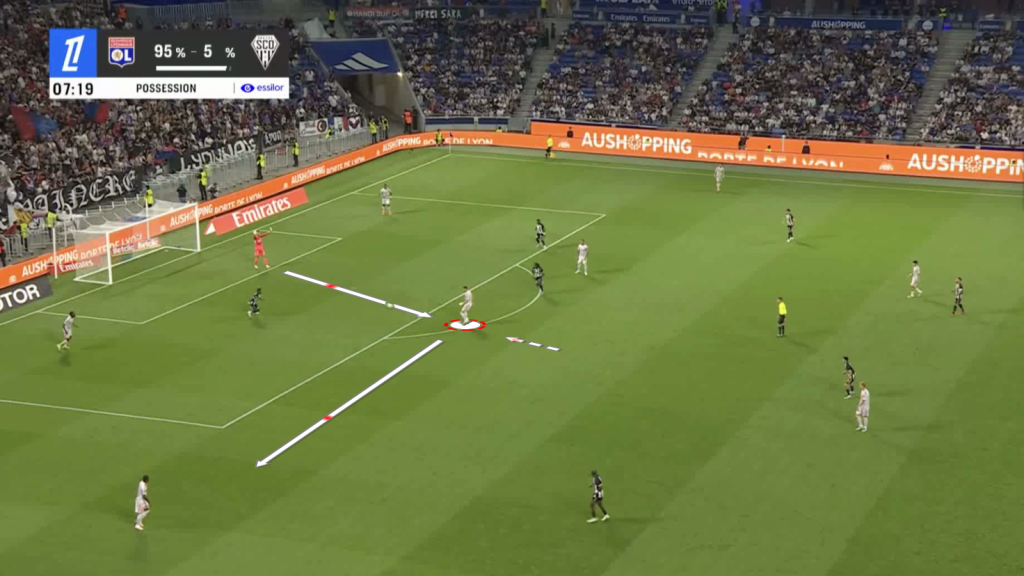
Lyon usually build-up either in a 4-3-3 structure with a single pivot or a 4-2-3-1 with a double pivot.
In the first case, the pivot acts as the deepest midfielder, offering a vertical option to the centre-backs and the goalkeeper.
In a double pivot situation, the ball-side pivot offers support to form a passing triangle, especially in the defensive third.
The image above shows a Lyon build-up scenario with a single pivot.
Here, the deepest midfielder has drawn an opponent, opening up a passing lane to his advanced midfielder.
With positioning like this behind the first line of opponent press, Paulo Fonseca’s side are able to progress without going long.
Here is an example of the double pivot.
We can see two midfielders on the edge of the penalty area, forming triangles with their full-backs.
In this situation, the goalkeeper receives the ball and plays it to the right-back.
This approach of going in to go out helps them create more space for the wide receiver, as the initial pressure is sucked in by the pivot.
Once they reach the midfield third, Lyon have displayed a tendency to form triangles between the lines, using them to play third-man passes.
This helps them find a player behind the first opponent pressing.
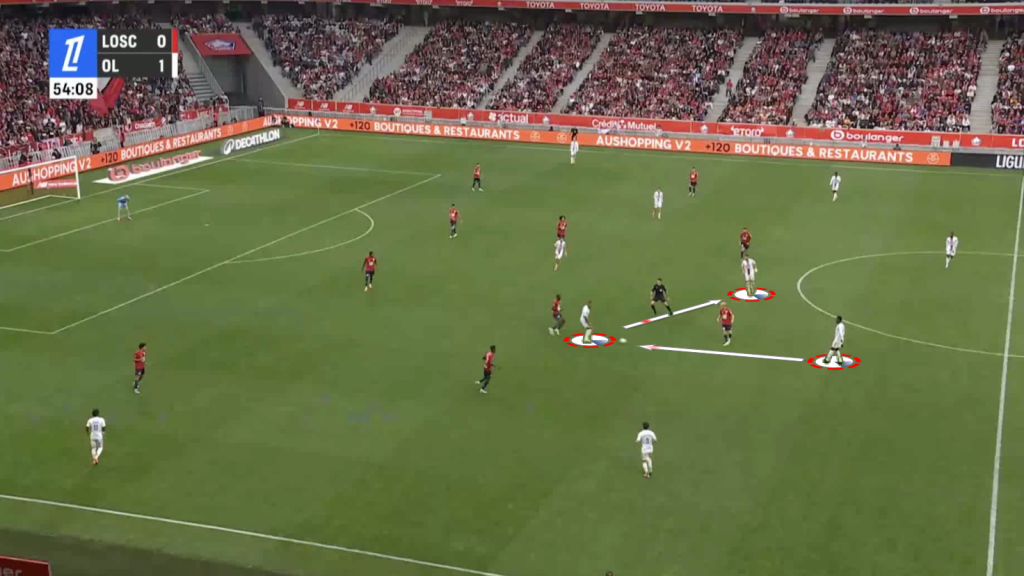
Here is an example: the centre-back finds a midfielder.
He finds the pivot positioned behind the opponent striker, who initially pressed the centre-back.
These midfield combinations move the opponents around, which opens up lanes to play vertically.
Paulo Fonseca’s full-backs often stay high and wide in possession, which gives the wingers room to operate in the half-space.
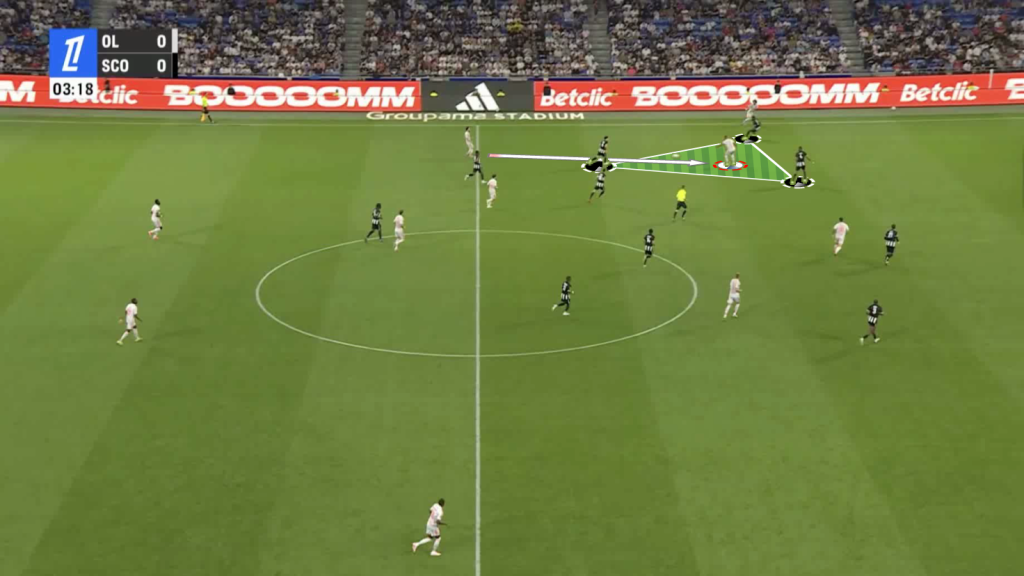
In this image, the left-back positions himself in the wide zone, attracting the opponent full-back.
This gives the left-winger enough space inside a pocket in the half-space.
The midfielder finds him with ease in this case.
From these situations, the winger can either combine with the striker or the full-back, depending on the open lanes.
There are also situations where the full-back providing width opens a passing lane for a half-space run in-behind for a winger or an advanced midfielder.
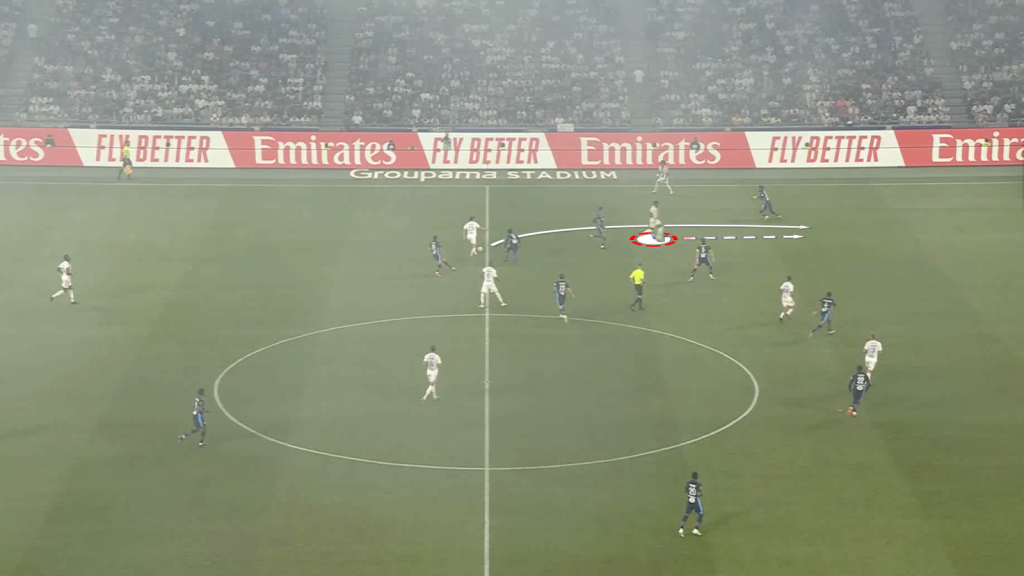
Here, the left-back’s positioning attracts the opponent’s full-back.
This opens the gap for the left-winger to receive on the run in-behind.
Due to the wingers’ ability to receive the ball in pockets, the opponent centre-backs are forced to step up and deny space.
However, sometimes it does not favour them, as the wingers then receive a pass behind, as shown in the example here.
Paulo Fonseca values pragmatism and adaptability in his system.
His players are comfortable playing directly to progress the ball whenever it is feasible.
It is also noteworthy that the attacking players on his side, especially the front three, are fluid in their positioning and movement.
The striker and the wingers often interchange positions to create space.
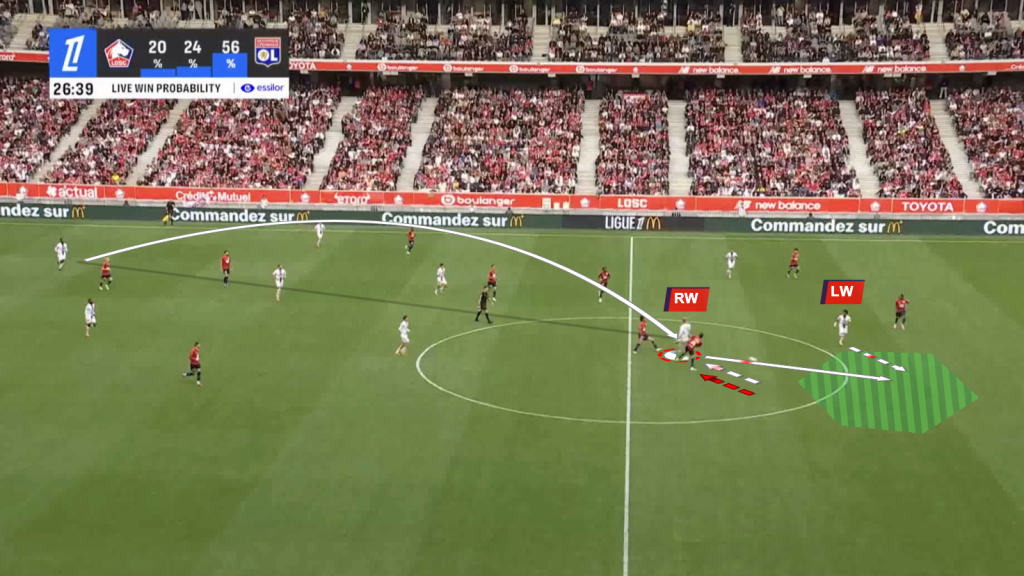
In this image, Lyon identifies the space available for direct progression.
Hence, the centre-back plays a long pass into the midfield third.
As illustrated, the wingers are moving in relation to each other, and are both positioned centrally.
Meanwhile, the striker is in the wide zone.
As the right-winger drops to receive the long ball, he is followed by his direct opponent (full-back).
This leaves space behind for the left-winger to exploit.
Entering The Attacking Third
Over the eight games this season, Lyon have made an average of 47.4 final third entries.
This is largely due to the use of width in attack.
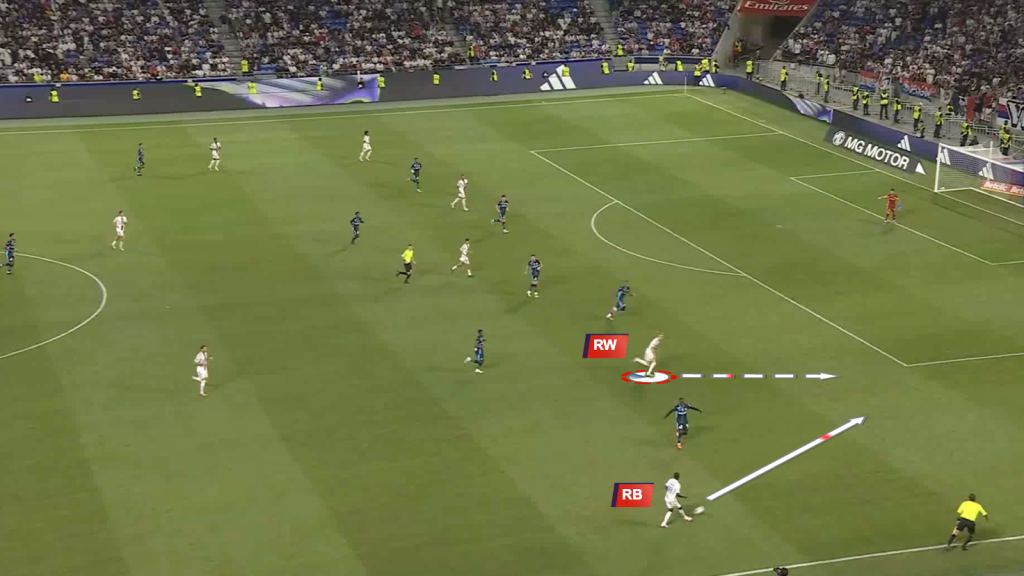
The full-backs staying high and wide allows the wingers space to make underlaps on the opponent’s full-back’s blind side.
In the image above, the right-back finds his winger, who makes an unerlap to receive in the attacking third.
These movements are very commonly seen under Paulo Fonseca.
To counter this, some opponents attempt to defend with numbers in the wide area.
This sometimes forces Lyon backwards; they, however, find a way to penetrate through combination play.
In this situation, Lyon have possession in the wide area.
However, the opponent has overloaded them in a 4-v-3.
They find space through off-the-ball movement to get the ball into a crossing position.
The final movement to receive also comes from an underlap.
In situations wherein there was a lack of space for these combination plays, Lyon aimed to shift play or find a central pass to penetrate quickly.
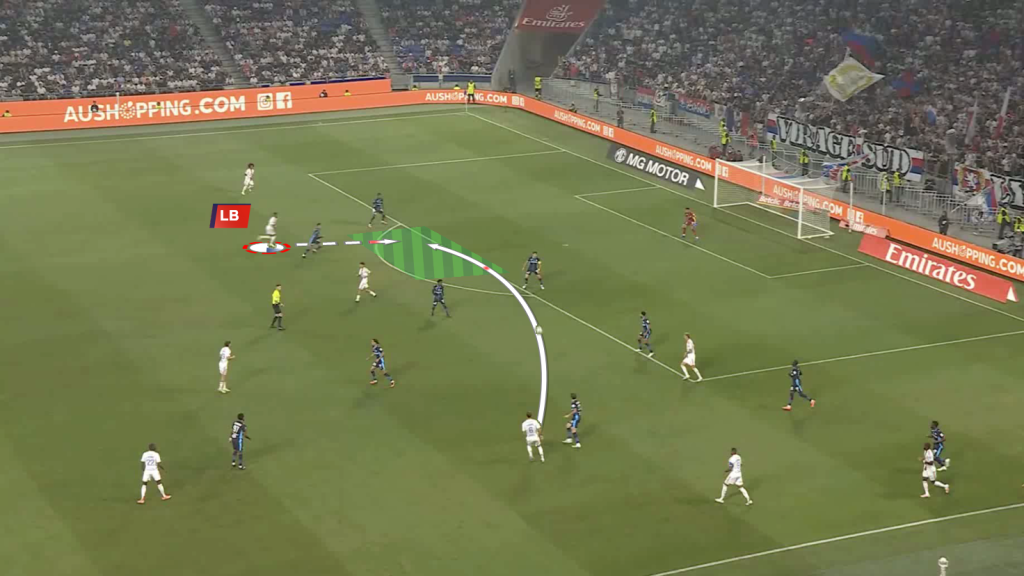
Here, the opponent has already cut out the space in the wide area by committing numbers.
This opens a space in the central zone, as the back line is somewhat disconnected.
As the left-winger is offering width at this moment, the left-back makes the inside run.
He ends up receiving inside zone 14.
Having variation in attack in forms like this helps Paulo Fonseca’s side to get shots away from different angles and positions.
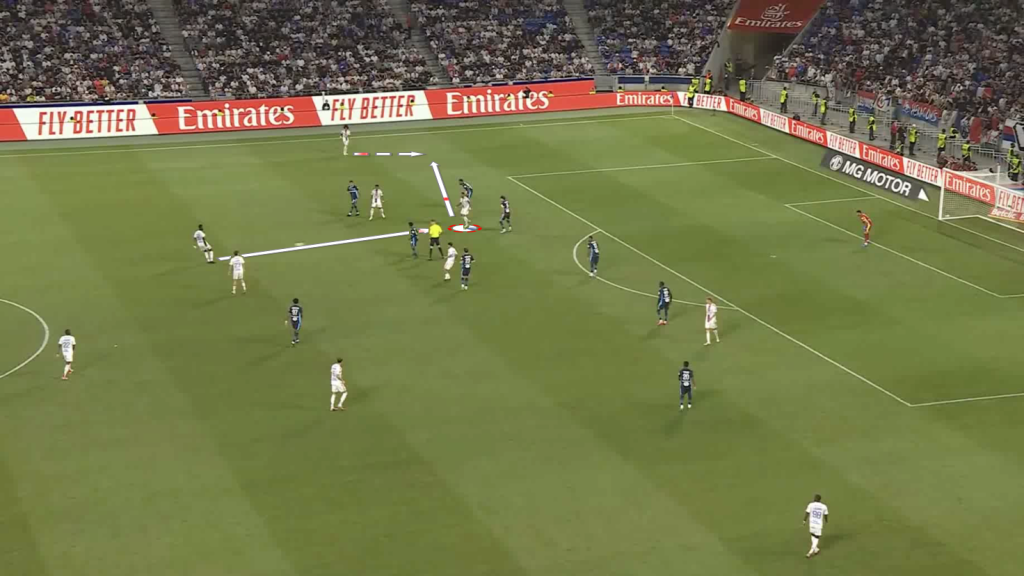
Third-man combinations are not limited to build-up and progression for Lyon.
They use these actions to drag defenders and create space in different areas.
For example, in the image above, the striker receives the ball in the left half-space.
Being surrounded by four opponents, he releases a pass to the left winger in the wide area.
This gives him enough space to either cross or opt for a take-on, and in some situations, find a teammate making an underlap.
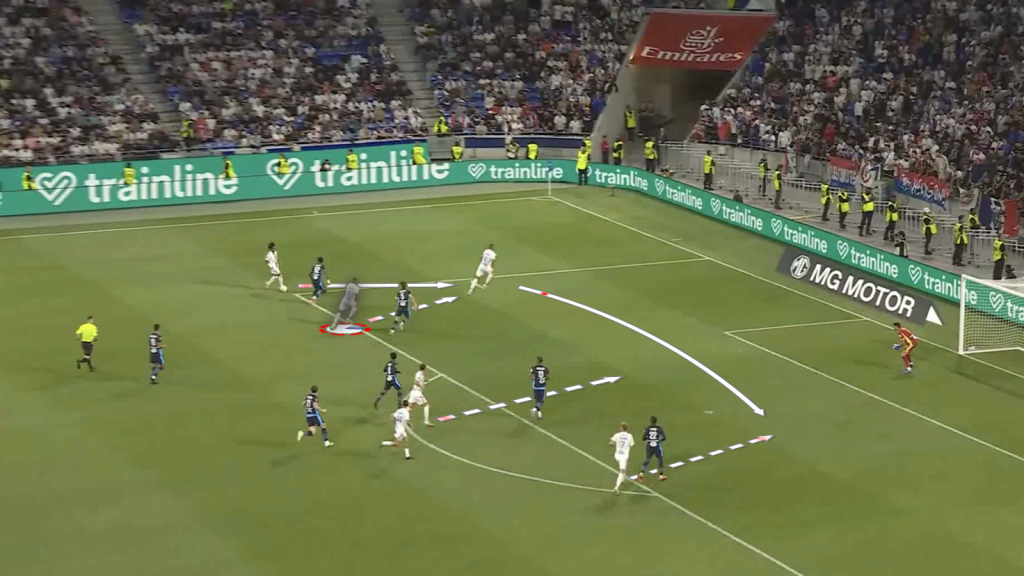
The underlap to cross is also a common theme in Paulo Fonseca’s system.
Here, we can see the full-back making an underlap to receive in-behind, then to play a low cross near the penalty spot.
The late runners from midfield, along with the striker, attempt to get to the end of these crosses.
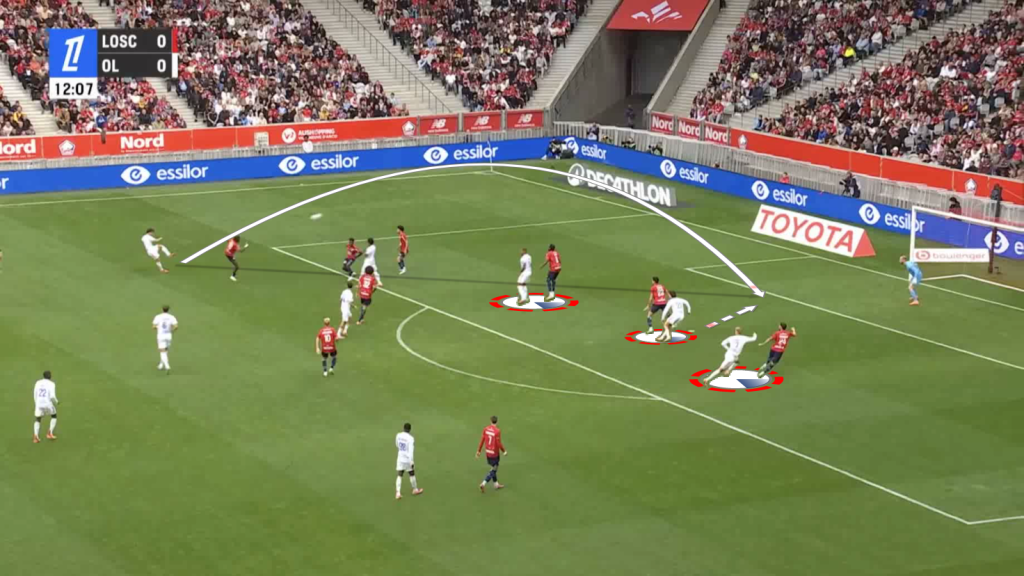
Here is an example of a cross from the edge of the box, with three Lyon players crashing the penalty area.
In this particular situation, they find the back of the net.
The goal scorer gets on the blindside of his direct opponent, which makes it difficult for the defender to track his run.
Paulo Fonseca Defending Tactics At Olympique Lyonnais
In this section, we will look at the defensive features of Lyon’s play.
Defending In Opponent’s Half
Paulo Fonseca prefers pressing the opponent high up to win possession and quick counterpressing actions to regain possession after being dispossessed.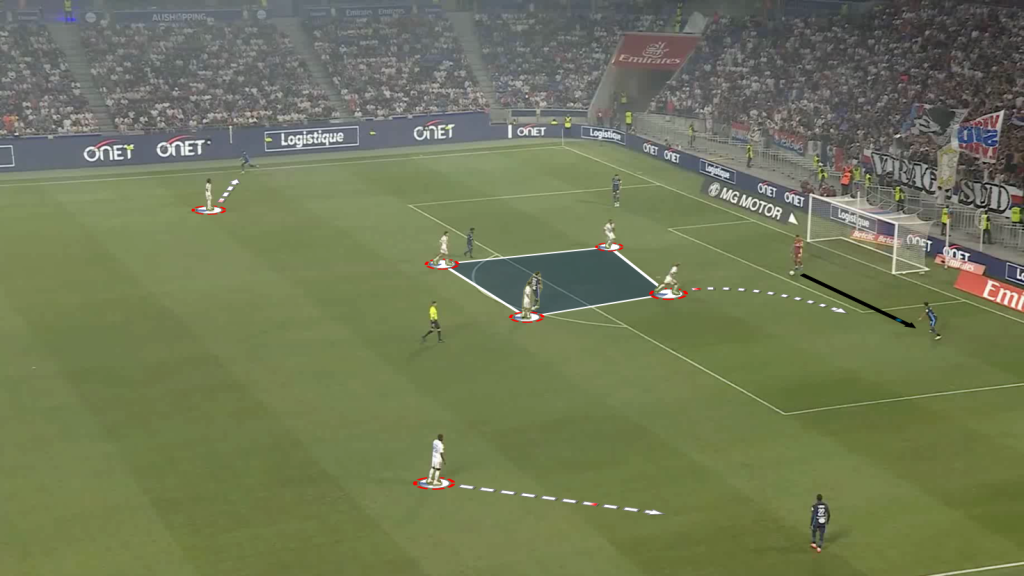
Lyon often press from a high starting position when the opponents have a static start.
Typically, the front two (striker and attacking midfielder) are involved in the initial wave of pressure, as shown in the image above.
The idea is to force the opponent to one side and cut short passes.
This is executed by the wingers closing down the opponent’s full-backs and the midfielders following the opponent’s pivots.
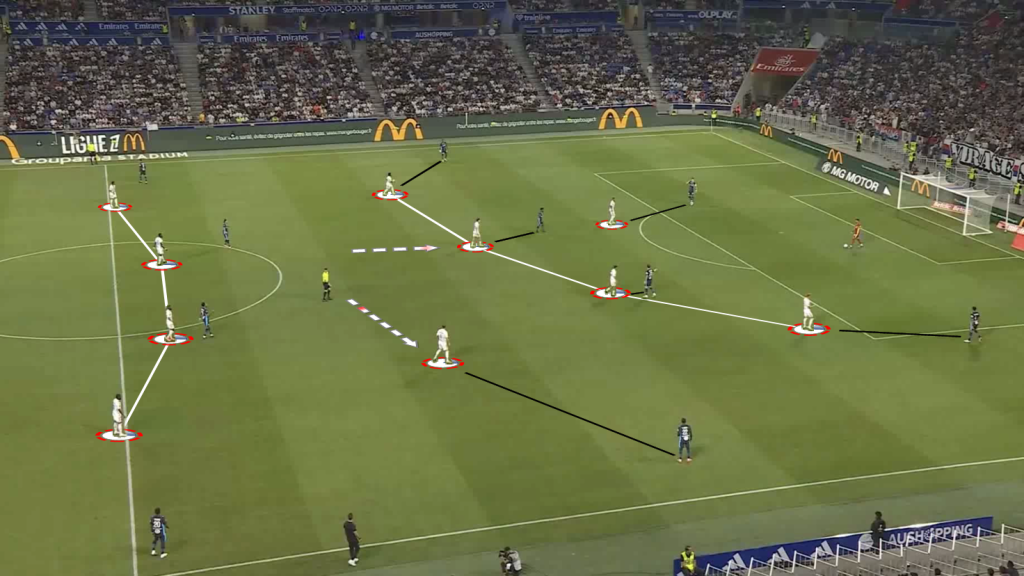
Here is an example of the same in a dynamic build-up moment for the opponent.
The front four steps up to apply pressure and close down short options.
The double also moves to zonally mark opponents to offer cover.
It can be challenging to keep track when the opponents exhibit more dynamism without losing structure.
If performed with enough compactness, the opponents are forced to go long.
However, there are times when the space behind the midfielders is accessible through ground passes.
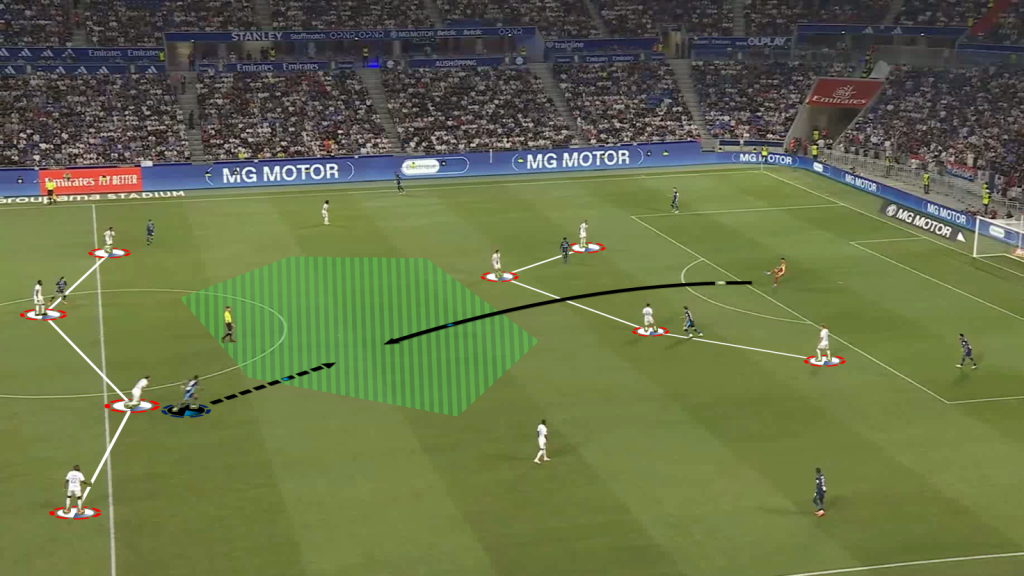
Here is an example: The front four, although high up to engage, is bypassed by the goalkeeper, who plays a vertical pass into the midfield third.
As the front four in this pressing situation comprises the striker and the three midfielders (wingers staying wide to mark the opponent full-backs), the midfield is left with ample space for one of the opposition attackers to drop and receive.
The disconnection in the lines of pressure is a common issue faced by high-pressure systems.
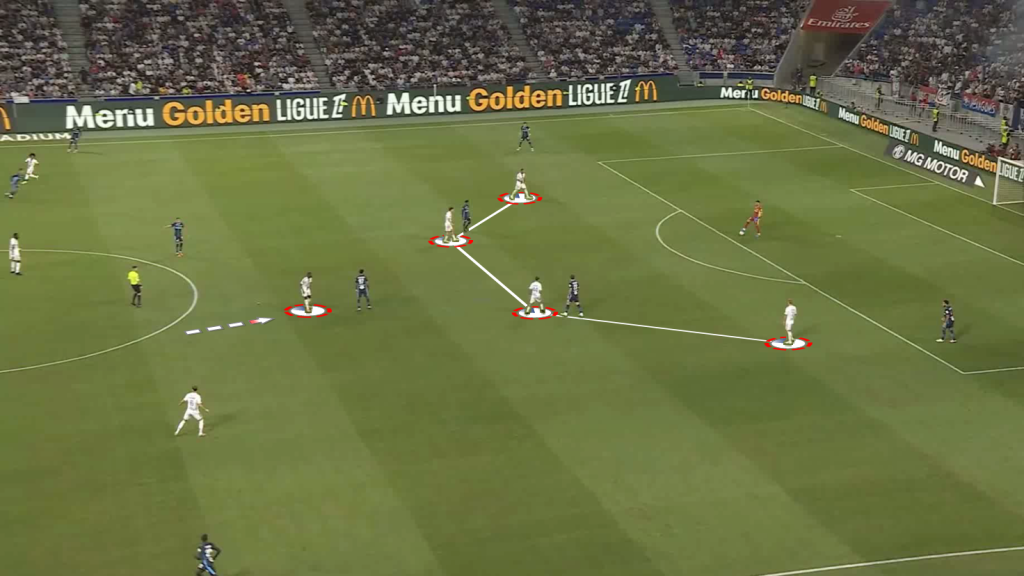
This is solved by one of the defenders, usually a centre-back, stepping up to follow the opponent into midfield.
As shown above, he stays tight enough to force the opposition goalkeeper to look for other options.
The idea behind counterpressing is to disrupt the opposition’s attack and initiate their own from an advanced position.
As shown above, Paulo Fonseca’s men make sure to apply pressure if the ball is in the vicinity.
So far in the 2025/2026 season, Lyon has made an average of 43 recoveries per game, which reflects their willingness to hound for the ball.
Defending In Own Half
The defensive theme in their own half revolves around discipline and compactness.
The objective is to allow the opponent to play as little space as possible between the lines.
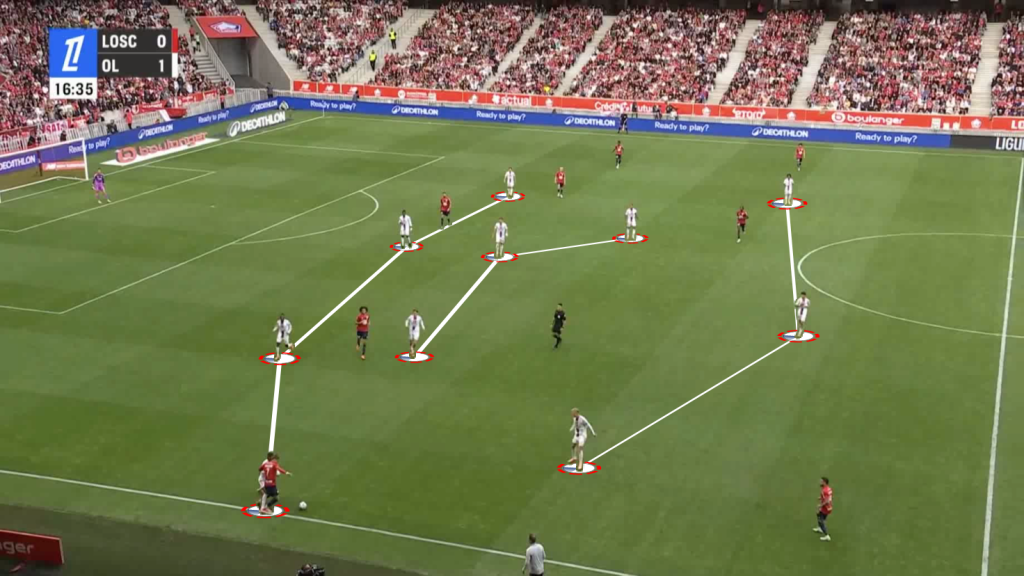
In this image, we can see Lyon’s defensive shape inside their own half.
The opponent with the ball is not allowed any clear options in the vicinity; hence, they are forced to retreat all the way back and reset the attack.
The individual defensive positioning in relation to each other is what contributes to the success of the collective defensive actions.
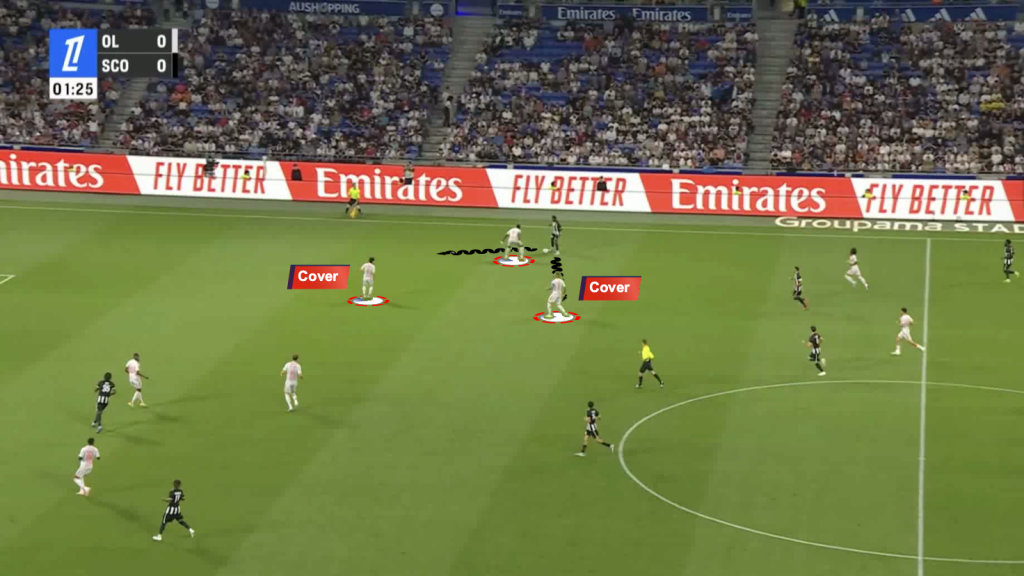
For example, the opponent is in the attacking phase.
As the left-back is beaten, the left centre-back covers for him and engages with the ball-carrier.
In this particular image, the left back has enough time to get back into a covering position, as the left centre-back has delayed enough.
In this situation, the active defender gets cover on both sides.
So, whether the opponent knocks it down the line or infield, Paulo Fonseca’s side have it covered.
Conclusion
Despite the financial constraints and the inconvenience of losing several important players, Paulo Fonseca has managed to adapt at Olympique Lyonnais.
He is gradually transforming them into a difficult side to play against.
Lyon follows the principle of width in build-up, finding depth through the progression of width.
They also use fluid positioning and quick interchanges in the attacking third, with underlaps and third-man passes being key contributors.
In the defending phase, they press high when the opponents have both static and dynamic starts.
Meanwhile, they also showcase energy in counter-pressing to regain possession high up the pitch.
When defending in their own half, Lyon focus on compactness, discipline, and covering for each other to keep the opposition out.
