
Wolfsberger AC (WAC) U18s are the oldest academy age group of the current Austrian Cup holders WAC.
The team is led by 24-year-old Alexander Johannsen, who took over in the summer as the youngest head coach in Austrian academy football and has brought with him a game model that emphasises proactive, attacking football.
Additionally, Alexander Johannsen serves as an opposition scout for the Austrian National Team under Ralf Rangnick, currently preparing for the 2026 FIFA World Cup.
Alexander Johannsen‘s WAC U18s are enjoying a strong season in Austria‘s highest academy tier.
In the first half of the season, they managed to pick up the third-highest number of points in their academy‘s history.
In this tactical analysis article, we will take a look at WAC U18s principles in all phases of play, principles that align with the prevailing identity that has arisen in Austrian football in recent years.
Alexander Johannsen High Press Tactics
In many top leagues, man-orientation is the predominant paradigm in pressing systems.
However, WAC U18s take a different approach, opting for a more ball-oriented zonal structure.
Whether pressing with their most frequently used 4-2-2-2 structure, with one pivot higher to cover the ‘6’ space, which effectively turns the structure into a 4-1-3-2, or another structure, such as a 4-2-3-1, their idea remains the same.
From goal kicks, they begin situated in their narrow structure, maintaining short vertical and horizontal distances between players to minimise the space afforded to the opposition centrally.
With little space for the opponent to play through WAC U18s centrally, the opponent will typically look to go around them and into the wide areas.
As the ball moves across, so does the WAC U18s’ zonal structure, often resulting in numerical equality or superiority once the ball reaches the side.
Alexander Johannsen instructs the players near the ball to aggressively lock onto the player in possession and any opposing players surrounding the ball.
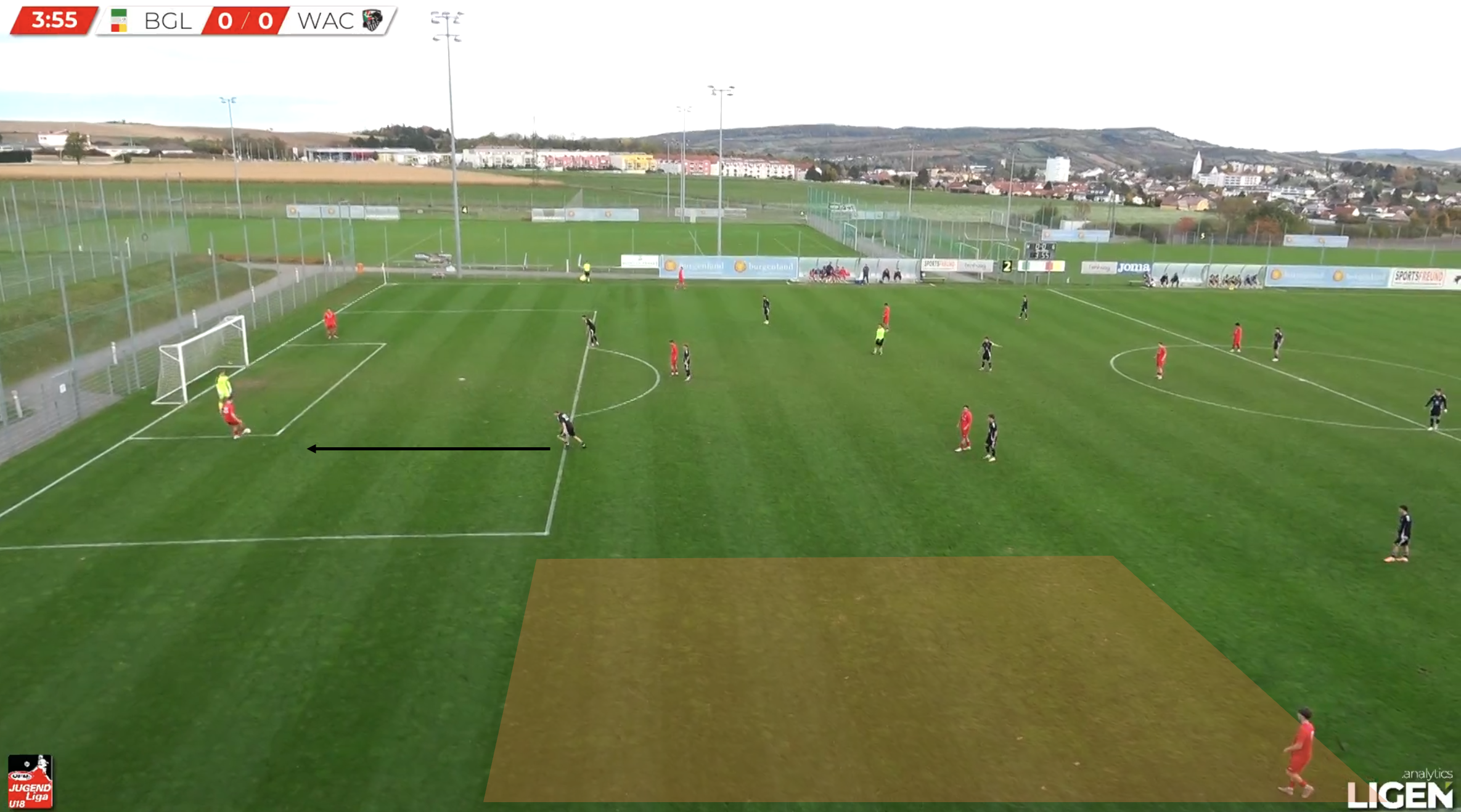
In the above example, the opponent starts with a goal kick, with WAC U18s positioned high in their 4-2-2-2/4-1-3-2 shape, with one pivot higher than the other.
Rather than positioning every player on an opponent, they prefer instead to retain their zonal structure, with short distances between them occupying the centre of the pitch.
With very few passing lanes and little space available centrally, the opposing goalkeeper opts instead to play wide, going directly to the full-back.
The direct option is likely preferred, with both centre-forwards in a dynamic body position, ready to sprint straight to either centre-back.
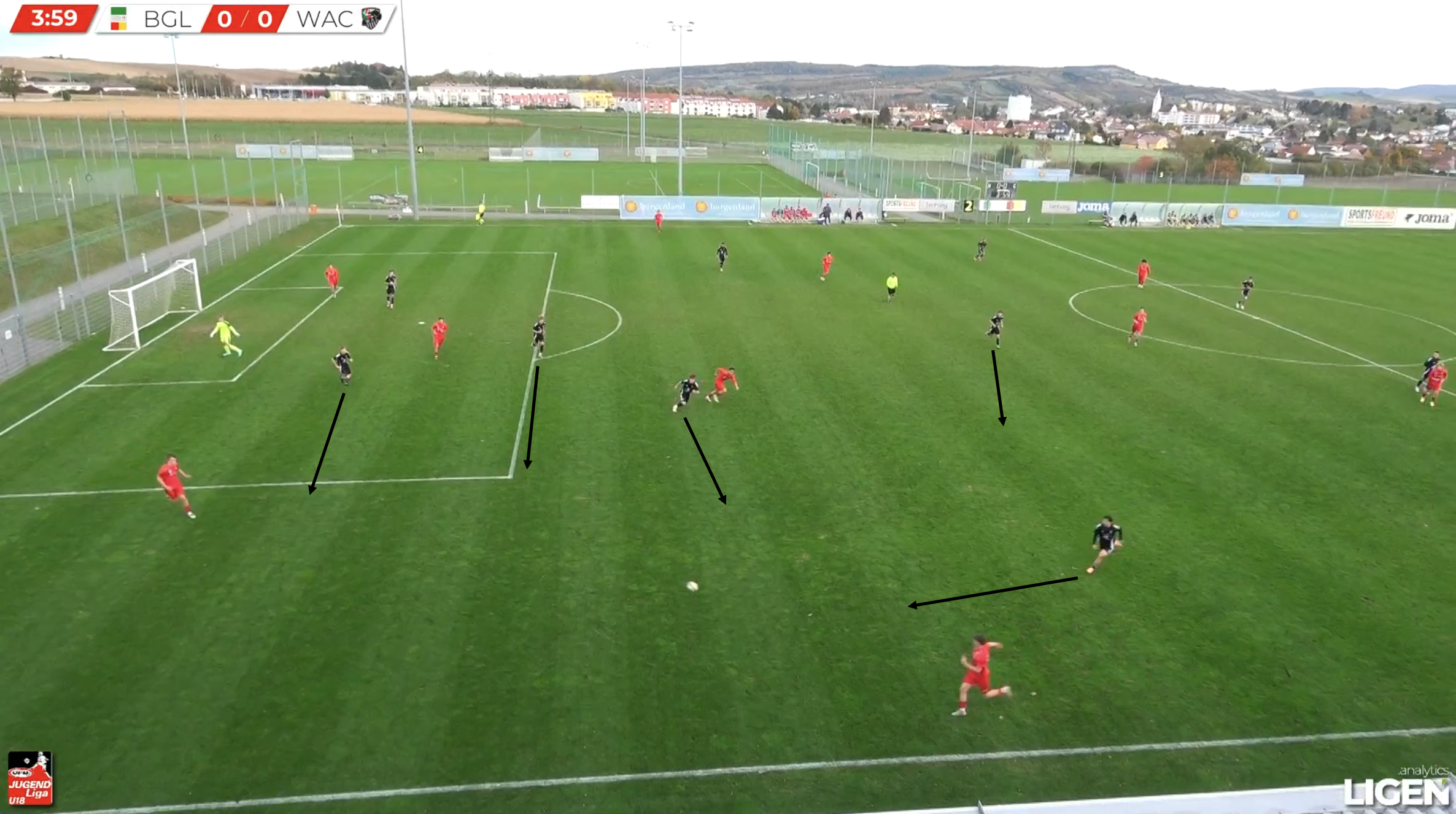
The switch out to the full-back in the wide channel acts as the trigger for WAC U18s to aggressively shift to the ball near side.
They’re happy to leave an underload on the far side, knowing that if they are quick and intense enough with their pressure, then a direct switch of play would be extremely technically difficult to perform.
Furthermore, connecting to the far side via the centre would pose its own challenges, given the high number of WAC U18s players situated on the inside of the player in possession.
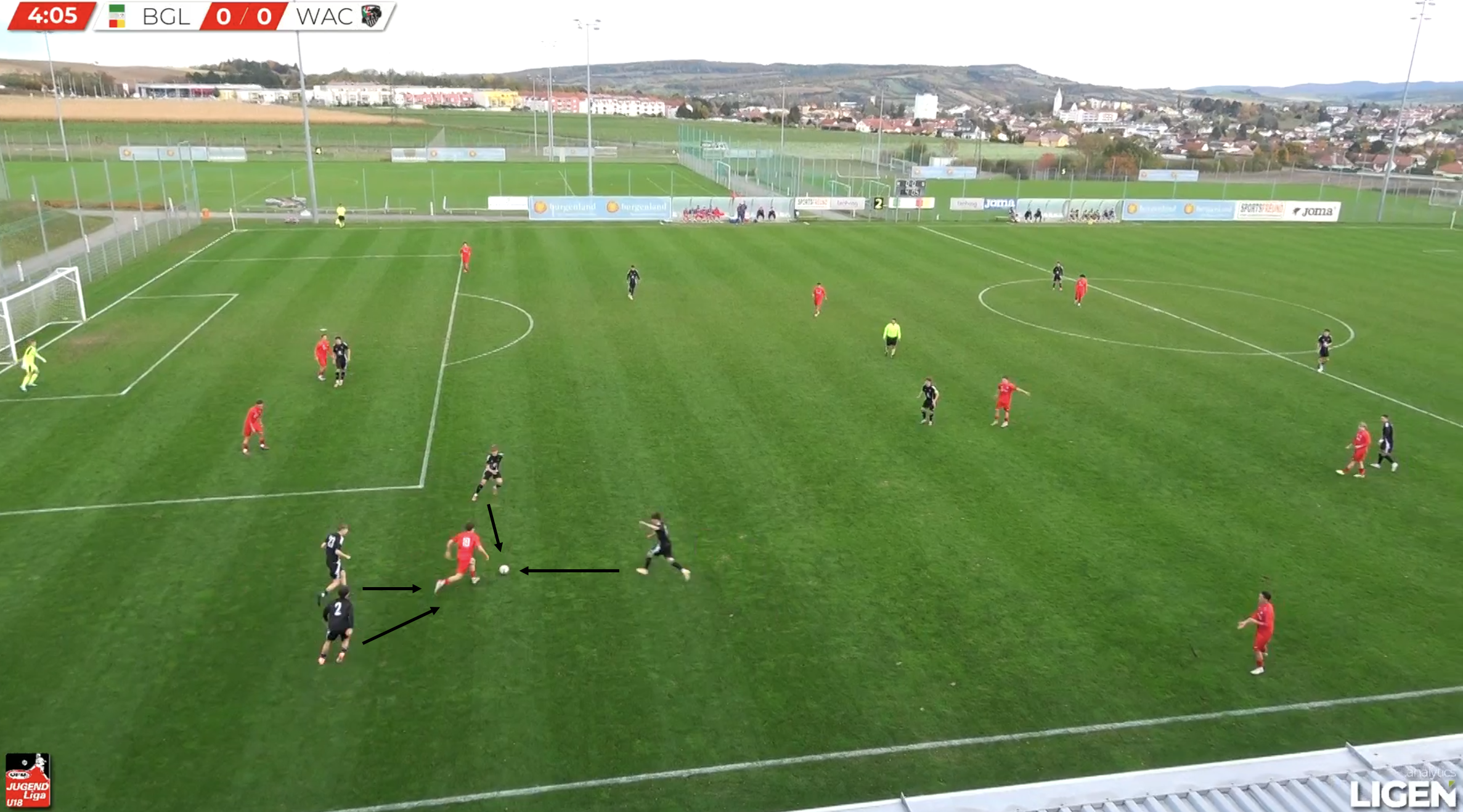
On this occasion, the player opts to take a few touches with no available passing options.
Immediately, four surrounding WAC U18s players run directly towards the ball to aggressively try to win the ball back.
This is demonstrative of their proactive nature in all phases of the game.
Pressing is not utilised as a tool to simply reduce passing options or force the opponent long, but rather to actively attempt to win the ball high up the pitch in dangerous positions.
Even with a different opponent using a different in-possession structure in the build-up phase, Johannsen can still set his team up in their typical 4-2-2-2/4-1-3-2 pressing structure.
In this case, many players, particularly in midfield, are taking up split positions between opponents as a result of abiding by their zonal structure.
Due to their compact shape, the WAC U18s players are never far from an opponent centrally, even if not directly marking a player.
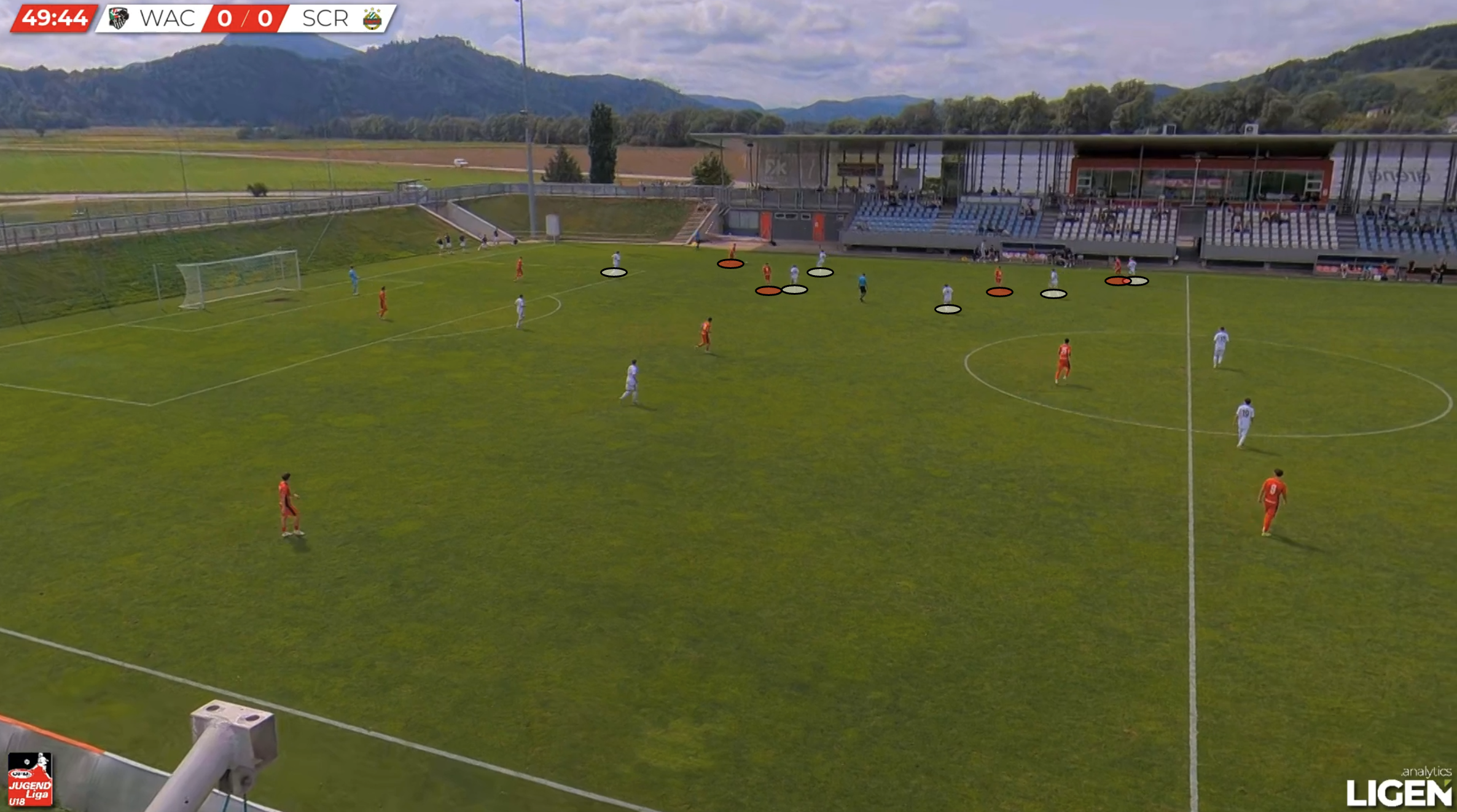
A different team with a different in possession structure, yet they are forced into the same action in build-up.
A direct ball is played into the full-back from the goalkeeper due to the compact structure of WAC U18s blocking central progression.
Again, they rapidly shift across as the ball is played into the wide channel.
On this occasion, instead of numerical equality, they achieve numerical superiority, a 6v4 situation now occurring around the ball.
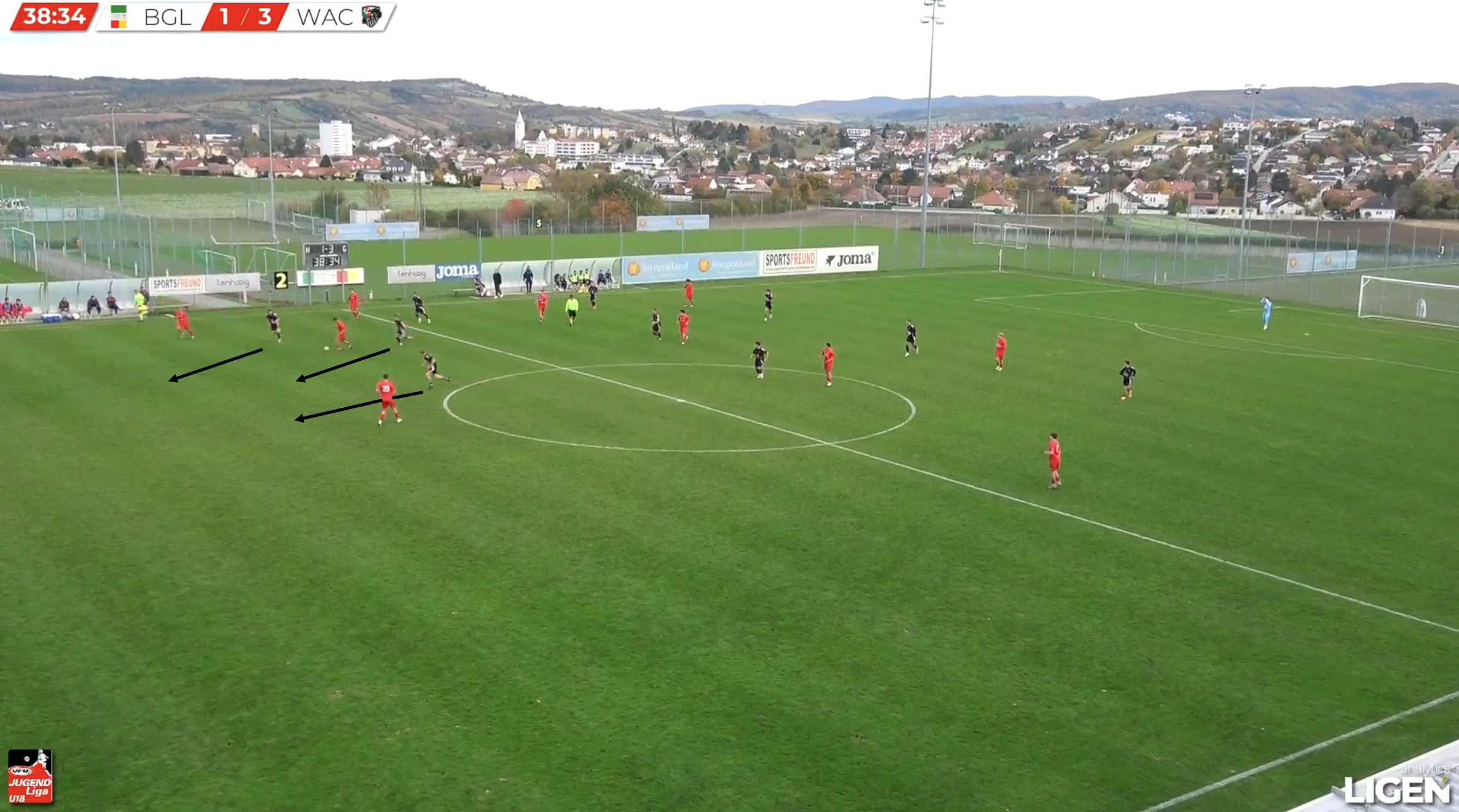
The above image exhibits another of Johannsen’s principles in the press.
In this case, the opponent is turned facing towards his own goal, ready to play a pass back to the goalkeeper.
The opponent’s orientation acts as a trigger for the forwards to sprint forward to apply direct pressure to the ball, in a proactive attempt to win the ball back.
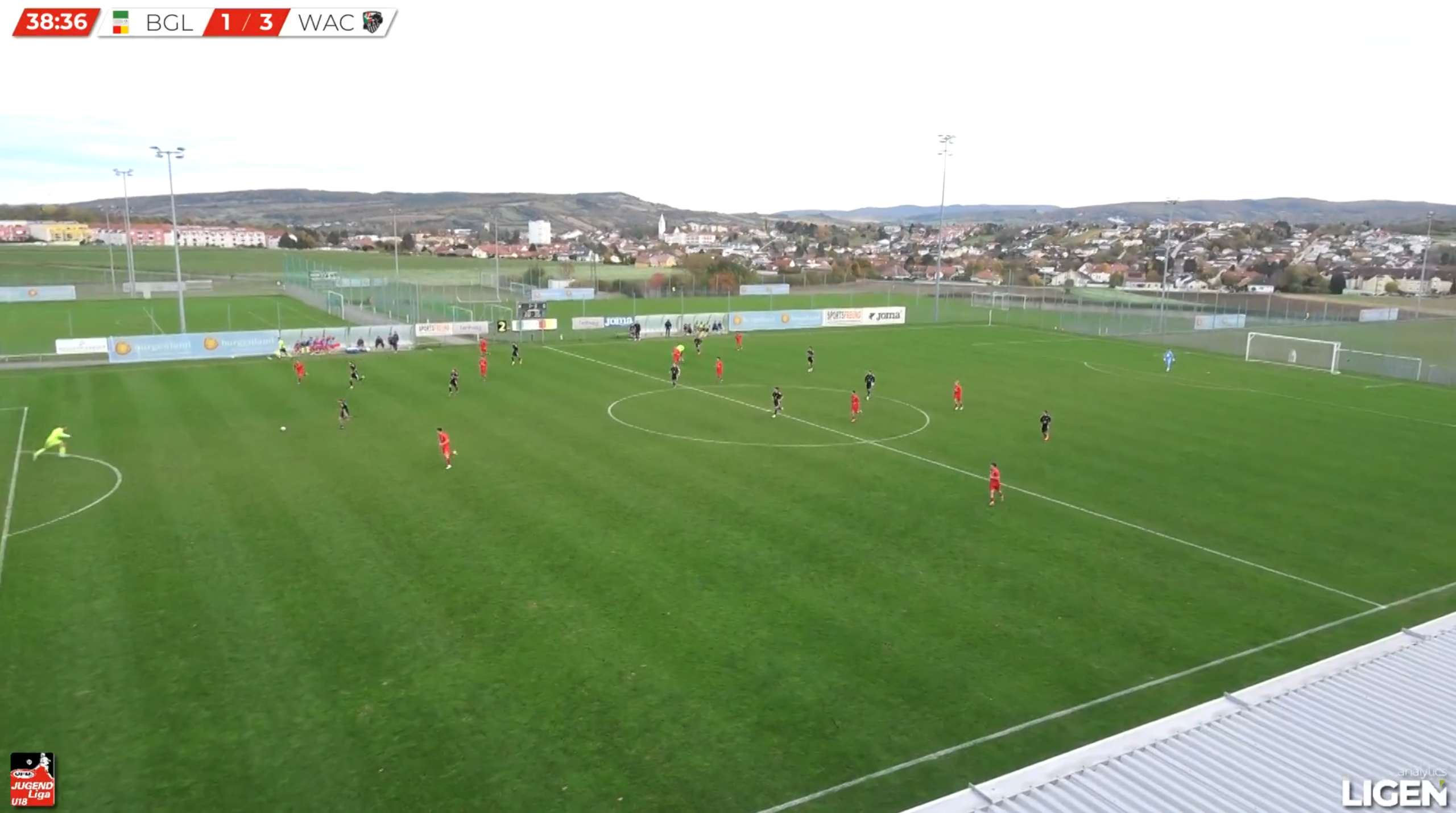
Initiating the sprint towards their goal before the pass has been played enables a high turnover in this instance, taking advantage of a loose pass from the opponent back to the goalkeeper.
This led to a 1v1 chance with the goalkeeper, resulting in a goal for WAC U18s.
Alexander Johannsen Mid Block Tactics
As with all phases, when Alexander Johannsen’s WAC U18s drop off into a mid-block, they remain active and engaged, looking to prepare for and dictate the next situation.
The idea remains similar to when they are in high-pressure moments: to be horizontally and vertically compact to block the centre, forcing the opponent wide before locking on to win the ball back.
The main difference between the two phases, aside from often a slight change in structure, is the behaviour of the forwards.
In a mid-block, the forwards instead look to pick their moments to jump to the opposing centre-backs, waiting for a trigger, such as a backward or loose pass, to do so.
The forwards, when not jumping out, attempt to block central options and tempt passes into the wide channel, where they can use the sideline to press the opposition.
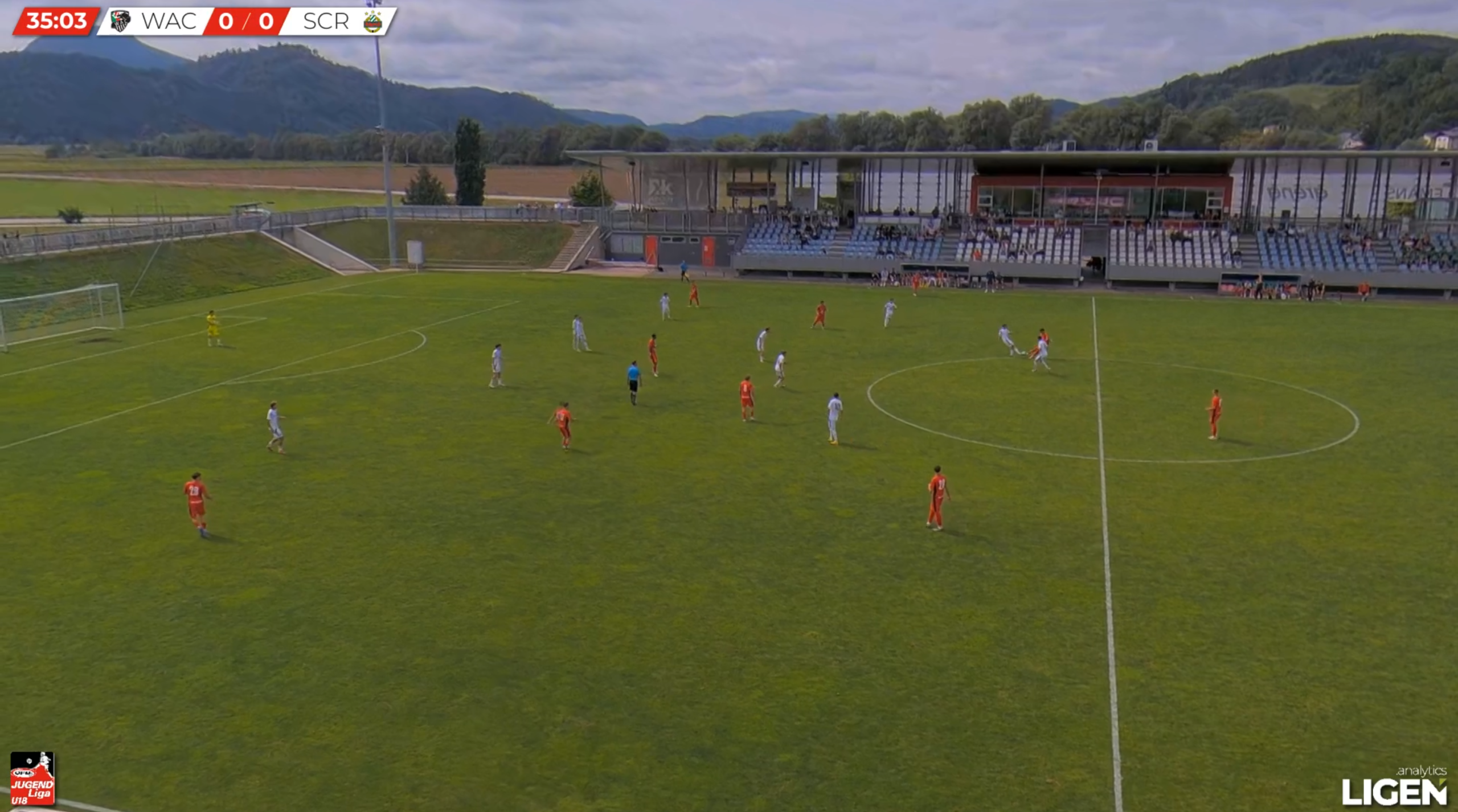
The most commonly used shape in WAC U18s’ mid-block is a 4-2-2-2, as shown above.
The opposition centre-back turns to face forwards, attempting to pick out an available teammate through the centre of the pitch.
No such option is available due to the compactness of the block, and he is forced into an extra touch.
The two centre-forwards of WAC U18s, instead of dropping off to attempt to stay in their structure, choose this moment to attempt to win the ball back and are successful in doing so.
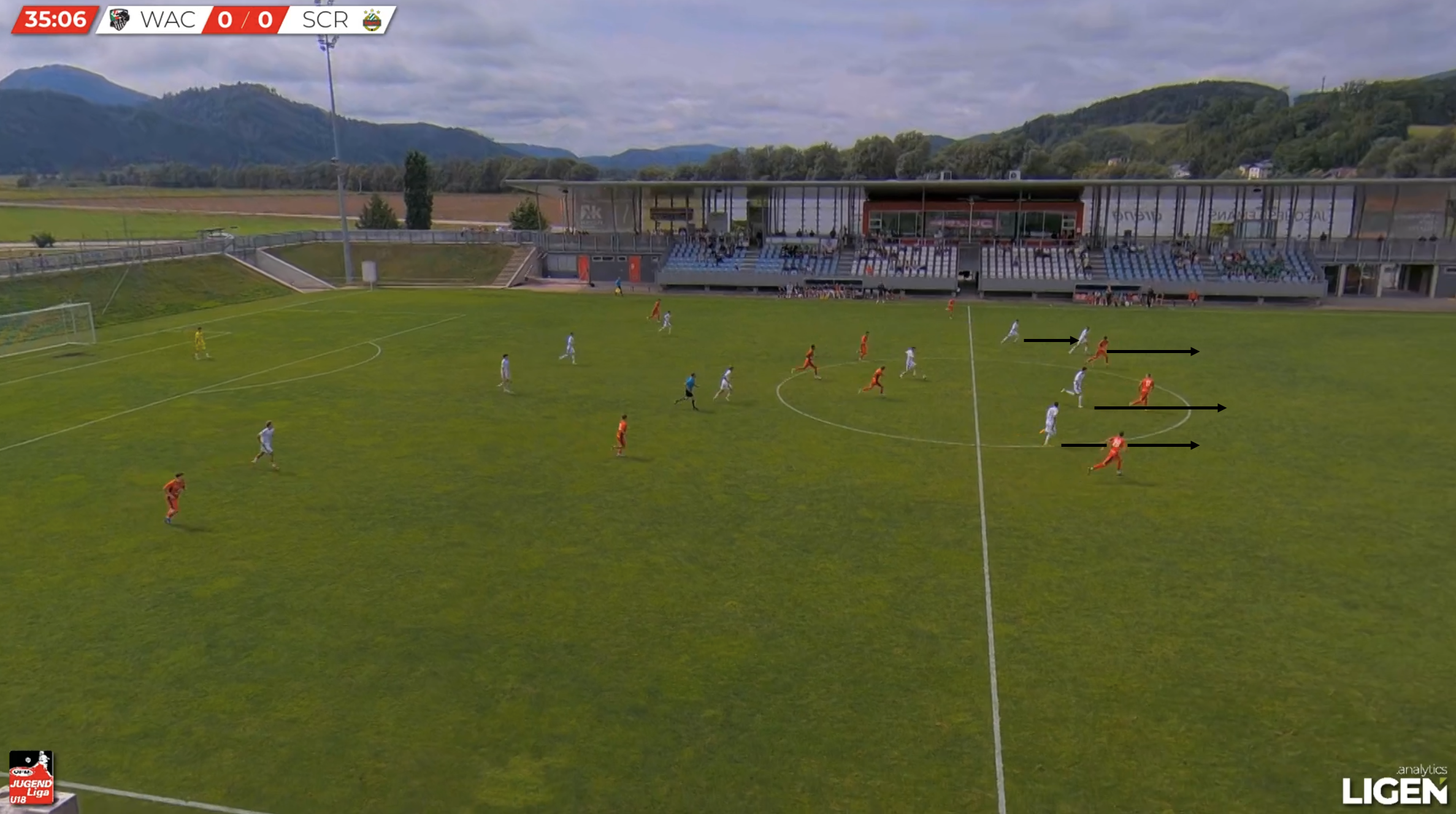
This creates a dangerous transition situation, facilitated by the high positioning and immediate vertical runs of the wide players.
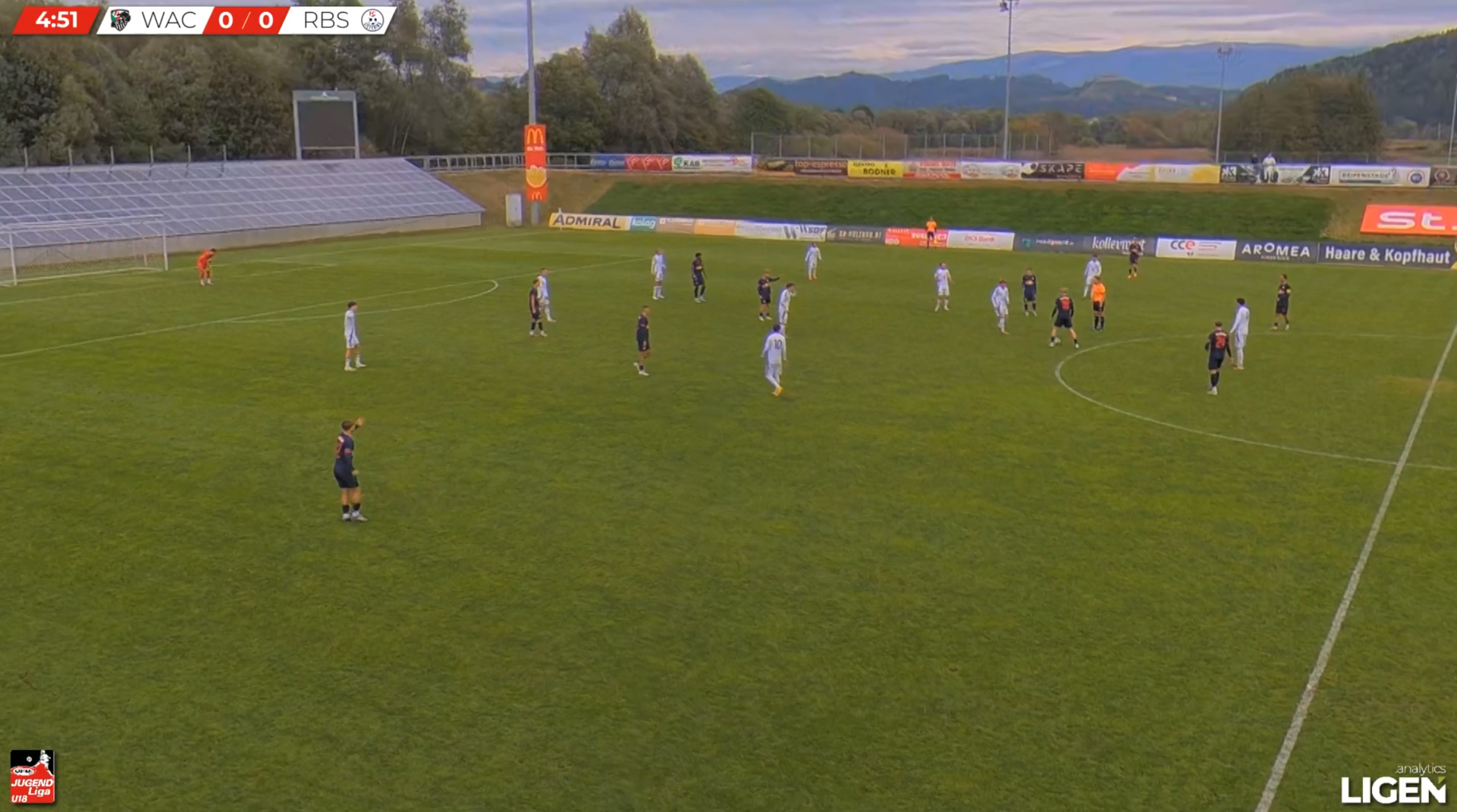
This example exhibits WAC U18s in a mid-block against opponents Red Bull Salzburg U18s, but this time in a 4-2-3-1 structure.
As ever with Alexander Johannsen’s U18s side, the principles remain intact no matter the structure, so space is afforded to the opposition out wide in favour of blocking access to central areas.
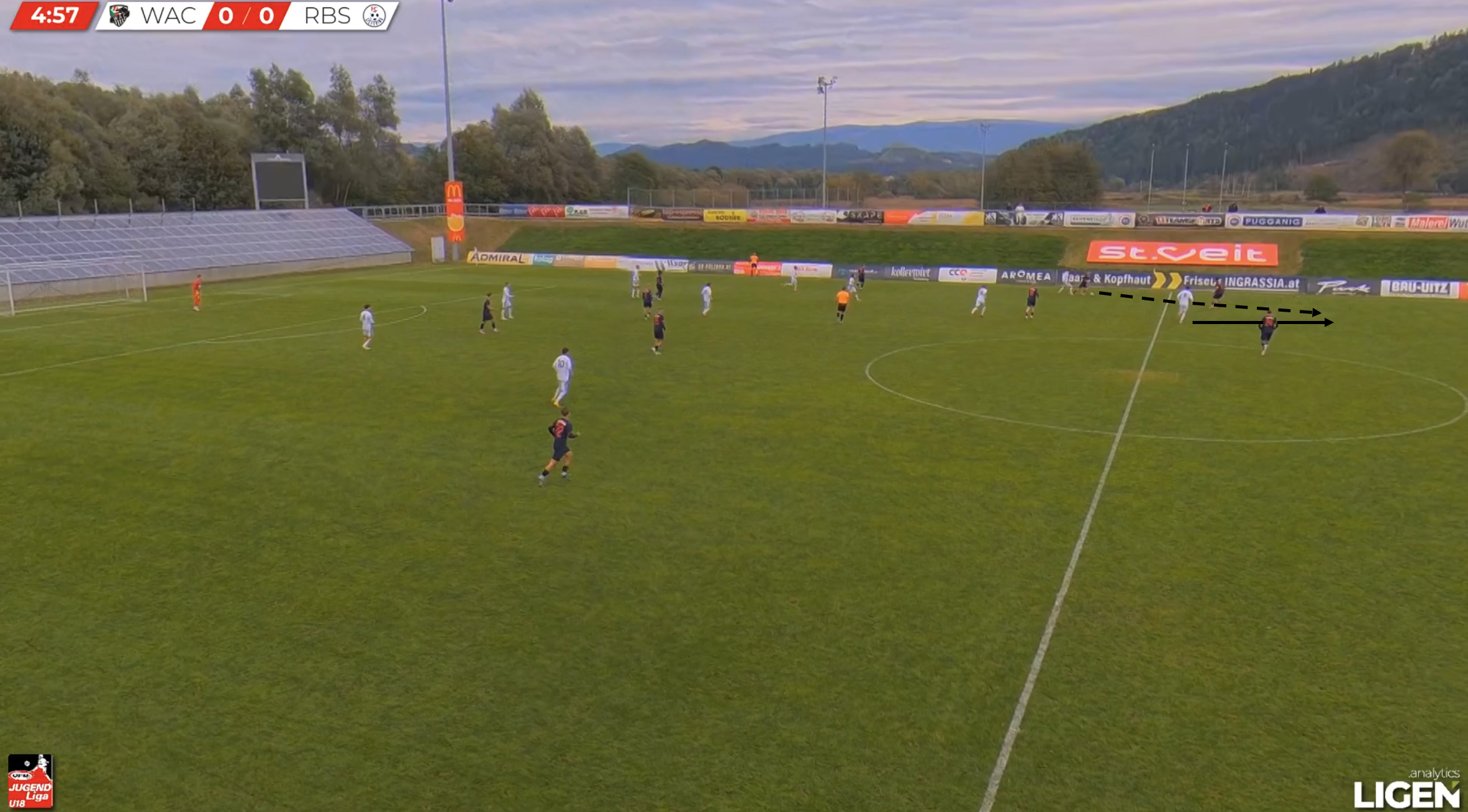
As the pass is played wide, WAC U18s take their opportunity to step out of their mid-block to press the opponent with intensity along the sideline.
With all passes blocked and the ball carrier under great pressure, a loose pass is played back towards their own goal and is seized by the WAC U18s centre-forward, from which he attacks the open space behind the defence and scores.
Alexander Johannsen Transition Phase Tactics
Perhaps WAC U18s’s greatest weapon under Alexander Johannsen is their ability to consistently create danger immediately after winning back possession.
This is possible due to both their off-the-ball movement and their awareness of the aforementioned runs, as well as their willingness to attempt to find those runners as quickly as possible.
The most noticeable factor giving WAC U18s such an edge over their opponents in these situations is the starting position of their forwards as soon as the ball is turned over.
Because of their proactive nature, they are looking to prepare the next phase before it begins.
In this case, that involves forwards taking up positions high and in between defenders when out of possession.
This strategy requires significant trust in the midfield and defensive units to be aggressive in the block and win the ball back quickly.
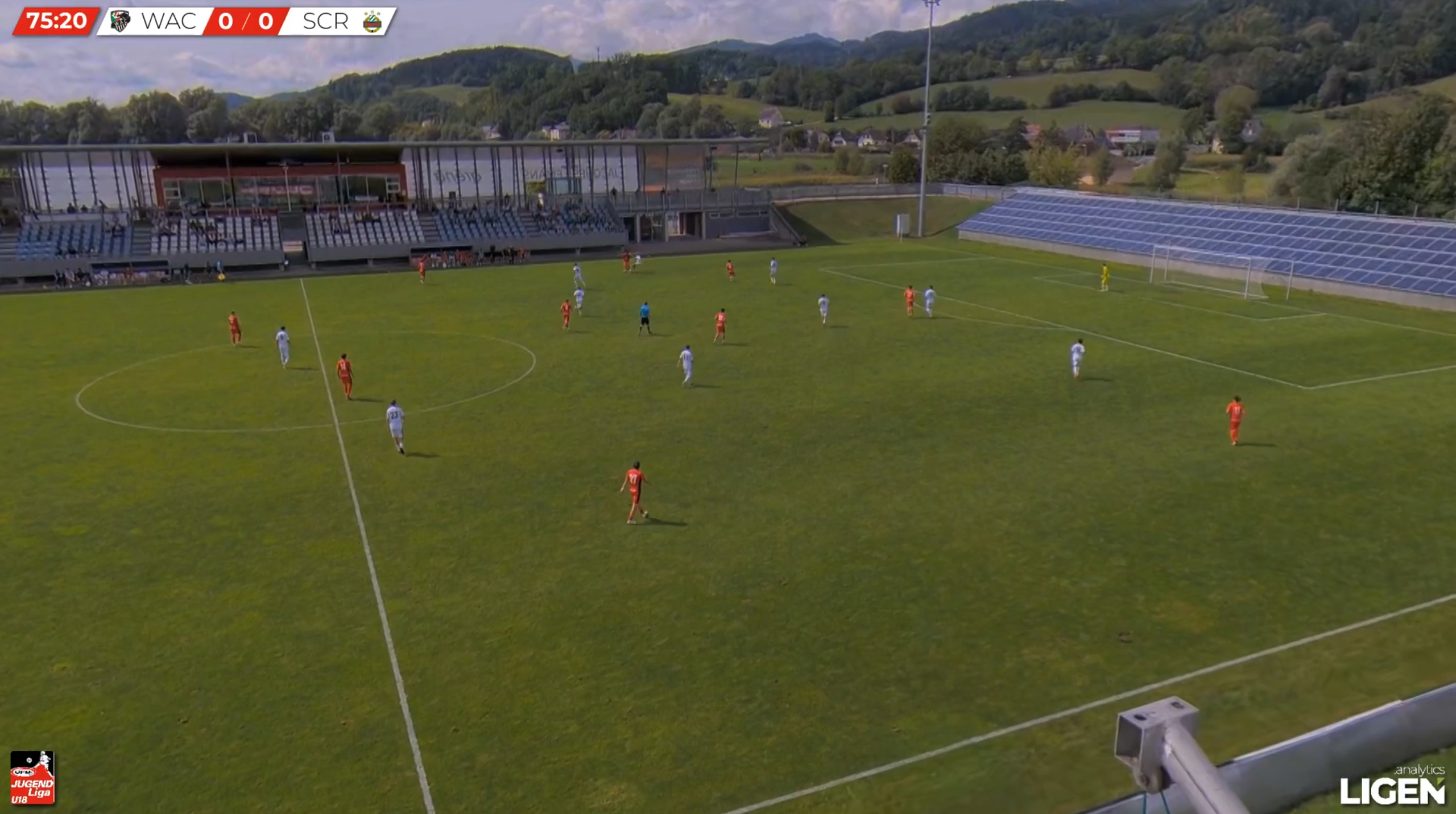
As can be seen above, the midfield and defensive units are aggressive in their block, looking to win the ball back.
Here, the full-back steps out of the backline to win the ball back from an opponent.
Meanwhile, the two centre-forwards of WAC U18s are positioned much higher, on the last line, in between opponents.
Being in between opponents allows for the best chance of a direct run in-behind when they regain the ball, keeping enough distance from any defenders that their run cannot be blocked.
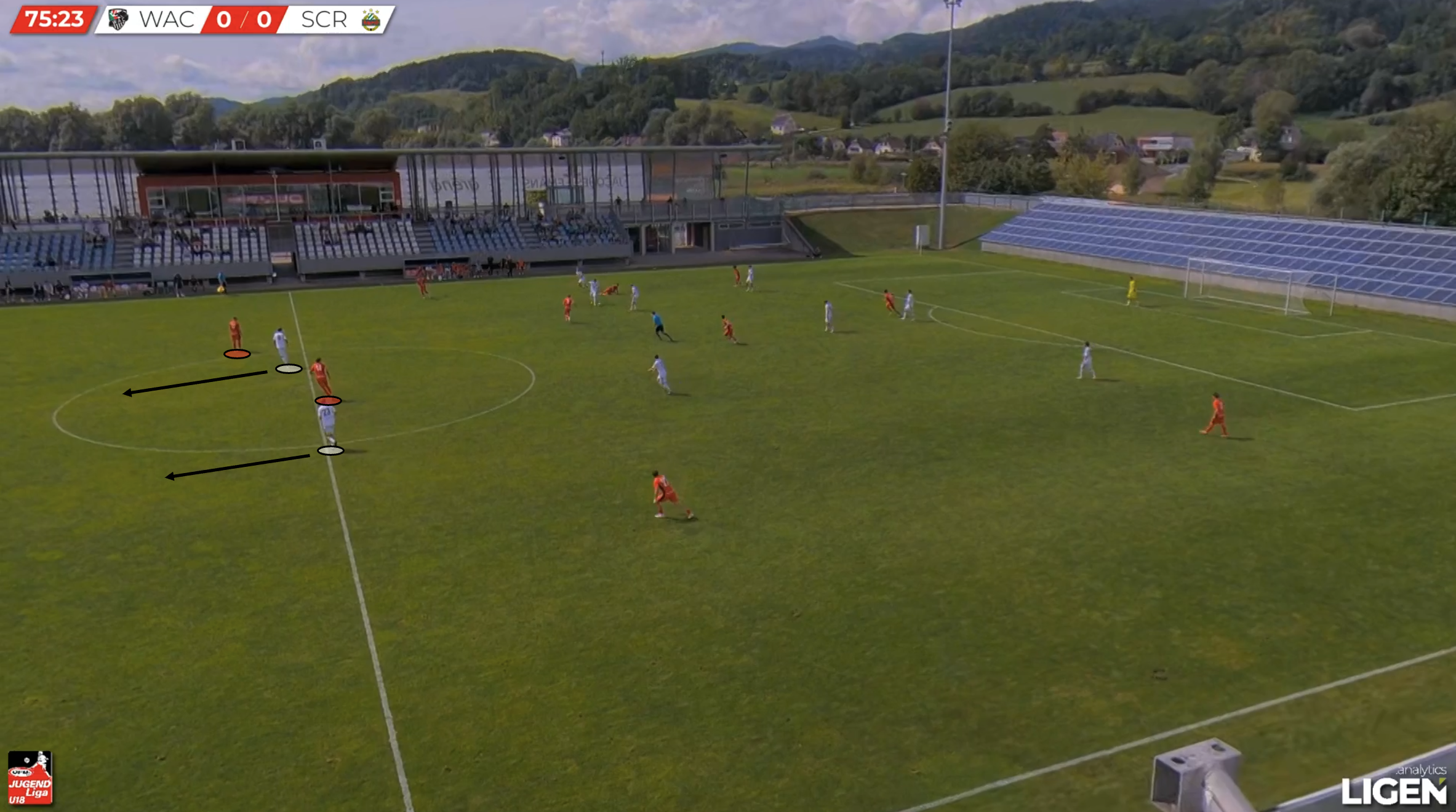
The result of this preparation for the attacking transition phase in this instance is a 2v2 in over half a pitch of space.
The forwards know to react to possession being won back by making immediate runs in-behind the defenders, knowing this pass will likely be played.
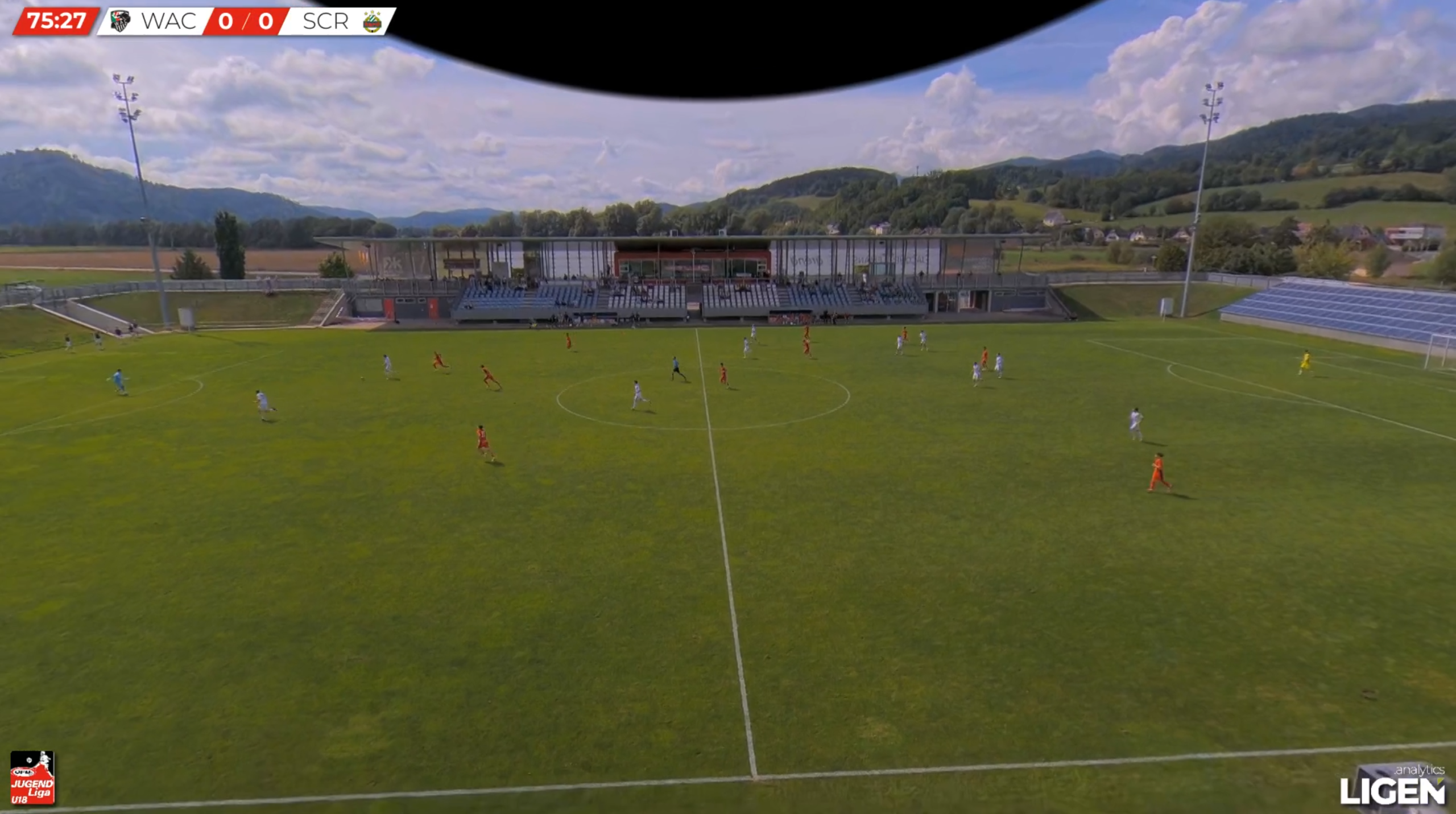
Alexander Johannsen makes certain that his players are attuned to the possibilities these aggressive starting positions give them for dangerous balls in-behind.
Any player who wins the ball back appears willing, without hesitation, to look for the forward runners.
With so much space to play into, the margin for error in the pass is increased, increasing the frequency of success and the variety of situations and locations from which these passes can be made.
In this case, the two centre-forwards face the goalkeeper, resulting in a goal.
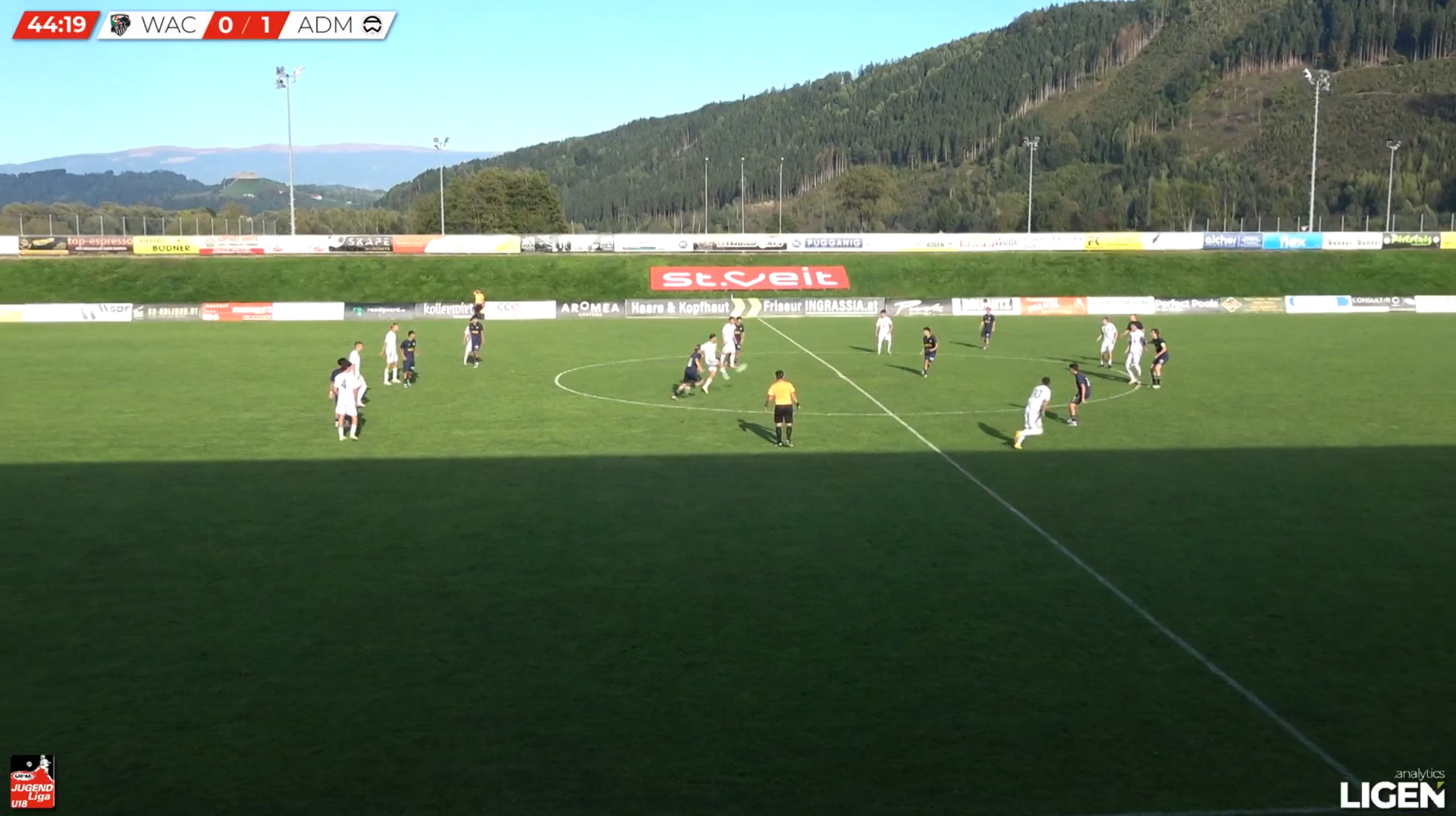
To demonstrate the variety of situations from which they can threaten, the above example shows the moment of first contact during an opposition goal kick.
Even in seemingly non-threatening moments, WAC U18s are able to manufacture high-quality chances through the high positioning of the forwards, and the willingness to play the ball quickly in-behind.
With the WAC U18s player’s first touch off the goal kick, he plays an immediate pass over the top of the opposing defence.
The forwards are alive to this and are again able to both run through behind the defenders and score from the situation.
In defensive transition, Alexander Johannsen’s side remains courageous, often springing into an intense counterpress upon losing the ball.
With their philosophy of proactivity, they are not simply doing so to delay an opposition counterattack; rather, they are trying to win the ball back.
This mechanism is enhanced by the short distances between players centrally in possession, with multiple players often close to the ball ready to engage in the counterpress.
Alexander Johannsen Build-Up Tactics
In build-up, WAC U18s tend to be vertical and direct, able to play short and quickly forwards, or go over the opponent directly to the forwards.
They most frequently set up in a 4-2-2-2 shape.
This is a shape currently often utilised by teams in the build phase; however, WAC U18s keep their front four narrower than you will typically see from teams deploying this sort of structure.
The rationale for this, is that when WAC U18s go short, the opposing full-backs are dragged infield, opening up the wide channel for either the high full-backs to receive and carry, or for the centre-forwards to make in-to-out runs attacking these spaces.
Alternatively, when they go long, the front four are all in close proximity to try to secure the second ball.
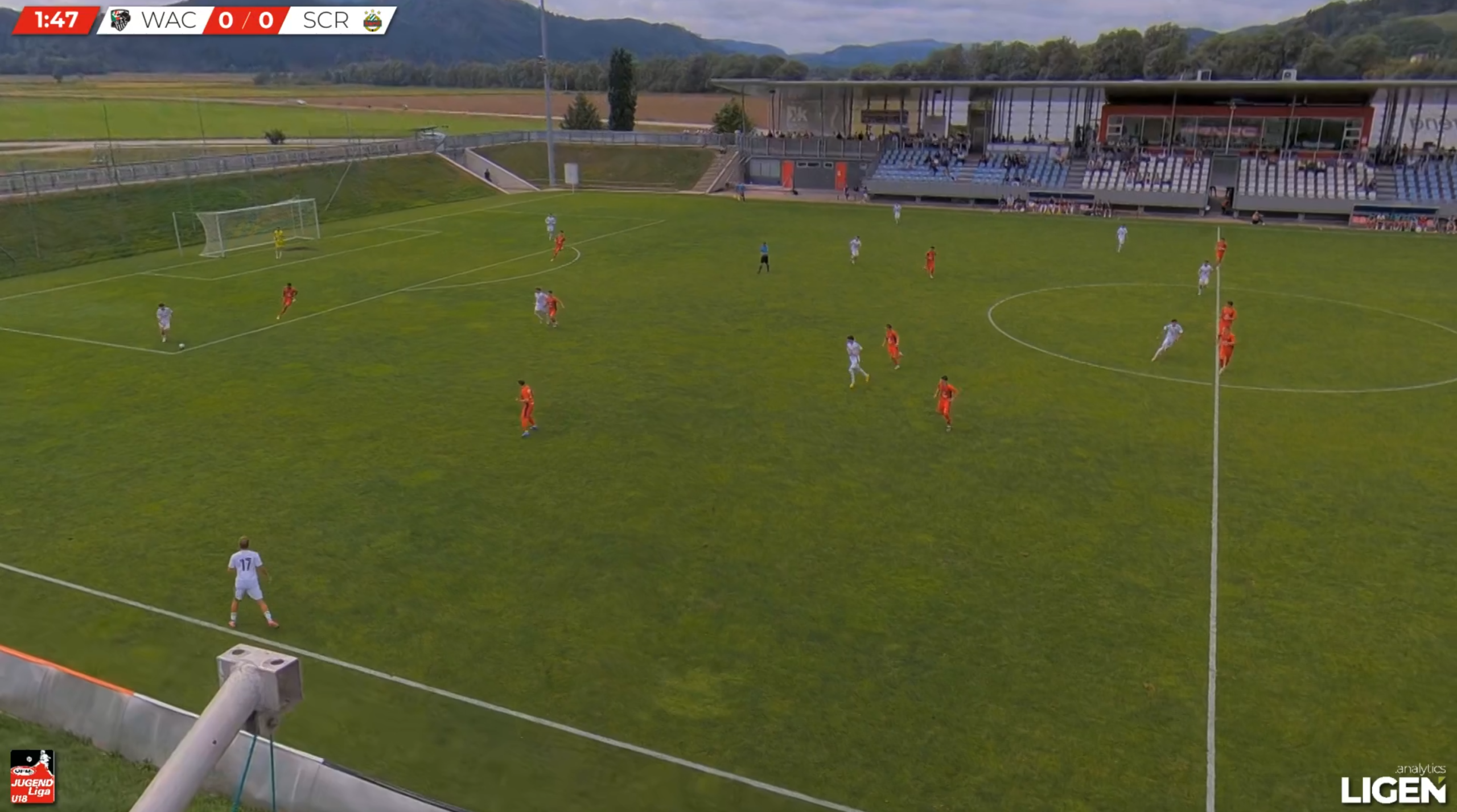
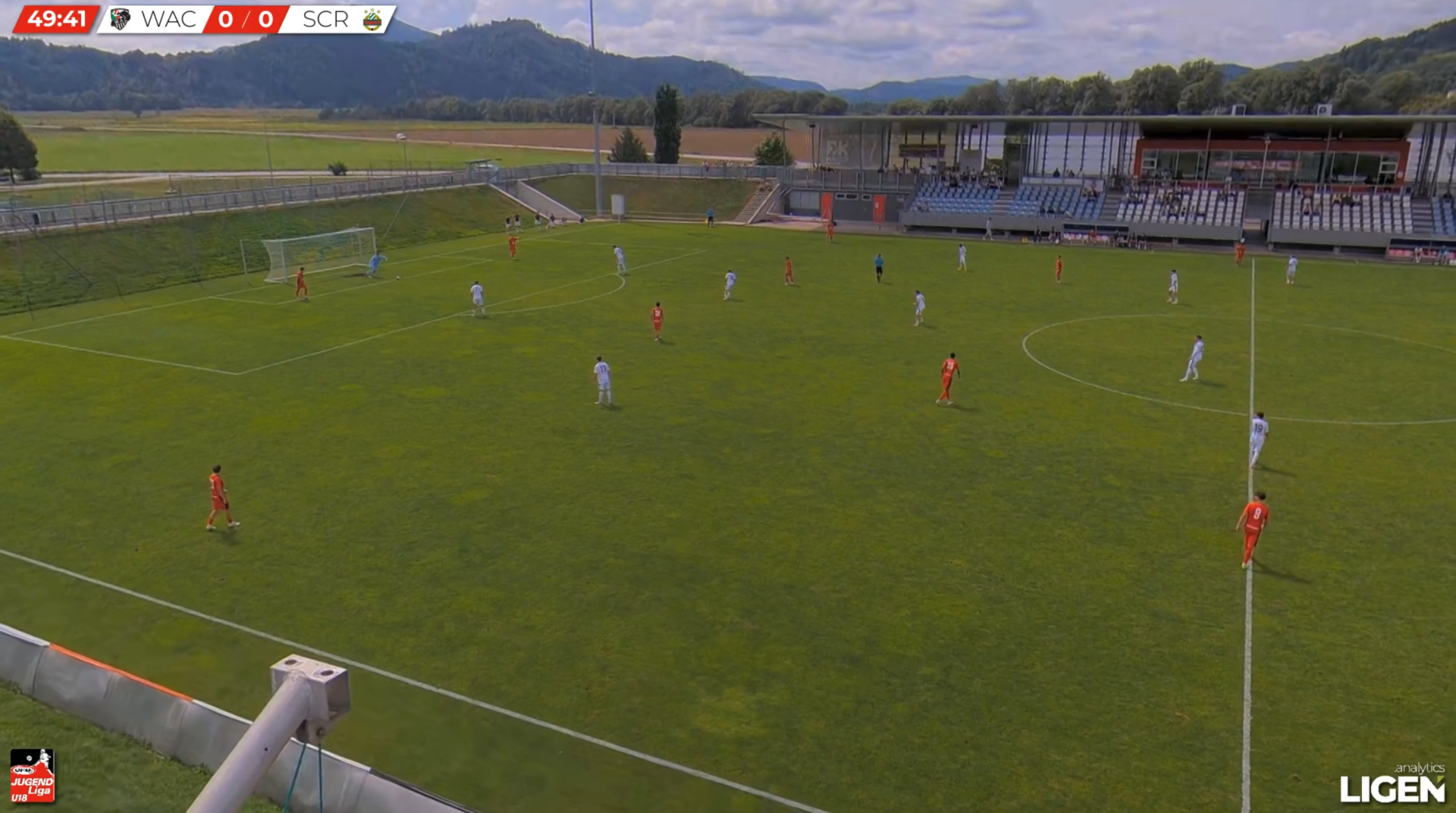
In the above example, WAC U18s are positioned in their 4-2-2-2 shape.
This clearly demonstrates the high positioning of their full-backs and their narrow front four.
The most frequent movement pattern that will be seen by Johannsen’s side is the near side wide-forward dropping to bring the full-back marking him deep, while the near side centre-forward makes a run in-behind to attack the space.
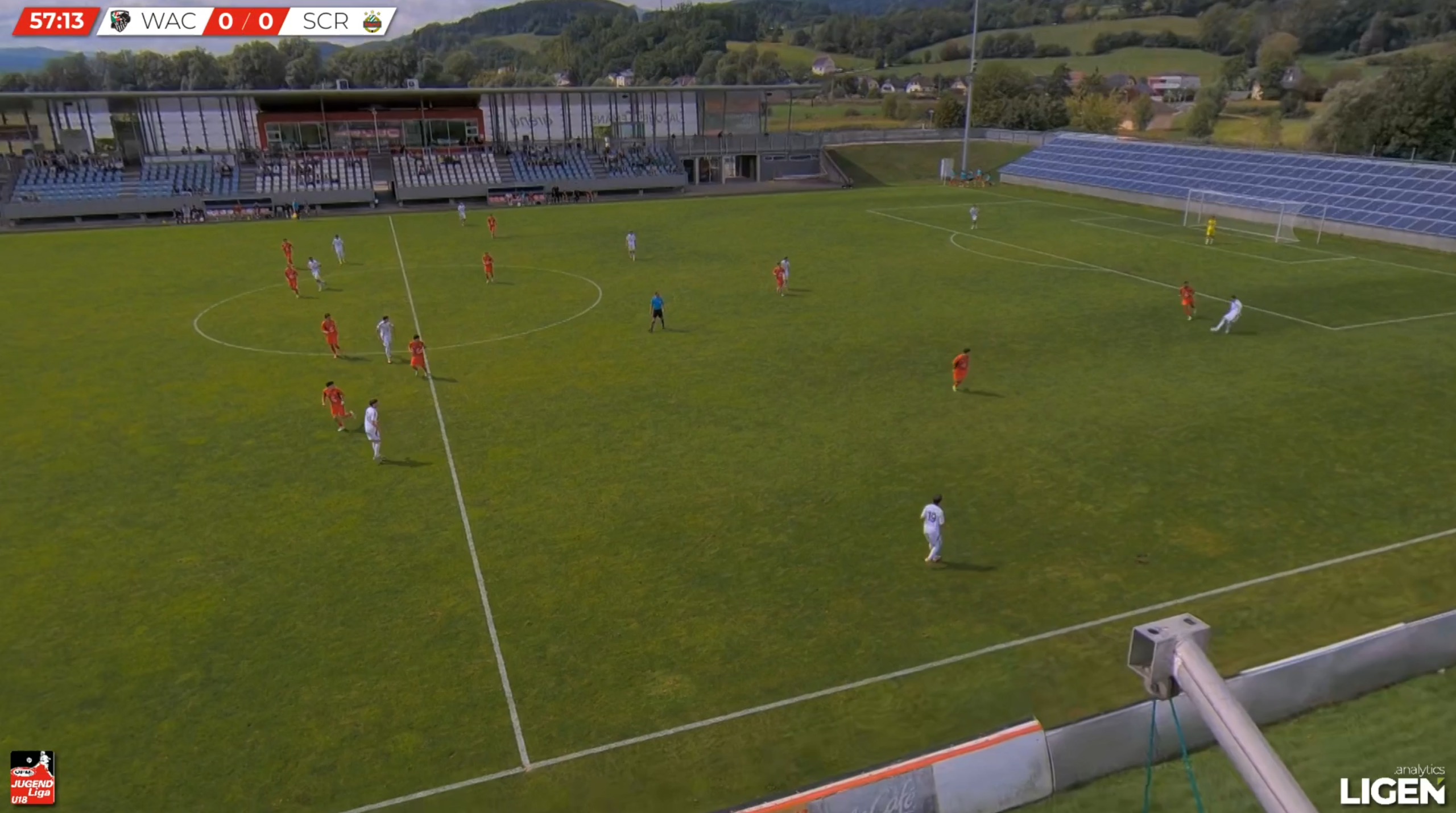
Here we see WAC U18s’ narrow front four drawing the opponent’s back four inside the pitch, opening both wide spaces.
In response, the full-backs move high to take advantage of the space, with the opposing wingers very often unwilling to track them all the way.
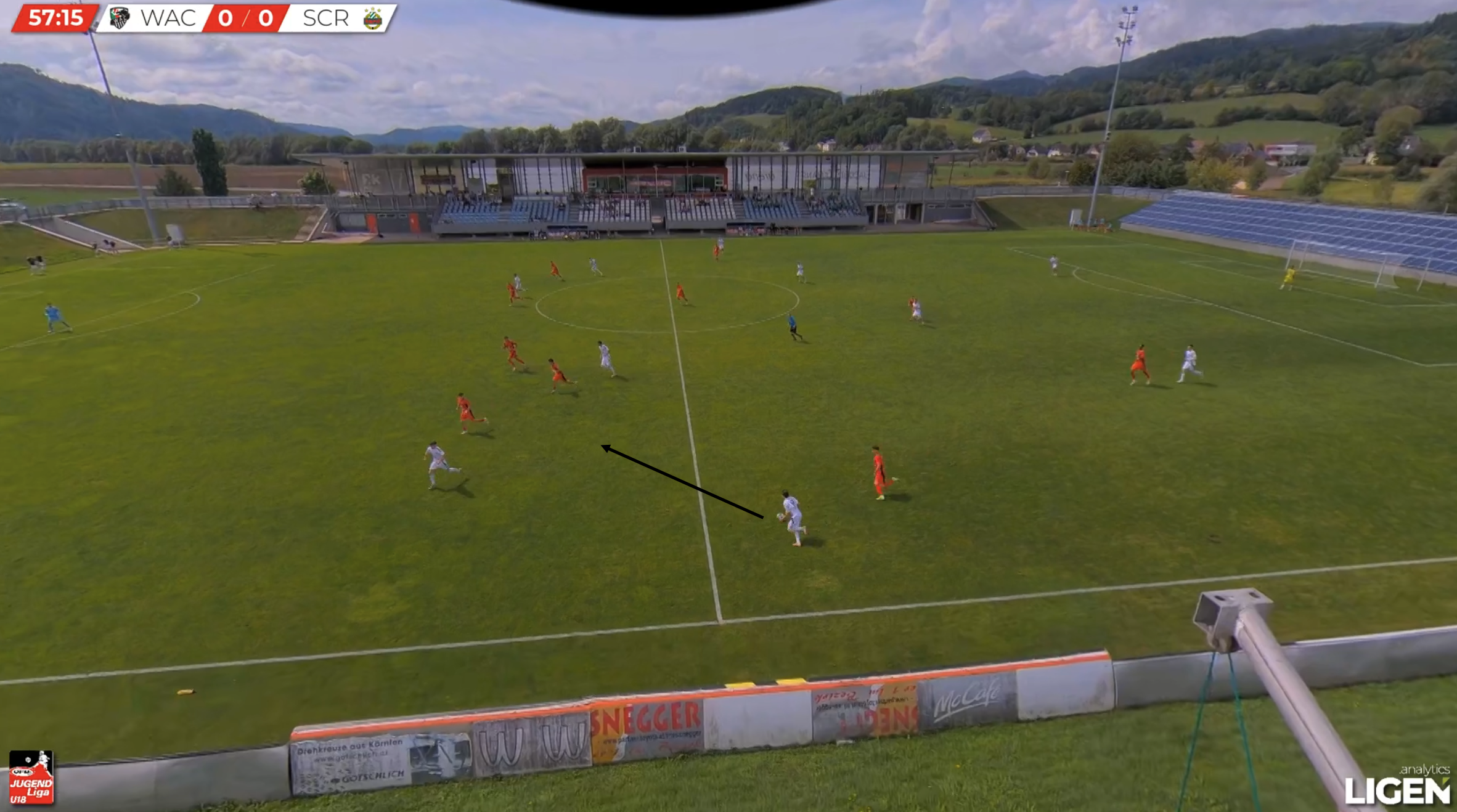
With just one pass from the centre-back, WAC U18s are now attacking the backline.
The wide forward looks to attack the space ahead in the wide channel, which encourages the full-back to drive infield with the ball, demonstrating another of their principles, rational space occupation, which looks to optimise the positioning of players to occupy as many defenders as possible to find the free player.
Alexander Johannsen Settled Possession Tactics
WAC U18s have many defining characteristics in settled possession phases, despite being a team that looks to dominate the transition phases.
This section will take a look at a few examples that demonstrate their key principles, principles from which emerge their vertical, dynamic game.
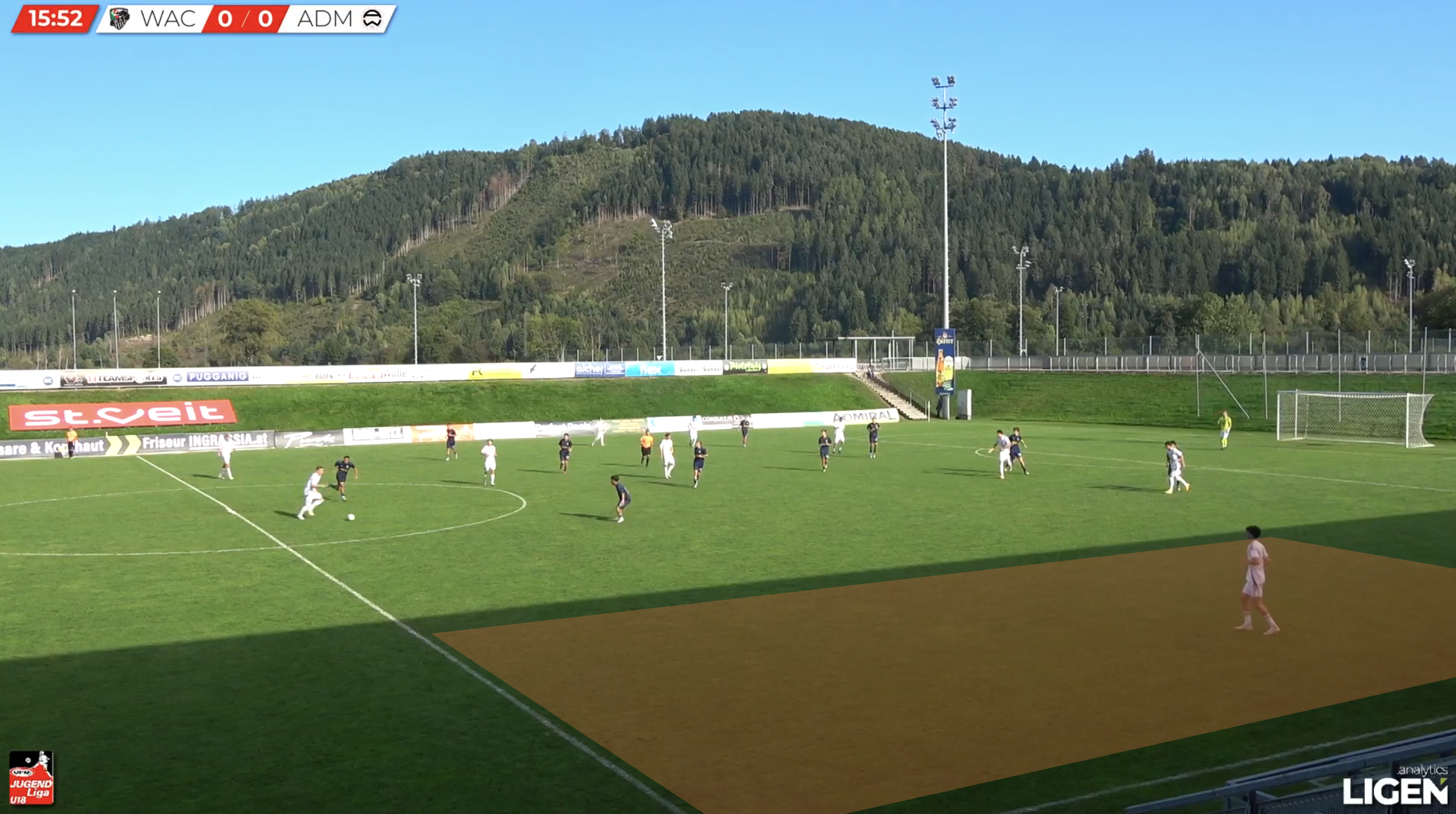
The first principle to observe in this example is Johannsen’s requirement for players to engage any available space ahead of them by carrying into it, as opposed to looking to wait on the ball to bait the press, as some teams choose to do.
This aligns closely with their proactive approach, always looking to be positive in and out of possession.
One of WAC U18s’ key principles in possession is maintaining central occupation.
This precedes any structure; however, their most commonly used 4-2-2-2 formation has the front four taking narrow positions, much like in the build phase, with the full-backs high and wide.
This creates a dilemma for the opposition; they must narrow to block the central passing options but then afford space in the wide channels.
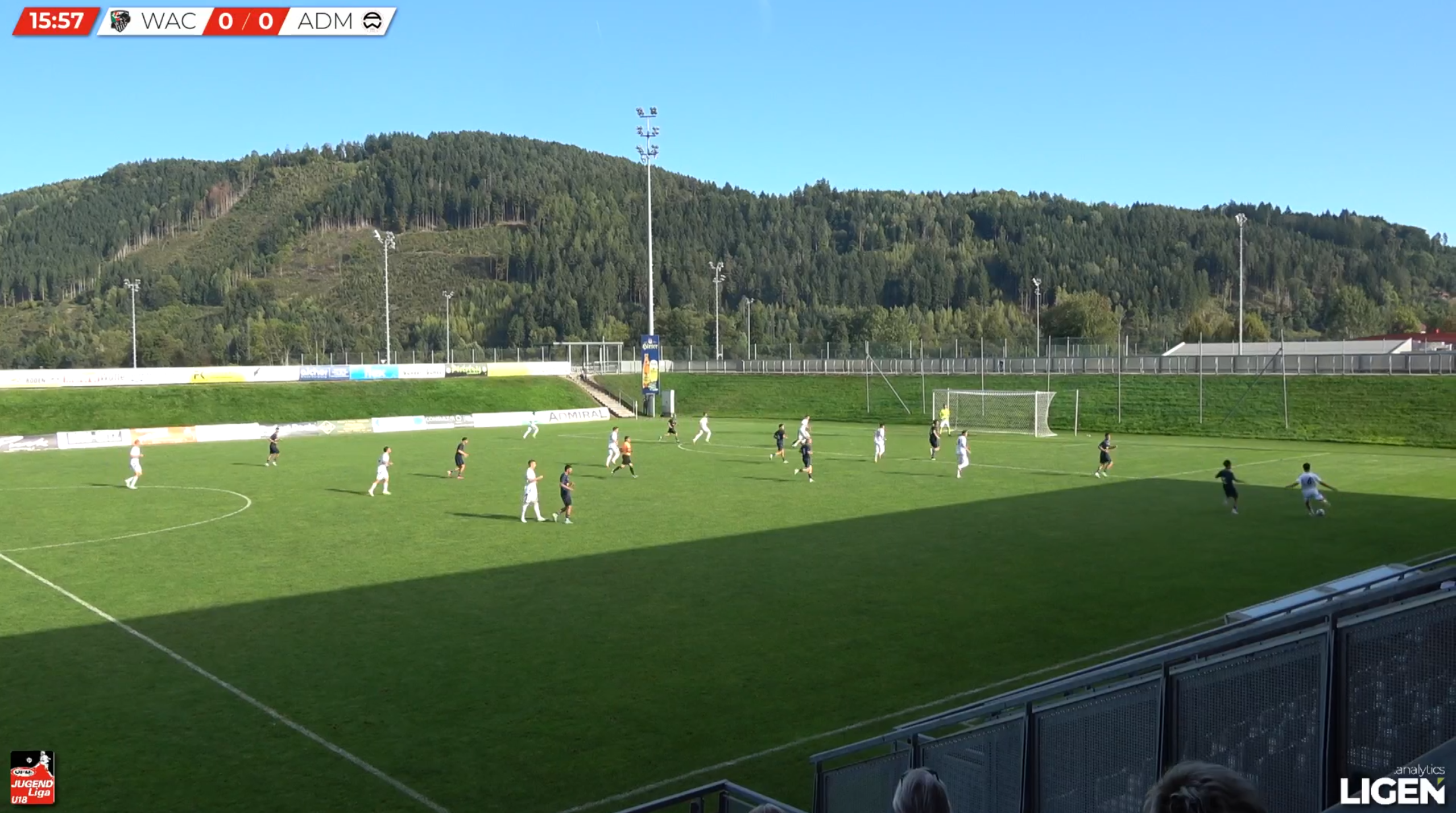
In this case, the space is available in the wide channel, and the full-back is able to carry the ball into a promising crossing position.
Another principle is then demonstrated by the Austrian side: committing high numbers to attack the box.
This is aided by the narrow nature of WAC U18s’ front four, enabling them to be in close proximity to the box.
Additionally, it demonstrates the verticality of Alexander Johannsen’s U18s side.
The tempo of play is accelerated as soon as they have an opportunity to attack the weak side, as opposed to a slow approach that looks to gradually gain territory.
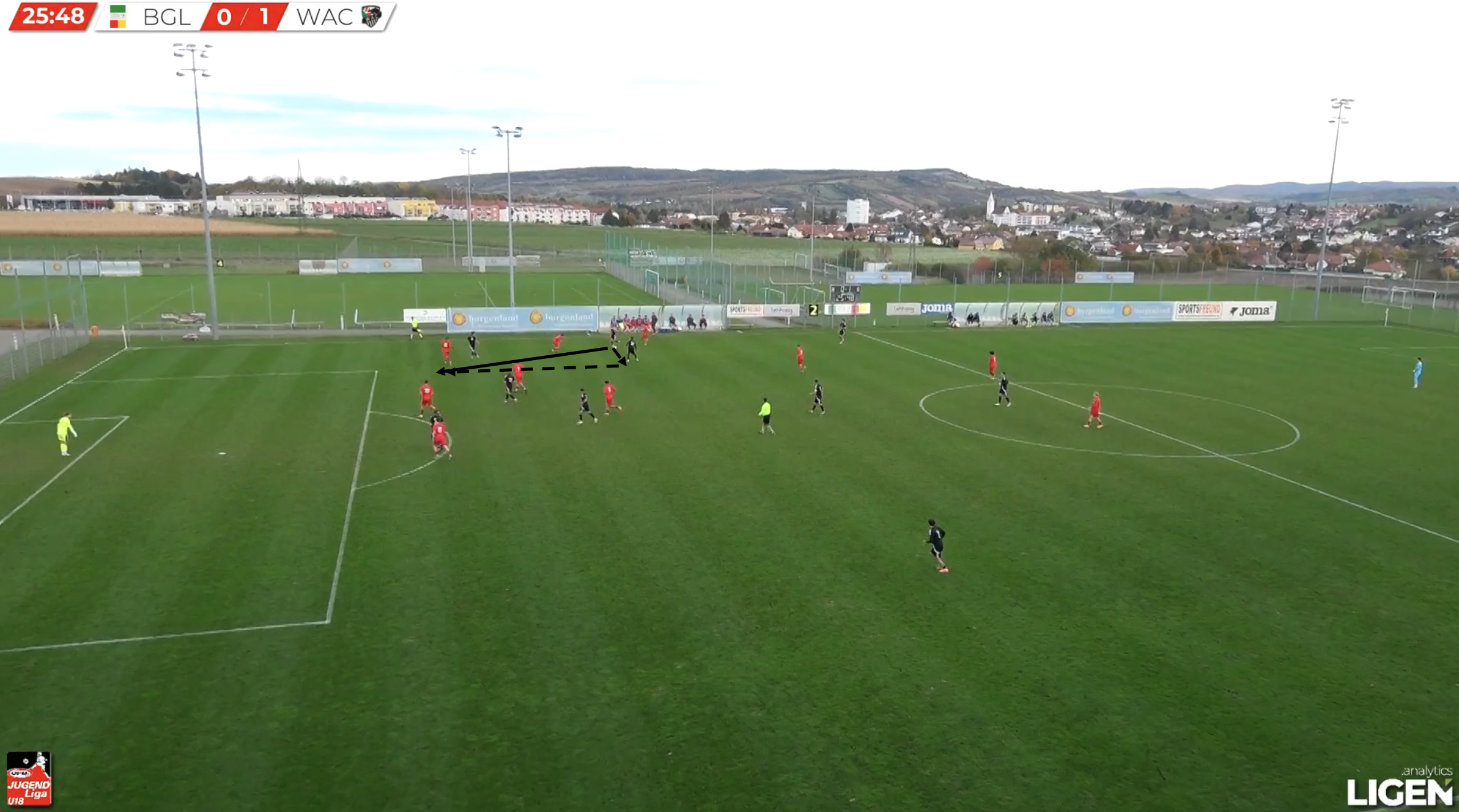
‘Pass and move’ is a prominent feature of Johannsen’s game model.
It aligns with his philosophy of being proactive by not being static and waiting for the free player to be found by simply shifting the ball, but by actively looking to attack available spaces.
Here, the forward has again moved wide, pulling the defender with him.
This opens up the space inside, which the full-back successfully accesses through a give-and-go with a teammate.
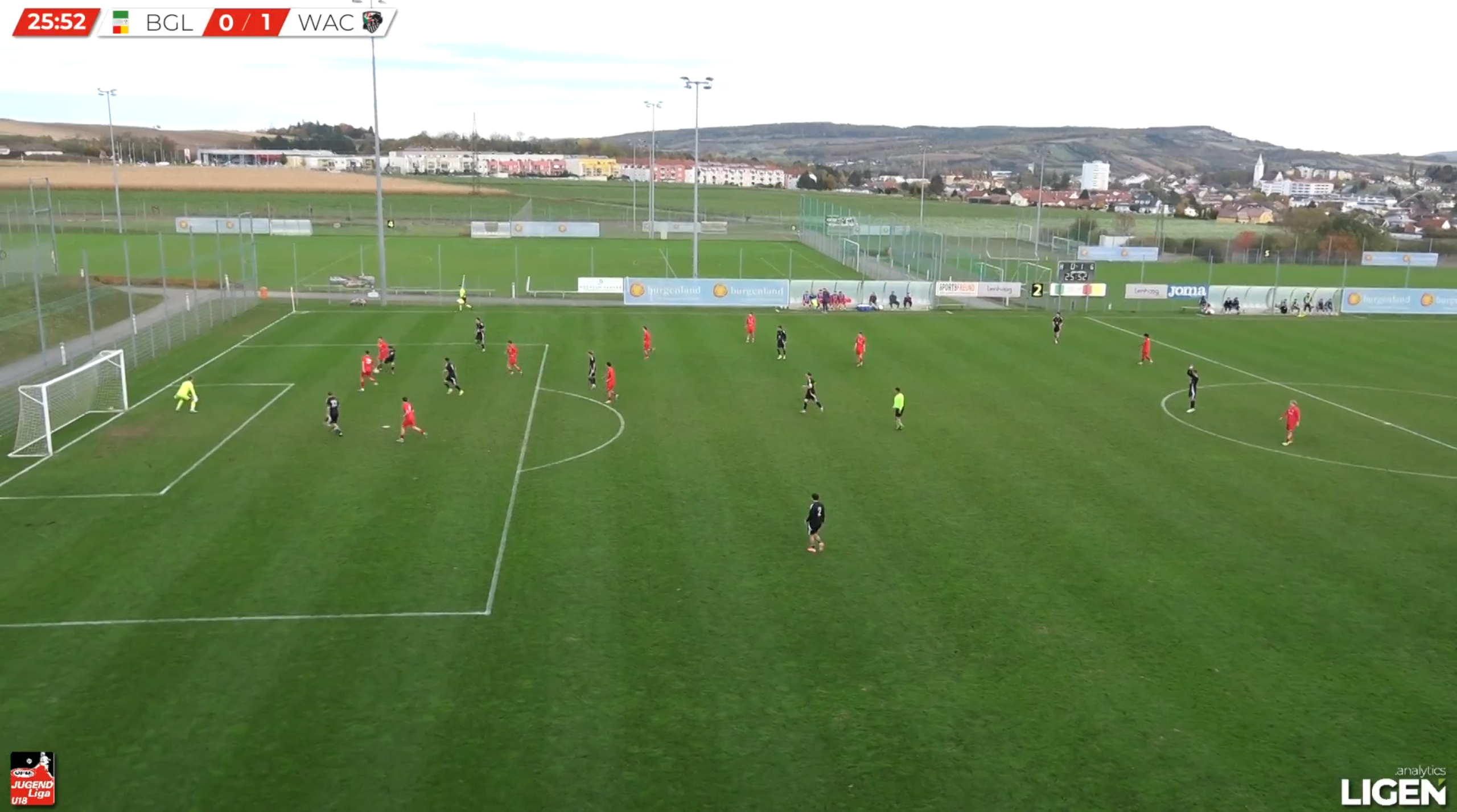
The full-back receives the return pass and attacks the space ahead of him.
To complete the action, he performs a cutback, with one forward attacking the far post and one who applies the finish waiting for the cutback.
Conclusion
WAC U18s clearly exhibit Alexander Johannsen’s philosophy of proactive, intense football in all phases of play.
Just as they do from open play, set-piece situations are approached in an equally front-footed manner, using many variations in their routines to create dangerous situations with high numbers of players attacking the box.
WAC U18s are demonstrating the merits of this style of game model, backed up by their impressive standing in the league table.
While many employ man-orientation and see possession as a means of control, Johannsen’s side instead press aggressively in a ball-orientated, zonal manner while utilising possession as a means to consistently arrive in front of goal.
