
Raffaele Palladino was recently appointed as the new head coach of Atalanta, following the sacking of Ivan Jurić, with La Dea occupying the 13th spot in Serie A, having won only two games, drawn seven, and lost two out of 11 games.
Despite achieving results in the UEFA Champions League, it appears that Atalanta’s management was not satisfied with the quality of football that Jurić offered, in addition to his results in Serie A.
That’s why the appointment of Palladino comes quite early in the season in order to save the campaign and help the team perform in a more convincing and rewarding way.
In this tactical analysis, the focus will be on identifying Palladino’s footballing ideas and principles based on his spells at Fiorentina and at Monza.
The analysis will also reserve a section that focuses on his possible changes to the current Atalanta playing style, as well as his possible lineup and formation.
More importantly, the analysis will attempt to explore how Raffaele Palladino will adjust Atalanta players’ roles to suit his ideas and philosophy.
Raffaele Palladino Style Of Play
Raffaele Palladino is a head coach who knows how to keep his team balanced and often avoids going for risky attacking plans or excessively defensive solutions.
He is rather someone who combines both phases with calculated risks and an ability to control his team, conceding few goalscoring opportunities per game while remaining capable of creating dangerous chances against any opponent.
We have already seen this with Fiorentina and Monza previously, as Palladino was capable of finishing sixth in Serie A and qualifying for the next UEFA Conference League with Fiorentina.
Additionally, he was able to avoid relegation during two successive seasons with Monza.
These long-term results confirm that Palladino is a reliable head coach who can guarantee stability and positive performances for any team he takes charge of.
However, the challenge for him will be that this time he will have to start fixing things and applying his ideas while the season is underway.
This will be the first time he takes charge of a Serie A team during the season.
Palladino is also a head coach who believes strongly in maintaining possession.
In fact, his possession ideas are not based on just possessing the ball passively and waiting for opportunities.
Palladino pushes his teams to have possession and use triangular passing until the opposing midfielders advance further and free spaces inside the final third.
And that’s when his teams go for vertical passing or penetrations to exploit those spaces and create the threat needed.
Palladino’s sides are characterised by patience in playmaking and by providing a lot of key passes per game to exploit the free spaces and always use those spaces either on the wings or centrally in order to use those spaces to punish the opponent.
Raffaele Palladino Possession-Based Football & Intelligent Use Of Spaces
The following goal action highlights Fiorentina’s gradual advancement with the ball until Nicolò Fagioli found a vertical passing possibility in space at the back of the defensive line from the left wing.
This helped Fiorentina create a dangerous opportunity from the wing, and the key to the move’s success was the patience of all the players involved.
They received the shown pass, advanced with the ball, but did not simply pass it to the most obvious destination, which was Lucas Beltrán in the centre of the box.
Instead, he opted for Moise Kean, who came from behind, and the latter did well to dribble past his direct opponent before shooting, instead of opting for a first-time shot.
All these decisions highlight the fact that Raffaele Palladino is capable of guiding his players to make the most suitable choices upfront without haste and without resorting to the obvious solution.

This does not mean that Palladino avoids counterattacks or does not rely on vertical passing.
In fact, Palladino believes in creating spaces within the opponent’s half and utilising them intelligently to reach the goal.
However, if those spaces are already created without effort, such as during counterattacks, Palladino does not hesitate to push his teams to exploit those spaces through quick and vertical passing, making the attacking transitions as quick as possible.
Many of Palladino’s team’s goal actions were created through counterattacking and without holding the ball for too long.
And this mixture of solutions makes Palladino’s attacking style too varied to be easily understood and defended against with efficiency.
Raffaele Palladino Mixed Attacking Solutions & Use Of Counterattacking
As soon as teams apply high pressure and attack with a high defensive block, thinking that Raffaele Palladino is only a possession-based head coach, he surprises them with very quick attacking transitions.
Palladino does not like to wait during such moments and prefers to exploit the spaces with rapid transitions that he uses specifically during such occasions.
This mixed modern approach to attacking, which combines possession-based football, triangular passing, and vertical passing on certain inviting occasions, makes Palladino’s attacking style complicated to predict and defend against successfully.
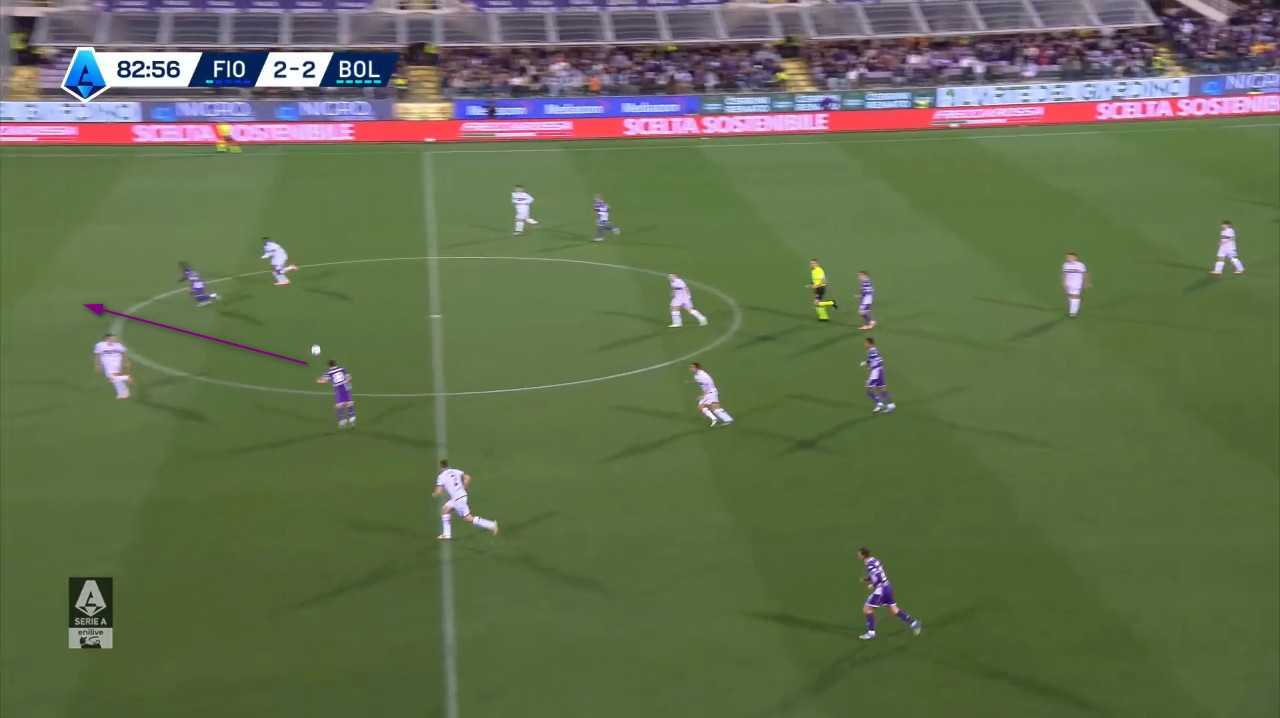
One of the perfect examples for this is Fiorentina’s third goal against Bologna, which was scored using just two passes, including David de Gea’s clearance.
Palladino utilises goalkeepers extensively in this regard, as he was the one who helped De Gea return to excellent condition, whether for goalkeeping or playmaking from the back.
In this action, De Gea notices the spaces behind Bologna’s defensive line and immediately sends the ball to Rolando Mandragora, who was reactive enough to see the space in front of Kean and provide him a header that put him in a 1-v-1 with the goalkeeper.
And with players like those of Atalanta who are already adapted to quick football under the management of Gasperini, Palladino will not face issues in applying such attacking plans, as he will find the necessary resources to do it even better than he did at Fiorentina.
The quality of the players at Atalanta will undoubtedly present Palladino with a convincing style of football.
However, the challenge for him will be to determine how to apply his changes and at what frequency.
Another remarkable trait that characterizes Palladino is that he is a versatile head coach who is continuously on the lookout for the most suitable plans and formations.
This will greatly benefit Atalanta in terms of unpredictability.
We can also expect a lot of movements without the ball, especially from midfielders, as Palladino believes in the importance of midfielders not only in playmaking but also in penetrating towards the box and being involved in goal contribution.
Under the management of Palladino at Fiorentina, the team scored numerous goals, thanks to midfielders’ forward runs, both with and especially without the ball.
And with midfielders who have excellent attacking qualities at Atalanta, we can expect to see an upgrade in those midfielders’ attacking contributions.
Palladino relies heavily on space creation without the ball, utilising passes that follow in the spaces created to advance intelligently and establish numerical superiority where it matters most.
Raffaele Palladino Space Creation & Midfield Roles
The following goal action against Empoli showcases the excellent build-up that led to Yacine Adli being in a position to score without being marked.
It starts with Beltrán retreating to contribute to his side’s playmaking and attract a defender, thereby freeing the space inside the box for anyone coming from behind.
And with the help of Albert Guðmundsson, who proposes a passing option while also attracting an opponent and freeing some space in midfield, Mandragora provides a first-time pass to Beltrán.
At the same time, Guðmundsson makes a U-turn behind Mandragora and receives another first-time pass from Beltrán.
In the meantime, Yacine Adli exploits the space left by the marker of Beltrán and attacks it to receive a through pass from Guðmundsson that invites him to finish inside the net.
This action highlights Raffaele Palladino’s reliance on quick passing, combined with intelligent movements from all players, to create spaces for those coming behind.
At Atalanta, such tactics will not be new to the players, as they were accustomed to applying similar plans under Gasperini.
Therefore, this will be a suitable opportunity for Palladino to apply his attacking plans with more efficiency compared to when he was at Fiorentina.
Raffaele Palladino Predicted Formation & Lineup At Atalanta
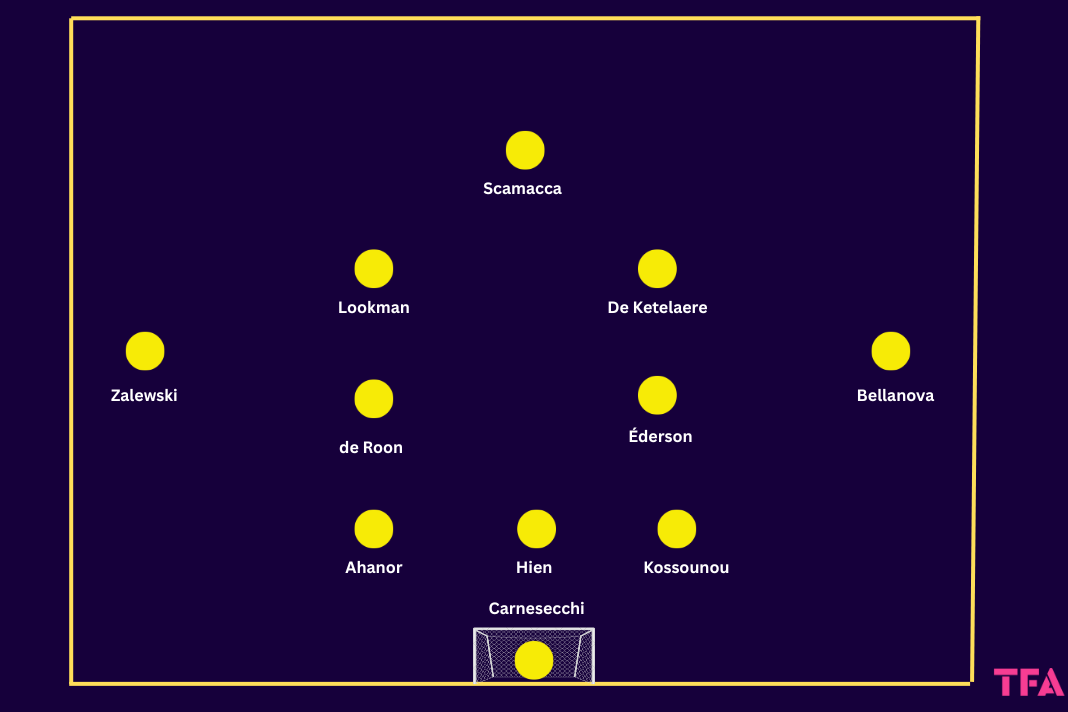
Palladino would probably maintain the same 3-4-2-1 formation or make slight adjustments to it, such as utilising it as a 3-4-3 formation with two advanced playmakers and a striker.
Palladino can also employ a 3-4-1-2 formation with an advanced playmaker and two strikers, depending on the game plan and the opponent.
However, overall, Palladino will not be changing the back-three defensive line structure, as the squad has reliable centre-back options that Palladino can rely on.
It would be useless to change the team’s structure at this critical time.
Raffaele Palladino Predicted Lineup At Atalanta
For the goalkeeper role, he will be using Marco Carnesecchi as the team’s goalkeeper, with a defensive line comprising Odilon Kossounou as a right centre-back, Isak Hien as a central centre-back, and Honest Ahanor as a left centre-back.
Both Berat Djimsiti and Giorgio Scalvini will serve as backup options for Kossounou and Hien, while the second option for the left centre-back position will be Sead Kolašinac.
The midfield will be comprised of Raoul Bellanova as a right wing-back, with Davide Zappacosta as the second option for that role.
On the left side, Palladino will most likely rely on Nicola Zalewski as a left wing-back, with the potential use of Ahanor in that position, as the latter has the necessary skills to support attacks while also providing more defensive security.
The two central midfielders will be Éderson and Marten de Roon, with Mario Pašalić as a third option, to be used especially during the second half.
Attacking-wise, it is expected that Palladino would rely on Gianluca Scamacca as the main striker option, with Nikola Krstović as the second option.
He would most likely use Ademola Lookman as a second striker alongside Scamacca, with Charles De Ketelaere as an advanced playmaker, since that is his natural position.
That said, Palladino will not hesitate to experiment with other attacking ideas with Lookman and De Ketelaere as wingers and Scamacca as a striker, knowing that Kamaldeen Sulemana will be a second-choice winger for Lookman.
On the left wing, Lazar Samardžić is expected to receive more playing time under Palladino’s management, as the Serbian player has had opportunities to play as an advanced playmaker or as a left winger/playmaker.
Conclusion
Raffaele Palladino will certainly improve Atalanta’s play and make the team play more convincing football compared to their performances at the start of this season.
Although it will be complicated to reach Gasperini’s peak years at Atalanta, Raffaele Palladino is expected to succeed with La Dea, especially if he knows how to manage his time and apply his ideas in a fluid way.
