
Total Football Analysis
Once.Sport
  • Football Analysis
    • Data Analysis
    • Formations
      • 2-2-4 Formation
      • 2-3-5 Formation
      • 3-1-4-2 Formation
      • 3-2-2-3 Formation
      • 3-2-4-1 Formation
      • 3-1-6 Formation
      • 3-3-4 Formation
      • 3-4-1-2 Formation
      • 3-4-2-1 Formation
      • 3-4-3 Formation
      • 3-5-1-1 Formation
      • 3-5-2 Formation
      • 4-1-4-1 Formation
      • 4-2-2-2 Formation
      • 4-2-3-1 Formation
      • 4-2-4 Formation
      • 4-3-1-2 Formation
      • 4-3-3 Formation
      • 4-4-2 Formation
      • 4-5-1 Formation
      • 5-3-2 Formation
      • 5-4-1 Formation
      • 6-3-1 Formation
    • Head Coach Analysis
    • Match Analysis
    • Player Analysis
    • Recruitment Analysis
    • Set Piece Analysis
    • Tactical Theory
    • Tactical Preview
    • Team Analysis
    • Training Analysis
    • Tactical Analysis
    • Scouting Report
  • Competition
    • ALL Competitions
    • English Premier League
    • Champions League
    • La Liga
    • Bundesliga
    • Serie A
    • Ligue 1
    • Eredivisie
    • EFL Championship
    • FIFA World Cup 2022
    • WEURO 2022
    • Women’s Super League
    • NWSL
    • Belgian First Division A
    • A-League
    • Liga Profesional de Argentina
    • Austrian Bundesliga
    • Campeonato Brasileiro Série A
    • DFB Pokal
    • 1. HNL
    • Danish Superliga
    • EFL League One
    • EFL League Two
    • FA Cup
    • EFL Cup
    • Indian Super League
    • K-League
    • J1 League
    • Liga MX
    • Copa América 2021
    • Copa del Rey
    • MLS
    • Eliteserien
    • Euro 2020
    • Primeira Liga
    • Scottish Premiership
    • Allsvenskan
    • Europa League
    • UEFA Nations League
    • Liga AUF Uruguaya
  • Coaches
    • All Coaches
    • Alfred Schreuder
    • Ange Postecoglou
    • Antonio Conte
    • Arne Slot
    • Bo Svensson
    • Brendan Rodgers
    • Bruno Lage
    • Carlo Ancelotti
    • Christophe Galtier
    • Claude Puel
    • Claudio Ranieri
    • David Moyes
    • Dean Smith
    • Diego Simeone
    • Domenico Tedesco
    • Frank Lampard
    • Eddie Howe
    • Edin Terzić
    • Emma Hayes
    • Erik ten Hag
    • Ernesto Valverde
    • Gennaro Gattuso
    • Gerardo Seoane
    • Gian Piero Gasperini
    • Giovanni van Bronckhorst
    • Graham Potter
    • Igor Tudor
    • Imanol Alguacil
    • Jesse Marsch
    • Jonas Eidevall
    • Jorge Sampaoli
    • José Bordalás
    • José Mourinho
    • Julen Lopetegui
    • Julian Nagelsmann
    • Julien Stéphan
    • Jürgen Klopp
    • Luciano Spalletti
    • Lucien Favre
    • Manuel Pellegrini
    • Marcelo Bielsa
    • Marco Rose
    • Marco Silva
    • Massimiliano Allegri
    • Mauricio Pochettino
    • Maurizio Sarri
    • Mikel Arteta
    • Niko Kovač
    • Nuno Espírito Santo
    • Oliver Glasner
    • Patrick Vieira
    • Paulo Fonseca
    • Pep Guardiola
    • Peter Bosz
    • Rafa Benítez
    • Ralf Rangnick
    • Ralph Hasenhüttl
    • Roger Schmidt
    • Roy Hodgson
    • Sean Dyche
    • Sérgio Conceição
    • Simone Inzaghi
    • Sonia Bompastor
    • Stefano Pioli
    • Steffen Baumgart
    • Steven Gerrard
    • Thiago Motta
    • Thomas Frank
    • Thomas Tuchel
    • Unai Emery
    • Vincenzo Italiano
    • Xavi
  • Teams
    • ALL Teams
    • AC Milan
    • Ajax Amsterdam
    • Arsenal
    • AS Monaco FC
    • Atalanta
    • Atlético Madrid
    • FC Barcelona
    • FC Bayern Munich
    • Borussia Dortmund
    • Celtic FC
    • Chelsea FC
    • Everton F.C.
    • Inter Milan
    • Juventus F.C.
    • Leeds United F.C.
    • Liverpool FC
    • Manchester City
    • Manchester United FC
    • Paris Saint-Germain
    • Rangers FC
    • RB Leipzig
    • Real Madrid CF
    • Tottenham Hotspur
    • West Ham United
  • Players
    • ALL Players
    • Alisson Becker
    • Bukayo Saka
    • Erling Haaland
    • Harry Kane
    • Jack Grealish
    • John Stones
    • Julián Alvarez
    • Kalvin Phillips
    • Kevin De Bruyne
    • Kyle Walker
    • Kylian Mbappé
    • Lamine Yamal
    • Lionel Messi
    • Luis Díaz
    • Mohamed Salah
    • Phil Foden
    • Virgil Van Dijk
  • Contact
  • Write For TFA
No Result
View All Result
No Result
View All Result
Total Football Analysis
No Result
View All Result
Home Head Coach Analysis

Francesco Farioli Tactics At FC Porto 2025/2026: From Chaos To Control Under The Young Strategist – Tactical Analysis

Bola Atta by Bola Atta
November 13, 2025
in Head Coach Analysis, 4-2-3-1 Formation, 4-3-3 Formation, Analysis, FC Porto, Francesco Farioli, Liga Portugal, Tactical Analysis
0
Francesco Farioli At FC Porto 20252026

By appointing Francesco Farioli as manager last summer, FC Porto signalled their intent to evolve, not just change leadership.

After a period of domestic stagnation, Dragões now seek a renewal of identity, characterised by a sharper tactical framework, greater control of matches, and a return to proactive football.

Farioli, aged just 36, arrives with strong credentials and a philosophical outlook.

President André Villas-Boas endorsed the new coach as an ‘ambitious’ but trusted choice, selected for his vision and his capacity to return the club to its winning ways with strength and discipline.

In this Porto tactical analysis, we will examine how Farioli is reshaping style, structure, and squad usage, identify the areas of progress, assess the risks, and outline key areas to monitor going forward.

FC Porto Build-Up & Progression Tactics

Under Farioli tactics, Porto have transformed their build-up from the back into a more structured, positional process.

The goalkeeper and centre-backs are involved early, with the pivot (No. 6) often dropping between the central defenders to form a back three and create numerical superiority in the first phase of possession, or when one of the full-backs stops with two centre-backs.
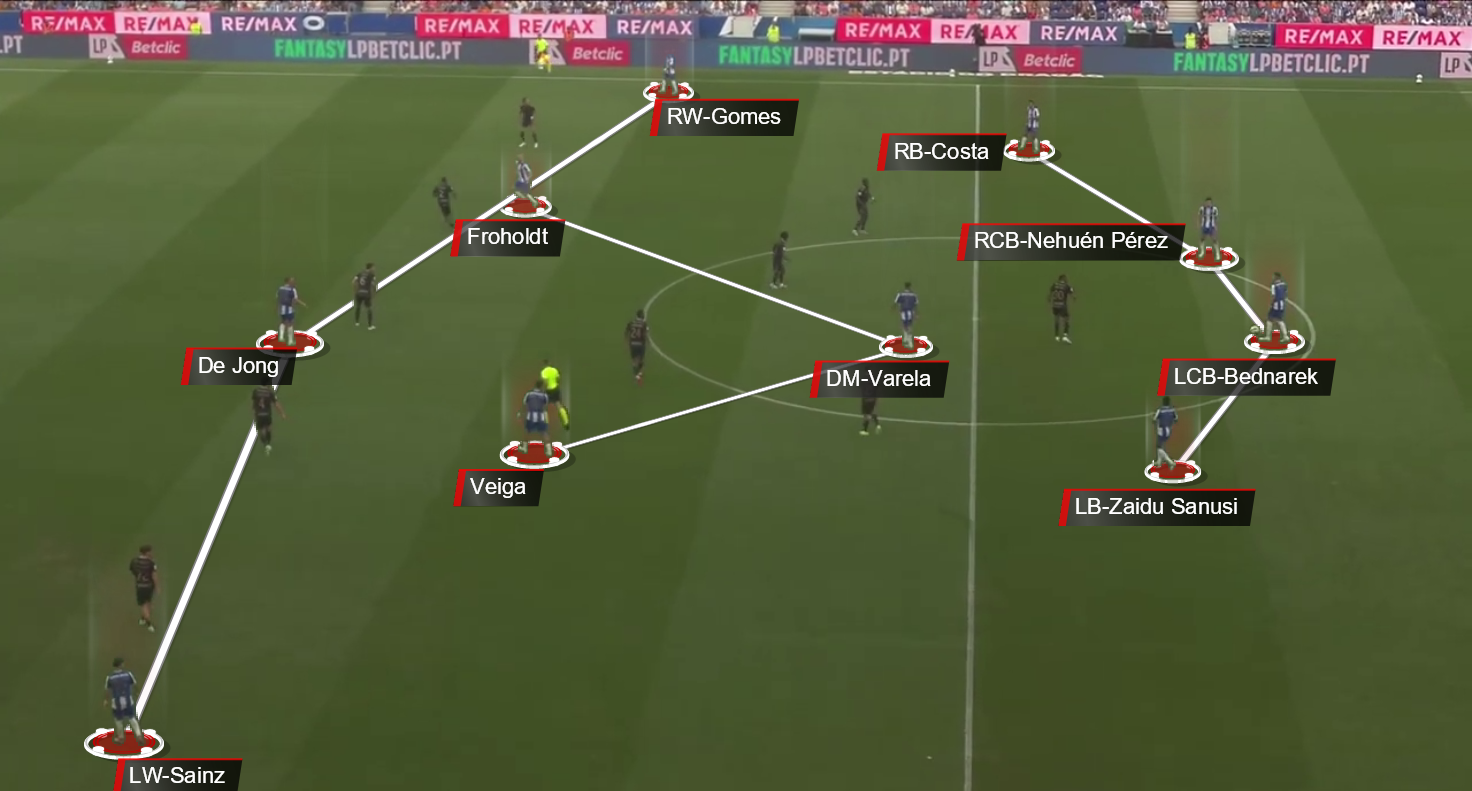
Francesco Farioli Tactics At Porto FC 2025/2026: From adaptation to dominationMeanwhile, full-backs typically invert centrally around the No. 6, allowing the two No. 8s to occupy advanced central positions and link play into the front three, as shown above versus Casa Pia.

build up 1The wide forwards stretch the play wide but are ready to cut inside or receive between lines, offering a dual dimension of width and interior overloads.

The emphasis is on short combinations, thoughtful progression rather than purely direct play, and managing opponent pressing by stepping either into midfield or bypassing it when required.

https://totalfootballanalysis.com/wp-content/uploads/2025/11/build-up-video.mp4

The right centre-back receives the ball from the goalkeeper as the team builds up with a back three (two centre-backs and the goalkeeper).

Midfielder Victor Froholdt shifts horizontally to create a passing lane, allowing a vertical pass into the striker and effectively breaking the first line of pressure.

Here is a clear example versus Sporting CP.

After establishing their build-up structure, circulating the ball between the goalkeeper, centre-backs, and a pivot or full-back, Porto begin the progression phase, purposefully moving the ball from deep areas into advanced positions.

Full-backs may invert into midfield, allowing the No. 6 to cover the backline, while the two No. 8s push into the half-spaces to receive between the lines.

In this stage, the objective is to break the first line of opposition pressure, exploit pockets of space, and move into the opponent’s midfield or final third with numerical superiority.

Porto have shifted away from long-balls, now prioritising short, intelligent combinations and fluid player rotations to exploit gaps. 

https://totalfootballanalysis.com/wp-content/uploads/2025/11/progression-1.mp4

This allows them to either accelerate into the final third with a decisive pass or patiently maintain possession when space is limited, all while posing a constant vertical threat.

We can see an example vs Casa Pia.

As Farioli himself says: “We were patient at the right moments and created opportunities.”

This phase is crucial because it links the build-up to attacking overloads; if executed well, Porto create advanced entries and openings behind the opponent’s defensive block.

FC Porto Final Third Tactics

Once Porto get the ball into the attacking half, their play is organised but flexible.

They don’t just rely on random moments of skill; their attacks are built on teamwork and balance. 

https://totalfootballanalysis.com/wp-content/uploads/2025/11/outputcompress-video-online.com-3-1.mp4

They typically push five players forward to occupy all attacking lanes, pinning the defence back with wide wingers and forwards who attack the channels between defenders.

As we saw in the last scene vs Sporting CP.

https://totalfootballanalysis.com/wp-content/uploads/2025/11/outputcompress-video-online.com-3-3.mp4

The rotations between the wide and interior channels are deliberate.

When the winger holds width, the nearest No.8, such as the full-back, drives into the half-space to pin the opposing backline, creating separation for cutbacks or third-man runs.

Farioli’s tactical philosophy emphasises creating attacking opportunities through patient and precise ball movement. 

https://totalfootballanalysis.com/wp-content/uploads/2025/11/outputcompress-video-online.com-4-1.mp4

Porto often circulate the ball along the perimeter of the opponent’s penalty area, waiting for a specific moment to make a decisive pass. 

https://totalfootballanalysis.com/wp-content/uploads/2025/11/outputcompress-video-online.com-5.mp4

This trigger is frequently the winger moving towards the centre of the field, which opens up lanes for diagonal passes or passes from the inside to the outside.

To break down defences, the team consistently uses quick, one-two passes and forms dynamic triangles with players, particularly on the right side of the field.

https://totalfootballanalysis.com/wp-content/uploads/2025/11/outputcompress-video-online.com-6-1.mp4

They create an overload of players on one side to draw in the defence, then quickly switch the play to the less-defended opposite side. 

Furthermore, the full-backs are strategically positioned higher up the field to maintain constant pressure on the opponent and regain possession quickly if it’s lost. 

This allows Porto to build sustained waves of attack instead of relying on single, isolated plays.

Crucially, Porto’s attacks are underpinned by rest defence discipline: the pivot and the far full-back remain positioned to control counterattacks, ensuring the team can maintain a high attacking rhythm without losing compactness.

The end product combines directness and control: crosses from advanced wide zones, low cutbacks toward the penalty spot, and late runs from midfielders who time their arrivals with precision.

The result is a side capable of both positional domination and ruthless efficiency once the opposition’s block begins to bend.

FC Porto Pressing Tactics 

Under Francesco Farioli, Porto’s defensive structure is a direct reflection of their attacking philosophy, emphasising proactivity and positional discipline. 

While Farioli’s teams are characteristically possession-based, his Porto side has evolved to feature one of Portugal’s most coordinated and effective pressing systems.

https://totalfootballanalysis.com/wp-content/uploads/2025/11/pressing-1.mp4

Upon possession loss, Porto’s first line of pressure is immediately activated.

The ball-side winger and striker engage the opponent’s centre-back or full-back, while the far-side winger narrows to maintain central compactness and deny easy switches of play. 

This initial press is supported by the two No. 8s, who aggressively jump to close down interior passing options, all synchronised with the holding midfielder screening vertical access into the midfield.

In established defensive phases, Porto organise into a compact 4-1-4-1 or 4-3-3 mid-block, with the shape often dictated by the opponent’s formation. 

https://totalfootballanalysis.com/wp-content/uploads/2025/11/mid-block.mp4

The trigger to engage the press is clearly defined: the moment the ball is passed to a full-back or forced into a backward pass. 

This cue initiates a vertical compression from the forward line, squeezing the available space, while the defensive line confidently holds a high position near the halfway line to restrict depth.

Farioli’s instruction is clear: win the ball as high and as soon as possible, but with rest and defensive stability to prevent direct transitions.

https://totalfootballanalysis.com/wp-content/uploads/2025/11/rest-defense.mp4

Out of possession, the centre-backs are proactive in stepping forward rather than dropping, aiming to intercept and immediately initiate new build-up sequences. 

The full-backs adjust fluidly: one steps up into the press when the winger narrows, while the far full-back stays deeper to prevent counters. 

This ensures that Porto’s pressing remains layered rather than reckless, always with a spare man behind the line of pressure.

https://totalfootballanalysis.com/wp-content/uploads/2025/11/by-pass6.mp4

Should the opponent manage to bypass the initial wave of pressure, Porto respond by collapsing centrally and creating intense ball-side density. 

This action is often led by the nearest midfielder, who drops back to form a 2-v-1 with the full-back, effectively isolating the ball carrier near the touchline. 

This ‘funnel-pressing’ pattern, designed to steer opposition attacks into predetermined, congested areas, is a tactical hallmark Farioli has carried over from his time at OGC Nice and now appears fully integrated into Porto’s defensive system. 

The ultimate goal is not merely to chase the ball, but to dictate the opponent’s spatial progression.

FC Porto Transition Tactics

Farioli’s Porto is not a team that counterattacks recklessly, but when they do, it’s calculated and rehearsed.

The moment the ball is recovered, Porto seek immediate verticality through precise passing angles rather than sheer pace.

https://totalfootballanalysis.com/wp-content/uploads/2025/11/counter-attack-1.mp4

The first pass is always inward, towards the nearest midfielder, such as Froholdt here, or dropping forward to stabilise the play and identify whether the team can attack instantly or reset into structured possession.

In the attacking phase, the wingers are tasked with providing immediate verticality, pinning back the opposition’s full-backs to create horizontal space across the backline. 

This width is complemented by dynamic movement from the midfield, with one of the No. 8s executing a surging third-man run into the half-space to provide a progressive passing option and disrupt the defensive structure.

Farioli’s emphasis on tempo control is key here: transitions are not purely about speed but about recognising the moment.

In defensive transitions, Porto exemplifies Farioli’s structural discipline perfectly. 

The moment possession is lost, they trigger an intense five-second counterpress: wingers and No. 8s quickly collapse on the ball carrier.

At the same time, the pivot secures the central lane to block any escape passes.

https://totalfootballanalysis.com/wp-content/uploads/2025/11/outputcompress-video-online.com-7-1.mp4

The primary objective of the press extends beyond immediate ball recovery; it is strategically designed to delay and disrupt the opponent’s initial build-up, preventing the first one or two passes and disrupting any rhythm that might be established.

Conclusion

Under Francesco Farioli coaching style, the team have evolved into a side defined by method and structure.

Their play now balances patient build-up with vertical precision, coordinated pressing with defensive control. 

Each phase reflects a team that seeks to dominate through organisation rather than chaos.

Farioli’s tactical influence has reshaped Porto’s rhythm and identity, creating a side capable of sustaining pressure, regaining control instantly, and dictating tempo in every zone of the pitch. 

If maintained, this framework positions the team not only as a domestic contender but as a modern tactical benchmark in Portuguese football.

Tags: FC Porto Tactical AnalysisFC Porto TacticsFrancesco FarioliFrancesco Farioli Coaching StyleFrancesco Farioli FormationFrancesco Farioli Manager StyleFrancesco Farioli PortoFrancesco Farioli Style Of PlayFrancesco Farioli Tactical AnalysisFrancesco Farioli TacticsLiga Portugal Analysis
Previous Post

Félix Correia Scout Report At Lille OSC 2025/2026: Ex-Manchester City & Juventus Talent Thriving In Ligue 1 – Player Analysis

Next Post

Jérémy Jacquet Scout Report At Stade Rennais 2025/2026: Rennes’ Emerging Defensive Leader – Player Analysis

Next Post
Jérémy Jacquet Scout Report At Stade Rennais 2025/2026: Rennes’ Emerging Defensive Leader – Player Analysis

Jérémy Jacquet Scout Report At Stade Rennais 2025/2026: Rennes’ Emerging Defensive Leader – Player Analysis

  • About Total Football Analysis
  • Contact Total Football Analysis
  • Write For Total Football Analysis
  • Advertise
  • Privacy Policy
  • Cancellation / Refund Policy
  • Resources
  • Terms Of Service

© 2026 Total Football Analysis

No Result
View All Result
  • Football Analysis
    • Data Analysis
    • Formations
      • 2-2-4 Formation
      • 2-3-5 Formation
      • 3-1-4-2 Formation
      • 3-2-2-3 Formation
      • 3-2-4-1 Formation
      • 3-1-6 Formation
      • 3-3-4 Formation
      • 3-4-1-2 Formation
      • 3-4-2-1 Formation
      • 3-4-3 Formation
      • 3-5-1-1 Formation
      • 3-5-2 Formation
      • 4-1-4-1 Formation
      • 4-2-2-2 Formation
      • 4-2-3-1 Formation
      • 4-2-4 Formation
      • 4-3-1-2 Formation
      • 4-3-3 Formation
      • 4-4-2 Formation
      • 4-5-1 Formation
      • 5-3-2 Formation
      • 5-4-1 Formation
      • 6-3-1 Formation
    • Head Coach Analysis
    • Match Analysis
    • Player Analysis
    • Recruitment Analysis
    • Set Piece Analysis
    • Tactical Theory
    • Tactical Preview
    • Team Analysis
    • Training Analysis
    • Tactical Analysis
    • Scouting Report
  • Competition
    • ALL Competitions
    • English Premier League
    • Champions League
    • La Liga
    • Bundesliga
    • Serie A
    • Ligue 1
    • Eredivisie
    • EFL Championship
    • FIFA World Cup 2022
    • WEURO 2022
    • Women’s Super League
    • NWSL
    • Belgian First Division A
    • A-League
    • Liga Profesional de Argentina
    • Austrian Bundesliga
    • Campeonato Brasileiro Série A
    • DFB Pokal
    • 1. HNL
    • Danish Superliga
    • EFL League One
    • EFL League Two
    • FA Cup
    • EFL Cup
    • Indian Super League
    • K-League
    • J1 League
    • Liga MX
    • Copa América 2021
    • Copa del Rey
    • MLS
    • Eliteserien
    • Euro 2020
    • Primeira Liga
    • Scottish Premiership
    • Allsvenskan
    • Europa League
    • UEFA Nations League
    • Liga AUF Uruguaya
  • Coaches
    • All Coaches
    • Alfred Schreuder
    • Ange Postecoglou
    • Antonio Conte
    • Arne Slot
    • Bo Svensson
    • Brendan Rodgers
    • Bruno Lage
    • Carlo Ancelotti
    • Christophe Galtier
    • Claude Puel
    • Claudio Ranieri
    • David Moyes
    • Dean Smith
    • Diego Simeone
    • Domenico Tedesco
    • Frank Lampard
    • Eddie Howe
    • Edin Terzić
    • Emma Hayes
    • Erik ten Hag
    • Ernesto Valverde
    • Gennaro Gattuso
    • Gerardo Seoane
    • Gian Piero Gasperini
    • Giovanni van Bronckhorst
    • Graham Potter
    • Igor Tudor
    • Imanol Alguacil
    • Jesse Marsch
    • Jonas Eidevall
    • Jorge Sampaoli
    • José Bordalás
    • José Mourinho
    • Julen Lopetegui
    • Julian Nagelsmann
    • Julien Stéphan
    • Jürgen Klopp
    • Luciano Spalletti
    • Lucien Favre
    • Manuel Pellegrini
    • Marcelo Bielsa
    • Marco Rose
    • Marco Silva
    • Massimiliano Allegri
    • Mauricio Pochettino
    • Maurizio Sarri
    • Mikel Arteta
    • Niko Kovač
    • Nuno Espírito Santo
    • Oliver Glasner
    • Patrick Vieira
    • Paulo Fonseca
    • Pep Guardiola
    • Peter Bosz
    • Rafa Benítez
    • Ralf Rangnick
    • Ralph Hasenhüttl
    • Roger Schmidt
    • Roy Hodgson
    • Sean Dyche
    • Sérgio Conceição
    • Simone Inzaghi
    • Sonia Bompastor
    • Stefano Pioli
    • Steffen Baumgart
    • Steven Gerrard
    • Thiago Motta
    • Thomas Frank
    • Thomas Tuchel
    • Unai Emery
    • Vincenzo Italiano
    • Xavi
  • Teams
    • ALL Teams
    • AC Milan
    • Ajax Amsterdam
    • Arsenal
    • AS Monaco FC
    • Atalanta
    • Atlético Madrid
    • FC Barcelona
    • FC Bayern Munich
    • Borussia Dortmund
    • Celtic FC
    • Chelsea FC
    • Everton F.C.
    • Inter Milan
    • Juventus F.C.
    • Leeds United F.C.
    • Liverpool FC
    • Manchester City
    • Manchester United FC
    • Paris Saint-Germain
    • Rangers FC
    • RB Leipzig
    • Real Madrid CF
    • Tottenham Hotspur
    • West Ham United
  • Players
    • ALL Players
    • Alisson Becker
    • Bukayo Saka
    • Erling Haaland
    • Harry Kane
    • Jack Grealish
    • John Stones
    • Julián Alvarez
    • Kalvin Phillips
    • Kevin De Bruyne
    • Kyle Walker
    • Kylian Mbappé
    • Lamine Yamal
    • Lionel Messi
    • Luis Díaz
    • Mohamed Salah
    • Phil Foden
    • Virgil Van Dijk
  • Contact
  • Write For TFA
  • Login

© 2026 Total Football Analysis