
As the dust settles on the 2024/2025 Premier League season, the focus naturally shifts toward the lessons learned and what they might mean heading into the 2025/2026 EPL campaign.
While headlines often revolve around goal scorers and playmakers, the foundation of any successful side remains defensive structure.
In a fast-paced and tactically demanding league as fast as England’s top flight, the ability to control space, limit high-value chances, and maintain discipline without the ball is often what separates serious contenders from hopeful challengers.
The 2024/2025 season offered a compelling range of defensive approaches among the Big Eight sides.
From Pep Guardiola’s ball-dominant Manchester City to Unai Emery’s compact Aston Villa, the defensive identities of these clubs were as varied as they were effective.
Each side not only had a different tactical blueprint but also displayed unique statistical trends, from aggressive pressing and sliding tackles to clearances, interceptions, and blocked shots.
Analysing those numbers provides us with deeper insight into what worked, what didn’t, and how each manager sought to protect their goal.
In this data analysis report, we analyse the defensive performance of Arsenal, Aston Villa, Chelsea, Liverpool, Manchester City, Manchester United, Newcastle United, and Tottenham Hotspur against the key metrics that define modern defensive systems.
Using a blend of raw statistics and visualisations, we’ll identify stylistic trends, highlight standout contributors, and explore how each team’s defensive output aligned with their overall tactical strategy.
This report reflects on the past season’s performances.
It serves as a scouting lens for how these clubs might evolve defensively in 2025/2026 Premier League season, whether through new signings, tactical refinements, or structural overhauls.
The defensive side of the game is no longer an afterthought; it is a cornerstone of success in the modern Premier League.
Pressing Intent & Defensive Intensity: Analysing PPDA In The Big Eight Premier League Teams (2024/2025)
In evaluating the defensive identities of the Premier League’s big eight sides during the 2024/2025 season, Passes Per Defensive Action (PPDA) offers a telling insight into their pressing philosophies and off-ball aggression.
Passes Allowed Per Defensive Action For The Big Eight Teams in the Premier League 2024/2025
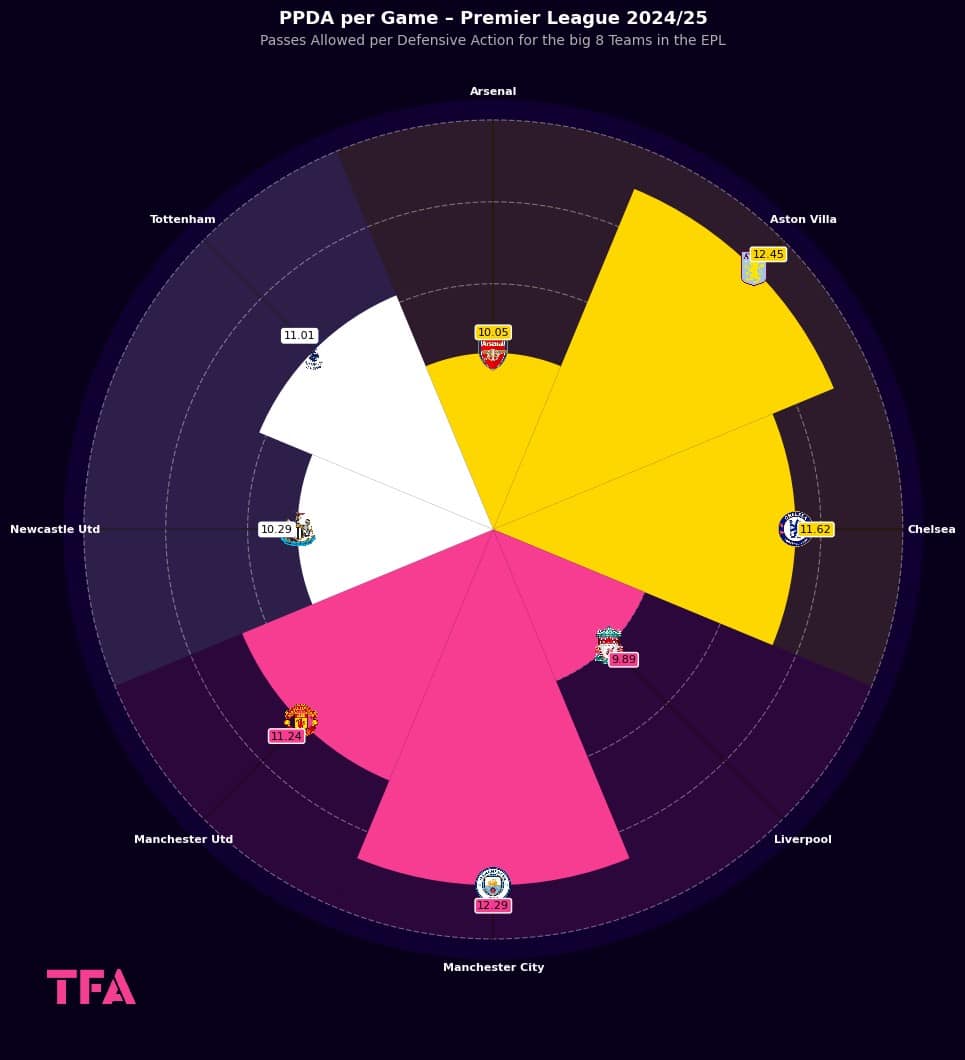
As a metric, PPDA reflects how many passes a team allows the opponent before attempting a defensive action in the opposition’s final 60% of the pitch; the lower the PPDA, the higher the pressing intensity.
Liverpool lead this pressing index with a league-low average PPDA of 9.89, underlining their aggressive high-press approach under Arne Slot.
Complementing this, they also register the highest number of defensive duels per game (67.21), indicating a side committed to pressing and consistent in engaging physically across the pitch.
Their interceptions (35.97) and clearances (12.63) per match further confirm a system that constantly looks to disrupt opposition build-up.
Arsenal also show a proactive approach with a PPDA of 10.05, ranking second-lowest.
Although they rank slightly lower in total defensive actions, 54.29 duels and 30.61 interceptions, Mikel Arteta’s side appears structured in their pressing triggers, allowing for slightly more control over chaos.
Newcastle United (PPDA: 10.29) also demonstrate a high-press tendency, backed by solid numbers in defensive duels (61.92) and an impressive 39.45 interceptions, the highest among the big eight sides.
This is indicative of Eddie Howe’s aggressive yet spatially aware defensive structure.
Conversely, Aston Villa (PPDA: 12.45) and Manchester City (12.29) operate with more patient defensive shapes.
City, in particular, registers the lowest number of defensive duels (50.16), aerial duels (21.61), and fouls (7.45), suggesting a pressing model that relies more on positional dominance than direct confrontation.
Ultimately, PPDA, when viewed alongside metrics like defensive duels, interceptions, and clearances, offers a layered picture of each team’s defensive character: from Liverpool’s suffocating aggression to Man City‘s calm control, each side’s tactical identity shines through in the numbers.
Manchester City Uncharacteristically Passive Pressing – A Tactical Shift Or Temporary Dip?
Among the most striking defensive data points from the 2024/2025 Premier League season is Manchester City’s pressing intensity—or rather, its unexpected decline.
Manchester City – Defensive Radar 2024/2025
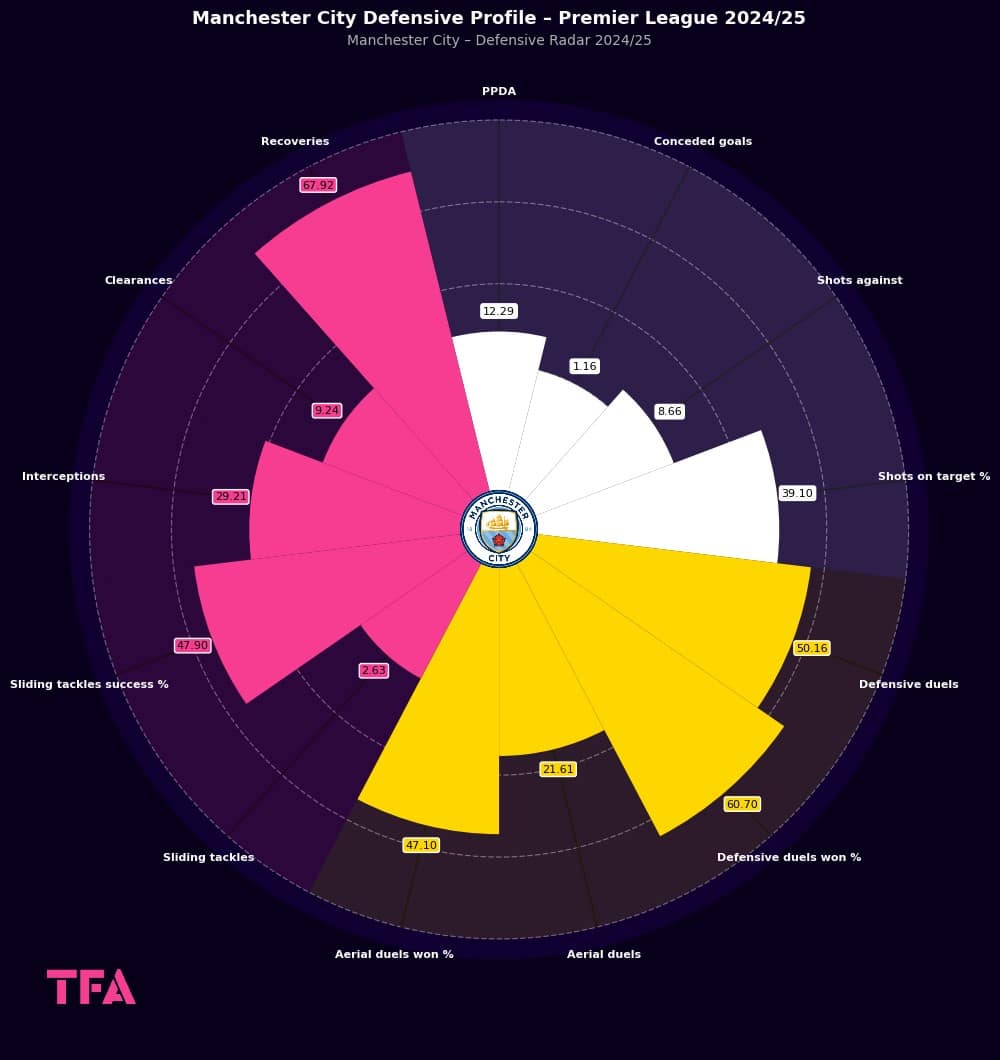
City posted a PPDA (Passes per Defensive Action) of 12.29, the second-highest among the Big Eight teams, signalling a significant drop in their pressing aggression.
This marks the first time under Pep Guardiola that the reigning English champions have shown such a pronounced retreat from their trademark high press, long associated with Guardiola’s relentless pursuit of ball recovery high up the pitch.
Traditionally, Guardiola’s sides suffocate opponents with structured, high-tempo pressing systems, often boasting some of the lowest PPDA figures in Europe.
However, this season’s figure suggests City allowed over 12 passes before initiating a defensive action, hinting at a more reserved and reactive defensive posture.
This shift coincides with a broader drop in City’s domestic performance, as they struggled to maintain their typical dominance in the league table.
Complementing the high PPDA is the lowest defensive duel average (50.16) among the analysed teams, alongside the fewest aerial duels per game (21.61).
These numbers support the notion that one side is less engaged in individual defensive contests, perhaps relying more heavily on positional control rather than physical confrontation.
Even in terms of interceptions (29.21) and clearances (9.24), City are on the lower end of the spectrum, indicating fewer moments of direct disruption.
Moreover, their fouls committed per game (7.45) is comfortably the lowest of the group, further reinforcing the idea of a less combative approach this term.
Whether this defensive mellowing represents a tactical recalibration or simply a symptom of fatigue and squad transition remains debatable.
What is certain, however, is that Manchester City’s 2024/2025 PPDA offers a rare glimpse into a Guardiola side that pressed less, engaged less, and, perhaps as a result, achieved less.
Manchester United & Liverpool Lead The Physical Charge As City Opt For Control – Analysis Of Defensive Duels & Aerial Engagements
When it comes to assessing the physical intensity and direct engagement of Premier League sides out of possession, defensive duels and aerial duels offer a revealing window into tactical intent.
Duels Per 90 For The Big Eight Premier League Clubs
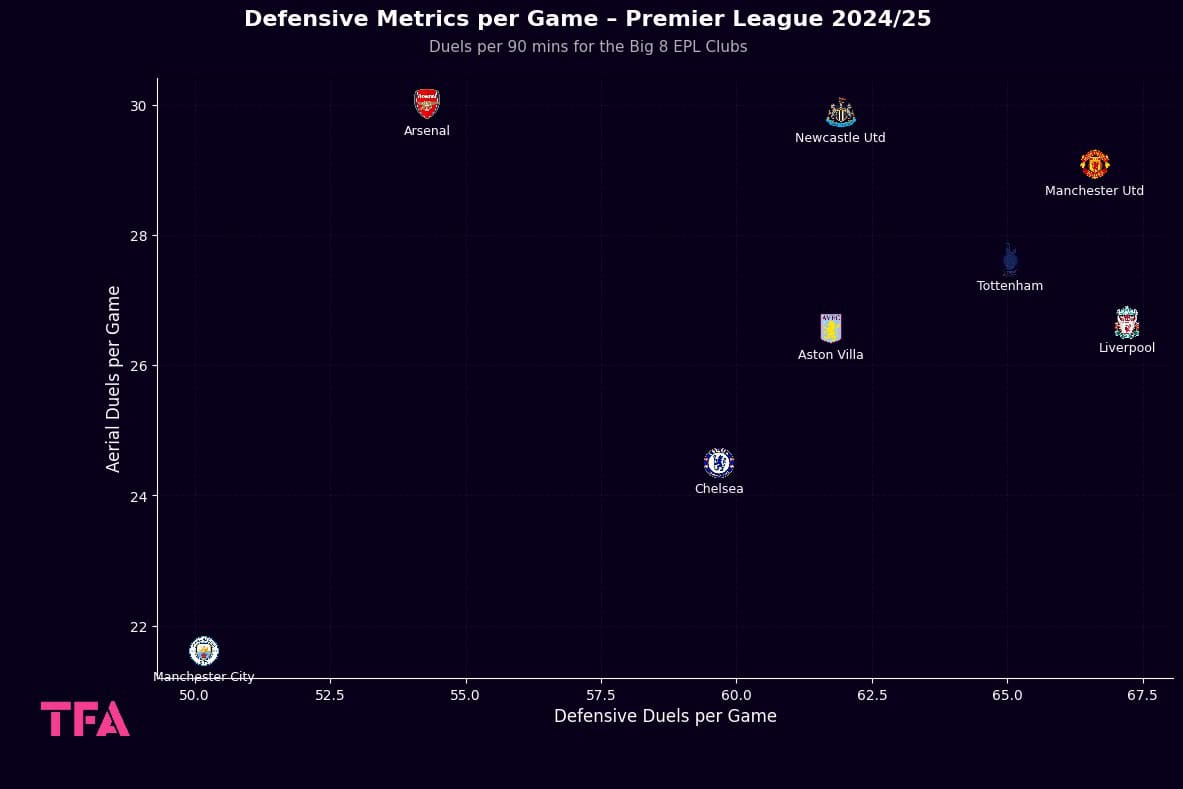
In the 2024/25 season, the Red Devils emerged as the most combative of the big eight, averaging 66.61 defensive duels and 29.08 aerial duels per match.
Closely behind were Arne Slot’s Reds (67.21 defensive duels), followed by Spurs (65.05), both of which highlighted their readiness to engage physically in the defensive third.
Interestingly, United also registered the highest volume of sliding tackles (4.13), underlining a front-footed approach to duelling and recovery that aligns with their aggressive defensive profile.
In contrast, Manchester City were clear outliers in this category, registering the fewest defensive duels (50.16) and the lowest aerial duel involvement (21.61).
These figures support the broader narrative of City’s declining pressing intensity and more passive off-ball structure this campaign.
Their low foul count (7.45) and relatively modest recoveries (67.92) further reinforce a preference for positional containment over physical confrontation.
The Gunners are somewhere in the middle ground, averaging 54.29 defensive duels and a notably high 30 aerial duels per game.
The latter suggests a more aerially secure backline.
Despite their more conservative tackling numbers (just two sliding tackles per match), Arsenal posted a solid recovery rate of 73.13, reflecting efficiency in regaining possession without overcommitting.
Chelsea, Aston Villa and Newcastle each averaged between 59 and 62 defensive duels per match, with the Villans and the Magpies showing a relatively balanced profile between ground and aerial engagements.
Notably, Newcastle’s 29.89 aerial duels per game is among the highest, speaking to their robustness in the air.
Ultimately, these numbers paint a clear contrast in approach, with sides like United and Liverpool thriving on defensive combativeness, while City have adopted a more restrained, possession-oriented stance.
Newcastle Lead While Spurs Surprise In Interceptions – A Tactical Lens On Off-The-Ball Defensive Activity
When it comes to interceptions, those proactive, often instinctive moments of breaking up play before it develops.
Interceptions Per Game – Premier League 2024/2025
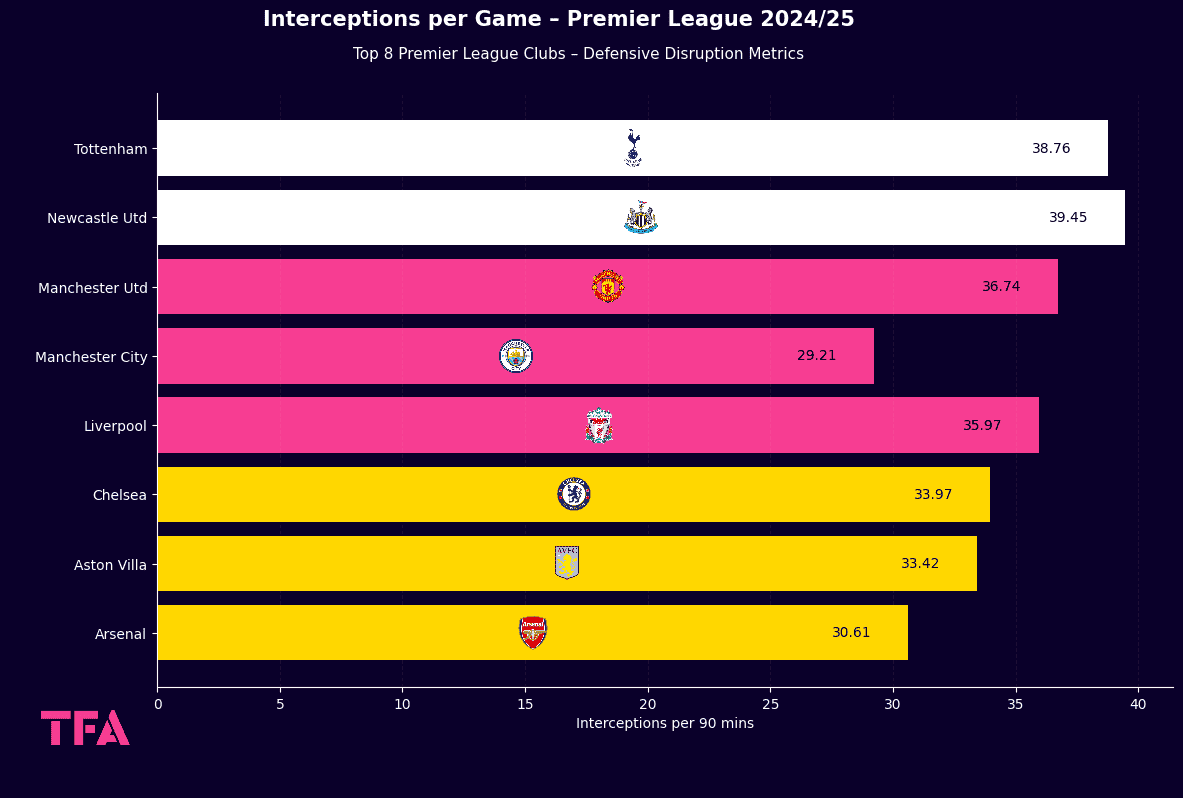
Newcastle United sit at the summit with 39.45 per 90 minutes, a figure that reflects their sharp defensive anticipation and cohesive off-the-ball structure.
Just behind them are Tottenham Hotspur, registering 38.76 per 90, a stat that flies under the radar given the attention their high-pressing attacking game usually attracts.
Yet, these numbers reveal a side that, under Ange Postecoglou, not only committed bodies forward but also showed real intent in disrupting passing lanes and regaining possession high up the pitch.
Manchester United quietly follow with 36.74 interceptions per 90, complemented by a league-leading 81.63 recoveries per 90 and a strong 13.97 clearances per 90, illustrating a defence that is statistically alert and reactive in key moments.
On the other end of the spectrum, Manchester City’s figures in these areas are notably underwhelming.
Their 29.21 interceptions per 90 place them near the bottom of the table, further highlighted by the lowest clearance rate in the league (9.24) and one of the least impressive recovery rates (67.92).
These are not signs of a team merely conserving energy through control; they point to a worrying defensive fragility.
City’s insistence on positional play and measured buildup often comes at the expense of raw defensive aggression, and the data suggests they are becoming increasingly vulnerable in transitional and second-ball phases.
Ultimately, interceptions don’t just represent individual sharpness; they reveal the broader defensive identity of a team.
While Newcastle and Spurs show hunger to break up play early, and United maintain respectable reactive metrics, City’s drop in defensive interventions could hint at deeper structural concerns.
Tottenham’s Leaky Backline Highlights Defensive Fragility In High-Risk System
Tottenham Hotspur’s defensive metrics for the 2024/2025 Premier League campaign so far paint a worrying picture of structural imbalance and tactical exposure.
Conceded Goals Per Game – Premier League 2024/2025
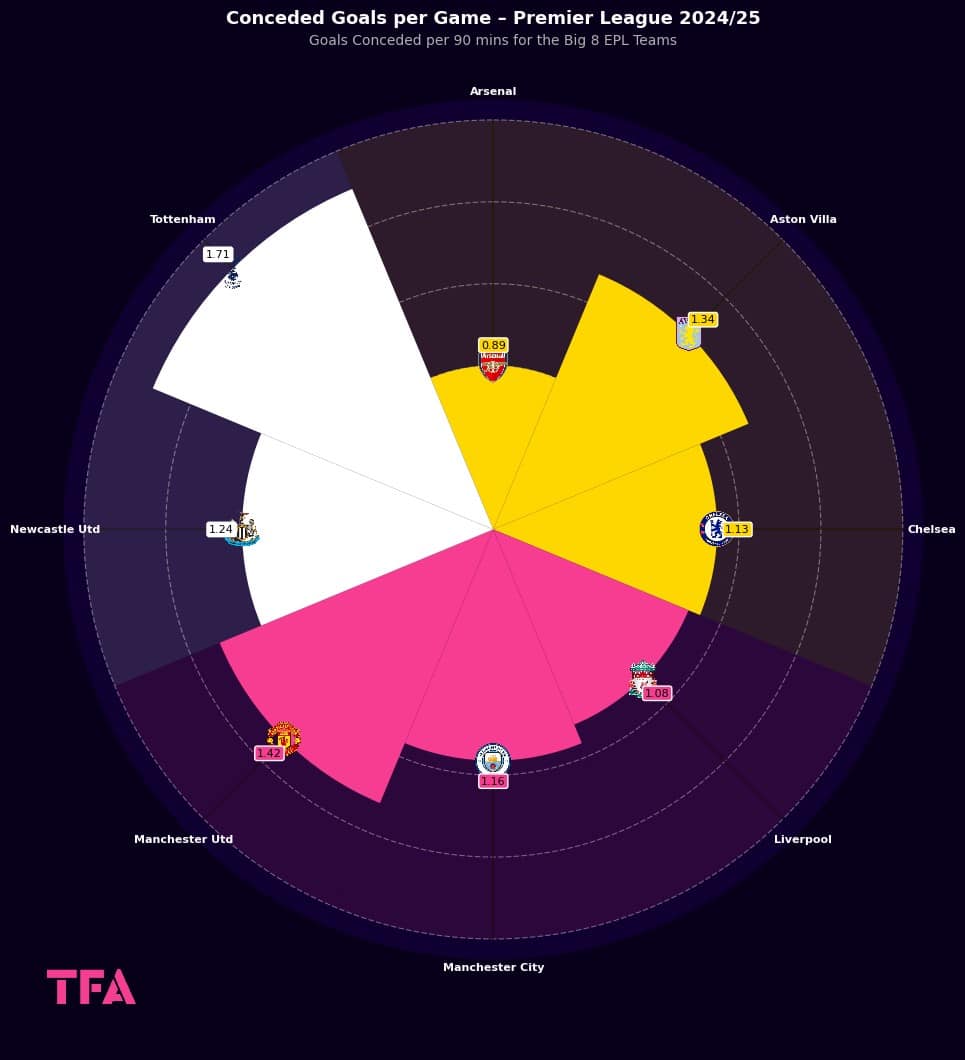
With an average of 1.71 goals conceded per match, Spurs possess the worst defensive record among the big eight teams.
This figure is more than double Arsenal’s 0.89 and markedly higher than Manchester United’s (1.42) and Newcastle United’s (1.24), both of whom are not without their own defensive flaws.
The root of the issue isn’t merely in how many goals Tottenham are conceding, but how often they allow their opponents to get into threatening positions.
Spurs face 12.82 shots per game, the most among the group, while 39.9% of those shots hit the target, indicating a lack of consistent pressure on the ball in key areas.
By comparison, Manchester City allow only 8.66 shots per game, showing their superior ability to control territory and tempo.
From a tactical standpoint, the high volume of defensive duels (65.05 per game) suggests a system that thrives, or at least tries to, on intensity and front-foot defending.
However, their duel success rate sits at 58.6%, a middling figure that signals vulnerability in one-on-one situations, particularly when compared to Manchester United’s 63.9% or even City’s 60.7%, who engage in far fewer duels but win them more efficiently.
In essence, Tottenham’s current numbers reflect a side that defends reactively rather than proactively.
Their aggressive setup leaves space in behind and often forces defenders into frequent last-ditch interventions.
Unless there’s a significant tactical adjustment or individual improvement in defensive execution, Spurs risk being undone regularly against top-level opposition.
For a club aiming for UEFA Champions League football, these figures are not just underwhelming, they’re unsustainable.
Tactical Balance Or Desperation? What Clearances & Recoveries Reveal About Premier League Defensive Structures
In modern football, clearances and recoveries provide a subtle yet revealing window into a team’s defensive organisation.
While recoveries reflect a side’s ability to regain control and reset in or out of possession, clearances are often reactive measures under pressure.
The Premier League’s big sides in 2024/2025 display contrasting approaches here, exposing the tactical DNA of each.
Clearances & Recoveries Per 90 For The Big Eight Premier League Clubs
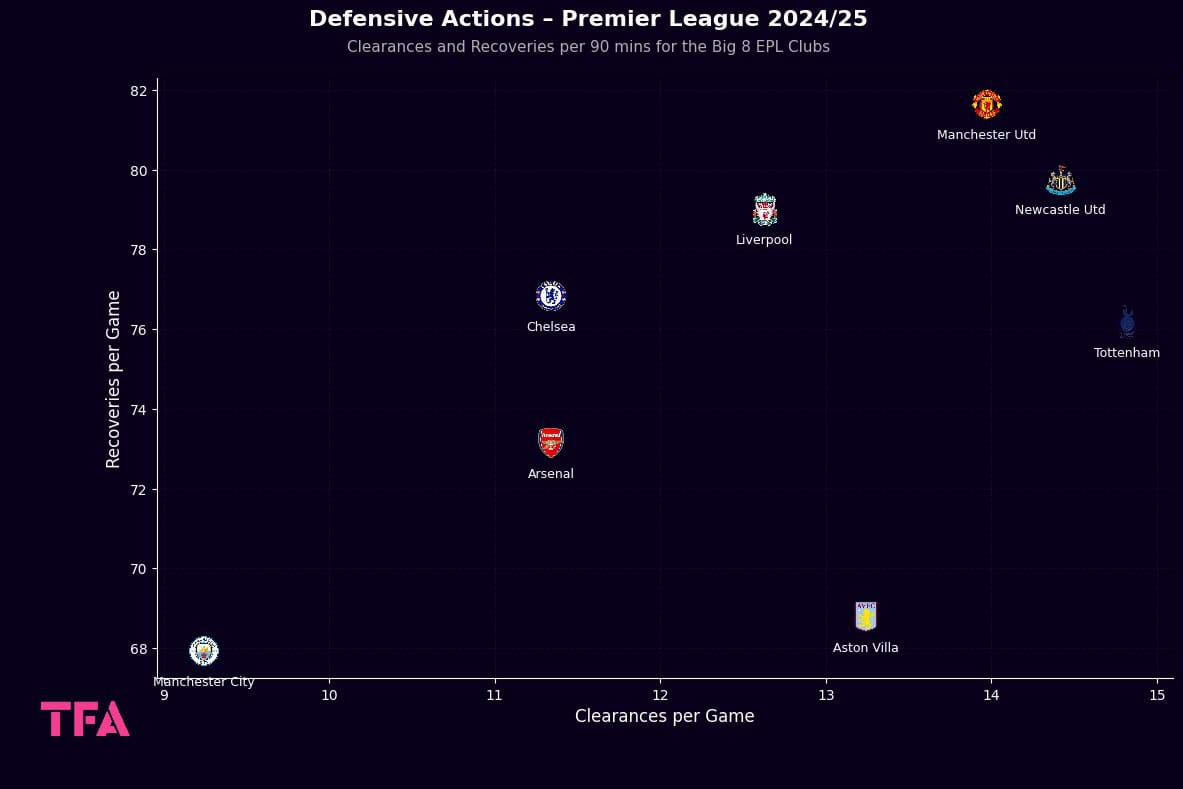
Manchester United top both categories with 13.97 clearances and 81.63 recoveries per match.
Rather than indicating a passive block, this blend shows an aggressive system that often wins the ball back high but is also forced into emergency defending, especially in transitional phases.
Their 63.9% defensive duel success, the highest in this group, supports the idea of physical resilience, though the relatively modest aerial duel rate (45.5%) hints at vulnerability in dealing with long balls.
Liverpool (79 recoveries) and Newcastle (79.74) also excel in regaining possession but differ in their stylistic defensive expressions.
Newcastle’s league-high 14.42 clearances paint the picture of a backline frequently put under pressure, likely due to their compact but confrontational setup.
In contrast, Liverpool’s slightly lower 12.63 clearances combined with a solid 59.2% defensive duel success show a team often recovering higher up the pitch, but still needing to sweep up behind when exposed.
Tottenham, with a concerning 14.82 clearances per match, exhibit a reactive, stretched shape.
Their recovery count (76.16) is relatively healthy, yet this mix of frequent last-ditch interventions and middling duel success (58.6%) suggests systemic flaws.
Manchester City stand apart with the fewest clearances (9.24) and recoveries (67.92) among the group, figures that, at first glance, reflect their exceptional control over territory and possession.
Their game model revolves around dominating the ball, restricting opponents’ time and space, and defending through preemptive positioning rather than reactive interventions.
In that sense, City’s minimal defensive actions suggest proactive defending rooted in structure and control.
However, while these numbers highlight their territorial command, they also reveal an underlying vulnerability that often goes unnoticed.
City’s low defensive activity across almost every metric may hint at a system so committed to possession that it leaves little margin for defensive error.
When possession is broken, the team’s structural commitment can expose gaps, especially in transitions or against direct, fast attacks, a trend repeatedly exposed in key fixtures.
Ultimately, the balance between recoveries and clearances illustrates how a team defends, by design or by necessity, and where the risks lie.
City may defend less, but they walk a fine tactical line when they do.
Conclusion
As we look ahead to the 2025/2026 Premier League campaign, the defensive profiles of the big eight sides from last season offer more than just statistical footnotes; they reveal the tactical philosophies, structural tendencies, and risk profiles that will likely shape the coming year.
The data confirms that there is no single formula for defensive success in the modern Premier League.
Manchester United and Liverpool exemplify a high-intensity model built on physical engagement, pressing aggression, and constant ball disruption.
Their high volumes of duels, recoveries, and interceptions reflect systems that embrace risk to dominate territory and momentum.
While such intensity can produce dominant spells, it also demands sustained energy and positional awareness to avoid overexposure.
Arsenal and Newcastle present more balanced, hybrid models. Arsenal combine structured pressing with aerial strength, whereas Newcastle show a more traditional, combative style, leading in interceptions and clearances, yet maintaining solid positional shape.
Both sides reflect flexibility that could be invaluable in navigating domestic and European fixtures.
Tottenham and Chelsea fall into more volatile territory. Spurs’ high numbers in duels and clearances suggest a reactive system prone to chaotic defending, numbers that demand tactical recalibration if they are to truly challenge at the top.
While statistically solid in recoveries, the Blues still lack defensive sharpness in key areas, especially under pressure.
Manchester City remain the outlier.
Their minimalist defensive activity, fewest duels, clearances, and recoveries, signals a deep reliance on possession and territorial dominance.
But as we’ve seen, when control slips, so too does their defensive stability.
Their metrics expose a growing fragility masked by elegant structure.
As the league evolves tactically, the importance of intelligent, adaptable defending has never been clearer.
The challenge is to find the balance between risk and resilience, whether through physical intensity, spatial control, or hybrid approaches.
The numbers from 2024/2025 offer a tactical blueprint, but in 2025/2026, execution will be everything.
