
As the 2025/2026 La Liga season approaches its decisive phase, focus is increasingly shifting towards both the title race and the battle for UEFA Champions League qualification.
After approximately 28 matches, the race for the title appears firmly concentrated between Barcelona and Real Madrid, with both sides establishing a clear gap at the summit of the table.
Barcelona currently leads with 70 points, closely followed by Real Madrid on 66, reinforcing a familiar two-horse race dynamic.
Behind them, Atlético Madrid and Villarreal have created a degree of separation in the fight for automatic Champions League places and look well-positioned to secure top-four finishes.
Meanwhile, the race for a potential fifth Champions League spot, contingent on UEFA coefficient allocations, remains highly competitive, with Real Betis, Celta Vigo, Real Sociedad, and Espanyol closely packed and pushing for European qualification.
This data analysis will examine the tactical profiles, underlying metrics, and structural differences shaping both the title race and the evolving contest for European places.
Expected Vs Actual Points In The 2025/2026 La Liga Title Race & Champions League Battle
As the 2025/2026 La Liga season enters its crucial final phase, the gap at the top between Barcelona and Real Madrid is wider than many models anticipated, with both outperforming their expected points tallies by a clear margin.
La Liga 2025/2026 Title & UCL Race – Points Vs Expected Points
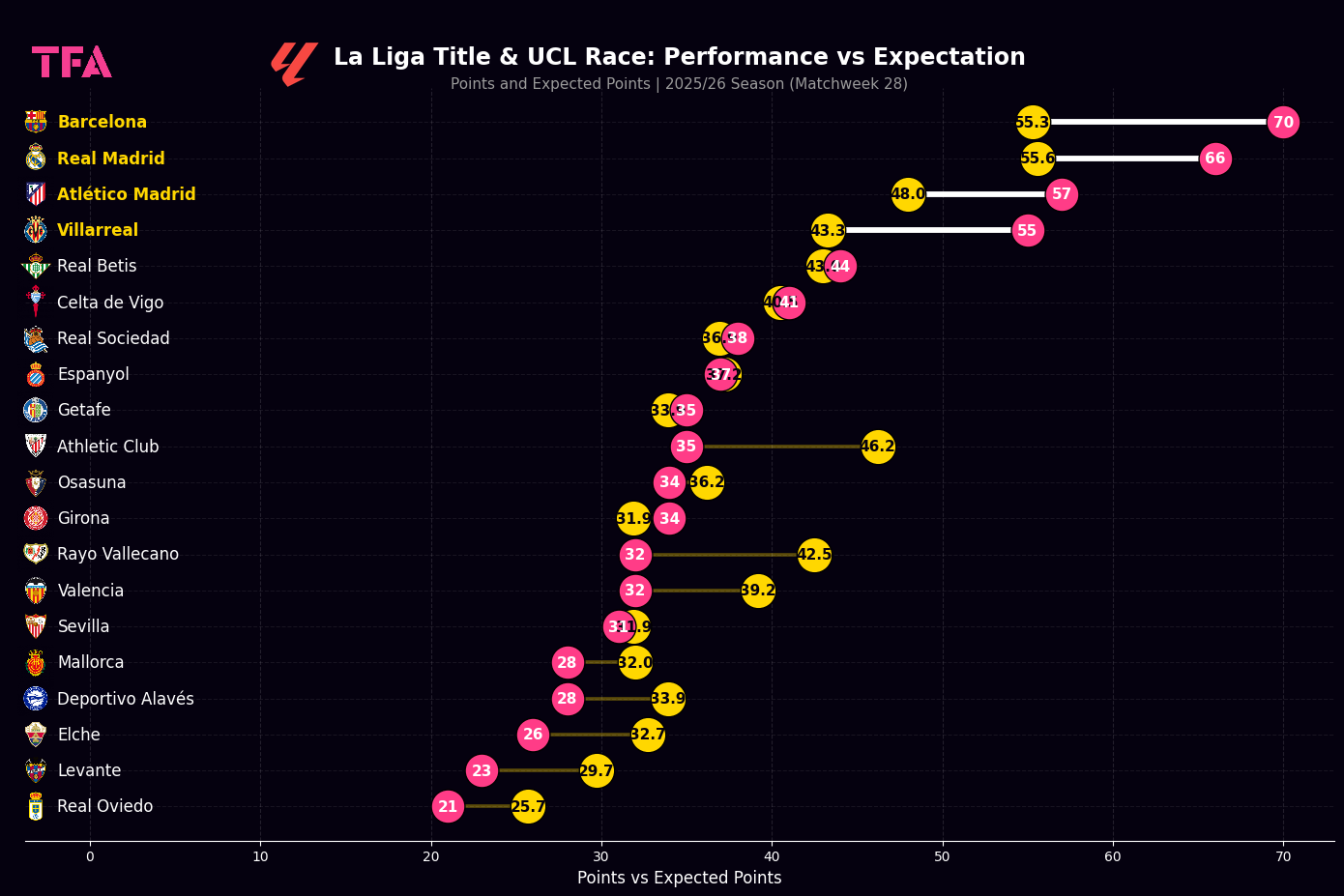
Barcelona sit on 70 points from 28 games, significantly above their expected total of 55.3.
In comparison, Real Madrid’s 66 points also well exceed their 55.6 expected points, highlighting how both heavyweights have consistently delivered on results rather than just underlying data.
Behind them, Atlético Madrid and Villarreal remain comfortably above their respective expected point totals (48 and 43.3), consolidating their hold on the top four with performances that blend efficiency with defensive solidity.
These four clubs have created a notable points buffer over the chasing pack, which includes Real Betis, Celta Vigo, Real Sociedad, and Espanyol, all of whom sit tightly clustered around the mid‑40s expected range.
Barcelona, managed by Hansi Flick, have translated their possession‑orientated attacking style into a remarkable points haul.
While Real Madrid, who began the season under Xabi Alonso before a mid‑season coaching change to Álvaro Arbeloa, have maintained title pressure through an effective blend of attacking threat and strategic pragmatism.
In contrast, the quartet battling for possible fifth place in the Champions League race have produced expected and actual points that align much more closely, emphasising the competitive and unpredictable nature of the European qualification fight.
Given how narrow the margins are between these clubs, small tactical shifts and individual match outcomes over the remaining fixtures could prove decisive in who ultimately reaches Europe’s elite competition.
Barcelona: Searching For Balance Amid Injuries & Its Impact On The Title Race
For Barcelona, the decisive phase of the season has been shaped not only by performance levels but also by the ongoing challenge of managing absences and maintaining structural balance.
Under Hansi Flick, Barcelona have aimed to preserve their positional identity, dominating possession, stretching opposition blocks, and progressing through short passing sequences.
Injuries have forced subtle but significant tactical adaptations.
In build-up, Barcelona continue to rely on a narrow double pivot to attract pressure centrally, creating space for full-backs positioned high and wide.
However, when rotations are limited, the fluidity of these mechanisms has occasionally diminished, reducing their ability to break well-organised presses consistently.
Barcelona’s Build-Up Play Through A Narrow Double Pivot & Reliance On Individual Quality In Wide & 1v1 Situations

As a result, the team have leaned more heavily on individual quality in the final third, particularly through wide isolation and 1v1 situations.
Offensively, the front line remains aggressive in pinning back opposition defences, but the lack of continuity in personnel has impacted timing in vertical runs and combinations between the lines.
This has led to phases of territorial dominance without the same level of efficiency in chance creation.
Within the context of the title race, these structural imbalances could prove decisive.
While Barcelona retain control through possession, sustaining attacking sharpness and defensive compactness amid squad disruptions will ultimately determine whether they can maintain their narrow advantage over their closest challengers.
Barcelona Outperforming, Real Madrid Underperforming
Analysing the 2025/2026 La Liga data, a clear contrast emerges between Barcelona and Real Madrid in terms of goals scored relative to expected goals (xG).
La Liga 2025/2026 – Goals Vs Expected Goals After 28 Matchweeks
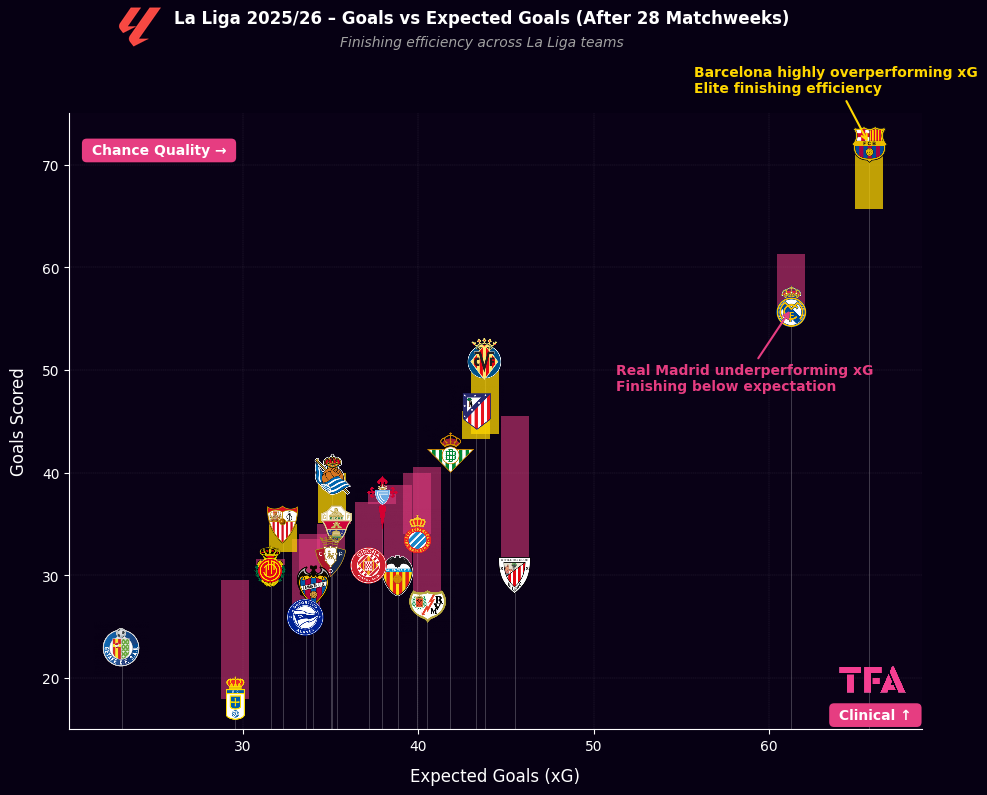
Barcelona have recorded 72 goals from an xG of 65.71, significantly exceeding their expected output, highlighting their clinical finishing and efficiency in converting chances.
In contrast, Real Madrid have scored 56 goals from an xG of 61.28, underperforming relative to the quality of chances they create, suggesting either less clinical execution or variance in finishing.
This divergence underscores Barcelona’s current attacking sharpness, particularly in wide isolation and 1v1 situations, which allow them to outperform their underlying metrics.
Meanwhile, Real Madrid rely on structured possession and left-sided overloads, but their finishing efficiency has lagged behind potential opportunities.
Other clubs, including Villarreal (51 goals, xG 43.79) and Atlético Madrid (46 goals, xG 43.31), show moderate overperformance, but the key takeaway is the striking contrast between Barcelona’s overachievement and Real Madrid’s relative underperformance in the goals vs xG context.
Real Madrid Left-Sided Overloads As The Core Attacking Mechanism
Under Álvaro Arbeloa, Real Madrid have developed a fluid and highly adaptive attacking structure, built on positional rotations, synchronised off-ball movements, and a clear emphasis on exploiting space through wide overloads.
Madrid’s strongest XI, without absences, typically aligns in a flexible 4-3-3, which morphs into a 3-2-5 in possession.
Real Madrid’s Left-Sided Overloads & Synchronised Off-The-Ball Movement In A Flexible 3-2-5 Setup During Possession
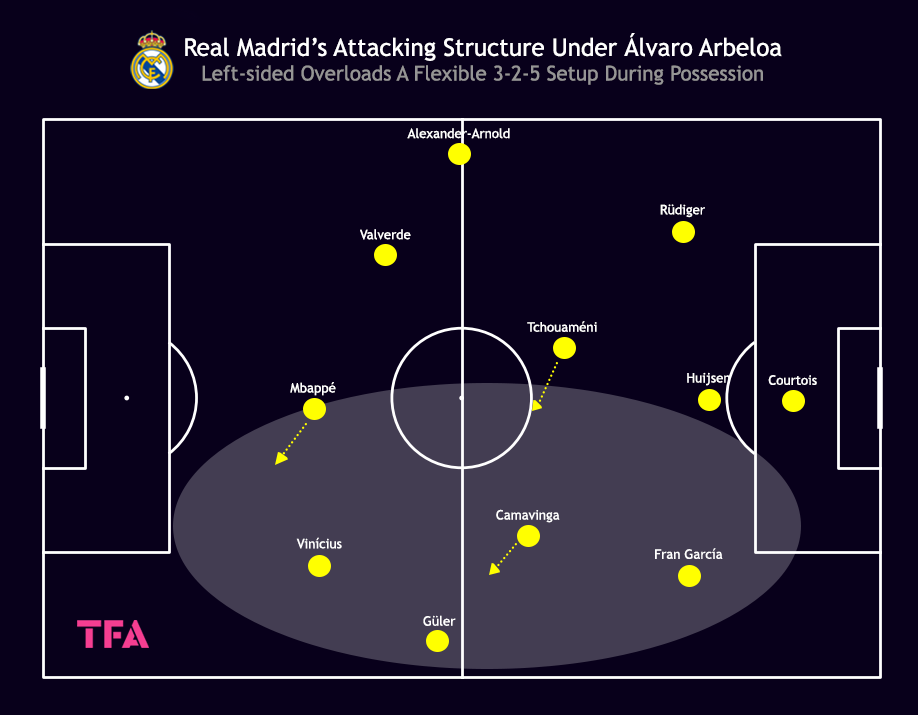
This structure provides the ideal framework for mapping their rotations, highlighting left-sided overloads, and illustrating how spacing and timing underpin their attacking efficiency.
In settled possession, Madrid often tilt their structure towards the left flank, where Vinícius Júnior operates as the primary outlet, supported by dynamic movements from midfielders.
The key objective is to manipulate opposition defensive blocks, particularly against high or hybrid presses, by attracting pressure on one side before accessing weak-side spaces.
Through “up, back, and through” combinations, Madrid consistently create vertical access into depth, often isolating the far-side full-back or winger in advantageous 1v1 scenarios.
In build-up phases, the presence of technically secure defenders allows Madrid to break initial pressure lines, while midfielders such as Aurélien Tchouaméni provide central stability and quick circulation.
These mechanisms are complemented by constant positional interchanges in the front line, which disorganise man-oriented marking schemes and open passing lanes between the lines.
Atlético Madrid & Villarreal PPDA Against: Defensive Pressure Faced
In the 2025/2026 La Liga season, Atlético Madrid have recorded one of the highest PPDA Against values in the league, indicating fewer defensive interventions from opponents.
PPDA Against At La Liga 2025/2026 – Pressing Pressure Faced
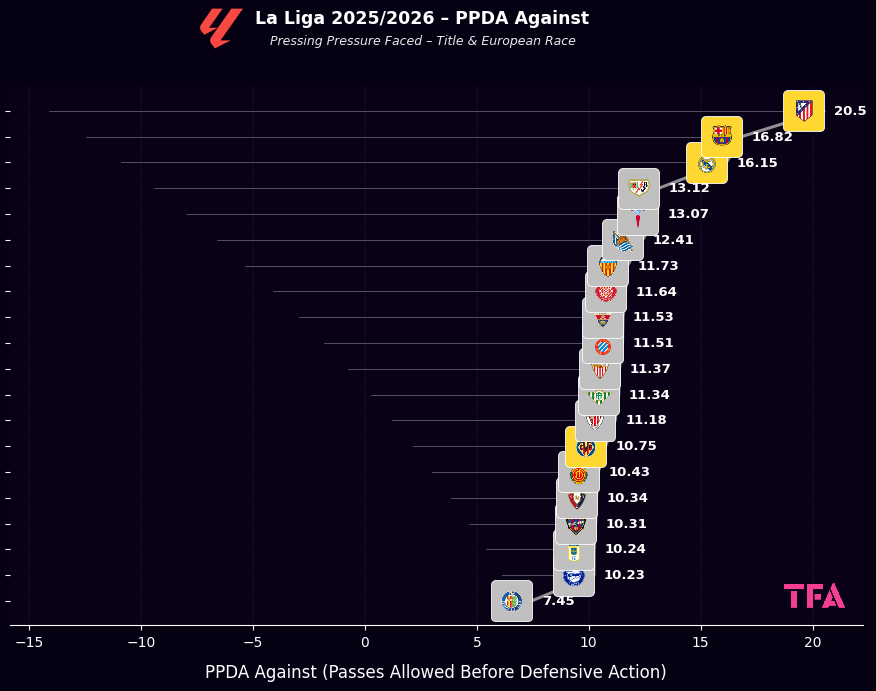
This is particularly impressive given Diego Simeone’s tactical shift this season towards a more attacking approach, combined with the January arrival of Ademola Lookman.
The squad, strengthened further by the presence of Griezmann, Sørloth, and Álvarez, has been able to retain possession effectively, reducing pressing intensity from rivals and allowing for controlled build-up play.
Atlético’s structure and disciplined positioning make it difficult for opponents to apply consistent pressure, highlighting the team’s strategic balance between attack and defensive stability.
On the other hand, Villarreal face considerably more defensive pressure from opponents, largely due to a comparatively weaker squad and less high-end attacking consistency.
Despite this, they remain close to Atlético in the standings, with players like Santiago Mouriño delivering standout performances.
The PPDA Against metric clearly illustrates how Atlético’s structural control limits opposition challenges, whereas Villarreal must often rely on individual brilliance to navigate intense pressing situations.
Santiago Mouriño: Villarreal’s Defensive Anchor & One Of La Liga’s Top Right-Backs
Santiago Mouriño has emerged as one of the most effective defenders in La Liga during the 2025/2026 season, particularly excelling as Villarreal’s right-back.
Top 25 Players By Successful Defensive Actions Per 90 – La Liga 2025/2026 After Matchweek 28
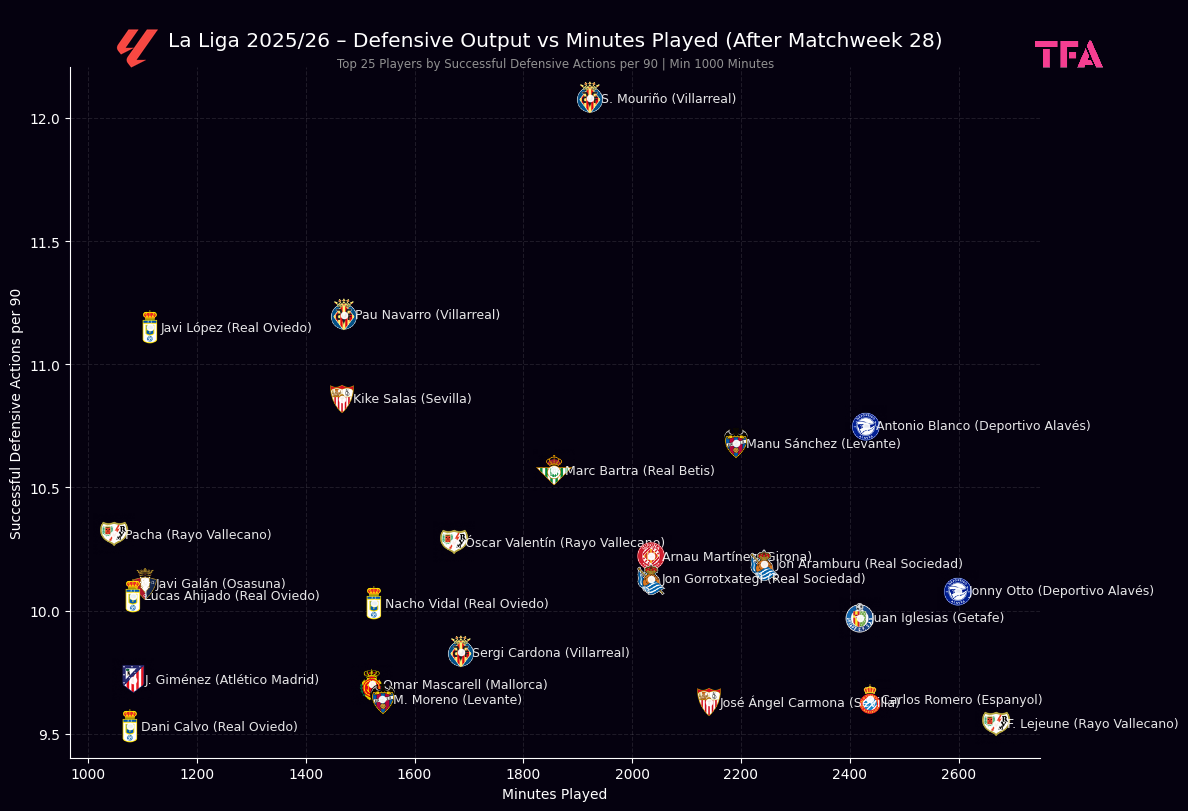
Over 1,922 minutes played, Mouriño has engaged in 229 defensive duels, winning 62%, demonstrating both consistency and reliability in 1v1 situations.
In the air, he has contested 62 aerial duels, winning nearly 60%, showcasing his ability to neutralise threats from crosses and long balls.
His work on loose balls is equally impressive, with 45 duels and a 42.2% success rate.
Mouriño also contributes significantly through sliding tackles, winning 40% of 10 attempts, while his reading of the game is evident in 105 interceptions and 223 recoveries across both halves of the pitch.
He has cleared the ball 57 times, underlining his proactive defensive presence.
Among La Liga right-backs, Mouriño ranks at the top in successful defensive actions per game, combining tactical awareness, physicality, and positioning.
His performances are central to Villarreal’s defensive structure, limiting opponent opportunities and providing a stable platform for the team’s attacking transitions.
Espanyol 2025/2026: Competitive Structure Without Full Breakthrough
Espanyol’s 2025/2026 La Liga campaign reflects a side that is competitive, organised, and capable of troubling higher-ranked opponents, still lacking the consistency required to fully break into the European qualification spots.
Espanyol Offensive Profile At La Liga 2025/2026
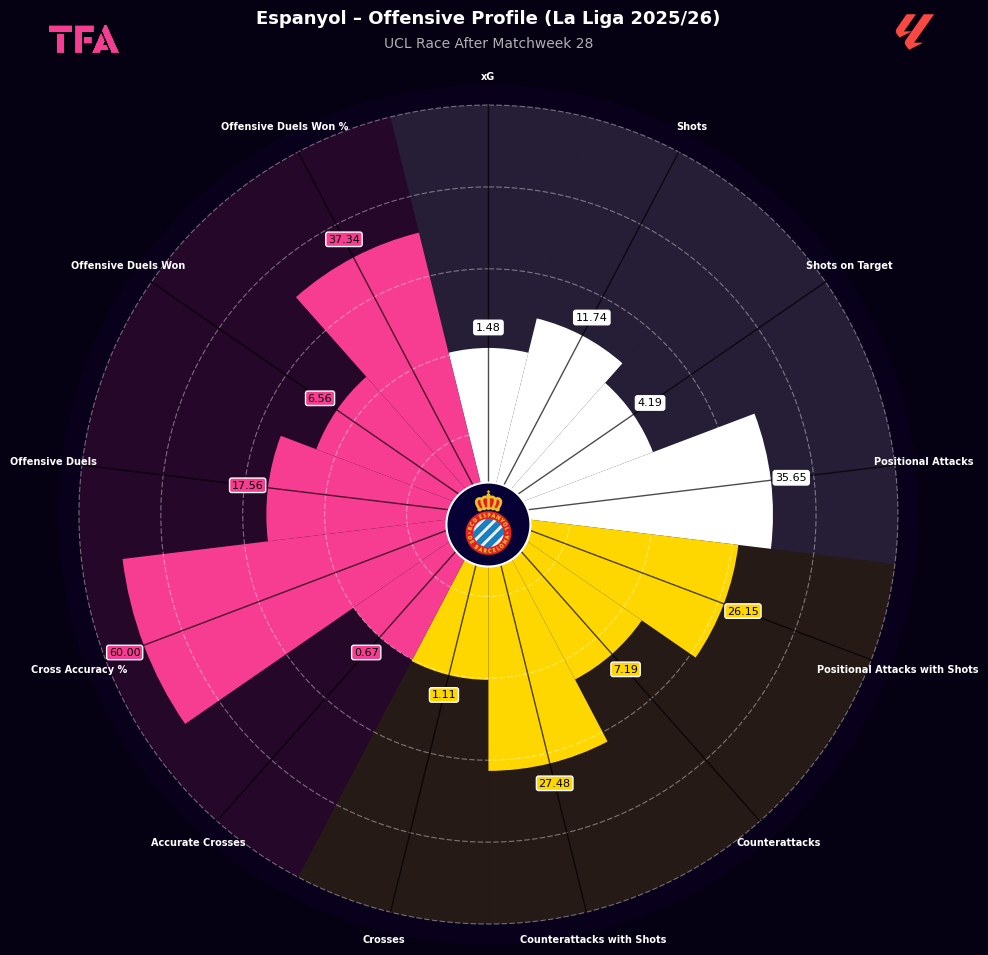
Averaging 1.48 xG per game while conceding 1.44, their underlying numbers suggest a relatively balanced team profile.
Offensively, they generate 11.7 shots per match with a solid mix of positional attacks and transitions, though efficiency in front of goal remains inconsistent.
Structurally, Espanyol show resilience, evident in results against stronger sides and their ability to remain compact without the ball.
However, fluctuations in chance conversion and defensive concentration have limited their points accumulation.
Despite sitting outside the immediate European places, their performances indicate a team not far from contention.
With marginal improvements in both boxes, Espanyol could realistically sustain pressure on the race for a potential fifth Champions League spot.
Edu Expósito: La Liga’s Leading Creative Force In Expected Assists
Edu Expósito has established himself as the most productive creative midfielder in La Liga during the 2025/2026 season, leading the league in expected assists (xA) with an impressive 7.11.
Chance Creation Output Vs Underlying Creativity – Top 20 xA Players At La Liga 2025/2026
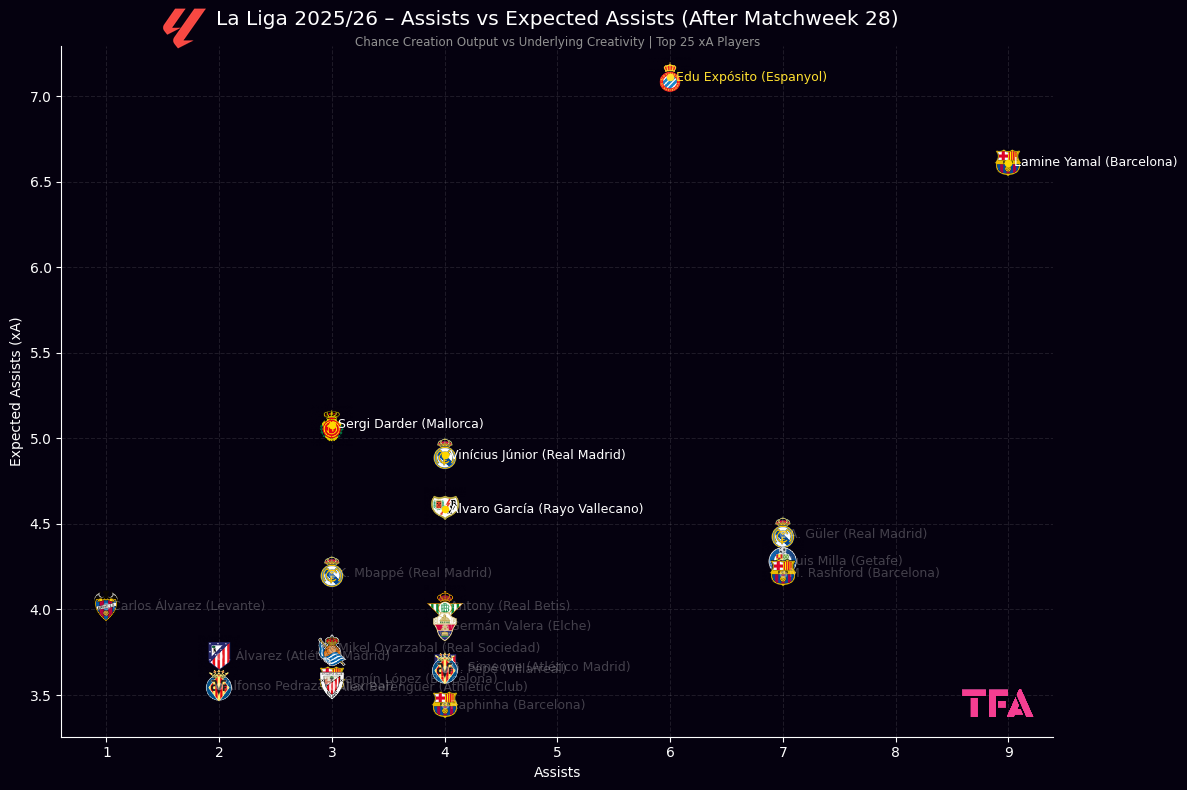
Across 1,849 minutes, his distribution profile highlights both volume and intent, completing 734 passes at 76.7% accuracy while consistently progressing play into dangerous areas.
His ability to break lines is evident through 148 passes into the final third and 84 into the penalty area, underlining his role as Espanyol’s primary chance creator.
Expósito also contributes with variety, attempting 87 long passes and 70 crosses, alongside 17 through balls aimed at unlocking compact defensive structures.
While he has recorded six assists, the gap to his xA suggests untapped attacking potential within the team.
His forward passing volume and positional awareness make him central to Espanyol’s offensive structure, dictating tempo and creating opportunities that position the side closer to European contention.
Deep Completions In La Liga: Measuring Access Into Dangerous Zones
In modern football analytics, deep completions refer to completed passes made into advanced, high-value areas close to the opposition’s penalty box, excluding crosses.
This metric provides a clear indication of a team’s ability to progress possession into genuinely dangerous zones, bridging the gap between territorial dominance and actual chance creation.
Unlike progressive passes, which measure ball advancement, or key passes, which capture direct chance creation, deep completions reflect sustained attacking pressure and consistent access to threatening spaces.
Across La Liga in the 2025/2026 season, FC Barcelona leads this metric by a significant margin, recording 410 deep completions, well ahead of Real Madrid (317) and Atlético Madrid (312).
Final-Third Entries Completed Within 20 Meters Of Goal — La Liga 2025/2026
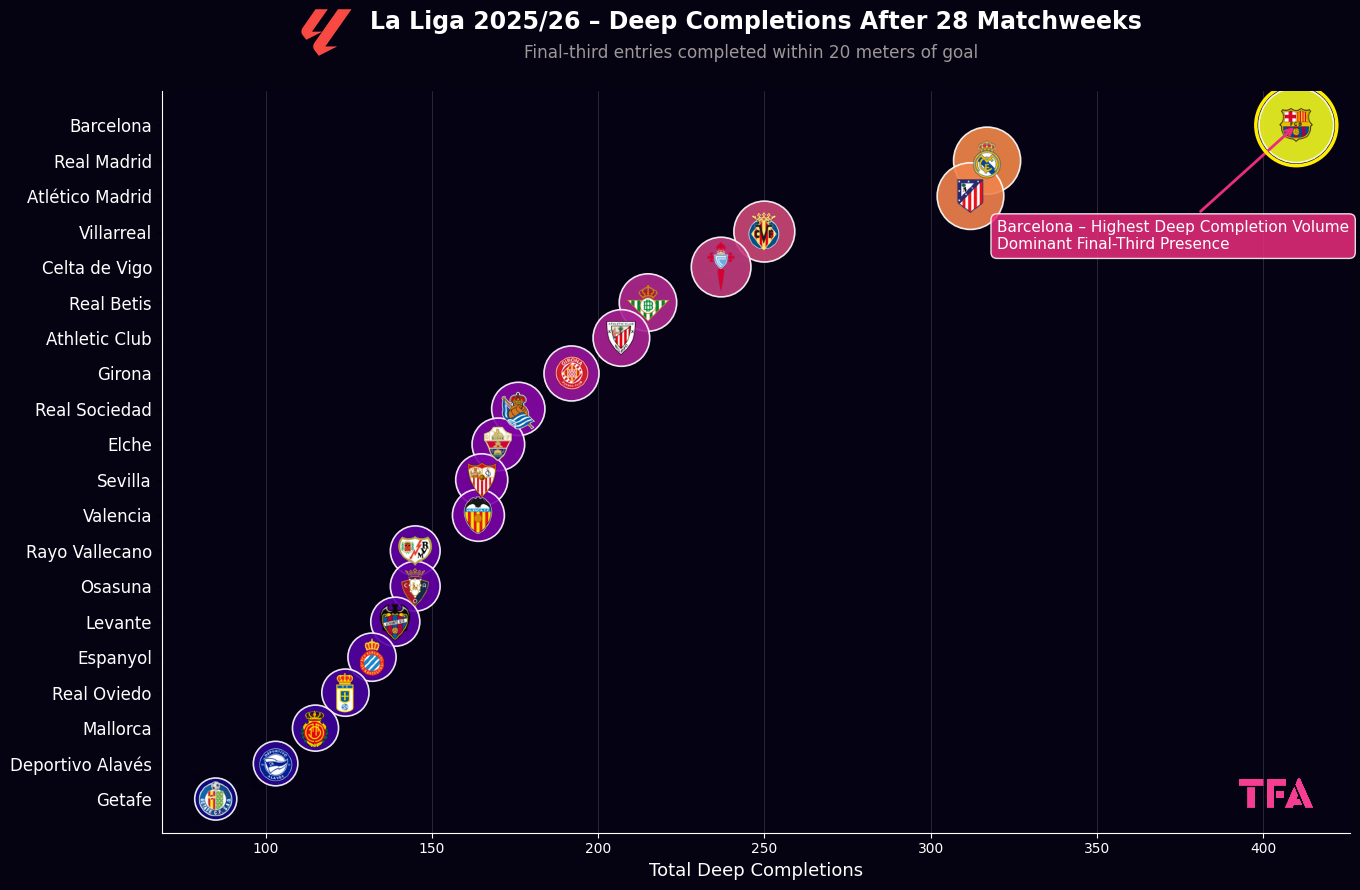
This substantial gap underscores Barcelona’s ability, under Hansi Flick, to consistently access the central and half-space zones in the final third.
Their positional structure, based on width, occupation of interior channels, and short passing combinations, enables repeated penetration of defensive blocks rather than sterile possession.
Meanwhile, sides such as Villarreal CF (250) and Celta de Vigo (237) show solid attacking presence, though at a noticeably lower frequency.
Overall, the distribution of deep completions highlights clear structural and stylistic differences across the league.
Conclusion
As the 2025/2026 La Liga season approaches its decisive conclusion, both the title race and the battle for European qualification remain defined by fine margins and contrasting tactical identities.
FC Barcelona and Real Madrid continue to set the pace at the top, combining strong underlying metrics with consistent results, albeit through different structural approaches, Barcelona’s positional control versus Madrid’s dynamic, overload-based attacking play.
Behind them, Atlético Madrid and Villarreal CF have established themselves as clear contenders for Champions League qualification, each reflecting a distinct balance between defensive organisation and attacking efficiency.
Meanwhile, the race for a potential fifth spot remains highly competitive, with teams such as Real Betis, Celta de Vigo, Real Sociedad, and Espanyol separated by minimal margins both in points and underlying data.
Ultimately, metrics such as expected points, goals versus xG, PPDA, and deep completions reveal not only performance levels but also the structural and stylistic nuances shaping each team’s season.
With limited fixtures remaining, marginal gains in efficiency, tactical adjustments, and individual moments of quality are likely to determine the final standings in both the title race and the fight for European football.
