
When a player hangs up their boots and transitions into the career of a football manager, one popular option is to start by coaching at the youth levels of one of their former clubs.
Steven Gerrard began his coaching career at the Liverpool academy before moving to SPFL side Rangers.
Another former Liverpool player trying his hand at management in an academy setting is Fernando Torres, who is currently plying his trade with Atletico Madrid’s U19s.
Their neighbours, Real Madrid, are currently being led by yet another ex-Liverpool player in Álvaro Arbeloa.
The former full-back is enjoying an incredible campaign with the Galacticos’ under-19 squad after a poor outing with the U16s last season – his first season in management.
He has impressed many with the U19s this season, which has led to him being linked with managing the first team in the future – something he is said to be very keen on.
This scout report will provide a tactical analysis of how Real Madrid play under Arbeloa’s leadership, their tactics in possession that have seen them score a bucketload of goals this season, and how they operate off the ball, too.
Our very own analyst, Mak Pakhei, recently visited Real Madrid’s academy training headquarters and spoke with Arbeloa and his staff, providing us with some incredible tactical pointers that we will drip-feed into this scout report.
Any data and match images used in this analysis will be taken from Real Madrid U19s’ fixtures from this season’s UEFA Youth League and Copa del Rey Juvenil due to limitations on access to footage and data of their league fixtures.
However, their league form is important, and 100% ties into the various analysis segments as their tactics remain the same.
Arbeloa’s side are currently top of their league group, having won 22 games out of 25, and remaining unbeaten so far.
In addition, they have a jaw-dropping goal difference of 78 – conceding just 12 goals and scoring 90.
Álvaro Arbeloa Formations

Arbeloa’s side has deployed a 4-3-3 the majority of the time, and this is likely down to its ability to tie in with some elements of their attacking tactics.
They like to utilise pitch width via a wide rotation system, which we will look at in more detail in this scout report – the 4-3-3 encourages this, as the wide forwards can tuck inside, allowing the attacking full-backs to push forward in wide areas.
They have also used a 4-2-3-1, a small portion of the time, which can also incorporate wide rotations smoothly.
In games where they require a heavier central presence, they have opted for either 4-4-2 or 4-3-1-2.
“Fuera”: Utilising Pitch Width & Wide Rotations
Wide play isn’t an uncommon strategy, regardless of the level of football, but Arbeloa’s tactics have some very interesting details.
In his conversations with our analyst, the former Spain international explained how he likes to make full use of the width of the pitch – Arbeloa can often be heard calling out “fuera” from the touchline, which is Spanish for “outside”: these are the areas he wants to focus on in possession.
Not only that, but there is a regular occurrence of numerous positional rotations, particularly in and around the wide areas.
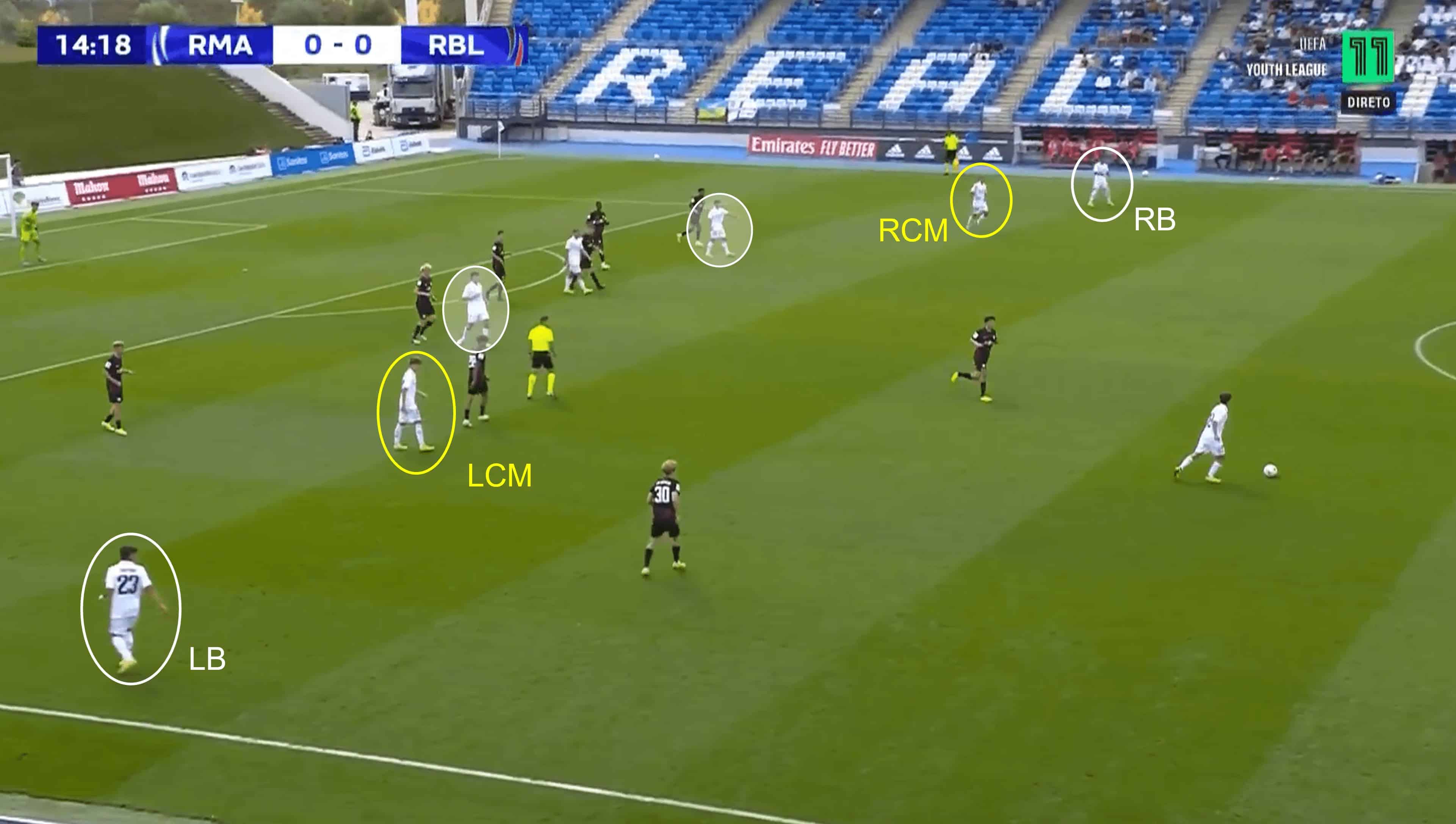
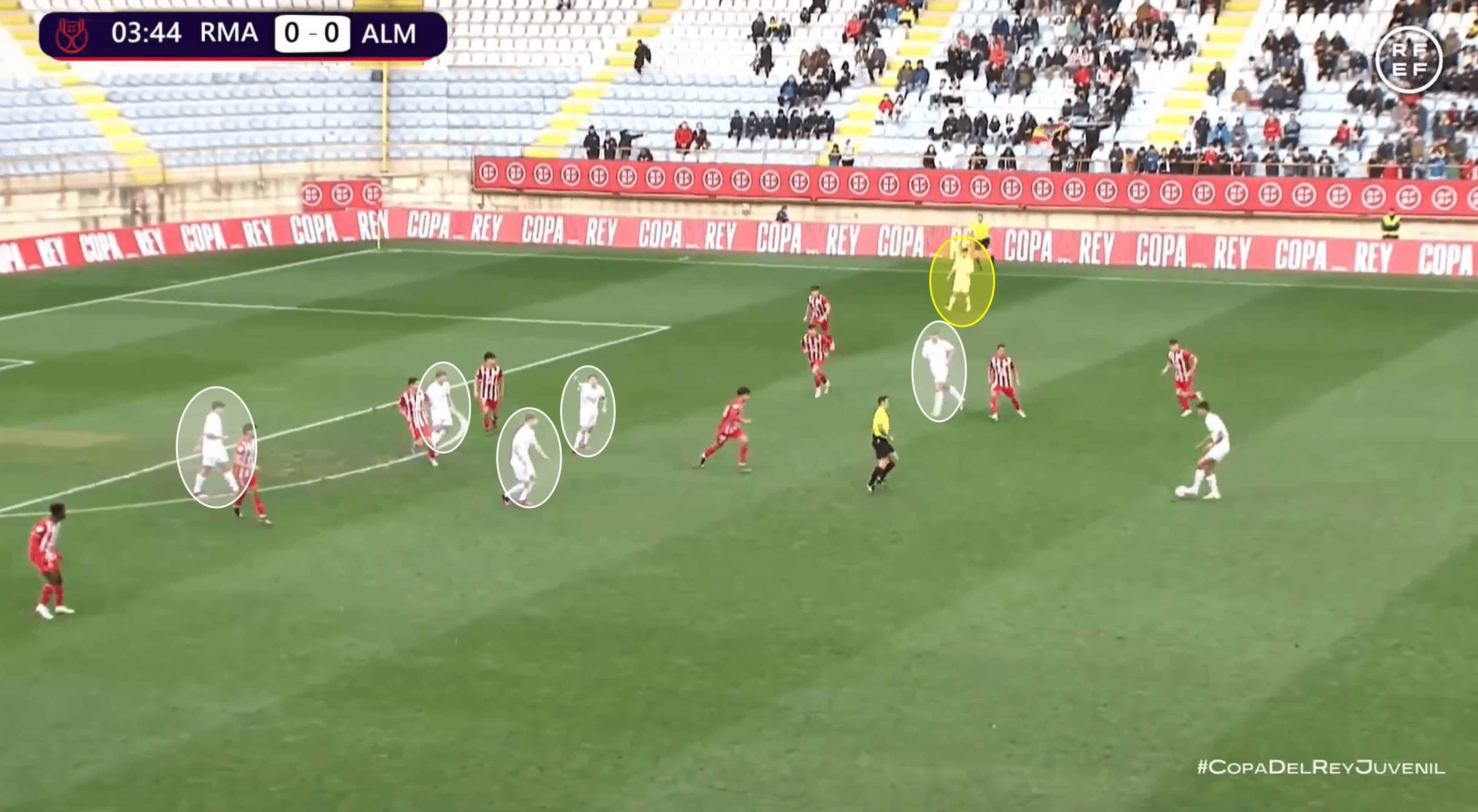
This first image is essentially a summary of Real Madrid’s approach, in many ways.
When in possession in the opposition half, they like to have a strong attacking presence with plenty of bodies in front of the ball.
But they don’t just send players forward with no direction – each player/unit has a specific role to undertake.
The front three are often very compact, which not only draws more opposition presence to the middle and leaves space in wide areas, but it also allows them to make a more direct contribution to the attack later on in the move.
The midfielders also play an important role, providing proximity support to the full-backs, who are often in a high and wide position.
This serves the purpose of stretching the opposition midfield but also allows Madrid the option of passing combinations in higher areas of the pitch.
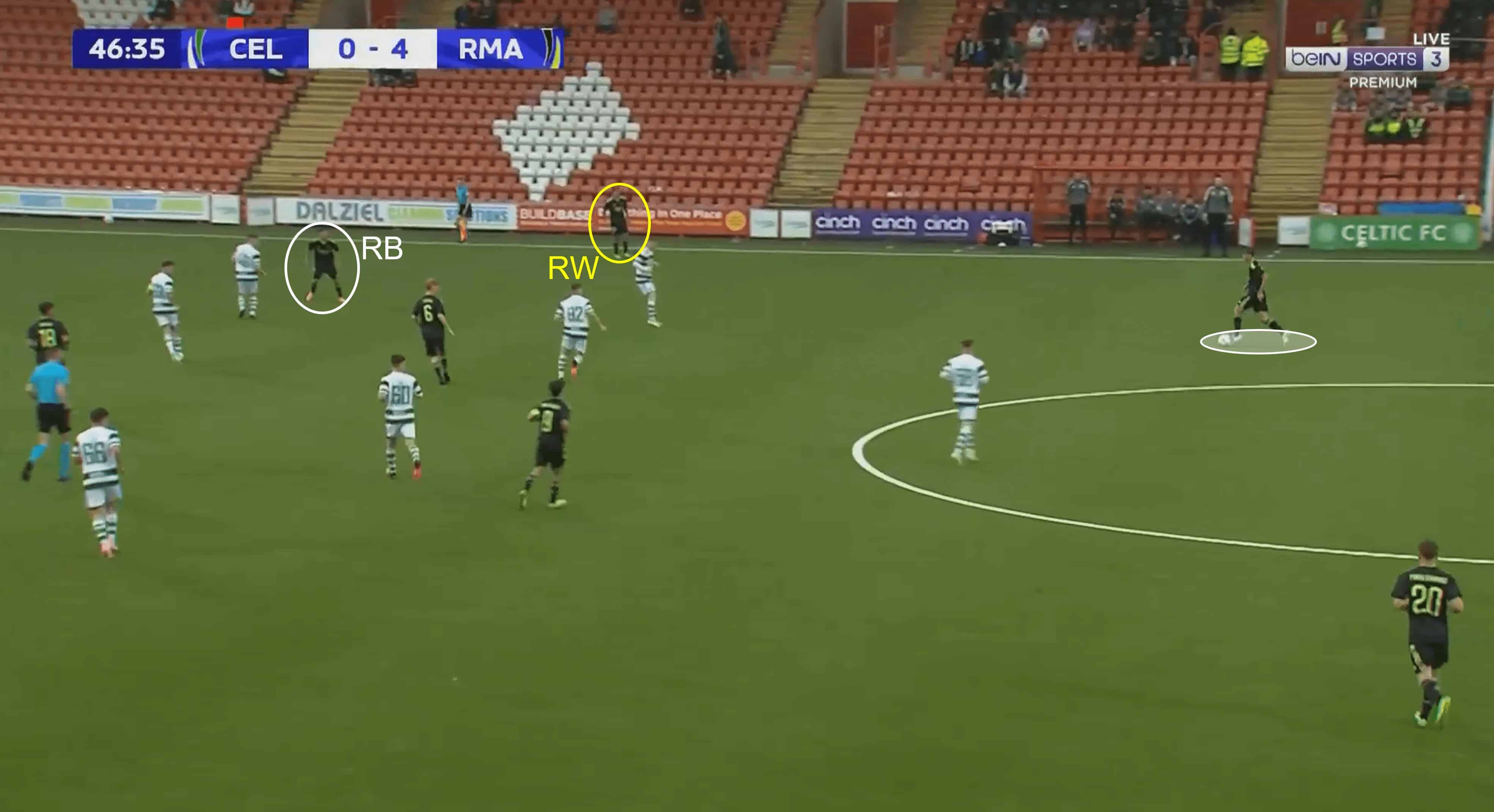
We mentioned that positional rotations are a feature of Arbeloa’s tactics, and here is one of them.
From time to time, we will see the full-back take an underlapping position in correspondence to the winger on their flank.
Often, Madrid alternates which player takes the wider option and which drifts infield.
The infield drifter can add a central presence while also creating space for the wide man to attack.
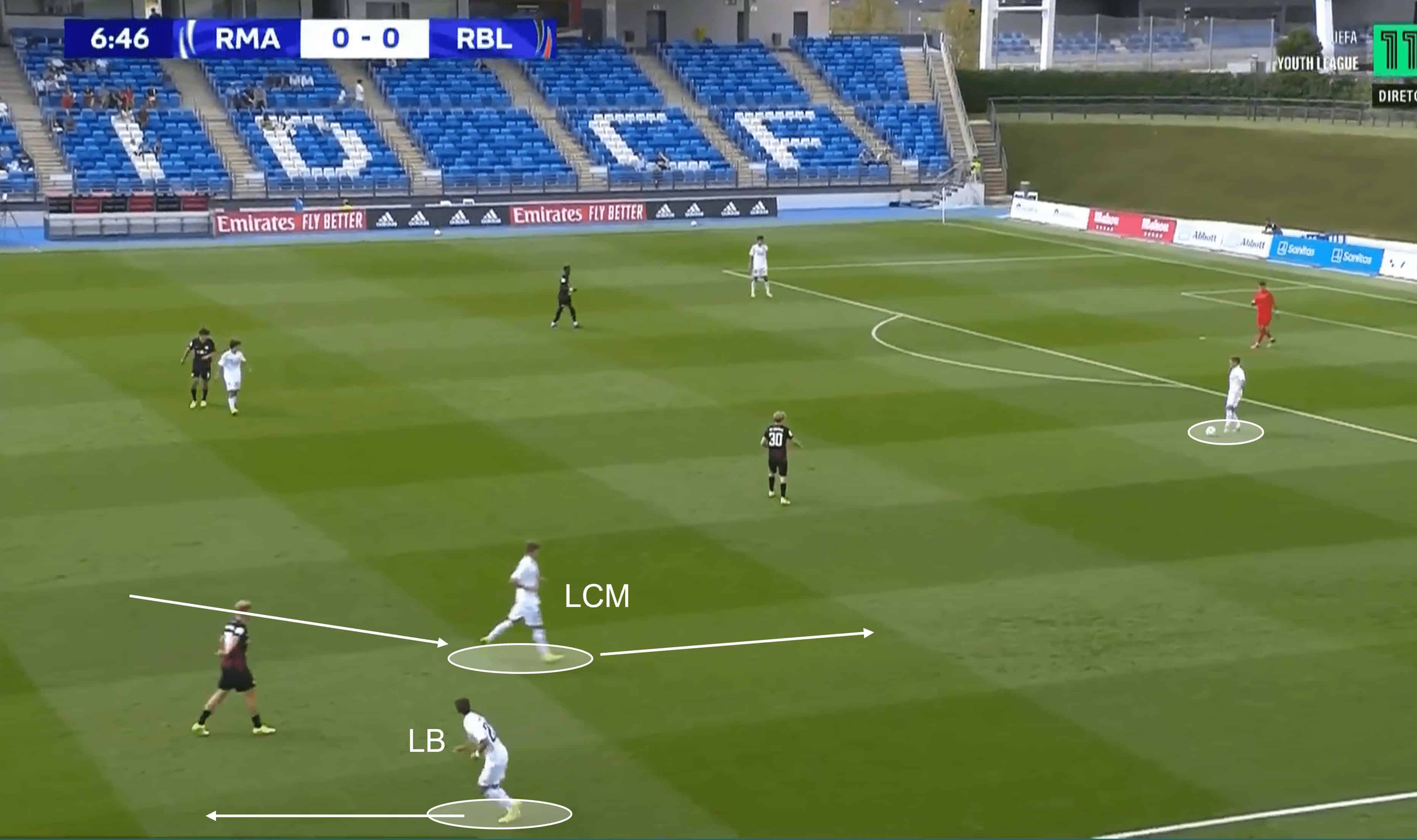
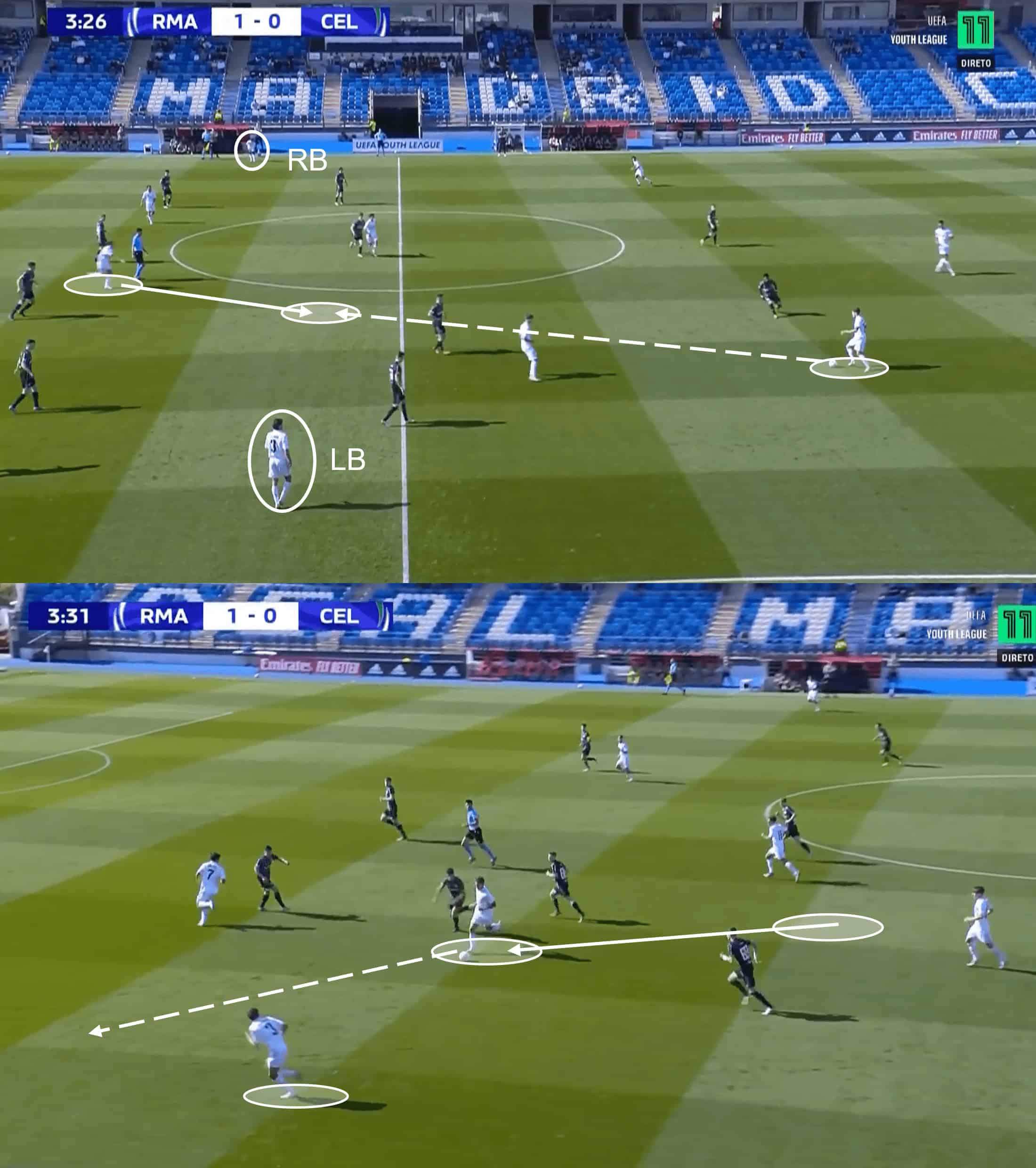
Another rotation that Madrid likes to deploy involves either the RCM or LCM, depending on which side the play is situated on.
Take the image above, for example, the LCM drifts into a deeper, wider area than his original position, giving his teammates in defence a reliable passing option.
His presence here also provides defensive security, which allows the full-back to push on into a higher area.
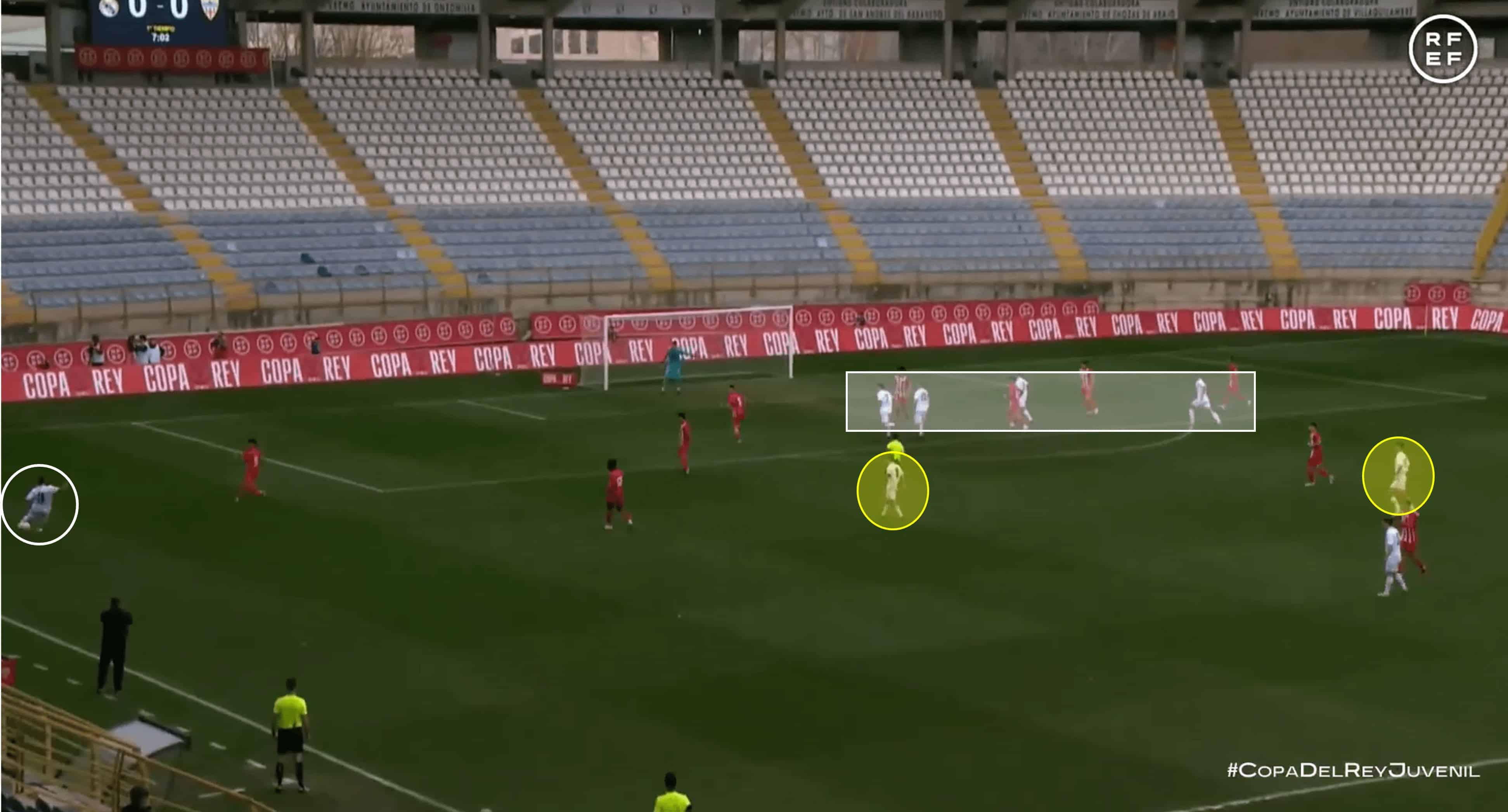
We have now established that playing in wide areas is a cornerstone of Arbeloa’s tactics in the build-up play phases, but what do they do in the final third?
Well, they like their crosses!
That isn’t to say that they just lump cross after cross into the box, but when a good chance presents itself, the full-back will deliver – usually when the attacking presence in the box is strong, like it is in the image above.
Breaking down who gets into the box, it won’t surprise you to learn that the front three are in there.
The fourth player is more often than not one of the midfield trio, with the remaining double hanging back to provide defensive insurance in the event of an opposition counterattack.

The responsibility of crossing often falls to the full-back due to the positioning discussed above, but just how good are they?
The map above has drawn data from this season’s UEFA Youth League, giving us an idea of the crossing tendencies of two of Real Madrid’s most-used full-backs in that competition – Youssef Enriquez (left-back) and Vinícius Tobías (right-back).
Both players are not shy when it comes to the task, but when we look a little closer, we see that Enriquez’s cross dispatch location has more of a telling pattern than his teammate at right-back – the LB likes to get closer to the edge of the box or even beyond that before making his delivery, whereas Tobías shows a tendency to float in a cross from deep – although he does provide a good number of crosses from attacking positions too.
Structure In Possession
Another element deemed essential in his tactics by Arbeloa is a strong structure of play, and if you watch multiple games from this campaign, you will notice certain patterns in their play.
This season, the U19s have averaged 63% possession per game, so they are accustomed to being in the driver’s seat each week.
As this analysis segment will discuss, Arbeloa has helped his players appreciate space, with off-the-ball movement being a vital cog in the machine.
Madrid likes to build a busy central area for two main reasons.
One of them is that it often draws the opponent in and creates space out wide, as we discussed earlier, and the other is that they can execute tight passing combinations to break down opposition defences.
In these times, we often see two of the three midfielders join the attack, with the remaining midfielder holding the fort down in the deeper regions.

The following example shows a similar event in Madrid, where the middle zones were packed out, and the resulting space was utilised out wide.
With no pressure on the ball, the Madrid midfielder has time to pick out his next move.
Often, we would see Madrid play a safe pass here, or even recycle possession if a productive short pass isn’t available, but every now and again, they will try a pass that holds more risk, just like the pass you see above.
This also adds an element of unpredictability to their play, making it even harder to defend against.
Sometimes, even though wide play is the primary focus of their tactics, it won’t become available until later on in the move, so they opt to play through the centre before shifting the ball into space on the flanks.
Take the image above, for example, the left winger makes a move that links back to the notion of clever off-the-ball movement by dropping deep into a pocket of space to receive the ball.
Continuing the move by driving forward, he is then supported by the corresponding full-back, who can then drive into the final third.
This shows that Arbeloa trusts the technical ability and decision-making of the individuals in his team, but it also gives the players the chance to develop those traits as well.
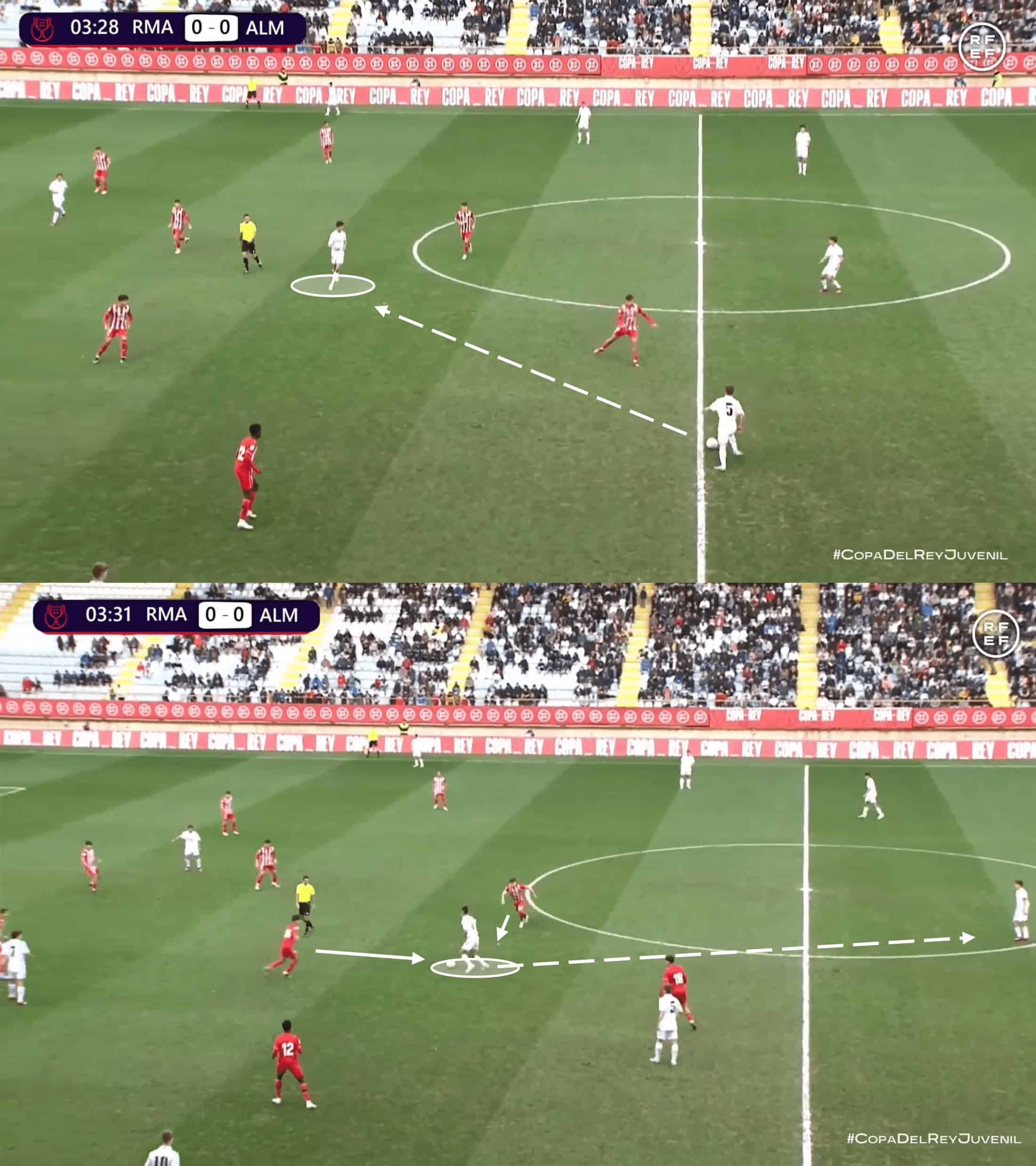
Part of development at the youth level is learning how to play in line with tactical instructions, but it is also important to recognise danger or recognise when a possession reset is necessary to avoid giving the ball away in a dangerous area.
That is exactly what we see above.
The midfield player scans the area only to discover that he is unmarked, but there are opponents close by, and he still has enough to receive the ball safely.
He does that, and at this point in the move, we are at the same stage as the prior analysis image, where the winger received the ball in a midfield area.
The difference this time, though, is that the chance to immediately progress forward did not present itself.
Some players would have tried it anyway, and some would have panicked in response to the opposition’s pressure.
But not the Madrid youngster, who showed good awareness of the situation to simply relay the ball back to the defensive unit, who could start another attack in another area.
“Salta”: High Energy, High Press
It is worth remembering that we are analysing a team that is still playing at a developmental level, with Arbeloa’s primary job being to prepare the players for Real Madrid’s first team.
In line with this, Arbeloa has also considered the physical demands of the senior game, as well as the technical side, as one of Arbeloa’s coaching staff told our analyst Mak that the side performs many high-energy drills in training, including pressing.
The idea is to match the physical levels of senior professional players, giving them a better chance of settling into the first team more quickly if they are called upon.
This approach seems to be working a treat so far – Arbeloa’s U19s currently have higher numbers in physical data metrics than Real Madrid Castilla, currently managed by Raul.
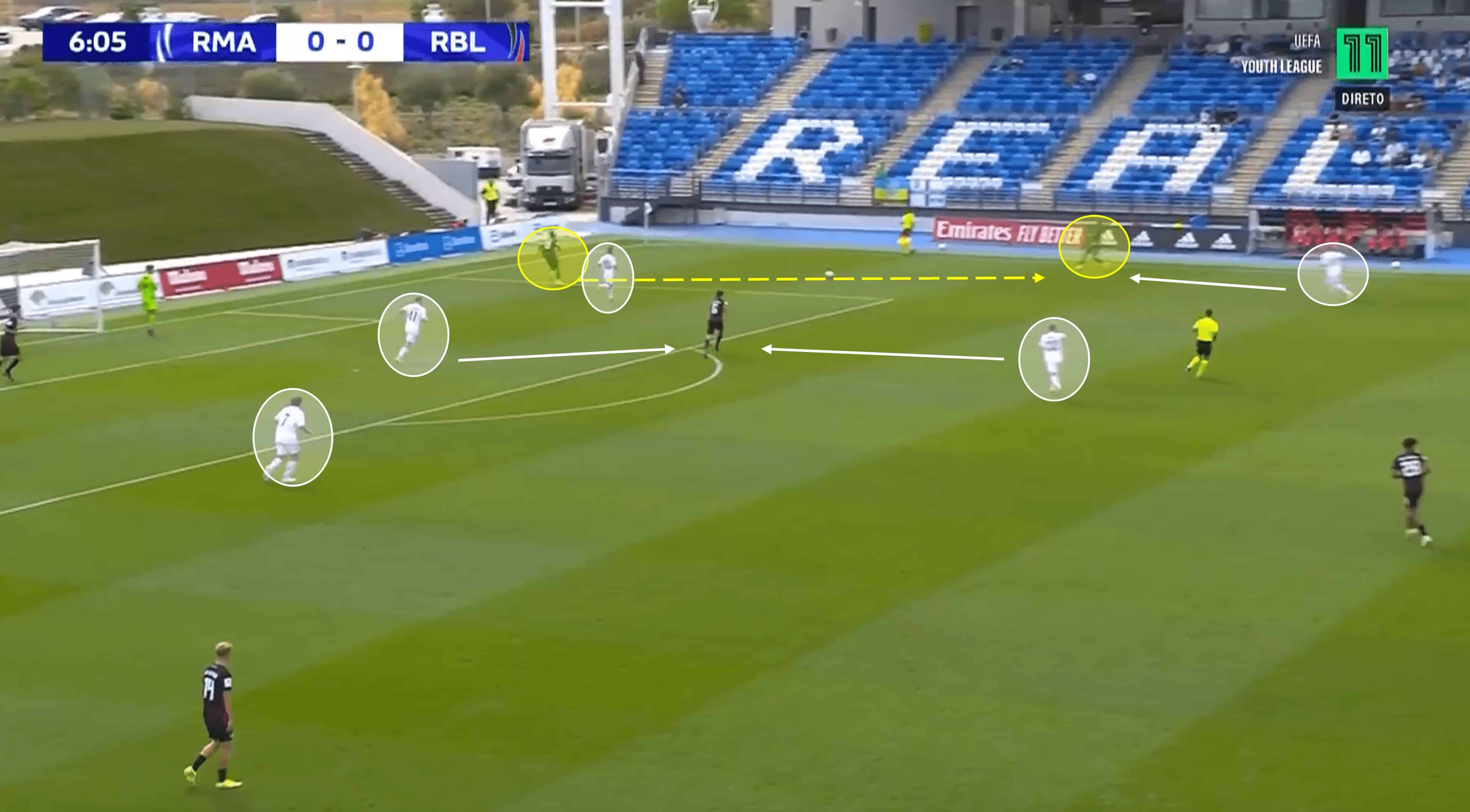
Salta – translates to jump – to move positions. Salta is another term Arbeloa holds in high esteem in his tactical arsenal, and it links into the top-notch physical work they do on the training pitch, which we see reflected on the pitch on matchday.
Madrid enjoys a high press and does so with good intensity and presence.
Often triggered by a player turning to face his own goal on the ball, or a short goal kick, Madrid press in numbers rather than just leaving the striker to chase down in a solo mission.
The front three will press in the initial areas, but two of the midfield unit will also gain yards up the pitch to close the gap further, aiming to force the opposition into pumping the ball long.
Conclusion
It can be challenging to judge a coach’s performance based on their time at the youth level.
Still, Arbeloa is doing a stellar job of preparing the Galacticos’ next batch of academy graduates, and we can expect to see a few players feature in the first team in the near future.
A few names in the squad have already made the step up to Castilla, so that the chance may come soon for some.
Arbeloa has a clear idea of how he wants his side to play, with tactical details that are clever but not over-complicated.
The Spaniard also deserves credit for his work on the training pitch regarding physical development, as this can be an area that doesn’t receive the required attention at many clubs.
It will be very interesting to see how this set of players progresses over the next 2-3 years, and the same can be said for Arbeloa and his managerial career.
