
Rangers have started their summer transfer window with keen intent.
Russell Martin has already been granted six new signings, with the understanding that huge improvements are needed to close last season’s 17-point gap to Old Firm rivals and reigning champions Celtic.
Two of these six signings have come in central defence, with Emmanuel Fernandez and Nasser Djiga recruited from Peterborough United and Wolverhampton Wanderers, respectively.
Fernandez arrived for a hefty fee of around £3m, whilst Djiga arrives on a season-long loan from the Premier League.
Martin has clearly prioritised this position, which is the foundation of his football.
This Rangers recruitment analysis and player analysis will examine the two profiles that the Gers have scouted, investigating how well they fit into Russel Martin tactics and how they could pair up in the lineup next season.
Russell Martin Tactics
The current options for Rangers at centre-half are Robin Propper, Leon King, John Souttar and Ben Davies.
Ben Davies and Leon King spent last year on loan and look set to depart again, and Propper is rumoured to be rejoining his former club, FC Twente.
As such, Rangers needed a significant overhaul in this department, hence the prioritisation.
Russell Martin’s style of football is built upon control and possession dominance.
He consistently looks to build out from the back, and this philosophy remained unchanged even when his Southampton side conceded an abundance of goals in the Premier League.
Because of these philosophies, Martin requires a lot from his defenders.
The two main necessities he looks for are:
- The physical attributes to play in a high line
- The technicality to play out of the back with confidence
Below, we will analyse whether Djiga and Fernandez have the traits required to succeed.
Player Profiles
Nasser Djiga
Nasser Djiga is a 22-year-old central defender.
He is 6’2″ and weighs roughly 84kg.
Despite his young age, Djiga has racked up over 100 appearances for European Clubs.
He started his career at Vitesse before making his first major transfer to FC Basel.
From Basel, he went on loan moves to Nîmes Olympiques and FK Crvena zvezda before the latter purchased him permanently.
Red Star sold him to Wolves in his third permanent move for a fee of around £10m.
After six months at Wolves, he’d made six Premier League appearances.
However, Vitor Pereira decided he was best suited to a season in Scotland to help acclimatise to British Football.
Emmanuel Fernandez
Emmanuel Fernandez is a 23-year-old central defender.
He is 6’5″ and weighs roughly 84kg.
Fernandez has also moved about at a young age; however has not experienced the same European pedigree as Djiga.
He started at Gillingham‘s academy and went on non-league loans before permanently joining Ramsgate.
He quickly stood out at this level, and Peterborough United, renowned for their savvy recruitment, swooped in.
Peterborough loaned him to Spalding United and Barnet; upon his return, the Posh gave him a chance in the first team.
Since then, he has gone on to make over 70 appearances, impressing massively and hence earning a big-money move to the Scottish giants, Rangers.
Strengths As A Potential Pairing
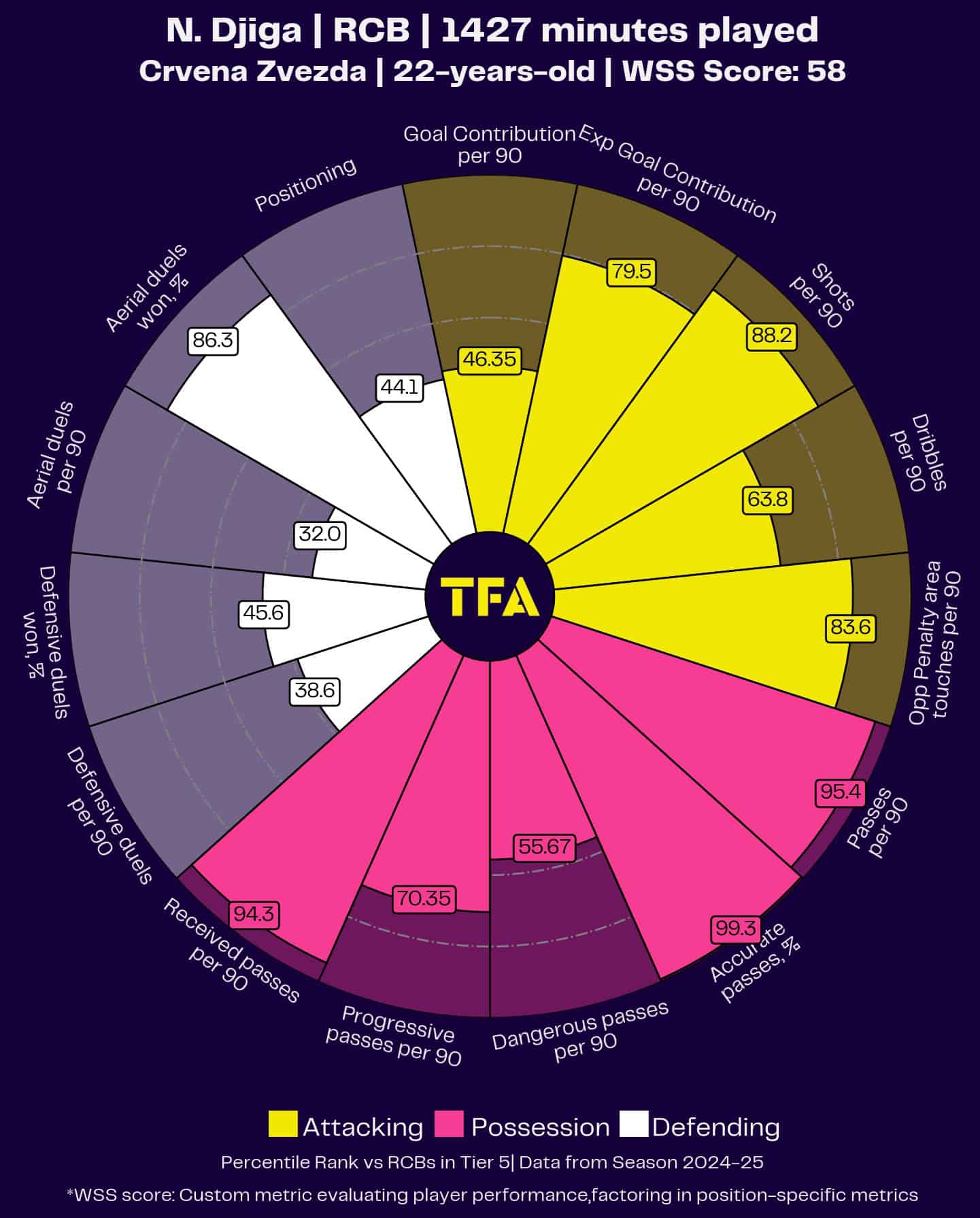
Nasser Djiga Radar Chart
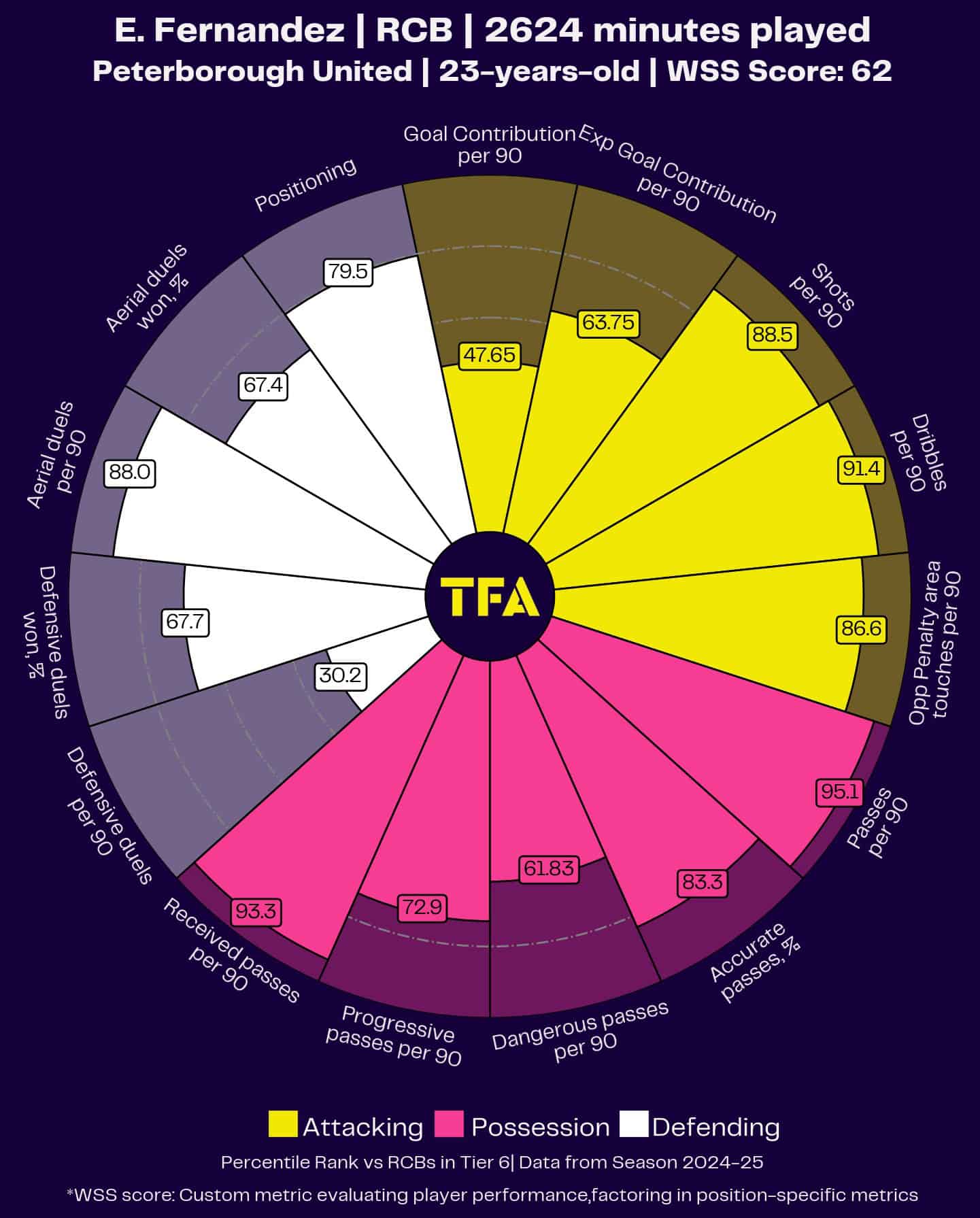
Emmanuel Fernandez Radar Chart
Physical Supremacy
Djiga and Fernandez are both very physically gifted defenders.
They are blessed with strength, agility, and relative speed for the position.
This is potentially something Rangers lacked last season, with the previous options more traditional and less athletic centre-halves.
They can use these strengths regularly in a Martin system, with the speed helping hold a high line and the strength and height helping dominate forwards and regain possession.
Aerially, Fernandez in particular is exceptionally dominant, though Djiga is still overly capable.
At 6’5, Fernandez is naturally imposing and combines this with an aggressive approach that ensures the opposition have little chance of winning any duels.
— Footie Clips (@FootieClips) July 14, 2025
Over his career, Fernandez’s aerial success rate is 66%, whereas Djiga’s is an impressive but slightly weaker 59.5%.
In the Scottish Premiership with Rangers, physical dominance like this could be essential.
Teams often look to go sit deep and play direct against Rangers, hitting long balls into the striker or over the top.
This pairing has the aerial abilities to handle long passes and the speed and agility to handle balls in behind.
These aerial advantages help in the attacking third as well.
Last season, Fernandez scored eight goals from centre-half; Djiga scored four.
Domination When Covering Space
Arguably, Fernandez’s biggest strength defensively is his ability to defend large spaces.
When an opponent bursts through against him, he is extremely hard to beat in a 1v1.
In these situations, he uses his body shape to bait the opponent into trying to go around him, knocking the ball down the line.
From here, he uses his speed and strength to get in front of the defender and puts his body in the way.
— Footie Clips (@FootieClips) July 11, 2025
Djiga is also good in this aspect, as he has the speed and agility to cover across quickly.
If we were to compare with Fernandez, Djiga has better game understanding and intelligence in these scenarios, and reads where passes may be played in advance, as shown below.
— Footie Clips (@FootieClips) July 14, 2025
— Footie Clips (@FootieClips) July 11, 2025
This could be extremely beneficial under Martin’s system at Rangers, as the combined attributes will allow them to take a risk with regular high lines.
Playing a high line allows teams to pin back the opposition deep into defensive zones, making it easier to dominate possession and apply pressure.
Should Rangers’ high line be broken with a long ball, these players should be more than capable of making quick recoveries to prevent any real goalscoring opportunities from developing.
Defensive Duels
Another strength the signing of Djiga will add to Rangers’ defence is a brilliant winner of ground duels.
Djiga boasts an impressive 80% success rate against dribblers challenged, with a loss rate of just 0.1 challenges per game.
Both of these rank him in the top 4% of defenders in the top-five leagues.
— Footie Clips (@FootieClips) July 11, 2025
Fernandez is brilliant over large spaces but struggles to win challenges in close, tight zones.
Djiga will help to balance this weakness and will likely be instructed as the one in the pairing to be more aggressive in pursuing ground duels.
The clip above shows how Djiga thrives at this.
When threatened by Bournemouth, he takes his time waiting for an opportunity to dive in to prevent it.
The situation is very high-risk due to the proximity of the goal and penalty box; however, he remains composed and fully focused on the ball.
Because of this, he wins possession smoothly and then takes no risks in clearing the ball.
In Possession Contributions
Both Djiga and Fernandez are comfortable in possession and could do well in a team that are happy building out from the back.
On one hand, Djiga is not overly risk-taking in his possession choices, but he prioritises safety and security in his options.
He can use both feet to build play, which opens passing options and helps maintain a high passing accuracy.
Last season, this statistic came to 93.2%.
On the other side, Fernandez is much more rash and risk-taking.
He definitely has the capabilities of a true modern defender, and is happy to use the ball to try and progress play and contribute to attacks.
When at his best, he can burst through teams into the midfield, much like Joël Matip would at Liverpool, and has even scored straight from doing so.
This will provide plenty of encouragement to the Rangers management.
— Footie Clips (@FootieClips) July 11, 2025
Additionally, he is a more than capable passer, able to pick out wingers with long, floated passes.
However, he loses the ball much more often than Djiga and can sometimes create issues out of nothing.
Despite having a decent passing accuracy of 88%, his long passing accuracy is just 47% and he loses the ball in his own half 10.04 times per 90 played.
— Footie Clips (@FootieClips) July 11, 2025
This must be improved if he is to thrive at Rangers, who will look to dominate the ball.
Nevertheless, as a pair, they could be well suited in terms of building play.
One is more secure, whilst the other adds an element of risk and progression through passing and ball carrying.
Weaknesses As A Pairing
Discipline
While both of these players are naturally suited to duels, their commitment to pursuing them can be immature.
Fernandez, in particular, can be rash.
He sometimes pushes out of defence to challenge for a ball that he isn’t required to, but also enters duels half-committed.
He often loses these, which means the opposition can glide past him, and his side is then outnumbered.
A good example is shown below.
— Footie Clips (@FootieClips) July 11, 2025
This overeagerness also explains his slightly worrying discipline record.
When he is out of position, he sometimes carelessly dives in with slide tackles that could test referees.
Last season, he picked up two red cards unnecessarily.
As mentioned above under strengths, until Fernandez matures, Djiga should be the one to pursue duels.
Although Fernandez is hasty in duels, he is very effective at sitting in and waiting for balls to come in behind.
Fernandez can also sometimes struggle with positioning and getting caught in dangerous zones.
He can be exceptional in this at times and has the potential to improve easily.
However, right now, he can be slightly lackadaisical and unfocused, leaving players unmarked and prone to drifting out of his required zone.
Experience
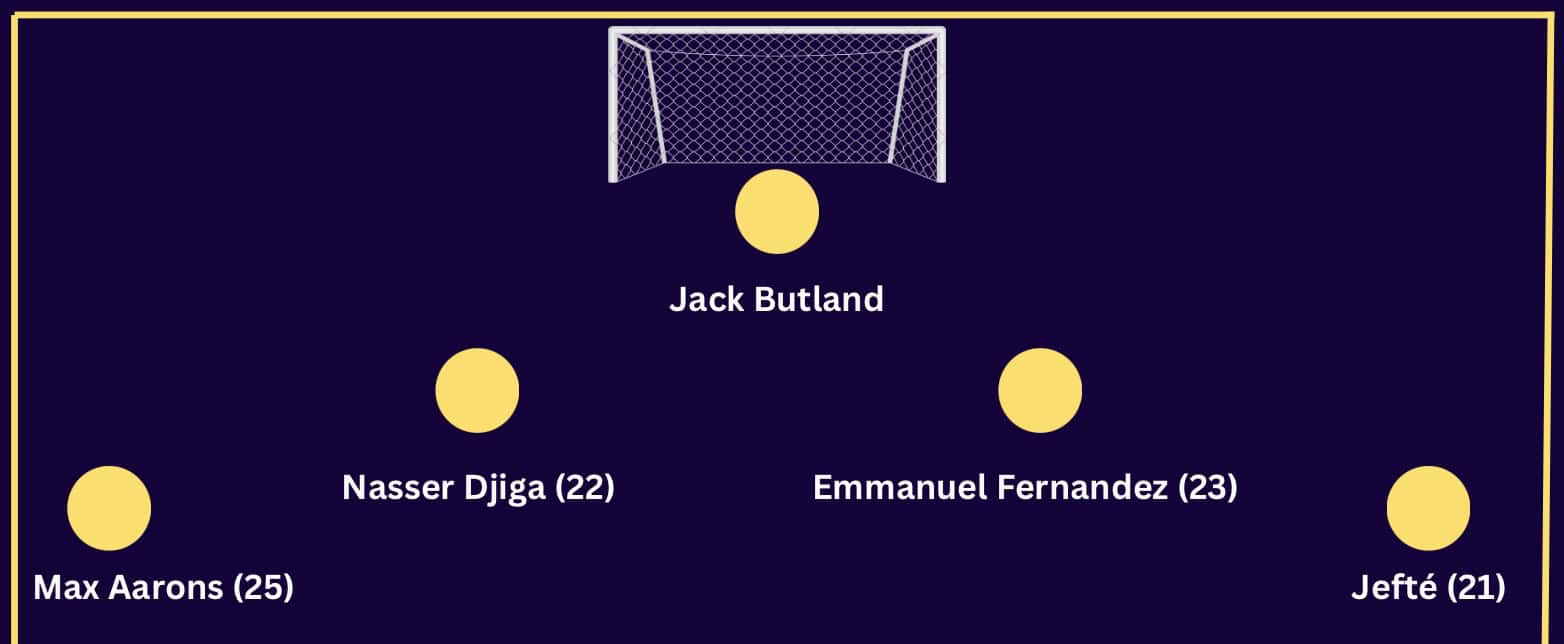
Despite all of the positives mentioned above, the apparent concern with this pairing is the youthfulness and lack of experience at the top level.
As a pair, they may struggle to maintain the required structure and organisation without a leader to command them, and throughout a whole season, they would likely concede some sloppy goals.
This may explain the continued rumours of Conor Coady, who would arrive with over 500 senior appearances, nearly 200 of which were in the Premier League.
As shown below, without an experienced defender, the defence will be very young.
This may worsen aspects such as organisation and shape, but also mental aspects like confidence and calmness under pressure.
Coady would bring leadership and seniority, which could help the new arrivals on the pitch and in training sessions.
Conclusion
In our opinion, Fernandez and Djiga are examples of brilliant profiling by the Rangers recruitment team.
Djiga is currently more mature despite his age and probably a higher-level footballer right now, but Fernandez has all the makings of a top-quality defender once refined.
They fit the exact attributes required by a Martin system, and should fit into the side smoothly.
However, there could be teething issues.
Both players are still young and slightly raw.
The addition of an experienced profile, such as Coady, could be pivotal in bringing out the best of both footballers and giving Rangers the best chance of success this season.
