
Vitesse, a prominent name in Dutch football, has faced a recent downturn after being relegated from the Eredivisie for the first time in 35 years. This unexpected blow came as a result of a probe into the club’s financial affairs, revealing startling links to Chelsea FC and Russian billionaire owner Roman Abramovich. As we delve into a recruitment analysis of Vitesse Arnhem, it becomes imperative to explore the intricate web of connections that led to a significant deduction of 18 points for the club.
The revelations of financial ties between Vitesse and Abramovich have sent shockwaves through the football community, prompting an in-depth investigation into the club’s operations. It was discovered that Vitesse fell short of meeting the licensing regulations set forth by the Netherlands Football Association, casting a shadow of doubt over the integrity of their recruitment practices and financial management.
This analysis will delve into the data and statistics surrounding Vitesse’s player acquisitions and departures, shedding light on the impact of their association with Chelsea and Abramovich. By examining the nuances of their recruitment strategies and the implications of their link to a Premier League giant, we aim to unravel the complexities behind Vitesse’s point deduction and its ramifications for the club’s future in Dutch football.
The situation
The saga of Vitesse’s descent into its current dire situation is a tale intertwined with the ambitions and machinations of football’s elite. It all began in 2003 when Roman Abramovich, the Russian billionaire, acquired Chelsea FC from Ken Bates for a staggering sum of 140 million pounds. Abramovich’s arrival ushered in an era of unprecedented investment in the London club, with millions poured into transfers and player acquisitions to propel Chelsea to the summit of English and European football.
Over the years, Abramovich invested an estimated 2 billion euros in transfers, assembling a star-studded lineup featuring the likes of Verón, Drogba, Ballack, Cech, and Crespo. However, the exorbitant costs associated with acquiring top-tier talent prompted a shift in strategy. Recognising the need for a more sustainable approach, Abramovich turned his attention to nurturing young talent through the club’s academy and loaning promising players to other teams.
This strategy led Abramovich to explore partnerships with other clubs, with the aim of providing loan opportunities for Chelsea’s young prospects. Enter Vitesse, a Dutch club that found itself thrust into the spotlight as Abramovich’s affiliate. In 2010, Vitesse came under the ownership of Georgian businessman Merab Jordania, who maintained a friendly and financial relationship with Abramovich. Under Jordania’s stewardship, Vitesse became a destination for Chelsea’s loaned players, cementing the bond between the two clubs.
However, the relationship between Abramovich and Jordania would eventually unravel, leading to the emergence of new ownership under Russian oligarch Aleksandr Chigirinskiy in 2013. Despite the change in ownership, Vitesse continued to serve as a conduit for Chelsea’s young talents, with the arrangement attracting scrutiny from football authorities.
The situation took a dramatic turn in 2014 when revelations surfaced regarding Abramovich’s alleged interference in Vitesse’s sporting ambitions. Jordania claimed that Abramovich had prevented Vitesse from securing a Champions League spot, exposing the extent of Abramovich’s influence over the Dutch club. Further revelations emerged, linking Chigirinskiy’s acquisition of Vitesse to Abramovich’s interests and casting a shadow over the club’s operations.
As the years passed, ownership of Vitesse changed hands once again, with Oyf, a former Gazprom director, taking control in 2017. However, the spectre of Abramovich’s involvement continued to loom large, culminating in heightened scrutiny from football authorities amid Abramovich’s growing legal and political troubles.
In the wake of the Russia-Ukraine conflict and Abramovich’s subsequent sale of Chelsea, Vitesse found itself under the microscope of regulatory bodies seeking answers regarding its dealings with Abramovich. However, the club’s failure to provide satisfactory responses led to a harsh penalty, including an 18-point deduction and a hefty financial fine, imposed in April 2024.
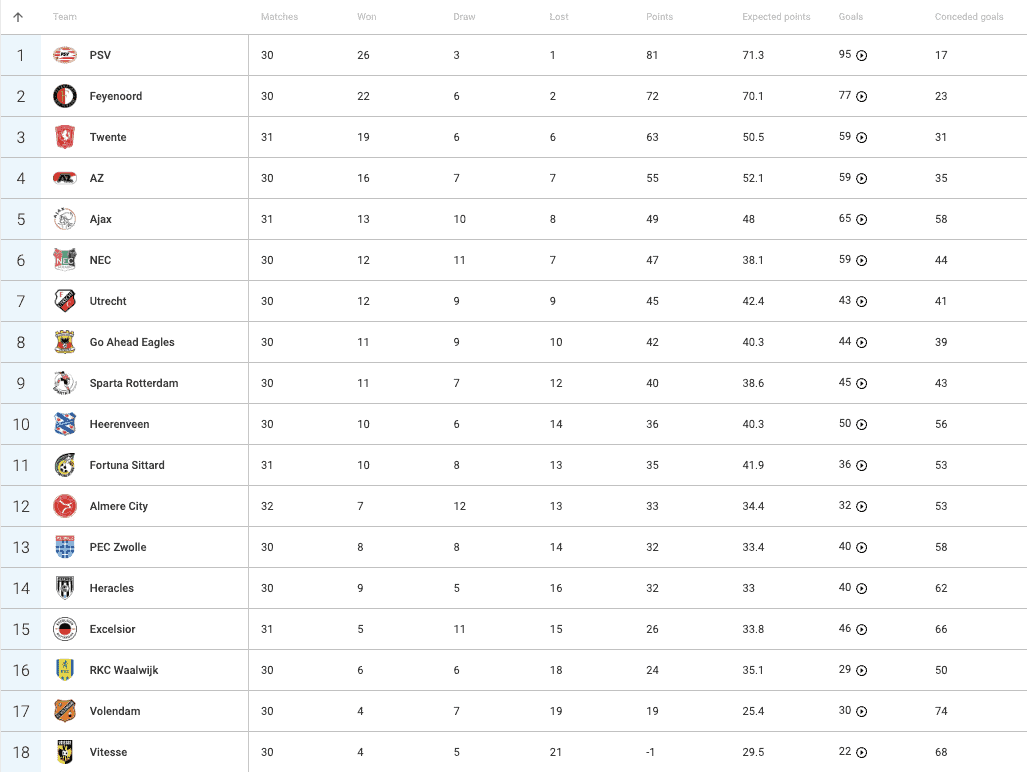
Thus, Vitesse’s journey from being a promising Dutch club to facing relegation and financial penalties serves as a cautionary tale of the pitfalls of football’s nexus with wealthy benefactors and the consequences of operating in the shadow of controversy and scrutiny.
The Chelsea Loan System
The symbiotic relationship between Chelsea and Vitesse Arnhem, often dubbed the “loan farm” or “Chelsea B” arrangement, provided a mutually beneficial platform for player development over the course of 11 years. While Chelsea loaned out a plethora of young talents to Vitesse, the Dutch club served as a nurturing ground for these players to hone their skills and gain valuable experience in competitive football.
From its inception in 2013, the loan system saw Vitesse become a destination for numerous Chelsea prospects eager to gain playing time and exposure to top-flight football. The list of players who made their mark at Vitesse reads like a who’s who of rising talents, including Mason Mount, Dominic Solanke, Armando Broja, Patrick van Aanholt, Nemanja Matic, Bertrand Traore, and Christian Atsu, among others.
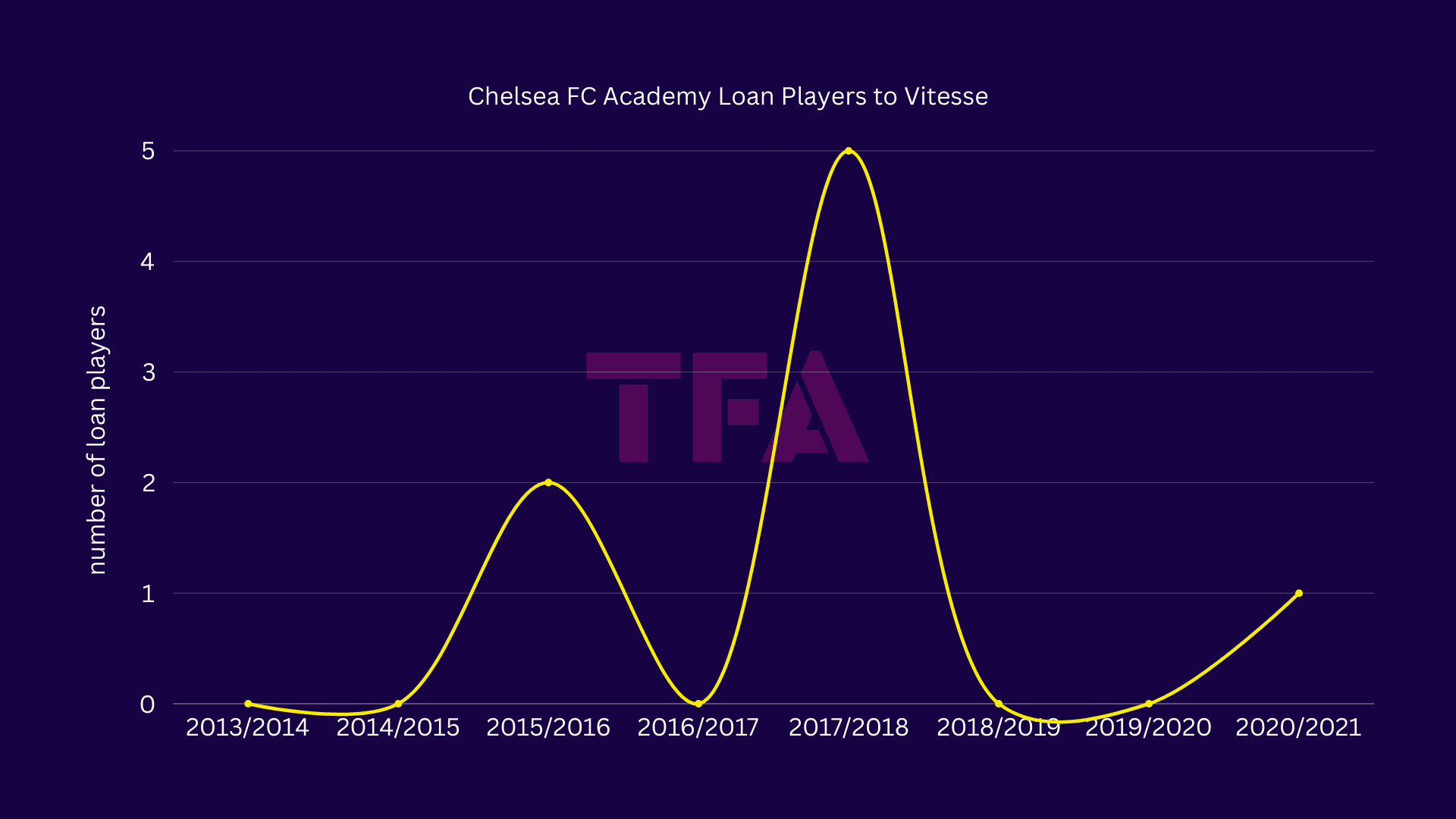
Throughout various seasons, Vitesse Arnhem benefitted from a steady stream of talented players loaned from Chelsea FC, each contributing to the club’s endeavours in the Eredivisie. In the 2010/2011 season, notable additions included Nemanja Matic at 22 years old, Matej Delac at 17, and Slobodan Rajkovic at 21. The following season saw Ulises Dávila, Tom Kalas, and Patrick Van Aanholt join the ranks, aged 20, 18, and 21, respectively. Gael Kakuta, aged 21, was the sole loanee from Chelsea in the 2012/2013 season.
As the partnership between the two clubs continued to flourish, the 2013/2014 season saw a cohort of promising talents don the Vitesse jersey, including Sam Hutchinson at 24 years old, Christian Cuevas at 18 years old, Lucas Piazon at 20 years old, and Christian Atsu, tragically deceased, at 22 years old. Season 2014/2015 welcomed Wallace Oliveira, aged 21, and Josh McEachran, aged 22, while the subsequent season featured the likes of Bertrand Traore, Nathan, Lewis Baker, and Danilo Pantic, aged 19, 19, 20, and 19, respectively.
The loan system continued to yield results in the 2016/2017 season with Matt Miazga, aged 21, followed by Eduardo and Jake Clarke-Salter in the 2018/2019 season, aged 35 and 20 respectively. In the 2019/2020 season, Jamal Blackman, aged 25, made his mark at Vitesse. However, in the subsequent seasons, the flow of Chelsea’s loaned players to Vitesse ceased, marking the end of an era in the collaborative partnership between the two clubs.

The influx of Chelsea’s loaned players injected Vitesse with a wealth of talent and potential, elevating the club’s profile within Dutch football and enabling them to compete at a higher level. For Chelsea, the loan system provided a valuable avenue for their young talents to gain invaluable playing time and experience in a competitive environment, preparing them for potential returns to Stamford Bridge or permanent moves elsewhere.
Several players even from Chelsea’s youth academy, including Dominic Solanke in 2015 and Mason Mount in 2017, were loaned to Vitesse, offering them invaluable experience in the Eredivisie. For Mount, in particular, this proved to be a transformative period in his career. During his loan spell, Mount showcased his talents, scoring 14 goals in 39 appearances and earning accolades such as the club’s Player of the Year award and a spot in the Eredivisie Team of the Year.
Mount’s impressive performances at Vitesse laid the foundation for his subsequent success. Following his loan stint, he continued to shine at Derby County under the tutelage of Chelsea legend Frank Lampard. Their partnership flourished, culminating in a reunion at Stamford Bridge ahead of the 2019/20 season. Mount’s journey from Chelsea’s academy to Vitesse and beyond exemplifies the benefits of the loan system in providing young talents with opportunities to develop and thrive.
However, the arrangement was not without its controversies and criticisms. In England, Vitesse was often derided as a mere extension of Chelsea’s youth development system, raising questions about the integrity of competitive balance within the Eredivisie. Critics argued that Vitesse’s reliance on Chelsea’s loaned players distorted the league’s competitive landscape and undermined the club’s autonomy and identity.
Despite the scrutiny and scepticism surrounding the loan system, both Chelsea and Vitesse reaped the rewards of their partnership. Chelsea’s young prospects flourished under Vitesse’s tutelage, while the Dutch club benefited from access to top-tier talent and improved competitiveness on the field.
Other Transfers
Vitesse has long been renowned for nurturing top talent, serving as a springboard for promising young players to showcase their abilities on a broader stage – not only from Chelsea FC. Among the notable names to have graced the club’s ranks are Wilfried Bony, Marvelous Nakamba, Martin Odegaard, and Lois Openda. These players flourished at Vitesse, either paving the way for their own success or catching the eye of larger clubs with their performances.
The club’s ties with Roman Abramovich reportedly even facilitated a loan deal with Real Madrid for Martin Odegaard in 2018, underscoring the global reach of Vitesse’s influence. Such arrangements align with the overarching ethos of the Eredivisie, a league renowned for providing opportunities for young talents to thrive and develop.
Vitesse’s success on the domestic and European fronts further bolstered its reputation as a breeding ground for talent. With an impressive streak of 12 consecutive top-10 finishes in the Eredivisie, the club consistently punched above its weight and earned a place in European competitions. In the 2021-22 season, Vitesse made waves by defeating the likes of Tottenham Hotspur in the Europa Conference League. However, their journey was halted by AS Roma, who clinched victory with an injury-time goal by Tammy Abraham, a former Chelsea loanee ironically eliminating his former club.
What’s Next?
Vitesse’s performances in the current season have been far from stellar, with the team struggling to find consistency and secure positive results. Despite starting the campaign on a high note with a victory in their opening league fixture, their subsequent matches have yielded only 13 points out of a possible 24. This lacklustre run has left them languishing in 17th place in the league table, precariously perched in one of the automatic relegation spots and trailing five points behind safety.
Vitesse’s recent form underscores the severity of their predicament. They have managed to accumulate just eight points from their last 15 league outings. This downward spiral has cast a shadow of uncertainty over the club’s future, with the prospect of relegation looming large. Notably, Vitesse has not faced the prospect of playing in the second tier since the 1980s, making the current situation all the more daunting.
Looking ahead, the club faces significant challenges both on and off the pitch. While budgets have dwindled over time, exacerbated by minimal spending on transfer fees amounting to €2 million since 2020, their heavy reliance on loan deals has left them with few valuable assets of their own to capitalise on.
The recent sale of Million Manhoef to Stoke City for €4 million in January stands as a rare exception, with no other players of comparable value remaining within the squad. As a result, Vitesse finds themselves in a precarious position, with uncertain prospects for the future as they navigate the complexities of financial constraints and sporting challenges.
Conclusion
The situation at Vitesse paints a stark picture of a club grappling with the consequences of a flawed recruitment strategy and financial mismanagement. Despite enjoying a fruitful partnership with Chelsea and securing talented players on loan, the overreliance on temporary acquisitions has left the club without valuable assets of its own. This, coupled with dwindling budgets and a lack of significant transfer activity, has hindered Vitesse’s ability to strengthen its squad and compete effectively in the Eredivisie.
Furthermore, the recent point deduction imposed by the Dutch Football Association underscores deeper issues within the club, including financial irregularities and breaches of licensing regulations. The fallout from these violations has only exacerbated Vitesse’s woes, pushing them perilously close to relegation from the top flight for the first time in decades.
In hindsight, it is evident that Vitesse’s recruitment strategy, while initially fruitful in securing talented loan signings, lacked the foresight to build a sustainable squad capable of long-term success. The overreliance on short-term solutions left the club vulnerable to fluctuations in player availability and financial stability, ultimately undermining their competitiveness on the pitch.
As Vitesse navigates the challenges ahead, it is imperative for the club to reassess its recruitment approach, prioritise long-term sustainability, and address the underlying issues that have contributed to its current predicament. Only through strategic planning, prudent investment, and a renewed focus on developing homegrown talent can Vitesse hope to regain its footing and emerge stronger from this period of adversity.
