


Sporting CP hosted Arsenal for the first leg of the 2025/2026 UEFA Champions League quarter-final at Estádio José Alvalade.
The Gunners ended up being victorious, taking a slender lead for the return leg in London.
Both sides were evenly matched across a wide range of statistics, with the visitors edging in ball possession (56%) and expected goals (0.71-1.33).
They had similar numbers in big chances (2-2), tackles (15-14), shots on target (5-4), final-third entries (41-40), and touches in the opposition box (16-14).
In this tactical analysis, we aim to highlight Arsenal’s strengths and weaknesses against Sporting CP.
Sporting CP Vs Arsenal Lineups & Formations
Let us look at how Rui Borges and Mikel Arteta fielded their squads.
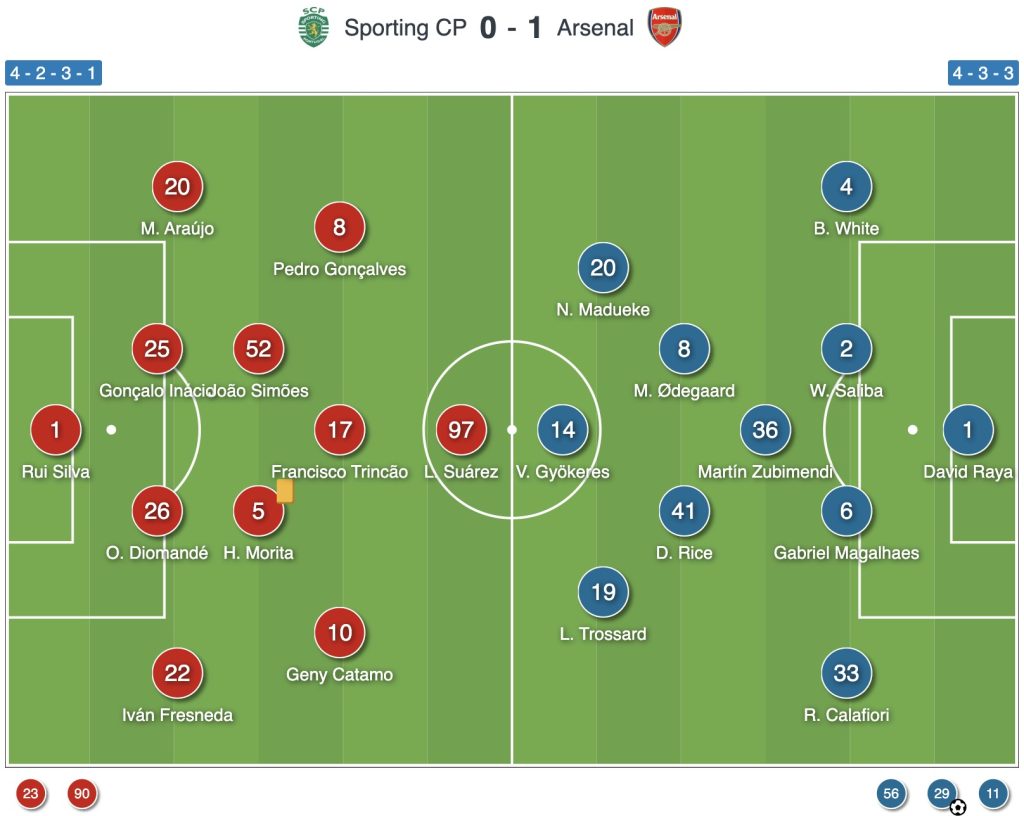
The hosts, Sporting CP, played in a 4-2-3-1 formation.
Rui Silva started between the sticks, behind a back four of Iván Fresneda (right-back), Ousmane Diomande (right centre-back), skipper Gonçalo Inácio (left centre-back), and Maximiliano Araújo (left-back).
Hidemasa Morita and João Simões played as a double pivot.
Daniel Bragança replaced the latter after 62 minutes.
Geny Catamo (right) and Pedro Gonçalves (left) were the wingers.
Rafael Nel came on for the latter at the 79th minute.
Francisco Trincão operated as the attacking midfielder behind Luis Javier Suárez.
The visitors, Arsenal, played in a 4-3-3 formation.
David Raya was the starting goalkeeper.
Ben White (right-back), William Saliba (right centre-back), Gabriel Magalhães (left centre-back), and Riccardo Calafiori (left-back) were the back four.
Martín Zubimendi played as the pivot, with Declan Rice and skipper Martin Ødegaard as the centre-midfielders.
Kai Havertz replaced the latter after the 70th minute.
Noni Madueke (right) and Leandro Trossard (left) were the wingers.
They made way for Max Downman (76’) and Gabriel Martinelli (76’), respectively.
Viktor Gyökeres played as the lone striker.
Arsenal Areas Of Struggle
Although Arsenal did not face a high press from Sporting, they struggled to play vertically in the central channel.
Their opponents did not engage them high up the pitch.
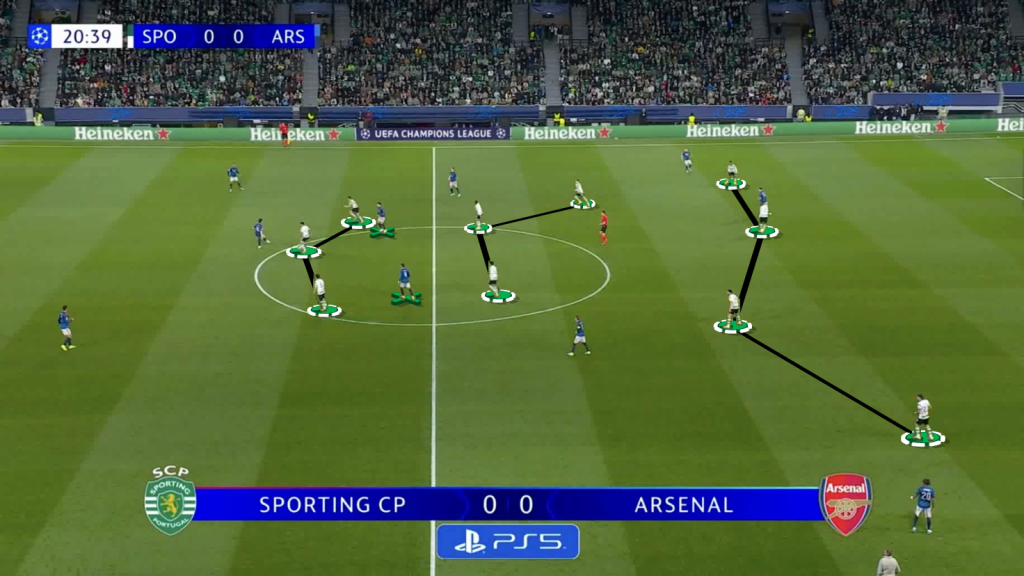
Sporting were in a 4-3-3 mid-block to start with.
Their front three were compact, which helped cut the passing lanes to Zubimendi and Rice whenever they positioned themselves inside the structure.
It was often seen that the hosts had their first two lines of pressure vertically compact, which forced Arsenal to go around their block.
To get more involved in the play, the midfielders needed to drop outside the structure.
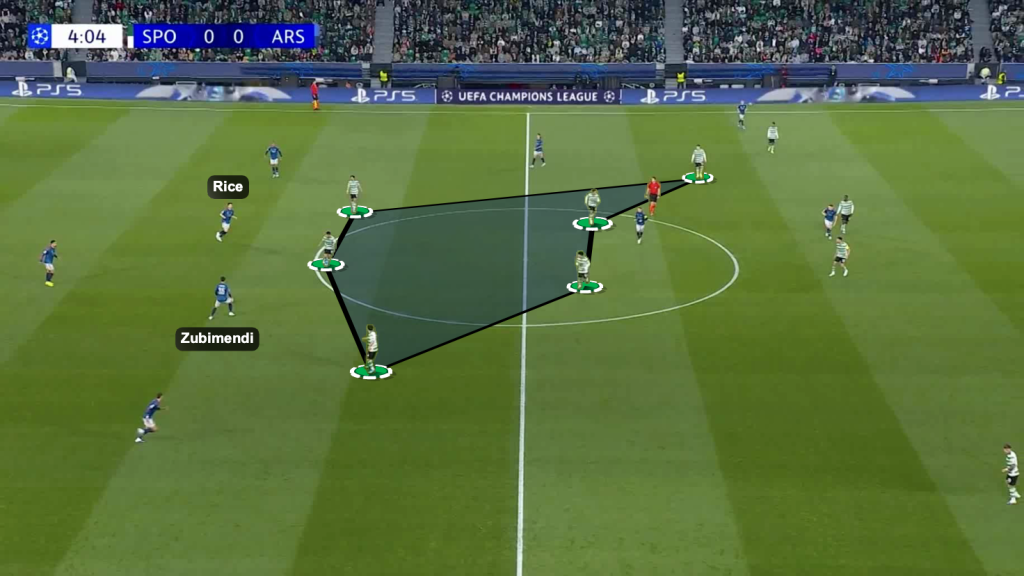
When they received the ball outside the press, the full-backs (White and Calafiori) could push up the pitch into different attacking zones.
There were spells of play where the Gunners had no players positioned inside the structure, especially between the first two lines of pressure.
Either the pivot being there or when the pivot drops, the attacking midfielders positioning themselves there helps with progression in more ways than one.
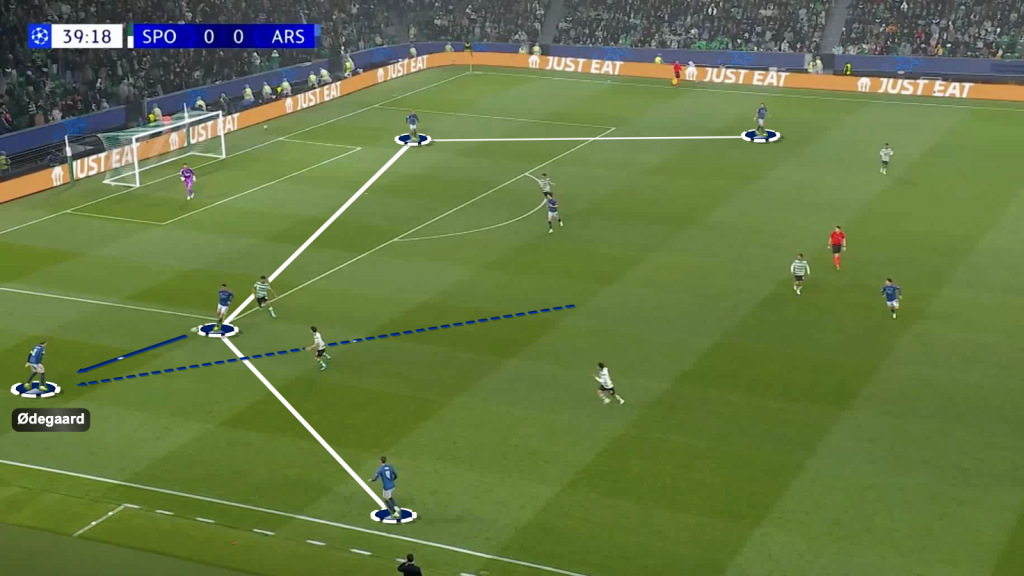
As for Ødegaard, he either positioned himself between the opposition lines of midfield and defence or dropped deep outside the structure.
The Norwegian dropping so deep meant that there was nobody close to the striker to link up with him.
When Arteta deploys Eberechi Eze to play closer to Gyökeres, Arsenal get more out of the Swedish international.
In this game, that became an issue, as neither midfielder was in proximity to the striker when the Gunners were in possession.
In most cases, more midfielders dropping deep causes the opposition to jump; however, that was not the case for Sporting.
They rarely pressed high, which forced Arsenal to go around the block unless it was a counterattack.
The moments when Arsenal found penetration, it came from the wide area.
However, the end product took a long enough time.
One of the clearest Arsenal chances came late in the second half after Martinelli came on.
The Brazilian received in the wide area, attracting the opponent’s full-back.
However, the centre-back does not offer adequate cover.
This opens space for Calafiori to make an underlap.
The missing part was the striker’s movement; with a burst of pace on the far side, Gyökeres would be in for a tap-in.
Getting these final actions right would have put the Gunners in a much better spot early in the game; it dragged on until the second half of additional time.
Sporting frequently changed their defensive structure, depending on how the Arsenal players positioned themselves in build-up.
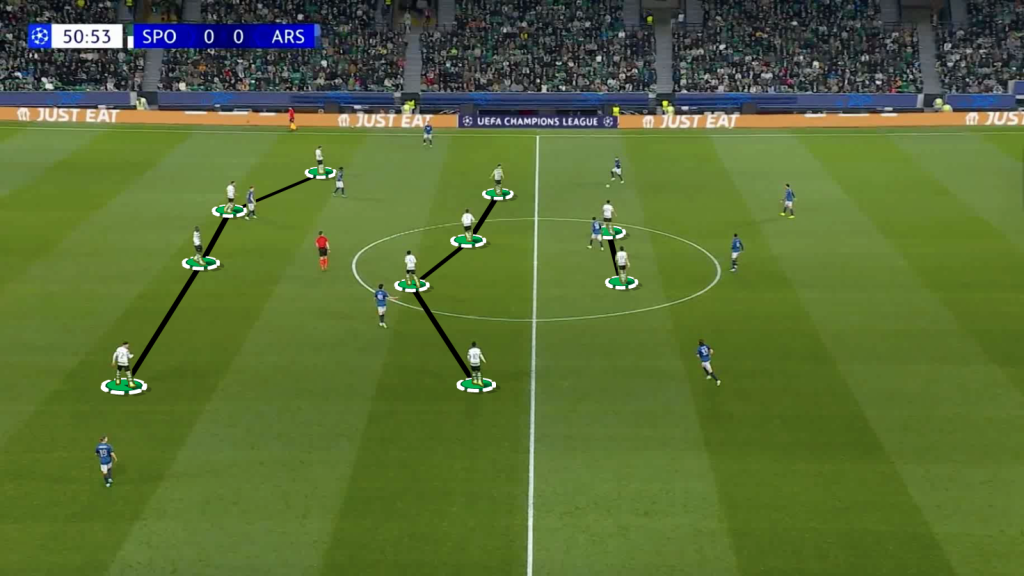
Later in the game, especially during the second half, they defended in a 4-4-2 mid-block.
The front two stayed compact, blocking the passing lane to the pivot; meanwhile, the midfield four stayed compact to block multiple passing lanes to the Arsenal players floating between the lines.
This included Calafiori, who frequently inverted to operate in the half-space; Rice and Ødegaard were present in the half-spaces; Madueke also inverted at times when White moved high and wide.
Their shape changed once again after Havertz’s introduction.
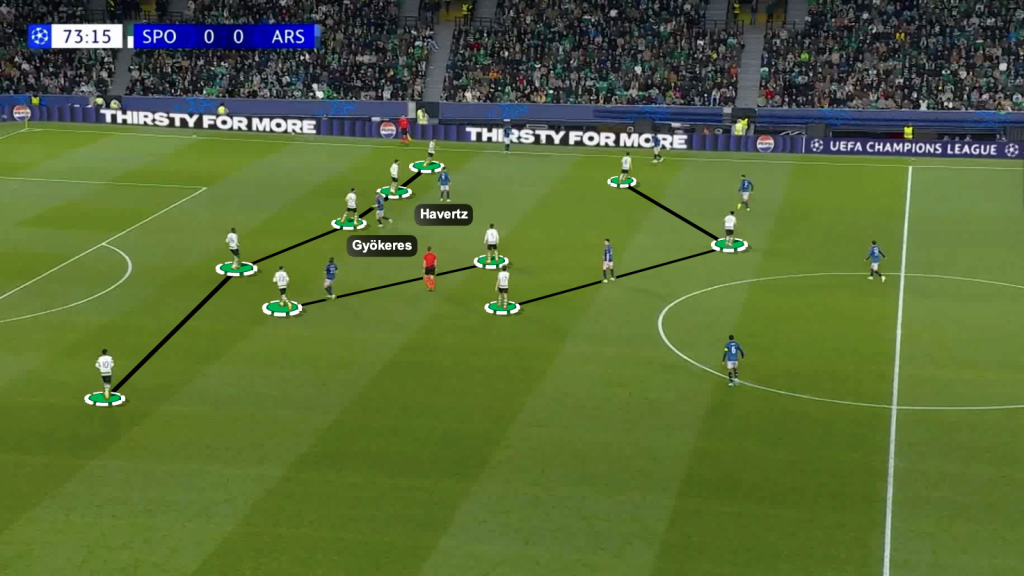
Once the German international replaced Ødegaard, he started positioning himself higher up the pitch and closer to the striker.
To deal with two central runners, Sporting went into a 5-2-3.
This created problems for the Gunners, since their compact shape meant that rarely any line-breaking passes went through.
Unlike Arsenal, Sporting created several chances to penetrate.
The ball goes to the wide channel before going back to the centre-backs; the winger makes use of the gap that opens up between the full-back and the centre-back
They also gave Arsenal some problems by being direct.
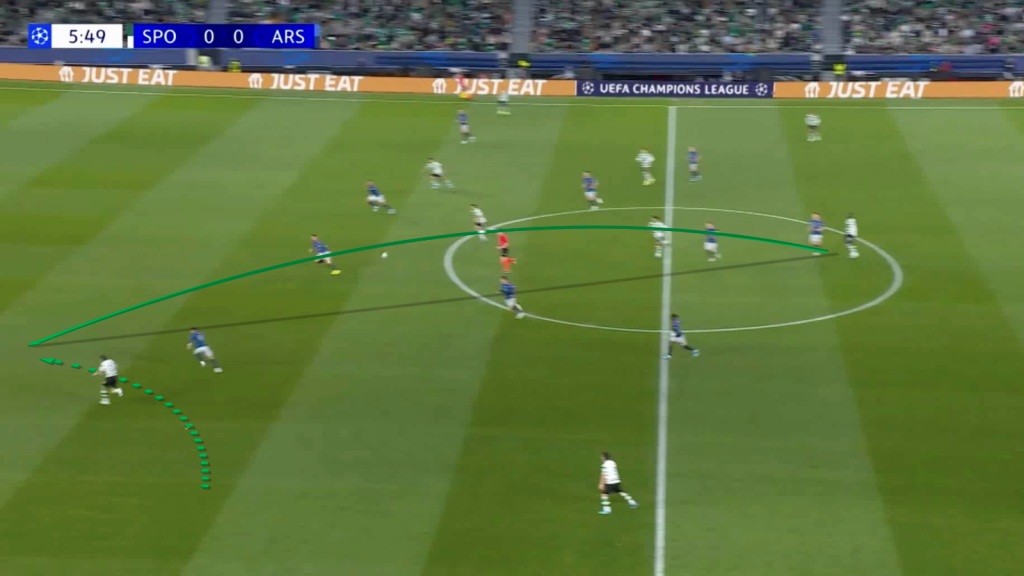
Their runs in-behind were found by long passes from the middle third.
A Sporting winger makes an out-to-in run above, and a Sporting winger makes an in-to-out run below to get onto the end of a long ball.
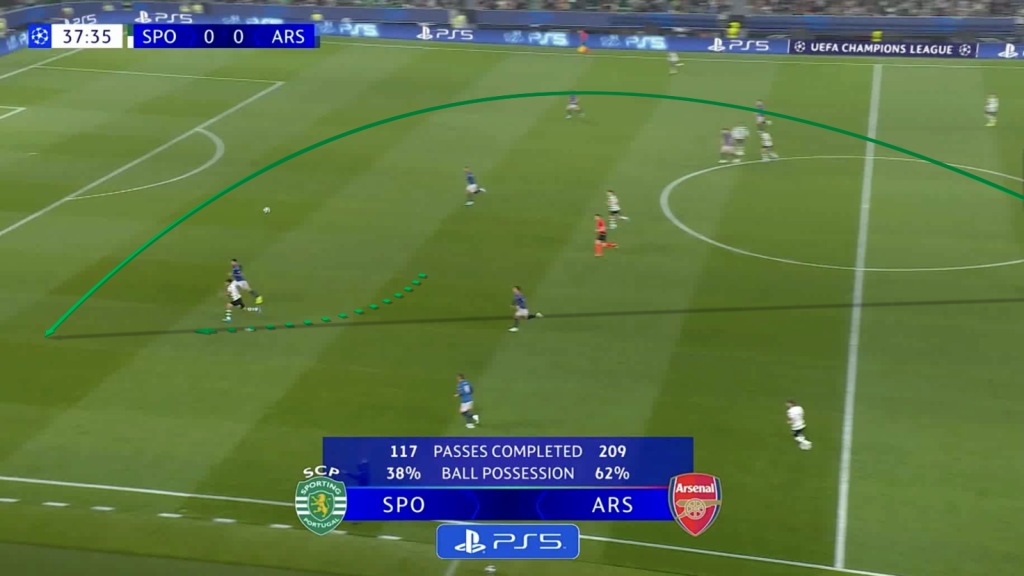
Arsenal struggled to maintain compactness as they dropped their line.
When the first ball goes in-behind, the Gunners immediately drop their backline.
However, it takes them a few seconds to drop their line of midfield; by that time, Sporting found a cut-back and an attempt.
Arsenal Strengths Vs Sporting
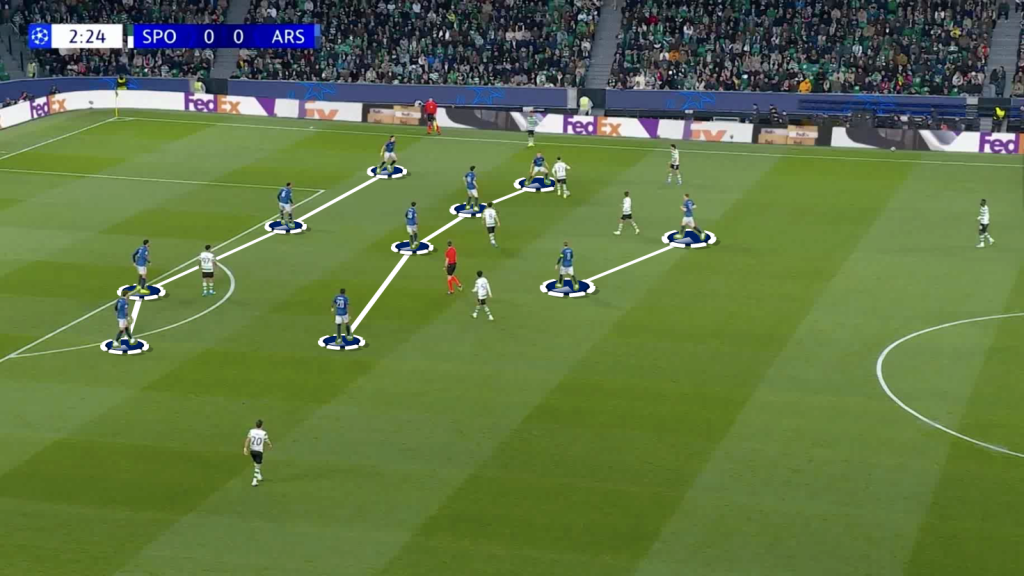
In the defensive phase, Arsenal maintained a compact shape, which kept their opponents out during organised attacks.
Their 4-4-2 shape was evident, especially in the defensive third.
The wingers made sure to tuck inside to cover the half-spaces while the midfielders covered the passing lane in the central channel.
Their defending in the wide area was another contributing factor to the clean sheet.
Whenever their opponents attempted wide combinations, Arsenal overloaded the wide channel.
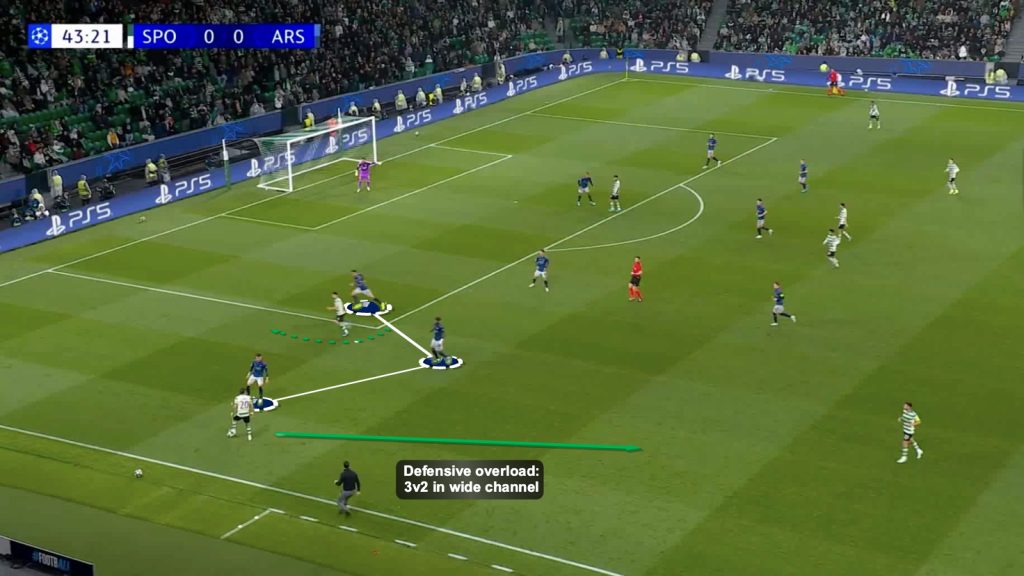 The Sporting winger makes an underlap for a through pass; however, the Arsenal centre-back tracks the run by sticking close.
The full-back engaging the ball carrier and the winger offering cover create a 3v2 advantage for Arteta’s side.
The opponents are forced to play backwards to keep possession.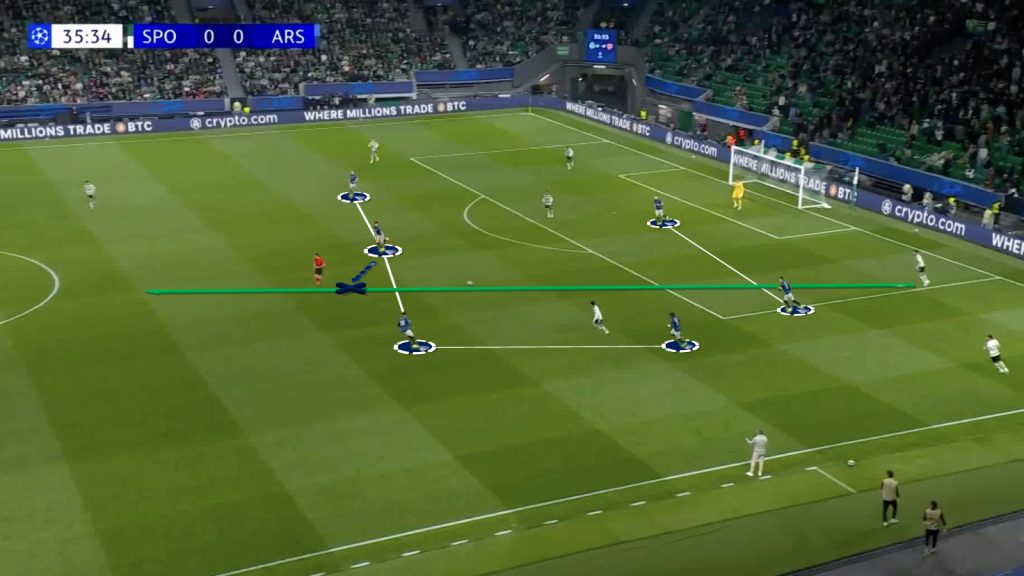 Their 4-4-2 shape continued when pressing high.
The front two engaged with the opponent centre-backs, and the wingers engaged with the opponent full-backs.
Here, Rice steps across to intercept a vertical pass from the opposition.
In such situations, the Sporting wingers dropped into the half-spaces.
However, Arsenal were efficient in dealing with this adjustment.
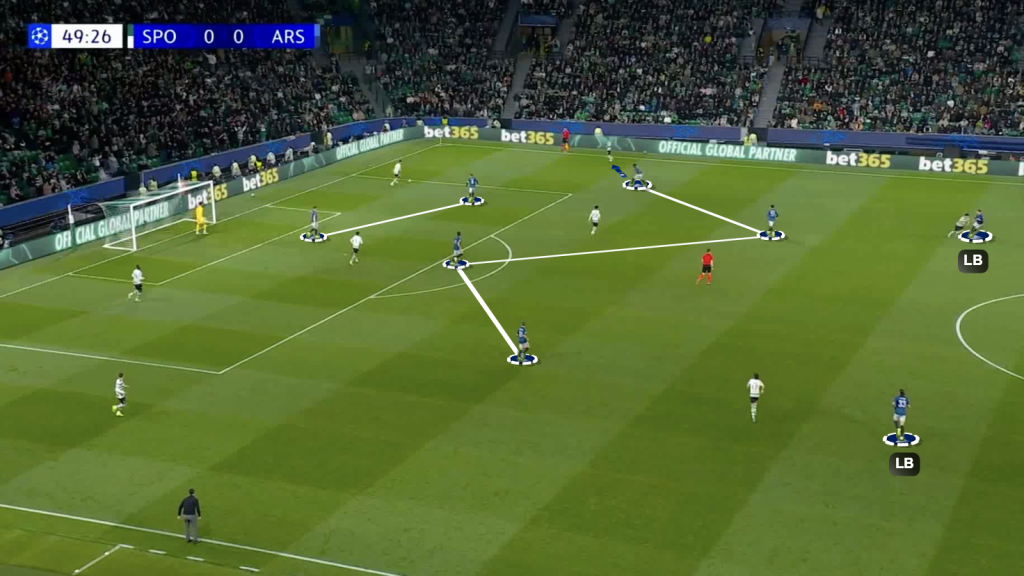 Arsenal press high in their regular 4-4-2 shape; meanwhile, their full-backs step to mark the opponents dropping in the half-space.
This way, they slowed down the opposition’s attacking speed, thereby getting everyone behind the ball.
In situations where the opponents moved the ball to the wide channel, Arsenal slid across to cut the forward passing option.
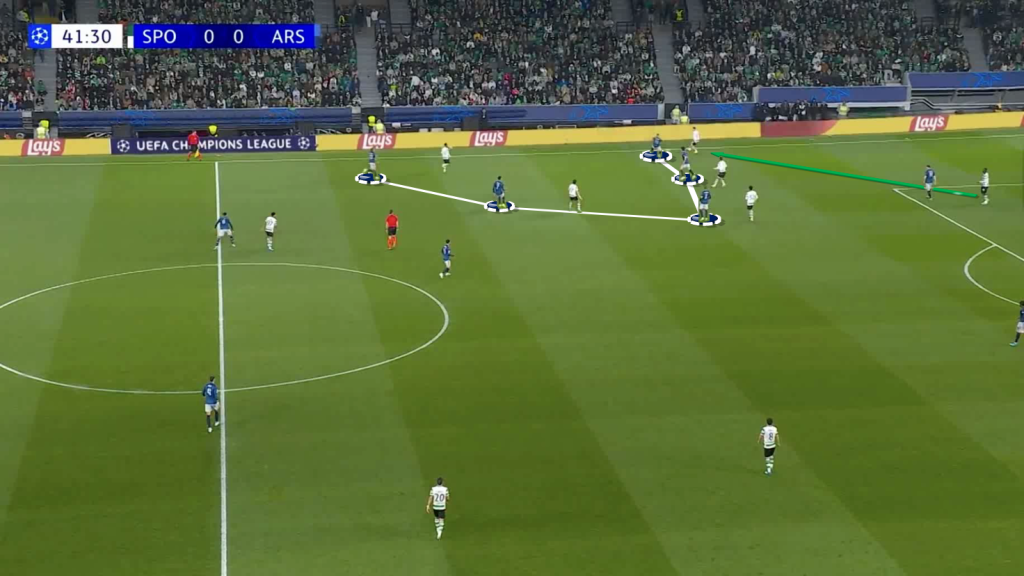
The opponents move the ball to the wide area, and Arsenal immediately shift across to squeeze the wide channel.
The ball-carrier’s forward pass is cut out in this situation.
While in a mid-block, Arsenal sometimes went in a 4-1-4-1 shape.
This was particularly driven by Rice and Ødegaard, who attempted to cut the passing lane in the central channel.
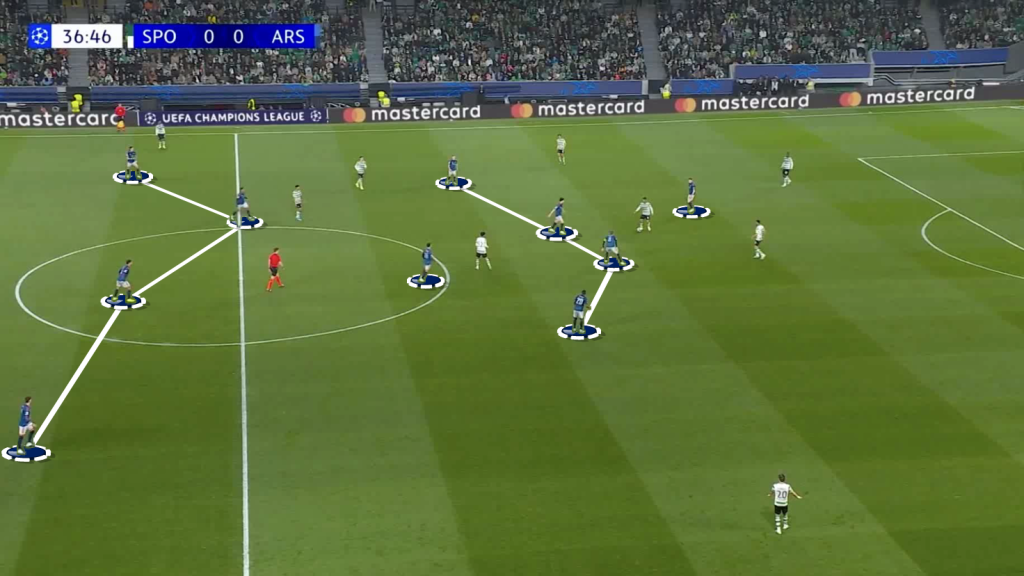
Arsenal are set up in a 4-1-4-1 block.
With their midfield four staying compact, they force the opponents to play sideways, which takes the pace out of the attack.
Since Arsenal had limited options to progress the ball due to their opponents’ defensive compactness, they attempted to do so from the wide channel.
It came from either ground passes into the wide channel or diagonal aerial passes into the wingers’ feet.
There were some moments when Arsenal found space to play out-to-in passes.
This helped get their central players on the ball more often.
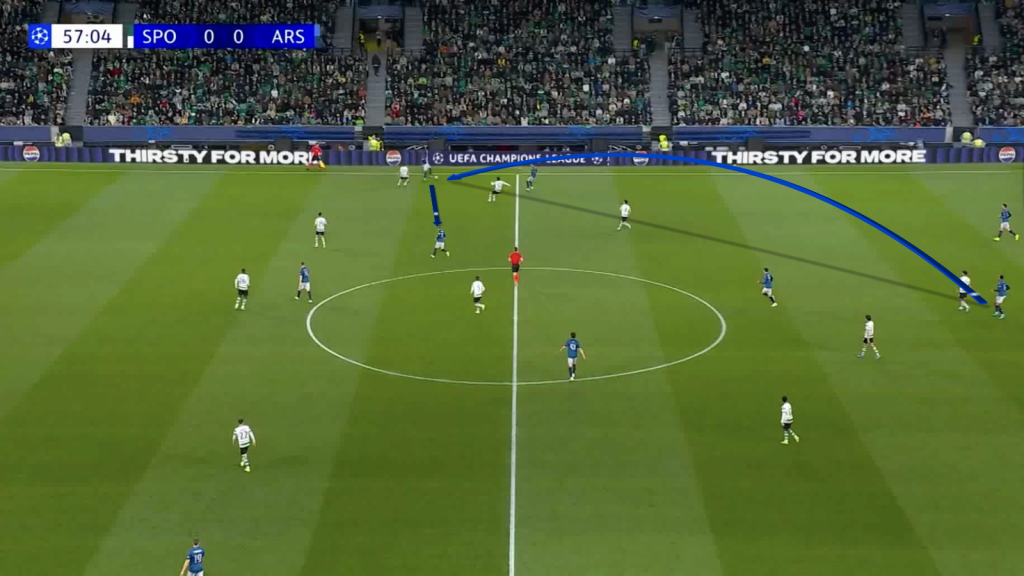
The centre-back plays a long ball into the wide channel, which the winger receives and plays it infield to a midfielder.
When opponents do not allow vertical passes, this is an alternative way to penetrate their structure.
There were brief windows when Arsenal had an open passing lane to find a central player.
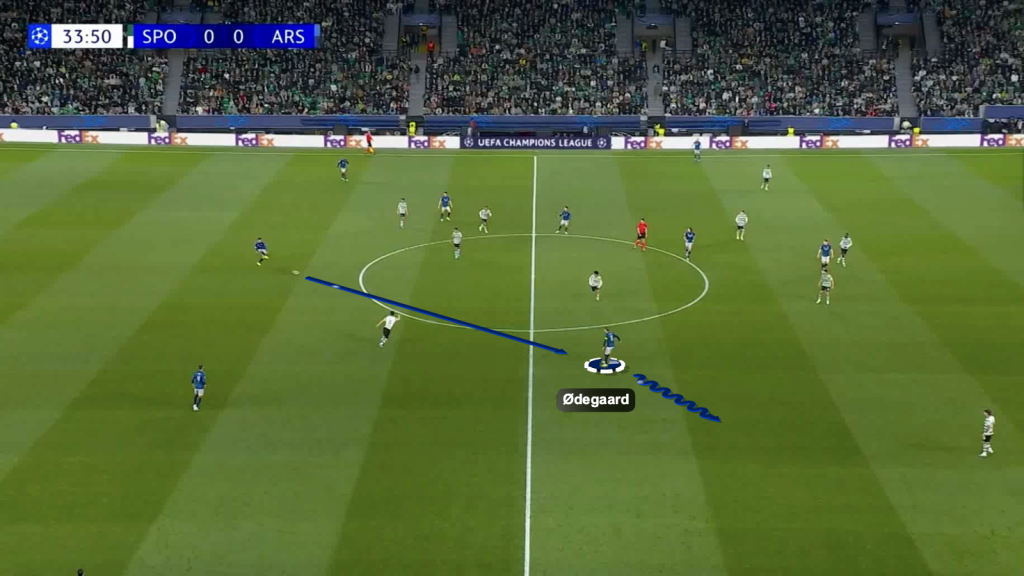
They made use of these moments to play in-to-out passes.
In this scenario, Ødegaard is the connecting player.
Since the majority of the Sporting players are concentrated on the other side of the pitch, the passing lane to the attacking midfielder opens up.
One way the Gunners attempted to find penetration in the attacking third was by virtue of Calafiori’s positioning.
The Italian frequented the left half-space.
This opened up chances to play through passes in the half-space.
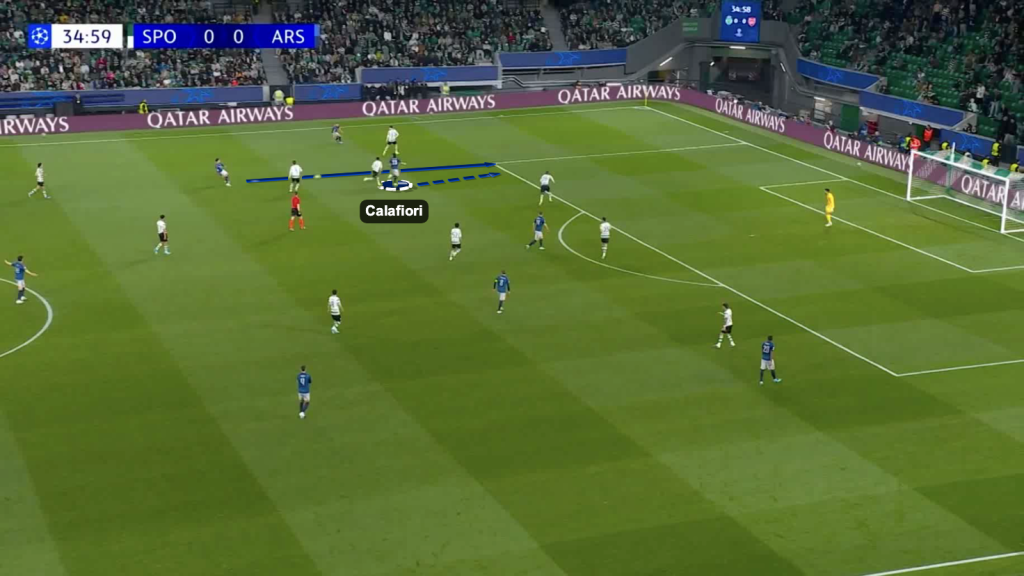
Calafiori makes a run in-behind in the half-space.
The Italian was intent on attacking the gap between the opposition full-back and centre-back.
An interesting part of this move is the winger’s positioning.
Trossard hugs the touchline, attracting the opposition full-back and creating the space.
Creating space for each other by either positioning or movement was how Arsenal broke the deadlock.
The goal came after a long wait; two second-half substitutes (Martinelli and Havertz) combined to fetch the winner.
The move starts with Arsenal playing an in-to-out pass, with Rice being the link player.
Upon Martinelli receiving the ball from the midfielder, Rice starts moving up, dragging a defender.
As the Brazilian is closed down in the wide area, he cuts inside to dribble into the space created by Rice’s movement.
Simultaneously, Gyökeres, being on the near side, attracts a centre-back.
This leaves enough space for Havertz to make the run in-behind untracked.
Martinelli finds him with a pinpoint chipped pass, which the German brings down with ease to then find the finish.
Conclusion
Sporting CP executed a compact defensive shape throughout the game, which made it tedious for Arsenal to find progression, especially in the central channel.
The structure changed from 4-3-3 to 4-4-2 and then to 5-2-3.
They also caused problems for the visitors by playing long passes in behind and exploiting the space between Arsenal’s lines in transition.
Arsenal kept a compact shape in the defensive phase when opponents were in the midst of organised attacks.
They pressed high in a 4-4-2 shape, forcing the opponents to play long, and also deployed their full-backs to step aggressively to mark opponents dropping into the half-spaces.
Their defensive shape also shifted to a 4-1-4-1 at times, usually when they were in a mid-block; this was intended to force opponents wide.
Once the ball went wide, they slid across to squeeze their opponents in the wide area, thereby winning possession.
Owing to Sporting’s resilient defensive shape, Arsenal lacked variety in their attack; they relied on wide-area progression to find penetration.
There were moments when they found space to play out-to-in and in-to-out passes; the eventual goal came from the latter.

