
Real Madrid and Bayern Munich met once again in the UEFA Champions League, two years after their previous knockout encounter, but this time with very different identities.
The Real Madrid of Álvaro Arbeloa arrived in the middle of an inconsistent season, struggling to find continuity in their performances.
Bayern, in contrast, travelled to Estadio Bernabéu in one of their most dynamic and aggressive phases in recent years, with a clear attacking structure and an intense defensive identity under Vincent Kompany.
The match reflected these contrasting trajectories.
Bayern dominated the opening stages with a high-intensity, man-oriented press and a well-defined positional structure that repeatedly pushed Madrid into their own defensive third.
Despite missing early chances, including a remarkable miss from Dayot Upamecano inside the six-yard box, Bayern eventually broke through with a goal from Luis Díaz just before half-time.
Harry Kane doubled the lead seconds after the restart, placing the visitors in a commanding position.
Madrid responded through individual quality and a structural shift in the final half-hour, reducing the deficit through Kylian Mbappé and generating momentum that kept the tie alive.
This tactical analysis examines how Bayern imposed their structure, why Madrid struggled to escape the pressure, and how the dynamics shifted in the final stages.
Real Madrid Vs Bayern Munich Lineups & Formations
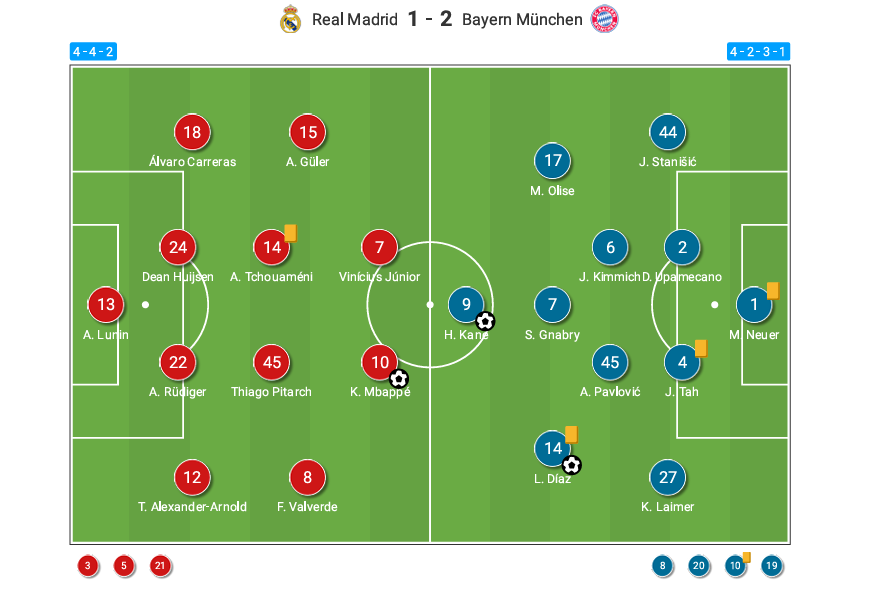
The match began with two teams whose structural intentions were immediately visible on the pitch.
Real Madrid set up in a 4‑4‑2 that prioritised vertical threat and defensive protection of the central lane, while Bayern Munich deployed a 4‑2‑3‑1 that morphed fluidly into a 3‑5‑2 in possession.
Andriy Lunin started in goal for Real Madrid behind a backline comprised of Trent Alexander-Arnold, Antonio Rüdiger, Dean Huijsen and Álvaro Carreras (from right to left).
Federico Valverde and Arda Güler started at right and left midfield, respectively, with Thiago Pitarch and Aurélien Tchouaméni in the middle of the park.
Kylian Mbappé and Vinícius Júnior led the attack for Los Blancos.
Manuel Neuer started in goal for the visitors behind Josip Stanišić, Dayot Upamecano, Jonathan Tah and Konrad Laimer (from right to left) in the backline.
Joshua Kimmich and Aleksandar Pavlović played in holding midfield for Bayern behind an attacking quartet of Michael Olise (right wing), Serge Gnabry (’10’), Luis Díaz (left wing) and Harry Kane (centre-forward).
The contrast between Madrid’s reactive, space‑oriented approach and Bayern’s proactive, position‑driven organisation shaped the early dynamics of the game.
Both sides entered the match with clear ideas: Madrid looking to survive the first wave and exploit transitions, Bayern aiming to impose control through structure, height and coordinated pressure.
Madrid’s 4‑4‑2 focused on protecting the centre and limiting Bayern’s access to the half‑spaces.
The wide midfielders narrowed inside, the full‑backs stayed conservative, and the forwards positioned themselves to threaten in transition rather than to press high.
Out of possession, the structure frequently collapsed into a 5‑3‑2, which strengthened the defensive block but left Madrid defending deep and struggling to connect recoveries with forward options.
Bayern’s High Press & The Imposed Game State
From the opening whistle, Bayern established the context of the match through an aggressive, man-oriented high press.
Their intention was not only to recover the ball but to dictate every decision Madrid made in their first phase.
Joshua Kimmich stepped forward to press Andriy Lunin, blocking central access and forcing Madrid to build through the full-backs.
The second line of Bayern’s press closed interior passing lanes, directing the ball wide and triggering further pressure.
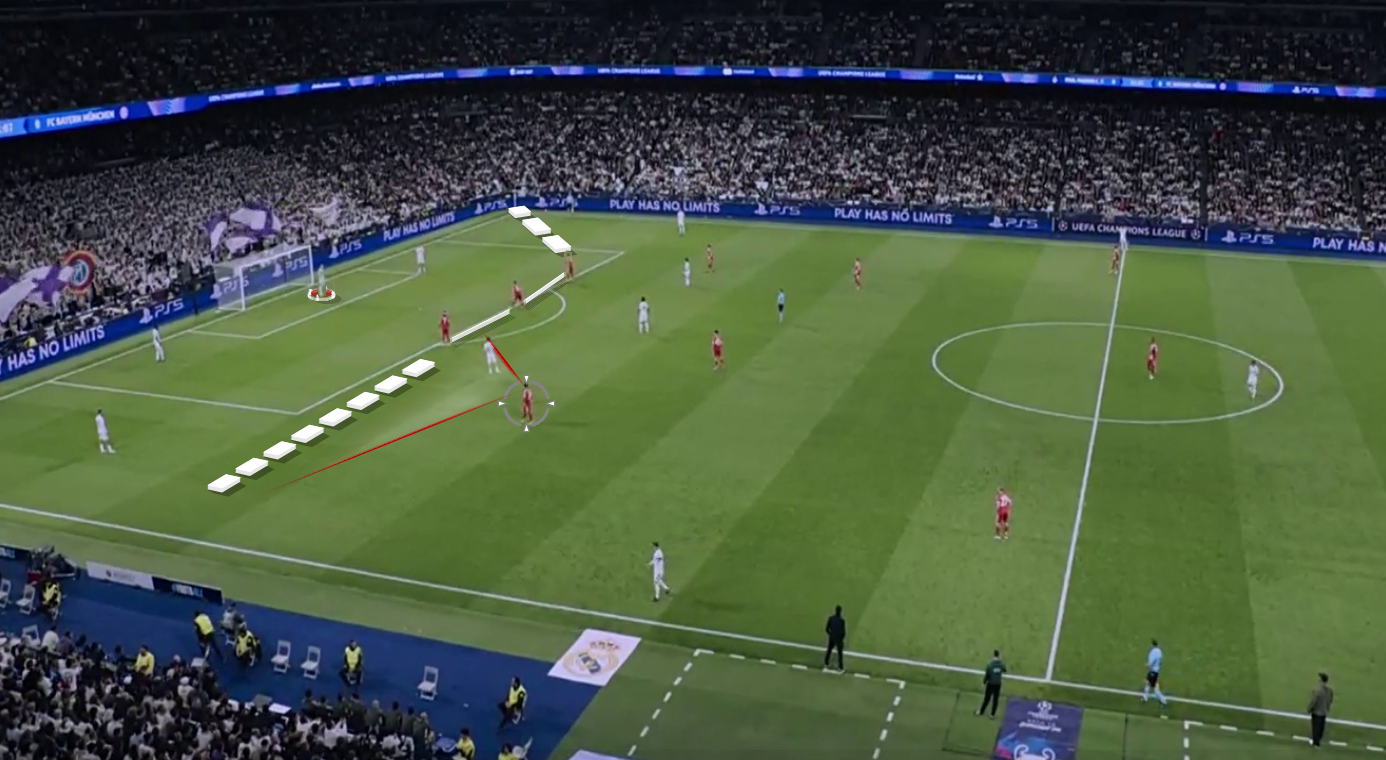
Bayern’s high press eliminated central progression from the first phase.
The visitors closed the inside channel and forced the goalkeeper to play towards the full-back, activating the press on the flank where they had numerical and positional superiority.
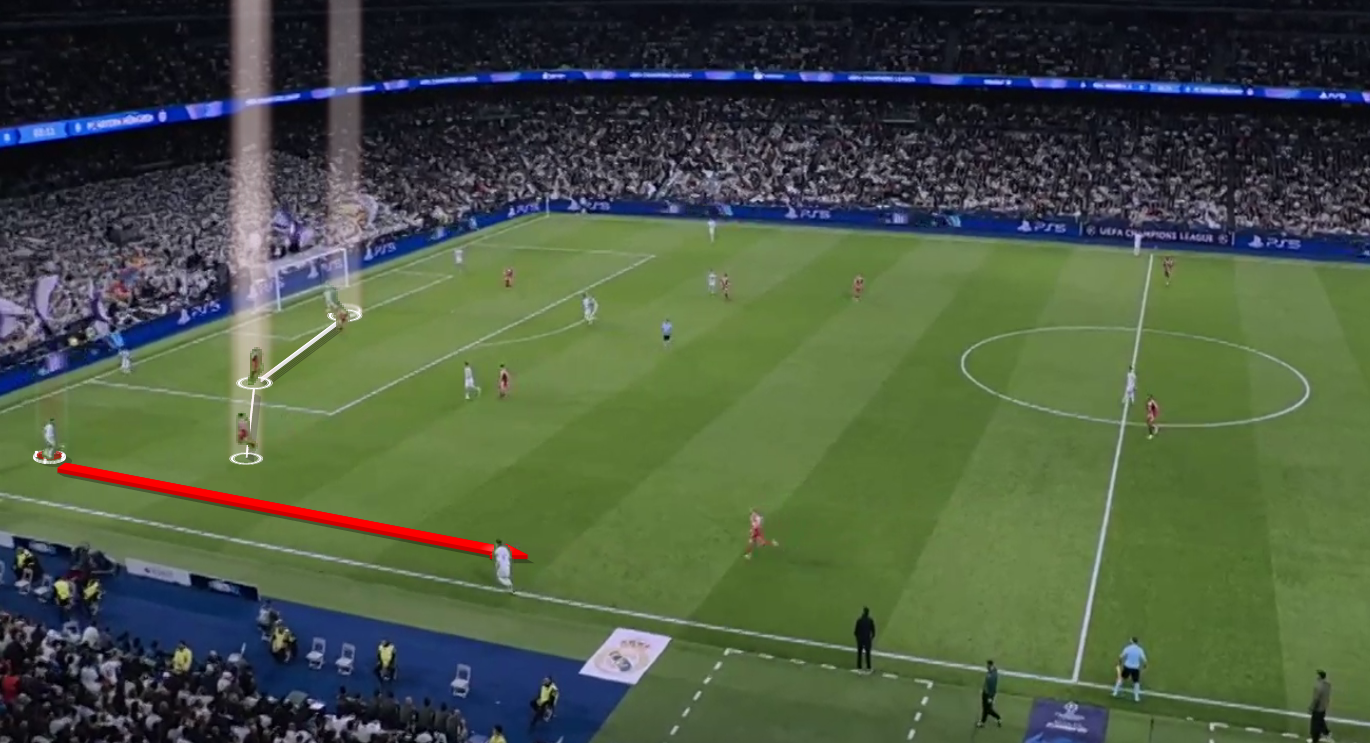
The press was designed to steer Madrid towards the touchline.
With the centre locked and the ball side overloaded, Bayern compressed the space around the receiver and prevented any progression through the middle third.
This pressing scheme repeatedly pushed Real Madrid back into their defensive third.
Each possession became a potential turnover, and Madrid were unable to establish any rhythm.
The home side were forced into long clearances or rushed passes, which Bayern recovered with ease thanks to their compactness and anticipation.
Real Madrid responded by adopting a 5-3-2 defensive shape, with Federico Valverde and Arda Güler narrowing inside to protect central spaces.
At the same time, the full-backs dropped deep to absorb Bayern’s first wave.
This adjustment helped Madrid survive the initial pressure but created a structural problem: every recovery occurred too far from Bayern’s goal.
As a result, Madrid struggled to transition effectively, unable to fix Bayern in their own half or generate sustained attacking sequences.
The match settled into a pattern where Bayern attacked with structure and Real Madrid defended reactively, waiting for isolated moments to break forward.
Bayern’s Positional Superiority & Directed Attacks
In possession, Bayern organised themselves in a dynamic 3-5-2 structure.
Konrad Laimer and Josip Stanišić adopted asymmetrical roles: one full-back advanced aggressively into the high zones, even arriving in the finishing areas, while the other moved inside to support the build-up and create numerical superiority in midfield.
This allowed Bayern to control central spaces while maintaining width and depth in the final third.
Kimmich and Aleksandar Pavlović formed the organisational axis, dictating tempo and ensuring Bayern always had a stable base behind the ball.
Ahead of them, five players occupied the last line: Olise wide on the right, Díaz wide on the left, Gnabry and Kane between the lines, and one full-back joining to create an additional threat.
Michael Olise was particularly influential. His ability to fix defenders, dribble in tight spaces and repeatedly attack Álvaro Carreras created constant instability in Madrid’s defensive block.
Carreras was left exposed in numerous 1v1 situations, often without consistent support from Güler or the midfield.
Tchouaméni, responsible for protecting the central channel, could not abandon his zone to help, and the defensive line hesitated between stepping out or holding their shape.
This indecision opened gaps that Bayern exploited with precision.
The goal from Luis Díaz just before half-time was the natural consequence of this sustained structural advantage.
Bayern had repeatedly directed their attacks towards Madrid’s weak points, and eventually, the pressure broke through.
Two Contrasting Attacking Identities
Bayern’s attacking play was defined by connection and synchronisation.
Every movement had a purpose. Kane dropped between the lines to create overloads, attract defenders and open spaces for runners.
Gnabry and Díaz attacked the back line with diagonal movements, while Olise stretched the pitch horizontally.
Kimmich orchestrated from the base with calmness and clarity, ensuring Bayern never lost their positional balance.
Madrid, in contrast, relied on individual talent to generate danger.
Despite being structurally inferior for long stretches, they produced a similar number of shots to Bayern.
Their attacks, however, emerged from isolated actions rather than collective mechanisms.
Mbappé was the most threatening player, constantly attacking depth, driving at defenders, and even contributing defensively in transitions.
His duel with Neuer defined much of the match, with the goalkeeper winning their first three encounters.
Vinícius, on the other hand, struggled to find his rhythm.
His decision-making was inconsistent, and he failed to capitalise on the few favourable situations he encountered.
From Bayern Munich’s Control To Real Madrid’s Threat
As Bayern retreated into a medium block to protect their lead, they lost part of their positional dominance. Their earlier superiority in occupation of space diminished, and Madrid began to impose themselves through momentum and territorial advantage.
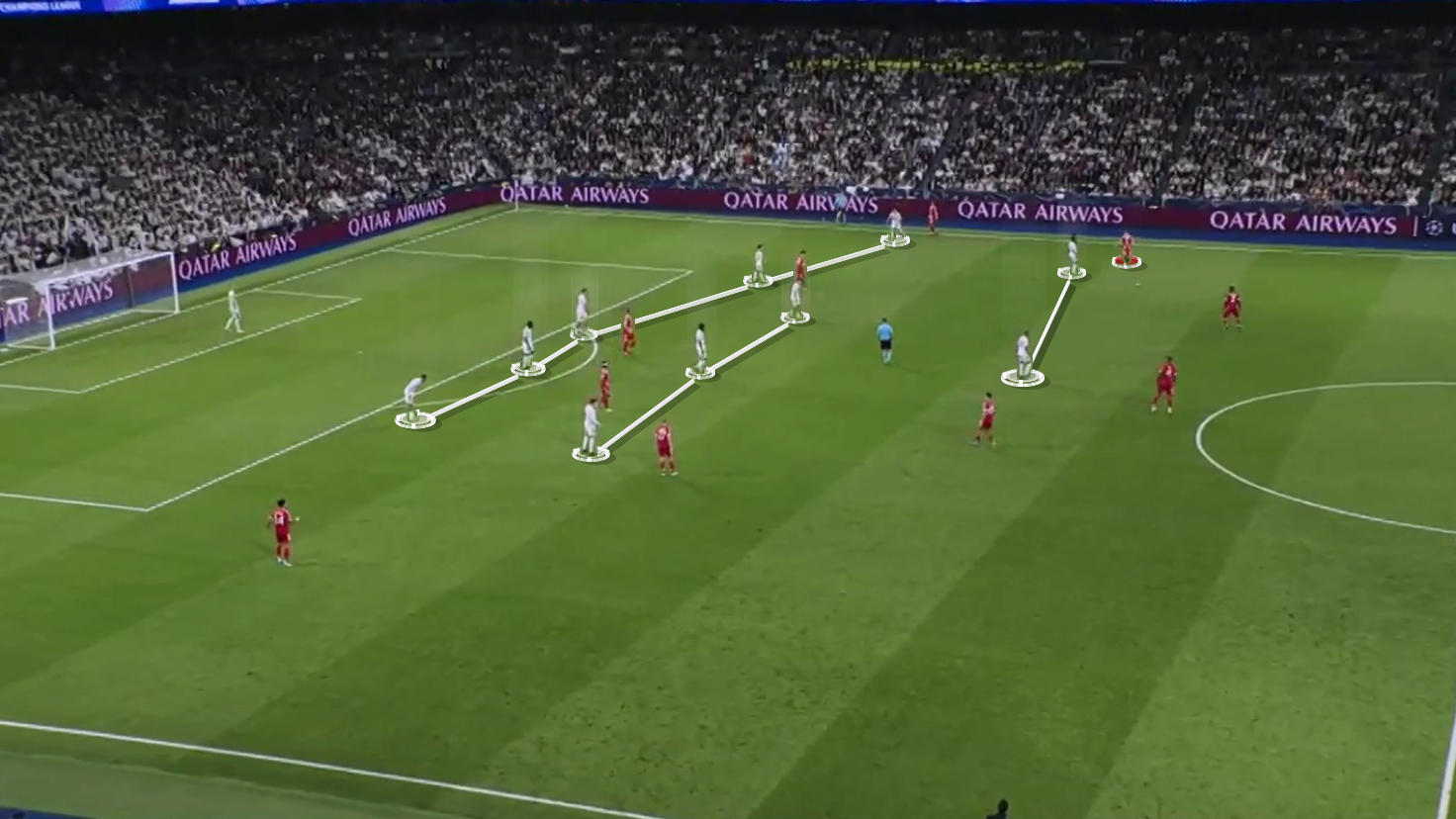
Madrid’s deep 5‑3‑2 illustrated the extent of Bayern’s territorial control.
The home side defended close to their box, unable to advance their block until the momentum shifted later in the match.
With more players committed forward and greater continuity in possession, Madrid created several dangerous situations.
The match opened up, with transitions in both directions and chances for both teams.
Neuer’s interventions were decisive in this phase, preventing Madrid from equalising and preserving Bayern’s advantage.
Mbappé eventually found the breakthrough, reducing the deficit and reigniting the Bernabéu.
His goal reflected Madrid’s improved structure and energy, as well as his own persistence throughout the match.
Conclusion
Bayern Munich were superior through structure.
Their high press, positional organisation and directed use of width allowed them to dominate large stretches of the match and create the clearest advantages.
Real Madrid, however, were superior through resilience.
Their ability to survive difficult phases, adjust their structure and rely on individual talent kept them alive in the tie.
The 2–1 result reflects this duality.
Bayern imposed their identity for most of the match, but Real Madrid’s response ensured that the second leg in Munich will be played under uncertainty.
The question now is whether Real Madrid’s late surge was a temporary reaction or a sign that they have found the arguments needed to challenge Bayern’s structural superiority in the return fixture.