


Even though Leverkusen and Mönchengladbach are relatively close to each other, most fans wouldn’t call the game a derby, simply because it lacks tradition.
Still, this Sunday’s game between Bayer Leverkusen and Borussia Mönchengladbach in the BayArena had a lot of eyes on it, but not for the right reasons.
On matchday four of the Bundesliga season, the two teams that had already changed their managers faced off, a sign that is usually not a good omen.
Home team Bayer Leverkusen decided to part ways with manager Erik ten Hag after just three games at the helm, following a disappointing draw against Werder Bremen.
They then appointed Kasper Hjulmand as their new head coach, with the Dane set to enter his third game within the span of one week.
For Borussia Mönchengladbach, manager Geroardo Seoane was relieved of his duties just this week, also after a disappointing game against Werder Bremen.
After the 0-4 loss at home last week, Gladbach is currently on the search for a new manager, so at the moment, interim and former midfielder Eugen Polanski is coaching the team.
In the end, the game ended in a 1-1 draw, which doesn’t really help either team, considering their current league situation.
However, there were several things we can unpack with the two new managers.
In this tactical analysis, we will examine the new tactics Hjulmand and Polanski introduced to their Bayer Leverkusen and Borussia Mönchengladbach teams, how the game unfolded, and whether the teams can maintain a positive outlook for the upcoming games.
Bayer Leverkusen Vs Borussia Mönchengladbach Lineups & Formations
For Bayer 04 Leverkusen, Kasper Hjulmand decided not to change up much in terms of formation.
For his third game, he employed a 3-4-2-1 formation for the third straight time, maintaining the foundation that Xabi Alonso had established in Leverkusen over the past couple of years.
The personnel overhaul this summer was huge for the club; however, the team still has a very new look.
In goal, Mark Flekken is the new number one with Jarell Quansah on the right, Loic Badé in the centre, and Edmond Tapsoba on the left playing as the three centre-backs in front of him.
Alejandro Grimaldo captained the team as the left wing-back, with former Real Madrid player Lucas Vázquez playing as his partner on the right side.
The double pivot consisted of Aleix García and Malik Tillman, with Eliesse Ben Seghir and Ibrahim Maza playing as the two attacking midfielders for the Danish coach.
In the attack, Patrick Schick started for Hjulmand, this time without a partner up front.
For Eugen Polanski, changes were necessary, and instead of playing with the back four that Seoane installed in Gladbach, he opted for a back three in his first game as a Bundesliga manager.
Moritz Nicolas still got the start in goal, with former captain Jonas Omlin still on the bench.
The three centre-backs were young Fabio Chiarodia on the left, Nico Elvedi in the centre, and newly signed Kevin Diks on the right side.
The double pivot was occupied by captain Rocco Reitz and Deadline-Day signing Yannik Engelhardt, who came on loan from Como.
The two wing-backs, Lukas Ullrich on the left and Joe Scally on the right, were the two players who always started in the back four.
Jens Castrop and Kevin Stöger played as attacking midfielders behind Japanese international Shuto Machino, resulting in a 3-4-2-1 formation.
Polanski opted to mirror Bayer Leverkusen.
Bayer Leverkusen In Possession
Even though Bayer Leverkusen’s start to the season was rather disappointing, the team is coming off a 3-1 win against a strong Eintracht Frankfurt team in Kasper Hjulmand’s debut last week, so they were the clear-cut favourites in this game.
For Borussia Mönchengladbach and Eugen Polanski, it was more about getting traction in the season somehow.
After just one point in three games and without a single goal in the Bundesliga going into the match, Gladbach were very keen on establishing some form of stability for itself.
The start of the game was no surprise, considering these factors.
Bayer Leverkusen dominated possession, and Gladbach fell back frequently, refusing to press aggressively and instead trying to maintain their defensive structure.

Bayer Leverkusen displayed rather decent positional play in these situations, adhering to their formation and shape, while attempting to break through the lines in the half-spaces.
Unlike under Ten Hag, the formation was maintained throughout the game; Hjulmand abandoned the idea of frequent positional rotations.
The two wing-backs consistently held their positions near the sideline in possession, creating a lot of width for Bayer Leverkusen, allowing for switches, trying to pull the Gladbach block apart, and keeping them moving.
The double pivot was kept very narrow, so the two attacking midfielders could position themselves between the lines in the half-spaces between the central midfielders and the wing-backs.
Bayer Leverkusen tried to get Maza and Ben Seghir involved a lot.
An interesting tidbit was the positioning of Patrick Schick, who consistently overloaded one side and often played right at the offside line, causing some chaos in the Gladbach backline.
This prevented the two outside centre-backs from aggressively defending forward and pressing the attacking midfielders in the channel.
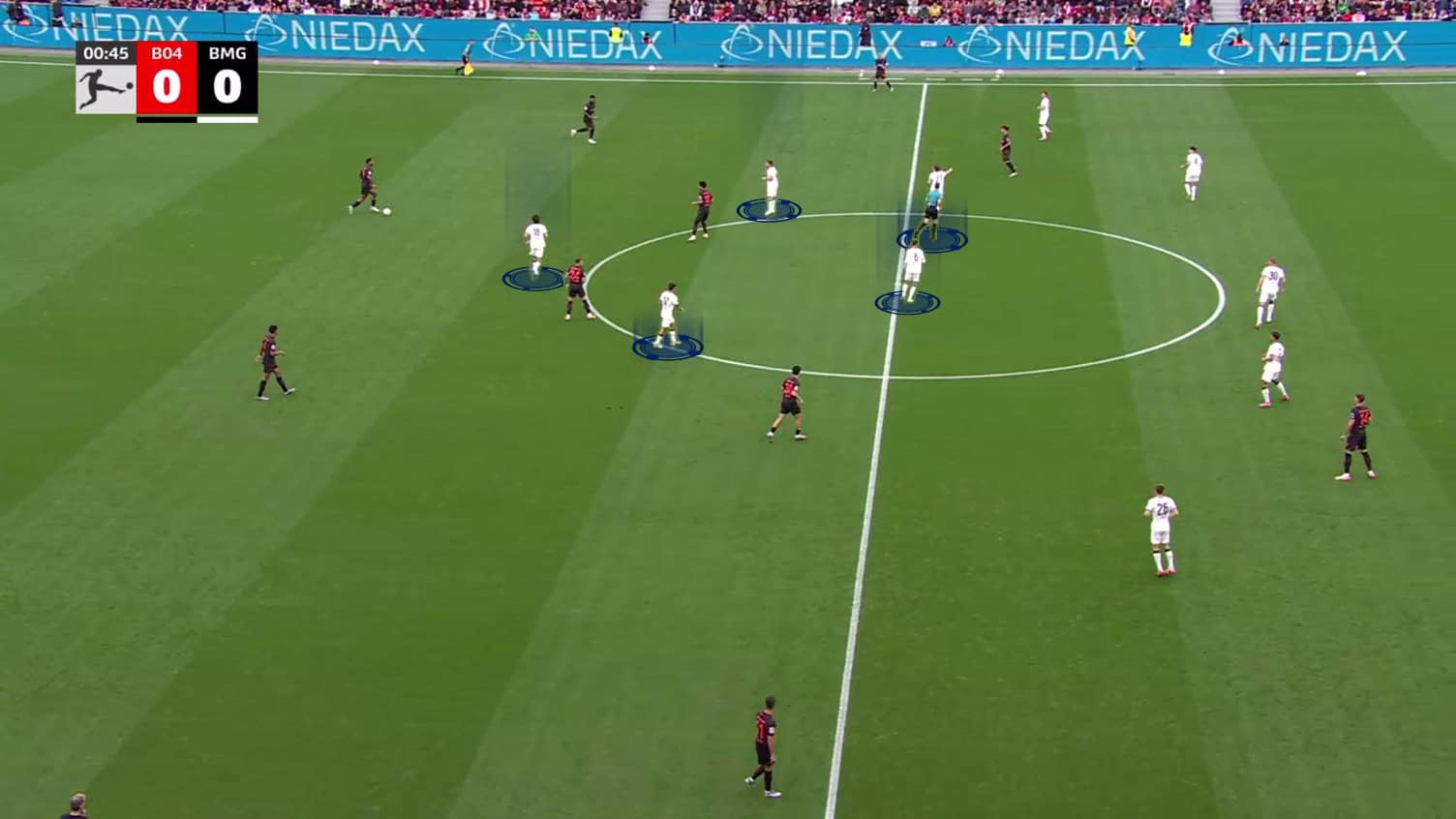
While this plan made a lot of sense on paper, Polanski was ready for exactly that.
While, in theory, mirroring the opponent’s formation and shape creates numerous man-to-man duels all over the pitch, Polanski opted for a more conservative approach.
Instead of playing a man-oriented press, Gladbach used their four midfielders and striker to close off the centre of the field, effectively eliminating the two central midfielders.
Even if Bayer Leverkusen were able to play into the channel in the half-space in certain situations now, Maza and Ben Seghir had no real chance of creating anything, and most of the time had to play a backwards pass even when not directly getting pressed.
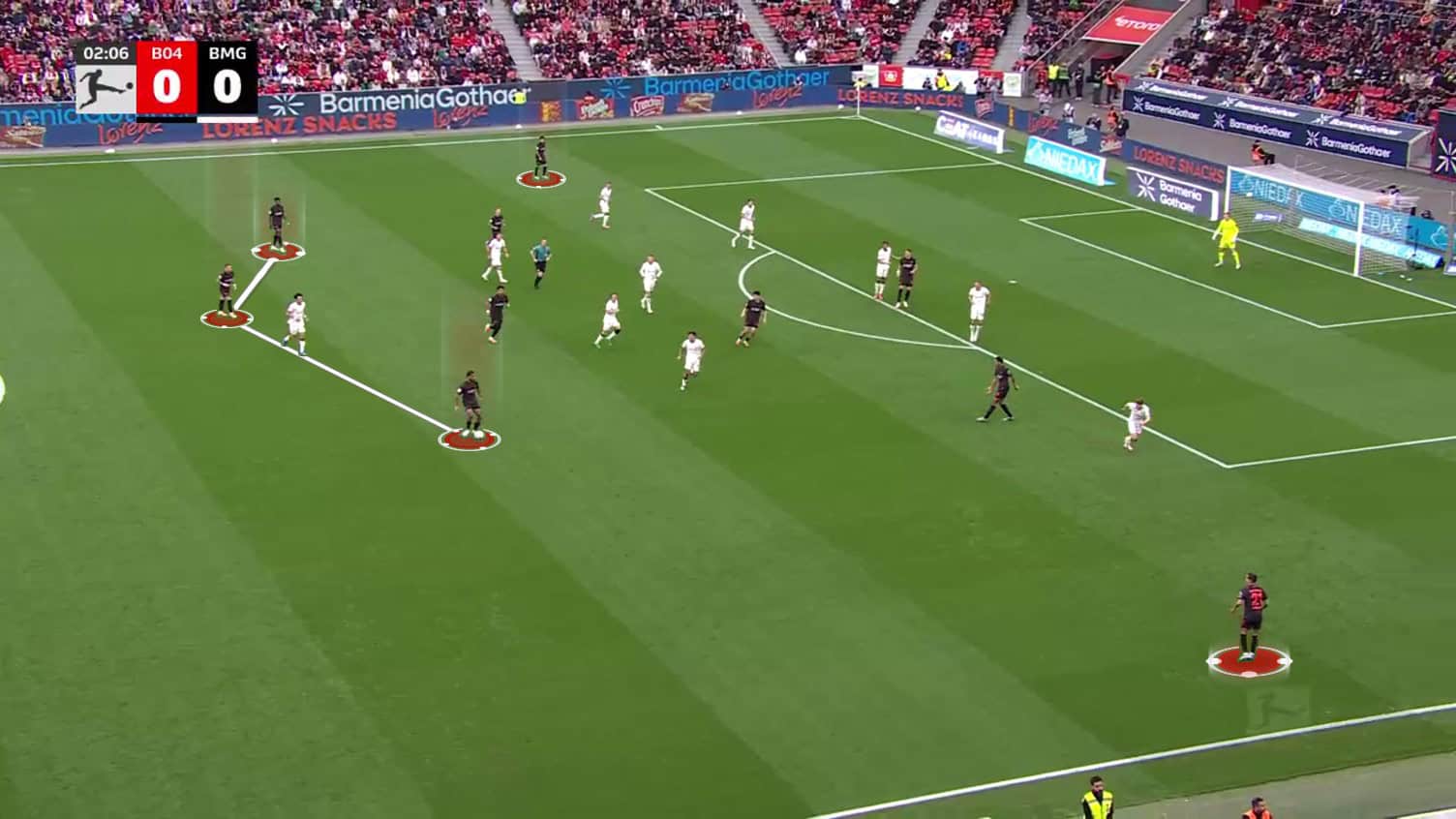
When Bayer Leverkusen were able to break the block for the first time, Gladbach simply fell back into a very deep block, often in a 5-4-1 shape.
This allowed them to have nine men back around their box, and once again, with a very narrow shape, they minimised the opportunities for Leverkusen’s four midfielders.
Hjulmand had his central players in a very narrow shape, even his three centre-backs.
This helped Gladbach immensely in defending that part of the pitch, as they simply had the numerical advantage there and could close off any open space without having to cover a lot of distance.
This left Bayer Leverkusen in a pretty bad spot because the only ball they could play in most situations was to the wing-backs.
Their only options were either playing it backwards with the first touch or crossing it, but Gladbach defended those crosses well with their many players in the box.
Hjulmand’s men easily established possession in the early phases of the game.
Still, they did not create substantial opportunities for their attacking players, and Gladbach were very happy with that after coming off a horrible defensive performance against Werder.
Borussia Mönchengladbach Simple Approach
The game progressed in this manner for the first 25 minutes, and Leverkusen grew increasingly frustrated as the time elapsed, while Gladbach managed to draw confidence from their defensive efforts.
This led the team to try to create more in possession themselves, and Polanski chose a very simple approach to do so.
Considering the performance last week, Hjulmand obviously wanted to press Gladbach high up the field to make use of their lack of confidence in the build-up.
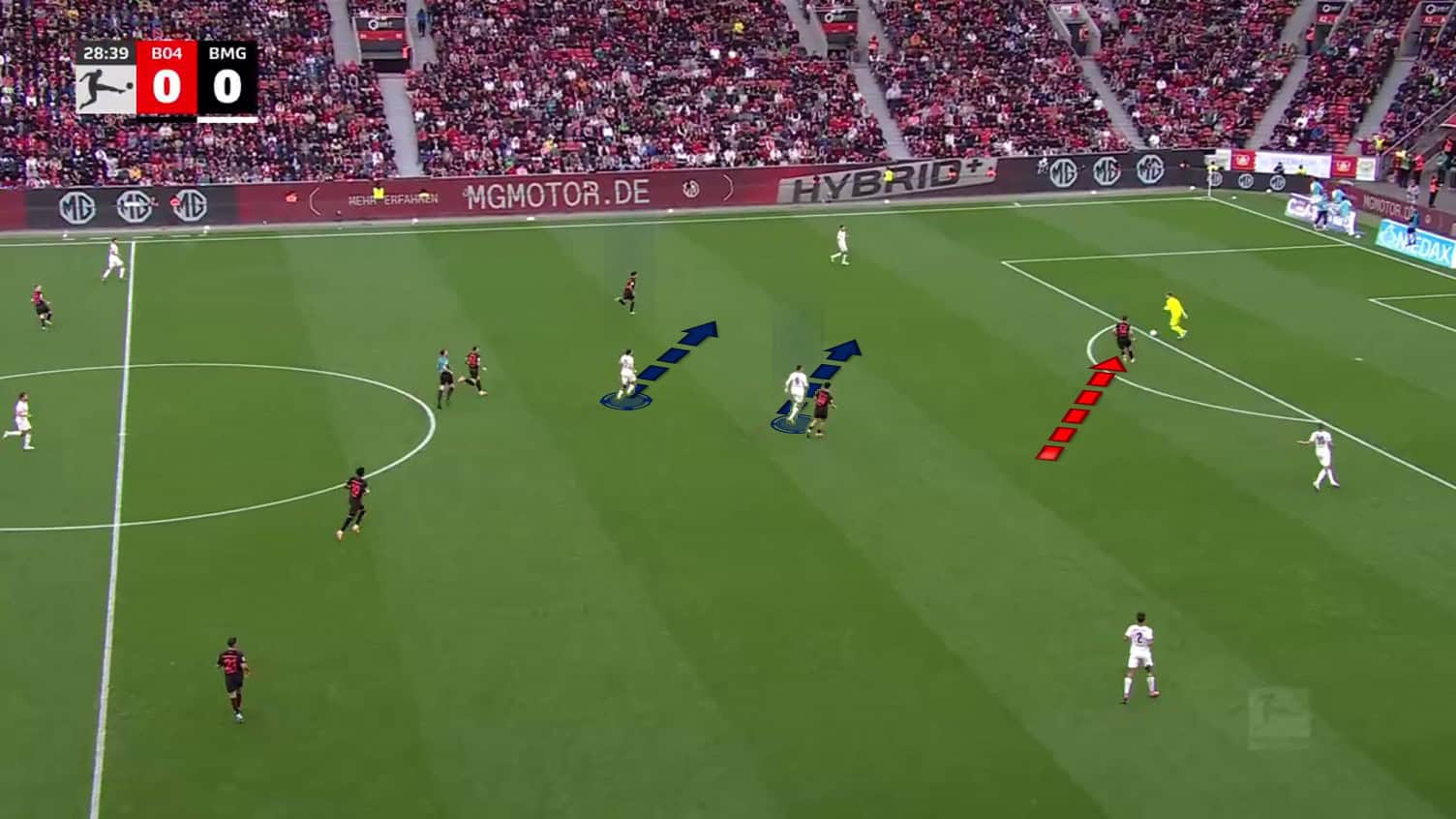
While the idea is understandable, in the end, Bayer Leverkusen were just too impatient when triggering their press.
They were aggressive, yes, and they applied decent pressure during the build-up, but at times they were overaggressive.
Looking at the picture above, the team is not yet fully pushed up the field, yet Schick still decides to press the goalkeeper, even though he has multiple passing options.
Luckily for Leverkusen, Gladbach were rarely able to punish them in these situations because the backline and goalkeeper seemed rather nervous; therefore, they never shied away from the long ball, even under minimal pressure.
Nevertheless, they managed to play over those individual pressing attempts with ease.
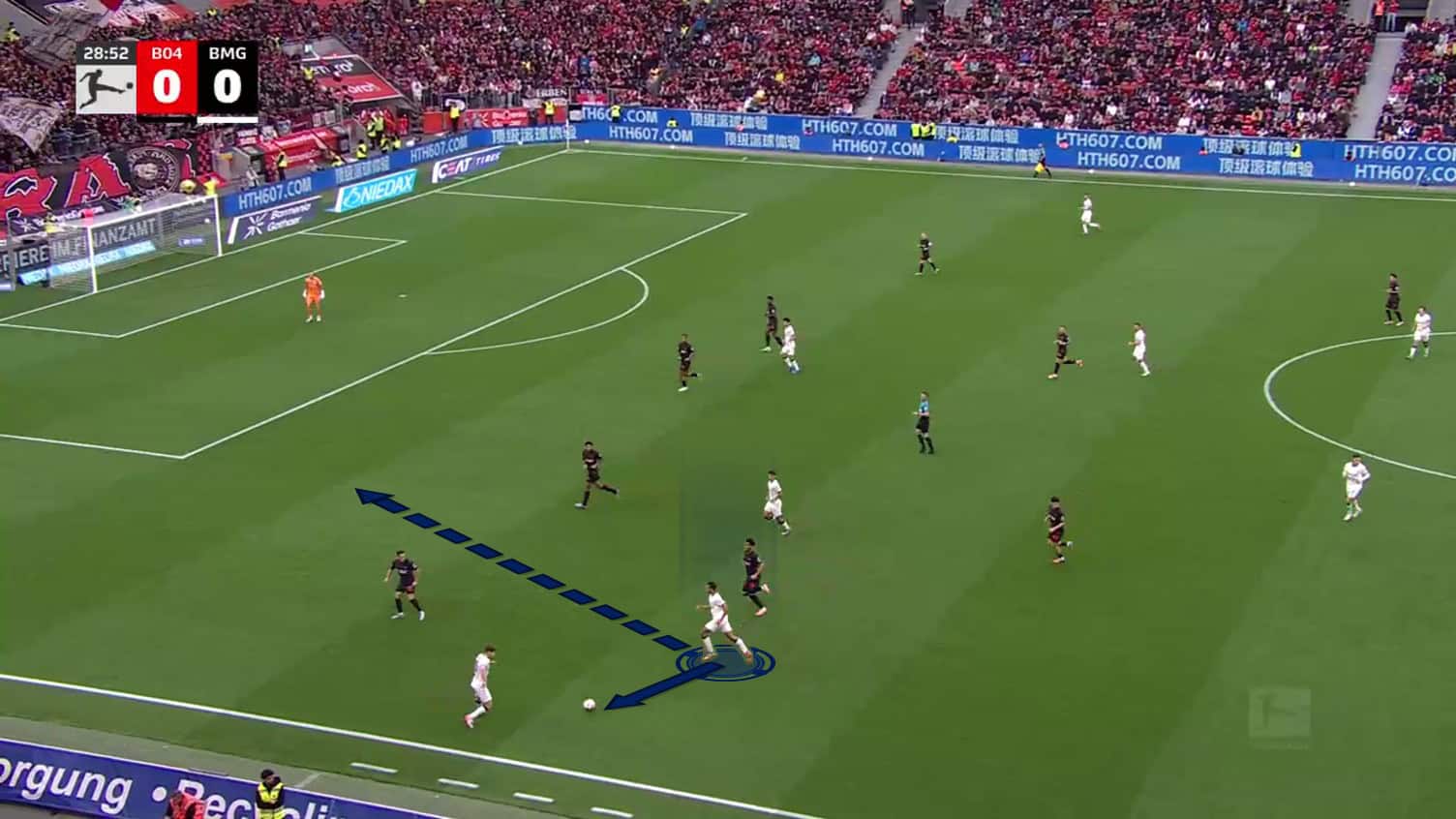
When they were able to establish possession, they rarely committed a large number of players forward; they always tried to maintain stability and avoid being caught on the counter, which is understandable, but it limited their attacking play for a long period of time.
Their ideas were rather simple in possession.
Gladbach actively looked for vertical passes behind Bayer Leverkusen’s high backline after winning second balls or when they managed to get behind the first line of press, as Leverkusen were too impatient.
Gladbach focused on playing on the wings, overloading the sides with their central midfielders, especially Castrop and Reitz, and then utilising their outside centre-backs and wing-backs.
The vertical passing worked out for them once.
After playing over Bayer Leverkusen’s pressing attempt once again, Reitz was able to find Castrop with a pass behind the backline, but after scoring the goal, VAR annulled it for offside.
This situation gave Gladbach even more confidence in their approach.
They now held possession for longer and employed another interesting principle: when they were unable to pass vertically, they simply ran vertically after playing the ball square.
Even their centre-backs, as seen in the picture above, were now playing balls to the wing and then making vertical runs, hoping to create pseudo-triangles, which helped Gladbach establish possession.
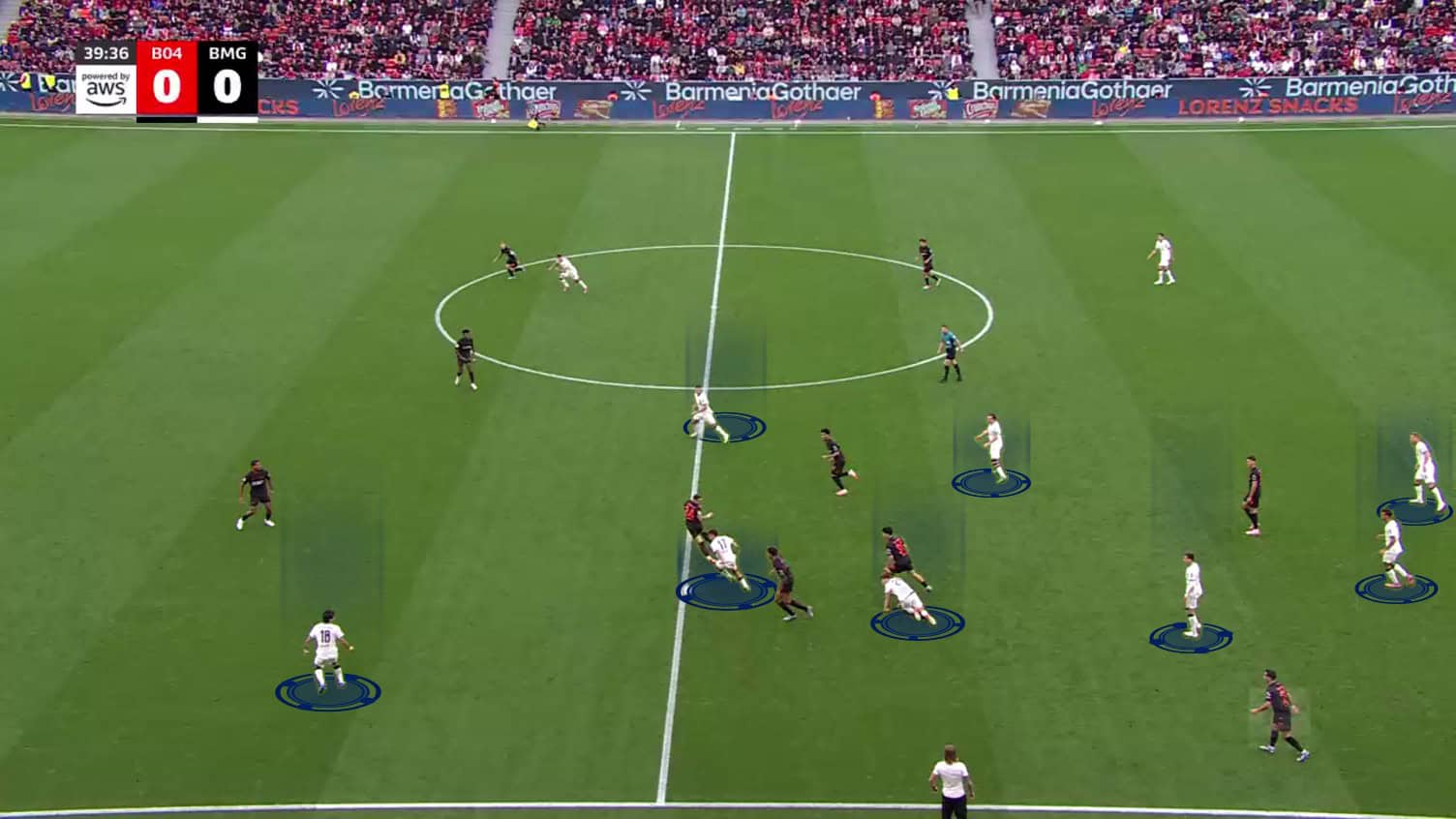
Even though they still struggled with the press, Gladbach were now trying to play football, and Bayer Leverkusen struggled with that.
Polanski’s men were now heavily overloaded on their left side, as shown in the picture above, and while their passing game was still not great, they managed to win a lot of second balls in the counterpress, demonstrating a very good amount of intensity.
Out of these situations, they often created a lot of dynamic and found the players on their vertical runs with vertical passes.
Gladbach created a couple of opportunities just before and after half-time, and it seemed like they were now getting on top of the game.
Power Play In The Last Minutes
In the end, Kasper Hjulmand still fielded more individual class, and it showed right at the time Gladbach were finally getting a real grip.
Funnily enough, after refusing to play long balls for the entire game, a long ball helped Bayer Leverkusen take the lead.
Schick simply blocked off Chiarodia, got free on the right side, and found Tillman in the centre with a bit of luck.
The American finished the opportunity.
From there on, the game completely changed over the last couple of minutes.
Hjulmand had his team lose all aggressiveness quickly and, from now on, defended in a deep block.
Gladbach now had to create opportunities out of possession to find their first goal of the season.
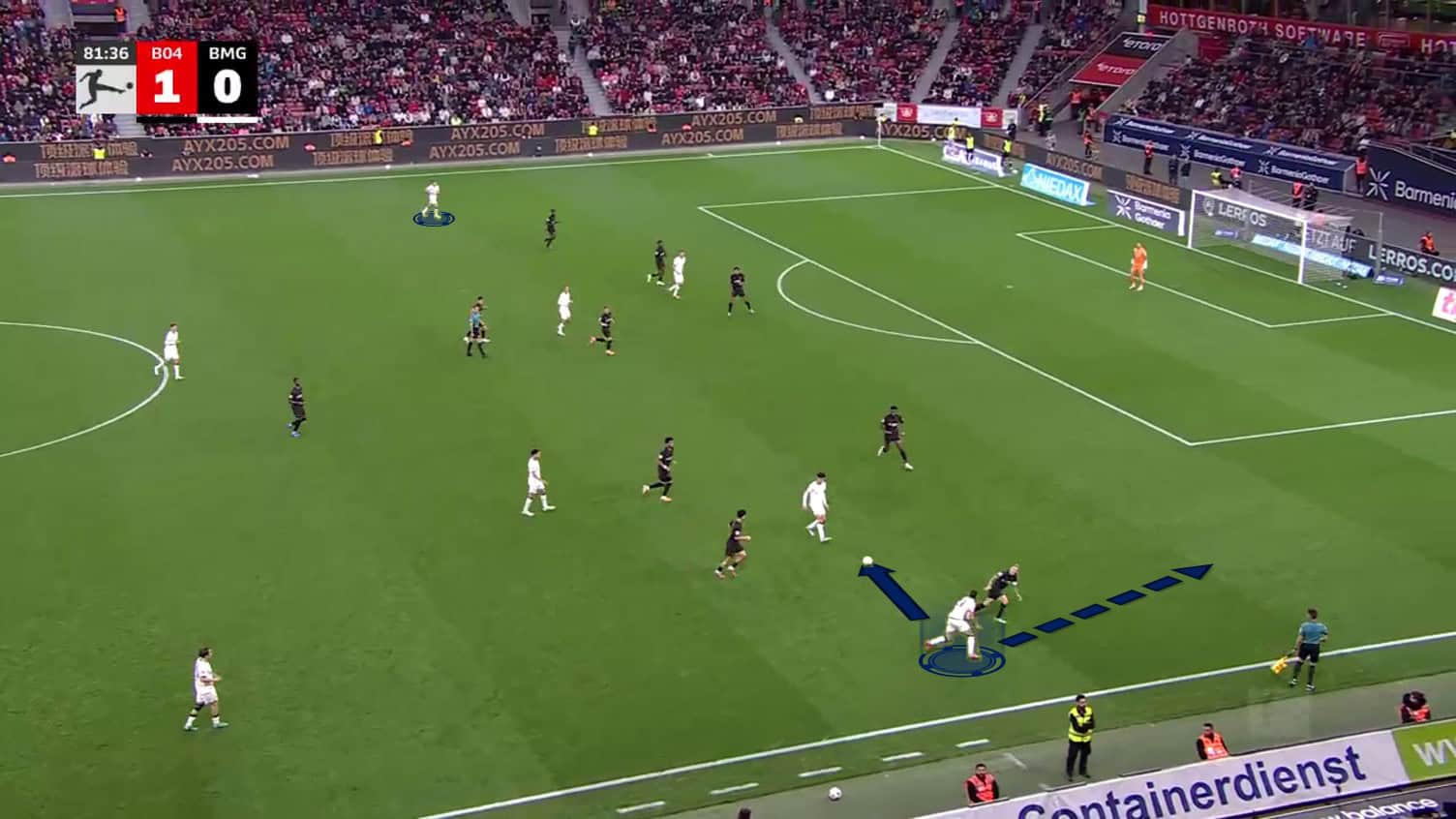
Gladbach kept their key principles intact. Looking at the picture, they still tried to break through behind the backline by playing square and running vertically, but in the end, they never really found success with that after Bayer Leverkusen dropped back.
Still, they are now committed to more players forward.
The far-sided wing-back was also pushing up the field, creating a bit of width, which helped them get more into isolated 1-v-1 situations, something that would ultimately benefit them.
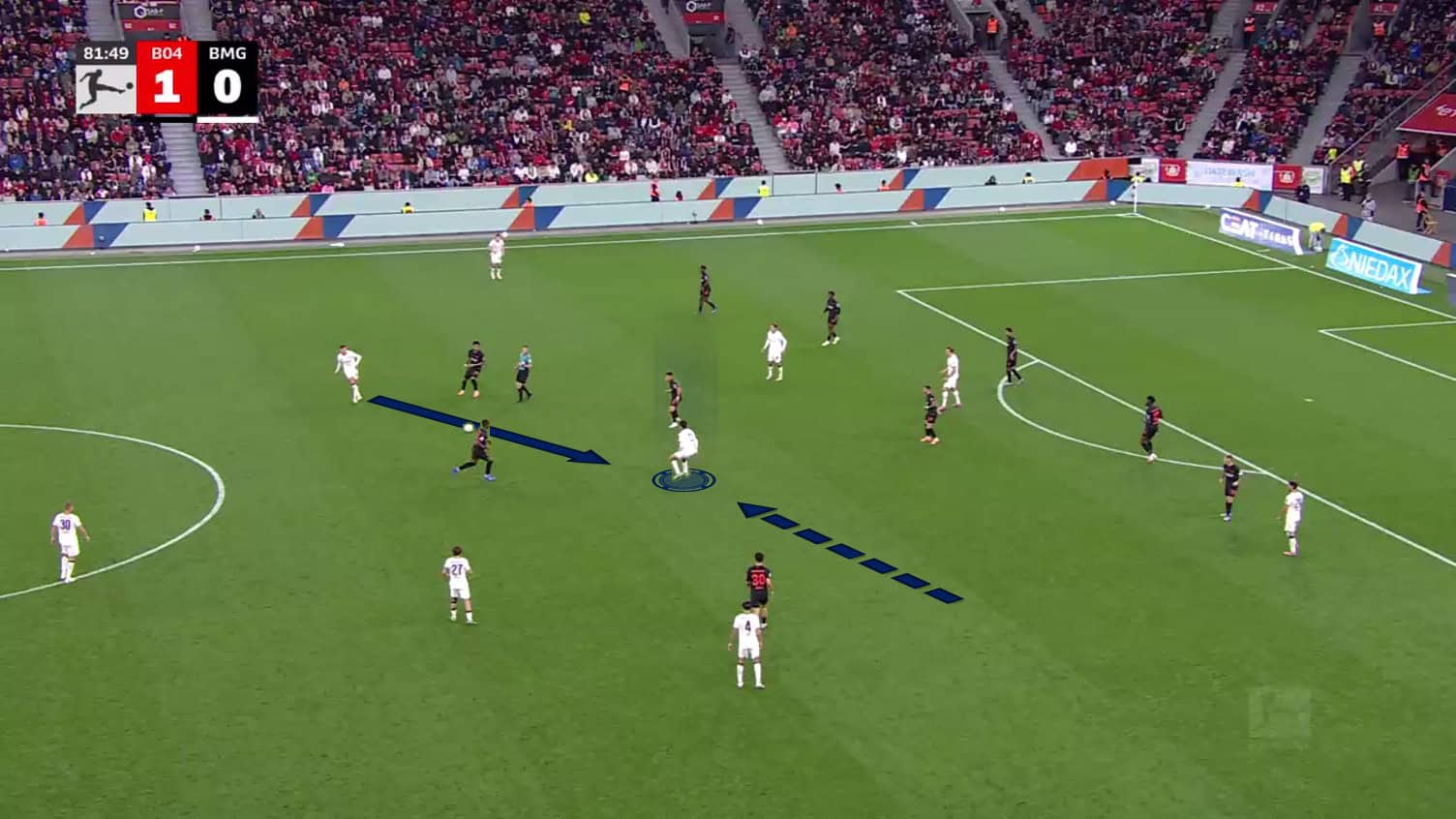
Also, Gladbach showcased that they can play liquid football, now finding more and more solutions through their midfield.
Especially Engelhard proved himself to be a very good footballer here, playing as a deep-lying playmaker, finding line-breaking passes rather often now.
The new attacking midfielders, Gio Reyna and Charles Herrmann, also managed to position themselves better in the half-spaces, giving the team more options and establishing some ball security in the final third.
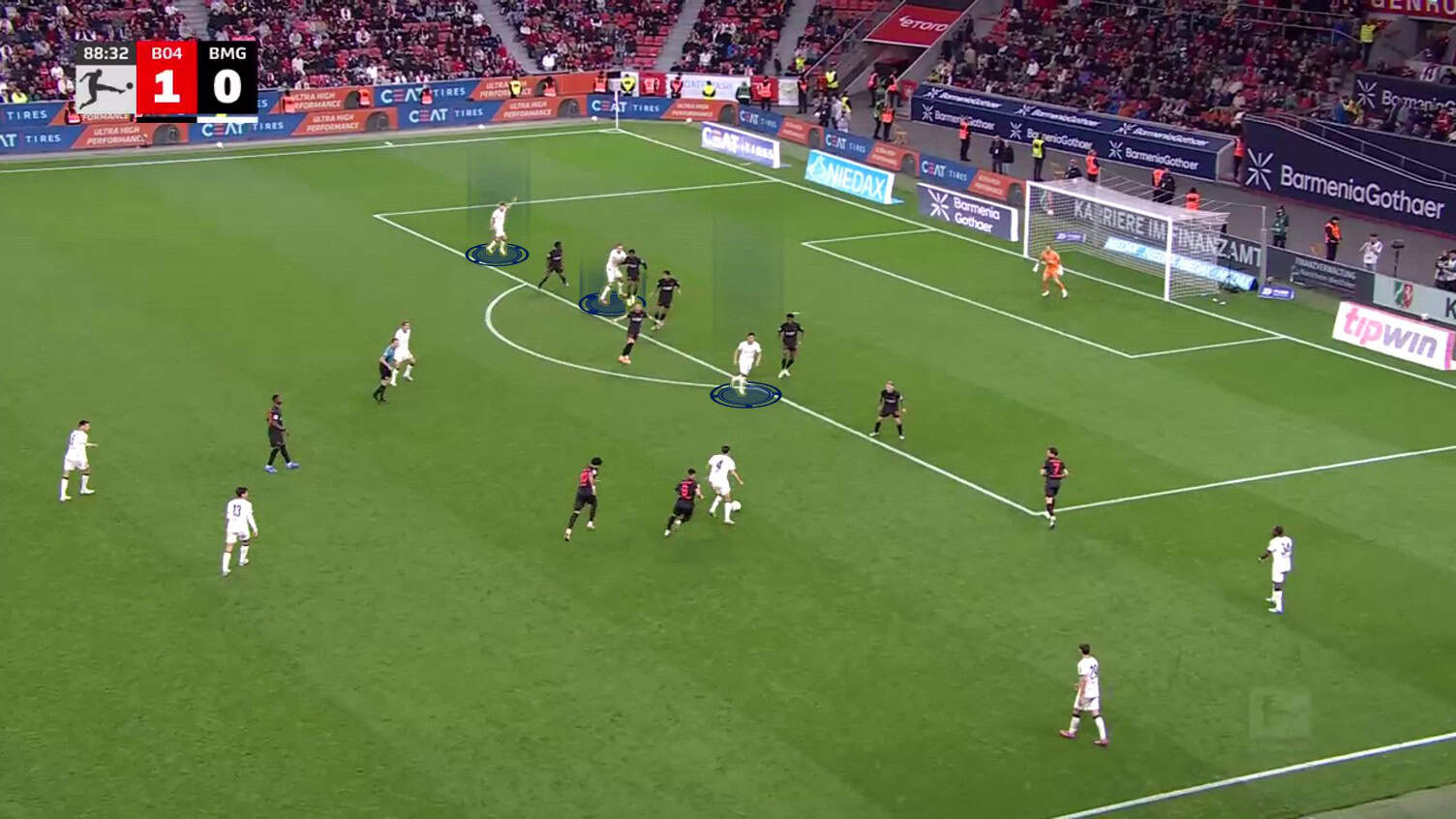
Lastly, their presence in the box improved massively.
The team just needs a target man in the box, while Shuto Machino is definitely the best option for Gladbach, with captain and German international Tim Kleindienst unavailable. Haris Tabakovic blends better with the rest of the attacking players.
As seen above, they now had multiple players in the box, allowing their players on the wing to be actually useful for once and cross the ball inwards.
All that combined led to the equaliser:
First, Charles Herrmann was able to get into an isolated 1-v-1 situation after a switch through the half-space, thanks to their new width, which got them a corner kick.
That corner ended up in a header for Tabakovic, who found the back of the net in stoppage time.
He scored the first Gladbach goal of the season and secured a point for his team in the BayArena.
Conclusion
Ultimately, the game proved to be what most people expected it to be.
For Bayer Leverkusen, it was the second problematic game after their win against Frankfurt; their struggles in the UEFA Champions League continued, and Kasper Hjulmand’s men’s performance was less than ideal.
In the end, they did not deserve to win this, but giving away the win in stoppage time was also very unnecessary.
For Borussia Mönchengladbach, it was a step in the right direction.
While many aspects still did not look good, and they were very focused on not losing the game rather than winning it for a long time, they still showed massive improvements, especially in terms of defending and intensity in the counterpress.
So, Eugen Polanski can be happy with what his team did this Sunday.
While one point might not be enough, scoring that late goal could prove to be important to them on a psychological standpoint.
Ultimately, I believe both teams will need to make significant improvements over the next couple of weeks to meet the goals they set at the beginning of the season.
![Inter Milan Vs Sassuolo [2-1] Serie A 20252026 – Tactical Analysis](https://totalfootballanalysis.com/wp-content/uploads/2025/09/Inter-Milan-Vs-Sassuolo-2-1-Serie-A-20252026-–-Tactical-Analysis-1-75x75.jpg "Inter Milan Vs Sassuolo [2-1] Serie A 2025/2026: Cristian Chivu Attack Overcomes Fabio Grosso Tactics - Tactical Analysis 11")
