


![PSG Vs Inter Milan [5-0] UEFA Champions League Final 2024/2025 – Tactical Analysis](https://totalfootballanalysis.com/wp-content/uploads/2025/06/Champions-League-Final-20242025-1.jpg "PSG Vs Inter Milan [5-0] UEFA Champions League Final 2024/2025 - Tactical Analysis 1")
Paris Saint-Germain have ended their wait for continental success—and in some style, too.
Les Parisiens demolished Inter Milan 5-0 in the 2024/2025 UEFA Champions League Final, earning the record for the largest-ever margin of victory in the final of Europe’s elite footballing competition.
For Luis Enrique, it’s an exceptional feather in his cap to be the one to finally lead PSG to UEFA Champions League success after years of the club falling short of the mark when it mattered most.
Conversely, Simone Inzaghi now bears the marks of two Champions League Final defeats in three years, though nobody can take it away from him that he did very well to get I Nerazzurri to the dance in the first place.
Saturday’s game was undoubtedly a showing for Inzaghi and Inter to forget, though.
Our UCL Final post-match tactical analysis examines how PSG took advantage of Inter’s tactical weaknesses in order to enhance their strengths on Saturday evening.
Listen to this article free on the Total Football Analysis Podcast via Spotify, Apple Podcast, or RSS.
2024/2025 Champions League Final Lineups & Formations
First, let’s run through how Luis Enrique and Simone Inzaghi set up their teams for Saturday’s game.
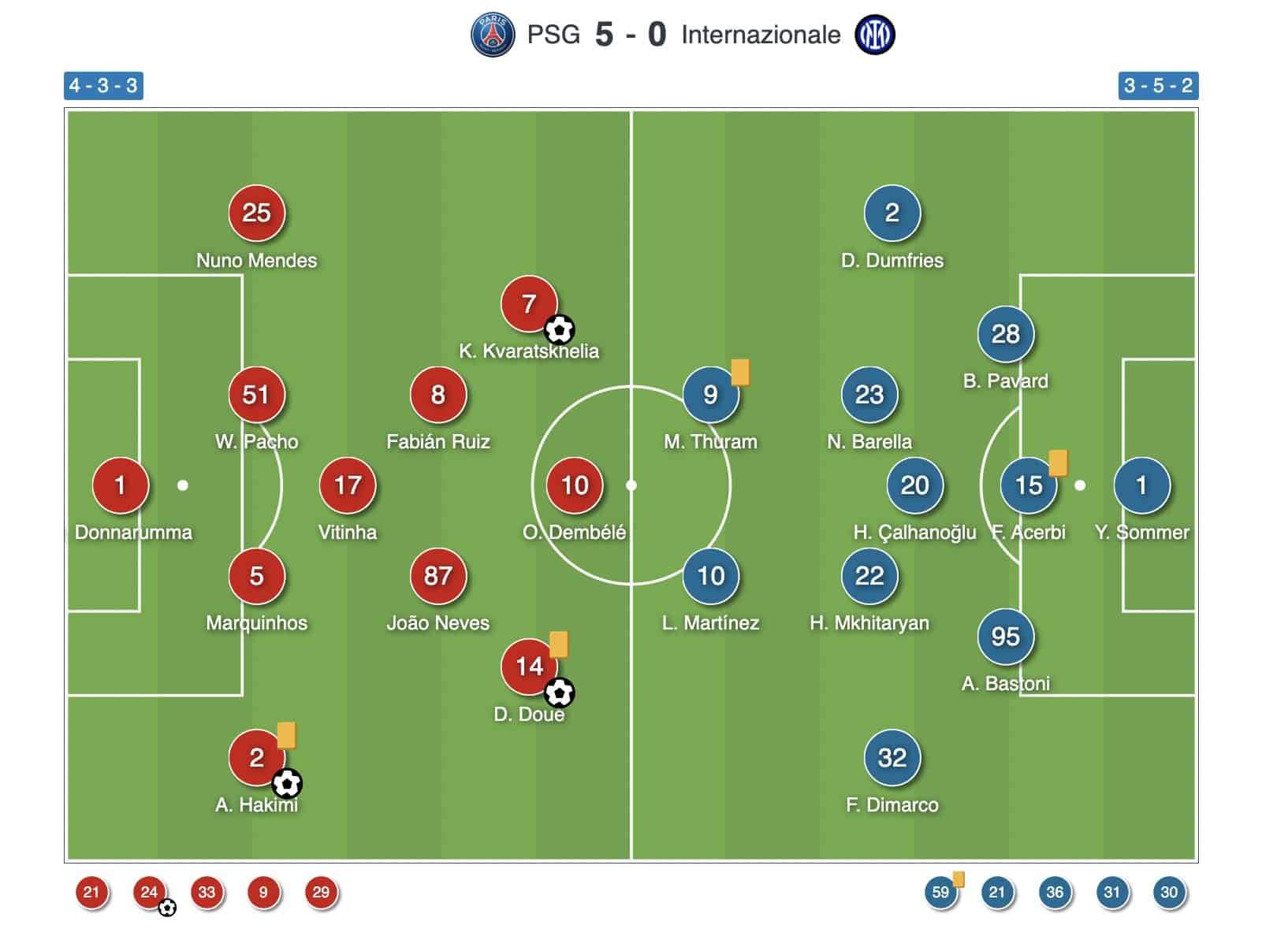
The eventual winner, PSG, played in a 4-3-3 shape.
Gianluigi Donnarumma stood between the sticks behind a back four of Achraf Hakimi (right-back), captain Marquinhos (right centre-back), Willian Pacho (left centre-back) and Nuno Mendes (left-back).
Left-back Mendes is the only member of PSG’s backline who didn’t finish the game—Lucas Hernández replaced him after 78 minutes.
Vitinha played the holding midfield position behind right central midfielder João Neves and left central midfielder Fabián Ruiz.
Désiré Doué started on the right wing, with Khvicha Kvaratskhelia on the left, and Ousmane Dembélé in the centre-forward position.
In addition to the aforementioned introduction of Lucas Hernández in the 78th minute, PSG made another four substitutions in this game.
Enrique’s first change saw Doué replaced by Bradley Barcola just after the hour mark.
Then, in the 84th minute, a triple substitution followed Hernández’s introduction: Gonçalo Ramos, Senny Mayulu, and Warren Zaïre-Emery came on for Kvaratskhelia, Fabián Ruiz, and João Neves.
As for Inter, Inzaghi lined his team up in a 5-3-2 shape with Yann Sommer in goal behind right wing-back Denzel Dumfries, right centre-back Benjamin Pavard, central centre-back Francesco Acerbi, left centre-back Alessandro Bastoni and left wing-back Federico Dimarco.
Nicolò Barella played at right central midfield next to Hakan Çalhanoğlu in the centre and Henrikh Mkhitaryan on the left.
Meanwhile, Lautaro Martínez and Marcus Thuram led the line for Inter up top.
Inzaghi also made five subs over the course of this game.
I Nerazzurri’s first double swap came a little before the hour mark, when Yann Aurel Bisseck and Nicola Zalewski were introduced for Pavard and Dimarco.
Another double change came shortly after an hour had been played, with Carlos Augusto and Matteo Darmian taking over from Mkhitaryan and Bisseck, the latter of whom had a very short time on the pitch due to injury.
Lastly, Inter brought on Kristjan Asllani for Çalhanoğlu in the 70th minute.
PSG Out-Of-Possession Tactics
PSG set out to press far more aggressively than Inter in this game.
Of course, with PSG taking the lead in just the 12th minute of the match and only extending it from there on, Inter were forced to try and be more proactive as the game progressed.
Sometimes, high pressure from Inter helped their cause, but they could never capitalise on opportunities resulting from the high turnovers they forced.
This was often due to poor technical play from individuals on the ball, including passes played with too much power and heavy touches, which handed possession back to Les Parisiens.
In relation to PSG’s out-of-possession phases, Enrique’s side were at their most comfortable when pressing high, as opposed to defending deeper.
PSG were prepared to press relentlessly, aiming to force Inter into hurried long balls with no real purpose, as well as into wide spaces where PSG could trap them and increase their pressing intensity as a unit compared to when Inter had the ball centrally.
PSG’s front three played a vital role in their out-of-possession approach.
This provided a stark contrast to PSG sides of recent years and further emphasised the necessity of total commitment across the board to out-of-possession duties in the modern game.
Luis Enrique has done very well to mould this side into his image of a modern, high-energy team without the ball, turning PSG from a team that didn’t offer much in these phases to one of Europe’s scariest pressing forces.
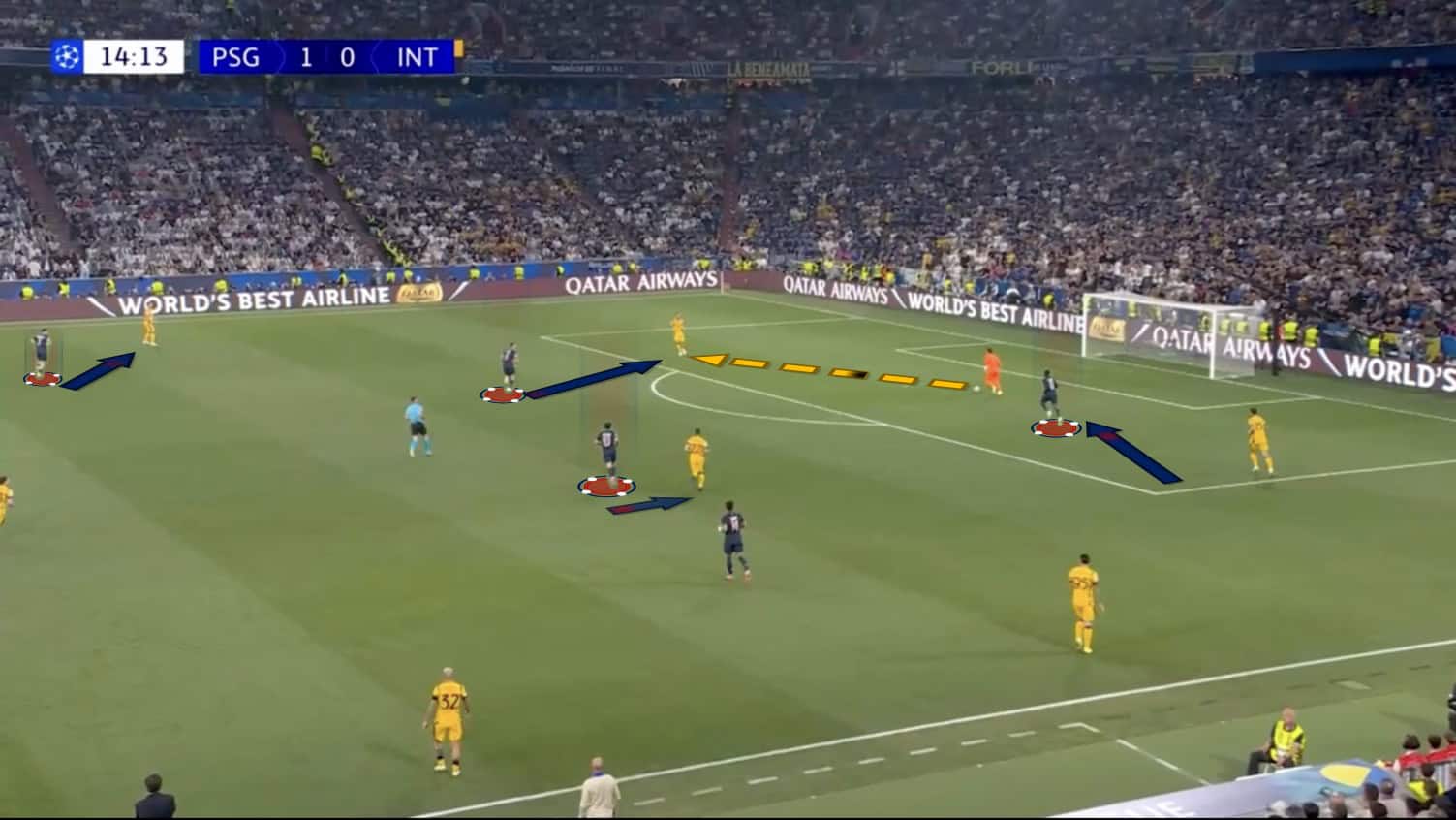
Figure 2 illustrates PSG’s man-oriented approach in the high block.
When pressing in the high block phase, PSG players got aggressively tight to their designated Inter counterparts.
It wasn’t strictly man-to-man marking; Enrique’s side did retain the key principles of a zonal marking approach.
However, they would get tight to players quickly and pursue them aggressively when they appeared as decent passing options for Inter’s build-up play.
In this case above, for instance, PSG’s two ‘8s’, João Neves (right) and Fabián Ruiz (left), are their team’s second and third-highest bodies.
Both men track Inter’s pair of creative central midfielders, Mkhitaryan and Çalhanoğlu, as they drop deep to try and assist their team’s build-up play.
At the same time, Doué on the right retains access to Inter’s left centre-back, Bastoni, who is positioned himself wide.
Dembélé can be seen aggressively closing down goalkeeper Sommer after he received the ball from central centre-back Acerbi just before this image was taken, and Kvaratskhelia retains access to Pavard.
Just behind the two PSG ‘8s’, Vitinha sticks closely to Barella, who tries to find some freedom in the middle of the park.
Mendes and Hakimi stick with wing-backs Dumfries and Dimarco, who’ve positioned themselves high and wide on the wings.
Meanwhile, PSG’s central defensive duo remains responsible for Lautaro Martínez and Marcus Thuram in case either one of them is the recipient of a long forward pass as I Nerazzurri try to escape the pressure.
This was an extremely disciplined, man-oriented pressing structure.
Enrique created matchups all over the pitch based on which Inter players started the move in their respective zones and carried out that pressing assignment for the duration of the attack until possession was regained.
Matchups were dynamic, changing depending on which player started in whose zone.
This was especially relevant in midfield, where Inter’s trio could rotate with plenty of freedom.
This could, for instance, alter Vitinha’s assignment from Barella to Mkhitaryan to Çalhanoğlu from attack to attack, giving him a very different challenge depending on who Inter’s most advanced midfielder was at that moment.
For the most part, Inter’s shape was quite rigid and matchups were consistent throughout the game, with PSG’s players almost always coming out on top in the end.
PSG forced many errors from Inter with their high-pressing approach.
Their opponents struggled to cope with the constant, immediate pressure from PSG when they received the ball, compounded by the scarcity of nearby passing options due to PSG’s aggressive nature in marking their opponents.
In the passage of play above, after Sommer receives, he plays the ball to Çalhanoğlu, who is occupying a right centre-back position beside him.
The Türkiye captain attempts a long pass forward but is charged down effectively by Fabián Ruiz.
This leads to an Inter throw-in from inside the Italian side’s own third, which gives Les Parisiens an opportunity to keep the pressure applied on their opponents in the wide area—another key component of their defensive approach on Saturday.
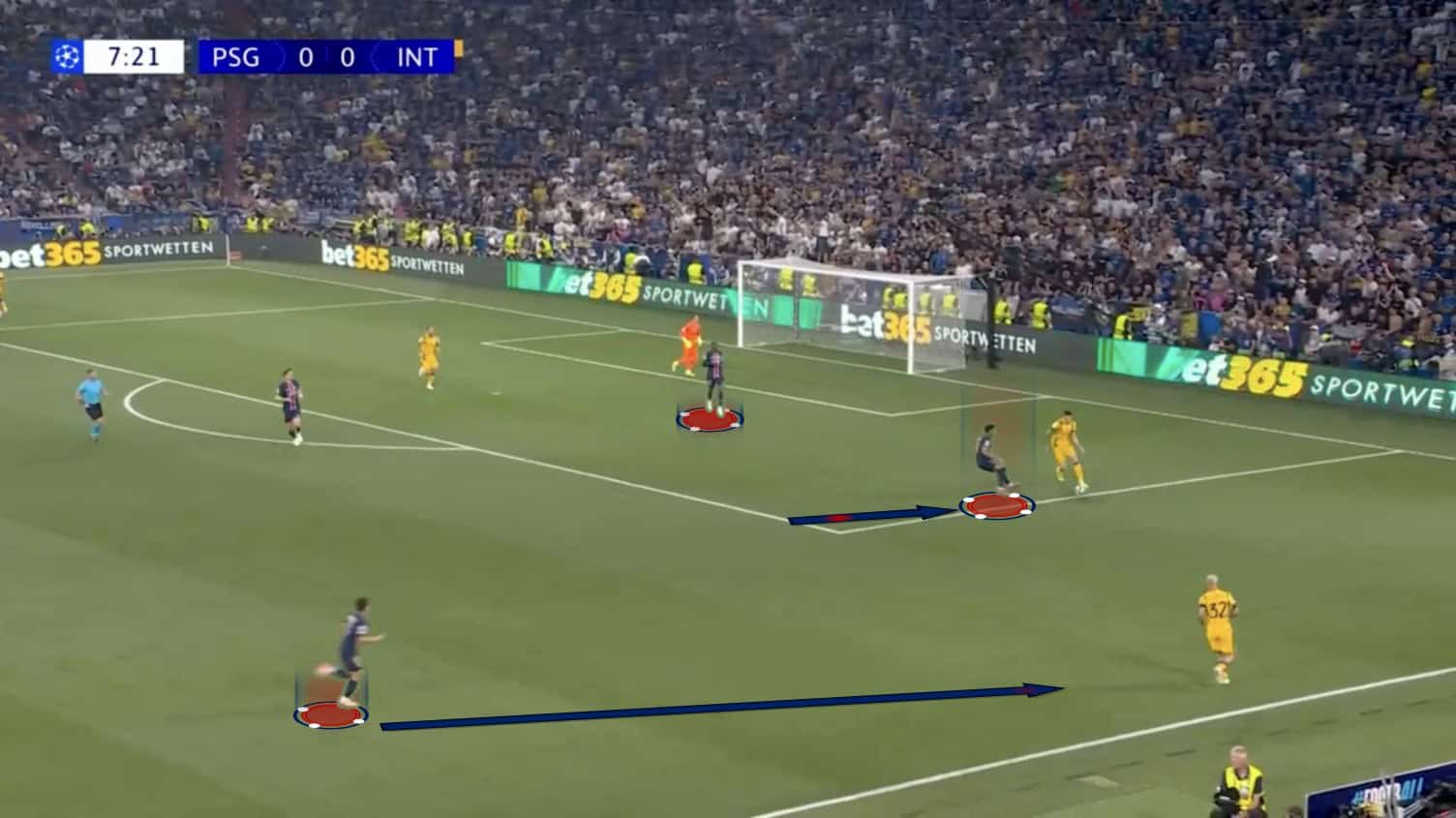
Here, we see an example of PSG funnelling possession out to the wing, where they could use the touchline as an extra defender, further limiting the scope of Inter’s passing capabilities.
In this case, Hakimi is occupied deeper, so João Neves assumes responsibility for Dimarco on the wing and begins closing the wing-back down as the pass makes its way towards him from Bastoni.
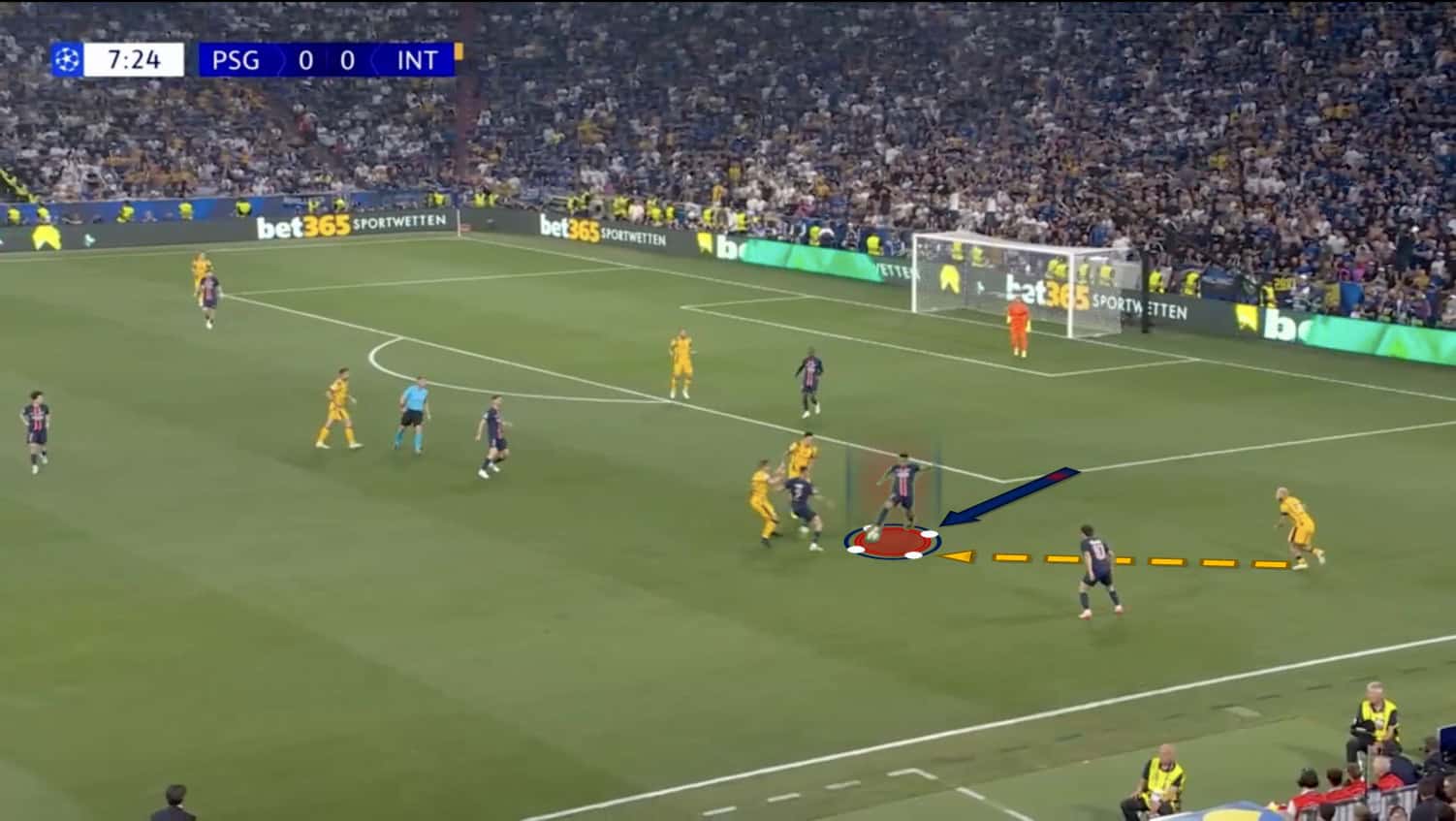
Dimarco tries to play into the centre as Bastoni makes a forward run, but the pass is weak, and the run is tracked excellently by Désiré Doué.
This creates a high turnover for PSG, giving them the opportunity to further consolidate possession inside the opposition’s half and try to create a good goalscoring opportunity.
Les Parisiens did well to force numerous high turnovers, such as this one, throughout the game, making the high press a critical feature of their chance-creation tactics.
On the opposite side, Inter failed time and time again to breach PSG’s high block and play into the middle of the park.
The French champions locked down the central midfield areas, completely dominating that part of the pitch and denying Inter any significant opportunities to create from those valuable areas.
We saw high pressing and tight marking in the high block, denying Inter access to the middle of the park, as well as excellent pressing in deeper areas when Inter did manage to play a progressive pass into midfield but ultimately spoiled the attack with a poor pass or poor touch, which wasn’t an uncommon occurrence either.
Still, PSG players needed to be active and alert to capitalise on those opportunities to regain possession, which they generally were.
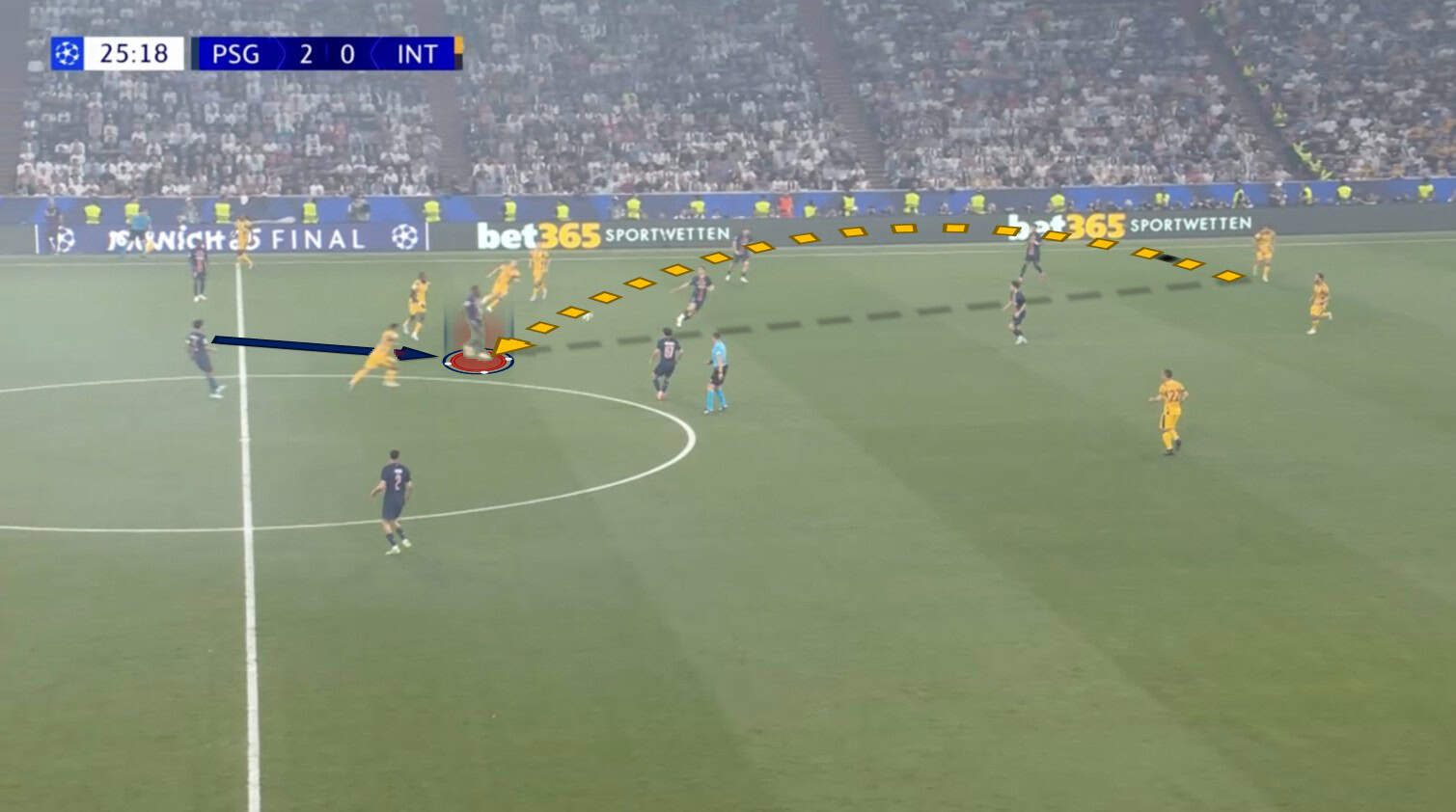
Willian Pacho was a defensive rock for PSG throughout this game.
The 23-year-old Ecuadorian engaged in 12 defensive duels over the course of the match—the most of any player from either side—winning 58% of them and making the most interceptions (seven) of any PSG player in this contest.
Pacho, in particular, was noticeable in his efforts to quickly deal with Inter’s long balls upfield.
He denied I Nerazzurri any chance to build attacks via direct play as an alternative to passes through the midfield area, which they constantly failed to access.
PSG forced many long balls via their high press, but those long balls rarely led to anything of substance for Inter, thanks to the defensive efforts of PSG’s centre-backs, particularly Pacho, who put in a Champions League Final defensive performance to remember.
The Ecuador international displayed an outstanding combination of physicality, anticipation and technical defensive skill to keep Inter’s forward line very quiet.
PSG In-Possession Tactics
Luis Enrique’s PSG delivered one of the all-time great Champions League Final in-possession performances versus Inter.
This is evident from the record-setting scoreline they managed to rack up.
Les Parisiens’ success with the ball on Saturday was born from intelligent preparation and solid application of basic principles of positioning and movement with the ball.
Firstly, Enrique prepared his side well to exploit the natural weaknesses of Inter’s 5-3-2 defensive shape.
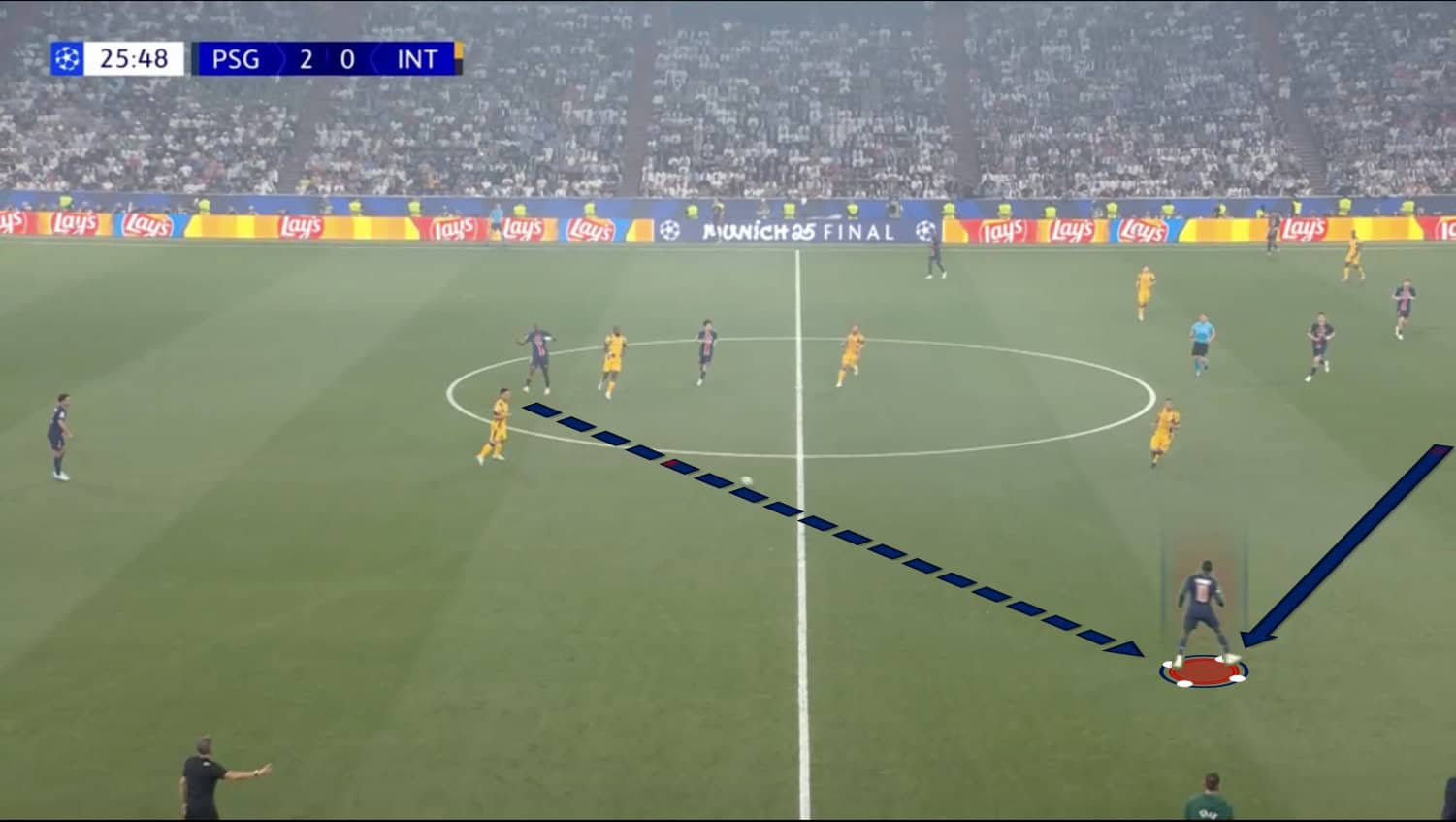
In short, Inter’s defensive shape was very horizontally compact, designed to guard the very centre of the pitch well.
However, Inter’s defensive shape naturally gave up a lot of space on the wings and in the inside left and right channels.
Achraf Hakimi could naturally invert into the right inside channel and did so frequently early on in the game.
As the match wore on, Ousmane Dembélé became the area’s most frequent inhabitant during the progression phase, as illustrated in Figure 6.
Dembélé was given the license to roam around from his centre-forward position and find space in which he could be most effective.
In the progression phase, that was normally this position where you might more commonly find a right-back because Inter’s defensive shape essentially failed to cover that area well.
The team failed to respond to PSG’s repeated simple progression from the backline to the final third via that channel—particularly via Dembélé, but also Fabián Ruiz, João Neves and Achraf Hakimi.
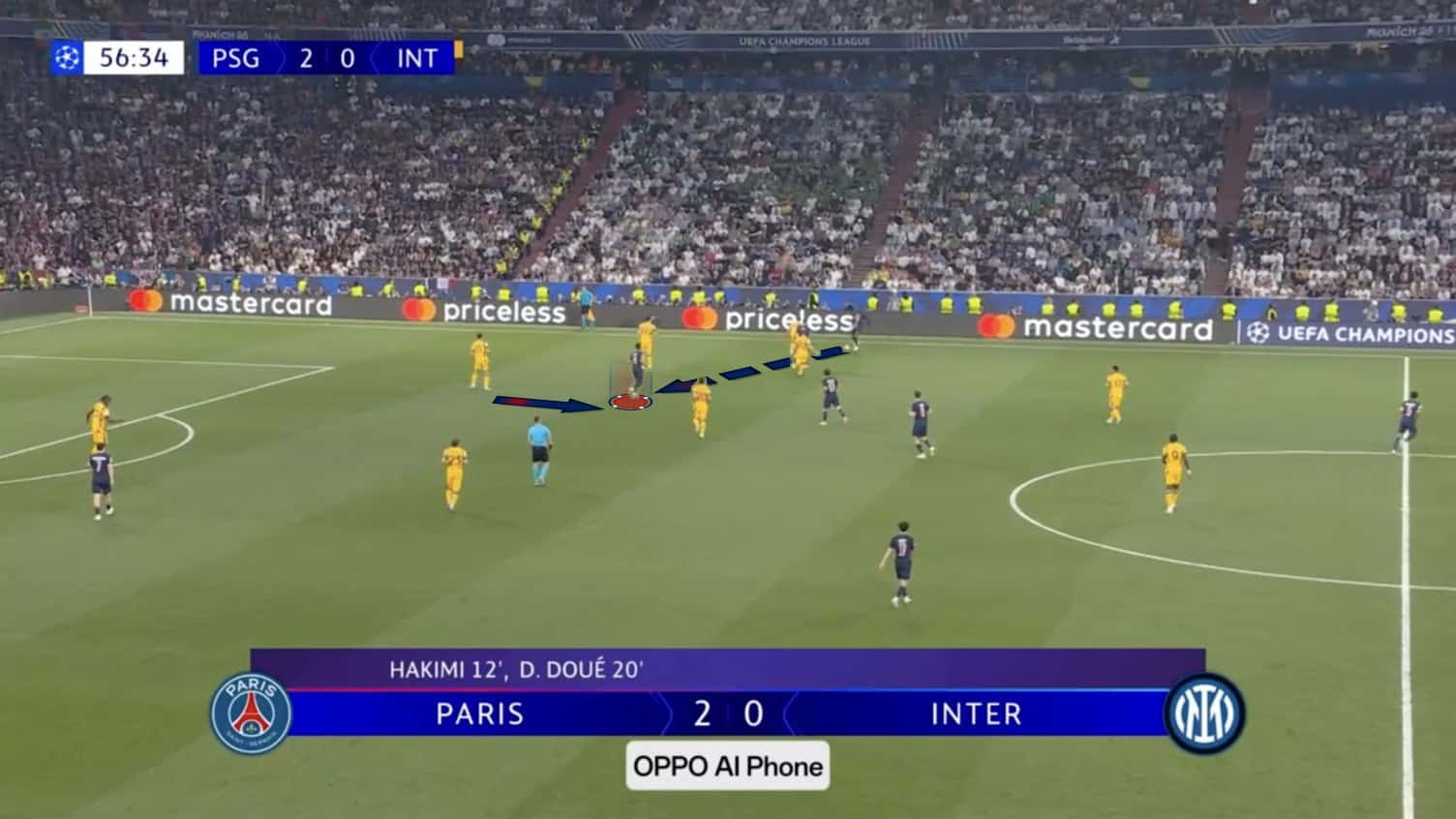
In addition to being very horizontally compact, another and probably a bigger defensive issue for Inter in the Champions League Final was their strict rigidity and overly flat defensive structure.
Inter defended in a rigid 5-3-2 shape, but they didn’t react sufficiently when PSG players positioned themselves between the lines.
Inter players focused a little too much on staying in their position to retain their overall shape and not enough on reacting to movement from PSG players into threatening positions around them.
They probably didn’t show enough respect to the technical quality they were up against and how Doué, as we see in Figure 7, could get on the ball in a tight space, turn, and create something.
The main pro of Inter’s defensive approach was that it ensured the overall structure stayed intact and compact, denying PSG large gaps they could exploit.
The con PSG exploited on numerous occasions, however, is that these defensive tactics are far too passive against elite ball-carriers and a team full of players with the intelligence to find space between the lines, receive, turn and run at the defence repeatedly to create chances.
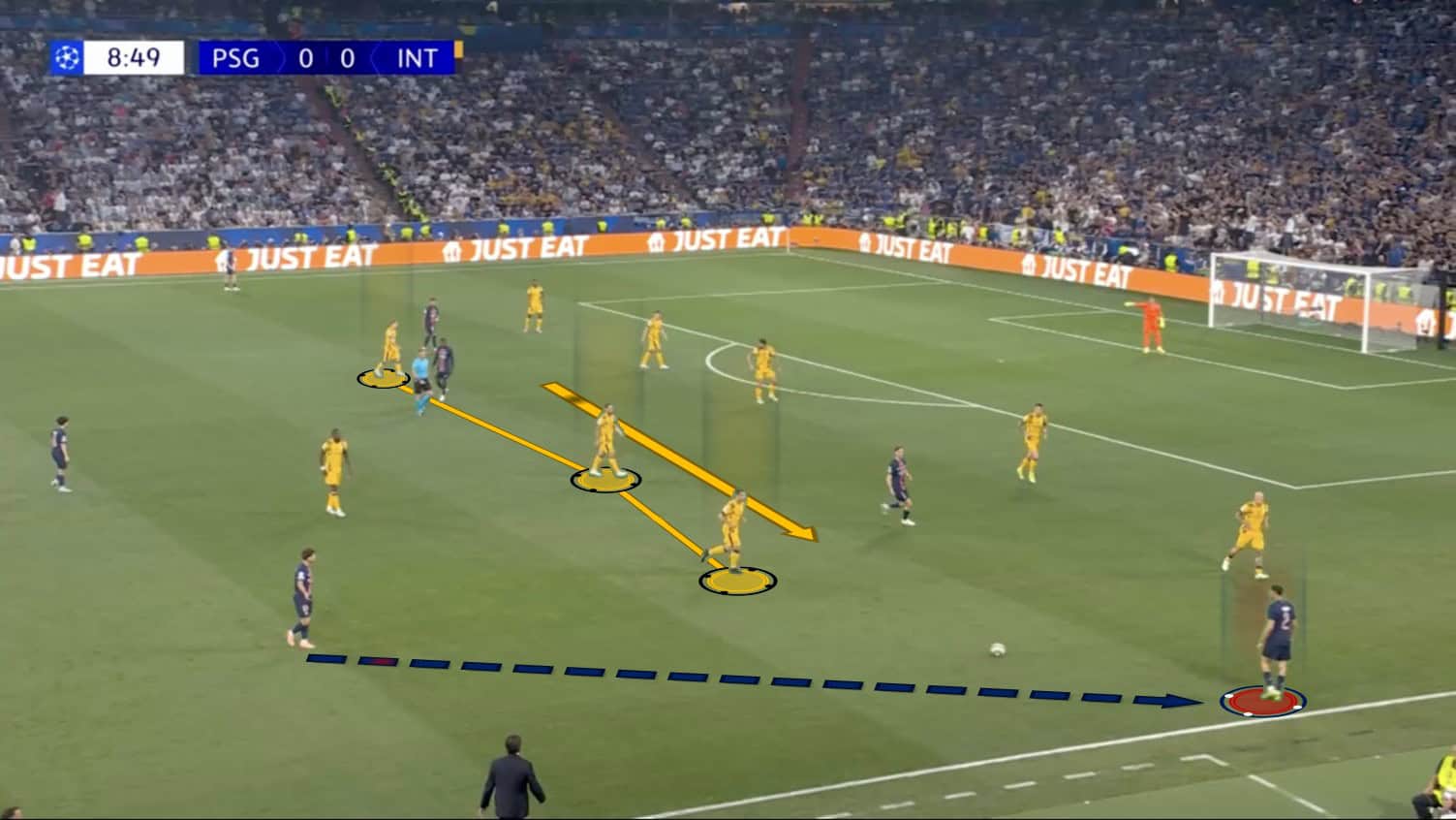
When Inter defended deep, PSG had to pass the ball around quickly to move Inter’s defence, which had to react as a unit to cover gaps.
In Figure 8, we see how PSG played towards the right on this occasion, influencing Inter to shift to this wing to cover space.
PSG still had the potential to play to the man in the half-space between the lines from here, which brings us back to our previous point, but that’s not what they went for on this occasion.
They quickly played the ball carefully from player to player back to the left, where there was now more space for the eventual receiver on that side, Nuno Mendes.
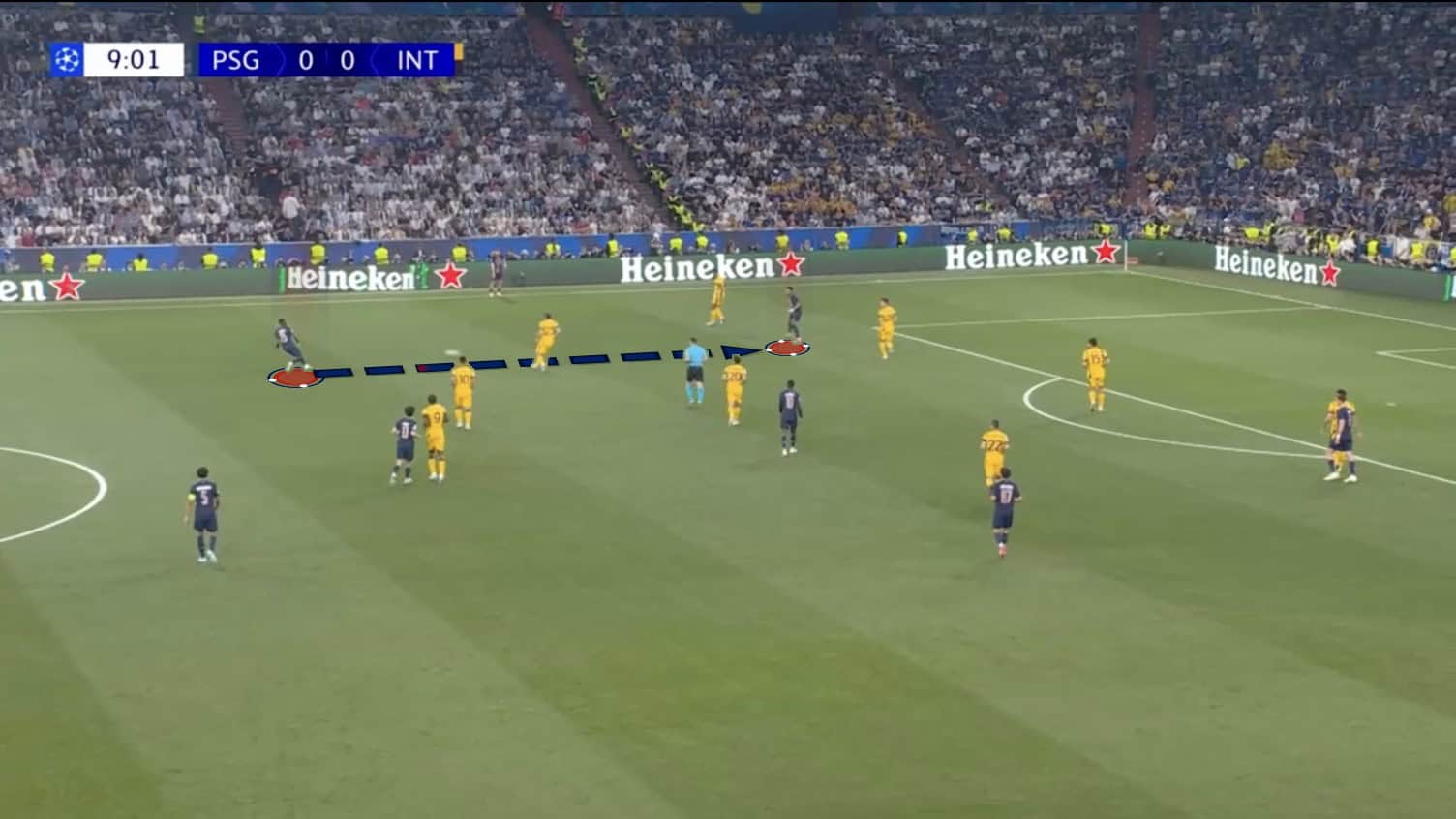
Mendes had time and space to get his head up and punch a pass through Inter’s midfield line and into Désiré Doué in the left half-space, who could turn and shoot.
The shot here was on target, though probably not the right decision in this particular moment.
However, intelligent passing created the opportunity to draw Inter’s midfield to one side, thus creating space on the opposite side of the pitch, which could then be exploited as PSG passed the ball back over.
This passing worked in combination with the winger’s intelligent movement and positioning in the half-space, who did well to exploit the Italian side’s rigidity to create a good goalscoring opportunity.
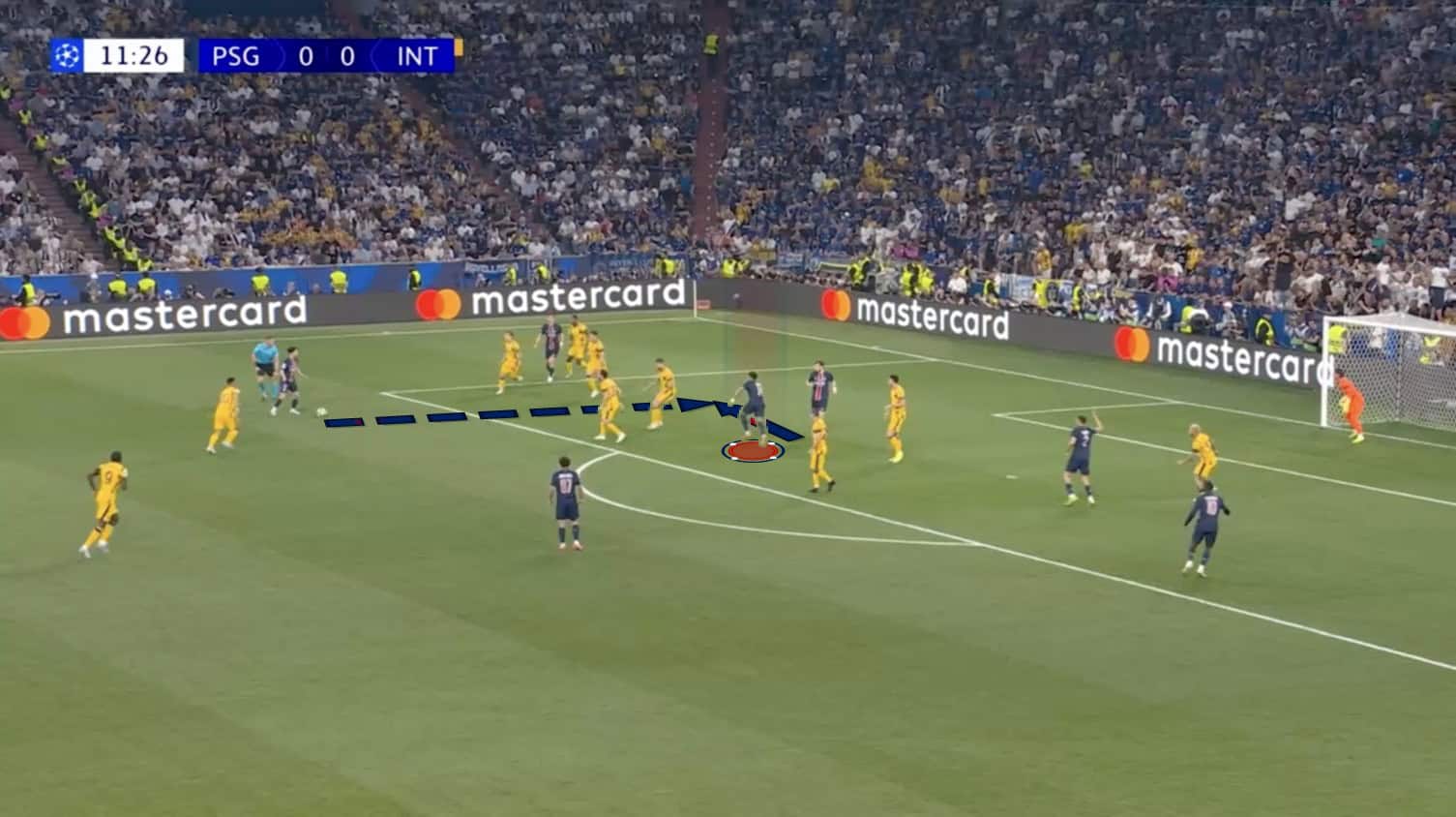
Another very similar PSG attack, which relied on good movement from the winger and punchy, line-breaking passing, came just a couple of minutes later and led to PSG’s first goal.
This highlights how crucial this intelligent movement and brave, creative passing were in Les Parisiens’ win.
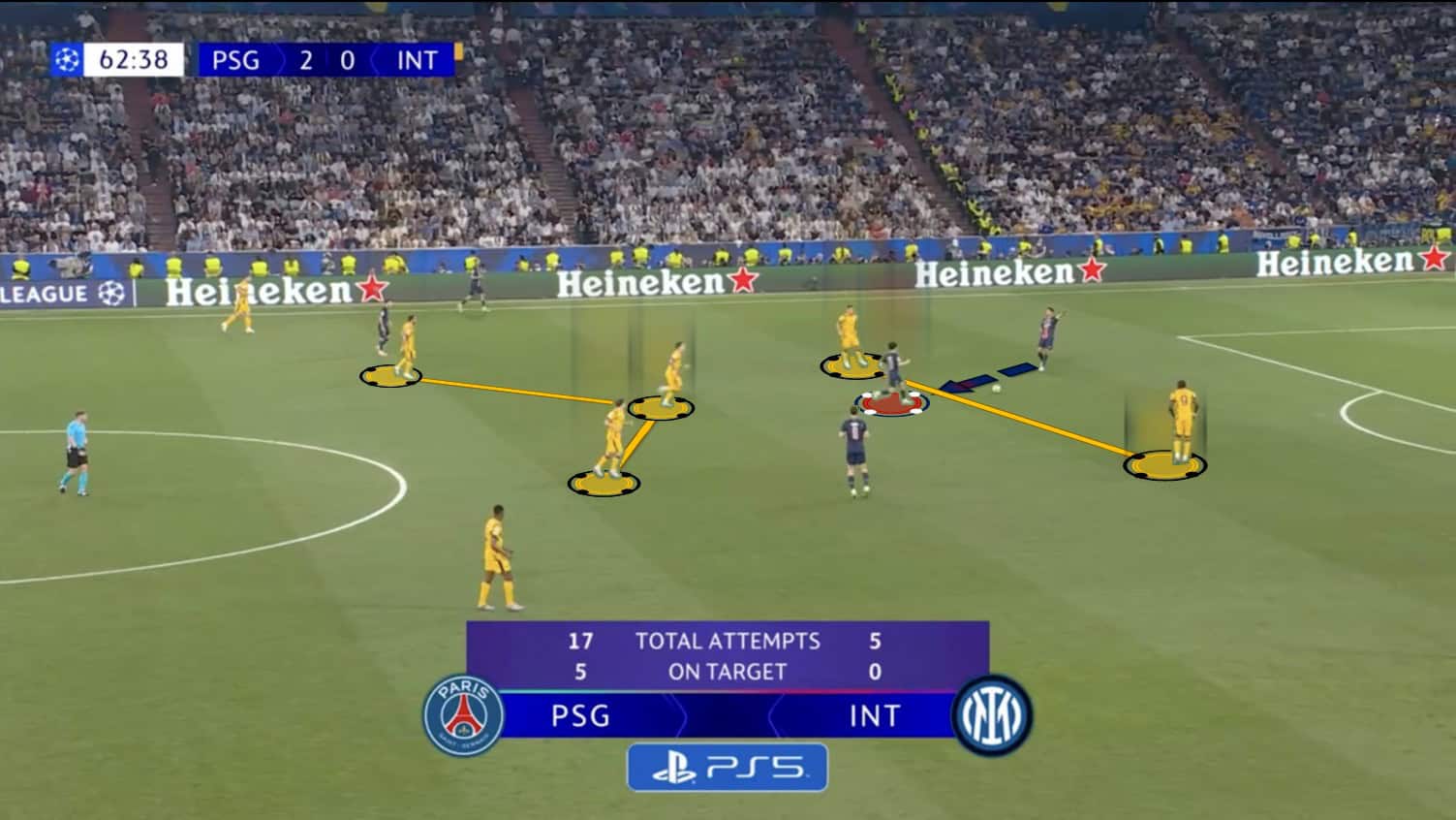
Vitinha played a pretty important role for PSG in finding space during the build-up when Inter pressed higher.
Even when pressing higher, Inter were far too rigid and failed to react to PSG’s movement in between the lines.
Here, Vitinha dropped in front of his centre-backs and was able to just receive in space between Inter’s strikers.
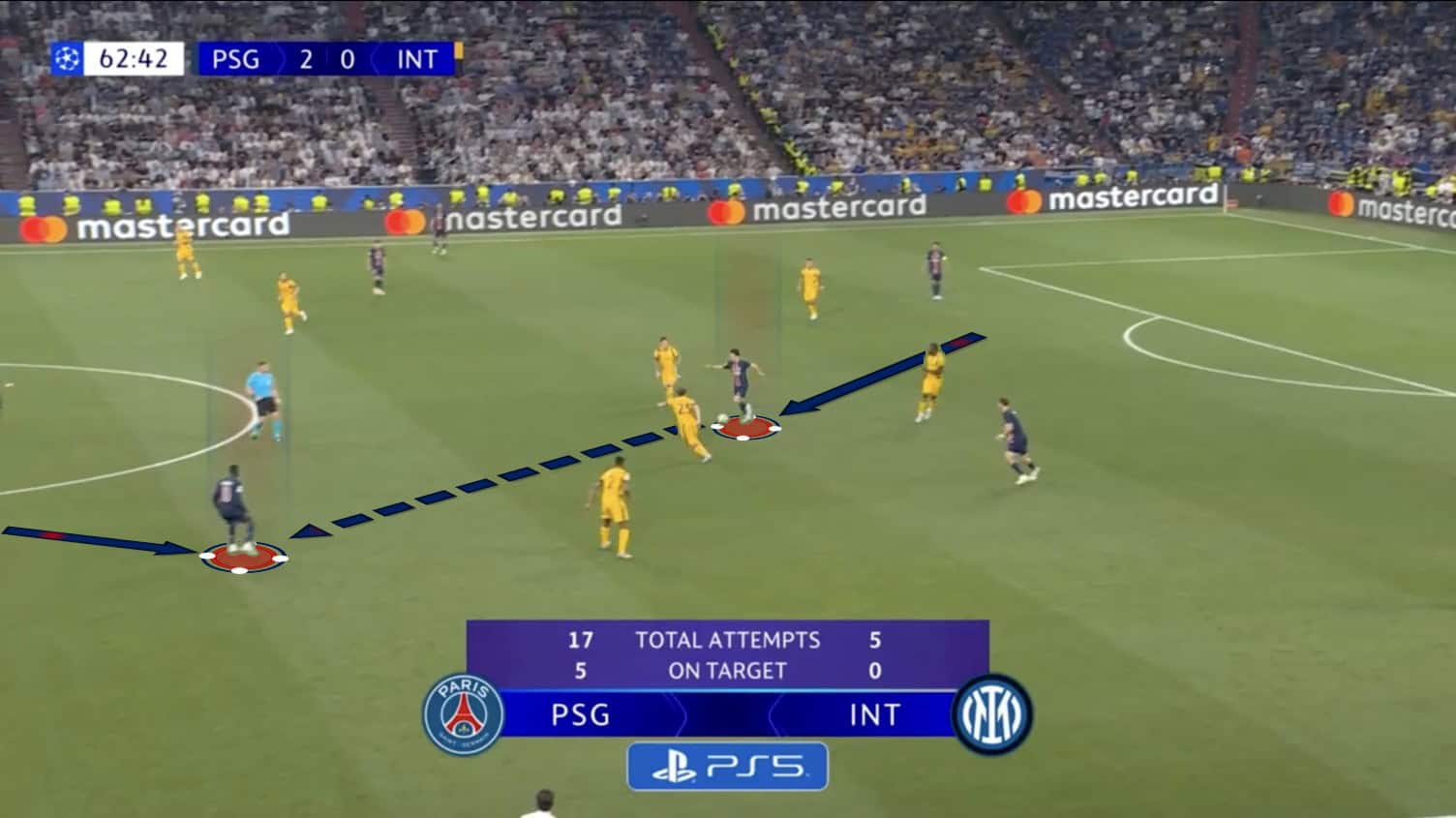
From here, the Portuguese midfielder was able to turn and carry the ball forward a few yards, drawing some pressure from Inter’s midfielders before he released it to Ousmane Dembélé, who occupied space behind Inter’s midfield line.
The ball was returned to Vitinha as he continued his run, and the midfielder assisted Doué’s second and PSG’s third goals of the game.
This was a great team move, going from back to front very quickly and effectively, hinged on elite execution of basic ‘pass and move’ principles.
Conclusion
To conclude our tactical analysis, PSG were on a completely different level to Inter on Saturday.
The new European champions shut Inter’s offence down with a man-oriented high press and excellent individual defensive performances from the likes of Willian Pacho, who won the majority of his duels in the Champions League Final.
With possession, PSG exposed Inter’s rigid structure and showcased the beauty and effectiveness of their technically proficient creators, putting five past I Nerazzurri in what will go down as one of the all-time great Champions League performances.

