
The last decade for Valencia has been truly tumultuous, to put it mildly.
At the turn of the millennium, the club was undoubtedly one of the most prominent in Spain, having won two titles, a UEFA Cup and a UEFA Super Cup between 1999 and 2004.
During this period, the club also reached two UEFA Champions League Finals.
However, the years following 2004 proved to be less fruitful for the side and with less success, a few signs of instability began to appear.
One of the most significant signs of this instability was the revolving door of managerial appointments, with young managers such as Unai Emery and Ronald Koeman all having stints at the club, as well as a few other interim managerial appointments.
Amidst all of this, the side still had many talented players on their books, with the likes of David Villa, Juan Mata and David Silva helping the club secure a Champions League spot in the 2009/10 season.
Although having several talented players, the club was forced to administer outgoings to balance their books, with David Villa sold to Barcelona and David Silva sold to Manchester City.
In the resulting three years after these exits, Valencia still remained competitive, finishing third twice as well as fifth.
However, the issues surrounding the debt incurred by the club persisted, with Los Che facing administration in 2014.
In August of the same year, Peter Lim purchased 70.4% of the club’s shares and subsequently became the owner of the club after negotiations with the creditors of the club.
Nuno Espírito Santo was trusted with the managerial responsibilities and, in his first season, managed to guide the side back into the Champions League places after a two-year absence.
Following an exodus of talent, the club made a notable attempt to improve the side’s strength by bringing in players such as Álvaro Negredo and André Gomes.
Although starting off brightly, Espírito Santo could not maintain the same form the following season and had a poor start to the 2015/16 La Liga season, resulting in his dismissal.
The following years consisted of another spell of Valencia’s personal managerial merry-go-round with several managers entrusted with the head coach responsibilities at the club.
As a result, Valencia’s on-pitch performances struggled, and questions began to be raised about Peter Lim’s ownership.
In 2017, the club turned a new corner with the appointment of Marcelino García Toral, who managed to guide the club to successive top-four finishes as well as a Copa Del Rey.
Nevertheless, with fans firmly against Peter Lim and Marcelino publicly showing his disgruntlement towards the ownership, the Spanish coach was sacked by the club.
Once again, the situation surrounding the club’s financial stability resurfaced, with the club forced to sell key players such as Dani Parejo, Rodrigo Moreno, and youngster Ferran Torres, all for below-market transfer fees.
Four years on from Marcelino’s departure and the wedge between ownership and the fans the largest it has ever been, Rubén Baraja, who played for the club as a midfielder in their successful years in the early 2000s, was appointed by the club at the start of 2023, with Valencia floating dangerously close to the relegation zone.
This scout report will provide a tactical analysis of how the Los Che former captain aims to address the tactical issues that plagued the side last season, as well as examine Rubén Baraja’s tactics being deployed at the start of this season.
Valencia Struggles Before Rubén Baraja Arrival
Valencia CF Shots Map
 When examining their underlying numbers, it is clear that Valencia’s attacking output is not the most significant cause of their 16th-placed finish last campaign, with the side scoring the 12th most goals in the division with 42 in total.
When looking at their goal figures from an xG perspective, Los Che underperformed by 11 goals, which, considering the xG totals of other La Liga teams, would have been the 9th-best goal tally in the Spanish top flight.
This suggests that the side did not necessarily struggle to create chances last campaign but instead struggled to put them away.
Valencia CF Shots Against Map
 From a defensive perspective, almost the opposite can be said.
Valencia’s record of 45 goals conceded was the 12th-best in the league; the side overperformed by seven goals in this metric.
However, their xGA tally was still the 11th-best in the league.
Overall, the underlying numbers suggest that Valencia were relatively unlucky to finish 2 points above the relegation zone.
It wouldn’t be unreasonable to suggest that internal turmoil at the board level, as well as fan discontent, contributed to the team’s poor performance last season.
Rubén Baraja Steadies The Chip
When coming into the club, Rubén Baraja clearly stated that the side needed to improve defensively.
By analysing Valencia towards the end of last season and this season, it is clear that Los Murciélagos have prioritised defensive security before refining the attacking aspects of their game model.
Although being, on average, defensively positioned relatively high up the pitch, as the image below suggests, Valencia was not highly aggressive in their attempts to win back possession.
Valencia CF Defensive Territory Map

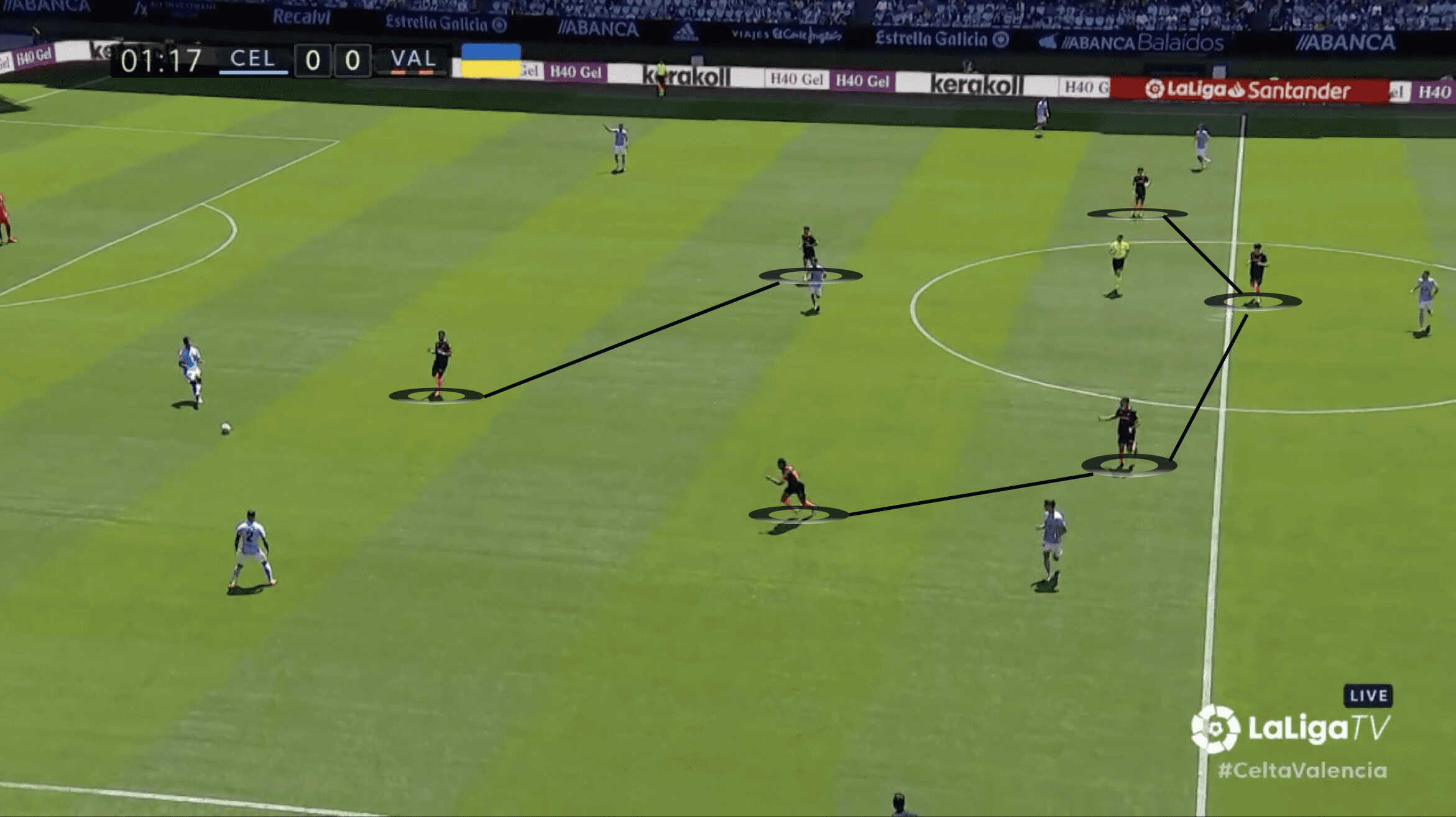
Valencia, under Baraja, have looked to defend in a 4-4-2 or 4-1-4-1/4-5-1.
An example of their 4-4-2 formation is shown in the image below.
Over the second half of last season, Los Che focused on denying passes to the opposition midfielder, looking to force the opposition to play down the channels.
A common weakness with 4-4-2’s is that due to the flatness of the formation, at times, it can be easy for the opposition to find players who are looking to receive the ball between the lines.
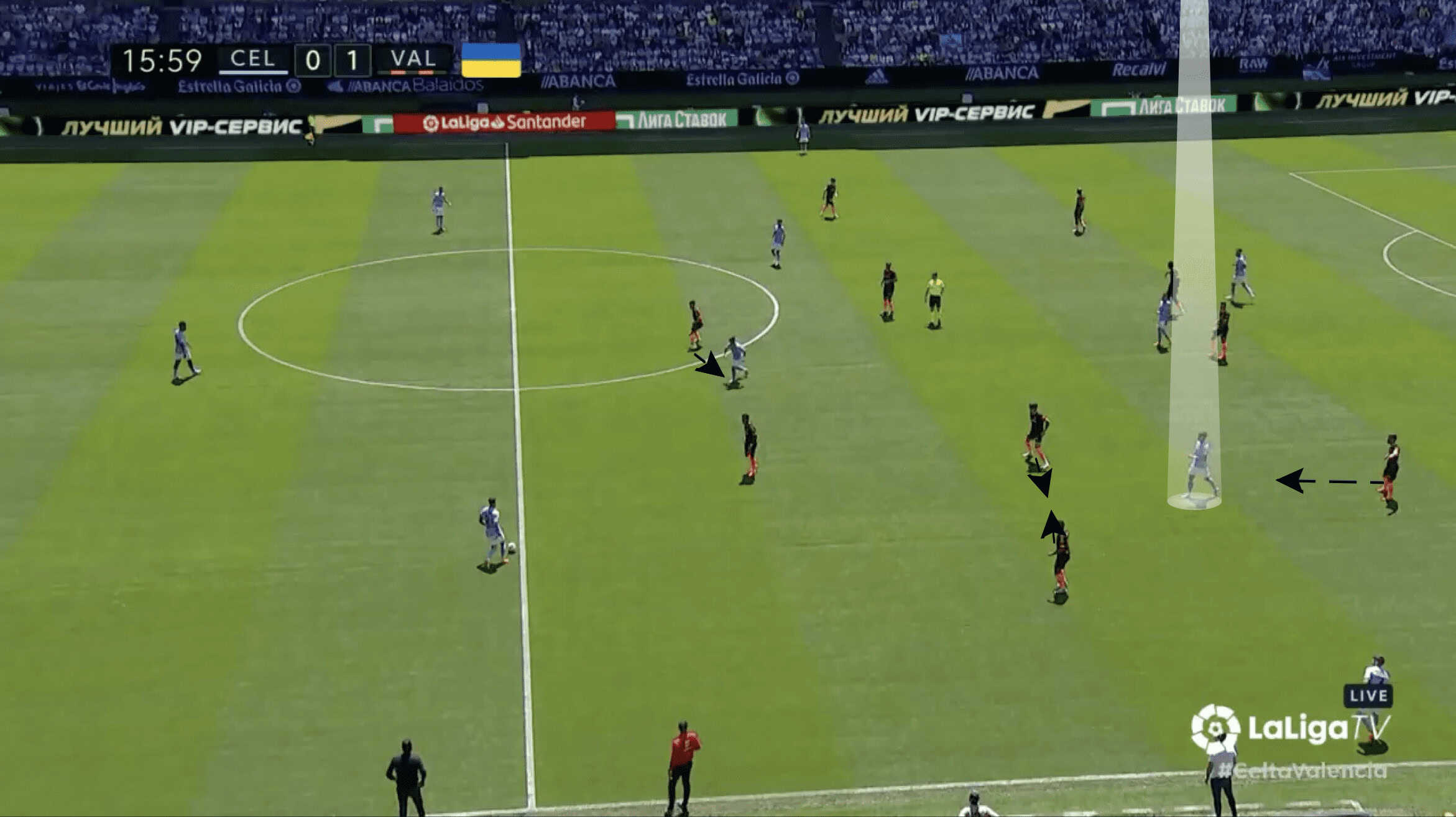
However, when watching Valencia, it is very apparent that the players are well aware of protecting potential passing lanes that the opposition may look to exploit.
As seen in the image below, Javi Guerra, the midfielder, adjusts his body shape to allow him to challenge for any passes played between him and Samuel Lino.
Additionally, José Luis Gayà is also positioned to challenge the opposition player between the midfield and defensive lines.
What is also apparent is the close distance between André Almeida and Justin Kluivert, allowing them to shift and cover the defensive midfielder as well as protect passes through the centre.
With the midfield able to protect passing lanes between them and receive support from players behind them, it is difficult to break down Valencia in the wide areas without committing several players to these zones.
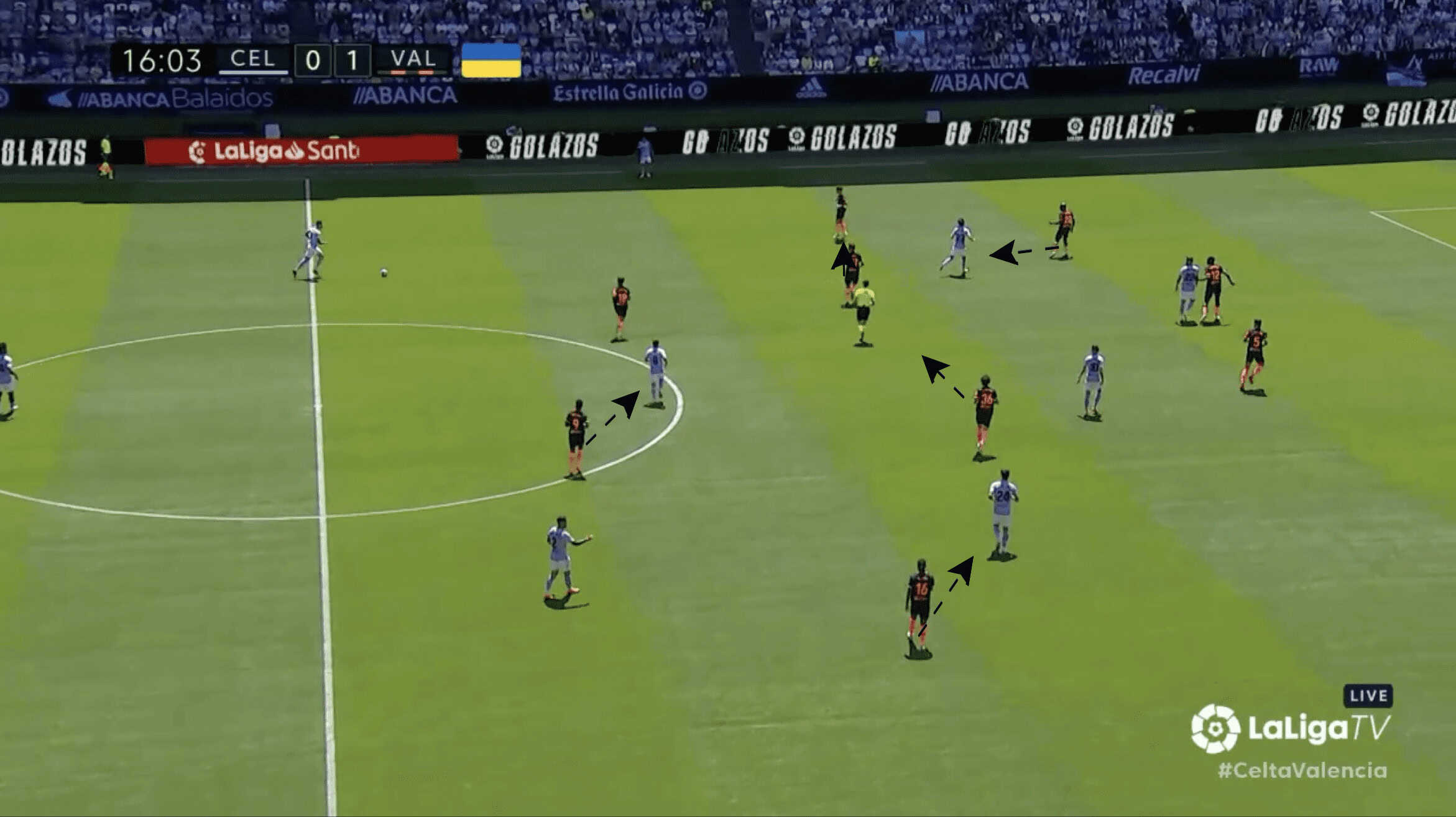
With four players across the midfield and good protection of passing lanes, the side can adequately defend one side of the pitch and be able to defend switches in play by the opposition.
This can be seen in the image below after the opposition right-back plays a pass to the left centre-back.
As a result, Valencia’s structure takes on a similar form to that of the previous example, with Nico González shifting to his right to reduce the space between him and Diego López.
Additionally, Dimitri Foulquier offers cover between them, similar to the cover provided by Gayà on the opposite side.
Although there are no glaring issues in the side’s defensive structures, in certain situations last season, it was apparent that a few players struggled with the timing and angle of pressure.
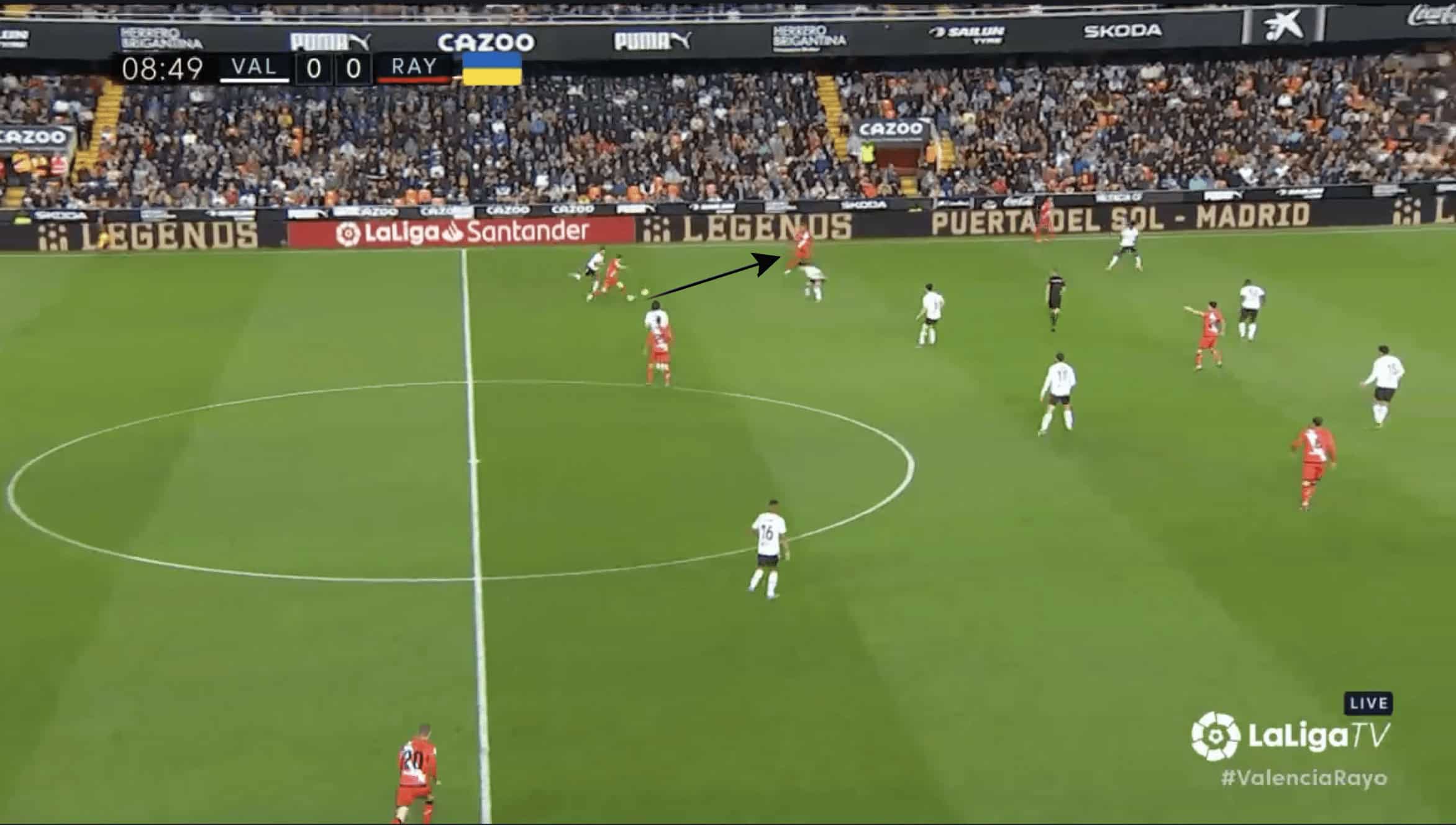
This can be seen in the example below: Justin Kluivert pressing the opposition full-back with a rounded run.
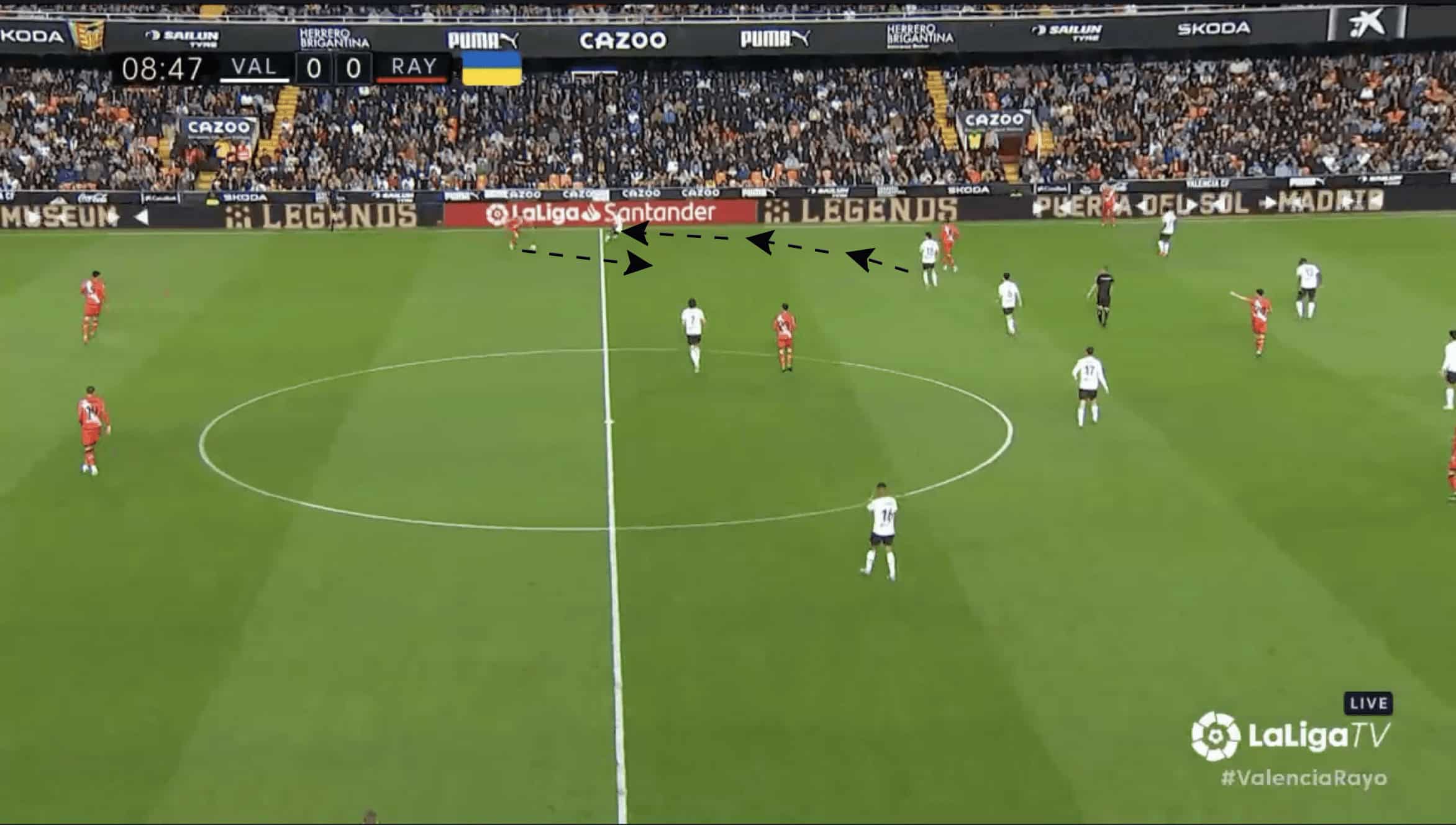
With this sort of angled run, as well as his flat body shape, Kluivert becomes relatively easy to beat in 1V1 situations and creates space for the player to attack, as seen in the image below.
As a result, the opposition full-back can engage both Kluivert and Almeida, which frees up a passing option to another player and allows the side to progress the ball down the wing.
On the left-hand side, Lino was also guilty of occasionally pressing with this type of run, which had the same resulting effect as the previous example.
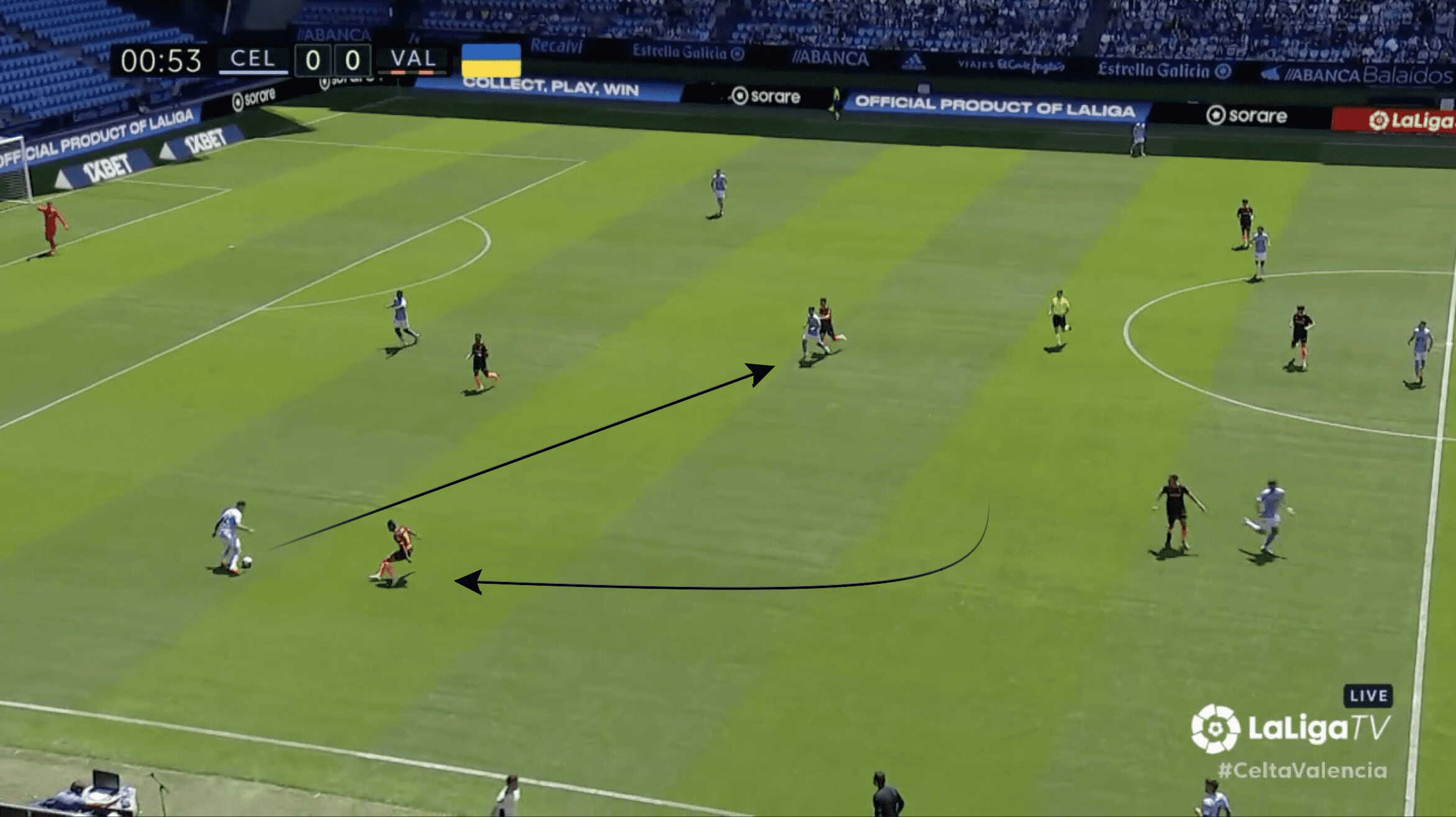
This can be seen in the image below, with Lino pressing at an angle that blocks access to the touchline but opens up space in the middle of the centre.
Although there is a 3v3 in this area, Lino’s pressing action has allowed the opposition to gain a positional advantage.
Valencia’s first two matches have strongly suggested that they do not intend to stray too far away from their structure and principles from the second half of the previous season.
Generally, the defensive security of the side has remained as stable as it was under Baraja in the last campaign.
However, this season, Mouctar Diakhaby has played as a central midfielder, not a centre-back.
This has harmed Valencia in the attacking phase of the game, particularly in terms of ball retention, but it has also exposed a couple of weaknesses defensively.
As mentioned earlier in this piece, Valencia’s midfielders were especially adept at defending the gaps between them to narrow passing lanes and prevent passes to players behind the line.
However, Diakhaby has often appeared heavy-footed in shifting across in time to prevent these passes.
This is illustrated in the example below.

Rubén Baraja Attack
At times, throughout last season and at the start of this season, it is clear that Valencia is less refined in possession than they are defensively.
This can be seen in the first stages of build-up, with the distances between players sub-optimal at times and an inadequate occupation of specific spaces that would aid the side in progressing the ball.
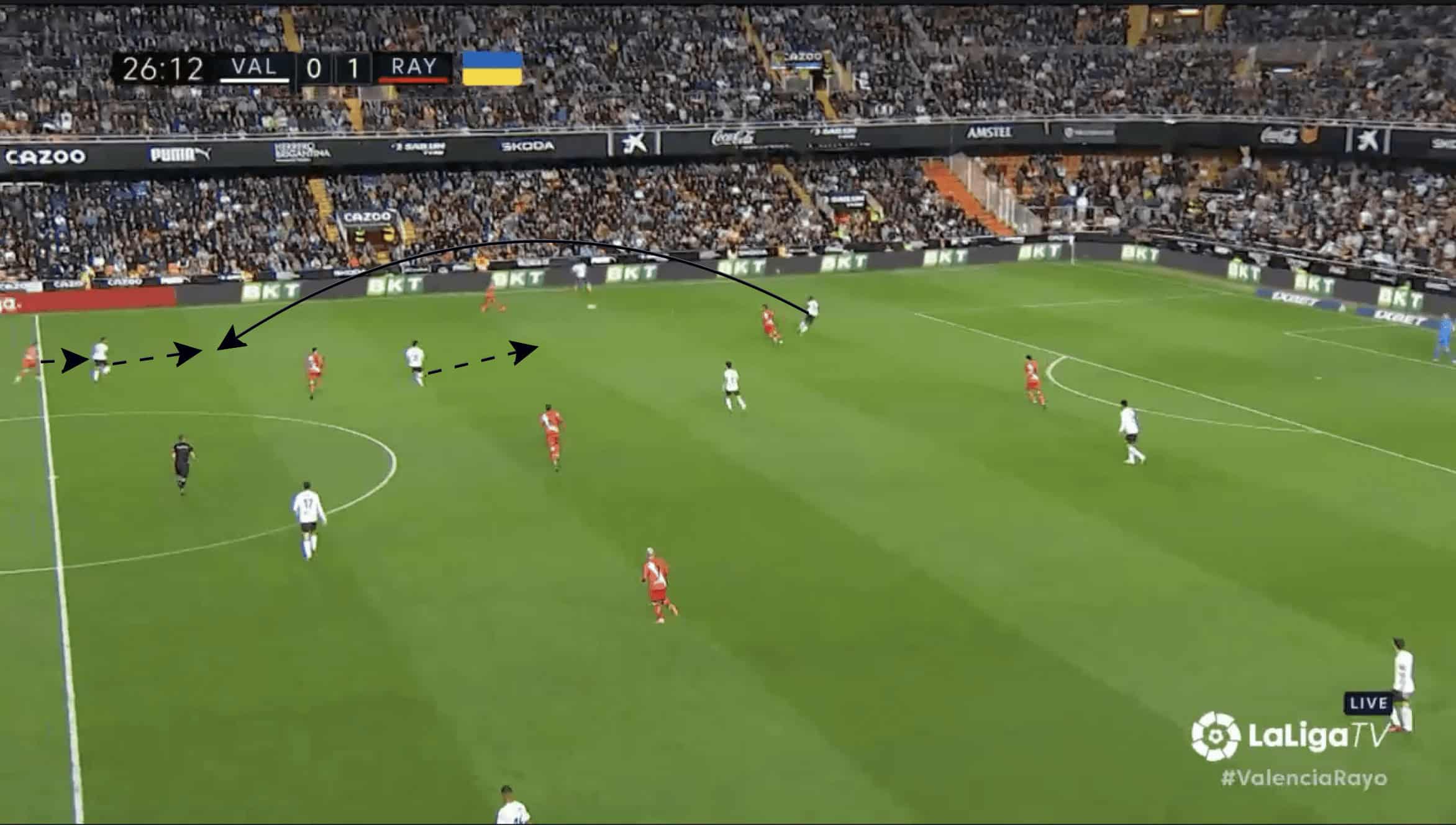
One aspect that worked to the side’s detriment last season was that wingers were always running towards their own goal to receive the ball, which resulted in difficulty receiving passes.
This can be seen in the example below, with Justin Kluivert running towards his goal to receive the ball with an opposition defender behind him.
An additional issue in this particular context is Almeida’s failure to move further towards the wide area and offer a passing option to Diakhaby, as well as a potential passing option for Thierry Correia, the right-back.
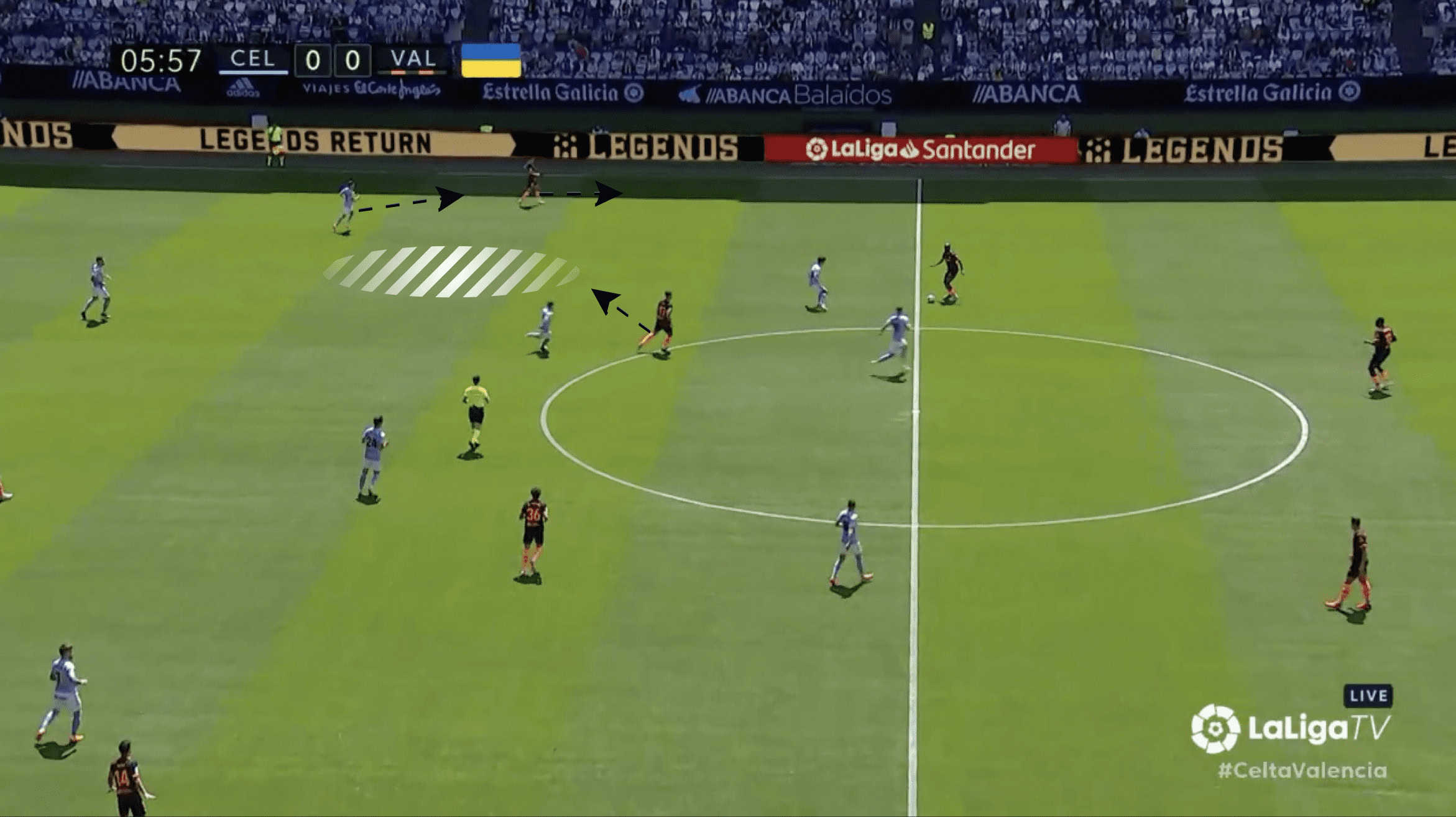
Towards the end of last season, the side began to utilise a back 3 in the build-up.
However, structural issues meant that the side still failed to find angles and connections that would allow them to progress the ball.
This can be seen in the image below, with the left winger once again in a position where they are running towards their own goal to receive the ball as the fact that there is no player present in the half-space to offer any meaningful support if the player were to receive the ball.
As a result, the sides have generally been unable to impose themselves on teams and dominate possession.
Before implementing their attacking identity, many managers have stated that their first priority is to ensure their side’s defensive security.
Although the side faces a few positional and structural issues in possession, this has not prevented them from finding solutions to create goal-scoring opportunities.
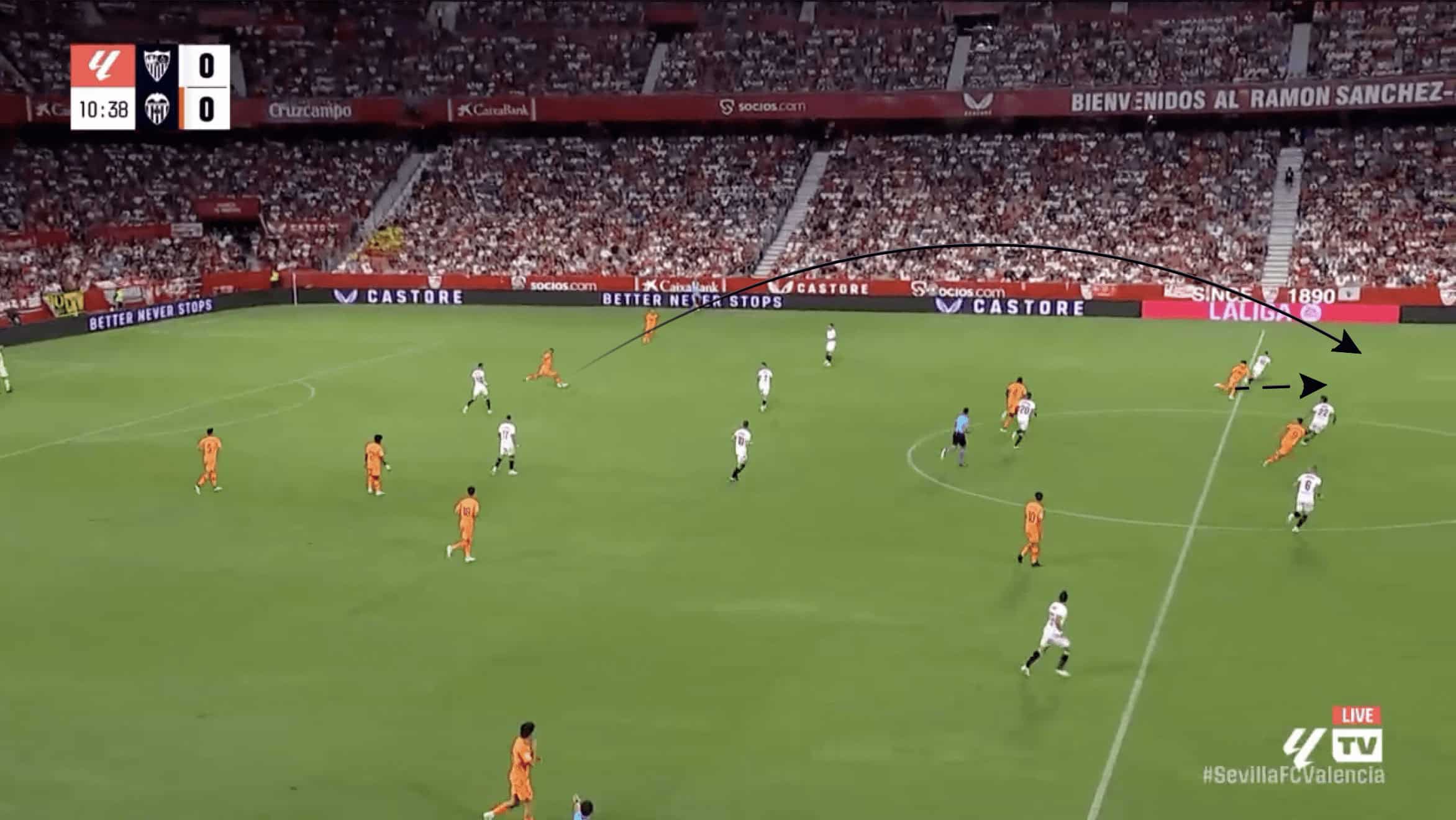
One aspect of the side that Baraja has looked to capitalise on is the relative youthfulness of the side, with their attacking 4 having an average age of 21.7 years old.
Although this may be alarming regarding experience, Valencia’s forwards are relatively quick and willing to chase long balls played into the space ahead.
This can be seen in the image below, with Diego López looking to run onto a pass from the centre-back Cenk Özkacar.
Conclusion
Valencia’s position in the league at the end of last season was not necessarily a true reflection of how the side had performed.
With a massive underperformance in front of goal and a defensive record amongst the top 12 sides in the league, Los Che may have been slightly unlucky last campaign.
Under Rubén Baraja’s style of play, as this analysis has explained, Valencia have been able to regain defensive stability.
Although still lacking potency in an attacking sense, there are signs that this season will not be as disastrous as the last.
However, with the ownership issues still lingering in the background, like many of his predecessors, Baraja may face many more hurdles to overcome.
