
In the 2020s, the Swedish Allsvenskan has been very competitive overall, but in the end, the result stayed the same for most years.
Over the last couple of years, Malmö FF have won four out of five Swedish top-flight titles, with only BK Häcken being able to win one in between so far this decade.
Things have changed drastically this season, however, with Malmö currently sitting in fourth place, 10 points behind the current league leaders, Mjällby AIF.
MAIF have played in the lower leagues of Swedish football for most of their history.
The club got promoted to the Allsvenskan for the first time in 2010 and stayed there for five years before getting relegated back to the Superettan five years later.
From then on, things quickly went awry.
In their first season back in the second tier, MAIF got relegated straight to the third division, had huge financial troubles, and nearly had to file for bankruptcy.
However, they turned things around and got promoted back to the Superettan in 2019.
They instantly won the league in 2020 and got back to the Allsvenskan for the second time in the club’s history.
MAIF stayed in the lower midfield of the league for the first couple of years but developed nicely under manager Anders Torstensson in his second stint at the club.
He finished fifth in the 2024 season and is currently leading the league by four points after 19 games in the 2025 season.
In this tactical analysis, we will examine the MAIF style of play under Anders Torstensson tactics, how they are dominating the league, and their near future, including whether the small club has the chance to actually win their first-ever piece of silverware this season.
Mjällby Bravery Through The Centre
The first thing I want to examine in this article isn’t necessarily a tactical issue like we usually do on this site, but rather something that could be described as the mentality or culture that the Torstensson team currently possesses.
MAIF is a very resilient team.
They look very prepared for every match and every situation.
They know exactly what they are doing, and that gives them some swagger to find solutions even under pressure or in tight situations.
Usually, Torstensson’s men line up in a 3-4-3 or 4-4-2 formation, and they fluently interchange these formations during games.
This puts a lot of pressure on the wings, but they are still able to play liquid football right through the heart of the pitch, the centre.

MAIF usually play through their wings quite a lot.
They did that at the start of the season, but teams obviously started to adapt to that.
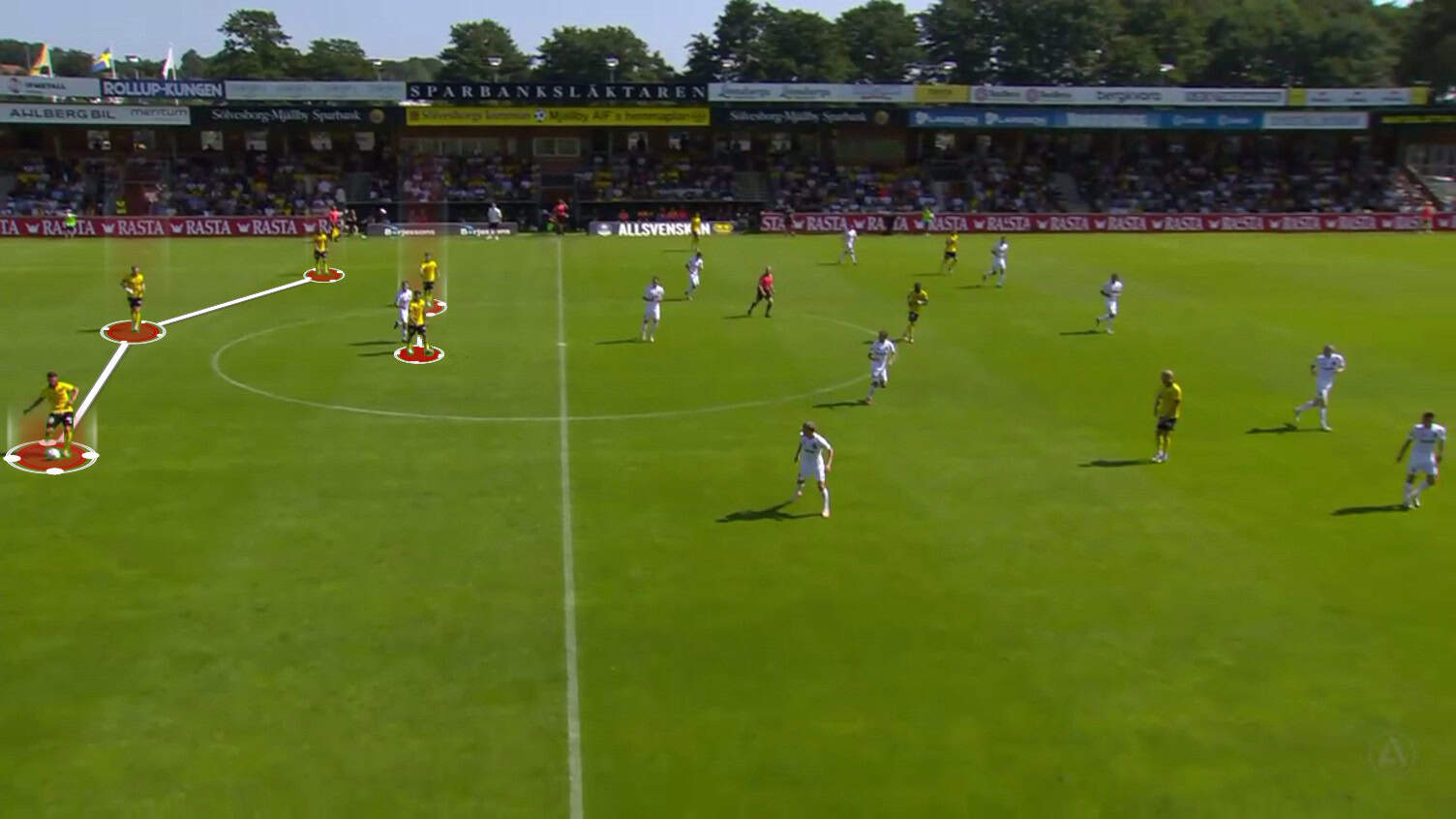
In the picture above, we can see the team once again setting up their wing play.
The centre-back dribbles forward and makes two movements in opposing directions on the wing, dragging the opposing full-back out of position and opening up the opportunity for a ball in behind the defensive line.
Their opponents know about this setup by now, so the left central midfielder closes the passing lane to the wing to cover for his full-back, opening up the centre of the field for MAIF.
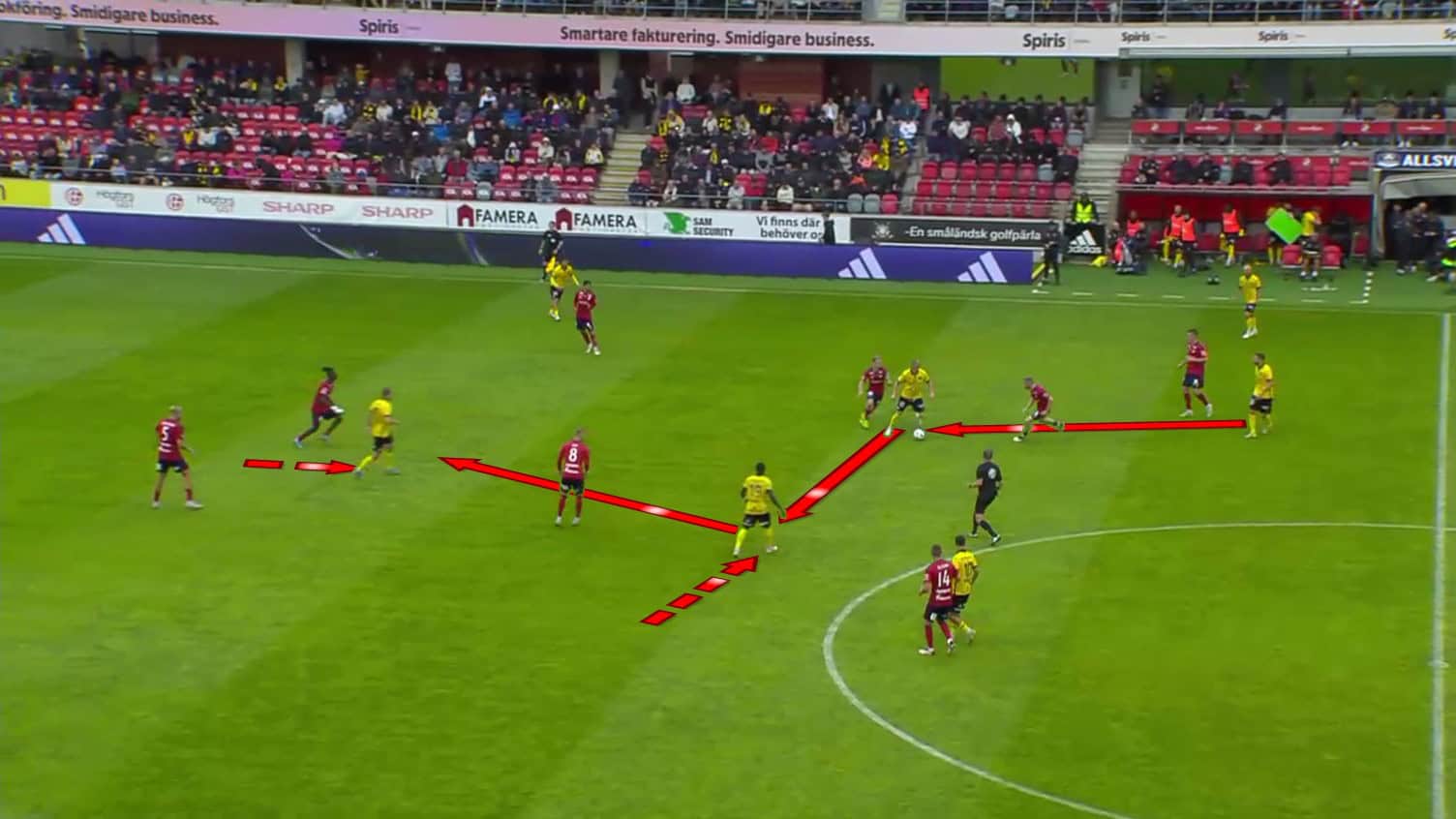
While it is not their usual strength and does not fit the pattern of play that the players usually perform on the ball, they still manage to find solutions with simple principles in these situations.
They play a vertical pass into midfield, right into the pressure.
Most teams would not do that with their wing play being set up; a loss in that area would be very dangerous, but Torstensson’s men currently have that kind of cocky attitude.
After the vertical pass, they play a quick layoff to the left attacking midfielder, who once again is under pressure, but plays another vertical pass with his first touch to his striker.
We see three passes in about two seconds, right in the centre of the field.
All are under pressure but still precise, cutting through the defenders and playing over the majority of them.
From there on, another layoff, another vertical pass and Jacob Bergström is through on goal, calmly scoring another one for the small club to keep their form going.
MAIF currently have the best attack in the Allsvenskan, and you can see why.
The players have a lot of faith in themselves and their teammates, allowing them to play beautiful football with that mindset, even when they are down and under pressure.
This attitude and looseness remind me a lot of Leicester City‘s title run in the Premier League 10 years ago.
Mjällby Build Up With Variance
As stated in the previous paragraph, Torstensson is primarily using two formations this season at MAIF: a 3-4-3 formation and a 4-4-2 formation.
They are not just used in different games; the team constantly switches between the two with and without the ball.
MAIF want to control the ball; they currently rank fourth in possession per game in the 2025 Allsvenskan season, with 53.3% of possession per game.
The team currently has the best attack in the league, and it all starts from the back.
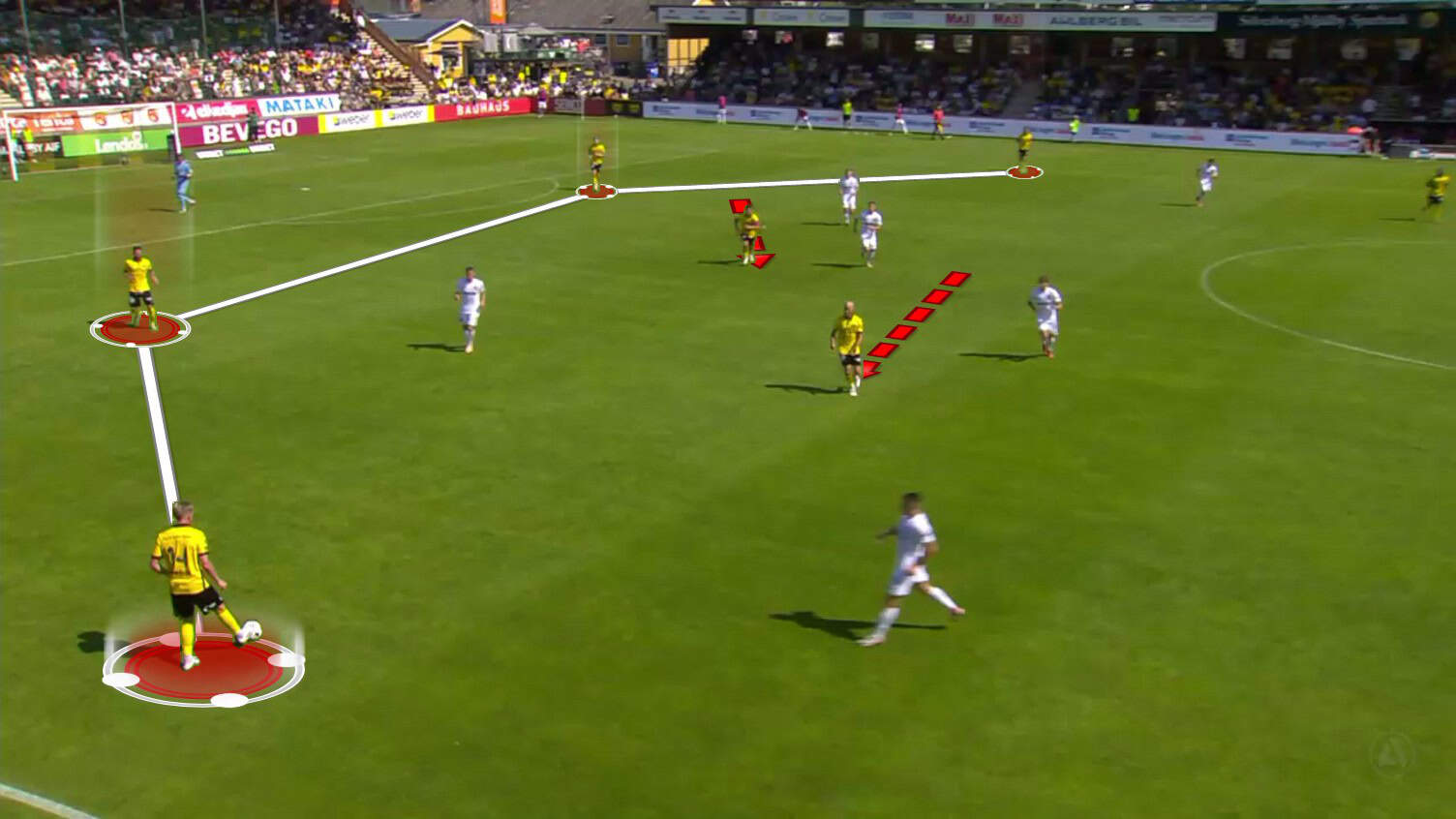
When building up in their first line, MAIF usually use their 4-4-2 shape to play through the opposing team’s first line of pressure, as seen in the picture above.
One full-back pushes high up the field, and the back three shifts to one side to form a back four in the build-up phase.
The full-backs are a couple of metres in front of the centre-halves.
They stretch out the play in their first line like that and force their opponents to react to that, creating space in the centre of the field or even just opening up the possibility for the full-backs to dribble past the first line of pressure with ease.
The space in the centre is then occupied by a double pivot that utilises the shadow football principle, a tactic also employed by coaches such as Roberto de Zerbi and Horst Steffen.
Looking at the picture, the near-sided central midfielder makes a run into the space right in front of the full-back, dragging one midfielder out of position, while the far-sided midfielder moves in his shadow and uses the space that got opened up that way.
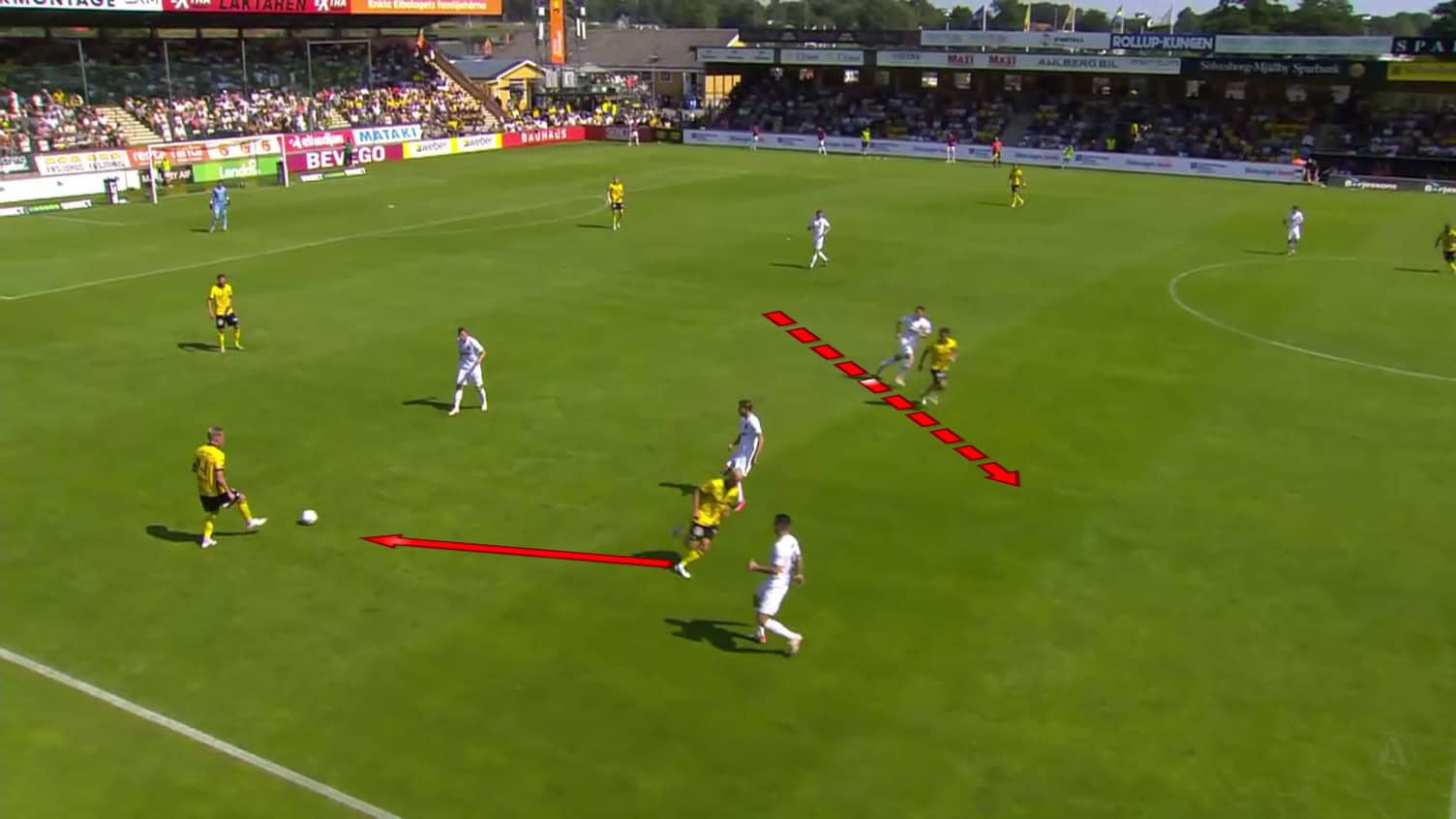
From there on, MAIF play a lot with opposing movements.
Here, we can see the near-sided midfielder making a run towards his right-back.
The far-sided midfielder instantly moves into the space right behind that run.
After playing the lay-off back towards his full-back, the other midfielder now also makes a delayed run, this time in the shadow of the far-sided midfielder.
With all of these movements going in opposing directions, the defenders have a lot of problems keeping up with the two midfielders.
Therefore, MAIF often manage to play through the first line of pressure with passes from their full-backs to the two central midfielders.
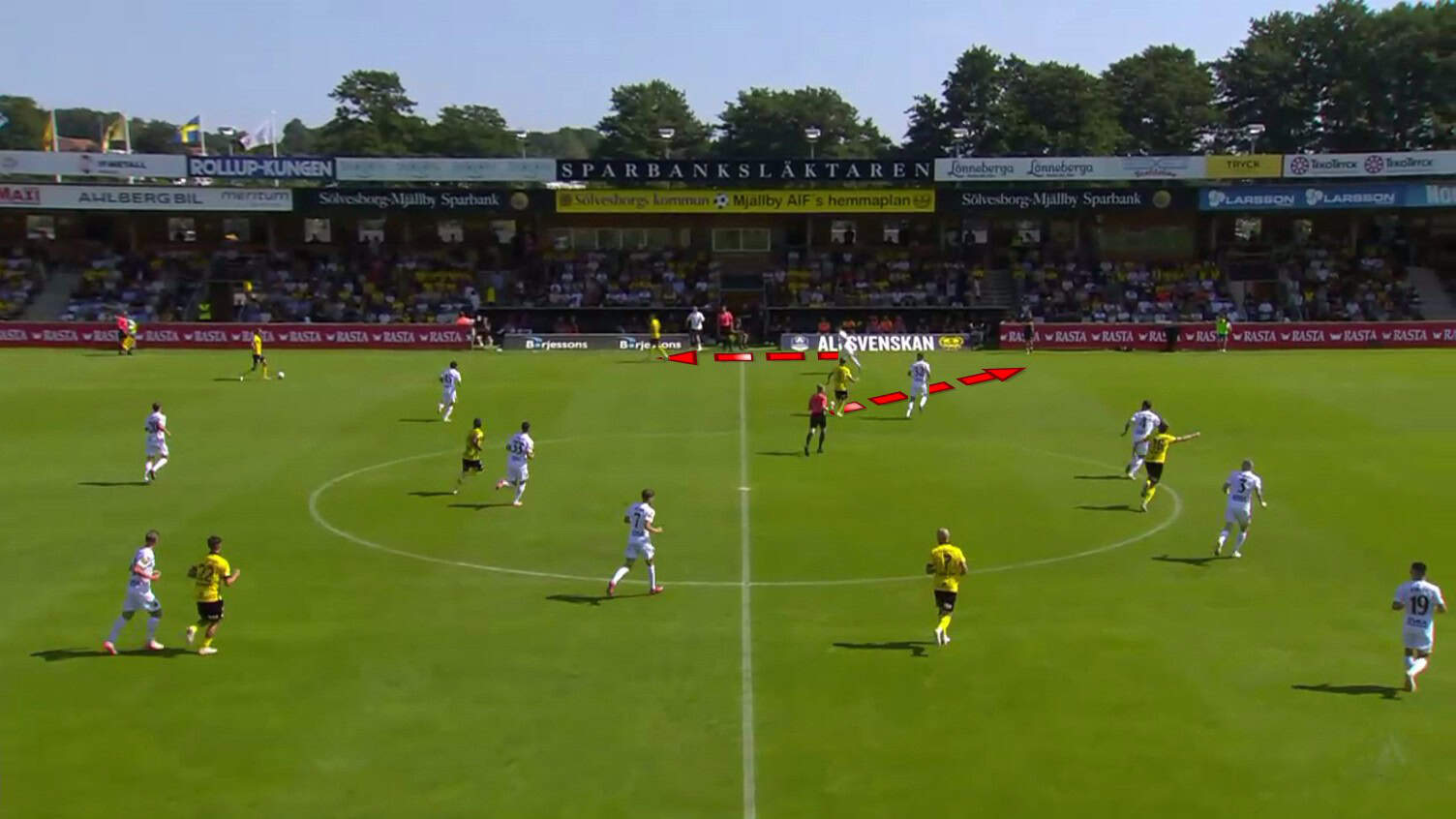
With their movements, MAIF often commit to one side of the field and overload it rather heavily, but this does not always work.
Sometimes, players simply decide not to trigger play and force things for no apparent reason.
After all, MAIF are incredibly secure on the ball and often try to keep possession when they are in the lead.
In this situation, they do not play through their right side because their opponent also committed to that side, so they just switch play through their two centre-backs towards their left-back.
With their opponent being forced to shift to one side, the left-back now has a lot of space in front of him and is able to dribble past the strikers and, therefore, the first line of press.
Looking at what happens down the field once again, Torstensson’s men are setting up their wing play by using opposing movements.
The winger drops back to drag the full-back out of position, and one of the midfielders now makes a diagonal run right into the back of the forward-moving full-back.
Their off-the-ball movement allows MAIF to consistently create opportunities for vertical passes, and they often don’t need much time to transition from their build-up into their attacking phase when they are facing an attacking press.
When building up in line two, Torstenssen has his men switch back to their 3-4-3 shape, which ends up as more of a 3-4-2-1 formation rather often, and goes into the 3-2-5 shape that many top teams in European football are currently using.
The key principles remain the same: the two central midfielders stay narrow and use shadow movements, and the centre-backs attempt to dribble forward and stretch the game out in their first line of play to prevent their opponent from gaining a foothold.
They create a 5-v-4 situation in their attacking line, stretching out the defensive block and opening up a player on numbers.
Often, players drop back in the half-spaces out of the attacking line to give the midfielders and defenders an option for vertical passes to break the lines.
Overall, MAIF are incredibly versatile on the ball, have a clear plan, and very good off-the-ball movement, which allows them to control the game at all times when in possession.
Mjällby Suffocating The Opponent
Anders Torstensson and his men currently have the best attack in the Allsvenskan, but that’s not all; after 18 games, they also have the best defense in the league, having conceded only 14 goals so far.
MAIF rank third in interceptions and sixth in defensive duels so far in the 2025 season, which shows how intense and effective they are at defending.
Their defence doesn’t start with their defenders; it begins with their attackers.
Torstensson lets his team play a very aggressive counterpress after losses, attacking every loose ball and every loss with a high intensity for about five seconds before they go into their defensive phase.
In their defensive phase, MAIF aren’t a team that attack very high up the field; they fall back behind the ball quickly and then play a midfield press onto the centre-backs out of their 3-4-3 formation that often turns into a 4-4-2.
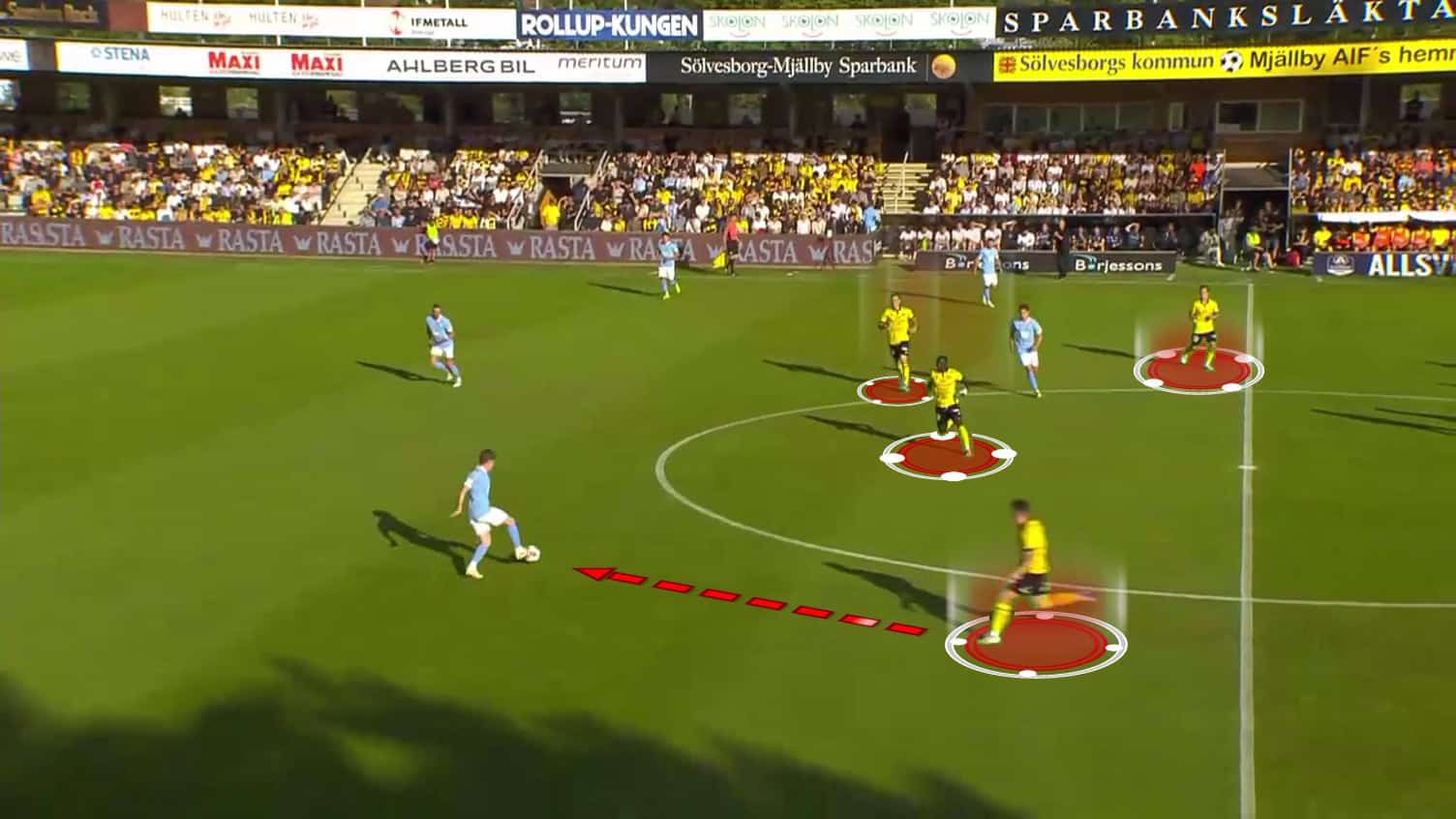
As we can see in the picture above, MAIF start their press in the opposing team’s half, but only when they are trying to get into their own half.
The two strikers stay very narrow and try to prevent passes into the centre of the field.
While the near-sided winger presses forward onto the ball, the far-sided winger pushes inwards to cover for the diagonal passing option.
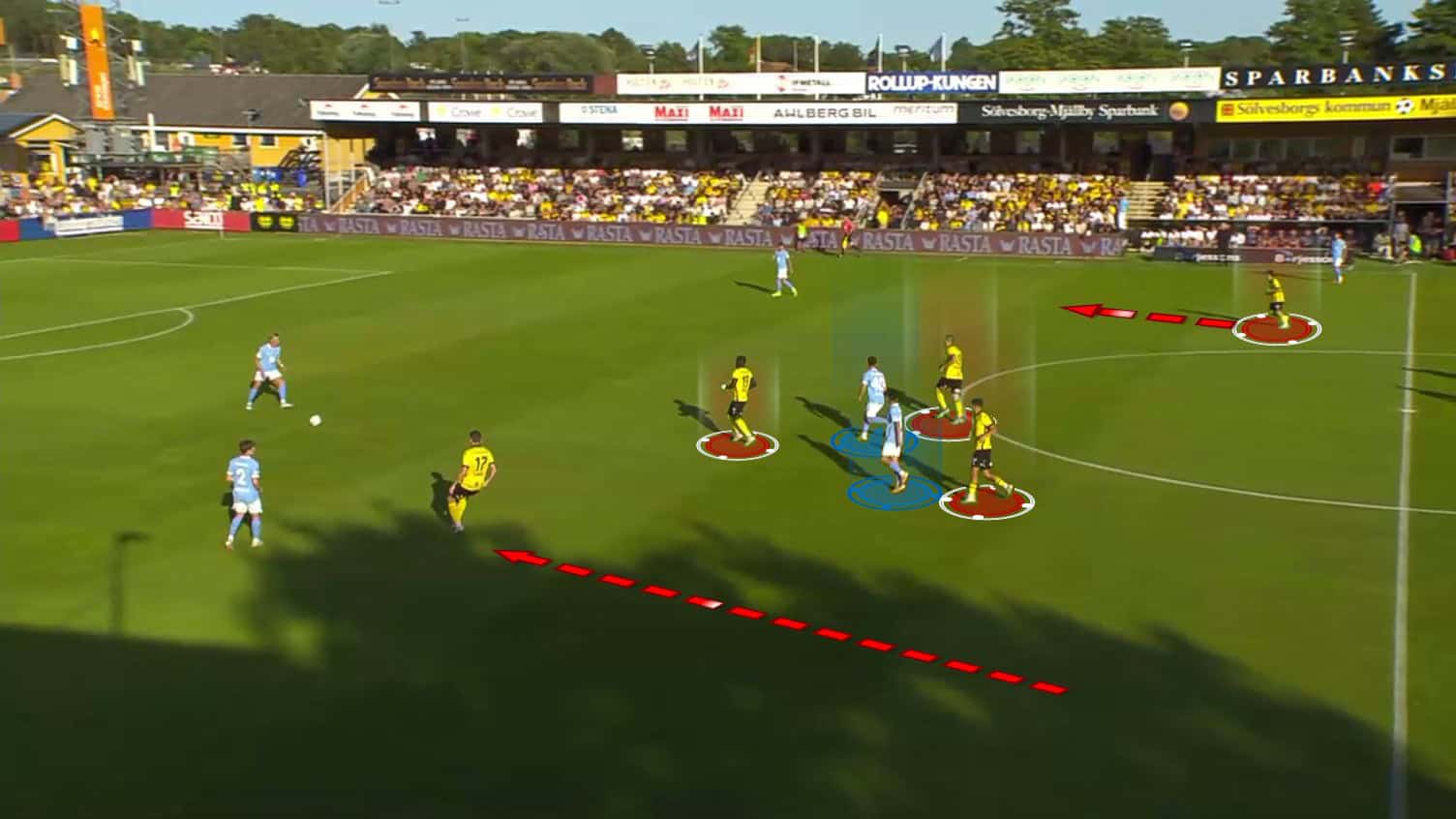
Even when their press is successful in the first phase, MAIF do not stop following their principles.
Malmö tried to outdo them by creating a numbers advantage in their own third.
Still, MAIF just committed one midfielder slightly more forward and created a 3-v-2 situation in the centre, preventing Malmö from playing through there.
The central player of the Malmö back-three is not getting pressed, but the two wingers are always ready to pounce on the passes to the outside players in the first line, making it incredibly hard for Malmö to get past the first line of pressure and into the MAIF half.
The key player here is Elliot Stroud, a young Swede who signed for MAIF two years ago, coming from the lower leagues of Swedish football, and is now leading the charge in their attacking press and is their top scorer with nine goal contributions so far this season.
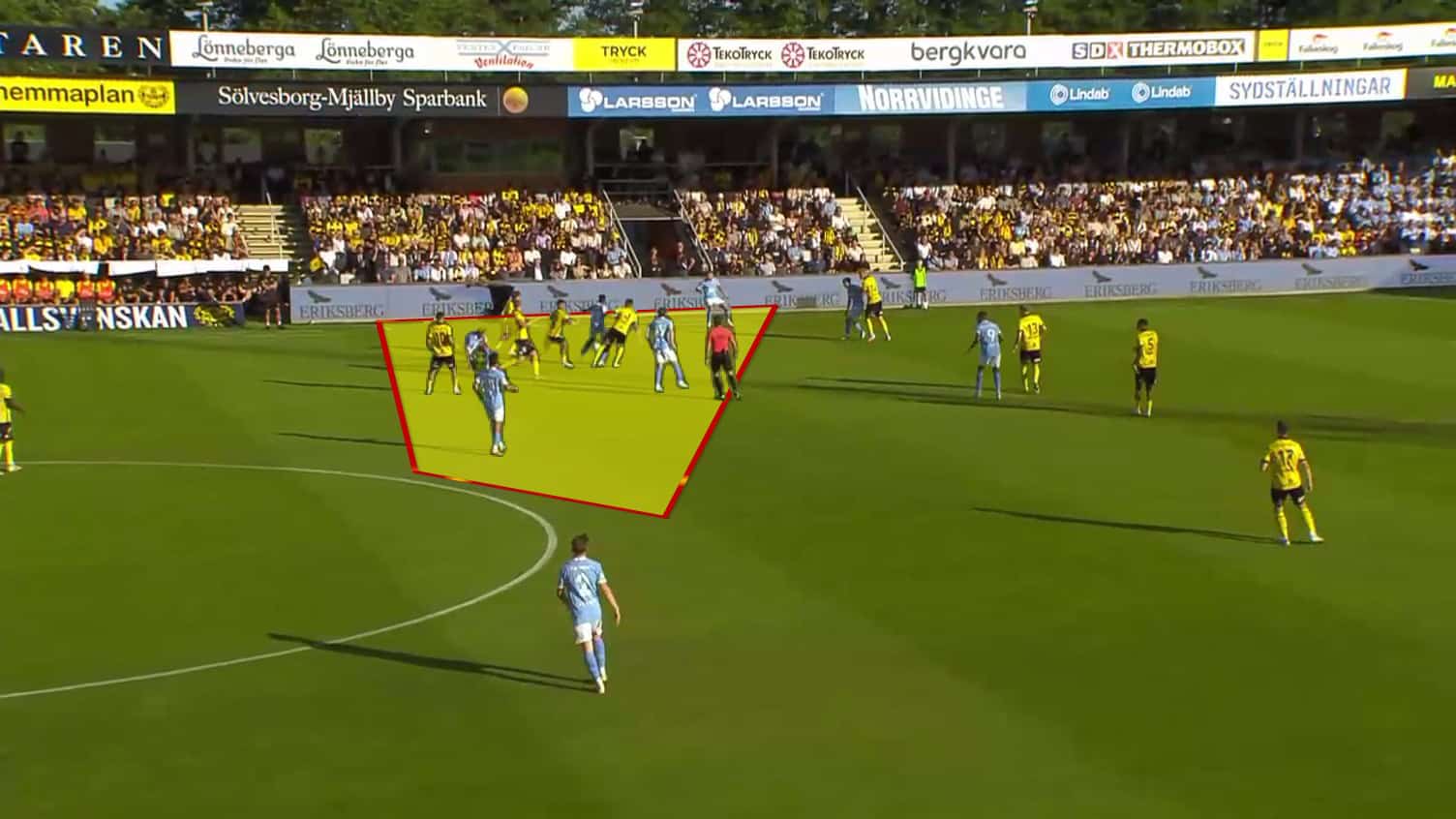
Another interesting tidbit: When forced to defend in their own half, the backline holds their positions pretty steadily and only defends forward when they have to, while all midfielders and strikers are completely crowding the area around the ball.
Just look at the picture above.
Five of Torstensson’s men are trying to get into a defensive duel, completely overloading this narrow space on the right defensive side and ultimately winning the ball.
With their suffocating press in midfield, MAIF have managed to barely even concede shots and goals in pretty much all games this season, proving the Anders Tostensson style of play works.
Conclusion
While finishing off this piece, I watched the Mjällby AIF game against Malmö on the side and I am still really impressed by the team.
With their swagger, their current form and their clear plan, they have the amazing opportunity to go down in the history books as maybe the most surprising Allsvenskan winner of all time.
They won the game in Malmö 3-1 this afternoon at the time of writing, effectively kicking the heavy favourite out of the title race.
MAIF are currently overperforming.
Yes, they are outperforming their xG, xGA, and expected points, but not by a huge margin.
This can be attributed to their good form and high confidence right now.
11 games are still a lot, and Hammarby IF are not that far off MAIF, but if they can keep on playing like they have over the last couple of weeks, the team has a very good chance to win the league this year.
