
The 2025/2026 Premier League season continues to evolve into one of the most tactically layered campaigns in recent memory.
With teams increasingly prioritising structured build-up, controlled possession, and transitional precision, the league’s attacking patterns are no longer defined purely by goals and assists, but by territorial manipulation and progressive value creation.
Expected Threat (xT) has emerged as one of the most insightful frameworks for evaluating how teams and players generate danger before the final action.
Rather than focusing solely on shots, xT measures how ball progression across zones increases the probability of scoring, offering a clearer understanding of sustained attacking pressure and structural dominance.
In this data analysis, we apply the xT model to the 2025/2026 Premier League season to explore tactical trends across teams and key players.
We will examine creative responsibility and spatial influence through case studies, including Bruno Fernandes at Manchester United and Dominik Szoboszlai at Liverpool, and assess how their involvement shapes attacking structures.
Understanding xT & Its Tactical Applications In Football
An advanced metric in football analytics, xT quantifies how players and teams increase the likelihood of scoring by advancing the ball through different areas of the pitch.
Unlike traditional statistics that focus on end outcomes, such as goals, assists, or shots, xT evaluates the incremental value of every action based on its location and effect on potential goal probability.
Each zone on the field is assigned a weight based on how advancing the ball through it increases the chance of scoring.
Passes, dribbles, and carries are all evaluated, allowing analysts to see not just who scores, but who consistently moves the ball into more threatening positions.
Expected Threat xT Zone Distribution
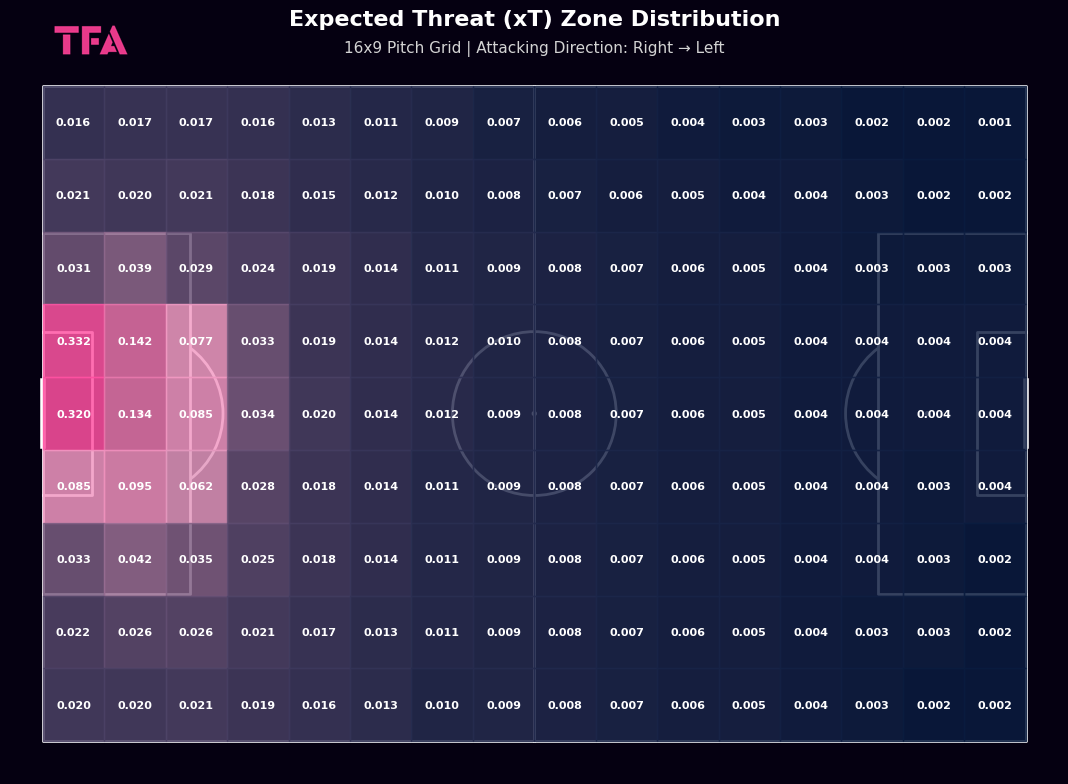
Tactically, xT provides coaches with deeper insights into how attacking structures function.
It can reveal which players excel at creating dangerous transitions, which channels or zones are underutilised, and how team shapes influence progressive threat.
For instance, a midfielder with a high xT contribution is not necessarily scoring, but is consistently positioning the ball to destabilise defensive lines.
Teams can leverage xT to optimise build-up patterns, identify key creators, and design pressing strategies that reduce opponents’ progression.
By understanding the spatial and temporal dimensions of threat generation, xT allows for a more nuanced, evidence-based approach to improving tactical efficiency and attacking effectiveness across matches.
Premier League xT 2025/2026: Tactical Context Behind The Numbers
According to expected threat (xT) rankings in the 2025/2026 Premier League up to Matchweek 26, Liverpool leads the division with 9,081 xT, followed by Manchester City on 8,604 and Arsenal on 7,525.
Measuring Territorial Progression Value & Final Third Threat Creation Across All 20 Teams – Premier League 2025/2026
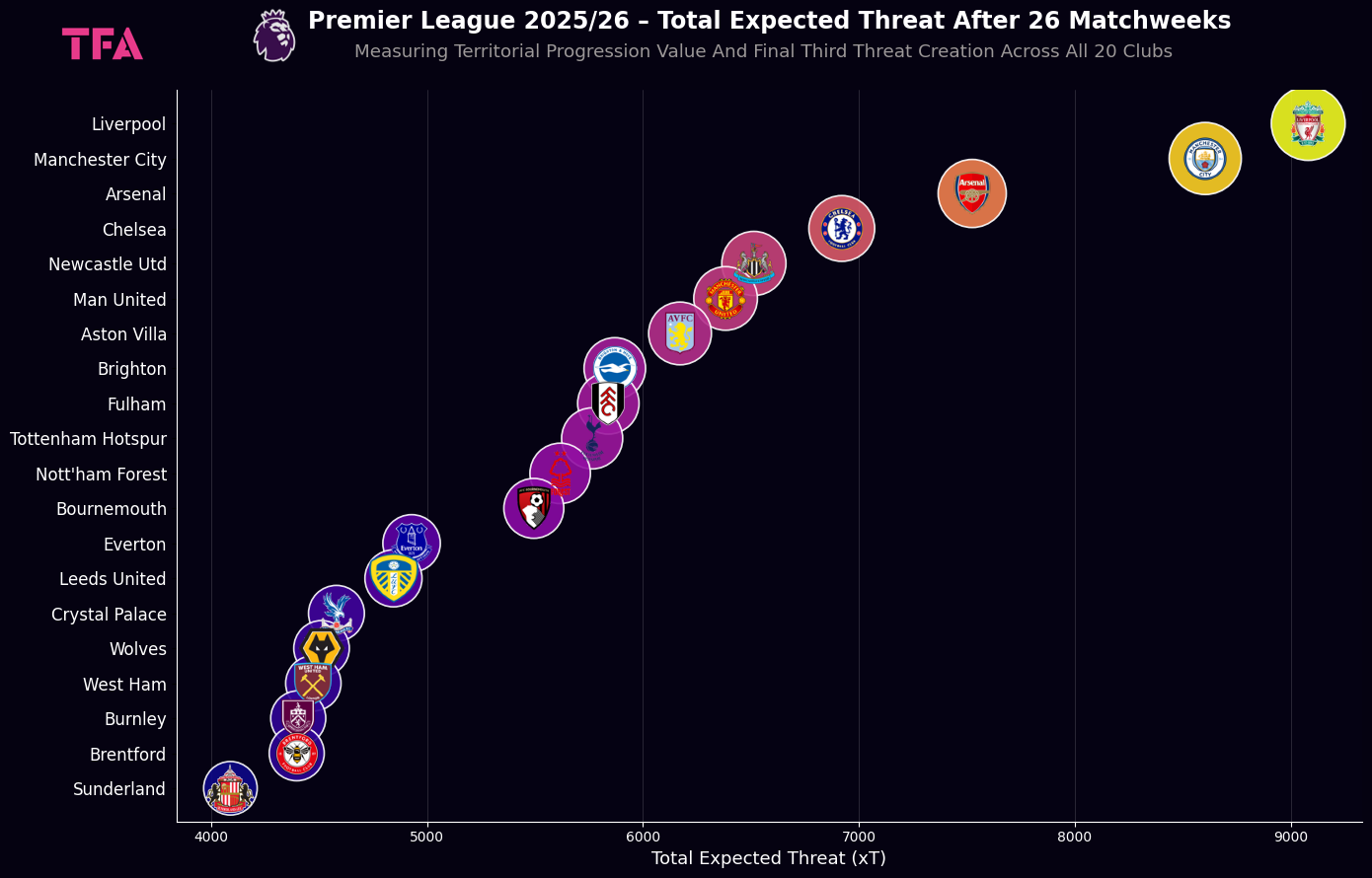
This metric quantifies how effectively teams advance the ball into high-danger areas, offering a way to assess attacking value beyond goals and assists.
Higher xT scores typically reflect greater ability to create sustained progression and destabilise opposing defensive structures.
Liverpool’s position at the top suggests a consistently proactive and progressive attacking shape, where transitions and build-up phases contribute to sustained threat.
Under Arne Slot, the Reds emphasise quick vertical transitions and structured patterns that push play into high-value zones, contributing to their xT generation.
Manchester City’s high xT is likely a product of Pep Guardiola’s possession-based dominance and patient build-up, where progressive passing chains and positional rotation effectively unlock defensive lines.
Arsenal’s third-place xT reflects Mikel Arteta’s tactical philosophy, which blends structured possession with fluid attacking patterns and a compact defensive base that retains the ball in threatening corridors.
Arteta’s use of inverted full-backs and creative midfield rotations increases their ability to generate danger through controlled progression.
Across the league, the variation in xT values highlights how managerial tactical diversity impacts threat generation.
Teams with higher xT generally display cohesive build-up, effective spatial manipulation and tactical flexibility.
In contrast, lower xT figures often indicate a more direct or conservative approach that sacrifices progressive possession for risk reduction or transitional play.
Premier League 2025/2026 xT: Top Creators & Tactical Influence
In the 2025/2026 Premier League season so far, Dominik Szoboszlai of Liverpool leads the xT charts with 1,007, a reflection of his all‑action influence in midfield and final‑third progression.
Premier League 2025/2026 – Top 20 Players Ranked By xT Rating
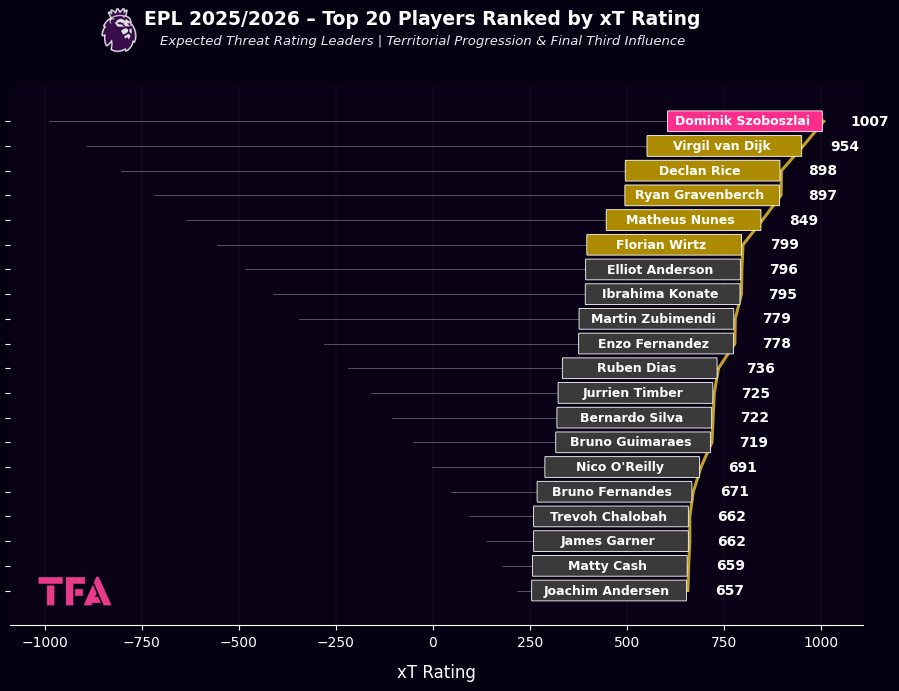
Szoboszlai’s ability to complete progressive passes into threatening zones, take set‑pieces, and link play vertically has made him one of the Reds’ most pivotal attacking outlets, blending creativity with positional fluidity under Arne Slot’s system.
His involvement in build‑up and transitional phases helps sustain Liverpool’s offensive structure.
Close behind, Virgil van Dijk, unusually high in xT for a defender with 954, underscores how modern centre‑backs contribute to progressive threat via long balls, diagonal switches, and set‑piece initiation from deep.
His composure and passing range steady Liverpool’s play from the back and feed attacking phases.
At Arsenal, Declan Rice (898 xT) has transitioned from a purely defensive No.6 to a complete midfielder, carrying the ball forward, winning duels and linking positional phases to drive Arsenal’s progression.
His stamina and ball‑carrying prowess complement the Gunners’ structured build‑up.
Ryan Gravenberch (897) of Liverpool similarly excels in linking defence to attack, shielding the back line while advancing play effectively.
His reading of the game and transitional control add to his xT influence.
Other contributors like Matheus Nunes (849) at Manchester City, Florian Wirtz (799) at Liverpool and Enzo Fernández (778) at Chelsea demonstrate how midfield versatility, creative vision and positional rotation help teams generate danger across the pitch.
City’s patient build‑up often sees Nunes progress play through central channels, while Wirtz’s attacking intelligence aids Liverpool’s final‑third penetration.
These high xT players anchor their team’s tactical identities, from structured possession and progressive passing to transitional creativity and spatial manipulation, showcasing the varied ways individuals influence attacking threat beyond mere goal contributions.
Comparing xT & xG – Tactical Implications For Top Creators
In analysing Premier League players across the first 26 matchweeks, the distinction between Expected Threat (xT) and Expected Goals (xG) becomes tactically illuminating.
xT measures how effectively a player progresses the ball into threatening areas, whereas xG reflects the probability of a shot resulting in a goal.
Notably, a high xT does not always coincide with a high xG, nor does a high xG imply an elevated xT.
Top EPL 20 Players Ranked By xT & XG Rating
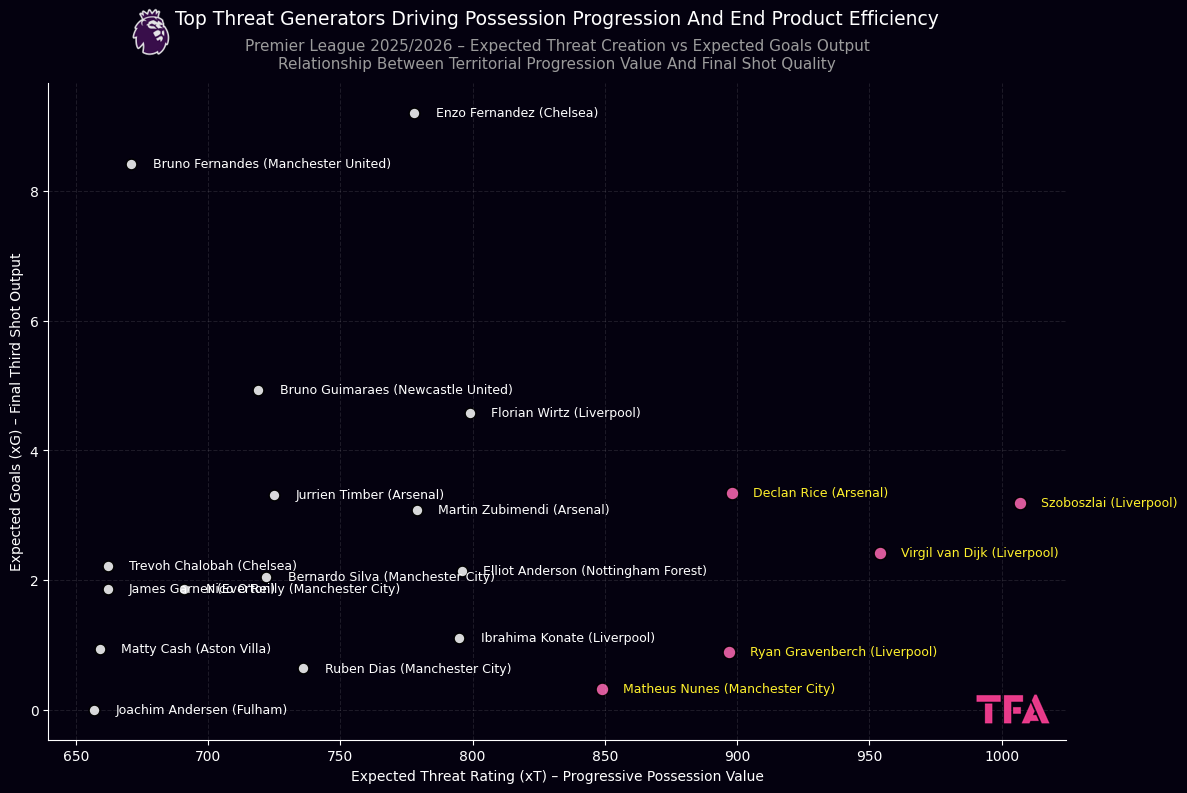
For instance, Dominik Szoboszlai (xT 1007, xG 3.19) excels at moving the ball into dangerous positions, linking play and creating attacking opportunities without necessarily finishing himself.
Similarly, Ryan Gravenberch (897 xT, 0.9 xG) demonstrates immense progressive influence through transitional control and midfield link-up; his direct shooting output is modest.
Conversely, Enzo Fernández (778 xT, 9.2 xG) or Bruno Fernandes (671 xT, 8.42 xG) show high goal expectancy despite comparatively lower xT, highlighting roles focused on finishing rather than territorial progression.
Tactically, the xT-xG relationship provides coaches a dual lens: xT identifies creators and structural influencers, while xG identifies finishers.
Understanding discrepancies between the two allows managers to optimise player roles, pressing schemes, and positional rotations to maximise both ball progression and scoring opportunities, ensuring holistic offensive efficiency.
Dominik Szoboszlai – xT As A Model Of Progressive Influence
Dominik Szoboszlai of Liverpool exemplifies the tactical significance of Expected Threat (xT) in modern Premier League play.
Leading the 2025/2026 xT rankings with 1,007, Szoboszlai’s influence extends far beyond conventional goal metrics.
His xG at 3.19 highlights his primary role in progressing play rather than finishing.
Dominik Szoboszlai Chance Creation & xT Zone Impact – Premier League 2025/2026
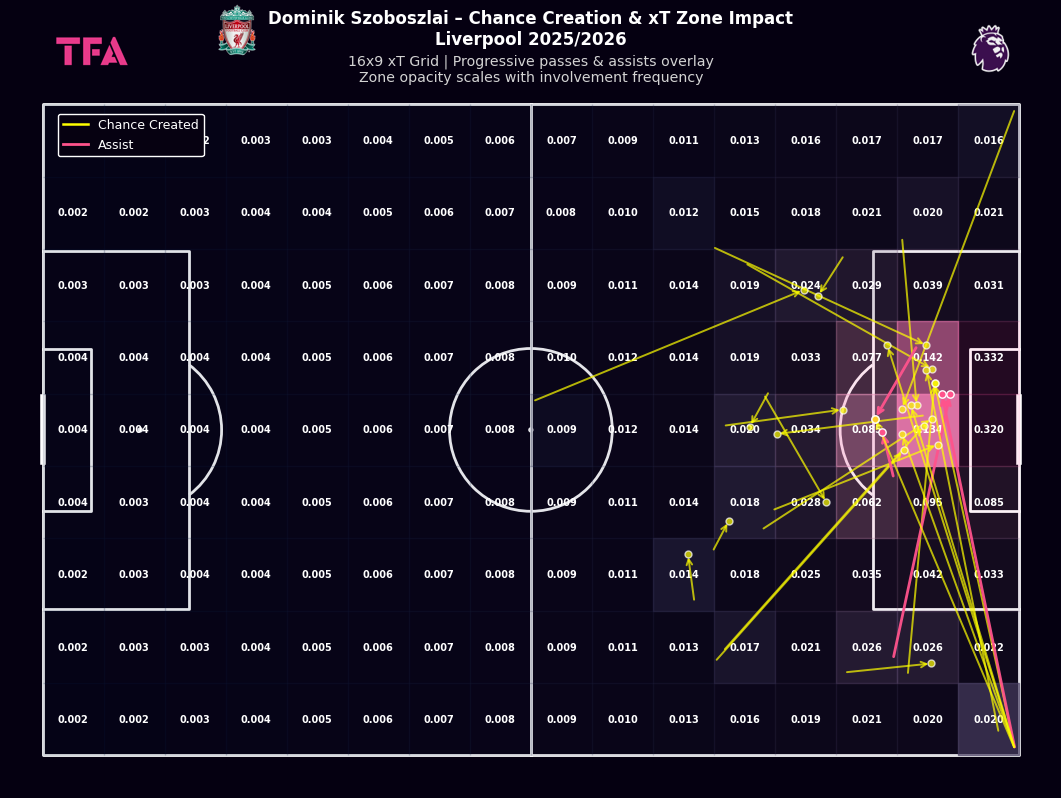
With 47 created chances, including a variety of set-piece contributions, he orchestrates attacking transitions, linking midfield to final third and positioning the ball into high-danger zones.
Under Arne Slot, Szoboszlai’s spatial intelligence and ball-carrying ability destabilise defensive structures, providing Liverpool with sustained offensive momentum.
He embodies the modern playmaker whose tactical value lies in territory gain and chance creation rather than direct goal output.
Bruno Fernandes – xG & Creative Output In Tandem With xT
In contrast, Bruno Fernandes of Manchester United illustrates a complementary yet distinct model of influence, ranking among the top 20 in xT with 671.
At the same time, his xG of 8.42 underlines his direct scoring threat.
Fernandes has created 76 chances, converting 12 into assists, reflecting both his creative vision and end-product efficiency.
Bruno Fernandes Chance Creation & xT Zone Impact With Manchester United 2025/2026

His role combines progressive ball movement with final-third penetration, bridging the gap between structural build-up and tangible outcomes.
Tactically, Fernandes exemplifies a dual-impact midfielder, capable of influencing positional play and generating expected threat, while simultaneously delivering measurable goal-scoring contributions, making him pivotal to United’s attacking identity and overall offensive efficiency.
Conclusion
The 2025/2026 Premier League season underscores the growing tactical sophistication within English football, where attacking influence extends beyond goals and assists.
Expected Threat (xT) has proven a pivotal metric, quantifying how players and teams generate progressive value by advancing the ball into dangerous areas.
Analysis of top performers, such as Dominik Szoboszlai at Liverpool and Bruno Fernandes at Manchester United, highlights contrasting complementary models of influence.
Szoboszlai exemplifies a playmaker whose spatial intelligence and ball-carrying drive structural progression, while Fernandes blends creative vision with finishing efficiency, bridging build-up and end-product outcomes.
Team-level xT patterns reveal the importance of structured possession, transitional fluidity, and positional discipline, with Liverpool, Manchester City, and Arsenal demonstrating how tactical philosophies translate into sustained threat.
Understanding xT alongside traditional metrics such as xG equips managers with a nuanced lens for optimising player roles, build-up patterns, and attacking efficiency, emphasising that modern football rewards both progressive creators and decisive finishers alike.
