
After one-third of the season played, Hammarby currently sit third in the Swedish Allsvenskan.
Despite a disappointing loss on Sunday against IFK Värnamo, which saw them slip from joint-top, the Stockholm side are just three points off Häcken at the summit of the table.
With the two sides meeting when the league resumes after the international break, there is every chance Hammarby will return to the top of the league.
New head coach Martí Cifuentes, a former Ajax youth coach, has his side playing a distinct possession-based style of play, similar to that of his old club.
The rewards of this approach are clear to see.
The Spaniard already has his team competing at the top end of the league and only missed out on the Swedish Cup by a penalty shootout loss in the final against Malmö.
This analysis will be presented in the form of a scout report focusing on how Hammarby’s positional play approach and domination at set-pieces have contributed to their positive start to the season.
In this tactical analysis, we analyse the key tactics behind Hammarby’s successful start to the 2022 campaign.
Martí Cifuentes Positional play
 Hammarby average 59% possession in the league this season and have had most of the ball in all 10 of their matches.
This includes a massive 72% possession in their 3-3 draw with last year’s Allsvenskan runners-up AIK.
The Swedish Cup finalists have completed the most passes in the league this season, averaging 537.39 per 90 minutes and are the most accurate passers with 87.5% of their passes finding a teammate.
They are also first in the league for progressive passes with 78.53, way above the league average of 68.17.
These impressive statistics are achieved through their positional play approach.
As shown in the above tactical diagram, Cifuentes’ team play in a traditional 4-3-3 with one defensive midfielder and two more advanced central midfielders.
The key to their positional play is that these three midfielders all occupy different vertical lanes.
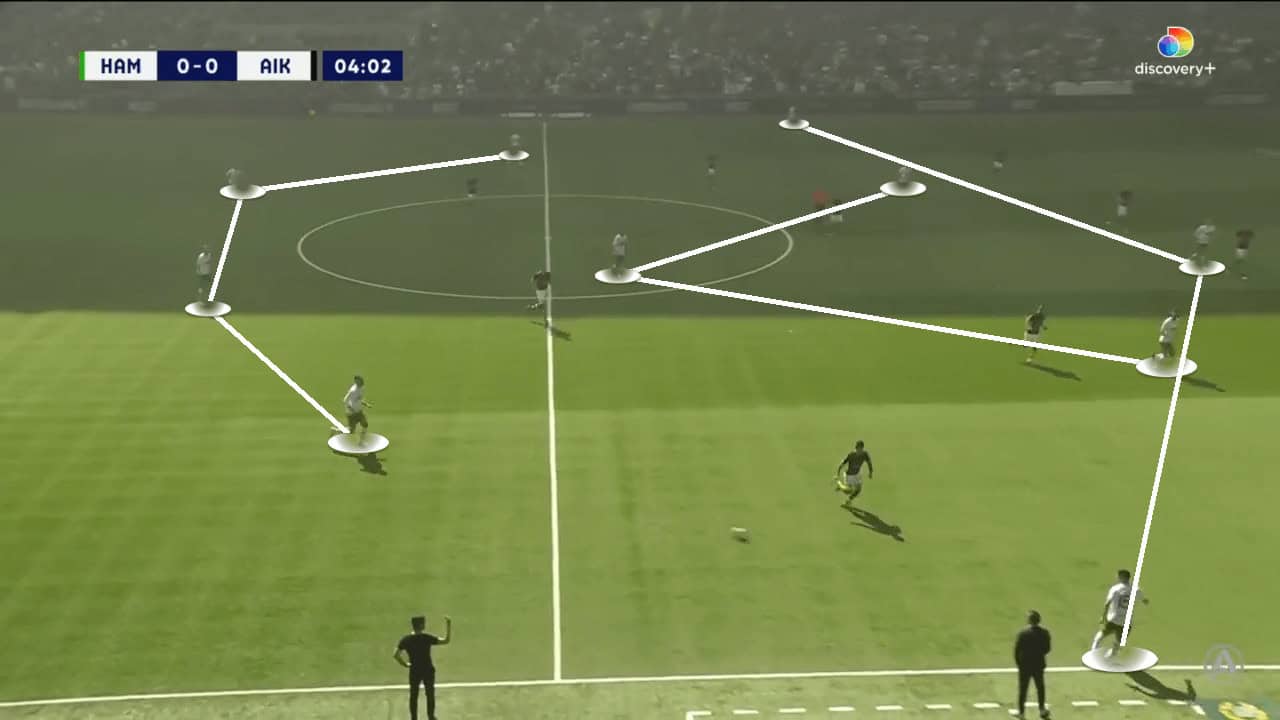 The above image shows the three central midfielders occupying different lanes (in the half-spaces and central area).
The defensive midfielder drops deep to receive the ball from his centre-backs, while the two central midfielders are in advanced positions.
The central midfielders are behind the opposition’s midfield and are almost as high as the opposition back-line.
This effectively creates a front 5, with the two central midfielders in between their three forwards, spread across the entire width of the pitch.
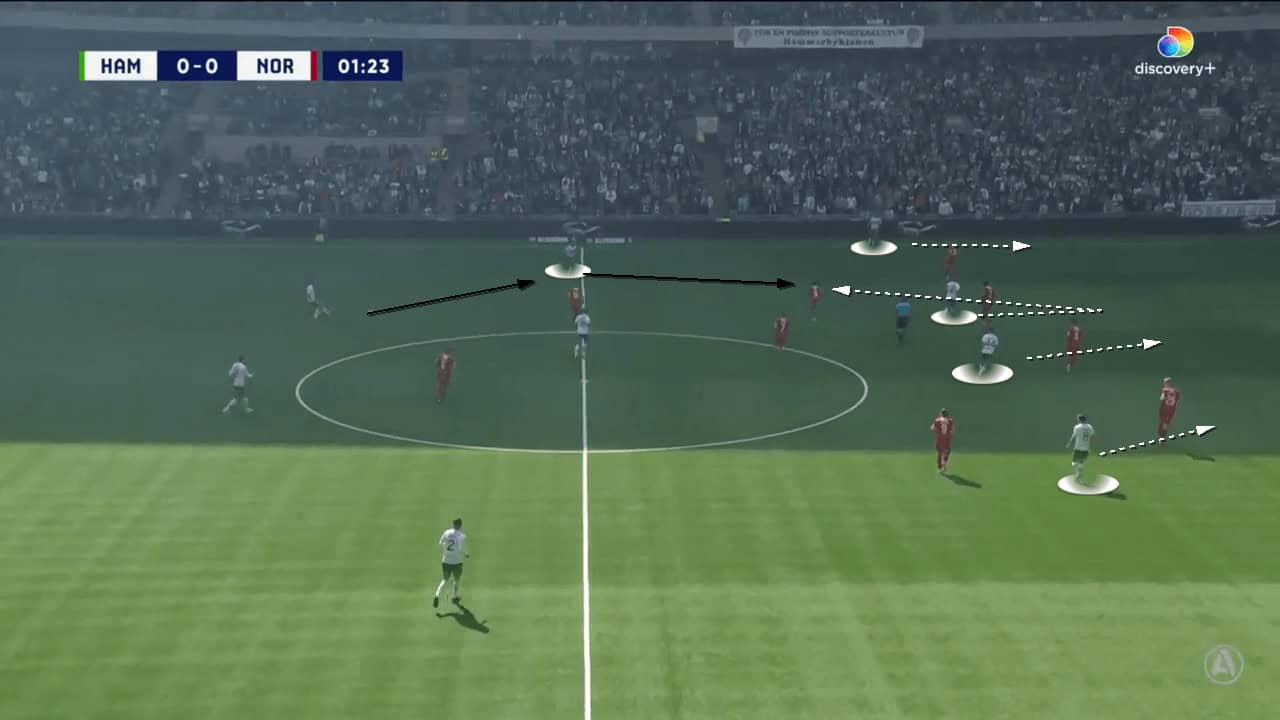
The above image shows the left centre back about to pass the ball to his left-back with Hammarby in a 4-1-5 formation with forwards occupying all 5 vertical lanes (the right-forward is high and wide, out of shot).
Arsenal also uses this type of structure under Mikel Arteta tactics.
As the ball is played into the left-back, this is the trigger for the advanced players to make runs in behind.
With at least one player always making a threatening run into the space behind, this makes it hard for the opposition to maintain a high line.
In this scenario, the opposition’s backline drops off, creating space between their midfield and defence.
Hammarby’s nearest central midfielder then makes a double-movement to receive the ball into his feet.
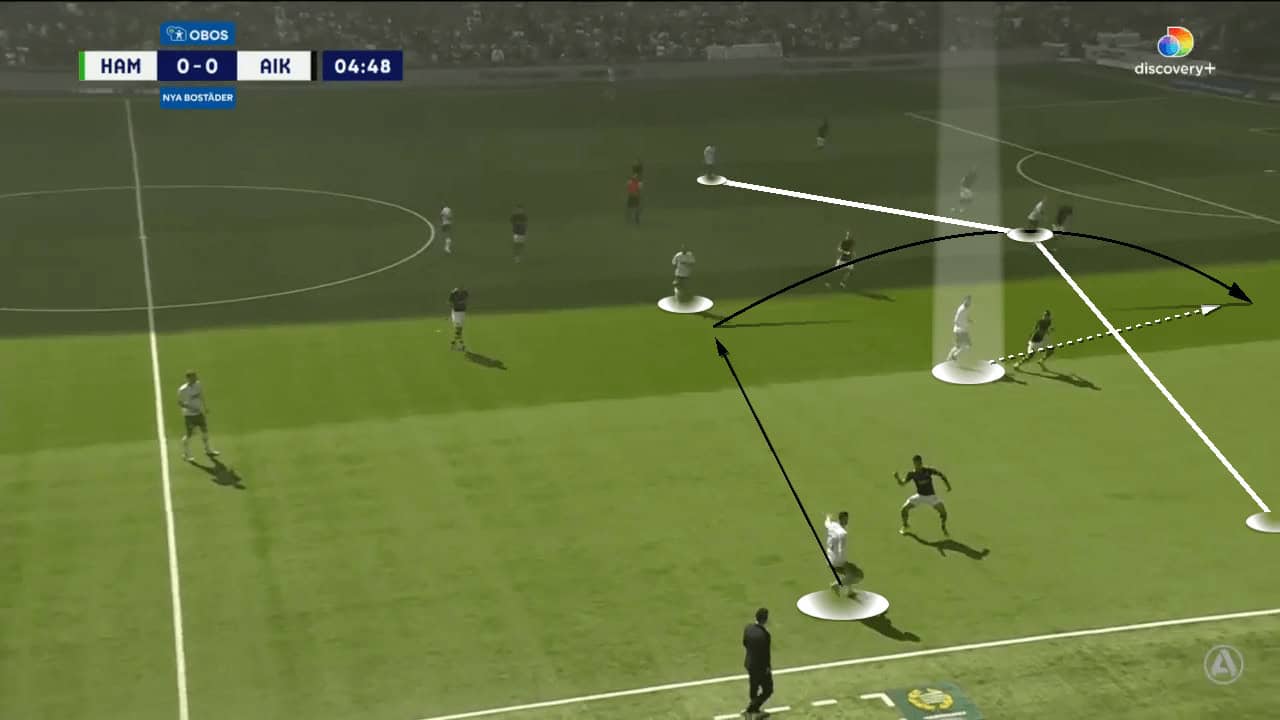 Being in these advanced positions also allows the central midfielders to make runs to receive the ball in behind the opposition back-line.
In the above scenario, the right-back has just received the ball, triggering the central midfielder to make a run in behind.
Just out of shot, the right-forward is high and wide and is showing for the ball, forcing the opposition left-back to close him down.
With the centre forward in the central area occupying the ball-near centre-back, a gap has been created between the centre-back and left-back.
The central midfield player being in an advanced position in the half-space allows him to run through this gap.
The right-back passes the ball inside to the other central midfielder, who plays his teammate in behind.
The ball-near central midfielder runs onto the pass and delivers a dangerous cut-back into the box.
Martí Cifuentes Inverted full-backs
Another important element of positional play that is evident in Hammarby’s shape is the relationship between their full-backs and wide forwards.
Typically, when the full-backs are inverted, in the half-space, the wide forwards stay high in the wide areas, providing the width and vice-versa.
Cifuentes often has his full-backs and wide-forwards using their positioning to combine with one another and get in behind the opposition’s full-back and into areas where they can deliver cut-backs.
 The above image depicts a very similar pattern of play to that in the previous section when the central midfielder made a run in behind from the half-space.
This time it is the left-back, number ‘5’ Mohanad Jeahze, who has recently been linked with a move to Celtic, who is making that run.
As the inverted Jeahze received the ball and drove forward with it at his feet, the ball-near central midfielder, instead of running beyond, moved towards the ball.
The left-back then passed the ball to the left-forward, which encouraged the opposition right-back to leave his position and close the forward down.
When the Jeahze saw the gap open up between the centre-back and left-back, he ran between them and was played in by his forward.
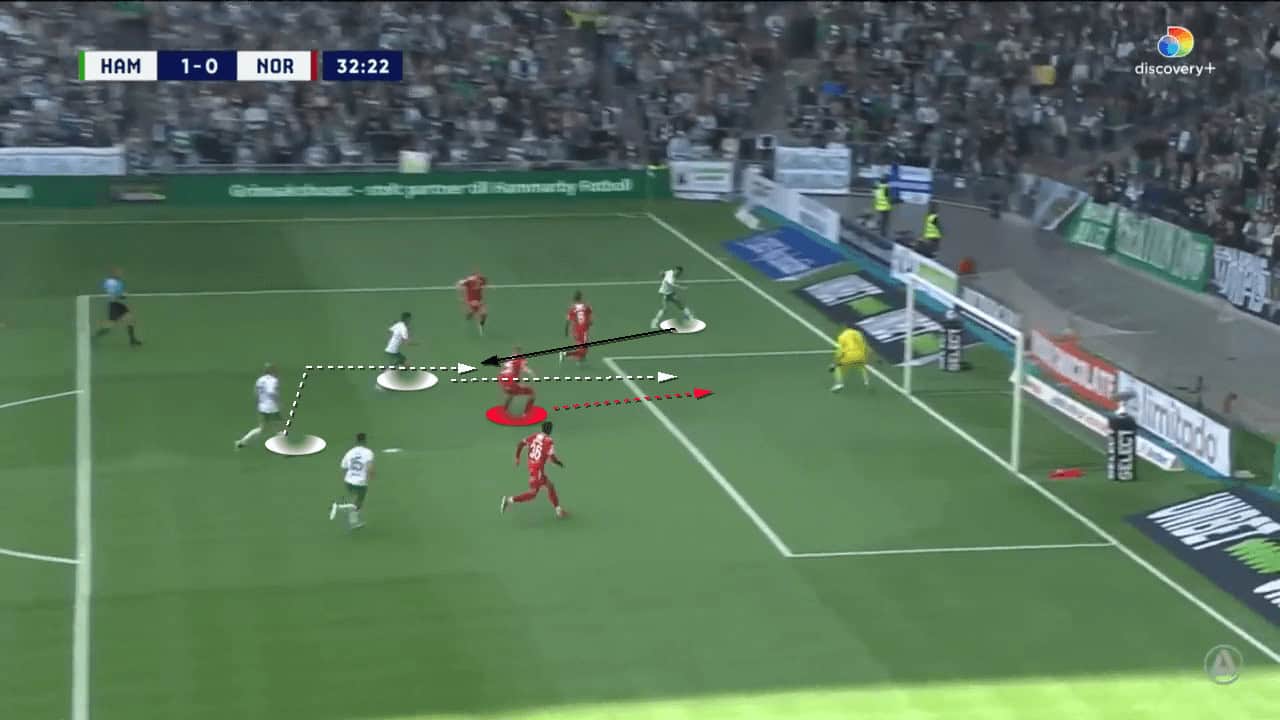 The above image shows the moments after Jeahze has received the ball beyond the opposition backline and is about to cut the ball back.
The nearest attacking player to the ball made a direct run to the front post, taking the defender with him.
The central midfielder, who originally ran to the penalty spot, cut to his left and into the space his teammate had vacated for him to receive the ball.
The ball-far central midfielder is only able to get on the end of the cut-back and score from close range because of his advanced position in the build-up phase.
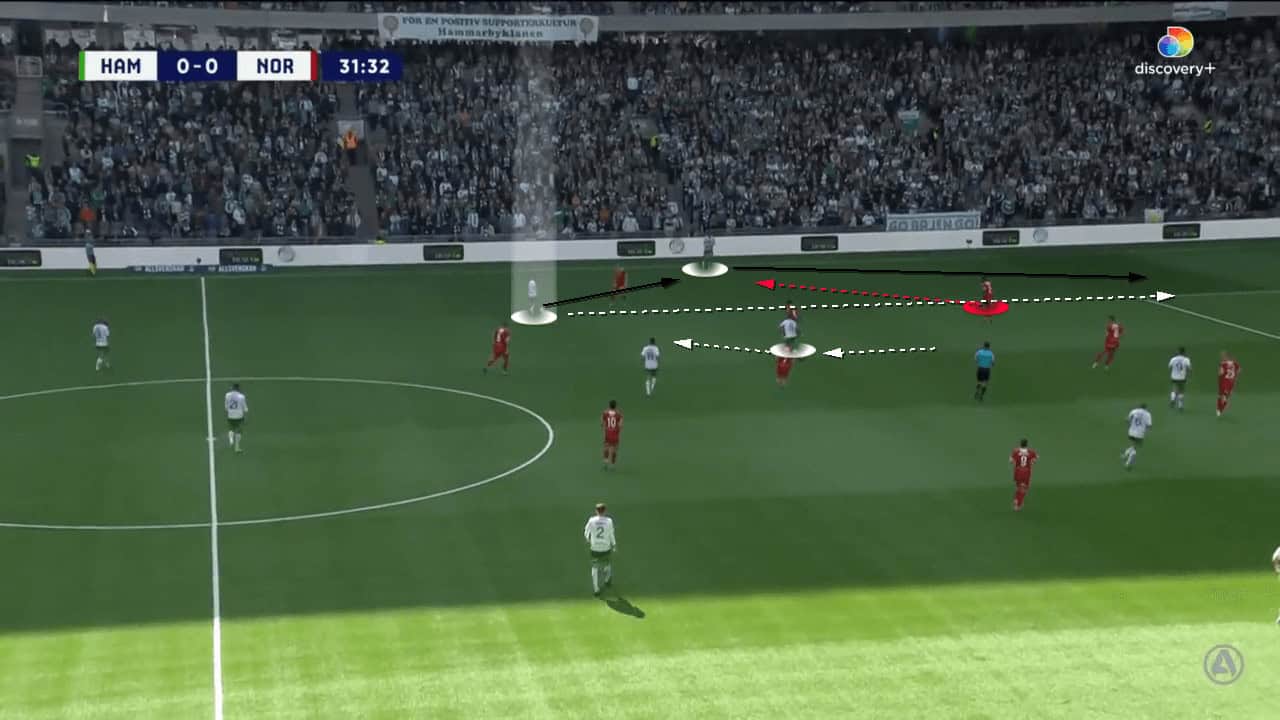
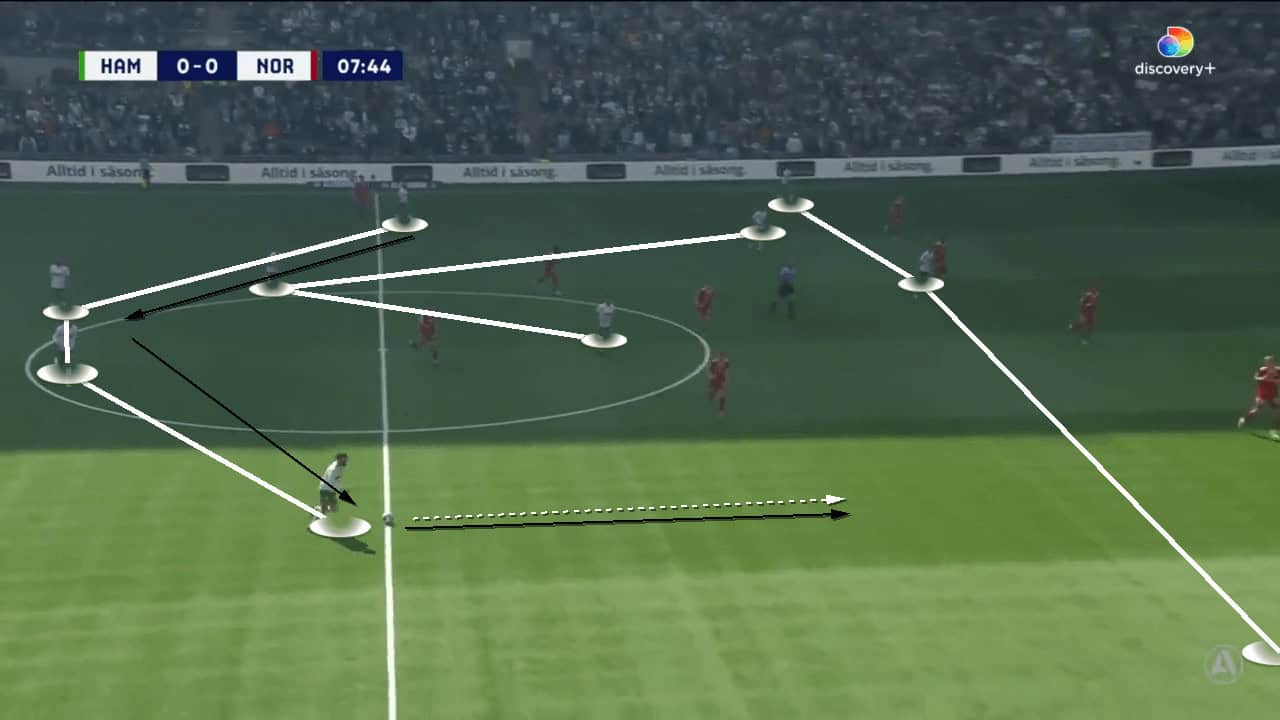 On the occasions where Hammarby’s three midfielders get bunched on one side of the pitch, they switch the ball to their inverted full-back.
The above image shows the moment the right-back, number ‘2’ Simon Sandberg, is about to receive the ball after a switch of play.
When Sandberg receives the ball, he immediately attacks the space in front of him.
The widest opposition midfield player, who is closing him down, is then pinned in place, which prevents the midfield unit from shifting across the pitch.
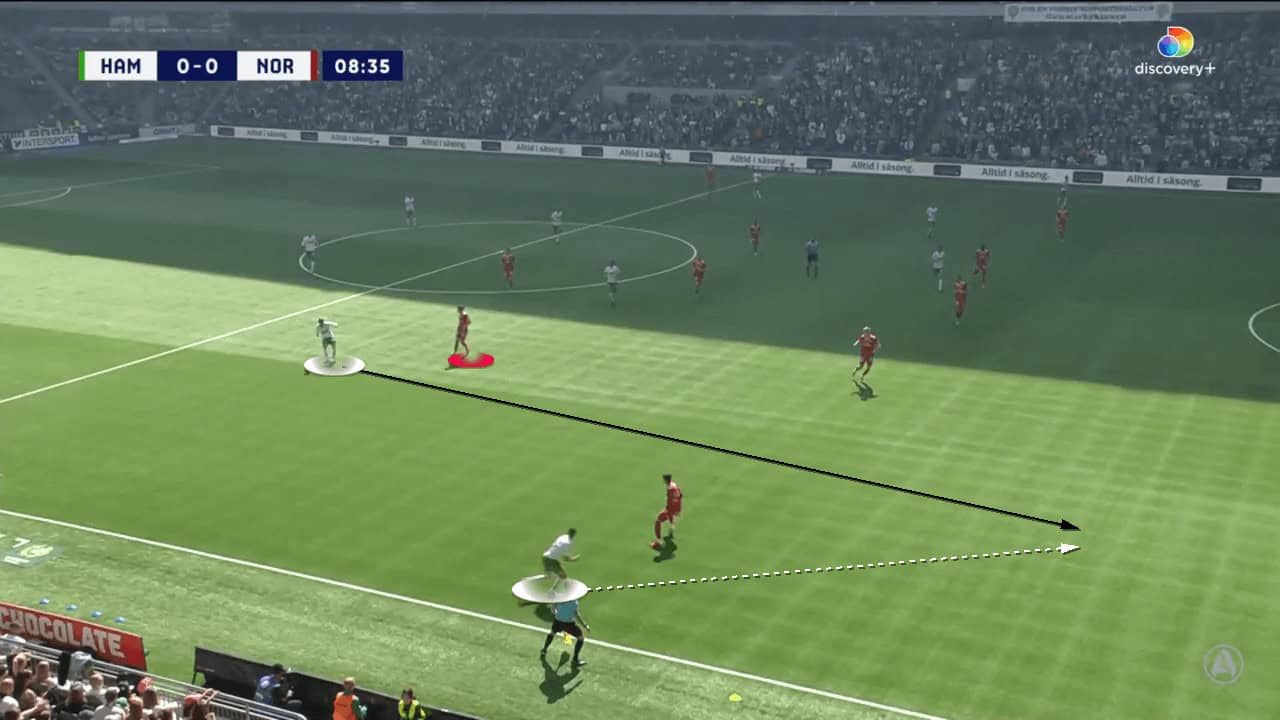 This isolates Sandberg’s right-forward, who is high and wide on the flank, one on one with the opposition left-back.
As happened in this situation, if the opposition full-back gets tight to the wide-forward, there is enough space for the full-back to play a through ball inside the opposition full-back.
Martí Cifuentes Set-pieces
A major reason for Hammarby’s positive league form this season has been their domination at set-pieces.
Averaging almost a goal per game, with nine goals scored and zero conceded, Cifuentes’ side have already equalled their total goals from non-penalty set-pieces for the whole of the 2021 Allsvenskan season.
These have come from various set-pieces, including corners and both crossed and direct free-kicks from different zones around the box.
The ingenuity and effectiveness of Hammarby’s set-piece routines lie in both the simplicity of their design and their clinical execution.
 For this outswinging corner routine, Hammarby group four players together around the penalty spot and one player in the 6-yard box.
One player remains at the edge of the box and there are two players over the ball.
By having two players over the ball, the likely response from the opposition is to send two players out to the ball.
Coupled with the opposition’s zonal set-up, this gave Hammarby a numerical advantage resulting in them having an unmarked player in the box.
Two of the four grouped players perform a screen for their teammate, who is the target of the delivery, to run unopposed to the front half of the second six-yard box.
As the target player makes his run, his unmarked teammate, number ‘44’, makes a run to the back-post area.
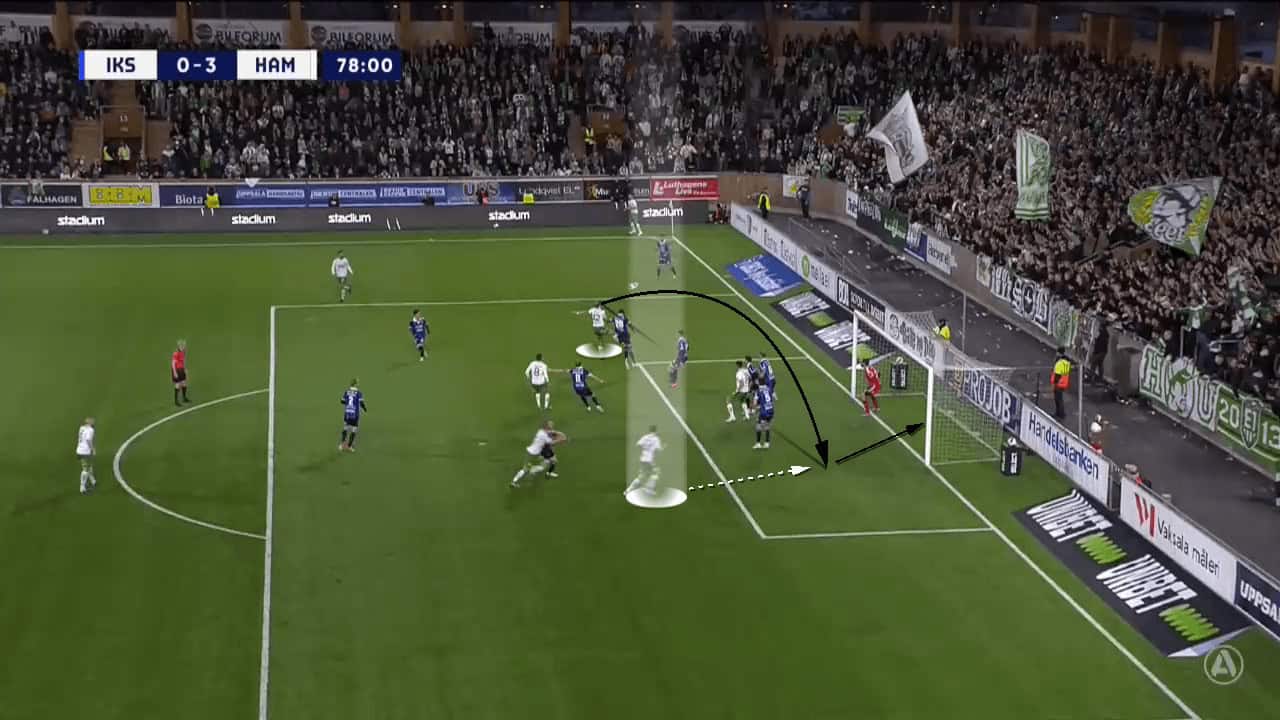 As the corner is delivered, the zonally positioned players are all looking in the direction of the ball so do not see number ‘44’ running into the back post area completely unmarked.
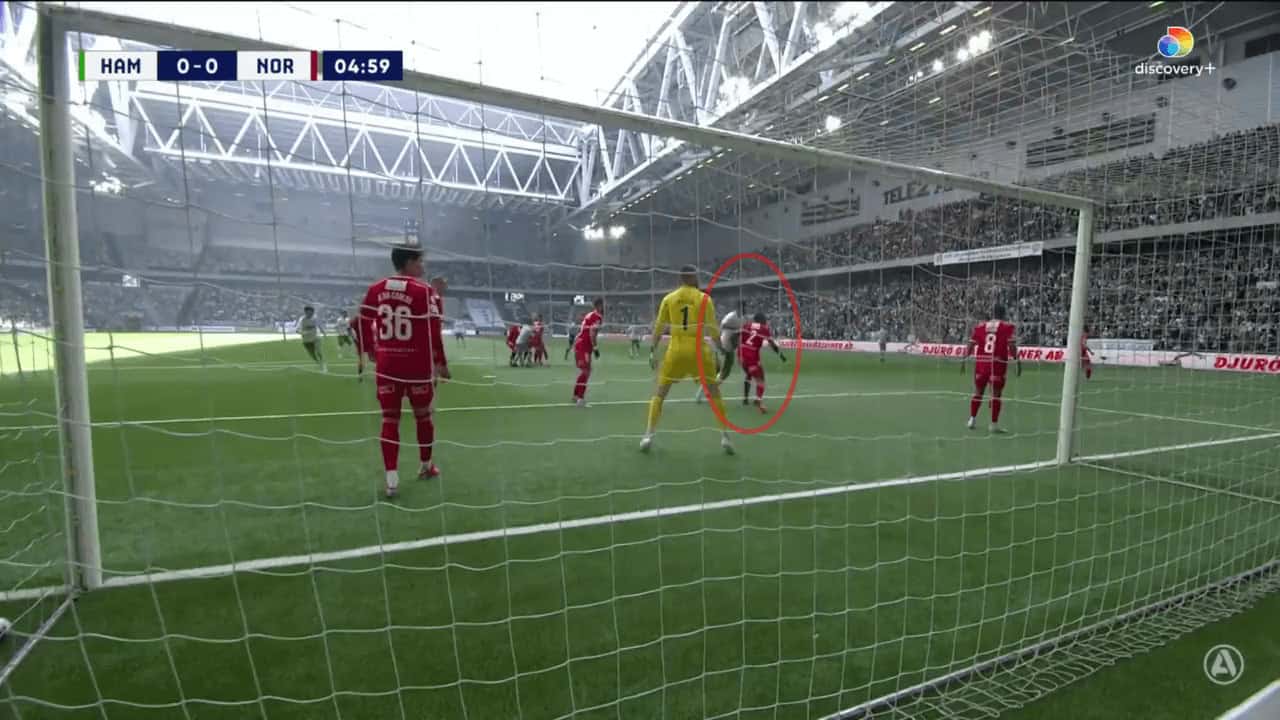 A key part of this corner routine being successful is the opposition’s front zonally positioned player not being able to attack the ball.
As shown in the above image of the same routine being performed in a previous match, the Hammarby player positioned on this zonal defender has been very aggressive in screening the defender from attacking the ball.
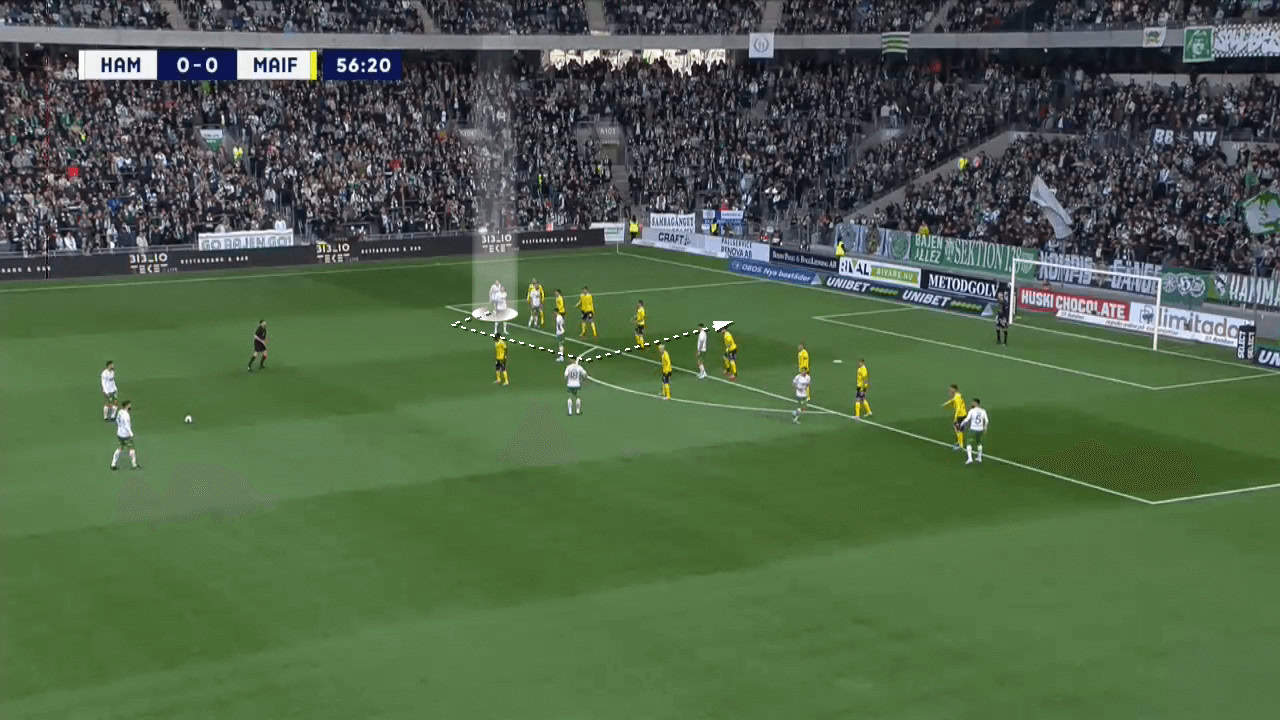 Hammarby have scored twice this season from free-kicks delivered to the box from central areas.
Both have been scored in almost identical fashion.
The target for the cross begins his run as the furthest player from the ball.
Just before the ball is delivered, he makes his run across the face of the defenders.
By making his initial movements in front of the defenders, he avoids getting in a tussle with them, and they are unable to screen his movements.
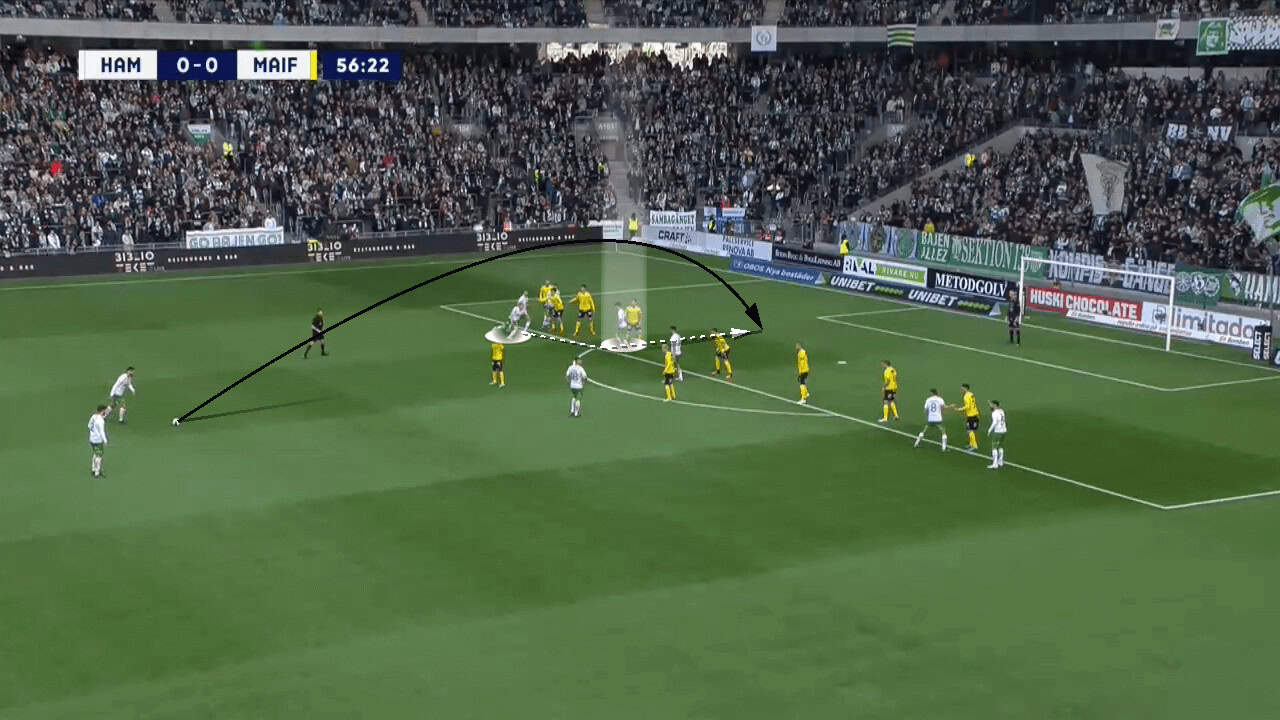 As the target man makes his run across the face of the defenders, his teammate screens the last defender on that side of the pitch to give the target player a clear run into the box.
As the ball is delivered, the target player darts into the box, either in front of the screen or through any gap that appears.
The ball is chipped over the defensive line, to the side of the second six-yard box, just far enough out of the goalkeeper’s range to come and collect the ball in the air.
On both occasions where this routine resulted in a goal, the target player was left completely unopposed.
Conclusion
Hammarby look like a formidable side at this stage of the season.
From an attacking standpoint, they are extremely well organised, with a clear style of play, and can score in a variety of ways.
For possession-based teams, set-pieces can often become a real weakness and/or their importance overlooked by coaches with this playing philosophy.
Cifuentes appears to have been able to merge being effective at set-pieces and playing attractive, attacking football at the same time.
