
Coming through Manchester City’s academy, one of European football’s most competitive youth setups, requires a resilient character.
James McAtee developed within that system and earned a reputation for his ball control and creative flair.
However, as with many Man City prospects, the challenge was never about ability but opportunity.
Breaking into Pep Guardiola’s senior side is a hurdle few manage, especially when contemporaries such as Liam Delap and, most notably, Cole Palmer have already carved out consistent roles elsewhere.
For McAtee, the time has come to step away from City’s shadows and build his own identity.
He decided to join Nottingham Forest, where he could go from a highly touted academy prospect to an established Premier League player.
Under Nuno Espírito Santo, a coach known for structured systems and disciplined organisation,
The question becomes how best to integrate a creative, technical midfielder into a team that often prioritises solidity and transitions.
This James McAtee scouting report and player analysis will explore James McAtee style of play, his background, and the tactical pathways that could make him a valuable addition to Forest’s starting XI.
Who Is James McAtee?
James McAtee comes from a family with a strong sporting background.
His older brother, John McAtee, currently plays for Bolton Wanderers in EFL League One.
Footballing pedigree runs even deeper in his bloodline: his great-uncle was Alan Ball Jr., remembered for spells at Everton and Arsenal but above all for lifting the FIFA World Cup with England in 1966.
It is little surprise that McAtee’s talent has long been seen as a natural inheritance.
He joined Manchester City’s academy at the age of 11.
He steadily progressed through the ranks, becoming a youth-level regular for England and most proudly captaining the U21s to victory at the 2025 UEFA European Championship.
In February 2022, he committed his future to City with a contract until 2026, describing it as a proud milestone and a sign of the club’s faith in him.
That faith was rewarded early when he made his first-team debut in the Carabao Cup against Wycombe Wanderers.
Seeking consistent senior minutes, McAtee went on a two-year loan at Sheffield United, where he gained valuable experience in contrasting circumstances: battling relegation in the Premier League and promotion push at the top end of the EFL Championship.
However, breaking into Guardiola’s City squad remained elusive.
Across the 2023/2024 and 2024/2025 seasons, McAtee was limited to occasional cameos despite earning praise from Pep for his attitude, training standards, and versatility.
Opportunities to become a starter were limited, and the need for a permanent move became clear.
Interest came from across Europe, including Bayer Leverkusen and Borussia Dortmund, but Nottingham Forest secured his signature.
For McAtee, Forest represents both a platform and a challenge.
A chance to establish himself as a Premier League regular and to form key on-field relationships with the likes of Chris Wood, Dan Ndoye, and the diverse attacking profiles within Nuno Espírito Santo’s squad.
James McAtee Style Of Play
James McAtee is a midfielder defined by elegance and balance.
At first glance, his game exudes a certain elegance: close control, deceptive footwork, and a natural ability to glide past markers.
However, beneath the technical polish lies a player with the robustness and work rate to contribute both defensively and creatively.
This pizza chart displays James McAtee’s performance profile from the 2024/2025 season, although the sample size is limited due to the 412 minutes played.
His standout metrics are positioning (95.7), dangerous passes (87.5), accurate passing (87.5), and penalty area touches (86.4).
However, his defensive involvement is minimal (4.2 percentile for defensive duels), which reinforces that he is more effective when given freedom than when tasked with ball-winning responsibilities.
It’s also important to note that the 50th percentile here represents the league median for players in his position.
James McAtee Pizza Chart

The statistical profile highlights McAtee’s possibilities as both a creator and a direct attacking presence.
He averages 3.53 shots per 90 (94th percentile), an unusually high volume for a midfielder.
This reflects his instinct to arrive in advanced zones and test goalkeepers from multiple angles.
His ability to receive the ball in high-value areas is demonstrated by 9.22 progressive passes received per 90 minutes (71st percentile) and 5.88 touches in the attacking penalty area per 90 minutes (82nd percentile).
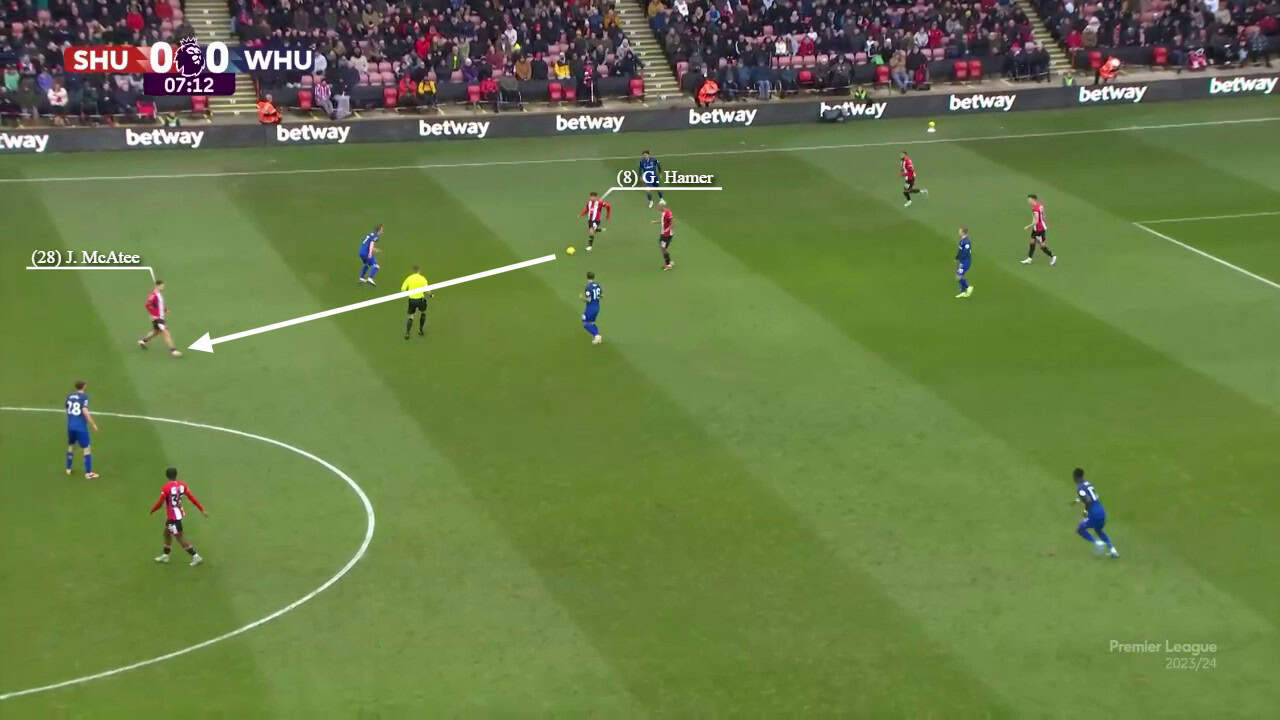
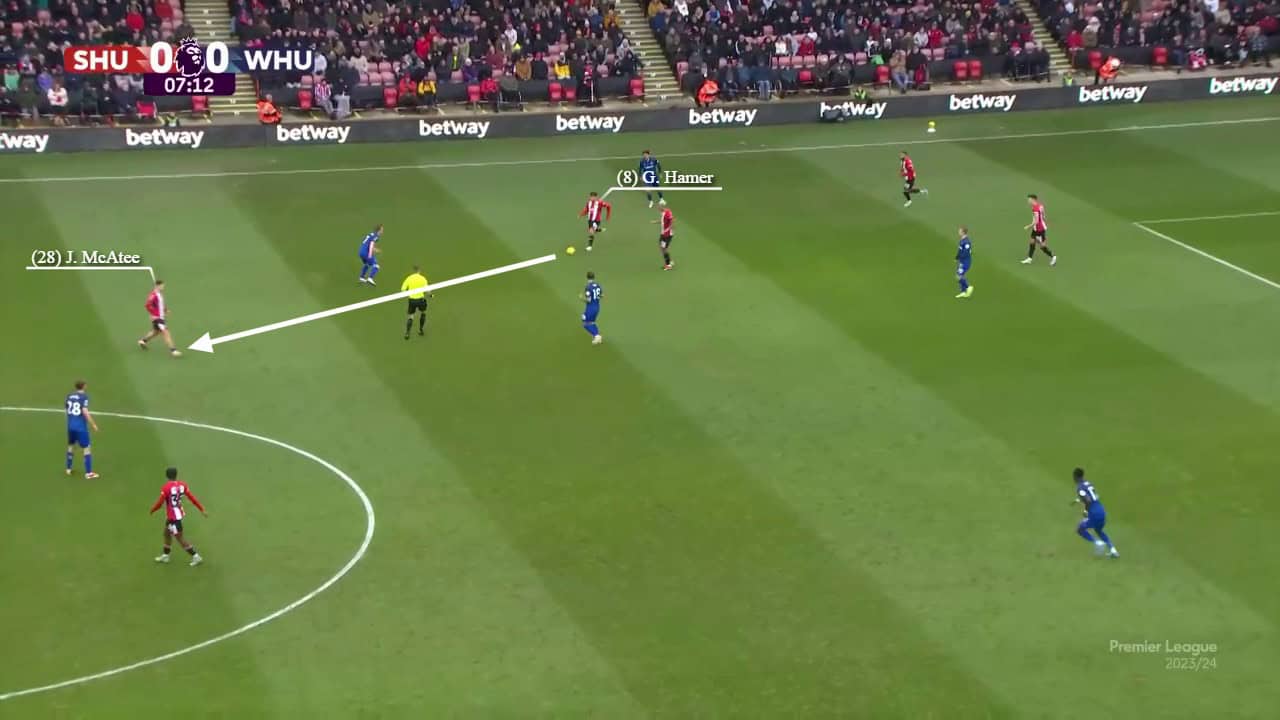
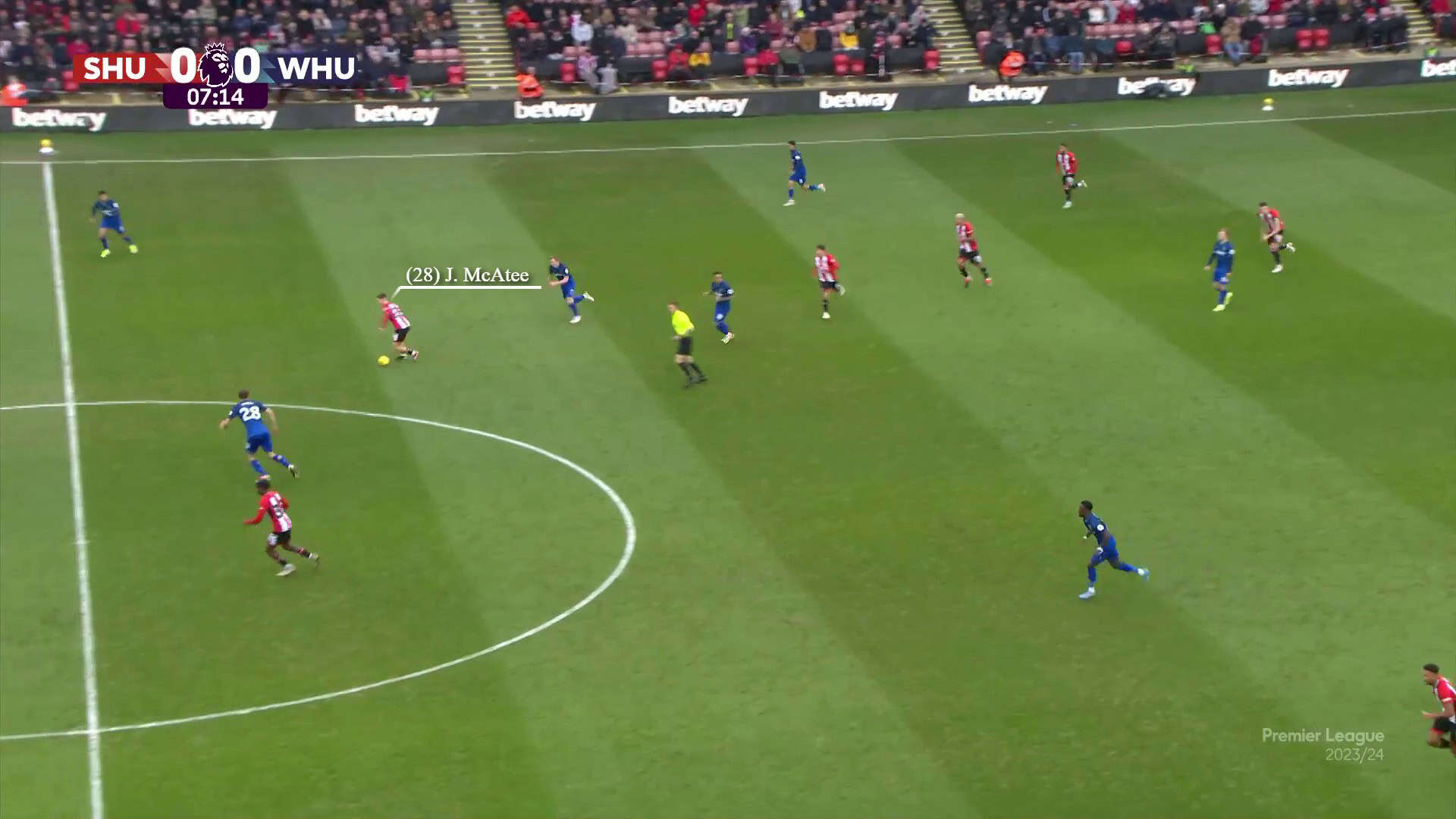
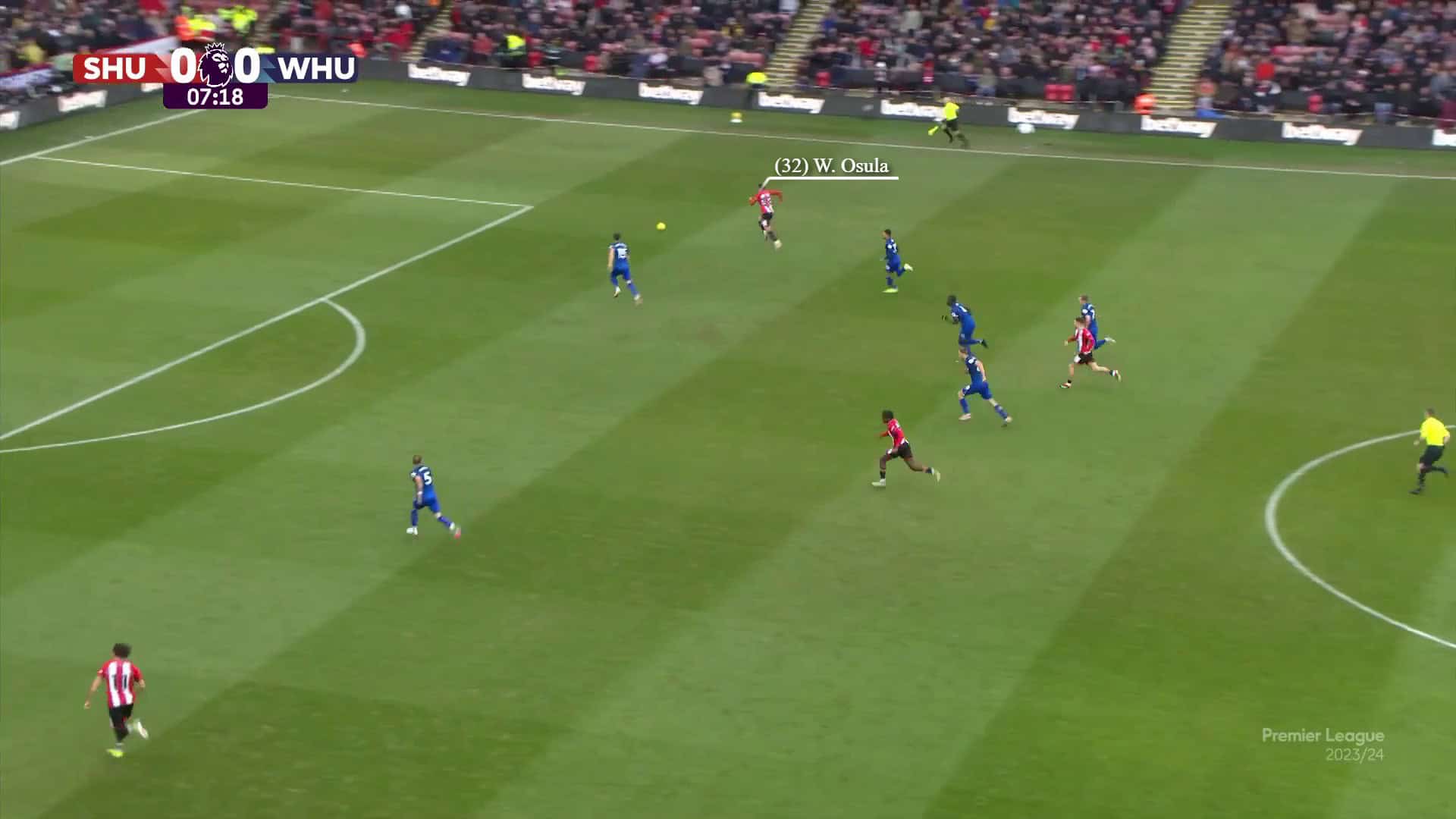
In a Premier League match against West Ham United, James McAtee collects the ball from Gustavo Hamer on the back foot.
He drives into space and threads a weighted pass into the path of William Ousla.
Kurt Zouma is caught on the wrong side and unable to intercept, which allows the move to develop.
These metrics must be viewed in context, as they are based on a relatively small sample of 459 minutes from the past year.
Even so, match with the eye test: James McAtee thrives on finding gaps between defensive lines, ghosting into pockets, and positioning himself to influence the final third.
He is less of a traditional playmaking number ten and more of a third-man runner, a midfielder who excels when others draw defenders out, and he can exploit the vacated spaces.
James McAtee Defensive Contribution
What makes James McAtee intriguing is his defensive work rate.
Despite his reputation as a technical playmaker, he records 1.96 tackles per 90 (90th percentile) and sits in the 94th percentile for lowest dispossessions (0.78 per 90).
This reflects two things: he presses with intent and protects the ball exceptionally well under pressure.
In a recent league fixture against Crystal Palace, McAtee demonstrates his close control by shielding possession through subtle ball manipulation and sole rolls, drawing Will Hughes into a challenge.
By using his body orientation and quick touches to apply pressure, he forces Hughes to commit, ultimately winning a foul.
In Premier League terms, this is important.
Traditionally, creative midfielders have often struggled with the physicality of transitions and have been pushed aside due to the growing focus on out-of-possession structures in recent years.
However, McAtee’s willingness to engage defensively and his ability to ride challenges mean he does not become a weak link when Forest are out of possession.
He is closer in profile to Bernardo Silva, a technically refined midfielder who contributes on both sides of the ball, than a pure playmaker.
James McAtee Technical & Physical Profile
Stylistically, James McAtee is a player who connects elegant grace with drive.
His dribbling is less about raw explosiveness and more about subtle manipulation of space: the shoulder drop, the disguised touch, the quick acceleration step.
His aesthetic style can almost appear languid, but this disguises a sharpness of movement and intent.
Physically, he can grow into a profile capable of handling the demands of the Premier League.
Though not imposing, he has the balance, core strength, and low centre of gravity to sustain possession under pressure, turn away from markers, and carry the ball through congested spaces.
He can ride tackles when opponents try to dispossess him in tight areas.
However, his lack of size and raw power leaves him vulnerable in crowded midfield battles where physical dominance is needed.
He can be overrun against opponents who compress space aggressively or overload central areas, and may limit his ability to dictate rhythm for extended periods.
James McAtee Developmental Context
Years in Manchester City’s academy instilled in James McAtee the discipline and ability to create and exploit superiorities through movement and timing.
This explains his comfort in receiving progressive passes and his awareness of where to move next.
As shown against West Brom, James McAtee identifies the gap between two opposition midfielders in the half‑space and times his movement to receive between the lines.
By receiving on the half‑turn, he drives into the open space.
He then releases a well‑weighted, vertical pass ahead of Rhian Brewster for a chance on goal.
This disorganises breaking West Brom’s defensive line and creates a progressive attacking action.
The loan at Sheffield United added the grit of fighting relegation.
These experiences have produced a hybrid midfielder who is technically sound and capable of playing for extended periods without the ball.
That duality could be helpful in how Nuno Espírito Santo integrates him into a Nottingham Forest side that does well when compact and initiating explosive counter-attacks.
James McAtee Tactical Fit At Nottingham Forest
Nuno Espírito Santo tactics have adopted a 4-2-3-1 base shape, shifting to a 4-4-2 or 4-5-1 formation when defending.
The structure is pragmatic.
Ibrahim Sangaré provides the defensive screen, Elliott Anderson offers pressing intensity and vertical surges, while Morgan Gibbs-White is responsible for the creativity between the lines and ball carrying.
Wide players such as Callum Hudson-Odoi and Ndoye stretch the game and feed Chris Wood, whose hold‑up play is excellent.
Within the starting XI, James McAtee is both an opportunity and a tactical dilemma.
James McAtee Alongside Morgan Gibbs-White
One possibility is McAtee starting in Anderson’s slot, as an advanced central midfielder.
This would give Forest two creators in the same XI, with Gibbs-White and McAtee combining to overload the half-spaces.
This would be useful against compact, deep-sitting opponents.
Forest could potentially shift to becoming a more ball-dominant side, and relying on Gibbs-White alone may be limited.
When MGW finds it challenging to get into the game, Forest can appear to run short of ideas; McAtee’s disguised passing and instinct for finding space between the lines would add an extra worry for the opposition.
The trade-off is out of possession.
Anderson’s role is the connector in Forest’s midfield triangle, linking Sangaré’s ball-winning to Gibbs-White’s creativity.
He covers the inside channels and makes vertical carries that shift Forest up the pitch.
Replacing him with McAtee risks reducing Forest’s ability to regain territory and control transitions.
Sangaré would be left with more ground to cover, and James McAtee would need to shoulder greater discipline without the natural instincts of a ball-winning eight.
In tactical terms:
- Anderson + Sangaré = balance, legs, security.
- McAtee + Sangaré = more technical control, but higher exposure in defensive transitions.
James McAtee Rotation With Morgan Gibbs‑White
Given Gibbs‑White’s status as vice-captain and undroppable #10, James McAtee may instead profile as a rotational option.
He can deputise centrally when Gibbs‑White is rested, or play as an inverted midfielder from the right when Ndoye is unavailable.
This would preserve the structure while maintaining a creative fulcrum.
The limitation is minutes: James McAtee risks becoming a specialist rather than a consistent starter.
The Hutchinson Question
The signing of Omari Hutchinson complicates matters further.
Hutchinson likes to cut inside from the right, often into the same zones McAtee wants to occupy.
Spacing and role definition will have to change if both are on the pitch.
Either Hutchinson holds width to stretch the line, or McAtee is forced deeper, which magnifies his defensive demands.
Nuno will need to engineer a balance to avoid congestion of creators in similar spaces.
Supporting Chris Wood
Where McAtee can make an immediate impact is in his relationship with Chris Wood. McAtee’s disguised through‑balls and third‑man runs complement Wood’s aerial game and ability to pin defenders.
He can profit from knockdowns and feed runners beyond Wood.
In short, McAtee provides Forest with a second supply line, reducing the over‑reliance on their captain.
Conclusion
McAtee offers Forest an additional creative axis, capable of linking midfield to attack and supplying Chris Wood in ways that ease the burden on Gibbs-White.
Yet, his integration raises structural questions regarding the sacrifice of Anderson’s dynamism, overlapping with Hutchinson’s tendencies, and testing his own defensive coverage.
Therefore, the question about his tactical fit regards whether Nuno is willing to tilt the balance of the side toward greater invention at the cost of stability.
