
The Wrexham fairy tale has divided opinion in football.
There are those who love the fact that TV and movie stars like Ryan Reynolds and Rob McElhenney have taken over a club in the National League, genuinely care about the city and the club, and want to see them promoted to the Premier League.
On the other hand, some fans have described the club, conjecture, and glamour the two have brought as ‘insufferable’.
Though it must be noted, having actors invest in a club to get them up the table, even if it is for their own personal gain, is a better story than some of the ulterior motives club owners have.
Taking a look at ownership in the Premier League reveals grisly details: Oligarchs and Regimes in charge of the super clubs.
With that being said, perhaps Wrexham came face-to-face with a club they aspire to be.
Under the ownership of Reynolds and McElhenney, they are clearly moving mountains, having secured promotion after promotion, and are now in the EFL Championship.
Though they ended up losing 4-2 to Chelsea, with George Dobson‘s sending-off no doubt contributing to the defeat, Wrexham took the game to extra time.
Dobson was sent off in the 93rd minute with the Welsh side needing to complete extra time with 10 men.
They made Chelsea toil and work hard with an excellent plan out of possession, even with Liam Rosenior‘s adjustments.
Though Chelsea’s quality eventually shone through, life was made difficult for the men, and Wrexham’s setup was impressive.
Wrexham Vs Chelsea Lineups & Formations
Phil Parkinson lined his Wrexham side up in a 5-4-1 shape.
Arthur Okonkwo started in goal behind Max Cleworth (right centre-back), Dominic Hyam (central centre-back) and Callum Doyle (left centre-back).
Ryan Longman and George Thomason occupied the right and left wing-back positions, respectively, with Zak Vyner and George Dobson in right and left central midfield.
Oliver Rathbone and Lewis O’Brien played on the wings, on either side of Sam Smith up front.
Liam Rosenior also went with three centre-backs in a 3-4-3 shape.
Robert Sánchez was in goal behind Malang Sarr (right centre-back) Tosin Adarabioyo (central centre-back) and Benoît Badiashile (left centre-back).
Josh Acheampong and Jorrel Hato started in the right and left wing-back positions on either side of Andrey Santos and Roméo Lavia in right and left central midfield, respectively.
Pedro Neto and Alejandro Garnacho played on the wings, supporting Liam Delap at centre-forward.
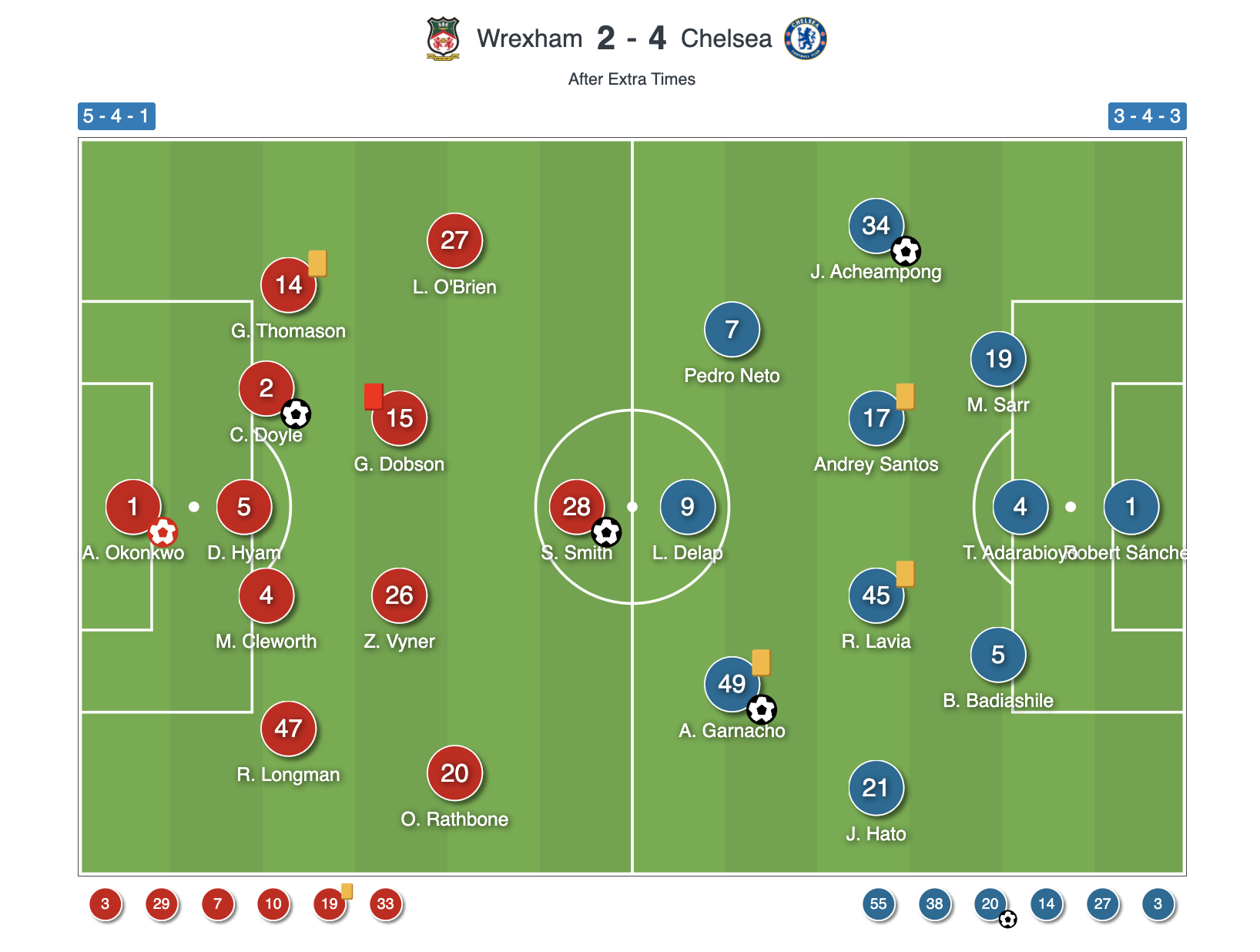
Wrexham Out-Of-Possession Tactics Vs Chelsea
Aggressive Wrexham Tactics Vs Chelsea Build-Up
The out-of-possession evolution over the last few seasons, making it hard for big teams to have an impact or find space in a game, has had a ripple effect down to the Championship.
The Red Dragons‘ setup would’ve impressed in the Premier League.
They set up in a 5-4-1 formation to surround Chelsea’s midfield pivot of Roméo Lavia and Andrey Santos.
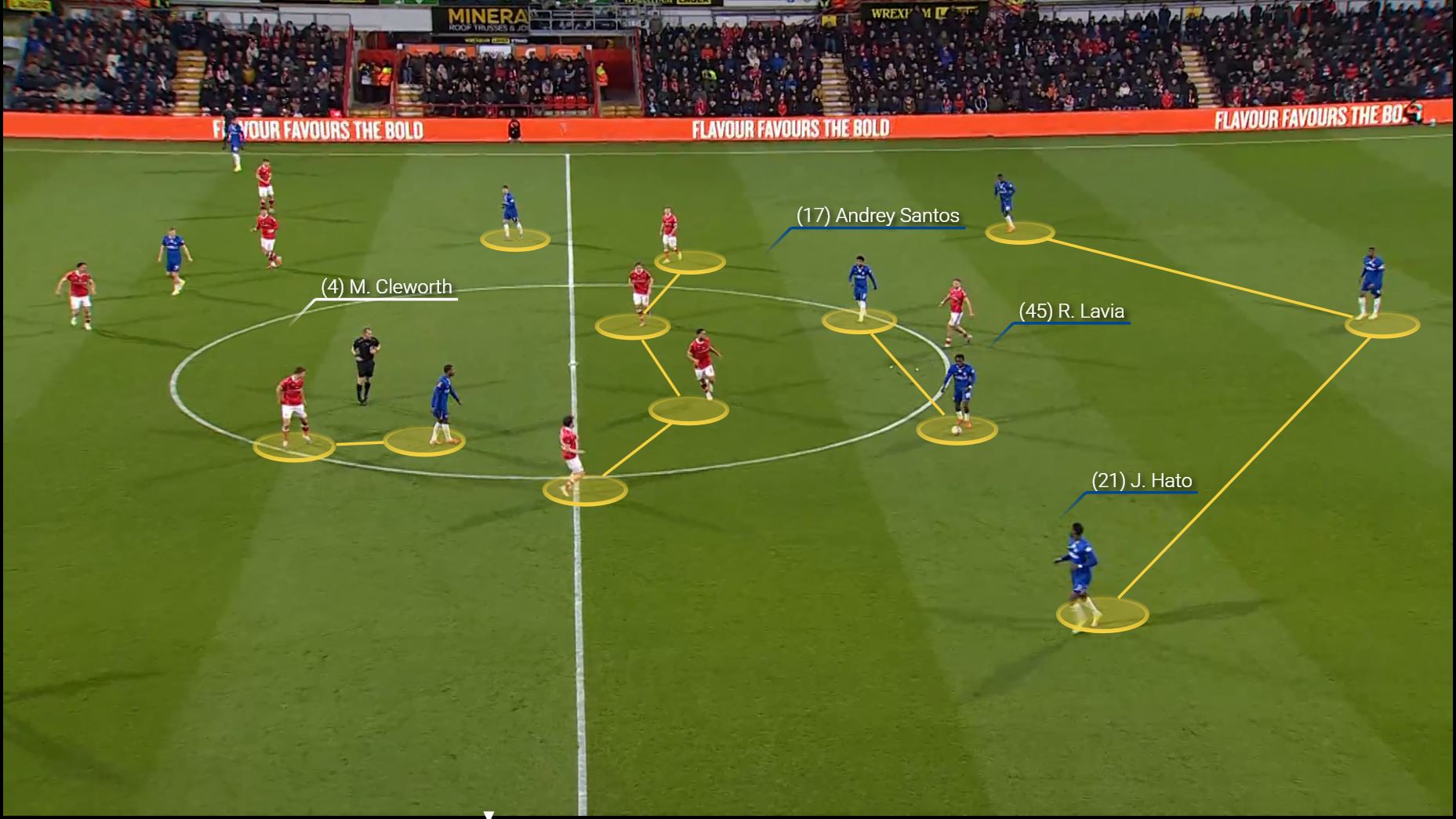
Chelsea looked to build up in a back three to provide width, but the masterstroke and bravery from manager Phil Parkinson came in the form of committing a centre-back to jump out of defence and follow a Chelsea attacker into the middle of the pitch.
This way, a player was placed just behind Wrexham’s midfield, but he couldn’t receive the ball; when he did, Wrexham got aggressive and in the attacker’s face, leading to a turnover.
Chelsea’s 3-2 build-up was excellently thwarted because the pivot players were surrounded.
When attackers in front of them started dropping in Pedro Neto and Malang Sarr, a defender jumped out to follow them.
It’s an aggressive, risky strategy, but it’s exactly what you need to do when clogging the middle and ensuring there is no space behind for the attacking midfielders.
As there are six players in the middle of the pitch, how do you expect a Chelsea defender to slice a pass through to break the lines?
Chelsea In-Possession Tactics Vs Wrexham
Telling a centre-back to jump out works miles better in a back three when attempting to nullify opposition, because if there were two centre-backs as opposed to three, Liam Delap would be left for the long ball in behind.
Chelsea’s goals to equalise once and then twice in normal time came because Delap finally got the better of dragging a centre-back out and wriggling away from him, but the aggressive plan worked for large parts of the game.
The other equaliser for Chelsea came when the game state was heavily skewed in Chelsea’s favour, throwing as many men forward as possible.
A Wrexham defender lost the ball on the edge of the penalty area, and with so many men committed, Chelsea scored.
The options after dealing with a setup like this for Rosenior were scant, and what Chelsea did instead was opt to go wide.
Of course, teams would rather this be the case than for them to find space in the centre, so Wrexham were happy to deal with this.
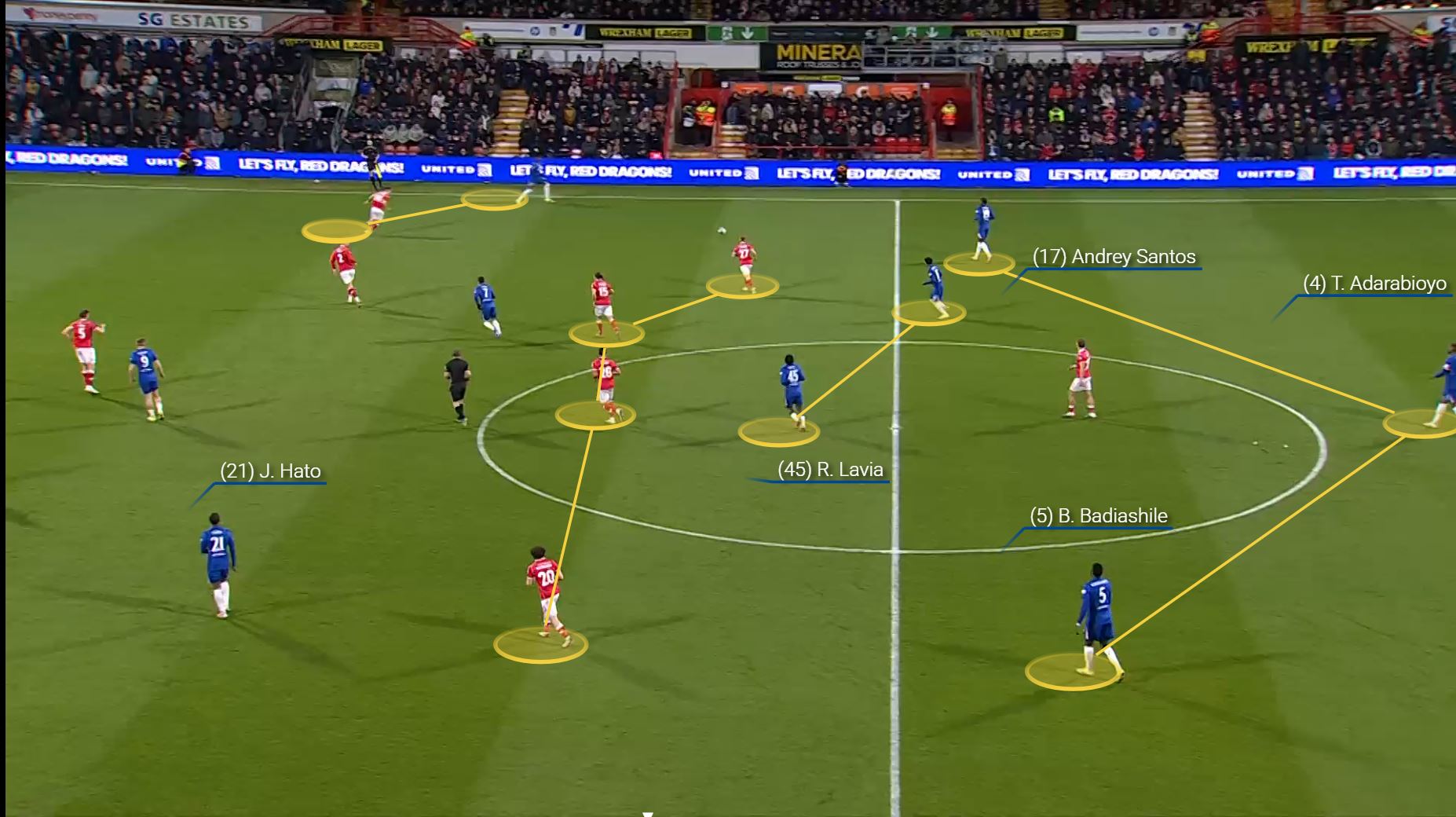
As you can see above, when the ball went to the wide wingers or a wide full-back holding width, because Wrexham were playing a back five, the full-back was happy to be aggressive on him.
It supports my notion and theory from a previous piece that demonstrated ‘park the bus’ and sitting in a mid/low block are things of the past; you still need to be active and reactive.
Wrexham’s aggressiveness and snuffing out attacks or danger led Chelsea to have to deal with tough tackles.
However, the Championship side did well in the sense that they only conceded four fouls in the first half.
They ended up getting a red card late on to shift the game’s nature, but their plan was effective and worked for long periods.
It led to Chelsea’s defence often sending the ball long to try and find Alejandro Garnacho or Neto.
In the first half, they couldn’t latch onto these balls as they would go astray or out of play.
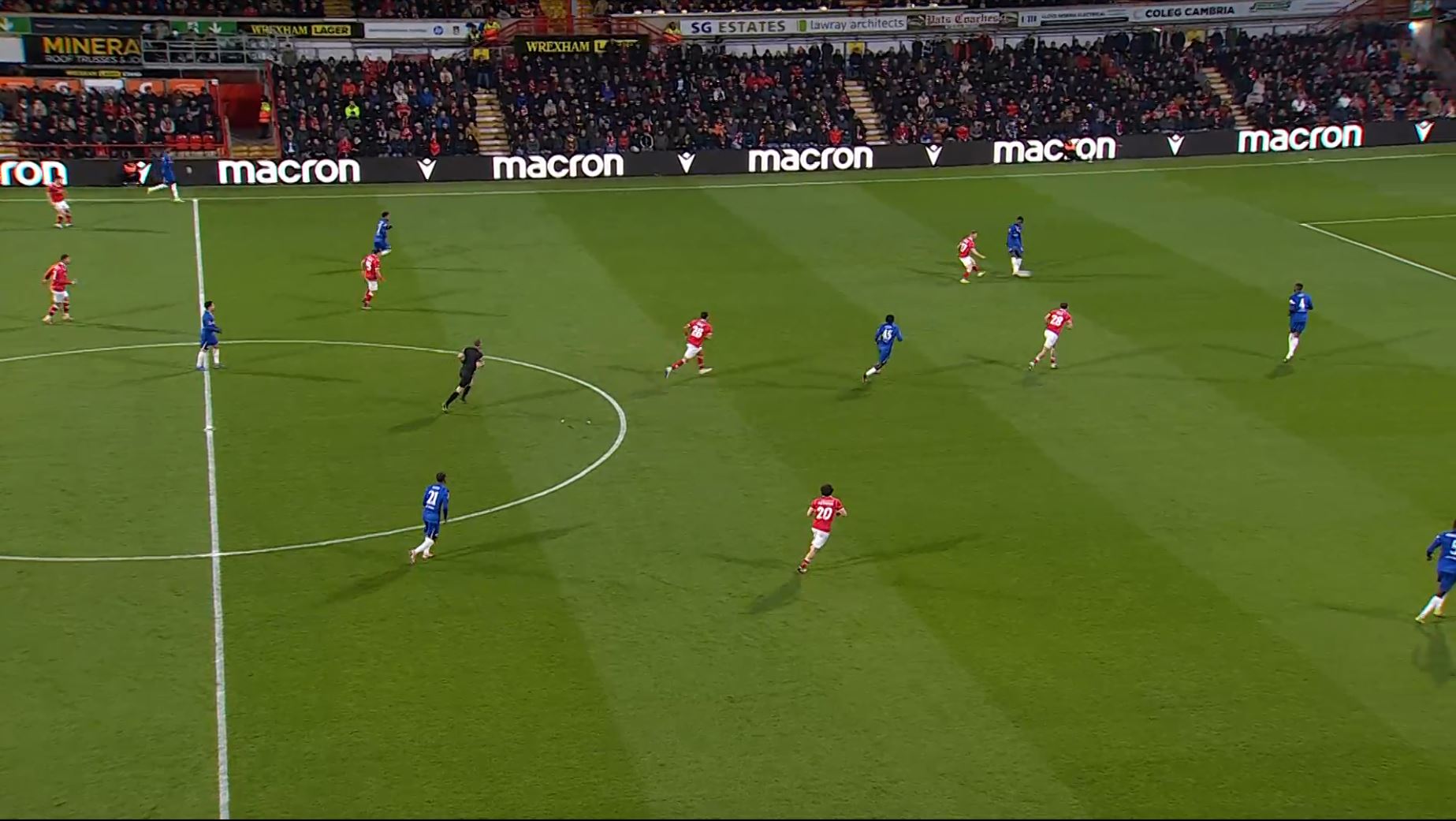
It got to the point that if Chelsea’s back three had it in the build-up, there were occasions when Wrexham would go to press and force them back to the goalkeeper, who would kick it long.
Neto and Sarr, in the middle at one point, got so frustrated that they retreated deeper and deeper, closer to the edge of their own penalty area.
From a Wrexham point of view, this isn’t threatening because they would have to receive, turn on the ball, and drive from their own penalty area all the way to the other side of the pitch.
On occasion, they did this, but they were met with a red shirt to stop them in their tracks.
Playing a dynamic back five allowed flexibility in the defenders, with players jumping out and getting in an attacker’s face when needed.
Often, Chelsea didn’t have an answer, and it also helped that Wrexham’s attack kept dragging Chelsea’s centre-backs out.
Benoit Badiashile and Tosin Adarabioyo are not two centre-backs who play often, so a tough cup tie against a striker like Sam Smith was a stern test on a cold Saturday evening.
He worked the defenders hard as he is a brilliant ‘feed off scraps’ striker, who can create moments, work the channels, and hold the ball up at handy times when a team is defending most of the time.
Chelsea Second-Half Changes
So, what changed in the second half?
Honestly, not much.
Marc Cucurella was introduced, and he is known to pick the lock on these occasions with his surprise runs into the half-space, but even he was suckered into dropping deeper for the ball.
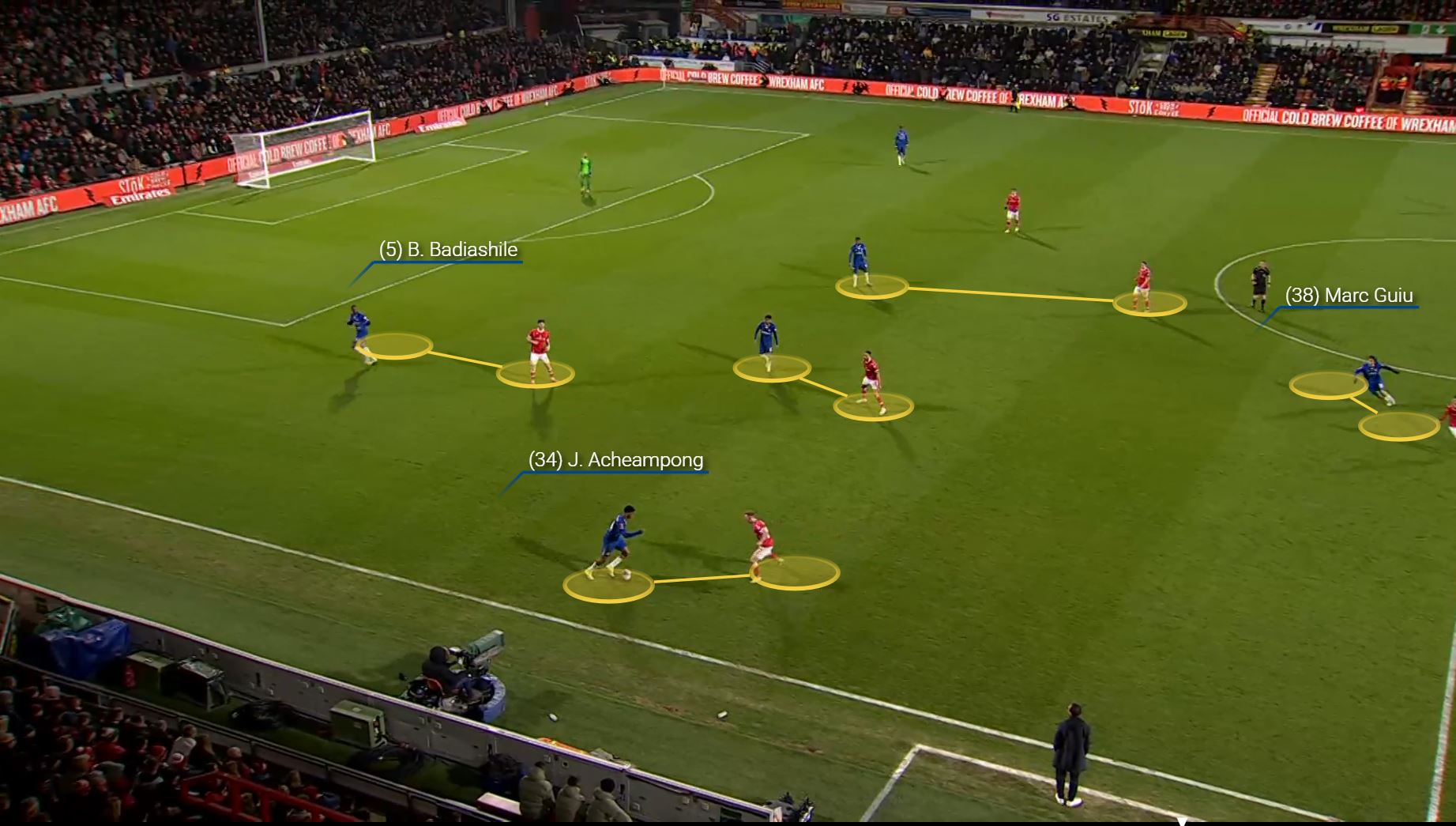
Another substitute, Marc Guiu, was tasked with dropping deeper, but you can see the difficulty Chelsea had above in build-up as Wrexham grew into the game and realised their plan was working.
The wider a Chelsea defender went in the build-up, the wider Wrexham’s midfield four would spread to whichever side the defender had it.
You can see that there isn’t really a man to pass to for Acheampong on this occasion; it’s no wonder Chelsea resorted to chucking the ball down the line or long on multiple occasions.
What could Rosenior have done to ease matters?
Well instead of having an extra player in attack, a extra central midfielder a ‘tempo-setter’ or ‘water-carrier’ to receive the ball off the defenders would have made Wrexham commit an extra player and maybe even a defender.
But it did feel as though, with a hefty schedule, he wasn’t prepared to risk much and was hoping the players out there would do the business.
They eventually did, but it wasn’t without a scare, and it wasn’t as though Rosenior figured out what Parkinson was doing and solved it.
Take a look at the players that were substituted on: Malo Gusto, João Pedro, and Marc Cucurella were the regular first-teamers, with some players not even making the trip, as Rosenior clearly had one eye on the PSG tie, which is understandable prioritisation.
Even still, the FA Cup and teams like Wrexham aren’t a cake walk as Chelsea found out.
You can have ‘depth’ in your squad, but if they face a well-organised team at home with a working plan, they will be undercooked and underprepared to deal with what is thrown at them.
Conclusion
Chelsea’s plan did not work well against Wrexham’s, and though the Welsh club are ultimately out of the FA Cup, their setup, game plan, and aggression weren’t characteristic of plucky underdogs with a hearty spirit; they were well prepared to go toe-to-toe with their Premier League opponents.
Rosenior and Chelsea will be happy to have made it through the tie, and that Garnacho’s persistence worked, but Parkinson and Wrexham should be happy with what they achieved.