
Sweden host Poland at the Strawberry Arena for the finals of the 2026 FIFA World Cup playoffs in Path B.
Sweden have earned a place in the playoffs mainly thanks to their UEFA Nations League performances, as they topped their group, earning them a World Cup playoff ticket despite finishing fourth in FIFA World Cup Qualifiers Group B.
In the playoffs, Sweden faced Ukraine and beat them to secure their spot in the finals.
On the other hand, Poland finished second in Group G, as they were unable to do better given that they were in the same group as a tough team like the Netherlands.
Afterwards, they faced Albania in the playoff semi-finals and overcame that difficult hurdle to face Sweden in an away game in the finals.
Therefore, Poland’s mission seems more complicated on paper, especially due to the fact that they will be playing an away game.
In this tactical preview, we explore both teams’ strengths and weaknesses and how they should approach the match to commit fewer mistakes and reach the World Cup.
Sweden Vs Poland Match Plan: What To Avoid & What Needs To Be Amplified
Sweden should rely heavily on long and through passing at the back of Poland’s defensive line, mainly because Poland’s defence can be vulnerable in similar situations, as they showed against Albania.
Poland High Line Defensive Weaknesses
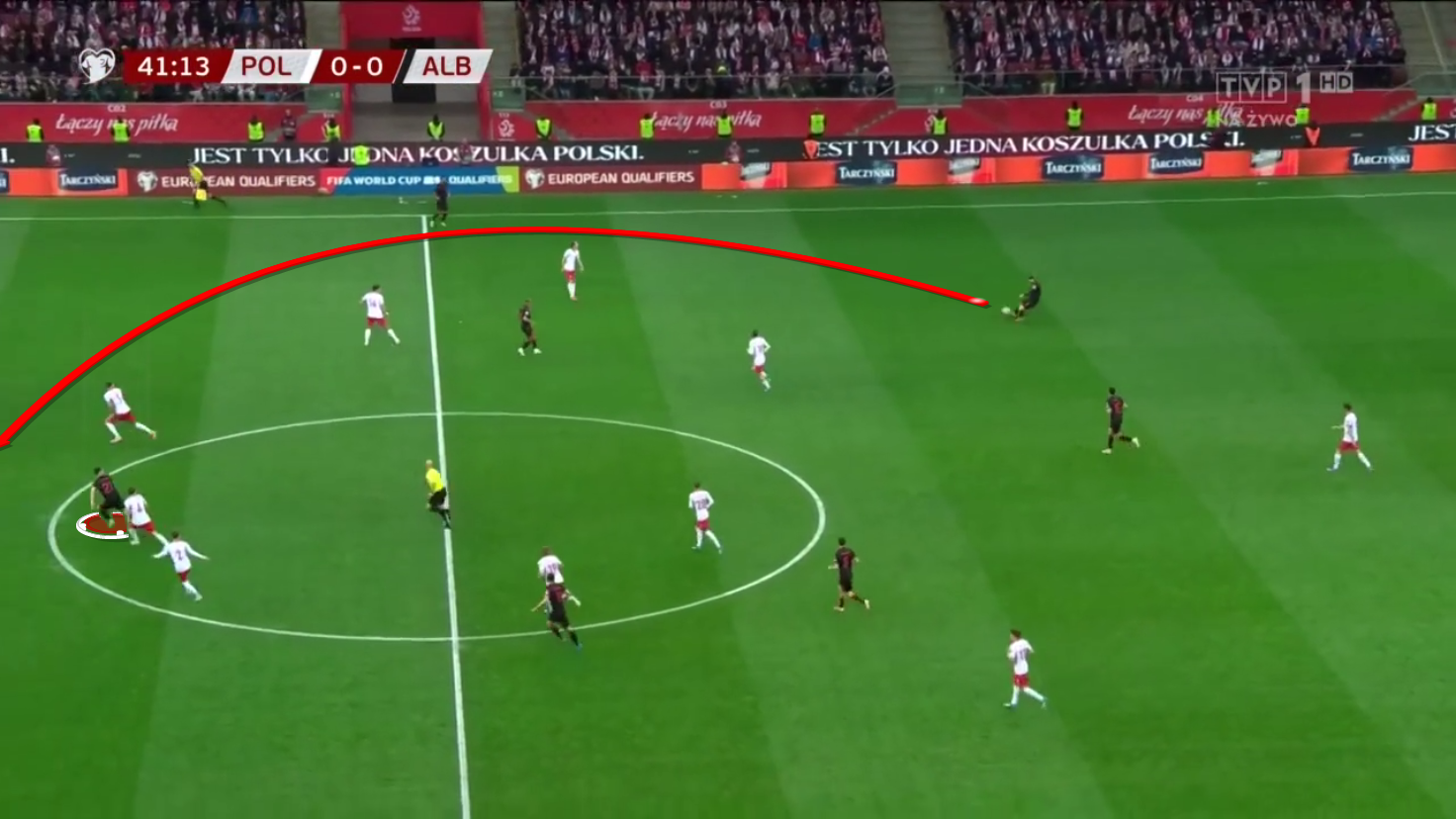
Albania were able to score their single goal of the match thanks to relying on ball possession before surprising the advanced defensive line with an accurate long pass towards the striker, while obliging Poland’s defensive line to retreat quickly and commit an error in clearing the ball.
The action confirms that Poland’s defenders lack communication and can commit crucial errors at the back, especially through wrong interceptions that favour the opponents.
With powerful, quick attackers like Anthony Elanga, Viktor Gyökeres and Benjamin Nygren, Sweden can punish Poland’s defence, especially if Poland relies on high pressing and therefore a high defensive line, as they did against Albania.
The following conceded goal against Albania confirms the gaps in Poland’s backline and encourages Sweden to opt for a direct counterattacking plan in this match to disrupt Poland.
Sweden Defensive Approach
That said, Sweden should also keep an eye on Poland’s set-pieces, as they can use them efficiently to score against Sweden, given their excellent executions of set-piece plans.
With excellent aerial ability from several Polish players, it is expected that they will rely on set-pieces to punish Sweden’s defence, especially if they fail to do so in open play.
Sweden should double-mark Robert Lewandowski in particular, as he is the one who can make the difference inside the box for Poland, thanks to his goalscoring instinct and excellent aerial ability.
Marking him tightly while keeping an eye on players coming from behind, such as Piotr Zieliński, who have excellent goalscoring qualities, will be extremely important as well.
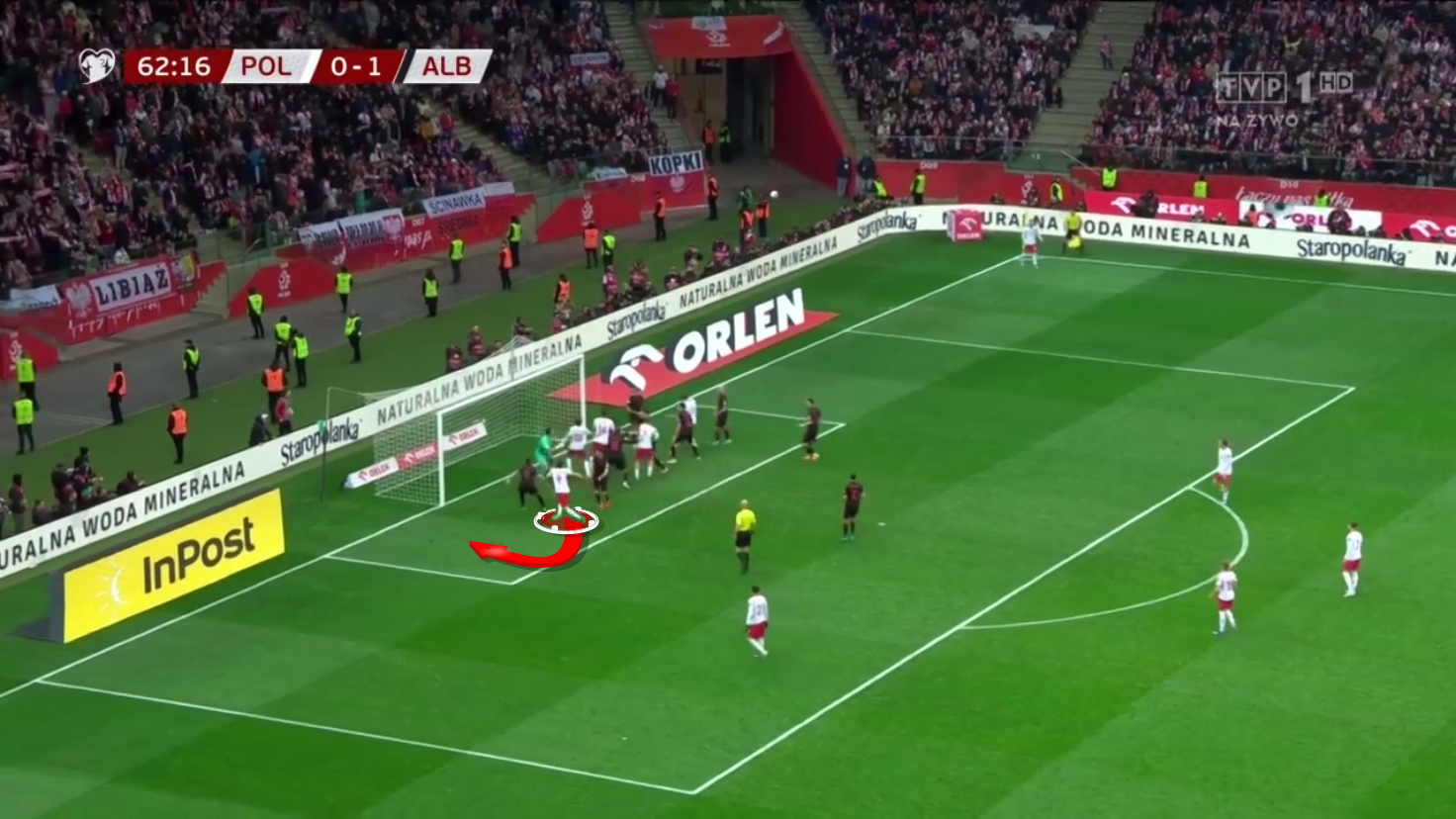
The following picture highlights Lewandowski’s aerial threat and his ability to quickly escape marking to score goals.
With Sweden not always succeeding in marking strikers well enough inside the box, it is possible, maybe even likely, for Poland to score thanks to their striker’s abilities if Sweden do not intensify their marking on him and provide clear instructions to follow him tightly, especially at set-pieces.
It should be noted that Sweden’s only conceded goal against Ukraine was scored due to passive marking inside the box on Ukraine’s forward, allowing him to head the ball without interference despite the short distance between the defender and the forward.
This defensive passivity should not be repeated against Poland, as Lewandowski’s experience and the numerical superiority Poland can create inside or at the edge of the box can make the difference and exploit Sweden’s lack of defensive compactness.
Poland Shooting From Distance
Furthermore, Poland showed against Albania that they can diversify their attacking attempts and have the potential to score, either through crosses and reliance on Lewandowski’s intelligent movements inside the box, or through ball possession and surprising shots from outside the box when needed.
Keeping an eye on and blocking the shooting trajectories of Zieliński and Sebastian Szymański will be essential for Sweden to avoid conceding surprising goals due to the lack of defensive organisation.
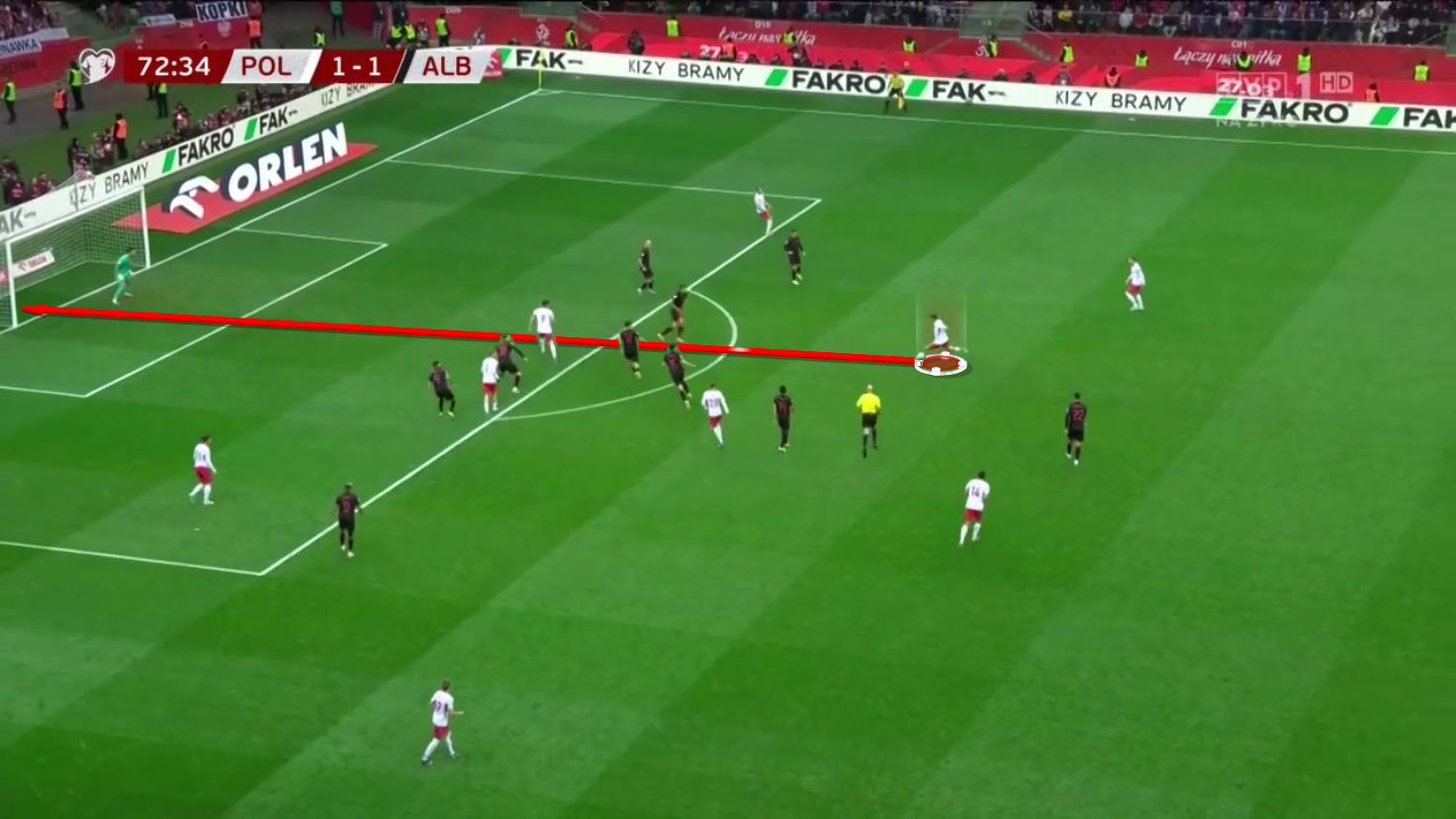
These two players in particular are known for their powerful and accurate shooting from a distance, and Zieliński’s winning goal against Albania serves as additional proof of that.
Albania allowed Zieliński a suitable shooting trajectory and did not try to block or deflect his shot, underestimating the threat it posed.
If Sweden succeeds in applying tight marking on Zieliński in such situations and concedes much less space to him during such opportunities, as opposed to Albania, this will enable them to limit Poland’s attacking solutions and oblige them to resort to passive ball possession without concrete attacking threats.
Sweden Attacking Solutions
Sweden should focus on Poland’s high line and do their best to exploit the space left behind it by relying on long passes and through passes, especially towards the wings, where Elanga and Nygren can be extremely dangerous thanks to their quick, explosive penetrations.
Furthermore, Gyökeres’ exceptional run of form at the international level should be exploited in this decisive match, especially in terms of goalscoring.
Sweden can disrupt Poland’s defence in multiple ways, rather than relying solely on long passes at the back of the defensive line.
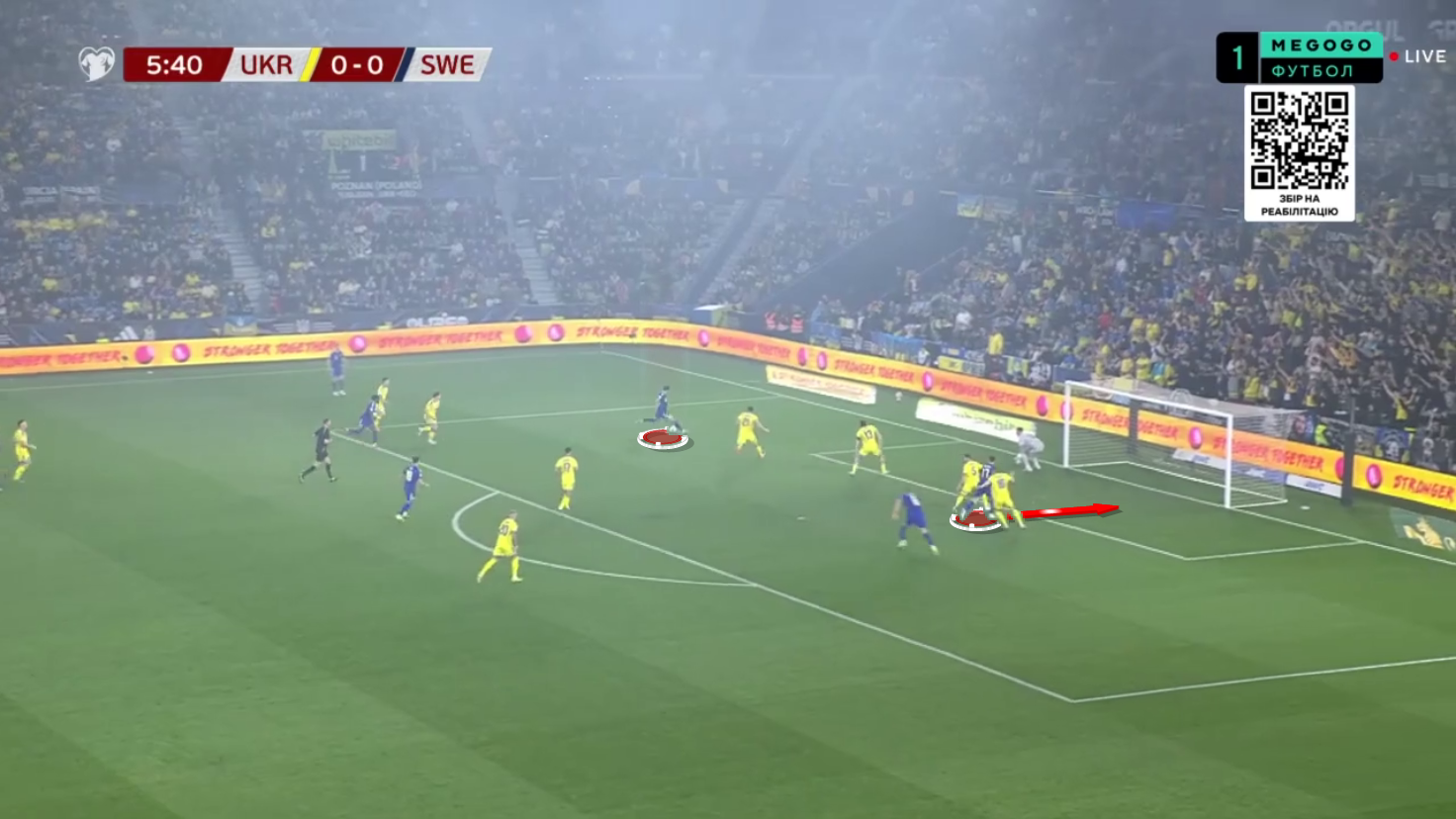
They can also rely on wingers’ positioning in the half-spaces and try to serve Gyökeres at the right time and place, following his movement without the ball to escape marking, just like Nygren did in the first goal action against Ukraine.
The movement in half-spaces and the ability to avoid marking allows Sweden to hurt any defence, and the fact that Poland’s defenders usually commit marking mistakes can only help Sweden in creating similar goalscoring situations.
The following picture highlights the movement without the ball from Gyökeres in order to create the opportunity for himself to finish without disturbance as soon as he received the ball from Nygren.
Furthermore, Elanga provides reliable attacking support on the right wing and can be extremely dangerous against Poland’s defence thanks to his excellent off-the-ball movement, whether on the wing or in the middle, which makes it difficult for Poland to mark him successfully.
Sweden have more powerful attacking players than Poland, and they should exploit this to their advantage by creating goalscoring opportunities to punish Poland’s high line and avoid playing a too cautious match.
Sweden should believe in their ability to score early and oblige Poland to fall into the trap of attacking, thereby leaving a lot more space at the back, as this would be the perfect game plan for Sweden.
For Poland, it will be important to mark Sweden’s attacking players tightly, prevent key movements behind their defensive line, and intercept passes in that direction.
Being very organised defensive-wise would help Poland gain more confidence in their ability to win, and accompanying that with shooting from distance attempts and key passes towards Lewandowski whenever the latter makes intelligent movements would eventually help Poland in scoring especially if Sweden commits defensive mistakes.
Sweden Vs Poland Predicted Lineups & Formations
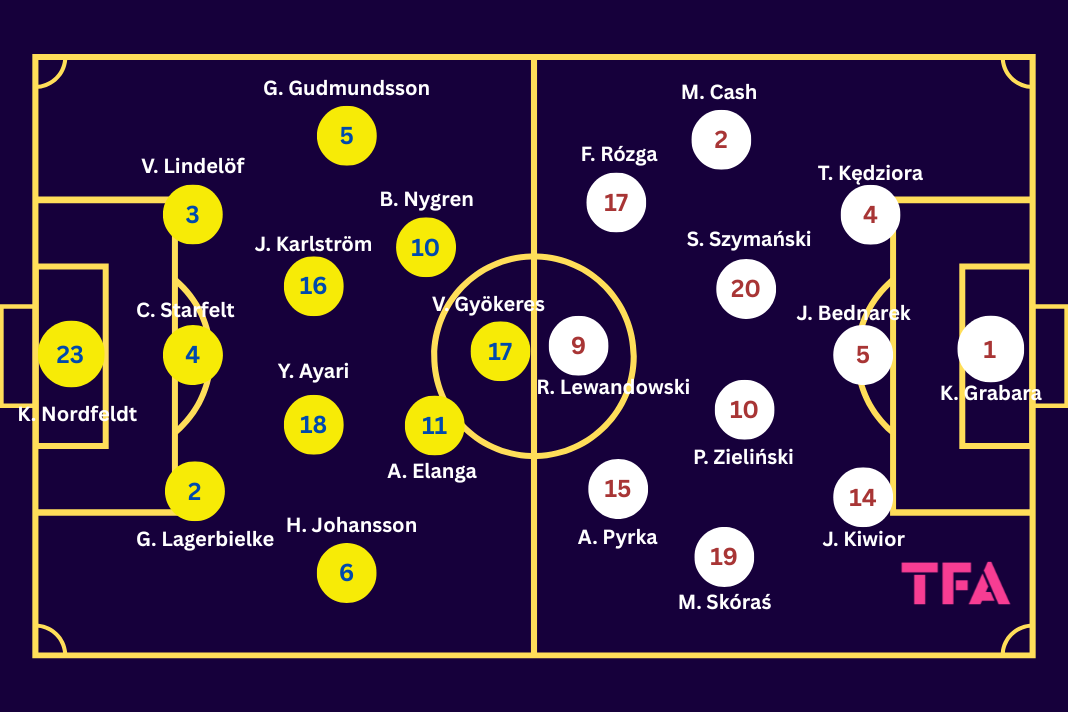
For Sweden, it is expected that the team would preserve the same lineup and the 3-4-2-1 formation for this final, with only minor changes.
Kristoffer Nordfeldt will start as a goalkeeper, with a defensive trio involving Gustaf Lagerbielke, Carl Starfelt, and Victor Lindelöf.
The midfield will most likely be made up of Yasin Ayari and Jesper Karlström as central midfielders with Herman Johansson and Gabriel Gudmundsson as wing-backs.
In attack, Graham Potter will rely on Elanga and Nygren as wingers, with Gyökeres being the main striker.
For Poland, Jan Urban will most likely use a 3-4-3 formation with Kamil Grabara as the goalkeeper and a defensive line of Tomasz Kędziora, Jan Bednarek, and Jakub Kiwior as centre-backs.
The midfield will most likely be composed of Zieliński and Szymański as central midfielders, with Matty Cash and Michał Skóraś as wing-backs.
Upfront, Arkadiusz Pyrka will replace the injured Jakub Kamiński on the left wing, Filip Rózga will play on the right wing, and Lewandowski will be the main striker.
Poland will most likely keep this back-three formation against Sweden, as it provides greater defensive security and suits the available players’ abilities.
Conclusion
Both teams are not very convincing in terms of defensive compactness.
This means that both can exploit each other’s defensive weaknesses and further focus on provoking defensive mistakes through their attacking plans.
Sweden remain the favourites to qualify thanks to their relatively more balanced squad and to the fact that they play at home as well.
But at the same time, this can give an additional boost for Poland to give more than 100% and surprise their opponent, especially since Sweden’s stadium is not one with a negatively impactful atmosphere on opponents.
In other words, the conditions at the stadium will not really affect Poland’s morale or performance, knowing that it might even put more pressure on Sweden instead.
