
As the 2025/2026 EFL Championship season approaches its decisive final stretch, the race for promotion has begun to crystallize, with clear separation emerging between the leading contenders and the chasing pack.
Coventry City appear all but assured of automatic promotion, holding an 11-point advantage over third place with only seven matches remaining.
Consequently, the analytical focus shifts towards the remaining automatic promotion spot, where Middlesbrough, Ipswich Town, and Millwall are locked in a tightly contested battle defined by marginal gains and fluctuating form.
Simultaneously, the competition for playoff qualification remains fiercely competitive, with Hull City, Southampton, and Wrexham all vying to secure their place in the top six.
This EFL Championship data analysis applies a data-driven lens, examining expected goals, pressing intensity, chance creation, and scoring trends to evaluate performance levels, underlying sustainability, and projected outcomes across the run-in.
EFL Championship Tactical Overperformance & Sustainability
A key lens in assessing the promotion race lies in the gap between actual points and expected points, offering insight into both tactical efficiency and potential regression.
Points Vs Expected Points – EFL Championship Automatic Promotion & Playoff Battle Race
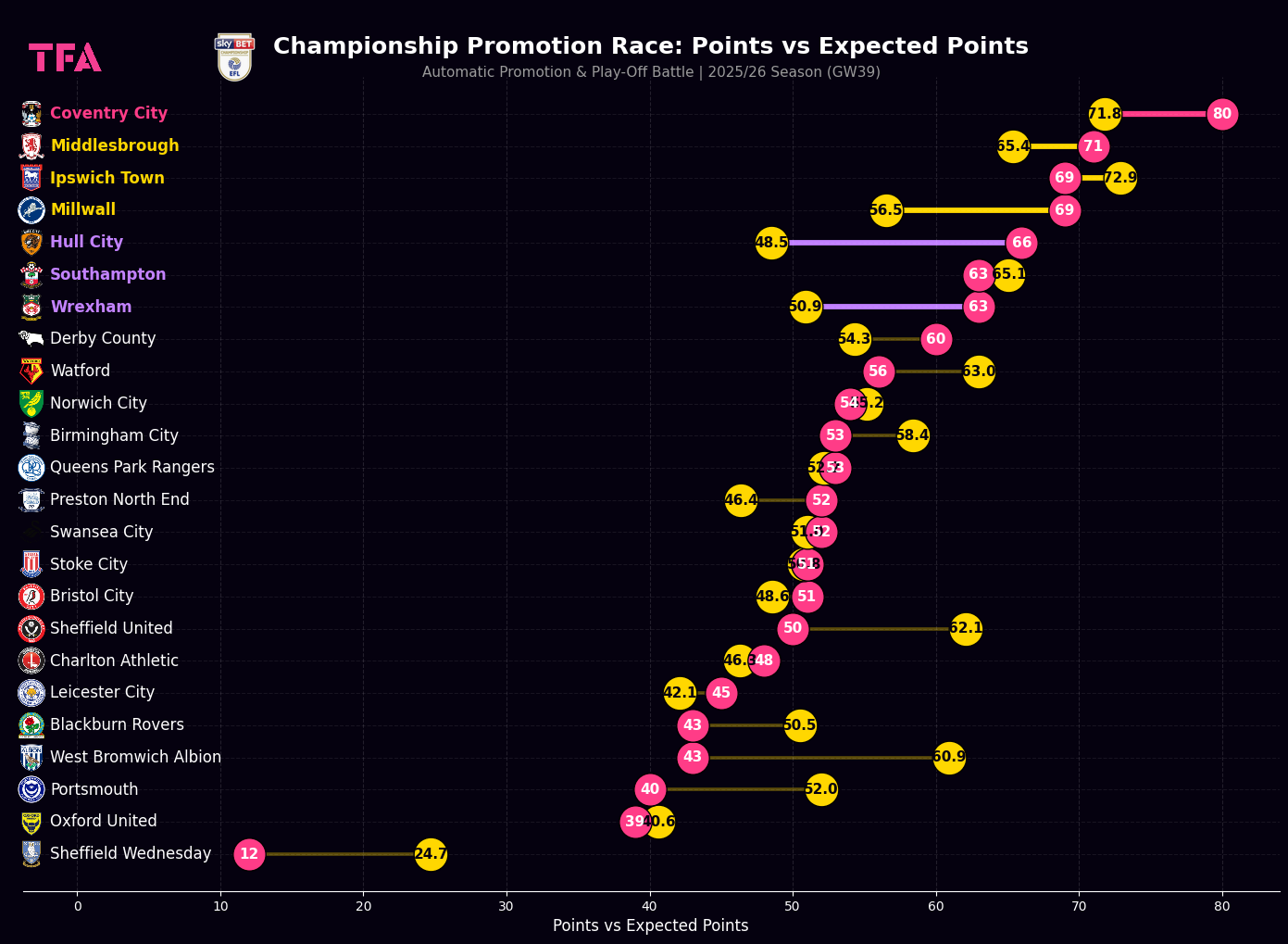
Coventry City, despite leading the table with 80 points, significantly overperform their expected return of 71.8.
Frank Lampard’s side have combined clinical finishing with strong game-state management, consistently converting narrow margins into victories, an efficiency that may prove difficult to sustain over the final stretch.
Ipswich Town stand out as the division’s most statistically robust side under Kieran McKenna.
Their possession-heavy, high-tempo structure generates 72.9 expected points, the highest in the league, suggesting their current total of 69 points undersells their true performance level.
Middlesbrough, now led by Kim Hellberg, present a different tactical profile; his aggressive, high-recovery system focuses on quick transitions and sustained attacking pressure, and their return (71 vs 65.4 xPts) still indicates moderate overperformance rather than structural dominance.
Millwall, under Alex Neil, remain one of the most extreme cases (69 vs 56.5), relying on direct play and efficiency in both boxes, raising questions over sustainability heading into the run-in.
Hull City, Southampton and Wrexham present contrasting profiles in the play-off race, Hull significantly overperform (66 vs 48.5 xPts), suggesting unsustainable efficiency.
Southampton, conversely, underperform relative to strong underlying metrics (63 vs 65.1), indicating upside potential, Wrexham’s moderate overperformance (63 vs 50.9) reflects a balanced slightly efficiency-driven approach.
Chance Quality & Clinical Edge In The Promotion Race
Beyond Coventry City and Middlesbrough, whose goal output closely aligns with their expected goals, the remaining promotion contenders show clear contrasts in the quality of chances and finishing efficiency.
EFL Championship 2025/2026 Goals Vs Expected Goals After 39 Matchweeks
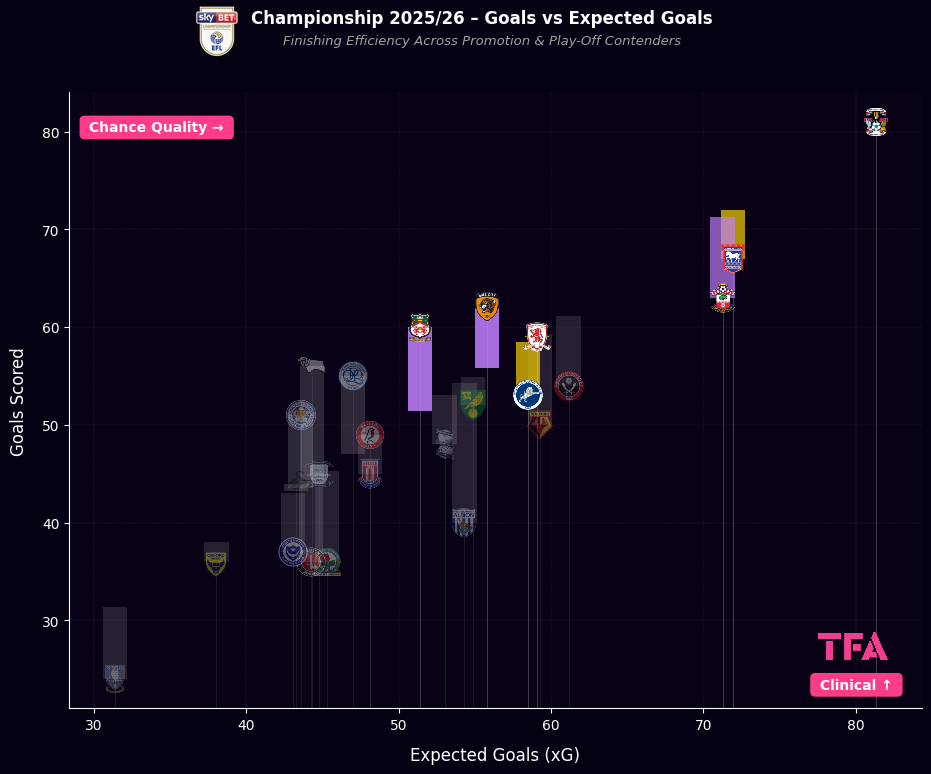
Ipswich Town, despite generating one of the highest xG totals (71.97), underperform in front of goal (67), indicating issues in shot conversion despite strong chance creation within McKenna’s structured attacking system.
Southampton, under Tonda Eckert, display a similar pattern (71.27 xG, 63 goals).
Eckert’s possession-based, high-tempo system produces high-quality chances, but their finishing efficiency in the final third has been slightly below expectations, limiting the team’s scoring output.
Hull City, in contrast, overperform significantly (62 goals from 55.79 xG), relying on efficient finishing and capitalising on lower-quality chances at a rate that may be hard to sustain.
Wrexham also impress (60 goals from 51.42 xG), blending direct attacking transitions with strong penalty-box efficiency.
Meanwhile, Millwall (53 goals from 58.49 xG) slightly underperform, reflecting a direct style that prioritises territory and volume over consistently high-quality shots in advanced areas.
Shot Quality & Finishing Efficiency In The Promotion & Playoff Races
Analysing shot quality and finishing highlights clear tactical differences between the sides competing for automatic promotion and those chasing play-off qualification.
EFL Championship 2025/2026 Shot Volume Vs Accuracy – Promotion & Playoff Contenders

In the promotion battle, Coventry City and Ipswich Town dominate in the final third, producing a healthy number of chances with strong accuracy, around 13 shots per game with roughly 35% on target.
Coventry combine territorial control with clinical execution, while Ipswich rely on a structured attacking system that consistently generates high-quality opportunities.
Middlesbrough, by contrast, create plenty of chances but rely more on volume than precision, indicating that Kim Hellberg’s high-press, fast-transition approach still leaves room for improvement in finishing.
In the play-off race, Hull City and Southampton illustrate contrasting profiles, Hull excel at converting lower-quality chances, showing high efficiency inside the box.
In contrast, Southampton, despite a similar volume of attempts, occasionally fall short in execution.
Wrexham sit between these extremes, blending direct transitions with solid finishing.
The tactical efficiency in chance creation and finishing quality, rather than sheer shot numbers, is the decisive factor in sustaining a push for promotion or securing a play-off place.
Dribbling & Individual Quality In The EFL Championship Promotion & Playoff Race
Dribbling and individual flair have emerged as subtle but significant tactical levers for teams embroiled in the EFL Championship promotion battle.
EFL Championship 2025/2026 Dribbling Volume & Efficiency
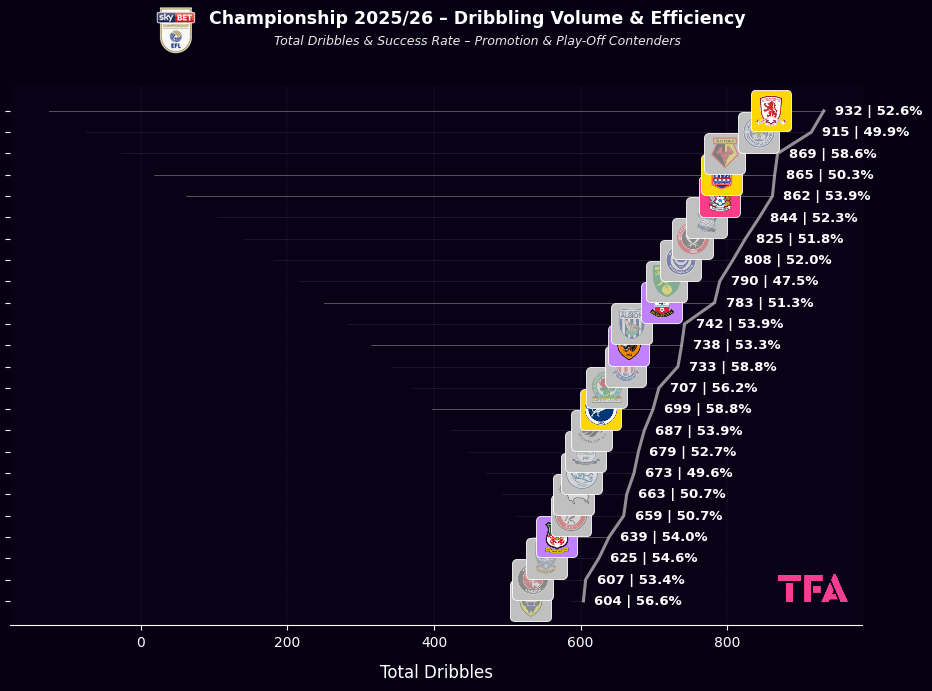
In particular, Middlesbrough and Coventry City leverage midfielders and attackers who can beat a man in tight spaces to unlock organised defences, while Coventry’s ball‑carrying from deeper areas helps sustain pressure in the final third.
Ipswich Town also benefit from individuals who can hold up possession and turn defenders, supporting their structured possession style and aiding chance creation.
In the play‑off mix, Hull City and Southampton deploy wide and central players whose ability to take on opponents stretches defensive lines, creating gaps for runners beyond.
This individual quality is especially valuable against compact units, allowing these teams to invent scoring opportunities where fewer chances are available.
Wrexham’s attack, led by experienced forwards like Kieffer Moore, noted for direct, robust play, combines physicality with opportunistic dribbling to exploit loose balls and unsettled defences.
Teams that blend effective dribbling with smart link‑up play tend to generate higher‑quality openings and create uncertainty in their opponents’ tactical shape, a marginal decisive edge in tight EFL Championship contests.
Deep Completions & Progression In The EFL Championship Promotion Battle
Deep completions, passes that reach the final third or penetrate advanced areas, have proven a critical metric in assessing attacking efficiency among EFL Championship promotion contenders.
EFL Championship 2025/2026 Deep Completions After 39 Matchweeks
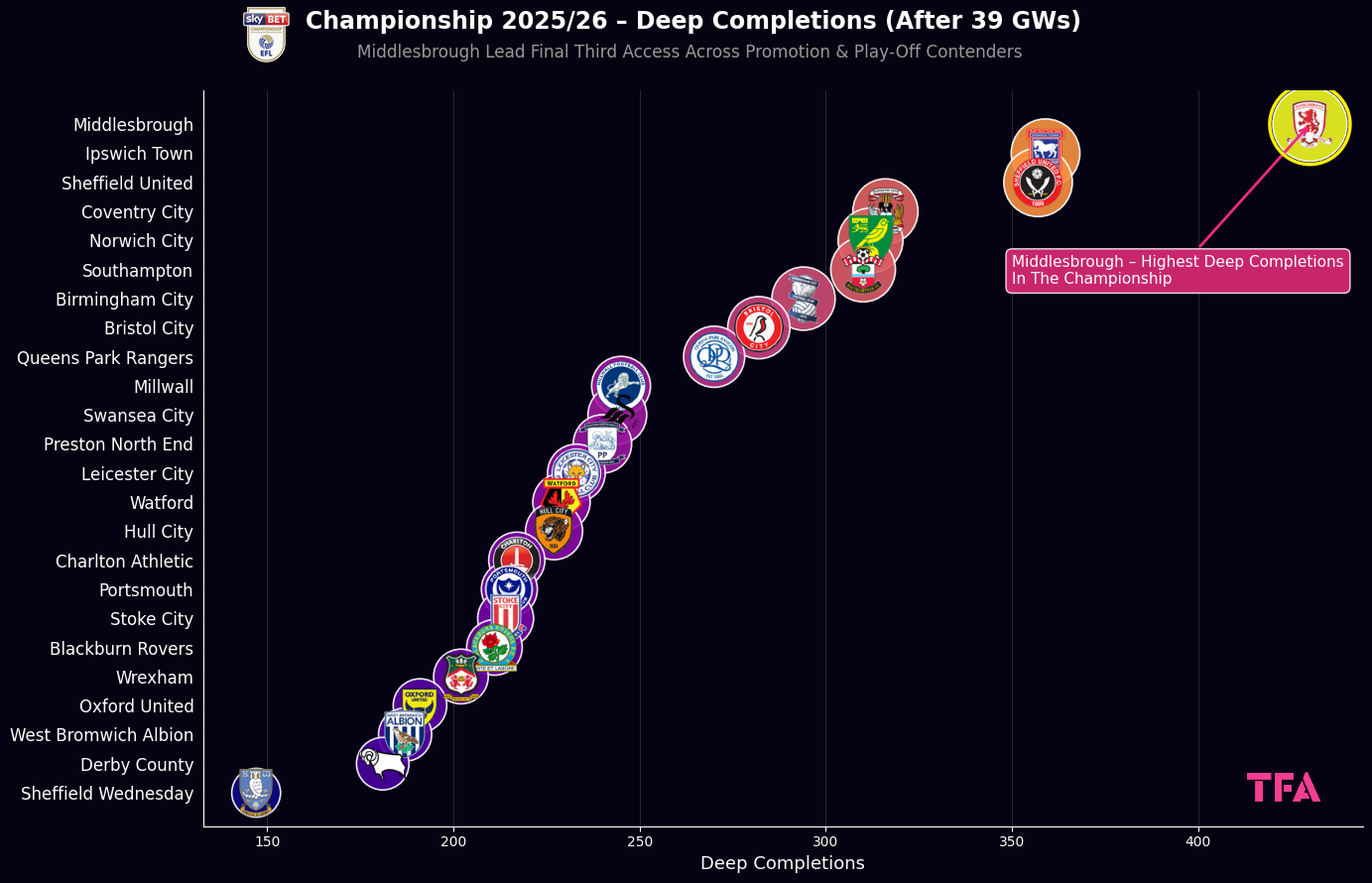
Middlesbrough lead the division with 430 deep completions, reflecting their high-tempo, transitional style that prioritises rapid forward movement and overloads in dangerous zones.
Ipswich Town and Coventry City, while slightly lower in volume, use deep passes more selectively to sustain possession and break down organised defensive lines, showcasing Kieran McKenna’s structured approach and Frank Lampard’s balanced system, respectively.
These passes are not merely about quantity; the quality of execution often dictates chance creation in tight matches.
In the play-off race, teams like Southampton and Hull City rely on precise deep completions from wide and central areas to manipulate compact defences, opening corridors for runners or dribbling forwards.
By advancing the ball effectively into threatening positions, these teams convert positional control into tangible attacking opportunities, making deep completions a subtle, decisive factor in sustaining both promotion pushes and play-off ambitions.
Defensive Structure, Game-State Control & The xGA Differential In The Promotion Race
Defensive performance, particularly the relationship between expected goals against and actual goals conceded, has played a decisive tactical role in shaping the promotion and playoff battle.
Defensive Performance Across Promotion & Playoff Contenders – EFL Championship 2025/2026
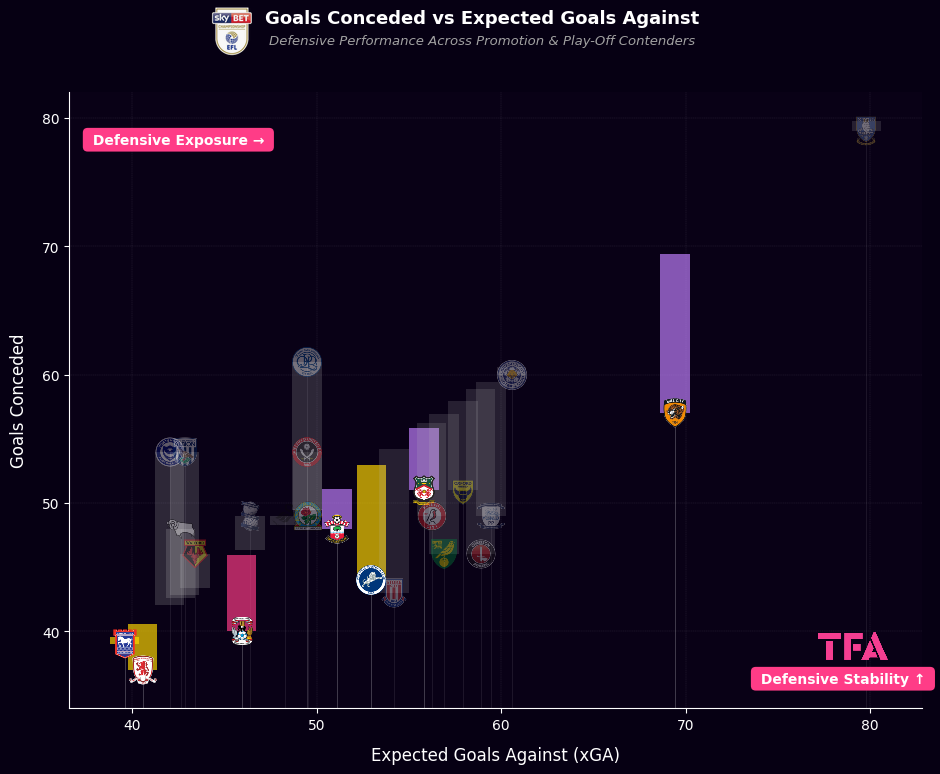
Ipswich Town stand out as the most structurally secure side, pairing the lowest xGA in the group with near-identical goals conceded, reflecting a compact, well-coordinated defensive block that limits both shot volume and shot quality.
Middlesbrough, meanwhile, concede the fewest actual goals, slightly outperforming their xGA, which points towards effective last-line defending and strong goalkeeping within an aggressive, transition-heavy system.
In contrast, Hull City emerge as the most defensively volatile of the contenders, combining a high xGA with a high number of goals conceded.
Their open, attack-oriented approach often leaves space in defensive transitions, making them vulnerable against direct opposition attacks.
Southampton and Millwall offer more balanced profiles, with Southampton showing minor underperformance, suggesting lapses in defensive execution.
At the same time, Millwall’s lower goals conceded relative to xGA highlights their deep, reactive defensive structure.
Defensive organisation and control of game states, rather than pure attacking output, continue to define consistency in the race for promotion.
Pressing Intensity, Defensive Activity & Out-Of-Possession Identity In The EFL Championship Promotion Race
Out-of-possession behaviour, measured through PPDA and challenge intensity, reveals clear tactical identities among the EFL Championship’s promotion and play-off contenders.
EFL Championship 2025/2026 Pressing Intensity Vs Defensive Activity – PPDA & Defensive Challenge Intensity

Millwall set the benchmark for defensive aggression, combining low PPDA with the highest duel, tackle and interception frequency, reflecting front-foot systems that disrupt build-up early and compress space between the lines.
This is reinforced by their strong defensive action volumes, particularly Millwall’s high interception and tackle-won totals, underscoring a reactive, physically dominant structure.
Ipswich Town and Southampton offer a more controlled pressing model.
Despite relatively low PPDA, their challenge intensity remains balanced rather than extreme, suggesting a positional press that prioritizes structure and passing-lane control over constant dueling.
This is reflected in Ipswich’s lower tackle volume, indicating efficiency in limiting opposition progression without overcommitting.
Middlesbrough and Coventry City sit in a hybrid space, blending coordinated pressing with solid defensive output.
Hull City and Norwich City, meanwhile, combine moderate PPDA with high challenge intensity, suggesting aggressive engagement phases rather than sustained high-pressing.
The pressing success is not purely about intensity, but about synchronization, structure, and the ability to translate defensive actions into territorial and transitional advantages.
Conclusion
As the EFL Championship season enters its decisive phase, the promotion race is increasingly defined by underlying performance rather than surface-level results.
While Coventry City’s lead reflects exceptional efficiency and game-state control, the battle beneath them highlights contrasting tactical identities.
Ipswich Town’s structural consistency and strong underlying metrics suggest the most sustainable platform for securing automatic promotion, whereas Middlesbrough’s aggressive, transition-led model offers high upside with minor inefficiencies.
Millwall’s overperformance raises questions around durability, particularly given their reliance on defensive resilience and direct play.
In the play-off race, Hull City’s volatility contrasts sharply with Southampton’s untapped potential, while Wrexham’s balanced approach keeps them competitive.
Success in the run-in will depend less on attacking output alone and more on cohesion between pressing structure, defensive organization, and chance quality.
The teams best able to align these elements, translating control into consistent results, are most likely to prevail in both the automatic promotion spot and the tightly contested play-off positions.
