
Southampton are one of several teams at the upper end of the highly competitive EFL Championship hoping to put themselves in a position to achieve promotion to the Premier League via the playoffs.
One of the key men they’ll be relying on to achieve that feat is Caspar Jander, who joined the Saints from 2. Bundesliga side 1. FC Nürnberg last summer.
The 22-year-old midfielder has been the subject of transfer speculation in recent weeks, amid rumours of homesickness and links to German Bundesliga sides such as VfB Stuttgart, RB Leipzig and TSG 1899 Hoffenheim.
Those reports, for what it’s worth, were quickly dismissed by Saints boss Tonda Eckert, who’s currently the subject of links to Bundesliga admirers himself.
If Southampton are to finish the season strongly and give themselves a shot at promotion, they’ll need to drown out external noise and focus on extending the 10-game unbeaten run in all competitions they currently find themselves on.
Caspar Jander has played a key role for the Saints this season, and in this recent run, he’s accumulated 76% of all possible minutes for the Saints in the league this term and been in the starting XI 81% of the time.
This Caspar Jander scout report uses data analysis and video analysis to detail Jander’s style of play, strengths, and weaknesses.
We aim to highlight why the €12m midfielder is one of the most exciting talents in England’s second tier at the moment, worthy of the attention he’s reportedly getting from clubs with UEFA Champions League ambitions.
Caspar Jander Stats
Firstly, we’ll present and analyse some 2025/2026 Caspar Jander data from the EFL Championship.
Figure 1 shows key 2025/2026 data on Caspar Jander, including a heat map, position map, and percentile ranks for custom-built metrics derived from weighted combinations of Wyscout’s raw data.
The percentile ranks benchmark Caspar Jander’s performance across our nine metrics against other central midfielders who have played at least 600 minutes in leagues of similar quality (the Belgian Pro League, the Dutch Eredivisie, the Portuguese Primeira Liga, and the Turkish Süper Lig) this season.
The data points toward a well-rounded central midfielder whose profile combines strong defensive activity with reliable in-possession security.
Caspar Jander Percentile Ranks 2025/2026
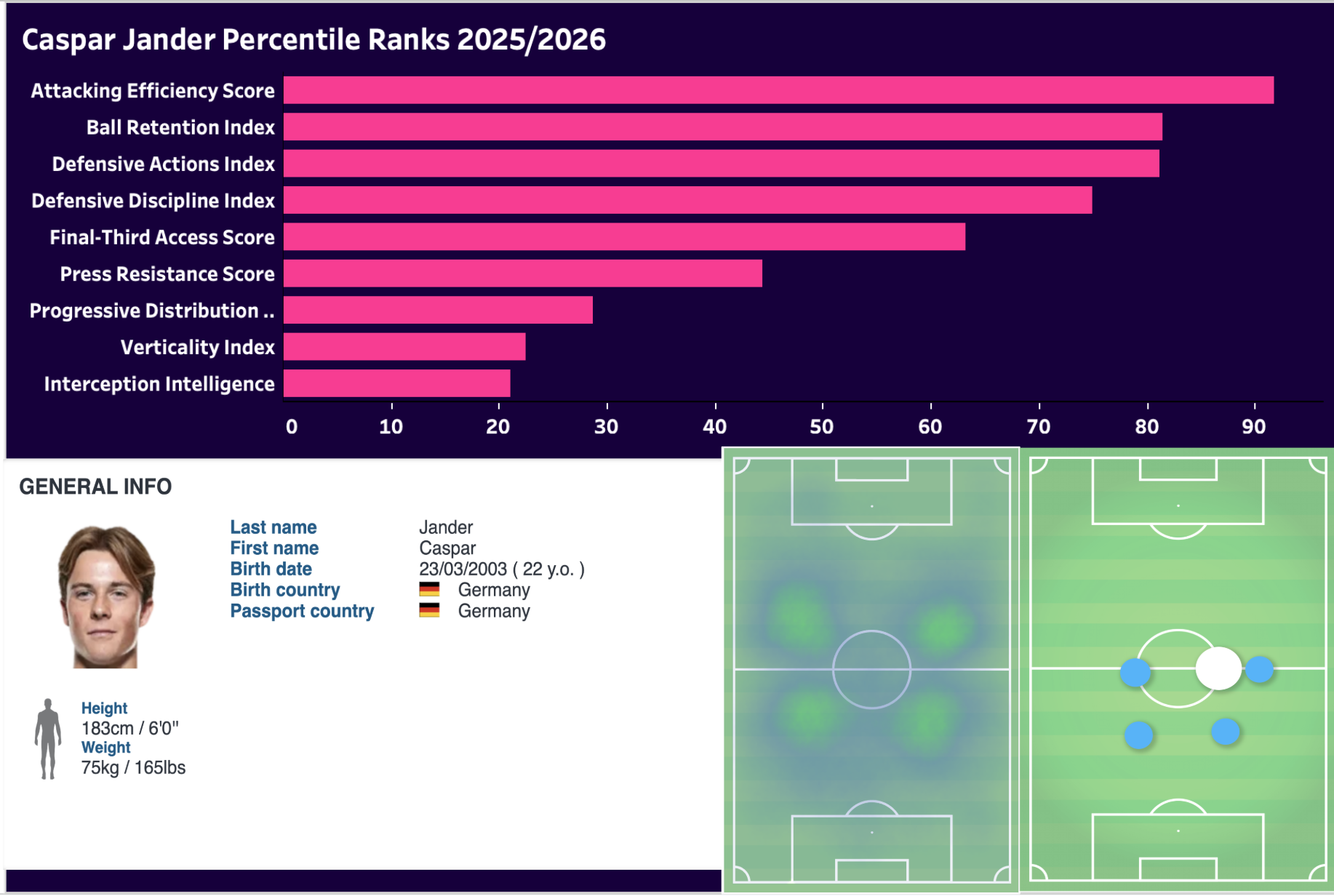
Caspar Jander posts strong numbers in our Defensive Actions Index and Defensive Discipline Index metrics, indicative of a midfielder capable of contributing high defensive volume while maintaining control in his engagements.
The combination of volume activity with discipline provides strong structural value to the team; this type of player provides an ability to disrupt opposition attacks without exposing the team through unnecessary fouls.
Notably, Caspar Jander’s Interception Intelligence sits closer to the lower end of the dataset, and this is where the 22-year-old’s worst performance in our nine custom metrics comes.
We see this in the data because Caspar Jander’s defensive value comes more from work rate and physical presence than anticipation and reading passing lanes.
In possession, Jander demonstrates strong technical security, as evidenced by his high Ball Retention Index ranking.
This indicates high involvement in circulation and reliable pass completion.
His Press Resistance Score is below average among our dataset, which is harsh from observing his game.
I’d rate Caspar Jander’s press resistance fairly highly and say he’s quite reliable at receiving under pressure and escaping it.
However, he is even better at finding space and putting himself in positions to receive away from pressure.
From those situations, he’ll often quickly relay the ball on, thus avoiding the pressure entirely.
I certainly wouldn’t say that Caspar Jander is below average in terms of press resistance.
His Final-Third Access Score sits comfortably above average, while his Progressive Distribution Score and Verticality Index are lower.
This points to meaningful link-up play and involvement in advanced areas, but a more measured passing style.
Caspar Jander doesn’t attempt many ambitious forward passes; rather, he prioritises security and structure when advancing possession.
If Jander received in the middle third, I’d expect him to try and carry forward into the final third and either play a through pass or, more likely, lay it off with a simple pass to a creator in space.
Similarly, if he receives while already positioned in the final third, perhaps after drifting into space with that skill of his to evade opposition radar, I’d also expect him to lay the ball off with a simple pass, acting as a connector rather than a playmaker most of the time in possession.
Lastly, Caspar Jander’s Attacking Efficiency Score ranks extremely highly in the dataset, indicating that when he does contribute in advanced phases, the quality of those actions is often high relative to the number of attempts he makes.
Jander tends to be more risk-averse and disciplined in all phases of possession.
For instance, he’s the kind of player who will get on the end of a bouncing ball on the edge of the box and pass it out wide to a crosser in space rather than be tempted to shoot or take a man on.
He doesn’t snatch at opportunities; his in-possession game is characterised by discipline.
Overall, Jander profiles as a balanced central midfielder who offers defensive activity, excellent off-the-ball movement, and secure possession play.
Caspar Jander In Possession
As Caspar Jander’s heat map shows, he’s primarily involved in the middle third, frequently occupying the half-spaces on either side of the halfway line.
A lot of Caspar Jander’s in-possession game in those positions can be boiled down to the following sequence: Find space, receive, turn, carry forward, release securely.
This is exactly what we see in the clip above, which perfectly demonstrates Caspar Jander’s technical security and role as a ‘connector’ within this Southampton side.
Constant scanning and off-the-shoulder runs are positive, commonplace features of Caspar Jander’s game as he finds space and puts himself in positions to receive.
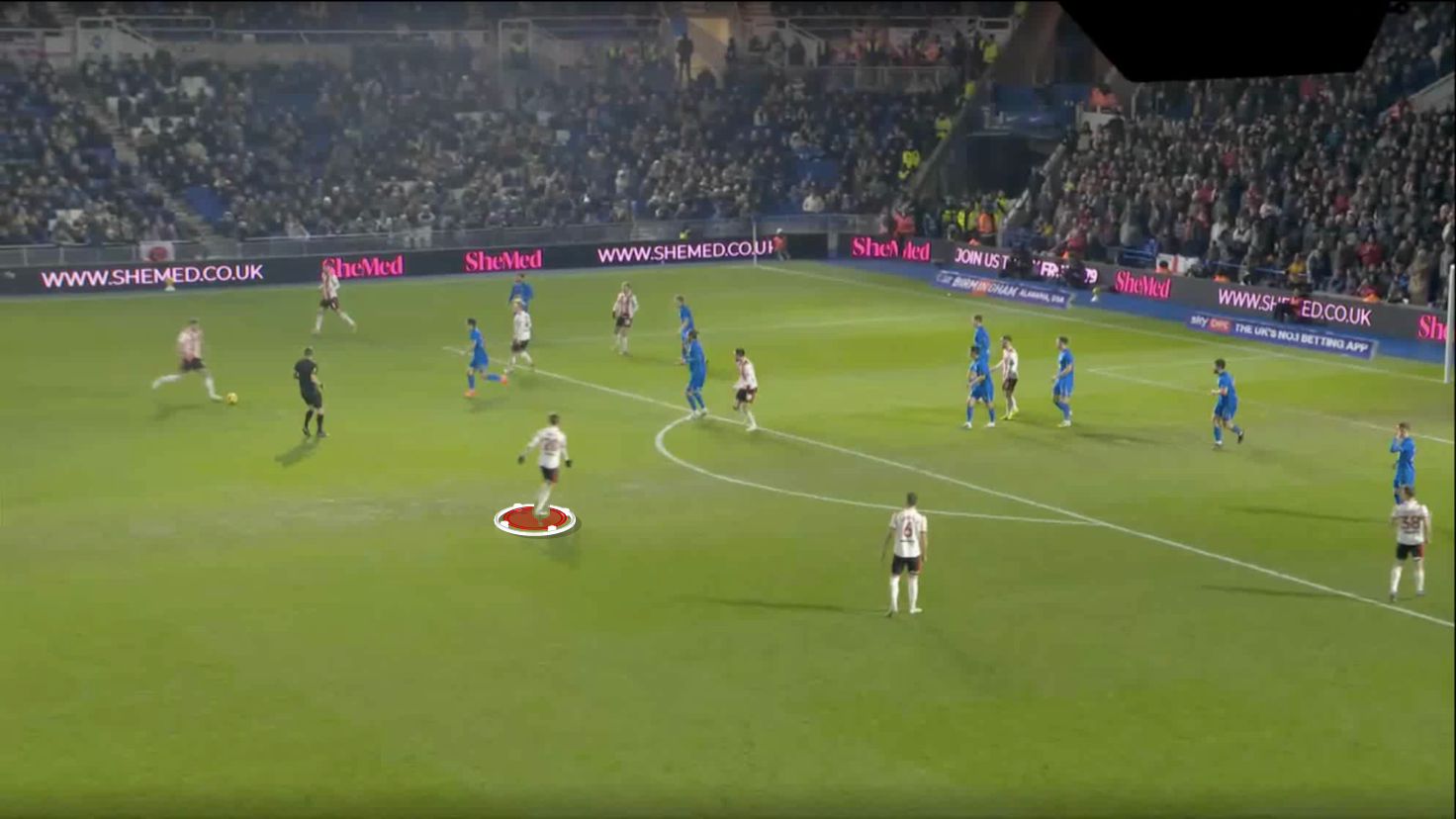
In the chance creation phase, Caspar Jander loves to hover around zone 14, as we see in Figure 2.
From this threatening, high-value position, he can contribute goals and assists, though you’d want to see improvement in his actual output.
Caspar Jander In Transition & Physicality
Caspar Jander’s physical profile is another big positive.
At 183cm, Jander has the height to compete in England’s physical midfield battles.
His height is backed with pace and intensity, the successful utilisation of which helps him to come out on top of midfield battles.
Caspar Jander can still develop physically and aim to build more muscle, which would further enhance his physical midfield profile and help him to contribute even more in transition, which is where he already provides significant benefit to his team through the aforementioned positives.
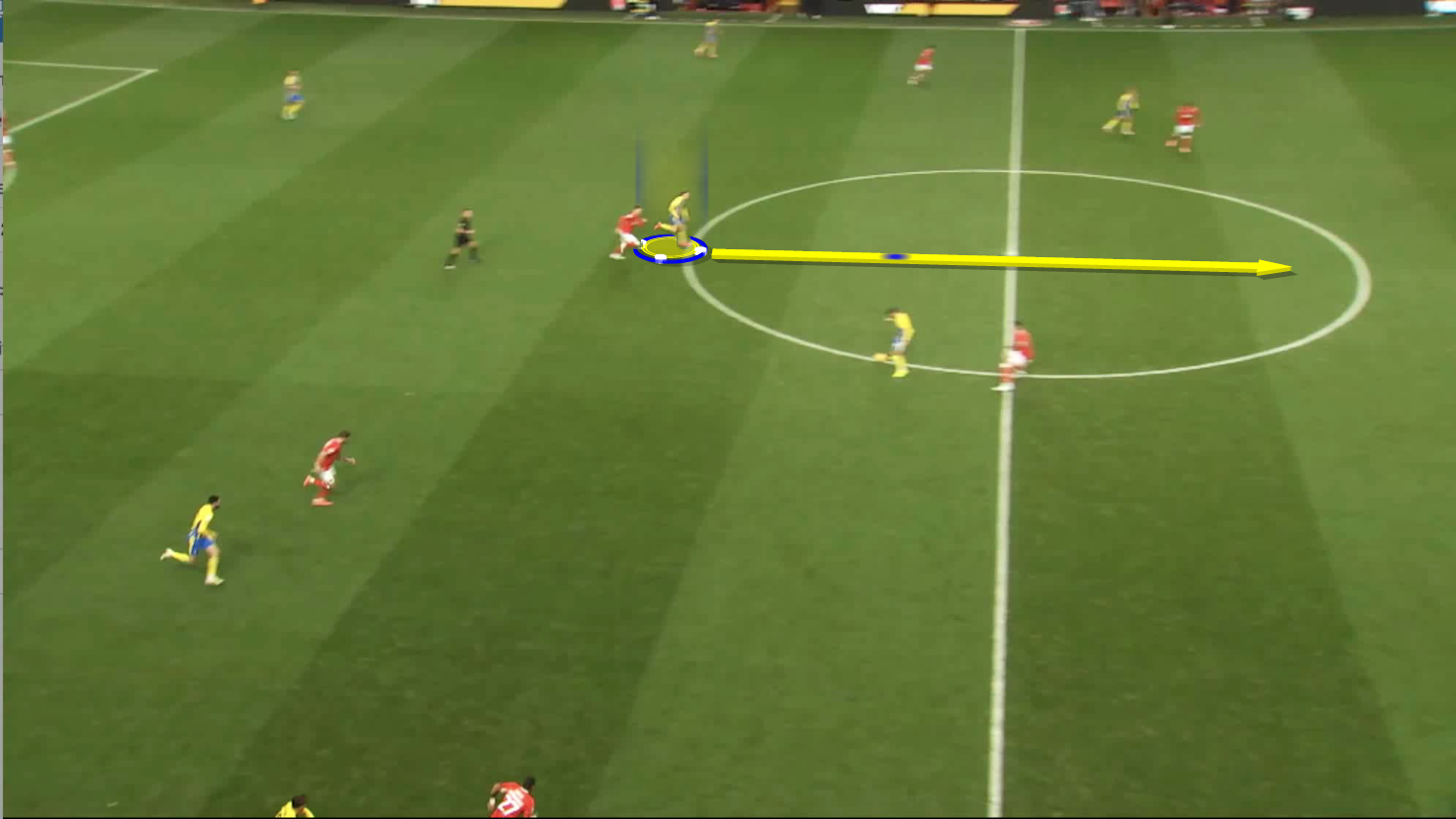
Caspar Jander is capable of sudden bursts, which make him a useful support runner in transition or when arriving late in the box to provide an option during the chance creation phase.
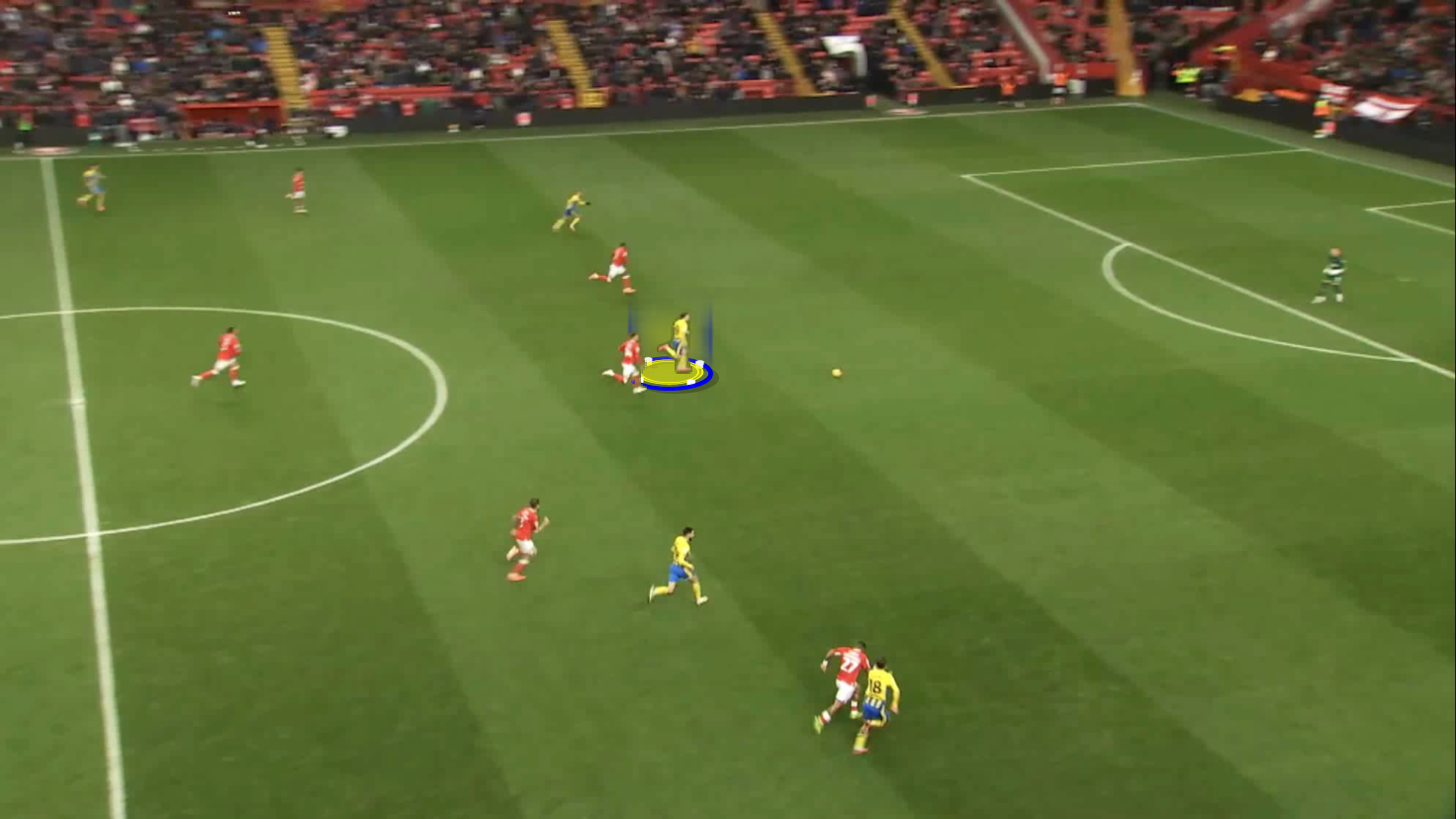
Figures 3 and 4 show how Caspar Jander was able to escape from his marker and provide a great through-passing option for his teammate through the middle of the pitch in transition.
This next clip shows how Caspar Jander’s pace and intensity helped him get to the end of a loose ball ahead of his opponent, then drive into the final third, where he can release to a creator.
Caspar Jander Pressing & Counterpressing
As well as those in-possession strengths, Caspar Jander is a useful pressing and counterpressing weapon for his side.
Jander’s main out-of-possession value lies in his pressing contribution higher upfield.
The clip above shows how Caspar Jander’s blind-side pressure stifled opposition ball progression, forcing the opponent backwards and nearly forcing a turnover in what would’ve been a very dangerous position.
Meanwhile, in the next clip below, Jander pounces on some lackadaisical in-possession play from his opponent to turn the ball over just inside the opponent’s half and kickstart an intense counterattack.
While Jander is more reserved in possession, he’s happy to take a bit more risk and commit physically without the ball.
Lastly, we see Caspar Jander’s intelligent positioning and quick reaction as soon as his team turns possession over in the next clip above, highlighting how the German midfielder is a fantastic counterpressing asset.
Conclusion
To conclude, Caspar Jander’s profile resembles that of his Premier League compatriot Pascal Groß, in that he constantly seems to just ‘appear’ in free pockets of space, releases fairly quickly after receiving, prefers a disciplined, risk-averse possession game, and primarily acts as a ‘connector’ and ‘support player’ for the next phase.
Another similarity between the two players lies in their high out-of-possession work rate and pressing/counterpressing contribution.
The two players differ in that while Groß has elite final-third delivery and technical precision, Jander has more athleticism and physicality.
I see Caspar Jander’s ideal role as a ‘connector’, No. 8 in a 4-3-3 or a pressing-oriented box-to-box midfielder.
I believe he’ll thrive in teams with structured possession that value midfield pressing and where he’s not expected to be his team’s main creator.
He’d be less suited to a pure, vertical, transition-based system or if expected to bear too much of the creative load.
