
In the last two seasons of European football, few coaches can say they have produced better results than Gian Piero Gasperini. The Atalanta coach steered the club to fourth last season, a position that would have meant Champions League football this term, and now has them in sixth which would guarantee European football for another year. In this period, Gasperini’s Atalanta has been one of the most entertaining in Europe with their quick passing, energetic pressing and the number of young players promoted to the first team by Gasperini. In this piece I will examine the tactics Gasperini has used to such great effect including his collective man-marking.
Gasperini’s preferred formation
During all of his years coaching in the Italian top flight, Gasperini has been synonymous with the 3-4-3 formation. In fairness, his formation changes between two adaptations of this formation; 3-4-2-1 and 3-4-1-2. Mainly it depends on the players he lines up or the setup of the opposition but in his two years at Atalanta his default setup in attack has been 3-4-2-1 while in defence it’s wrong to talk about a shape. I’ll come to this later. Below is an illustration of a normal line-up in the attacking phase.

Atalanta’s high-pressing
Atalanta are one of the most aggressive teams in Italy and Gasperini instructs his players to press high up the pitch to disturb the opponent. The stats back this up as Atalanta make 18.9 tackles per game on average, a total only Fiorentina better. Similarly, only three teams (Roma, Napoli and Sampdoria) allow their opponent less passes per game than Atalanta’s 351. These stats highlight the effective pressing of Gasperini’s side and how difficult it is to keep the ball against them. So how do they go about it?
When Atalanta press high they do so with extremely obvious man-orientations in a way similar to Eusebio Di Francesco’s Roma. Gasperini’s overall defending strategy is to man-mark the opposition, as we’ll look at later and therefore it comes as no surprise that man-orientated pressing is adopted. Given man-marking’s reactionary nature, Gasperini adapts his pressing schemes based on the opponent’s setup. Let’s look at two different scenarios below.
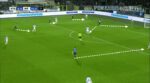
The first example is from their home game against Inter. Inter chose to build up in a 3-2-4-1 in this game which meant Gasperini pushed his front-three up against Inter’s three defenders in the first line. His two central midfielders marked Inter’s two midfielders and Atalanta’s wing-backs marked their direct opponents on the wing. In the scene below, Inter’s right wing-back Cancelo is pressed by the left wing-back Robin Gosens. Left forward Alejandro Gomez marks Inter’s right-sided centre-back while central midfielder Freuler pushes up on Inter midfielder Gagliardini in the centre. Right forward Cristante marks Inter’s left-sided centre-back. The striker Musa Barrow removes the option to go back to the goalkeeper while blocking the pass to the central centre-back. Inter are forced long and Atalanta win the ball back.
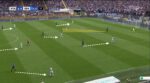
The scene below is from last weekend’s clash with Genoa. Genoa set up in a 3-5-2 and Gasperini adapted his pressing schemes to this shape. Again we see how the wide forwards push up on the wider centre-backs in the opposition’s structure. The striker Barrow again presses the goalkeeper while using his cover shadow to remove the option of bypassing him to find the central centre-back. One of Atalanta’s midfielders push up on Genoa’s playmaker, the other picks up a midfielder and there’s once again a straight wing-back battle. Because Genoa had three in midfield against Atalanta’s two but only two forwards against Atalanta’s three defenders, Gasperini would have one of his centre-backs step up to mark the third Genoa midfielder when needed.
This extremely man-orientated pressing works really well to stop teams building attacks from the back and forces them into longer passes instead. This forces teams to play a more chaotic way, which suits Atalanta and disorganises the opponent. This is the reason so many teams who normally control possession (Napoli, Fiorentina and Roma for example) struggle against Atalanta.
Collective man-marking
As mentioned above, also when not pressing high Gasperini deploys a collective man-marking approach. He adapts the positions of his players based on the positions of the opposition to be able to mark each opponent or in some cases allowing one player, often a defender, to be free in order to keep a spare man in his own defence. Normally there’s a certain flexibility in this marking as particularly defenders often pass an opponent on and stays in his natural position. In some games, however, they are strictly man for man regardless of how their opponent moves. This approach makes it difficult to talk about a defensive “shape” in the traditional term as there isn’t a fixed one, rather it’s a fluid concept where Atalanta are concerned.
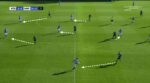
Let’s look at three different games where the setup has differed. Firstly we have a game against Napoli, famed for their sublime passing in a 4-3-3 formation. Gasperini sought to disturb their build-up play and man-marked as seen below. He decided to man-mark both Napoli centre-backs and all three midfielders, removing all central options to progress the ball. The two full-backs where left alone until they were about to receive the ball which was the trigger for the ball-near wing-back to push out. This approach especially worked well last year with Atalanta completing a domestic double over Maurizio Sarri’s men.
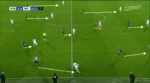
The aforementioned Inter game presented a different scenario due to Inter attacking shape of 3-2-4-1. That shape mirrors Atalanta’s so it was quite straightforward to find each player a direct opponent, as imaged below.
Below is a scene from last season’s clash with Juventus who played in a 4-2-3-1. This might be the most interesting example yet and the one which really shows the extremes to which Atalanta go in their man-marking. The striker, Gomez in this game, presses Barzagli. We can clearly see how Atalanta man-mark both Pjanic and Khedira in Juventus’ central midfield. Juventus’ right-back is marked by left midfielder Kurtic. Highlighted in yellow is left centre-back Andrea Masiello who has left the defensive line and followed Paulo Dybala towards the ball.
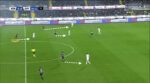
In the below image we now see Pjanic in possession being pressed by Freuler. On the far side is Kurtic again marking Juve’s right-back and at the bottom left corner is Cristante with Khedira. Again highlighted in yellow is Masiello. Look at his position! He is the left-sided centre-back but has followed Dybala across the pitch. Highlighted in black is Mattia Caldara, Atalanta’s central centre-back, who follows Gonzalo Higuain into midfield. Here we see how strictly the players follow Gasperini’s instructions. This is why it’s so problematic to talk about a defensive shape. The “shape” constantly changes because of the movements of the opponent.
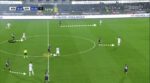
Below is a nice overview of Atalanta’s defensive approach in the Juve game. In this game they differed so much from their normal setup that it’s impossible to come up with a formation. They basically had two defensive players on each wing with the left midfielder Kurtic marking Juve’s right-back Dani Alves while left-back Spinazzola marked right winger Cuadrado as you see below at the top of the image. The same setup was used on the right with right midfielder Hateboer marking left-back Alex Sandro while right-back Conti marked left winger Mandzukic. Two of the centre-backs (in black) marked Juve’s front-two with the third centre-back as a spare man (yellow) and then the two midfielders marked Juve’s duo. The striker Gomez would shift between pressing either centre-back and leaving the other one free.
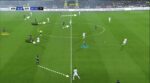
The image above shows how fragile this setup can be if there’s a mistake made in the marking. Cristante (blue) has left Khedira and become attracted towards Chiellini and the ball. Khedira becomes free, receives and turns. It could have created a problem but it didn’t on this occasion. Let’s just once again note the positions of the centre-backs. Have you seen anything like that before?
Despite man-marking’s reactionary nature, this type of man-marking becomes proactive since teams are forced to adapt to Atalanta’s way of playing after Atalanta has adapted their shape to them. It creates problems for the opponent and it’s horrible to play against. It works too, with Atalanta having conceded 36 goals so far, a total only bettered by Juve, Napoli, Roma and Inter. With the energetic and aggressive nature of Atalanta’s pressing, the collective man-marking make them a team no one wants to face and explains why their defensive stats are so impressive.
Gasperini’s possession setup
In possession, Atalanta are extremely organised and well-prepared. They set up in a 3-4-2-1 shape in possession and therefore always maintain width through their wing-backs as well as having four players at different heights in central midfield. This box midfield creates further problems for the opposition as the midfielders will have two Atalanta players in front of them as well as two behind them. The possession structure is highlighted below.
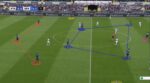
They try to build from the back and do so by quick and sharp passing. One of the central midfielders often drops towards the wide area to help progress the ball in the space vacated by the attacking wing-back. The two attacking midfielders normally stay in each half-space and when they receive the ball they quickly turn and go forward. The whole idea behind Atalanta’s possession play seems to be to get the ball forward as quickly as possible in a controlled manner. If pressed, however, Atalanta aren’t afraid to go long from the goalkeeper or one of the defenders. They then look for the striker or Cristante and look for a flick-on or to win the second ball.
They’re also adept at controlling possession for longer spells, ranking sixth in Serie A for average possession. They have a solid base to build from with the three centre-backs and the two midfielders which also creates a stable protection against counter-attacks. The aim is to deliver the ball to the wide areas quickly and to give the wing-backs space and time to attack the defensive line. We’ll look at this below.
Creating chances
Wing play
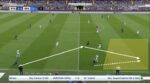
The main source of Gasperini’s method to create chances is the wide areas. As mentioned the wing-backs always maintain maximum width and Atalanta look to find them in space either wide or behind the opponent’s defensive line from where they can deliver low crosses or cutbacks. That’s important to note; Atalanta rarely put in high crosses due to the difficulty of finishing from those. Instead they focus on low crosses or cutbacks which can be finished with one touch and more controlled since it comes along the ground and the probability to score are higher than the aerial alternative. To give the wing-backs as much time as possible to make their delivery with good quality, Atalanta work with quick switches of play from one side to the other, often by passing into the attacking midfielder in the half-space who will attract attention from the opponent’s full-back and then spray the ball out to the onrushing wing-back. I’ve drawn up an often seen scenario below.

Another method to get the wing-backs into good positions is through combinations like the one pictured below. Toloi plays the ball into the attacking midfielder Cristante who plays it into space for right wing-back Castagne to run onto.
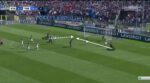
As the ball is on one side for the wing-back to deliver into the box, the far-side wing-back moves into the box and attacks the far post area. Last year Andrea Conti perfected Gasperini’s wing-back role and scored eight goals in the league as well as making five assists which earned him a move to AC Milan. Below is an image of right wing-back Hateboer squaring the ball for left wing-back Gosens who scores easily.
Central combinations and runs from midfield
Another way they create chances is from central combination play between the front-three and/or an onrushing midfielder. Players like Alejandro Gomez, Josip Ilicic and Bryan Cristante are key to this method with their creativity and passing quality. The striker is often used as a reference point and he then tries to link the play with the players around him. One key behind Cristante’s stunning form this campaign, nine goals in the league, is the way he times runs into the box and runs past the striker to get on the end of through-balls. In the example below, Petagna has received the ball with his back to goal. Cristante and central midfielder Freuler both make deep runs past Petagna who plays it through for Cristante who then brilliantly squares it for Freuler to tap it into an empty net. Freuler has scored five this season and his colleague in midfield Marten De Roon has three and they play an important role in joining the attack with these types of deep runs.

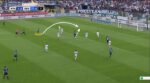
The combination between Gomez and Cristante has perhaps been the main talking point of Atalanta’s season with the young Italian slotting perfectly into this role of timing runs into the box and anticipating moments to get behind the defensive line. Below, Gomez lobs a pass into the path of Cristante who finishes emphatically.
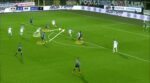
In the below scene, Gomez has just dribbled forward and attracted pressure from Inter’s centre-half Skriniar (highlighted with white). He passes to Cristante before continuing his run and Cristante plays him through in the space vacated by Skriniar. This combination was made possible due to the close proximity between the two attacking midfielders/wide forwards. With the strikers position as well this gives Atalanta three players in central positions up against the opponent’s centre-backs and because of their great combinations they will be threatening.
The combination of dangerous combination play centrally and the threat from wide areas make Atalanta a tough team to defend against since they can hurt you in different ways. They’ve also scored 14 goals from set-pieces this season, which makes up for 25% of their goals. It’s fair to say Gasperini has made them a threat from all angles.
Summary
Gian Piero Gasperini’s work at Atalanta over the last two seasons is remarkable given the resources at his disposal, the financial standing of his club compared to the other Italian top clubs and perhaps most importantly the departures he’s had to deal with. Roberto Gagliardini (Inter), Franck Kessie (Milan) and Andrea Conti (Milan) have already been sold and Mattia Caldara (Juventus) will leave in the summer. All were given their chance by Gasperini. Gasperini has again turned to youth and the cheap, virtually unknown signings his sporting director Giuseppe Sartori, probably Italy’s best in his role, has made to replace them. The results have been remarkable as Atalanta are just as strong this term. Gasperini is on the verge of leading Atalanta to European football for the second year running and he has done so with a unique brand of football which excites both fans and neutrals. Long may his reign in Bergamo continue!
Like tactics and Italian football? Check out this analysis of Juventus-Napoli.
