
Eusebio Di Francesco Preferred Formation
In his first season in Rome, Eusebio Di Francesco has steered his former side to their first Champions League semi-final in 34 years and look set to finish in the top four in Serie A.
The season has been a bit up and down for Roma though, with real highs but also quite a few lows.
Performances have varied from dominant displays against high-quality opposition to being demolished by others.
The consistency hasn’t really been there throughout.
It should be remembered, though, that Di Francesco has only been in the job one season, and it is his first managing a top club.
And it’s still possible, though another miracle is needed, he leads AS Roma into a Champions League final in a few weeks.
In this article, I take a look at his tactical setup and whether he can be the man to make Roma a winning club.
Di Francesco’s tactics almost exclusively play out of a 4-3-3 formation, which he has stated is the ideal formation, apart from the fact that it does not allow for marking the opponent’s playmaker by default.
At times, like in the brilliant crushing of Barcelona as well as the heavy defeat at Anfield, Di Francesco has deployed a 3-4-1-2 to try to combat his opponent.
Most often, though, Di Francesco sets up a back-four with attacking full-backs, a midfield three with one holding midfielder and two more advanced, either side of him (a position called mezzala in Italian terminology) and two wingers, either side of a strong striker.
Eusebio Di Francesco Attacking Strategy
I will start with Di Francesco’s attacking strategy, then discuss his ideas on building from the back, and finally, how his sides look to create chances.
Di Francesco is a very attacking coach and wants his team to dominate every game.
His possession style is very vertically focused, and he wants the side to progress the ball forward as quickly as possible.
One important facet of Di Francesco’s tactics is the use of positional rotations in different areas of the field.
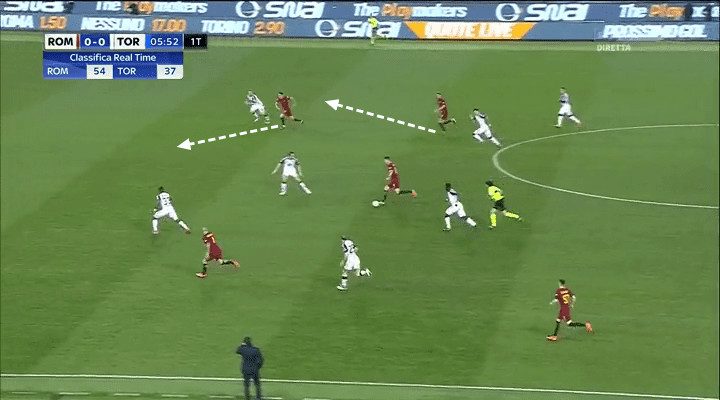
Normally, this involves the central midfielders and wingers rotating to change positions, with the midfielder moving wide to open up space for a pass into the half-space, which the winger has vacated.
This movement is the most often used rotation by Di Francesco’s teams and maintains the balance in the positional structure in possession, but causes confusion for an unprepared opponent.
One example of this rotation is shown below.

The aim behind this is probably to create a free man between the lines while simultaneously creating a 2 vs 1 situation against the opponent’s full-back.
Either this comes by the central midfielder overlapping the winger, or as usual, by the full-back bombing on down the wing.
As I’ll come to later, using the wings well are key to Di Francesco’s approach to create chances and goals.
Another rotation Di Francesco uses when trying to build attacks from deeper positions is similar.
It sees the full-back push on high down the wing with the winger again rotating inside to the half-space.
The central midfielder on the ball near side in this rotation moves into a deeper wide position to create a triangle with him at the base and the full-back and winger ahead.
This creates a problem for the opponent’s winger, who will easily be played around no matter how he presses.
The scene below illustrates this.

A third rotation can often be found in wide areas with the full-back in possession.
In this rotation, the winger will maintain width and make a move towards the ball.
This movement often drags the opponent’s full-back towards the ball too, and then the ball-near central midfielder will make a deep run into the space between the full-back and the ball-near centre-back, as illustrated below.

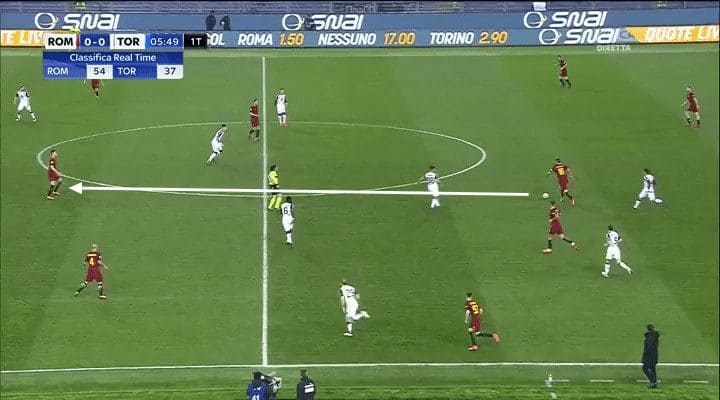
Apart from these three most common rotations, Di Francesco also looks to utilise his striker as a reference point in constructing attacks.
The physical strength and superb hold-up play of Edin Dzeko make him ideal to be used in this way.
Roma will most often look to play the ball to his feet along the ground, but sometimes also in the air over the opponent’s midfield, and the two central midfielders will then make movements to receive in an angle.
Dzeko will thus have two options to lay the ball back to, and when the midfielders receive it, they can then attack the back four or spray the ball wide.
When the midfielders receive the ball from Dzeko, Roma will likely be able to attack the opponents’ back four with a numerical advantage, 5 vs 4, as shown in the scene below.

The sequence below from the game against Torino highlights this method to progress the play, albeit with Patrik Schick as the striker instead of Dzeko.
Note the rotation between winger and central midfielder as discussed earlier.
To summarise this section, Di Francesco makes his teams build attacks from the back and wants them to be the dominant team in every game they play.
To help advance the attack, he employs several positional rotations to try to move the game forward.
The passing is always quick, and the aim is always to be vertical and progress forward as quickly as possible.
The rotations are an important tool in this aim as they help to destabilise the opponent’s defensive shape.
The rotations also help keep the balance of the positional structure, as there will always be a wide outlet even if the wingers come inside.
Eusebio Di Francesco Final third
When the ball has been moved into the final third and it’s time to create chances and score goals, Di Francesco utilises the wings as key components behind chance creation.
Be it crosses or diagonal runs in-behind from wingers, the wings are vital in Di Francesco’s way of playing.
As I discussed above, the wingers often rotate inside with a central midfielder or most often a full-back attacking the wide space.
As in the illustration below, Roma have created a 2 vs 1 situation against the left-back.
The winger plays the ball into the run of the full-back and the striker, the ball-far winger and one central midfielder attacks the penalty area.

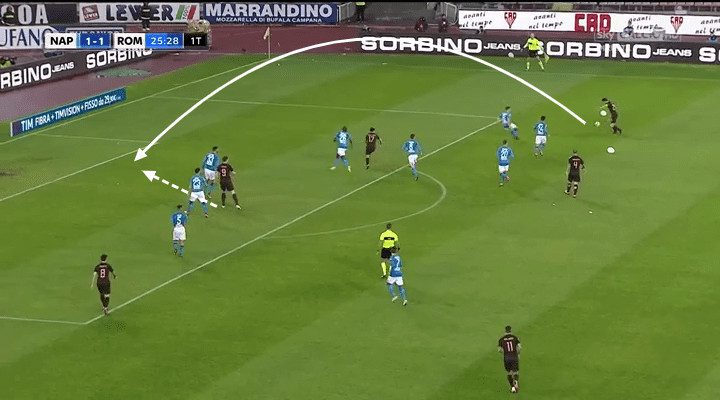
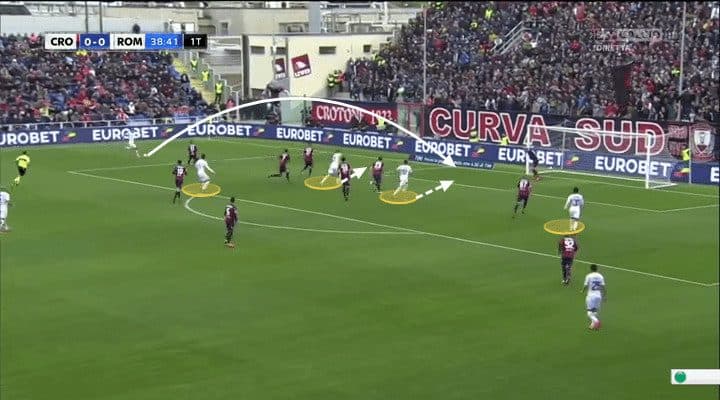
Crossing is the most used method to create chances this season for Di Francesco’s Roma.
The presence of Dzeko in the box makes every cross a danger for an opponent.
The strength of the Bosnian and others, such as Kevin Strootman and Radja Nainggolan, as well as the well-timed runs from Diego Perotti, Stephan El Shaarawy, or Lorenzo Pellegrini, makes Roma prolific from crosses.
The two images below highlight two goals scored by Roma from crosses this season.
Note the number of players making runs into the box to get on the end of crosses.
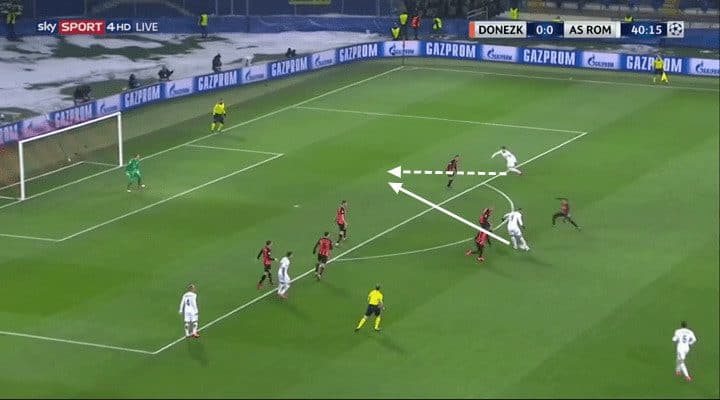
When not attacking from the wide areas, Roma use diagonal runs from wingers to create opportunities.
In the image below, Dzeko slips the ball through to Cengiz Under, who makes a diagonal run inwards from his position on the right wing.
Under, El Shaarawy and Perotti are all masters of this type of run, a trademark movement of a Di Francesco side in the final third.
The wingers are also important players as creators from central positions.
When they rotate inside to the half-space as the full-back occupies the wide area, they need to help create openings.
One way of doing this is by using lofted diagonal passes in behind the opponent’s back-four.
In the example below, El Shaarawy creates a goal for Dzeko by spotting the Bosnian’s diagonal run and then lifting the ball into his path.
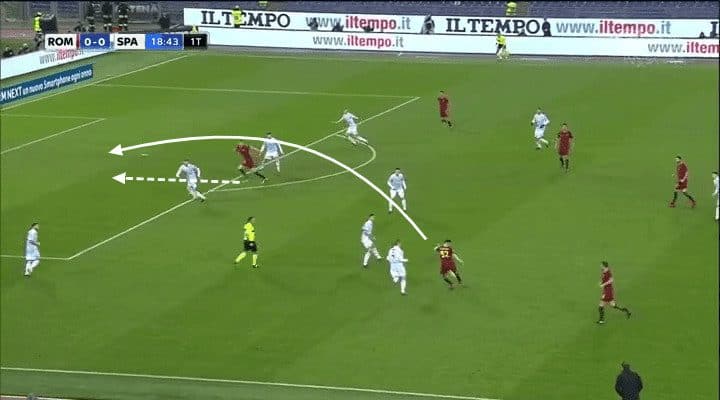
Lofted diagonal passes towards the runs made by Dzeko is another trademark way for Di Francesco’s Roma to create chances.
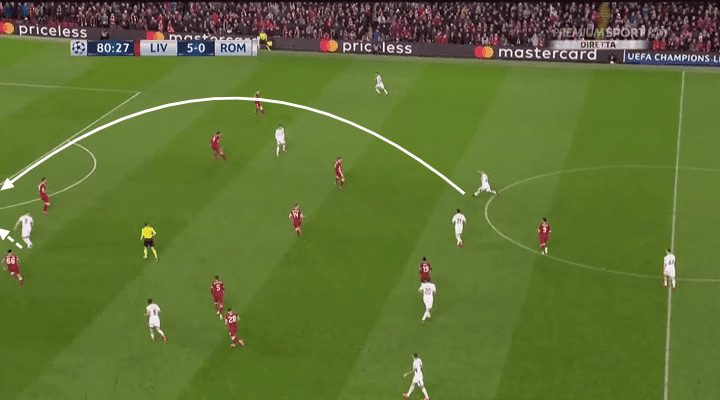
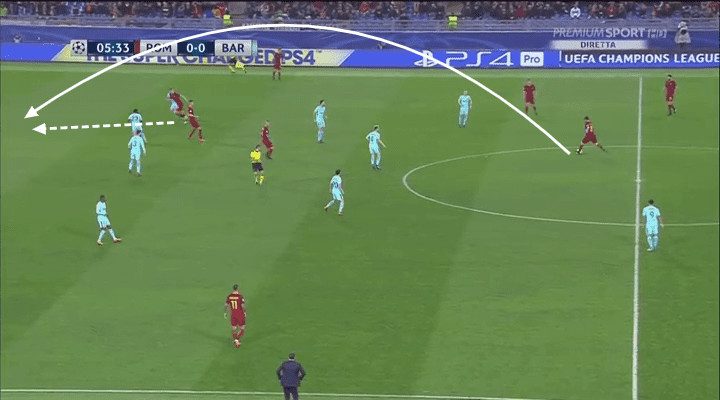
They often look for passes played into the space between the ball-far centre-back and ball-far full-back, which finds Dzeko on the blindside of his centre-back opponent.
The passing quality of the likes of Nainggolan and Daniele De Rossi is lethal from these situations.
And this is despite the opponent often having eight or more players behind the ball.
Below are goals scored from this type of play against Liverpool, Barcelona and Chelsea.
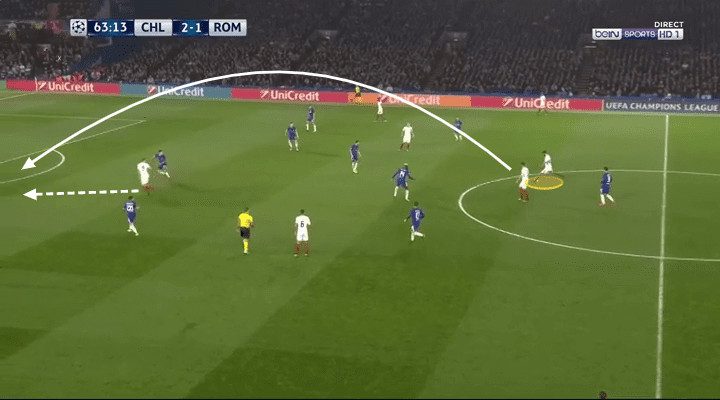
To conclude this section, Di Francesco’s Roma look to create chances either from crosses, lofted passes over the top or diagonal runs into depth from wingers.
They focus on attacking down the wide areas, particularly with lofted passes, as well as the shooting quality of players like Nainggolan, making Roma dangerous from central areas too.
Eusebio Di Francesco Defensive Setup
This vertical and rather aggressive style of attacking is mirrored in the way Roma defend.
Di Francesco wants his team to press high and immediately win the ball back.
Another idea he seems to have is to win the ball high to quickly turn the play and counter-attack the opponent, which is another way Roma have used to create chances and score goals.
The pressing is usually high and very aggressive, as we’ll see below.
Man-oriented pressing and high defensive line
Di Francesco’s style of pressing is often strictly man-oriented.
He adapts his team’s pressing schemes to the formation of the opponent and deploys a man-oriented strategy against back-fours as well as back-threes.
Let’s look at the way Di Francesco has set up against teams with different setups.
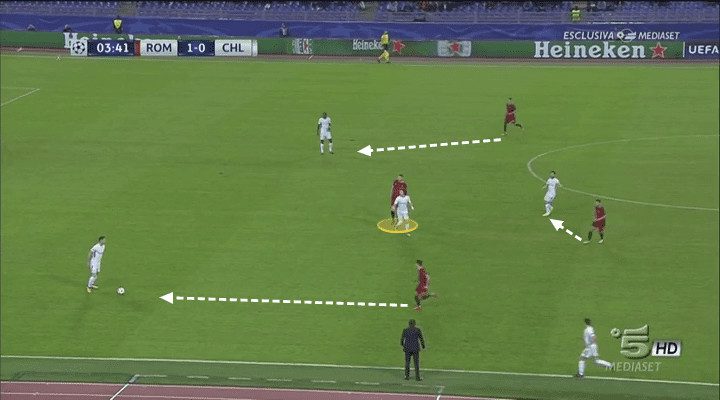
In the image below, Roma press against Chelsea’s back-three in their Champions League clash this season.
The two wingers press against Chelsea’s wider centre-backs, the central striker Dzeko marks Chelsea‘s central centre-back David Luiz.
Strootman has pushed up to mark Fabregas as well.
This man-oriented pressing stopped Chelsea’s normally effective build-up play and forced the Blues into a lot of longer passes.
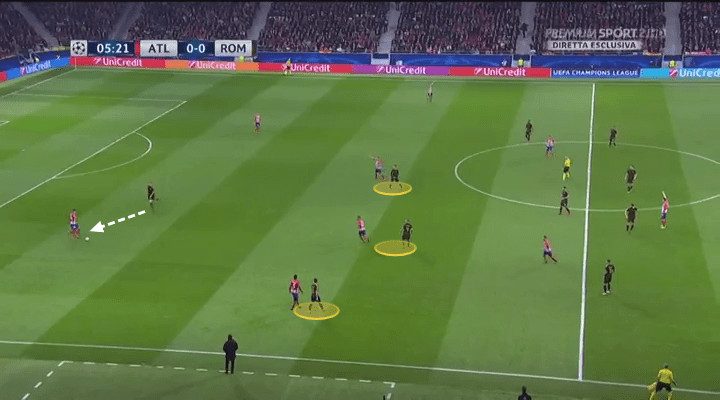
Another opponent in their Champions League group was Atletico Madrid.
Against their build-up structure with two centre-backs and a midfield duo centrally, Roma’s 4-3-3 was perfect for a man-orientated approach.
The striker Dzeko would press one of the centre-backs and angle his run to block the pass over to the other.
The two advanced central midfielders would mark Atletico’s while the wingers would be ready to press either full-back.
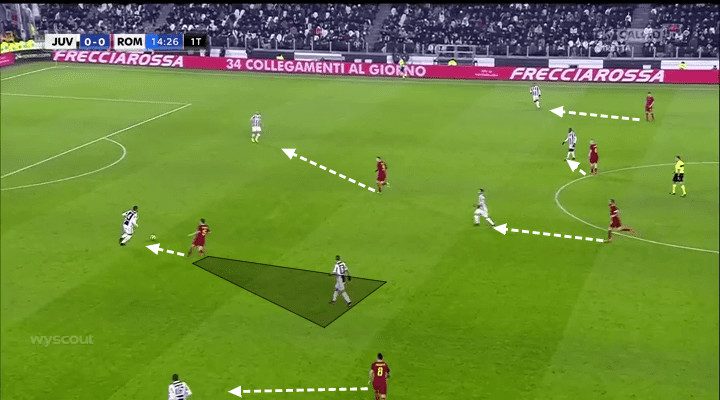
When Roma has gone up against a team with two centre-backs as well as three midfielders, Di Francesco has deployed a pressing scheme as the one seen below in the game against Juventus.
The wingers maintain their access to the opponent’s full-backs, while the striker chose one centre-back to press.
When the other centre-back got the ball, the nearest central midfielder would leave his man in midfield and press that centre-back.
Note the clear man-orientations from the remaining two central midfielders.
High-pressing naturally means Di Francesco wants his defence to keep a high line.
This reduces the space between the lines and gives good back-up to the initial pressing if it were broken.
Opponents will, therefore, find it difficult to play through a high-pressing Roma.
On some occasions though, the high line his side keeps have led to problems when opponents have opted for long balls over the defence, such as the crushing Liverpool inflicted on Di Francesco’s side testified too.
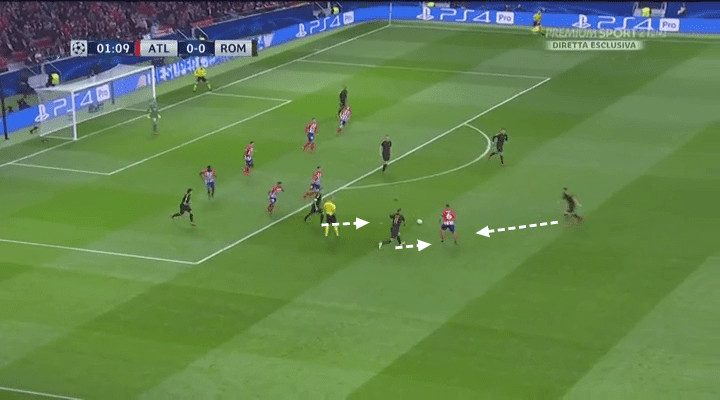
From his aggressive strategy in possession to his aggressive pressing, the aggressiveness also shines through in the way Di Francesco wants his players to counter-press when the ball is lost.
The closest players will quickly look to close down the opponent in possession to regain possession.
In the image below, we can see three players quickly providing pressure on the ball.
When forced to defend deeper, Di Francesco deploys a 4-5-1 with a more positional orientation, as the central midfielders will largely look to cover the space in front of the back four.
Sometimes they’re still attracted towards the ball, however, which can open up huge space between the lines, which is an area Roma have had troubles with all season.
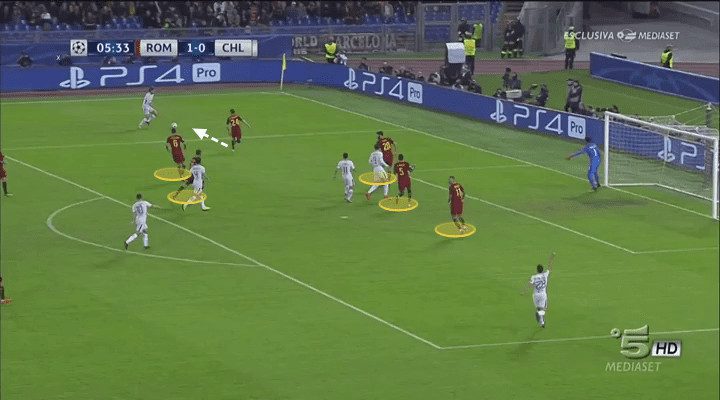
The more positional orientation shines through in the way Roma look to defend crosses, with the ball-near full-back providing pressure on the crosser, the ball-near centre-back defending the first-post area, the ball-far centre-back defending the area just in front of the goal, and the ball-far full-back defending the back-post area.
The midfielders then defend the space in front of the defenders to reduce the risk of shots conceded from cutbacks.
You can see the setup below.
Just like their attacking, Roma’s defending under Di Francesco is very aggressive and they always look to press their opponent high.
This naturally involves playing a high defensive-line which worked perfectly against Barcelona but disastrously against Liverpool.
Summary
Eusebio Di Francesco has had a successful first season in Rome, regardless of whether the team finishes in the top four.
To be his first season at Roma and the first at a big club whatsoever, a Champions League semi-final spot and a top-five finish in the league should be considered good.
His tactical approach seems well-suited to the squad he currently possesses, but the debacle against Liverpool shows that there’s still some naivety in his approach to games.
You can’t play your favoured style against every opponent unless you realise their strengths too.
Liverpool’s direct play behind Roma’s defence should have been dealt with at half-time, with the score at 2-0, instead of continuing and going down to 5-0.
But hopefully, this charismatic and very active coach will learn from his mistakes and improve further going forward.
His attacking style of play has been a joy to watch in Serie A first with Sassuolo and now with Roma, and hopefully, he can continue his work for a few years with the aim of bringing Roma’s first Scudetto since 2001, when he was one of the players.
The future for Roma looks bright with Eusebio Di Francesco at the helm as their coach.
