
The 2025/2026 Premier League season has revealed a striking tactical shift: the resurgence of the long ball.
After several years defined by controlled possession and methodical build-up play, English clubs have once again embraced a more direct and vertical approach.
Data from the opening nine gameweeks highlights a clear rise in long passes, faster transitions, and notably higher direct speed metrics, signalling a collective move away from sustained sequences.
This data analysis examines the numbers behind this transformation, from long passing trends and accuracy rates to the balance between direct speed and sequence length.
It explores how Premier League teams are redefining efficiency through risk-taking and territorial gains, prioritising penetration over patience.
Crucially, the report also focuses on Liverpool’s current difficulties within this new landscape, as Arne Slot’s side struggle to impose their familiar possession structure against opponents increasingly comfortable with bypassing the press through rapid, direct progression.
Premier League Passing Trends: 2016/2017-2025/2026
After Manchester United’s 2–1 victory over Liverpool, Arne Slot was quick to clarify that his post-match remarks were not meant as criticism.
The Dutch manager simply pointed out an emerging truth: opponents are increasingly relying on long-ball strategies to unsettle the Premier League champions.
Slot noted that, much like United, several sides this season have looked to bypass Liverpool’s high press with direct progression, a method that, in recent weeks, has repeatedly exposed the vulnerabilities of his approach.
This tactical reality aligns with a wider trend across the Premier League.
Over the past decade, the evolution of passing has illustrated a broader transformation that has now reached a decisive inflection point.
Premier League Passing Trends 2016/2017-2025/2026

Between 2016/2017 and 2020/2021, the league recorded a steady rise in the number of passes per game, culminating in a record average of 945.2 during the 2020/2021 season.
That campaign, largely played behind closed doors due to the pandemic, offered players a calmer environment to patiently recycle possession and dominate through structured build-up play.
Even after the return of fans, the pattern persisted, with 2023/2024 averaging 941 passes per match, showing how deeply possession football had become ingrained in the league’s tactical DNA.
The past two seasons, however, have broken that rhythm.
The average dropped to 893.4 passes per game in 2024/2025 and then fell further to 849.1 after the opening ten rounds of 2025/2026, the lowest figure since 2010/2011.
Premier League Long Passing 2025/2026
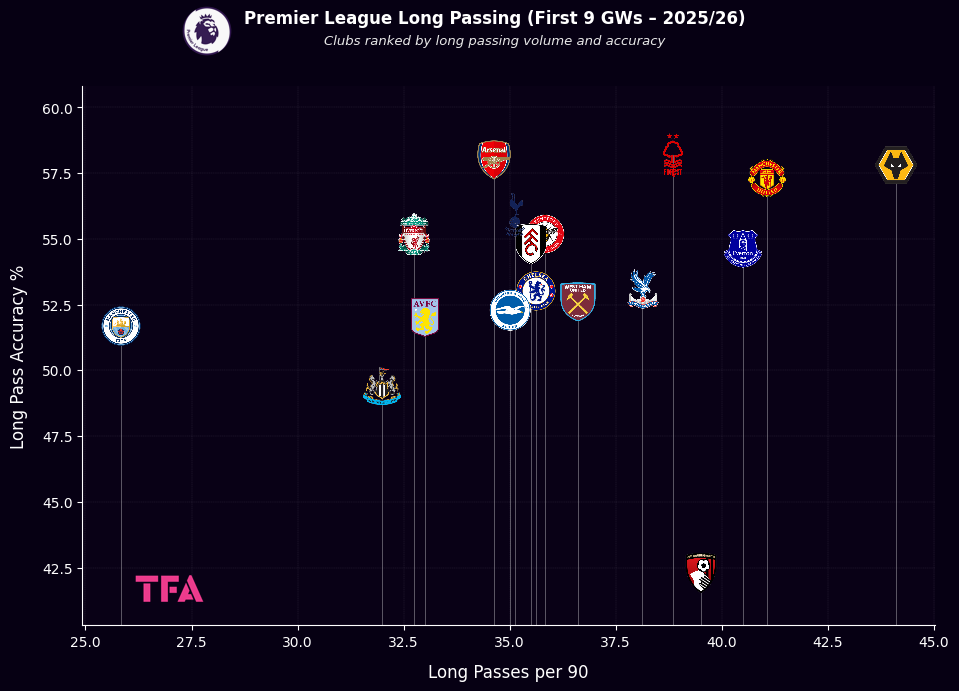
This downturn is far from coincidental; it signals a deliberate shift in tactical priorities.
Teams now favour direct progression, vertical speed, and territorial gain over slow, controlled circulation.
Quicker, transition-heavy patterns are replacing the long, risk-averse passing sequences that once defined English football.
The data underscores a new era, one in which fewer passes mean sharper intent and greater efficiency.
Liverpool’s Struggles Against The Premier League’s New Direct Wave
The 2025/2026 Premier League season has exposed how vulnerable Liverpool have become to the division’s growing preference for direct vertical play.
Under Arne Slot, the Reds remain committed to a possession-heavy 4-2-3-1 structure, averaging around 17 passes per minute of possession and maintaining high accuracy in shorter exchanges.
The opponents have increasingly identified this as an opportunity rather than a threat, deliberately opting to bypass the press with aggressive long passing.
No team has faced more long balls this season than Liverpool, 571 in just nine games, representing 20.5% of the total passes against them.
By comparison, Bournemouth are the only other side to have even faced over 500, underlining just how consistently teams now target this weakness.
Most Long Balls Faced: Premier League 2025/2026
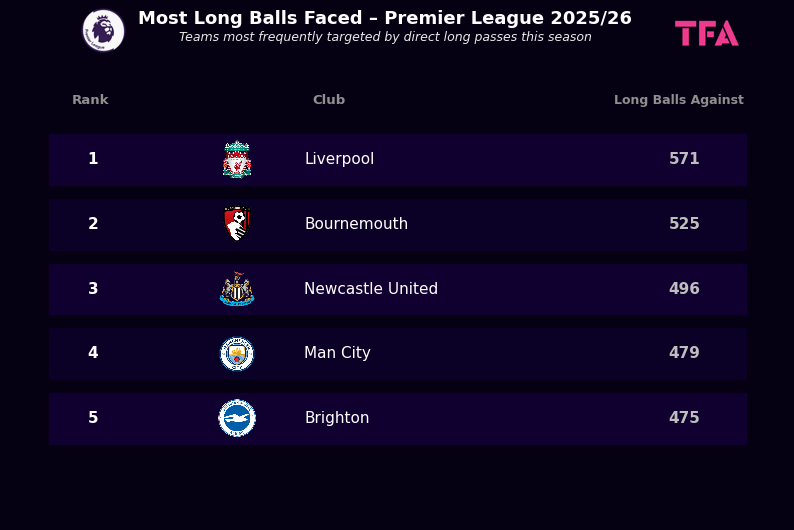
The numbers tell a clear story.
In their four consecutive league defeats, to Crystal Palace, Chelsea, Manchester United, and Brentford, all four opponents used direct build-up patterns that combined low average passes per possession (between 15 and 17) with long-ball rates above 25%.
United’s 2–1 win at Anfield typified the trend, with 75 of their 294 passes (25.5%) travelling at least 32 metres, their highest such proportion since 2017.
Crystal Palace followed a similar route, attempting 71 long passes, while Brentford’s 70 capped off a sequence of matches in which Liverpool were repeatedly dragged out of shape.
After the defeat to Brentford, Slot admitted that “it’s a very good strategy to play against us; we haven’t found an answer yet, ” a rare public acknowledgment of a tactical flaw.
Opponent Long Passing Vs Liverpool 2025/2026
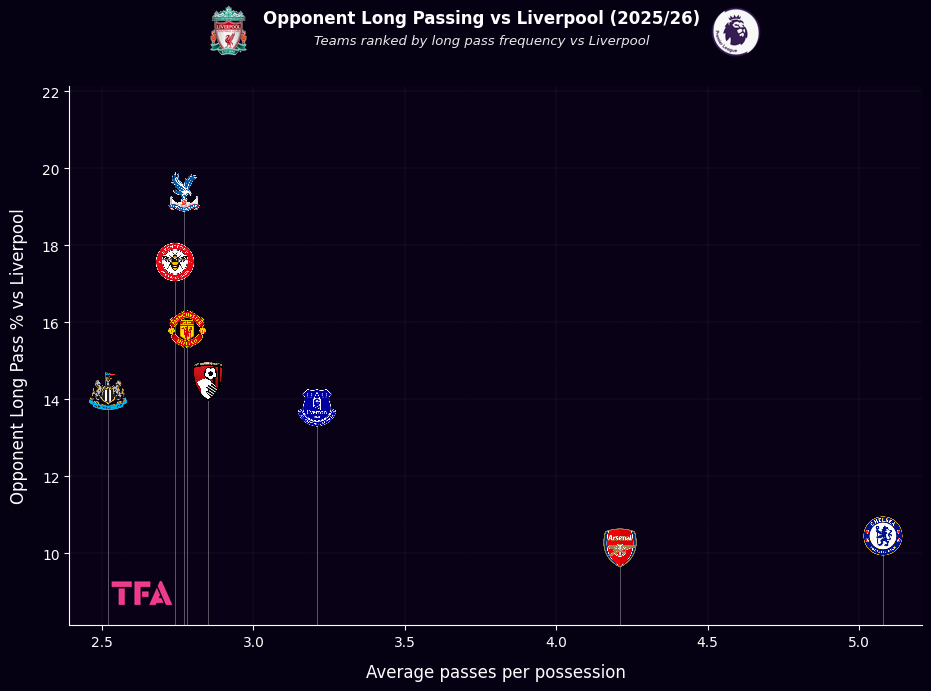
Even though Virgil van Dijk and Ibrahima Konaté remain dominant in aerial duels, winning 78% and 70% respectively, Liverpool’s issues often arise from the second-ball phase, where midfielders fail to secure territory after the initial clearance.
Their PPDA (10.6) ranks fifth in the league, which is respectable but notably below their peak pressing standards.
Their 54 high turnovers suggest declining effectiveness in recovering possession.
The outcome has been decisive, from five straight early wins to four losses in a row, a seven-point swing that reflects how the Premier League’s direct, transitional shift has forced Slot’s Liverpool into unfamiliar, uncomfortable territory.
Premier League Direct Speed & Pass Sequences 2025/2026
The first nine rounds of the 2025/2026 Premier League season have underlined how direct speed and pass sequencing have become key tactical battlegrounds across the division.
The data points to a collective acceleration; teams are progressing upfield faster, committing to shorter passing chains, and favouring territorial gain over prolonged circulation.
This is more evident than anywhere else at Manchester City, where Pep Guardiola has overseen one of the most notable tactical shifts of his tenure.
City’s average passes per sequence have dropped from 5.12 to 3.97, while their direct speed has risen from 1.43m/s to 1.61m/s.
This change reflects a more pragmatic, vertical style, one that has also influenced their recent transfer decisions, such as the signing of Tijjani Reijnders, whose dynamic forward play complements this evolution.
We examined this shift in detail in our 2025/2026 Manchester City under Guardiola tactical report, which focused on how these structural adjustments have reshaped City’s approach in and out of possession.
Premier League Direct Speed & Pass Sequences 2025/2026
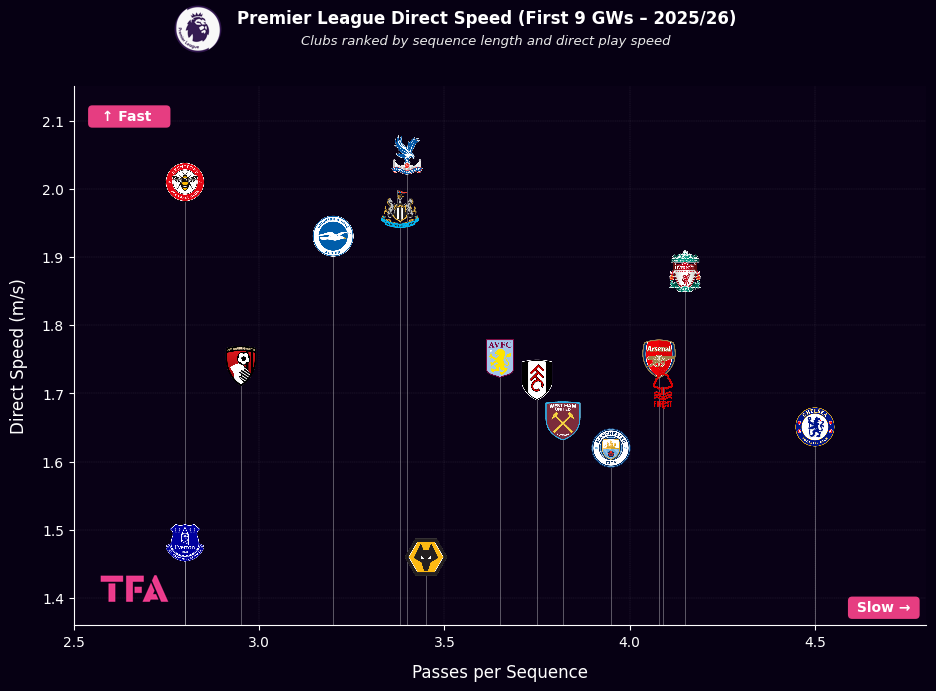
Brentford have emerged as the league’s most direct side, averaging just 2.84 passes per sequence, while Chelsea remain the most intricate with 4.52.
One of the season’s surprise packages, Crystal Palace tops the charts for direct attacking speed at 2.02m/s, whereas Wolves, with a sluggish 1.46m/s, sit bottom of the table.
Interestingly, Nottingham Forest have moved in the opposite direction, from one of the fastest and most direct outfits under Nuno Espírito Santo last season to a far more patient, possession-oriented side this season, though that is likely to change under Sean Dyche.
The league’s average sequence duration has shortened from 10.4 to 9.6 seconds, with shorter build-up and a growing reliance on early forward passes.
The data encapsulates a Premier League increasingly defined by vertical precision, calculated risk, and speed over style, signalling a decisive departure from the slow, methodical possession era that once dominated English football.
High Turnovers Decline In 2025/2026: The Fading Weapon Of The Press
One of the most notable tactical shifts in the early months of the 2025/2026 Premier League season has been the sharp decline in high turnovers, situations where possession is regained within 40 metres of the opponent’s goal.
After several seasons in which aggressive pressing defined English football, the intensity of these regains has notably cooled.
Premier League High Turnovers & Direct Play 2016/2017-2025/2026
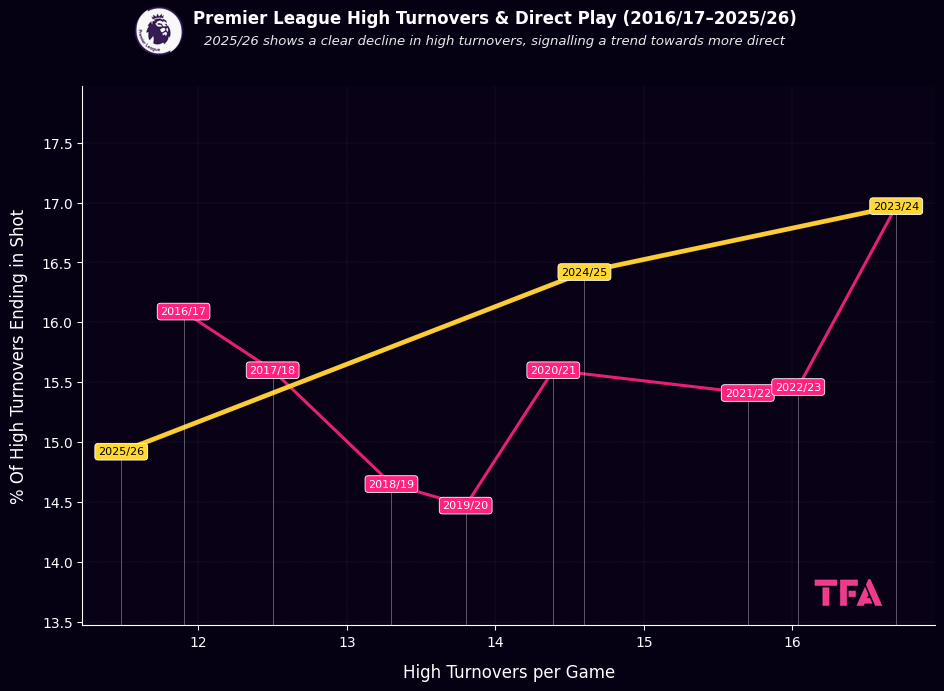
The numbers illustrate this regression: from an average of 16.7 high turnovers per game in 2023/2024, the figure dropped to 14.6 last season and now sits at just 11.5, the lowest in a decade.
This trend doesn’t necessarily imply weaker pressing systems; rather, it reflects a league adapting to avoid them.
Many teams are now choosing to bypass pressure altogether, launching longer passes from deeper areas and reducing the risk of being dispossessed high up the pitch.
Even Manchester City and Liverpool, once leading in high turnovers, have seen steep drops, largely because opponents no longer build short.
Consequently, high turnovers are not only rarer but less threatening, with the share leading to shots down to 14.9%, confirming that this once-feared tactical weapon has lost much of its edge in the Premier League’s increasingly direct environment.
Conclusion
The data from the 2025/2026 Premier League season paints a clear picture of a competition in tactical transition.
The age of slow, possession-heavy football appears to be fading, replaced by a new era defined by verticality, direct progression, and calculated territorial gains.
Across the league, teams are moving the ball faster, building shorter sequences, and increasingly opting for long passes to evade high pressure.
This shift has not only reshaped attacking structures but also diminished the influence of pressing systems, with high turnovers falling to their lowest level in a decade.
Even traditional possession-based sides, such as Liverpool and Manchester City, have been forced to adapt, finding themselves caught between risk and pragmatism.
This evolution reflects a broader redefinition of efficiency in English football, where intent, precision, and adaptability now take precedence over control.
The Premier League’s tactical identity is changing once again, and this time, speed reigns supreme.
