


The Bundesliga varies between having two or three promoted teams each year, with their relegation play-off; this season, only two teams managed to come up.
However, these two teams are very familiar faces, and this Sunday they matched up against each other.
The home team, 1. FC Köln was promoted back to the German top flight as champions of the second division, just one year after being relegated.
They had to hire a new manager before the season started and opted to go with Lukas Kwasniok, who had previously coached SC Paderborn.
Under Kwasniok, Köln’s start to the season was decent.
With 11 points out of the first eight games, Köln’s return to the Bundesliga has been a very pleasant one so far.
At the same time, Hamburger SV were promoted back to the Bundesliga after seven long years in the second division.
The club was the only German side never to be relegated from the top flight until 2018.
Then, they got stuck in the second division for quite some time.
Now, they are back in the big time after Merlin Polzin got his team promoted last season.
While the score of 4-1 in favour of Köln might sound like an easy game for them, the contest was way tighter than it seems.
In this tactical analysis, we will examine Kwasniok and Polzin’s tactics, their preparation of their respective teams for key moments in the match, and how Köln ultimately won the game decisively.
Köln Building Through The Centre
Köln define themselves through their work against the ball.
They try to capitalise on counterattacking opportunities rather than dominating possession most of the time.
Köln under Lukas Kwasniok tactics don’t really play with possession, with just 44.9% on average; they rank in the bottom three of the Bundesliga in that regard.
Still, in the first couple of minutes, Köln tried to introduce some structure into the game through possession.

Köln were very keen on trying to establish possession deep in their own half and refused to play long balls in line one; instead, they tried to get HSV to push forward and not defend in a deep block.
Kwasniok knew that Polzin’s team was very decent at defending their box.
He also knew that his team struggled significantly when playing against such teams, simply because they often lacked ideas to find footballing solutions in confined spaces.
So, he wanted to prevent his team from running into a wall in the final third.
Goalkeeper Marwin Schwäbe was heavily involved in the build-up, and what was even more interesting was the positional play of their backline.
While Kwasniok’s side usually plays with a back three, they built up with a back four in the first line, with Joel Schmied pushing towards the right-back position and Jakub Kaminski pushing high up the field.
The manager wanted to utilize width to stretch out his opponent in this game and then dynamically move into the central spaces to open up the play with passes towards his midfielders.
While he decided to play with a double pivot and one single attacking midfielder, even the attacking midfielder often dropped back to overload the centre, and HSV were not able to apply any pressure on the build-up in the early stages of the game.
In the situation pictured above, Schwäbe is simply able to find a pass towards his midfielder, and Hamburg’s entire press falls apart quickly.
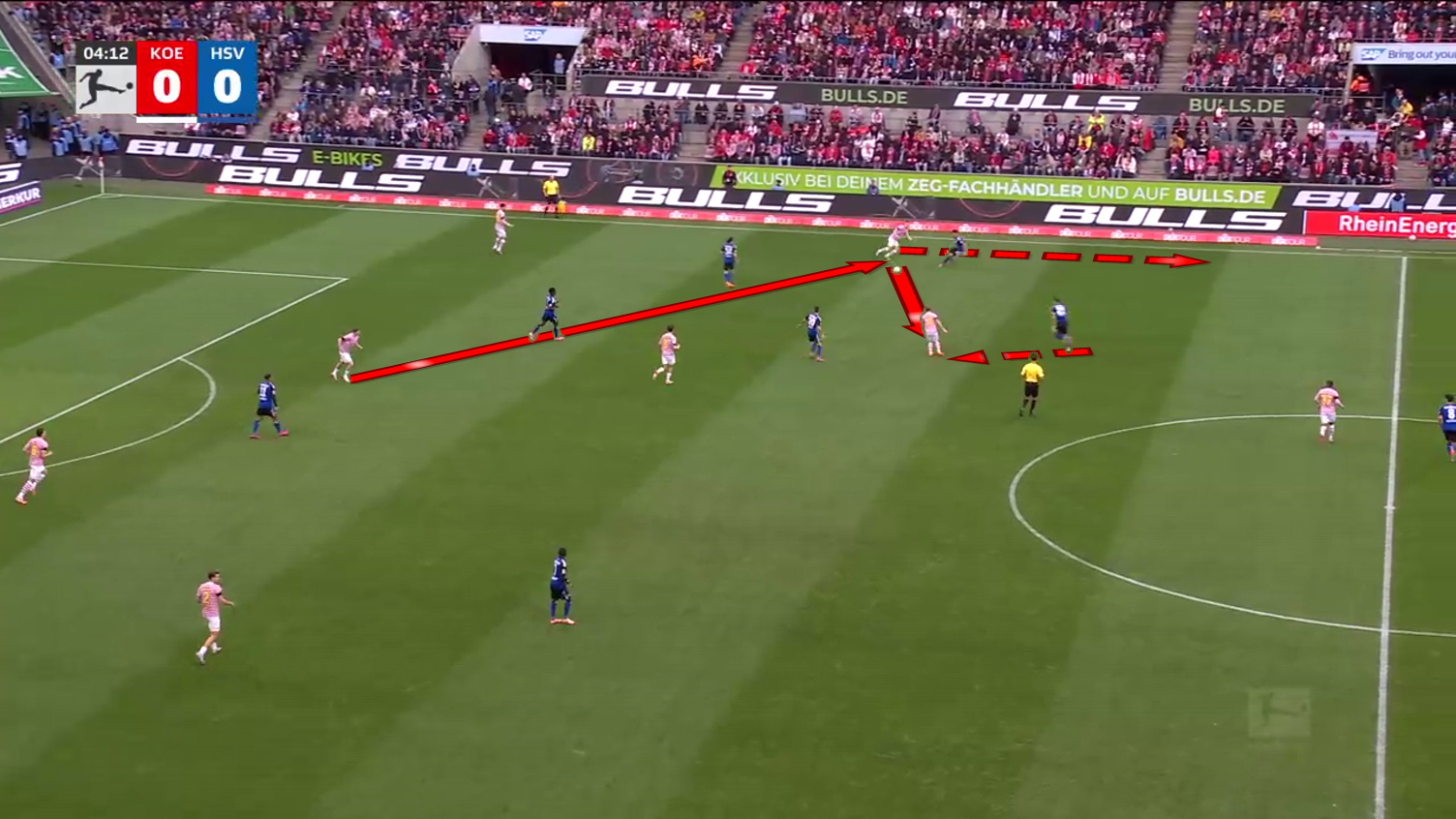
From then on, Köln tried to do the same thing pretty much all the time: They played from the centre outwards to get the HSV players to shift to one side and then found a pass against the direction of their movements back towards the centre.
In this case, Isak Jóhannesson finds the pass towards his left-back, who then plays a pass to one of the strikers, who drops back into midfield.
This solution worked rather often for Kwasniok’s men.
They were able to get past Polzin’s midfield quickly, often with just one or two passes, particularly in the early stages of the game.
This really put pressure on HSV because the team was unable to gain a firm grip on the game with their press.
Unfortunately, Köln often struggled to find space behind the defensive line from this point forward.
Kristoffer Lund wanted to move forward after playing the pass to the centre again, but the HSV defenders defended those playing and moving situations on the wing really well.
Köln were forced into numerous duels in the middle of the field, which created an unpleasant flow to the game.
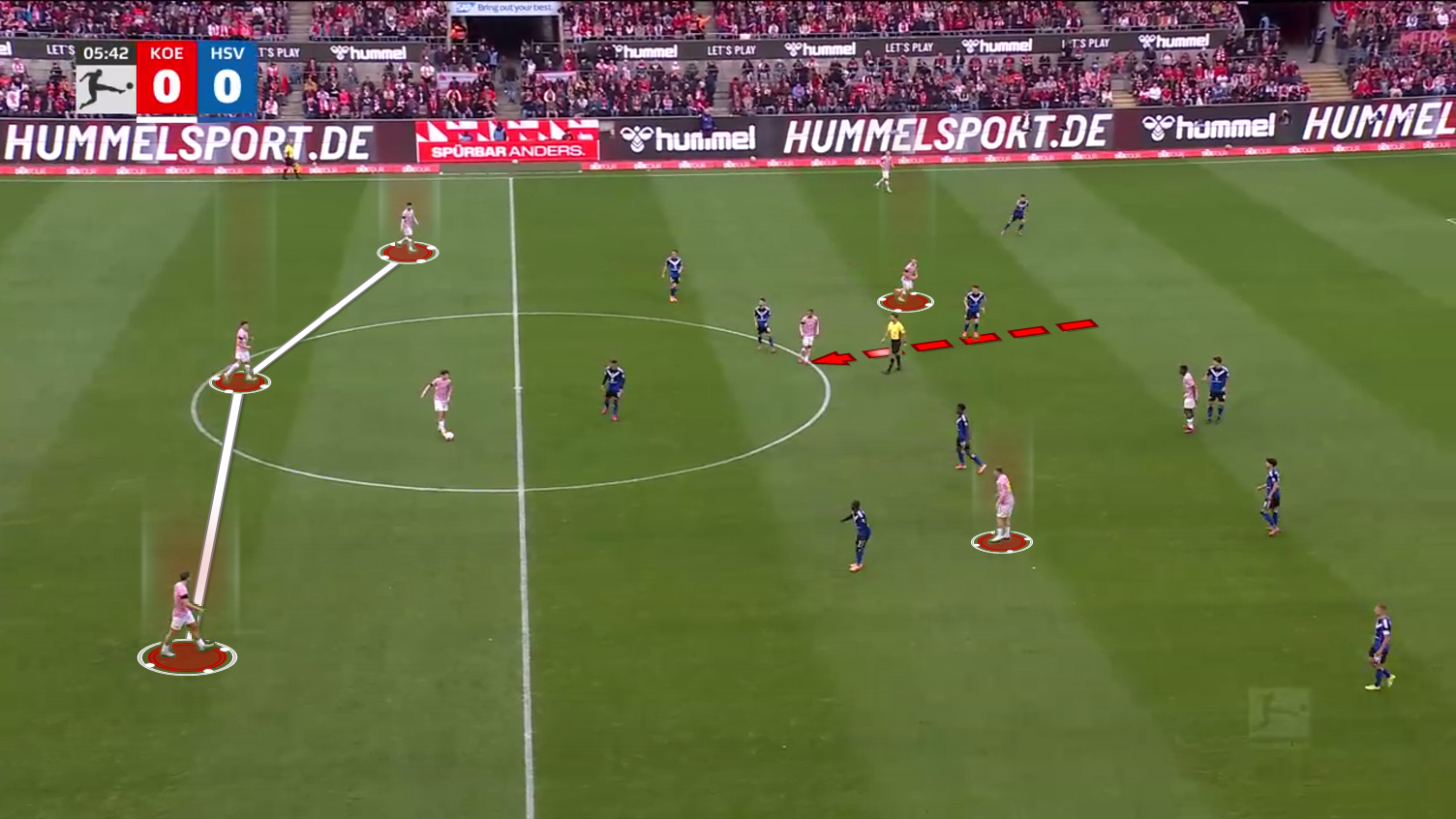
Often, Köln ended up being forced to build up in line two from then on out.
Instead of playing with a back four, Kwasniok used his back-three in these situations, as we can see in the picture above.
The two wing-backs are now pushed really high up the pitch and into the attacking line, once again trying to stretch out the HSV block.
As we can see, Polzin’s men did not care about that and kept their narrow shape most of the time.
Therefore, Kwasniok did something rather interesting.
He dropped one of the two central midfielders back and then did the same with his second striker, Linton Maina.
Then, the two central midfielders pushed into the space behind the HSV midfielders, creating a huge problem for the defenders’ assignments.
As we can see, the gap between HSV’s right back and right centre-half is really big now in this situation, and Kwasniok wanted his men to punish that.
They chip the long ball towards Ragnar Ache, who now moves right into that space, and Ache lays the ball off to Florian Kainz, who only barely misses the goal with his volley.
It was relatively simple football, but it worked out very well for Köln to start the game.
HSV Struggling To Find Solutions
On the other side, Merlin Polzin’s team struggled to get a grip on the game for the first couple of minutes.
Their press did not work at all, for the reasons laid out in the first paragraph of this article.
They did not manage to defend well in the deep block, and when they had the ball themselves, they were forced into many physical duels and struggled to win them for the majority of the first half.
After about twenty minutes of the game, Köln held about 55% of possession and won about two-thirds of the duels on the pitch.
Polzin could not have been less happy with how his team started the game.
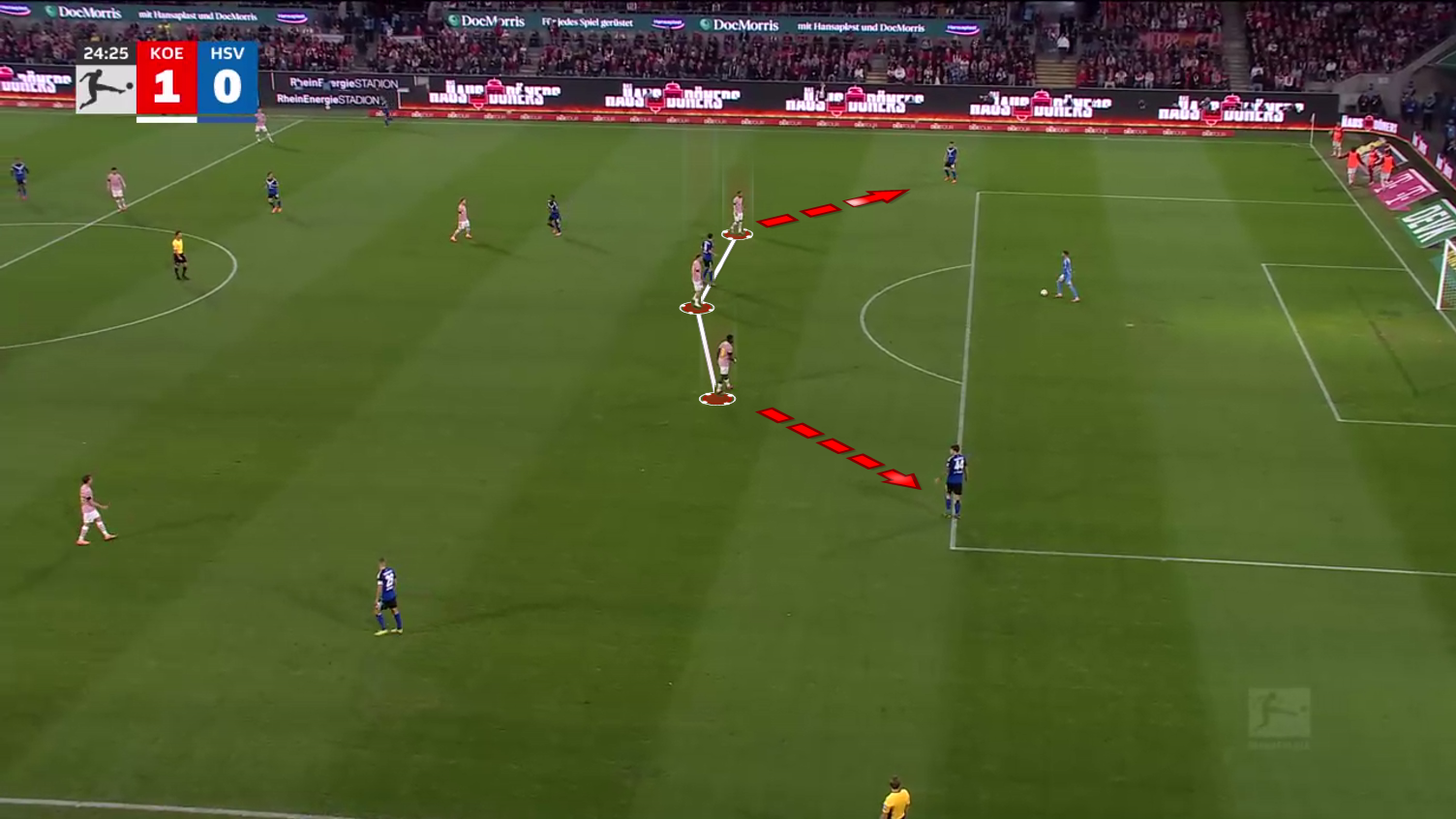
Kwasniok actually forced them into the duels with a relatively simple tactical measure.
Köln employed a man-marking system throughout their press, forcing 1-v-1 situations everywhere, and HSV struggled to adapt to it.
As Köln did, Polzin involved his goalkeeper in the build-up, but Köln pressed far more effectively compared to HSV.
To start, they pushed the attacking midfielder forward, forming a three-man attacking line with a very narrow shape, completely preventing passes into the midfield in line one.
Köln wanted the goalkeeper to play towards one of the centre-backs and then have their strikers trigger the press by sprinting towards the centre-back in a curved path, forcing them to play towards the outside or play a long ball.
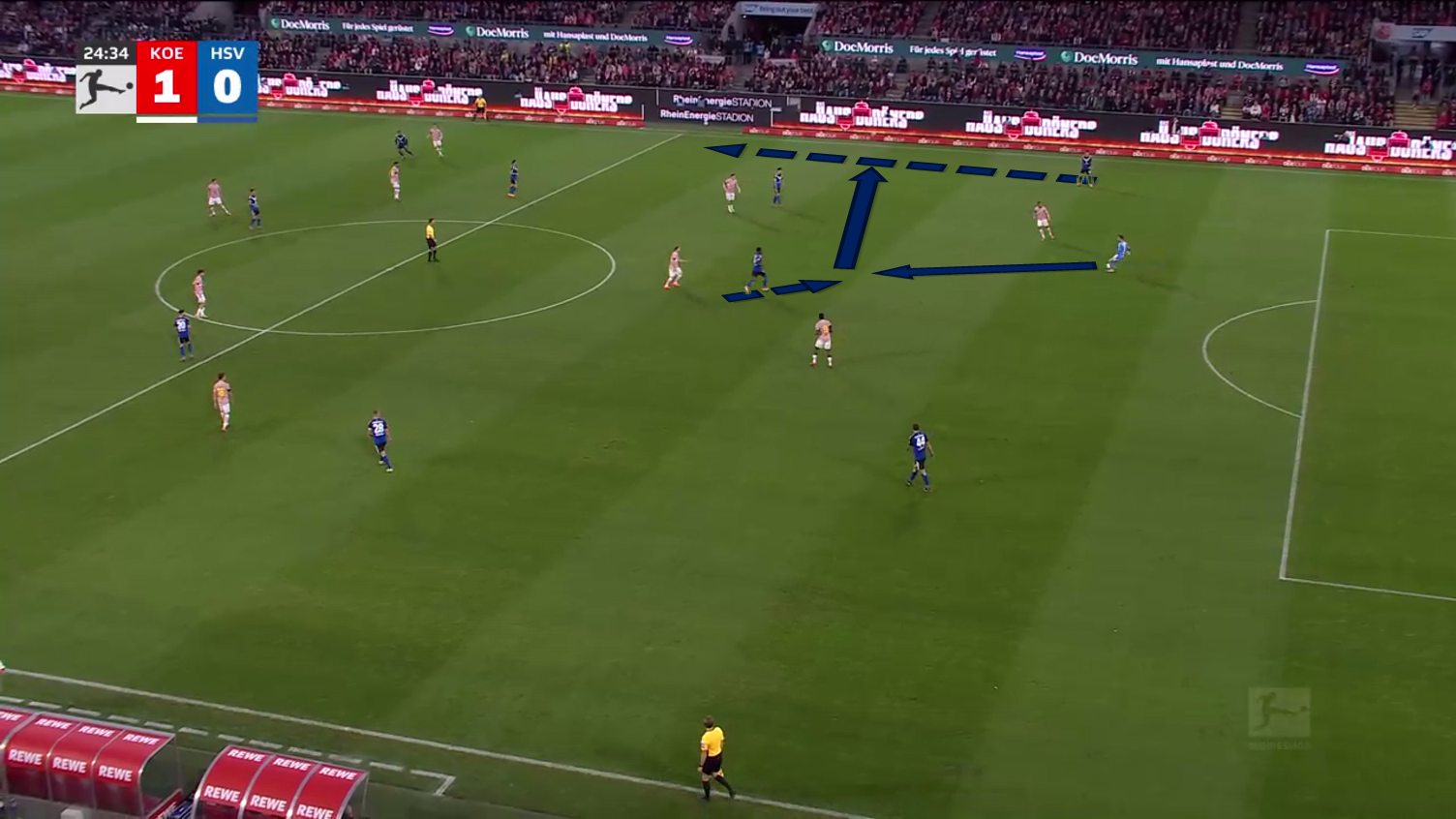
HSV attempted to answer this by pushing their holding midfielder higher up the pitch, getting Kainz out of the attacking line and pushing their centre-backs wide, thereby increasing the distance the two strikers had to cover.
Then, they dropped one of the midfielders back into the now wider gap between the strikers and have their goalkeeper break the first line of the press with a vertical pass.
From there, the plan was for the holding midfielder to play towards the outside, where one centre-back moves forward and can exploit the space behind the two strikers.
However, as established, Kwasniok played man-to-man coverage, so Kainz simply followed the midfielder until he received the pass.
Albert Sambi Lokonga fails to win yet another duel, and Kainz is able to pick up the pieces.
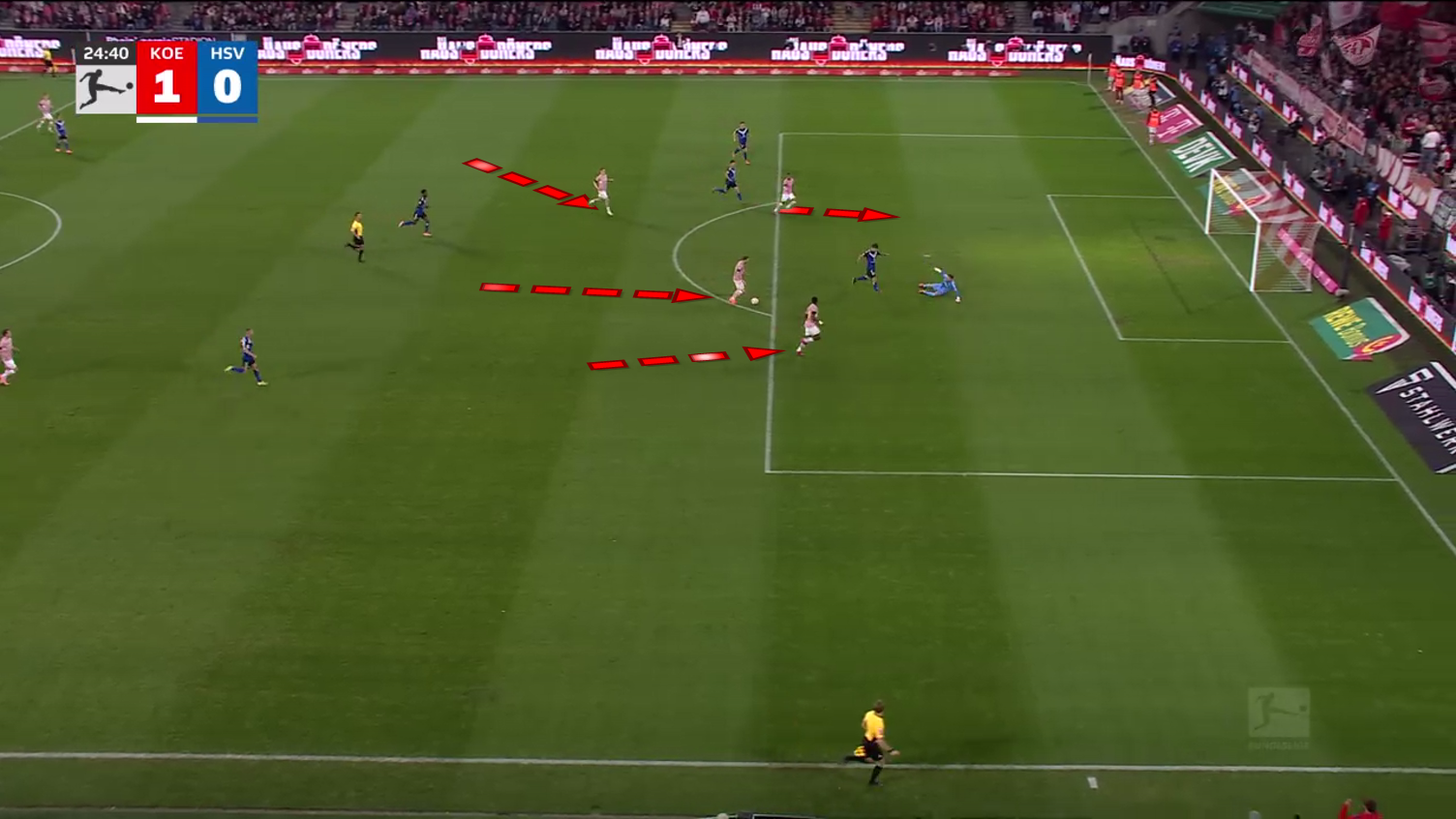
With the full-backs pushed high up the field and the centre-backs in very wide positions, Köln took the ball to the box easily and should have scored here.
In the end, they really played the situation poorly.
Kainz refused to play the pass, and his shot was blocked.
Maina’s second effort was also blocked on the line, but luckily, the ball bounced to Ache, who now finished the opportunity from close range and put Köln in the lead.
These risks HSV had to take came back to bite them in the end.
They failed to find solutions to build up against Kwasniok’s man marking and struggled even worse to win decisive duels in the midfield.
Therefore, the 1-0 lead Köln took into halftime was more than deserved, even though HSV got into the game a bit better after the goal.
A Different Second Half
The start of the second half was very chaotic.
Florian Kainz scored a beautiful direct free kick to double the Köln lead just three minutes into the second half.
Fábio Vieira answered quickly, but after a six-minute VAR check, the goal was taken back by the referee, who would now start to take a prominent role in the game, unfortunately.
Now down two goals, HSV needed to take action, but Köln were content with falling back and playing on the counter, which is what they do best.
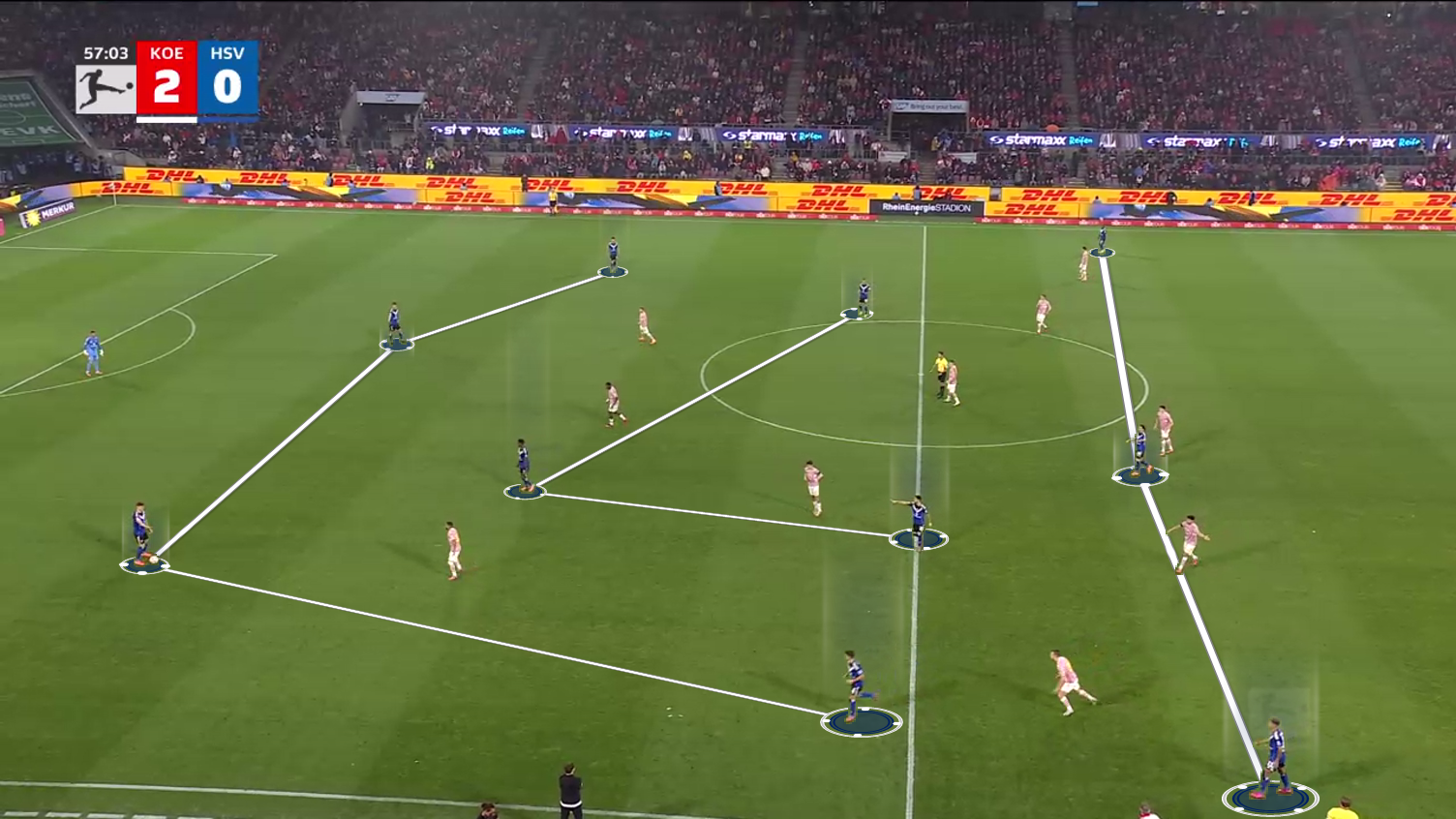
While it turned out to be a tough afternoon for Polzin’s team, they ultimately managed to dominate the game, holding more possession and facing less pressure from Köln.
They stayed in a 4-3-3 shape, now most of the time, occasionally building through a back-three.
They stretched out the Köln backline with their two wingers in very wide positions and doubled their positional play on the near-sided wing, creating huge problems for the wingbacks there.
This allowed Polzin’s midfielders to find more success in the half-spaces as well, and they were now able to show more confidence in their abilities in the passing game.
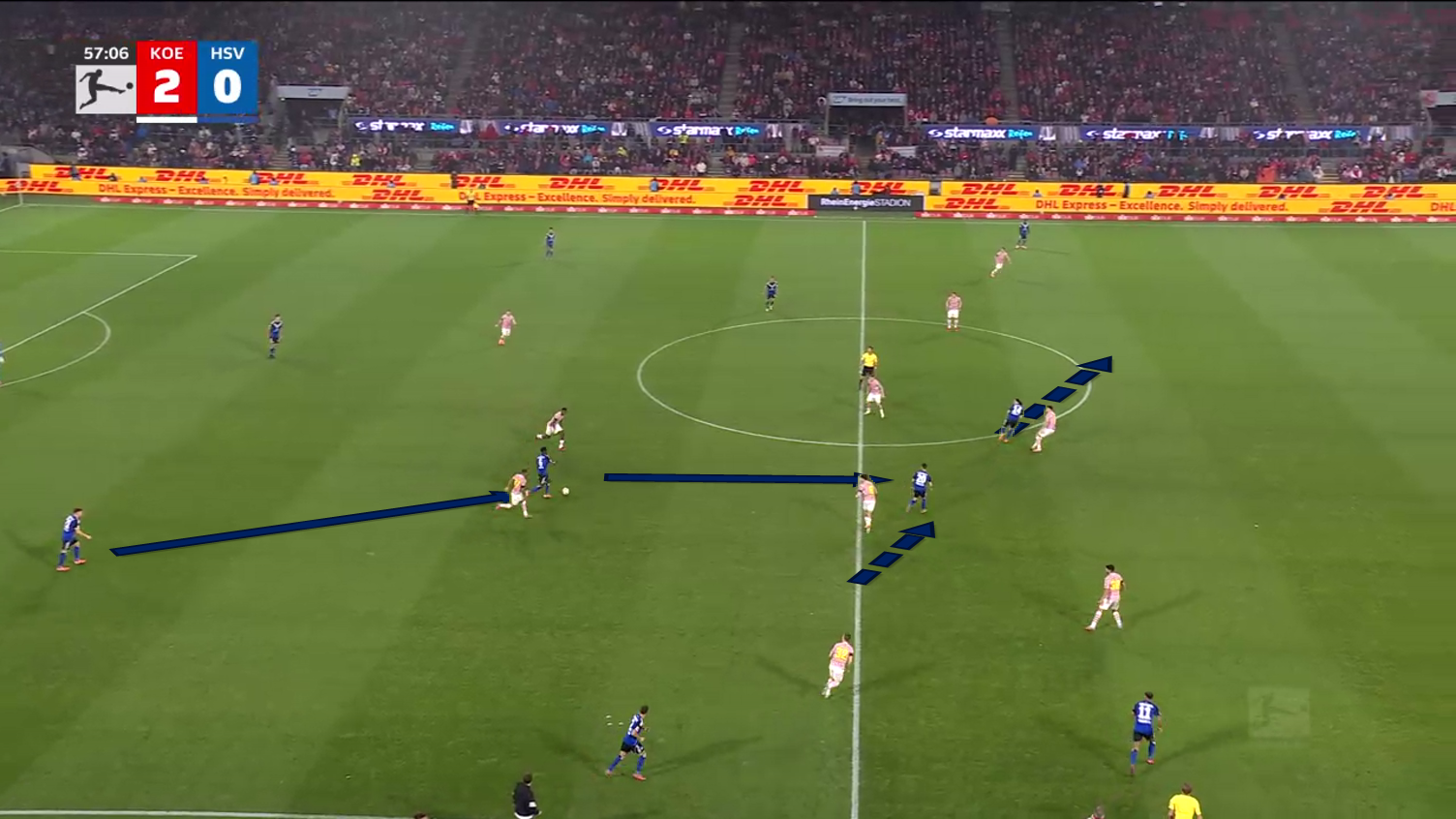
HSV now started to play with good vertical passes.
Here, Luka Vušković played the pass to Lokonga between two attackers, but the Belgian midfielder was able to turn and find Viera behind the midfielders because of the striker’s run and the Portuguese midfielder’s good movement.
From then on, HSV made numerous switches to their far-sided wingers and played a lot of crosses after they managed to get their pacey players into isolated 1v1 situations.
The goal resulted from such a switch, and suddenly, HSV was back into the game.
They created two more decent opportunities; Köln had one decent opportunity after a counterattack, but both teams failed to score out of these situations.
Then, the referee completely changed the momentum, sending off two HSV players in quick succession, creating a two-man advantage for Köln.
Wonderkid Said El Mala and Kaminski then took over the reins of the game, scoring and assisting a goal in stoppage time, which made the score 4-1.
This seems rather high, considering HSV had played decently in the second half.
Conclusion
In the end, I think Köln and Kwasniok deserved to win the game.
Their tactical approach in the first half worked really well, but they only barely managed to capitalise on it, and they put the game away late in the second half.
HSV and Merlin Polzin’s attacking struggles continue, and their inconsistent play in midfield cost them the opportunity to earn points here.
They were overpowered entirely in the first half and were unable to find any solutions against the press.
Playing midfielders because of their ability on the ball is just a death sentence in the Bundesliga.
In the end, Köln won because of its resilience and intensity in the duels; Polzin’s team was never able to match that.
For Lukas Kwasniok, this win means a jump to seventh place with 14 points, a very good start to the season after the promotion.
Marlin Polzin and HSV remain in 13th place, but with the other results, their gap to the bottom three has suddenly narrowed to just two points.
![AC Milan Vs AS Roma [1–0] – Serie A 2025/2026: Max Allegri Transitions Beat Gian Piero Gasperini Possession – Tactical Analysis](https://totalfootballanalysis.com/wp-content/uploads/2025/11/Milan-1-0-Roma-Tactical-Analysis-75x75.png "AC Milan Vs AS Roma [1–0] - Serie A 2025/2026: Max Allegri Transitions Beat Gian Piero Gasperini Possession – Tactical Analysis 10")
