


Last week, after a protracted period of speculation, Rangers announced Russell Martin as their seventh permanent manager in 10 years.
Taking over from Barry Ferguson, who had been put in caretaker charge after the departure of Philippe Clement in February, Martin joins a club in transition, having just been bought into by 49ers Enterprises.
Martin, arriving from relegated Premier League side Southampton, has faced doubts over whether his style of play is suited to the Gers, a team whose fans expect their side to dominate domestic opponents.
The 29-times capped Scotland player has also managed at MK Dons and Swansea City, where he has imposed his possession-based style of play.
Despite competing in League One, a league not renowned for possession football, Martin’s side had the third-highest average possession percentage in European football, behind only Barcelona and Pep Guardiola’s Manchester City.
This tactical analysis will examine the features of Russell Martin style of play in his most recent role with The Saints and assess how well it is suited to what the Glasgow giants will face in the 2025/2026 Scottish Premiership season.
Listen to this article free on the Total Football Analysis Podcast via Spotify, Apple Podcast, or RSS.
Can Russell Martin Break Down A Mid/Low-Block?
One accusation thrown at Russell Martin coaching style is that he does not have the experience or track record of breaking down teams in low or mid-blocks, and his playing style may not fit what he will inevitably face in opponents as Rangers manager.
This is wrong on two counts.
While he will often face stubborn defences in the Scottish Premiership, it is a myth to say teams never high-press the Old Firm.
Celtic, for one, who he will face in the season’s four most crucial league matches, will press his side high up the pitch.
Another is that his playing style will struggle to break down such teams.
Looking at games in the Premier League alone, let alone when his side was high-flying in the Championship, it is clear, contrary to much on social media, that this is one of Martin’s strengths.

This image is from the build-up to Martin’s last goal as Southampton manager, and his team’s equaliser against Chelsea in December.
Chelsea have dropped into a deep 4-4-2 mid-block with all 11 players behind the ball.
Martin has played with both a back three and a back four in his over 200 games as a first-team manager.
In his last season at Southampton, he initially played with three, switched to a four, and then reverted to a three before his dismissal.
In this match, Southampton played with a back three (or five) out of possession but showed great fluidity in their attack by building up with a four.
To create this, the right wing-back dropped into a more inverted full-back position, with the left centre-back Kyle Walker-Peters, doing the same on the opposite side.
Martin likes to create overloads in central areas to dominate the ball and control the game.
Here, his striker, highlighted, has dropped to receive from his right wing-back, in a position in front of the opposition’s central midfielder, Moisés Caicedo.
Although this action appears innocuous enough, it draws one of the two Chelsea midfielders closer to the ball, which has bigger ramifications later in the move.
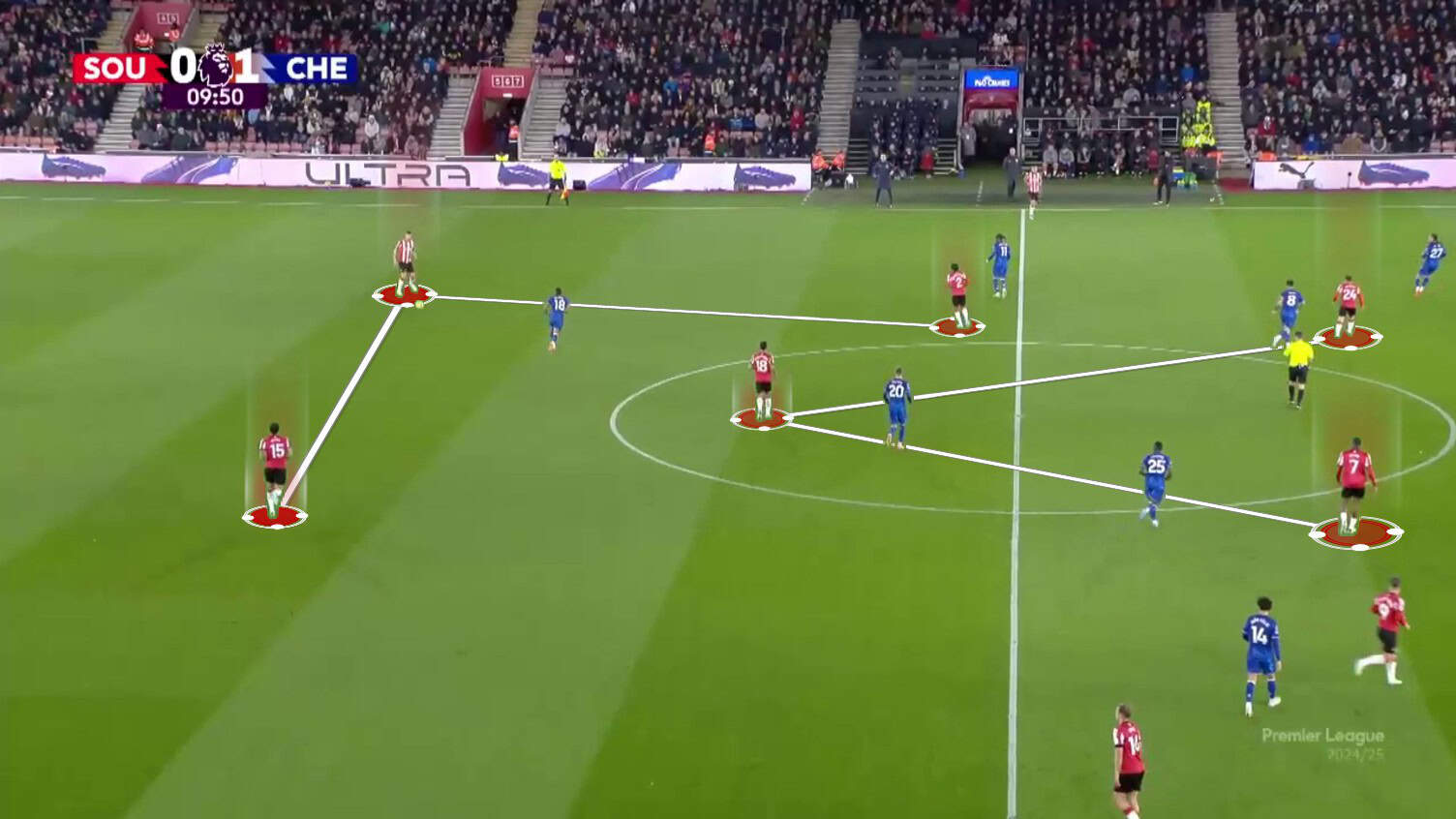 When the ball gets switched, Walker-Peters remains in an inverted position, with Southampton’s midfield shape now visible.
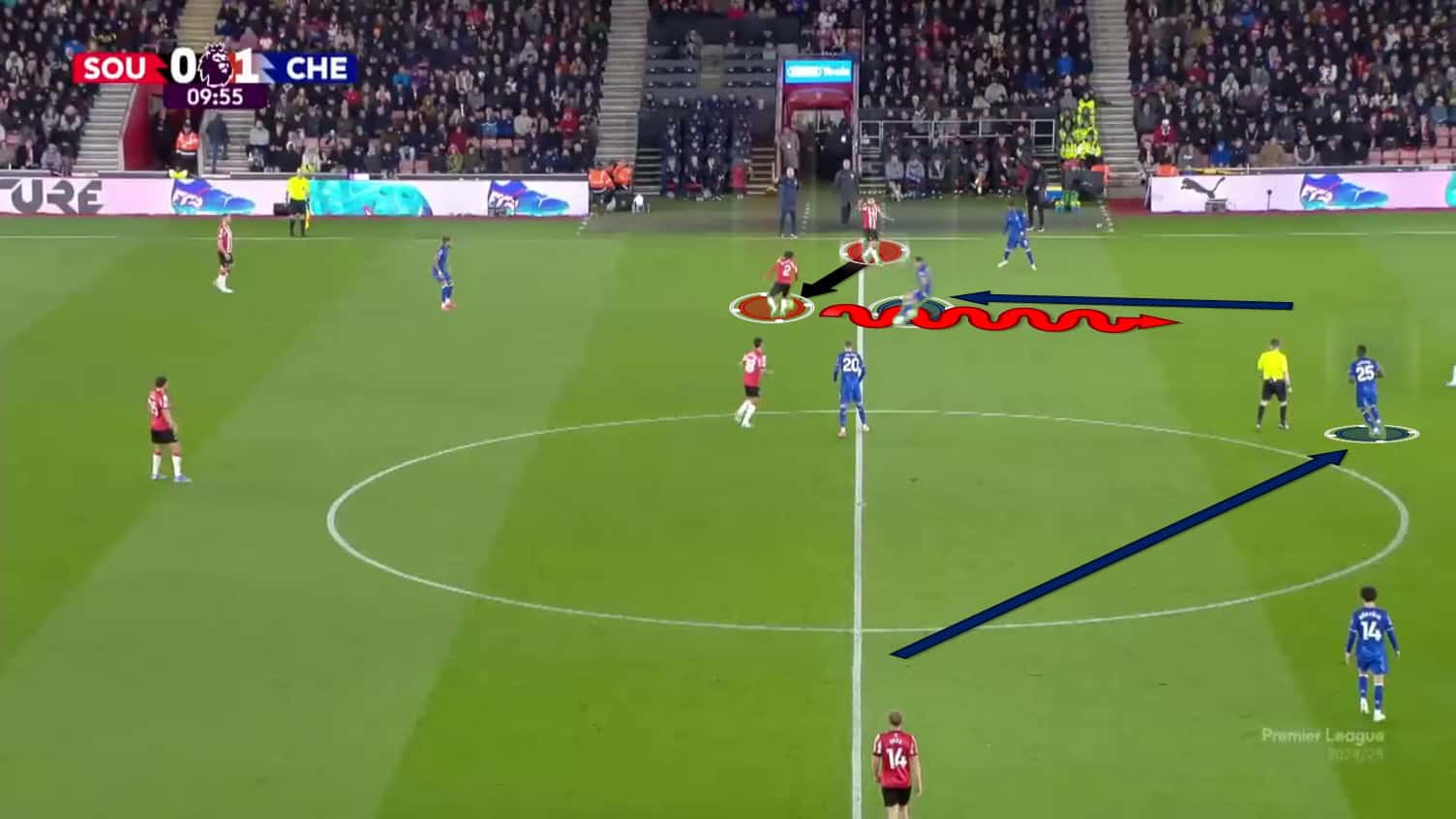 When the ball is played wide, into Southampton’s left wing-back, and bounces into Walker-Peters, Chelsea’s midfielder has a long way to jump to the ball.
This allows Walker-Peters to skip past him, and with Caicedo having been pulled to the opposite side of the pitch, he is unable to get across in time to cover.
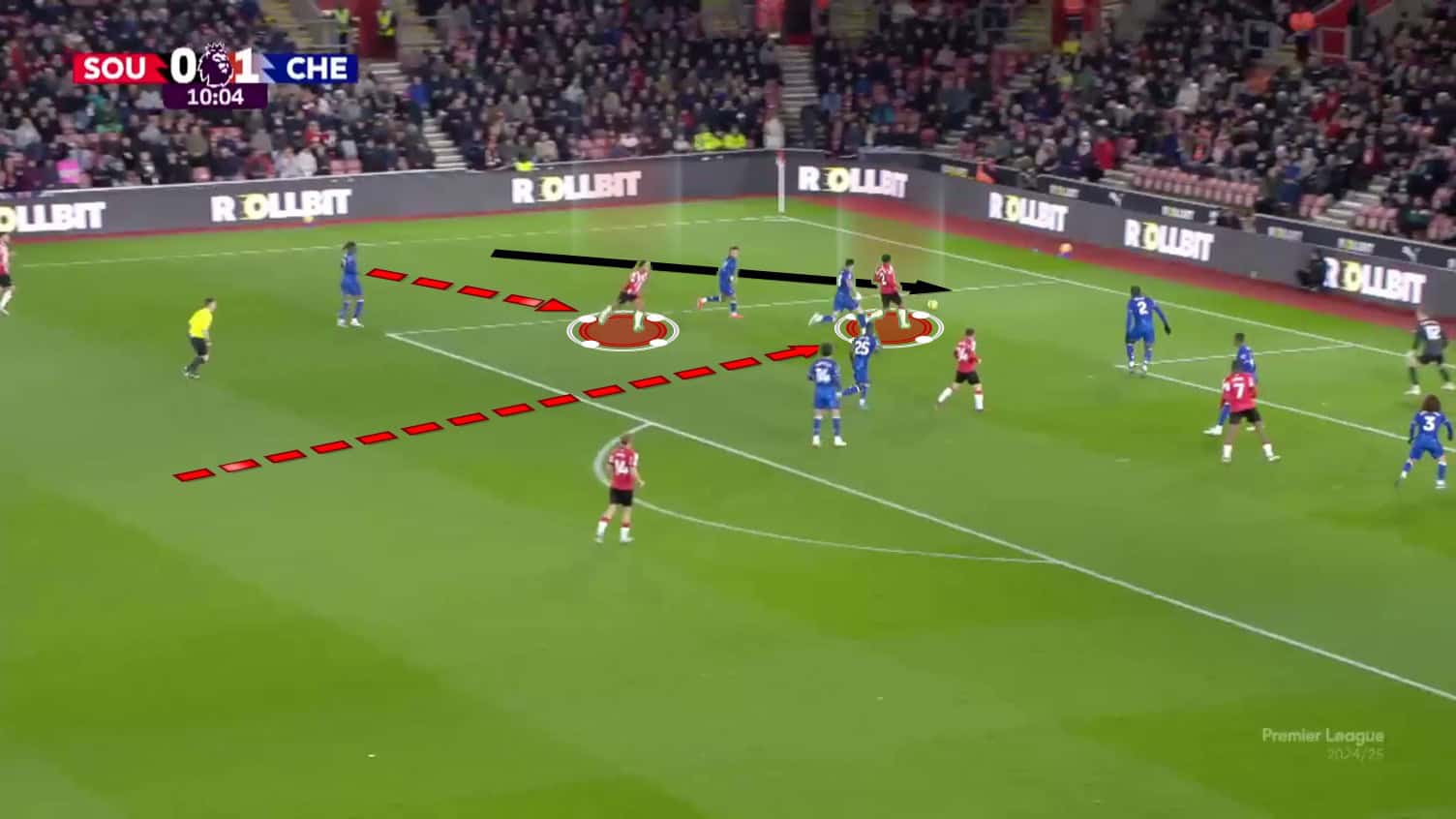 Walker-Peters then passes the ball out wide before continuing his inverted run into the box and receiving it in behind.
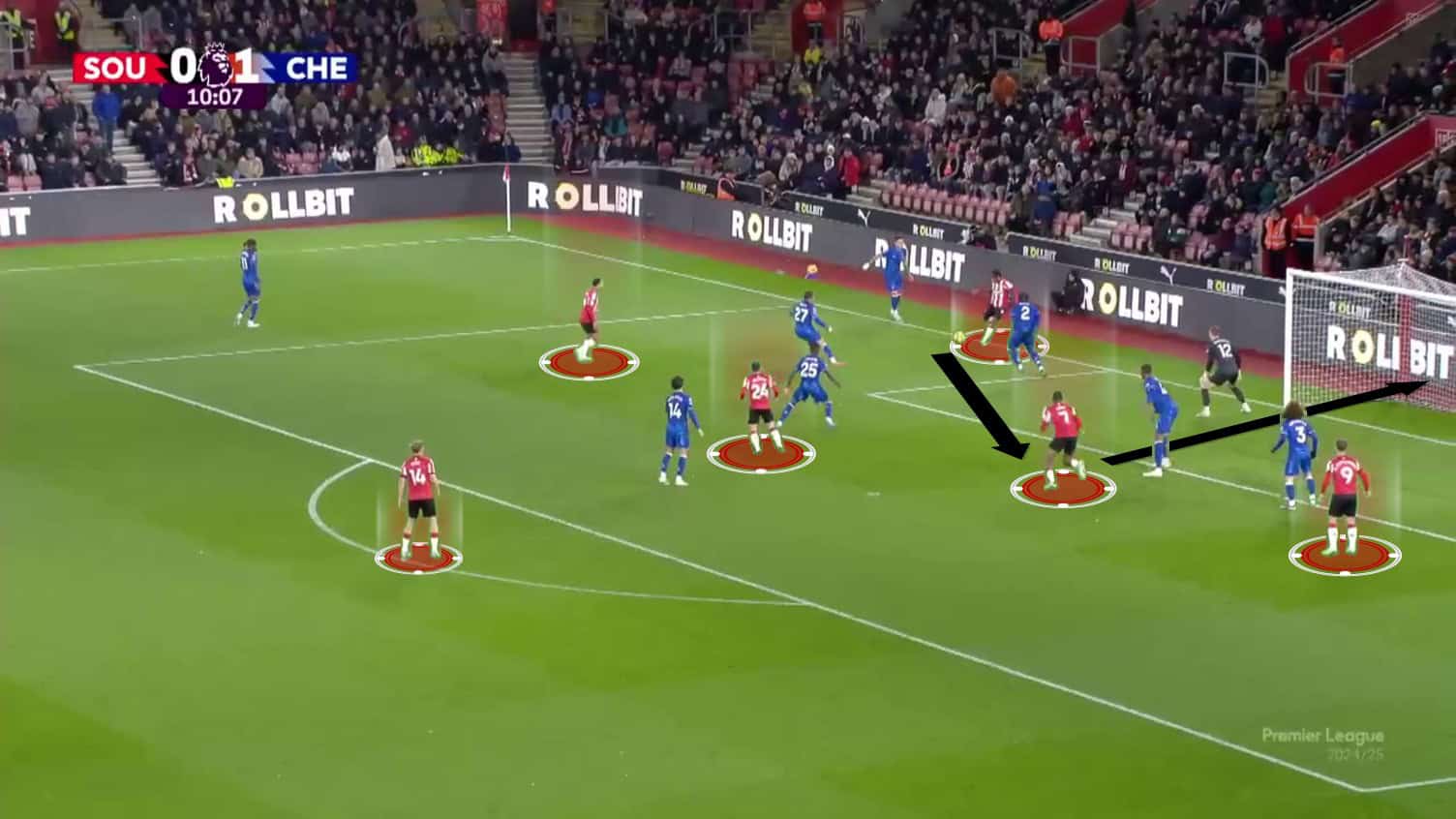
A common trait of Martin’s attacks is for players to flood the box.
Here, against a much more fancied opponent in Chelsea, Southampton still have six players in and around the box, with more arriving.
Breaking Down A Low-Block
Especially during the later stages of the play-off winning season, it was common for the St Mary’s side to come up against stubborn, low-block defences, which Martin had several answers for.
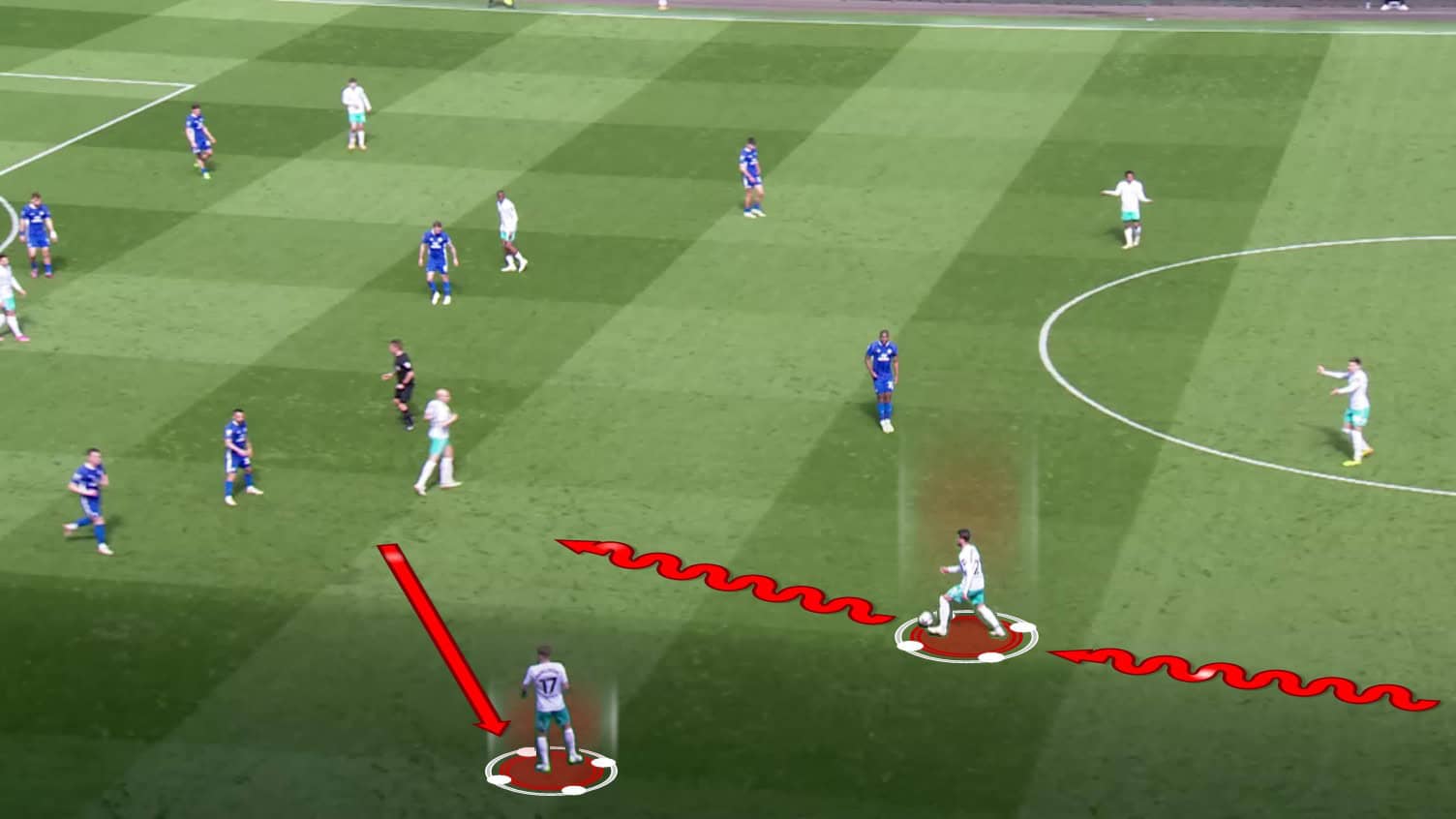
One trait of Martin’s side when playing against a low-block is for his centre-backs to drive forward with the ball at their feet.
Here, against Cardiff City, central midfielder Stuart Armstrong has moved between centre-back and left-back to allow his left-back to play higher.
With the ball at his feet, centre-back Taylor Harwood-Bellis attacks the space ahead of him.
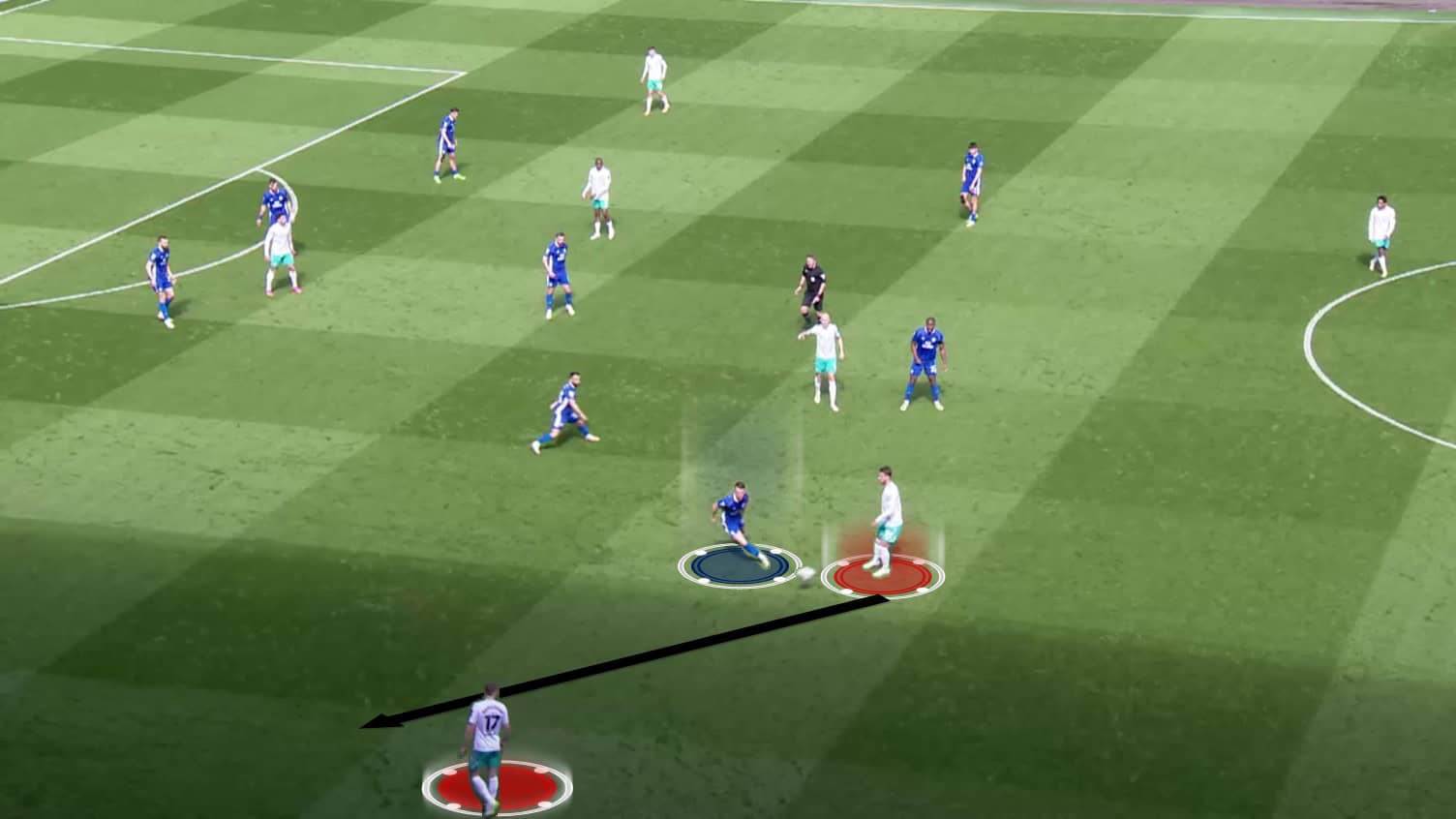
Harwood-Bellis dribbles at the opposition’s widest midfielder, before slipping the ball to Scotland international, Armstrong.
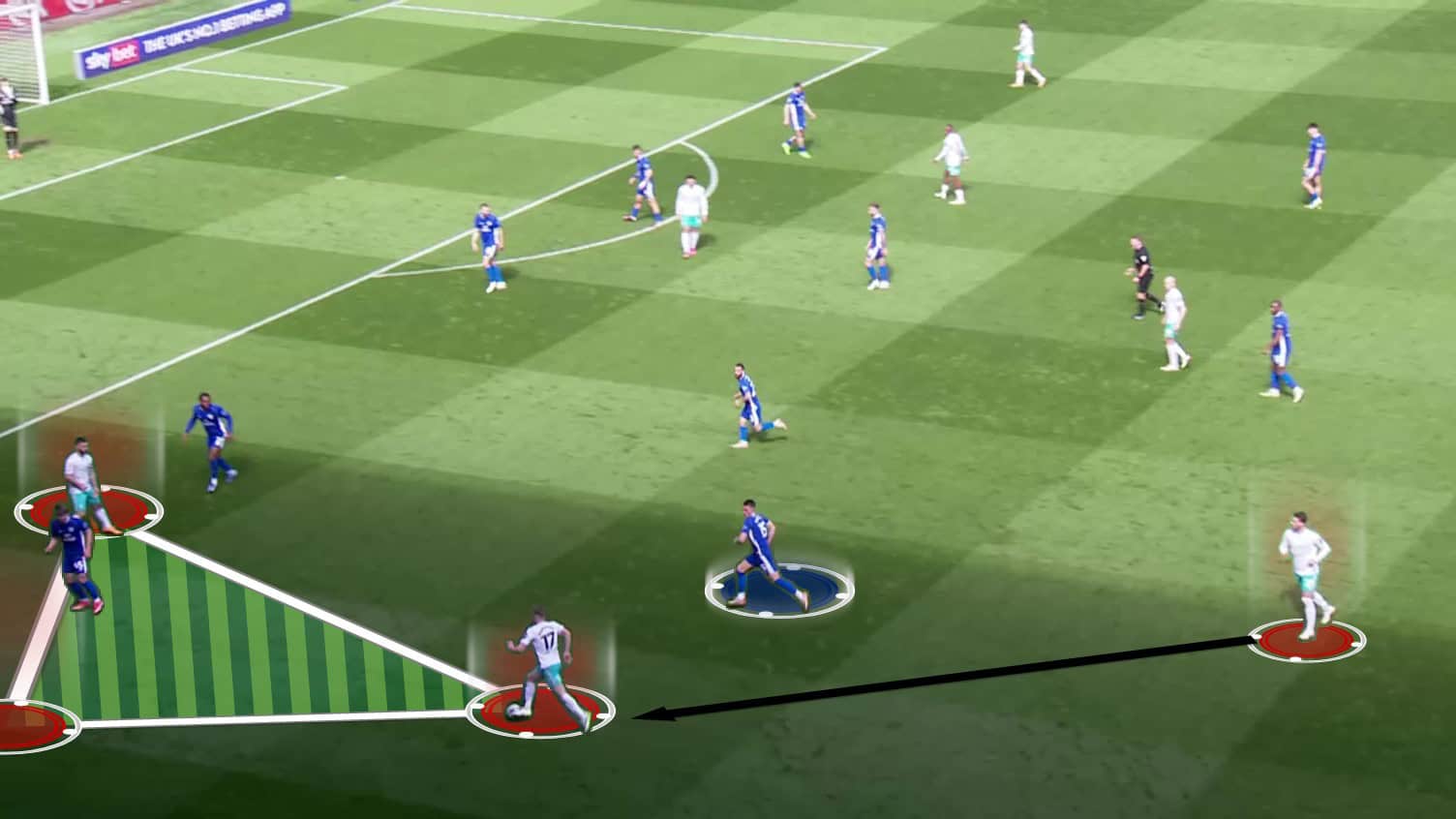
This creates a three-versus-two overload in the wide area, another Martins trend, which Southampton exploited to open the scoring against the Bluebirds.
Attacking The Space Gone Wrong
Whilst this tactic worked very well in the Championship, where Southampton generally had superior players, there were moments in the Premier League when it worked against them.
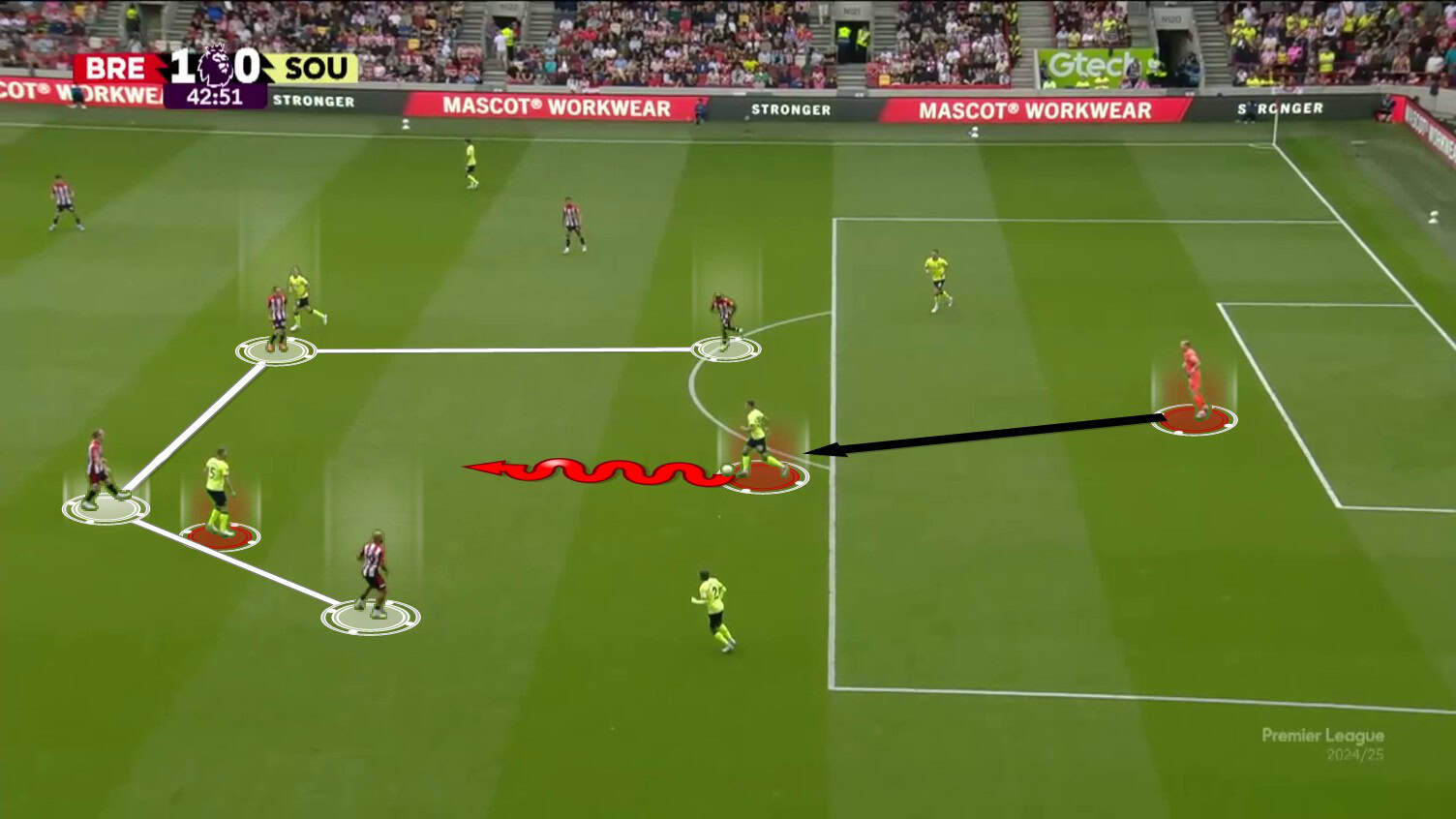
Having received the ball from his goalkeeper, Aaron Ramsdale, the centre-back dribbles into the space ahead of him.
In what appears to be a fairly obvious pressing trap, Brentford surround and ringfence the centre-back, taking away all nearby passing options.
With their striker bearing down on him, Brentford make it impossible for the centre-back to go back to the goalkeeper or his central defensive teammate.
The defender is forced to play into his midfielder, who has only one option, to play to the open centre-back.
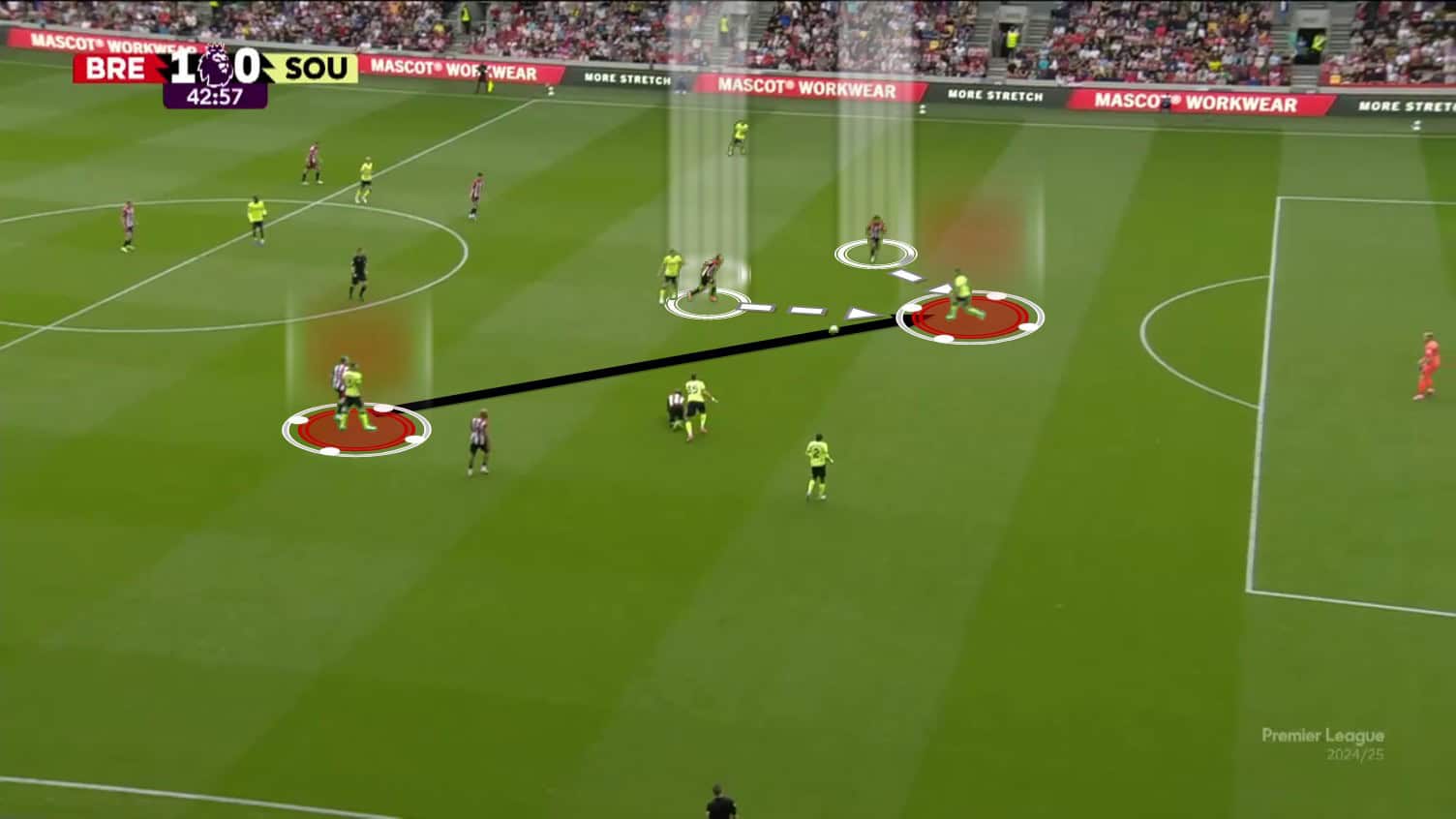
This backwards pass to the open centre-back is predictable and triggers Brentford’s forwards to pounce.
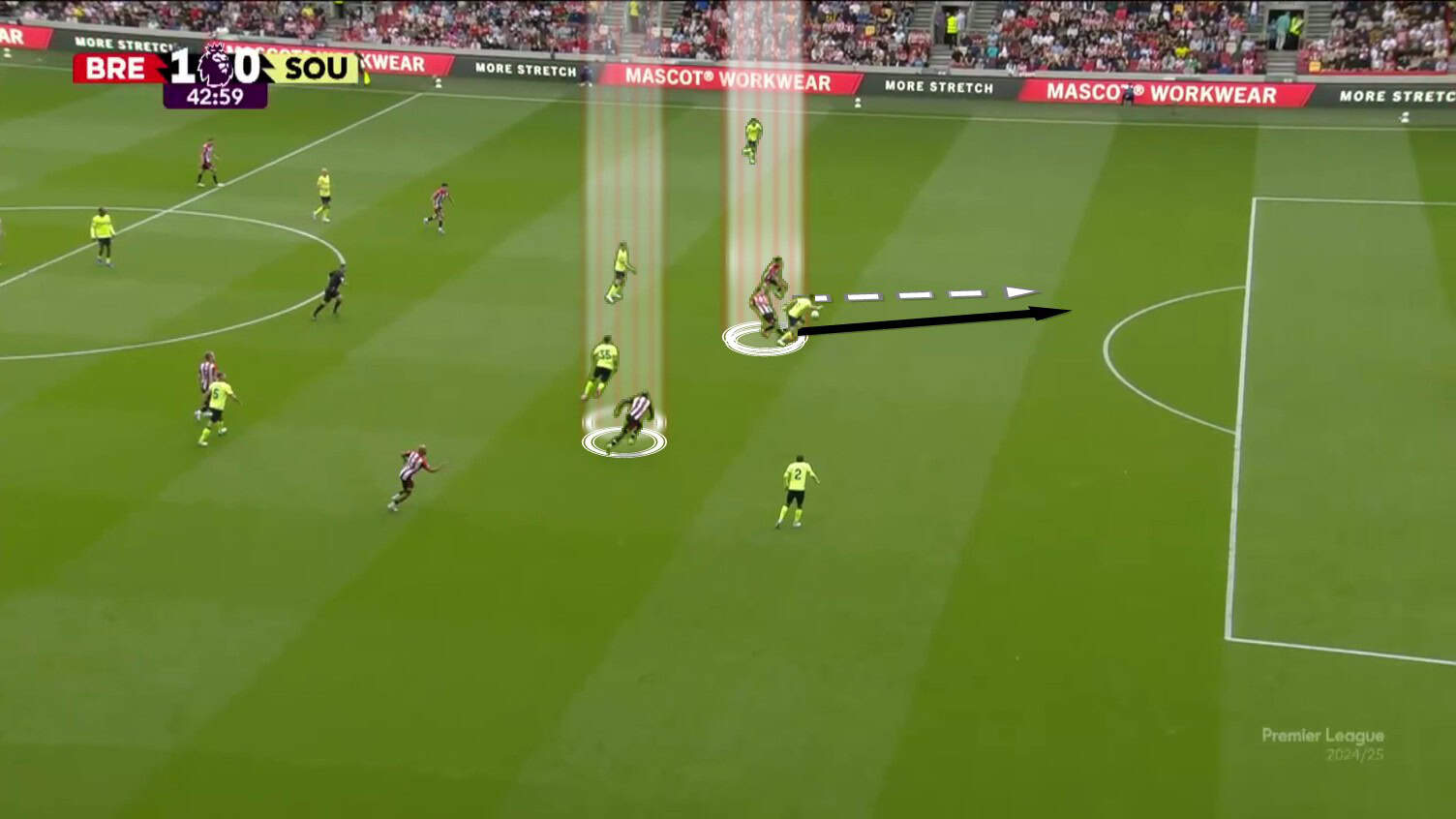
The defender is dispossessed, allowing Brentford’s forward to be played through on goal.
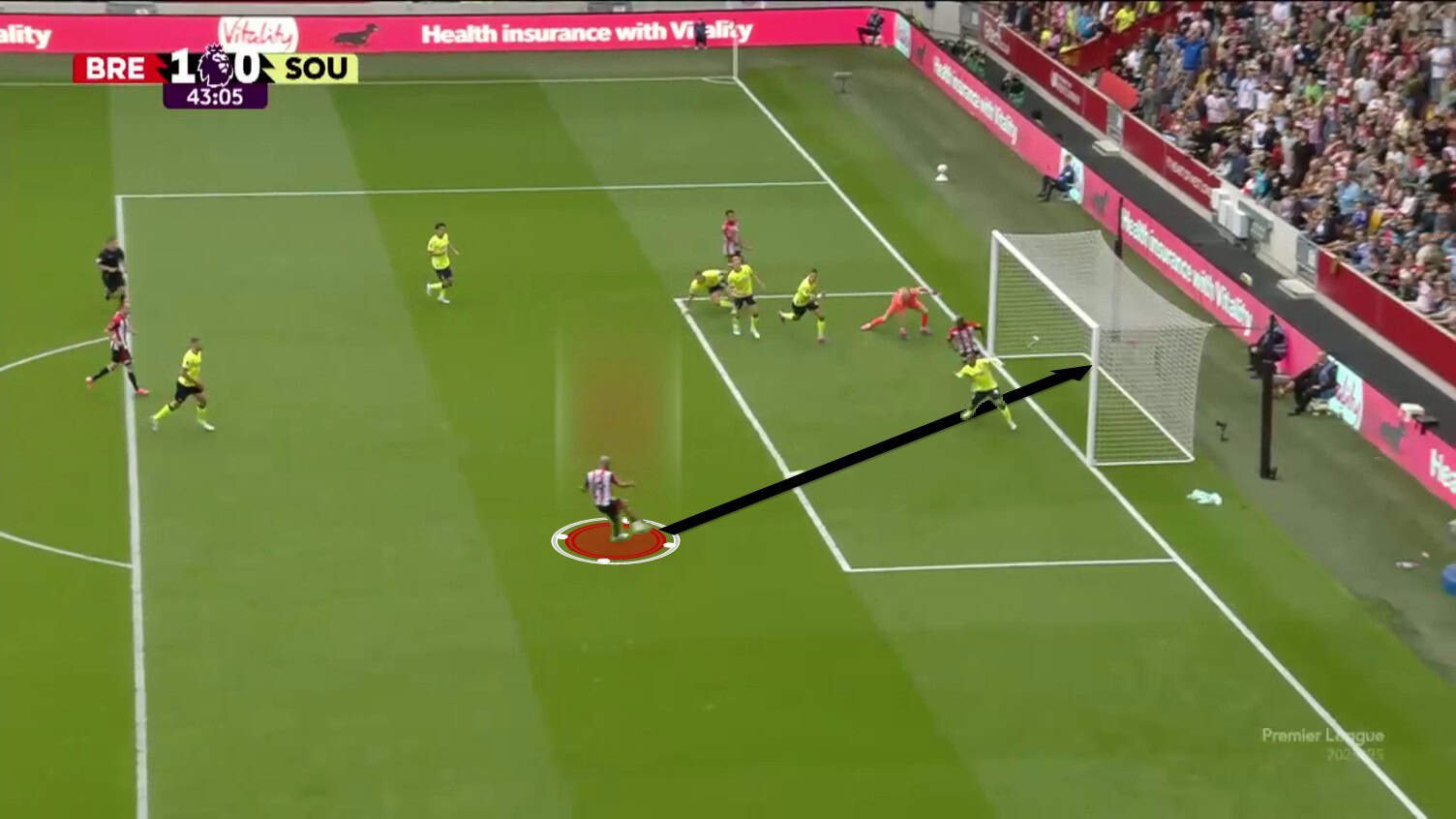 Whilst the first shot rebounds off the post, the ball lands to a Brentford player who scores.
Combination Play Against A Low-Block
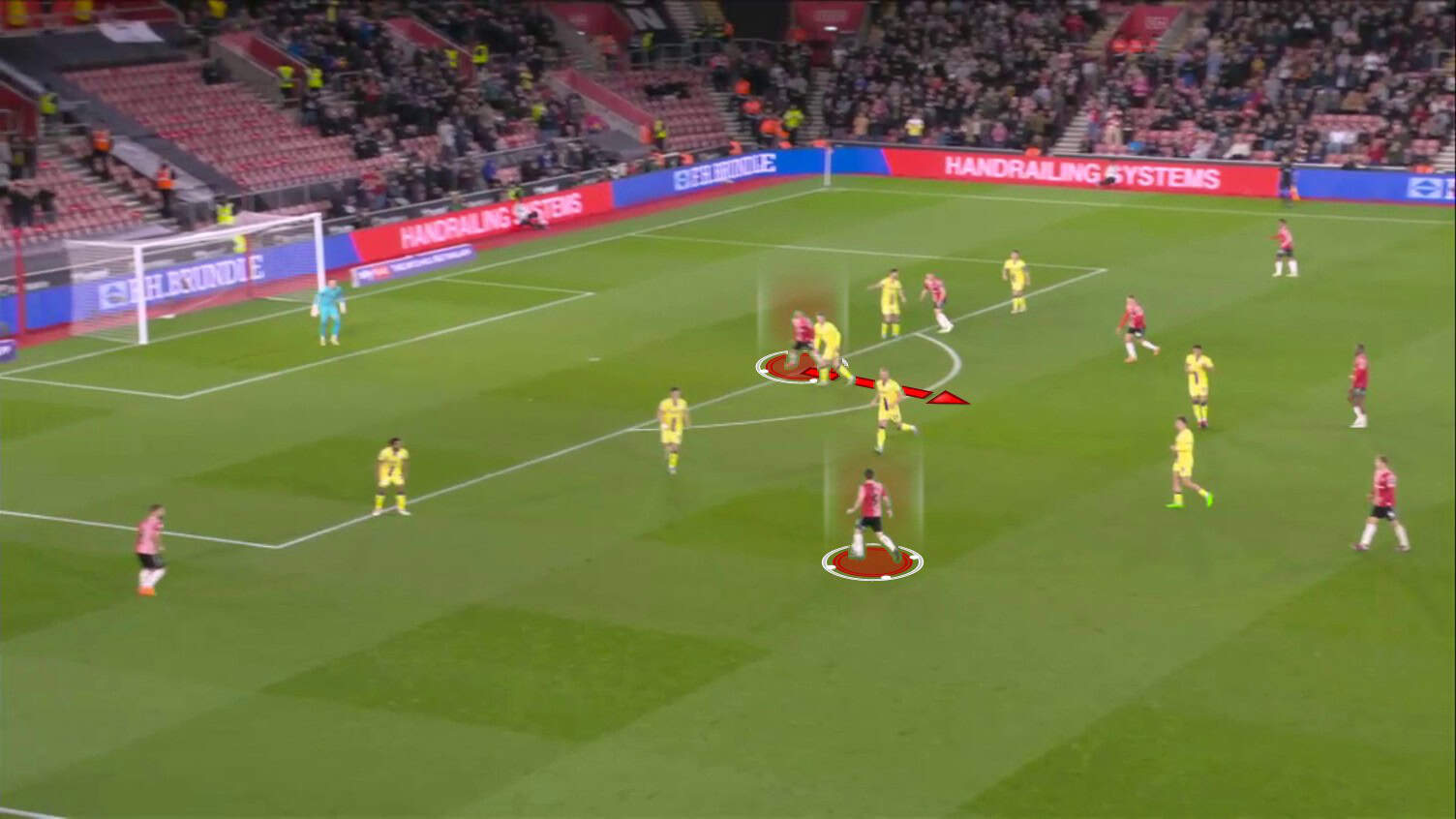
This play against Preston North End’s stubborn low-block is just one example of the free-flowing combination football Martin’s past teams have played.
Having received the ball from his centre-back, who, again, progressed the ball by initially dribbling forward, Southampton’s midfielder has several options ahead of him attacking the box.
Striker Ché Adams, highlighted at the top of the box, is just coming onside from playing in an offside position to make himself more difficult to pick up.
Just as the Scotland striker gets onside, he makes a darting run to the edge of the ‘D’.
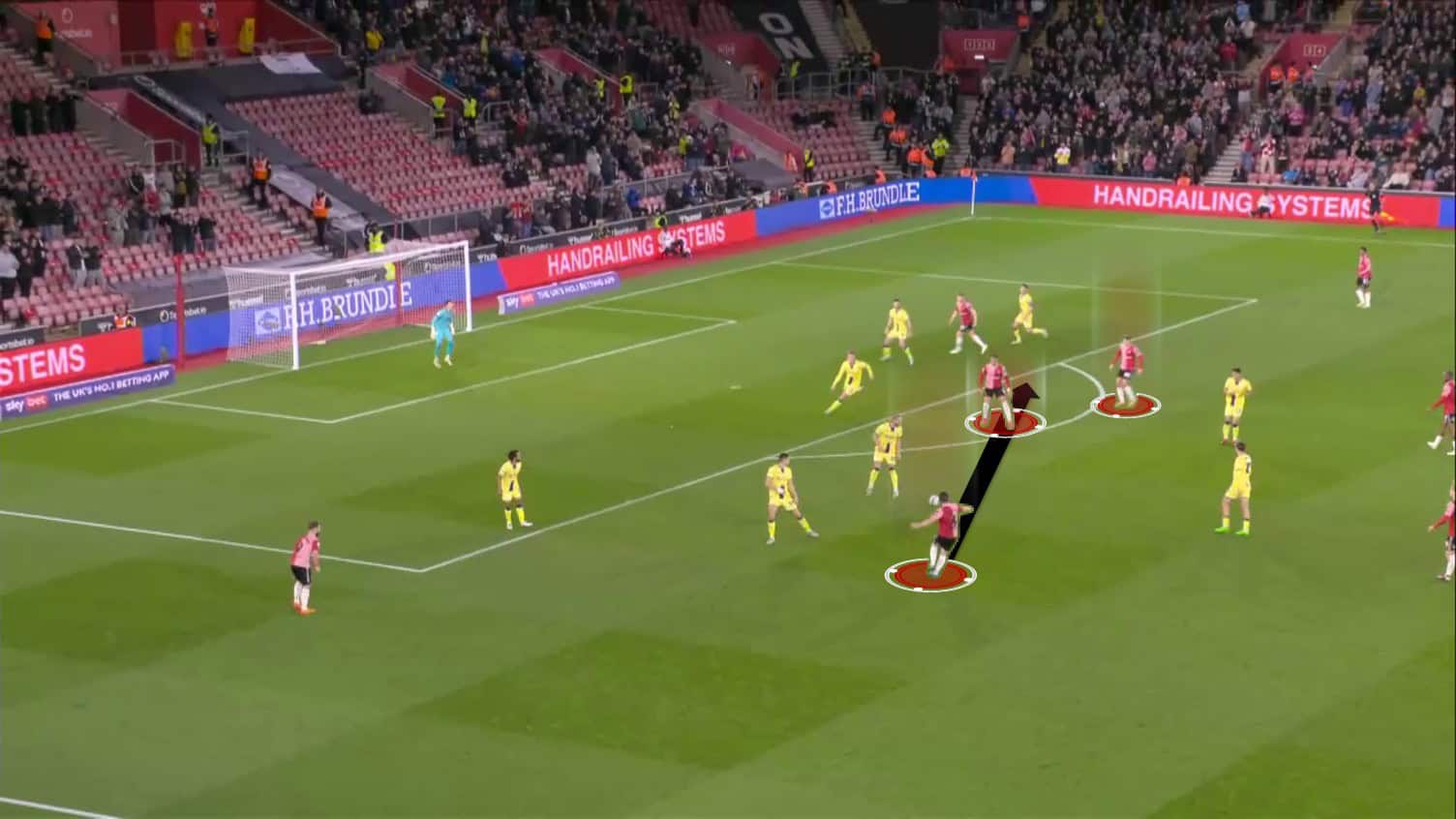
The ball is fired into Adams, who lets the ball go between his legs.
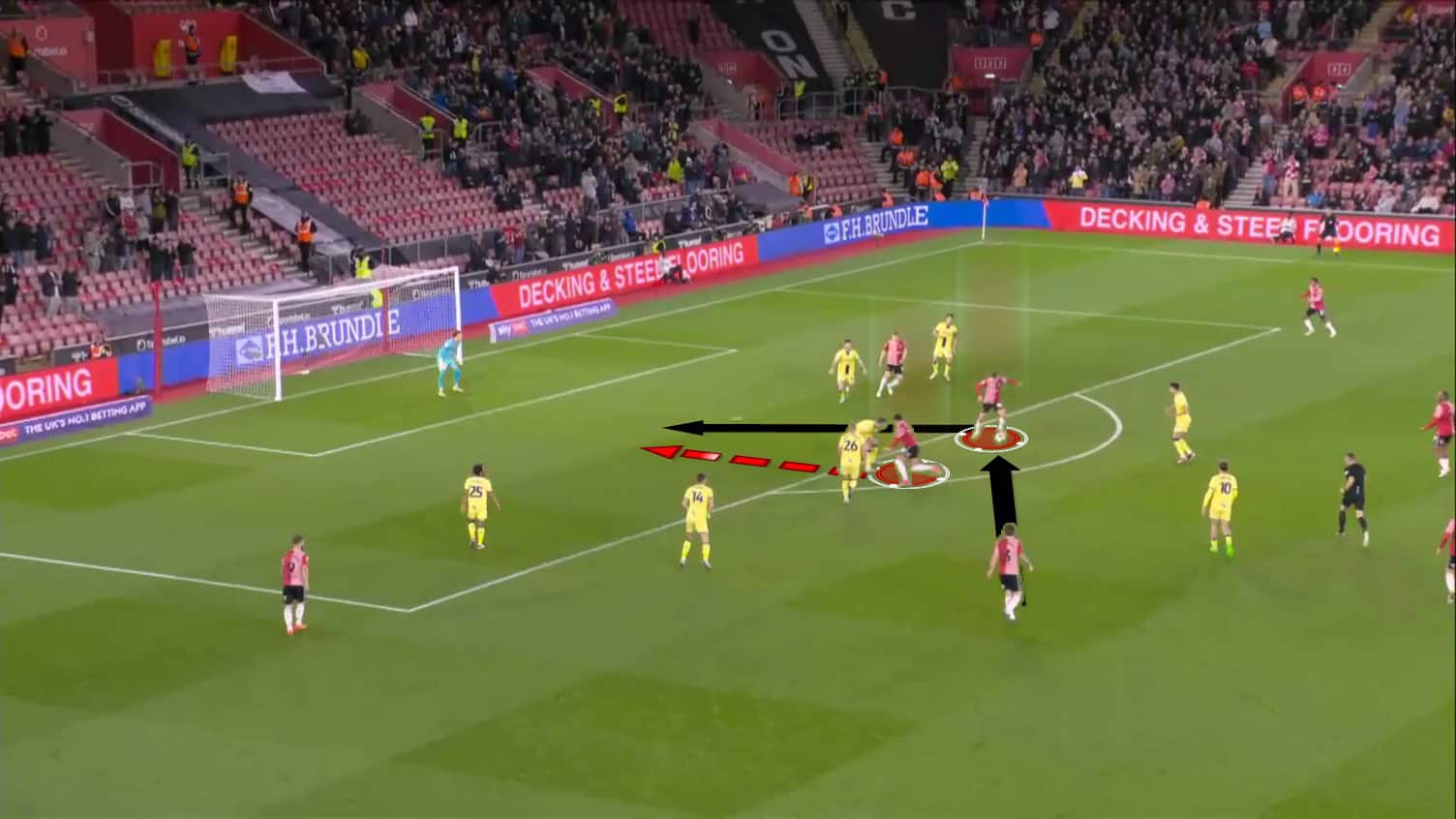
Adams then spins to receive the ball and smashes it into the net.
Were Southampton Too Stubborn In Playing Out From The Back?
The biggest concern for Rangers fans should be the number of goals Martin’s sides have conceded in the last couple of seasons.
Especially as he is entering a club that has kept just two clean sheets in their previous 14 domestic games.
In their promotion-winning season, Southampton scored the third most in the Championship that year with 87.
However, their defensive frailties, which they’d be punished for in the division above, were perhaps already clear, with 63 goals conceded.
For comparison, Birmingham City were relegated to League One that same season, having conceded 65.
In his last three games, Martin’s side conceded 11 goals, suffering defeats to Tottenham Hotspur, Aston Villa, and Chelsea.
The obsession with those commenting on his appointment, and therefore the focus of this analysis, is the way Martin has his teams build up from the back.
The defensive frailties, which can be analysed more in depth at another time, are not a result of how Southampton built out.
In his last game as Southampton boss, within 25 minutes, his side were 4-0 down, having conceded four goals in different ways.
One came from a high pressing position, one from a low- to mid-block position, a long ball, and a counterattack.
The fifth, coming just before half-time, was the result of a sustained Tottenham attack.
Southampton had lost possession of the ball and played a long pass to their striker.
There were mistakes made in the build-up play last season, but the evidence suggests and is backed up by results after Martin’s departure, that the squad’s defensive make-up was not up to Premier League standard.
After all, this is a club that has only amassed 37 points in its previous two Premier League seasons combined and only just survived on 40 points, five above the relegation zone, in 2021/2022.
So, while there may be defensive issues, it can be argued that Southampton’s poor run of form, which led to Martin’s dismissal, had nothing to do with his attacking, possession-based style of play.
It must also be remembered that this stretch of games was played without Southampton’s first-choice goalkeeper.
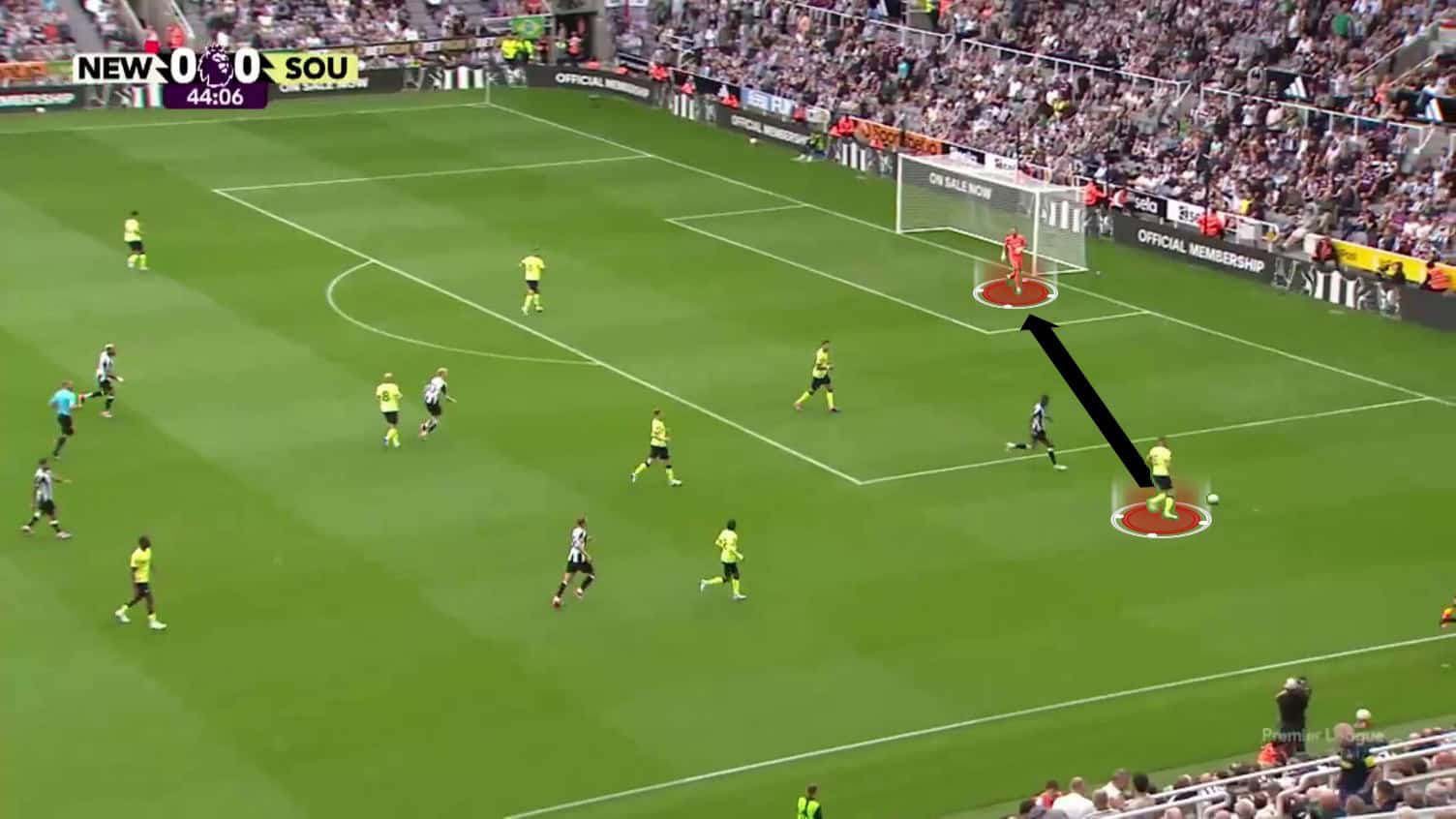
This image, taken on the opening day of the season against Newcastle United, highlights the errors made by Southampton players in the early part of the season under Martin.
With his back to the goal, the Southampton defender cleans up after a Newcastle attack and passes back to his goalkeeper, who can receive under little pressure.
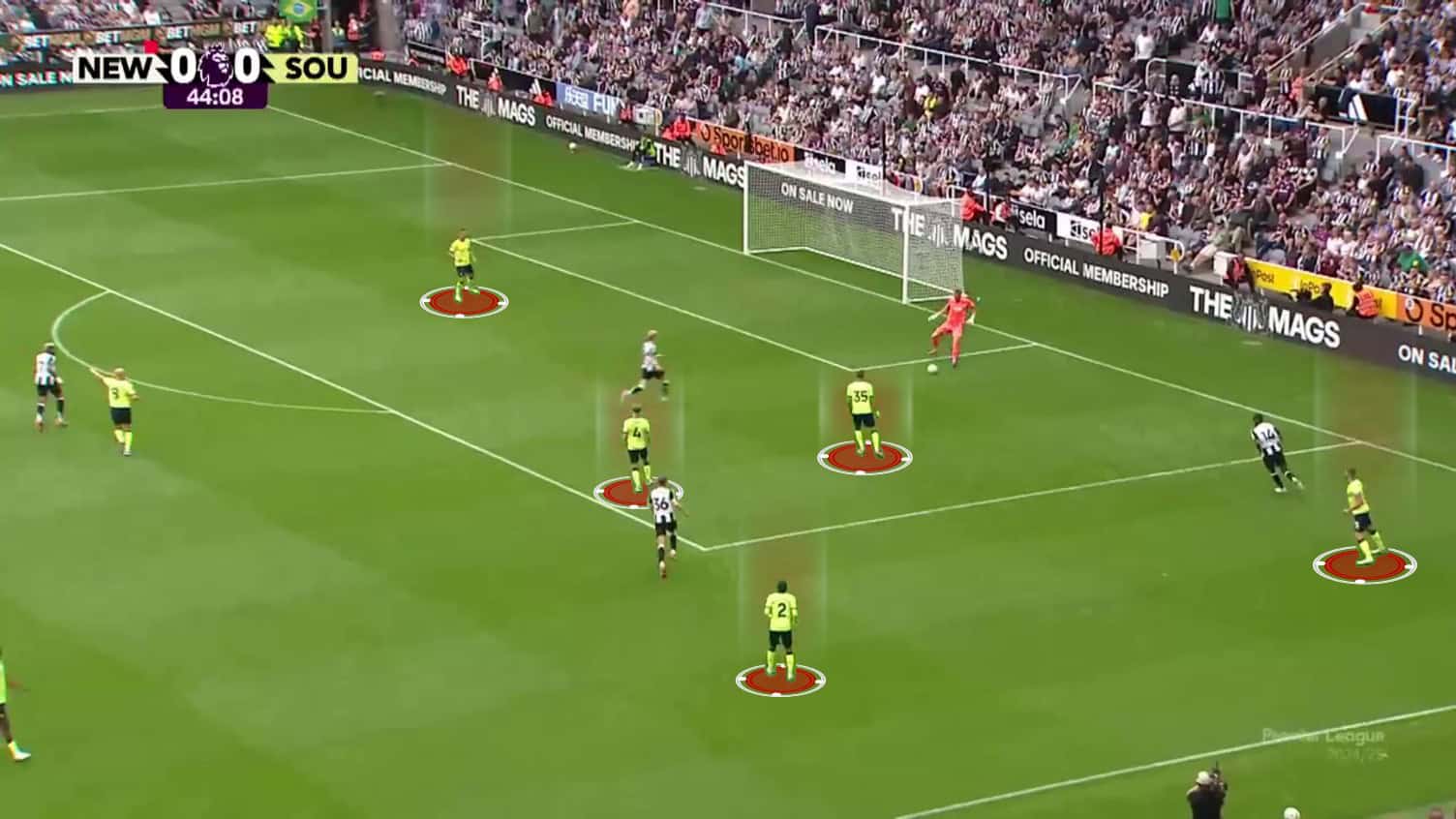 Five Southampton players are both providing an option for a pass and added security should the ball be lost.
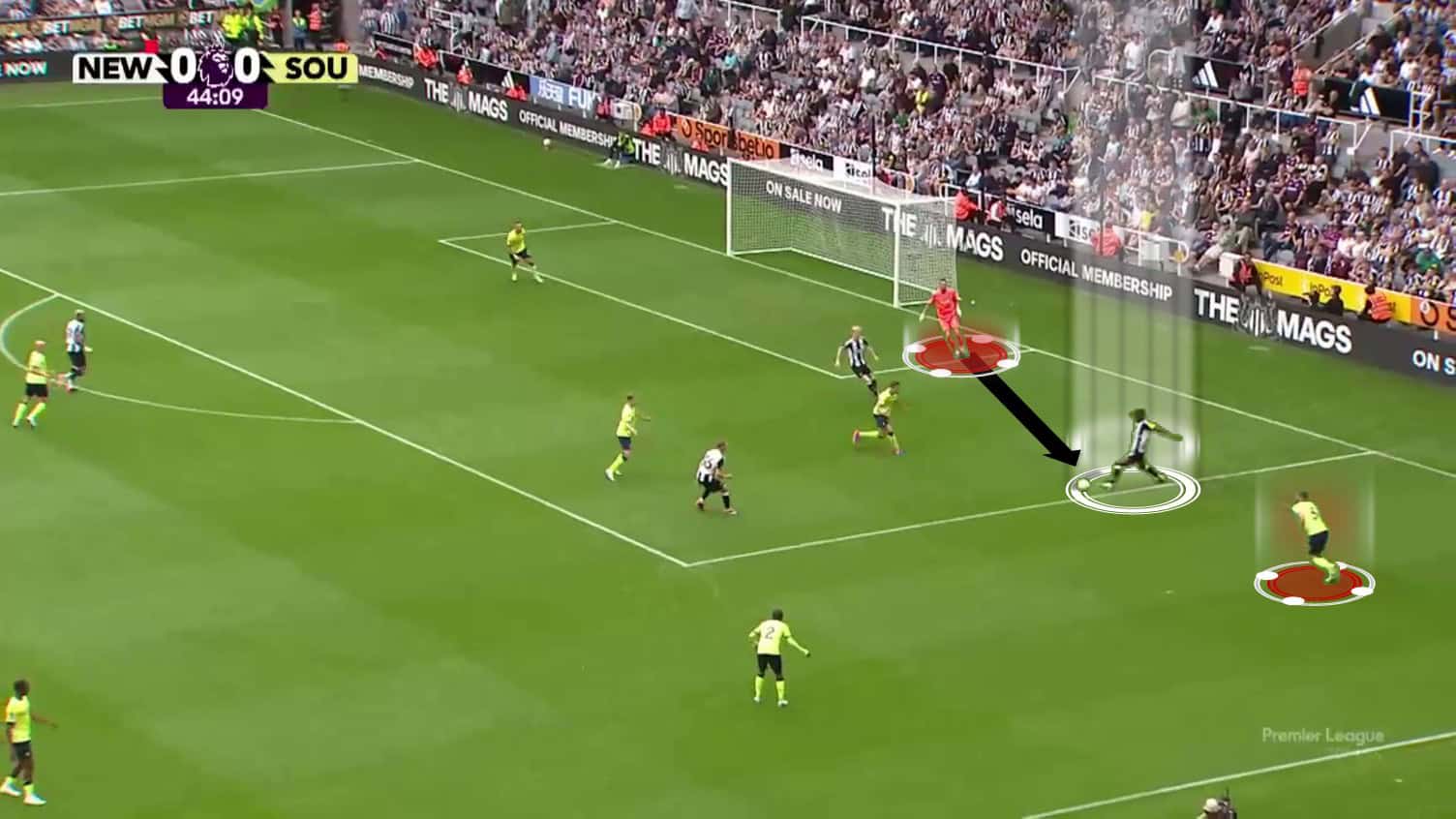
Despite having so many clear passing options, the goalkeeper manages to play the ball straight to a Newcastle forward’s feet.
An uncharacteristic error, perhaps, by a back-up goalkeeper low on confidence and match sharpness.
Southampton was severely punished for the mistake.
The ball was cut back and clinically finished for the only goal of the match.
Whilst this counts as a mistake in the build-up phase, it has nothing to do with the style of play.
Every Premier League goalkeeper would be expected to find a teammate in this position.
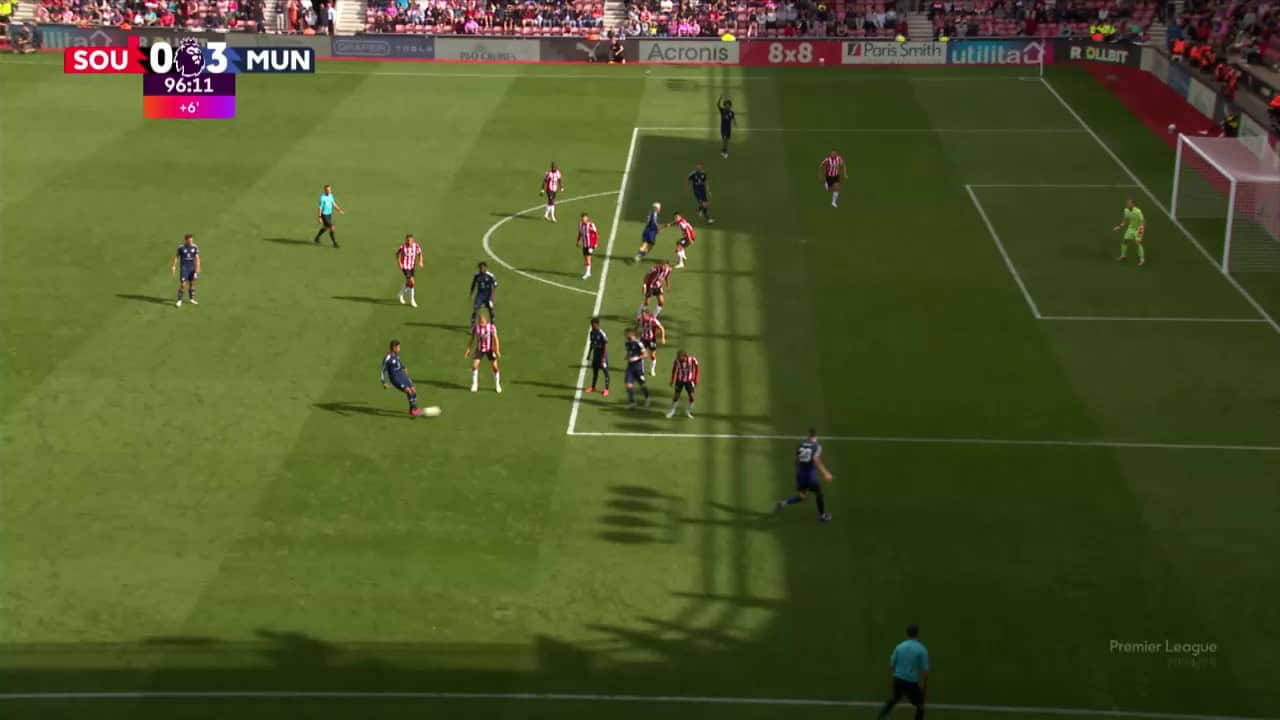
Other inexplicable individual errors led to goals, made by players who were still finding their feet in the Premier League.
Although not as decisive in terms of the end result, the image above illustrates another individual error that directly leads to a goal.
Here, Southampton’s right-sided defender tracked a forward’s run into the box, when it would have been better to hold the line instead.
This played Manchester United‘s winger onside, allowing Bruno Fernandes to slot him in before the ball was cut back for the Red Devils‘ fourth goal.
Conclusion
Martin’s football is not just possession-based, pleasing-on-the-eye “good” football; it is also effective.
If there are any concerns with this appointment, they should be the number of goals conceded by Martin’s sides and Rangers over the previous seasons.
Being able to break down the stubborn defences Rangers often face will not be an issue for this manager, and if working with relatively better players, conceding so many goals should also not be a problem, especially in the manner that Southampton were scored on in the Premier League.
Comparisons with their cross-town rivals and manager, Brendan Rodgers, are inevitable.
It could be argued that Rodgers achieved a lot more in his first stint in the Premier League with another unfancied club, Swansea City, but this is an unfair comparison.
Swansea were in a very different position and went on to even further success under Michael Laudrup, winning the League Cup and remaining in the division for an additional six seasons.
Rodgers, it must be remembered, despite all his success, was involved in a relegation battle himself with Leicester City.
One bad season, under very difficult circumstances, does not define a manager.
Martin is best at unlocking deep defences, and if the players he is working with are what Rangers fans expect with their new investment, Celtic may finally face some competition.

