
As the English Premier League drew to a close this season, so did Southampton‘s decade-long stay in England’s top flight.
Over the five years, the side have experienced a steady decline, from once participating in the UEFA Europa League to consistently finding themselves in the relegation battle.
In contrast, Russell Martin‘s trajectory as a coach over the last five years has risen exponentially, with the former Premier League player excelling at MK Dons and, most recently, Swansea.
On and off the training ground, Martin has managed to instil belief in his players and the fans of both his previous clubs through possession-based football and an evident passion for the game.
This tactical analysis will provide an analysis of Southampton’s tactics in possession, highlight the side’s key weaknesses in possession, and explain how Russell Martin coaching style can improve this aspect of the side.
Southampton struggles in progression
Southampton’s most recent Premier League campaign saw them finish with just 36 goals, the third-lowest total in the league.
This figure is not a result of poor finishing, as the side only underperformed their expected goals by three goals, which would still rank them among the bottom three teams in the league.
This suggests that the side struggled to create chances over the last season, which is also reflected in the fact that they managed only 20.08 penalty area entries per game, the lowest in the league.
Before comprehensively analysing the reason why Southampton struggled to create chances in the final third, their build-up play in the first two-thirds must be assessed.
Southampton Tactics in build-up
In their own third, Southampton build up with a back four, with their full-backs advancing slightly and their double pivot of James Ward-Prowse and Roméo Lavia.
An example of this is shown in the image below.

Southampton’s centre-backs from these positions will look to pass to either Ward-Prowse or Lavia.
Still, due to the midfielders often facing aggressive opposition pressure, they can only pass back to their defenders.
As a result, most of Southampton’s play is directed towards the wide channels, with the centre-backs passing to the full-backs.
This is illustrated in the example below, where the former Marseille defender Duje Ćaleta-Car plays a pass to Romain Perraud.

This scenario poses two main issues for Southampton.
The first and most apparent is that in the wide areas, players receiving the ball have limited space due to the touchline.
This means that when the full-backs receive the ball, their next actions can be somewhat predictable, as only a handful of passes can be played if the opposition supports each other well.
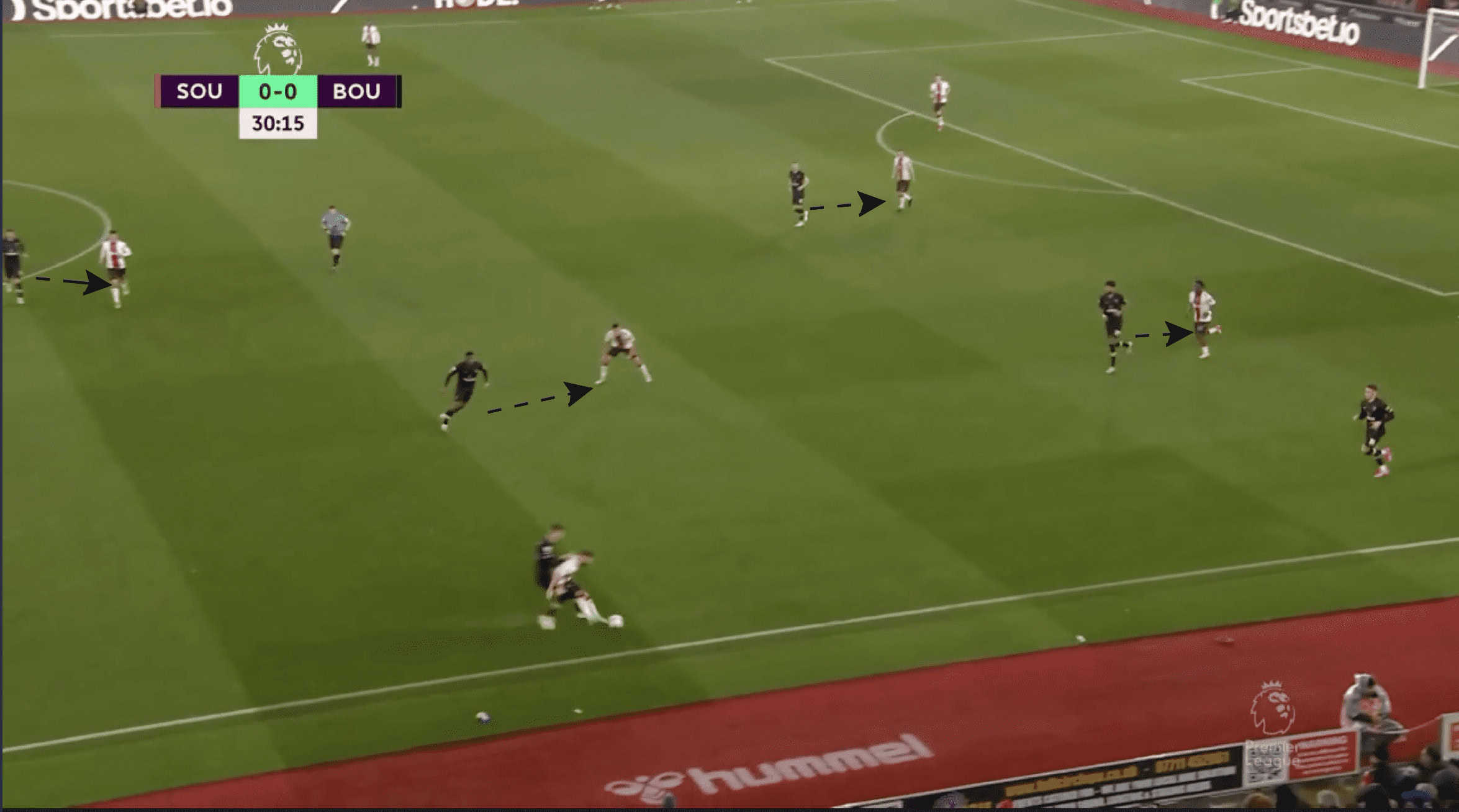
As shown in the image below, the opposition players have covered Ćaleta-Car and Lavia, meaning Perraud can only play a pass down the line.
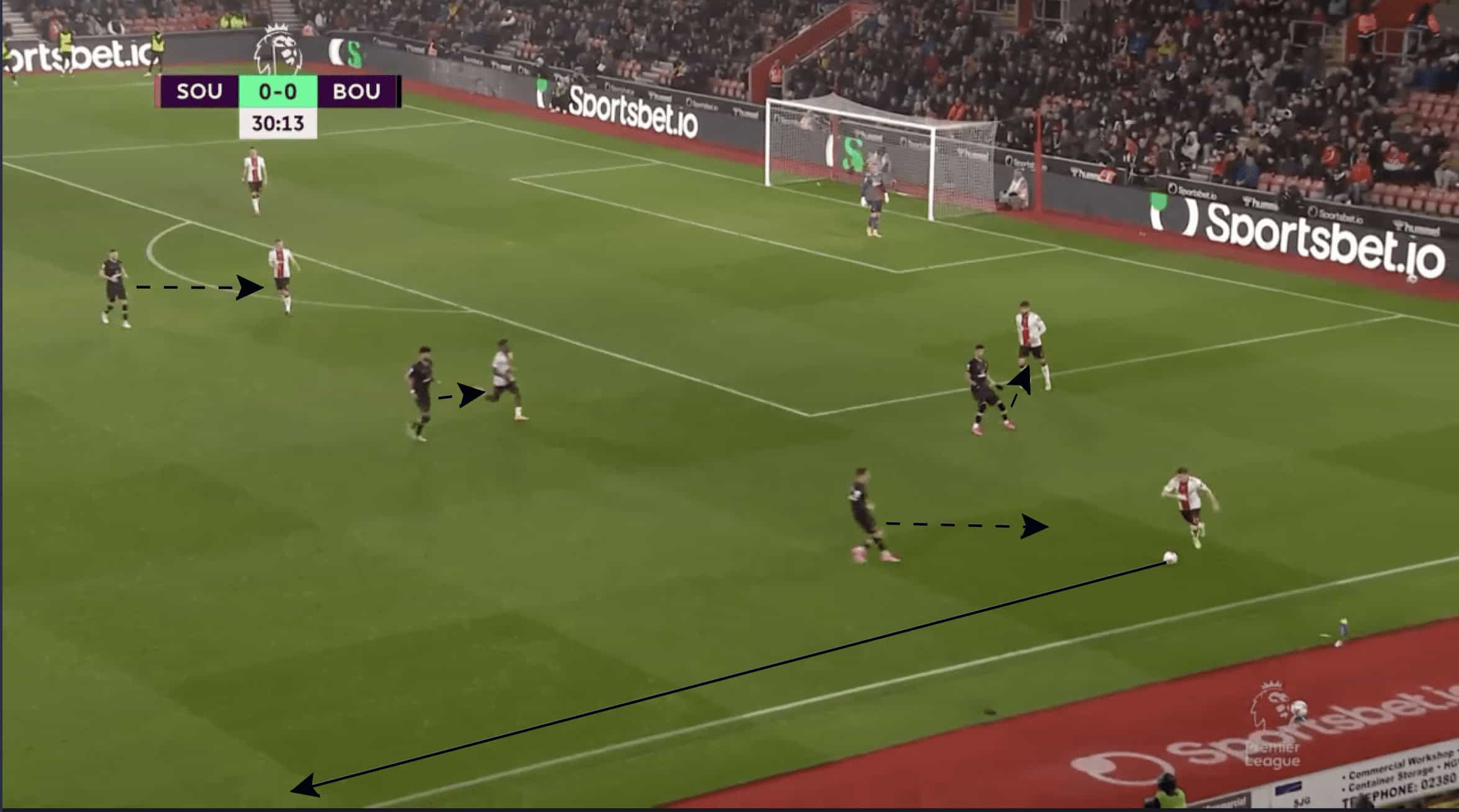
When Adam Armstrong receives the ball, he then looks to play a pass inside, but the opposition players are in good positions to cover the Southampton players and are able to force a turnover.
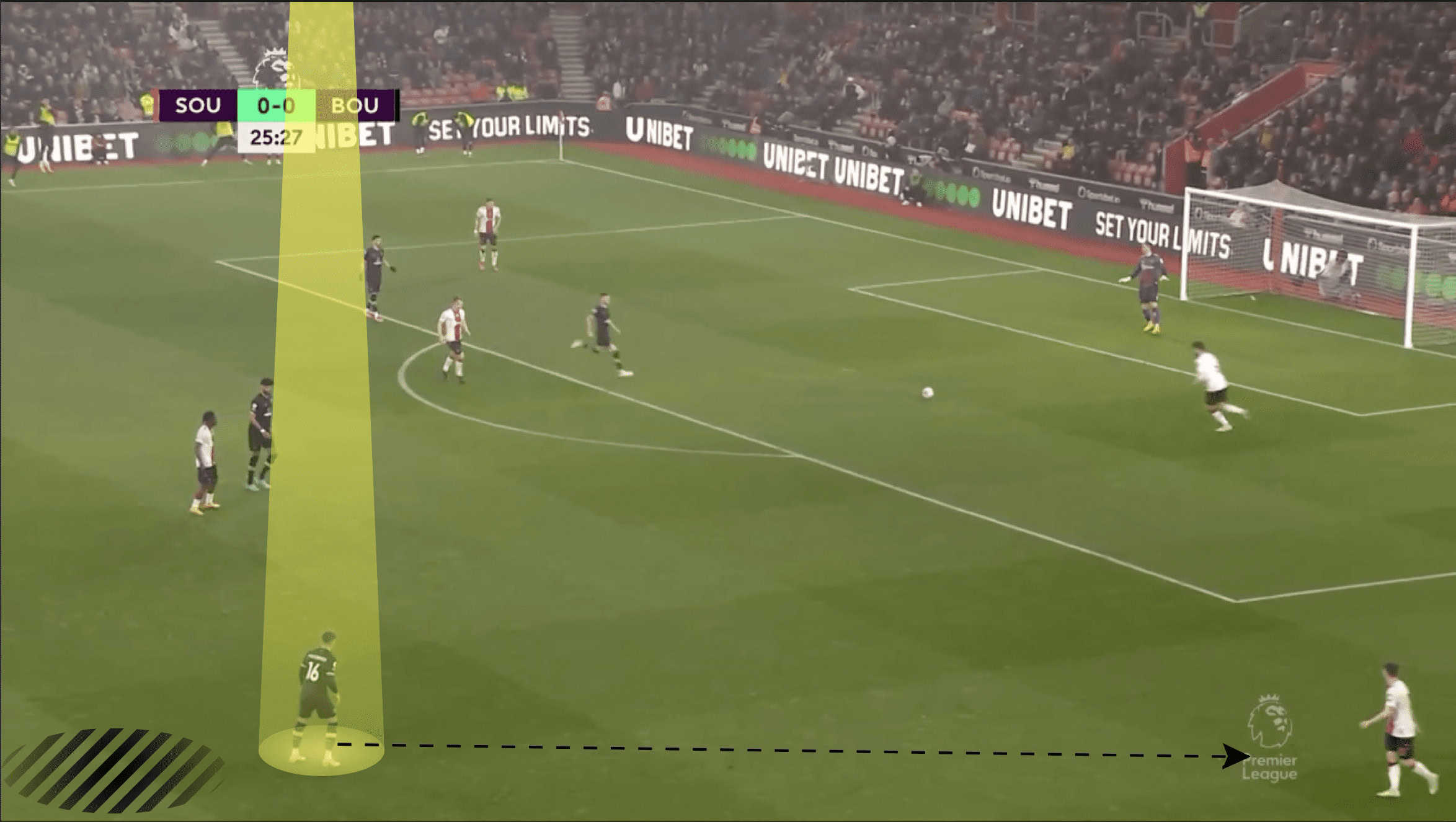
A second issue with the structure of Southampton’s build-up is the position of their full-backs.
Due to their method of progressing the ball in the wide areas, their full-backs often receive passes from their centre-backs.
As a result, they often build up with a relatively flat back four.
If the opposition press is high, this creates easier situations for the opposition to press the Southampton players.
From the scenario below, Perraud’s position is deep enough to allow the opposition winger to protect the space behind him and have quick access to Him if a pass is played to the full-back.
The opposition’s right winger is not forced to make any decisions in regard to his positioning.
If Perraud were to advance and the right winger dropped deeper as a result, more space could be created for Ćaleta-Car to advance the ball, forcing the opposing players to decide whether to press the centre-back, which would create space for other Southampton players.
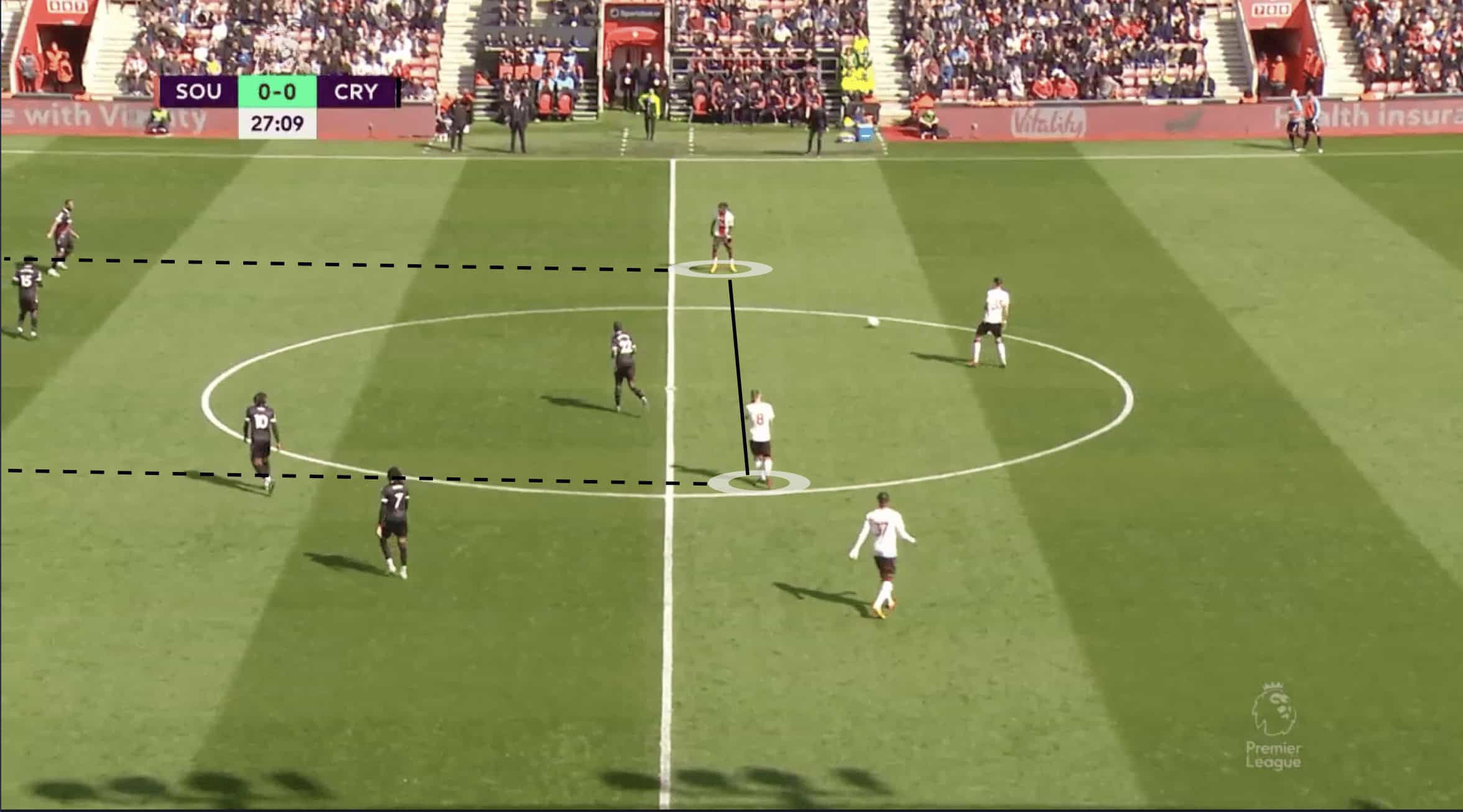
The depth of their full-backs would not entirely be an issue if it were not for the distances between the midfielders in the double pivot and the two attacking midfielders.
This results in the side being disjointed and limits the number of passing options the side can access in the build-up.
The relatively large distances between the attacking midfielders and double pivot can be seen more clearly further up the pitch in the middle third.
In the example below, Lavia and Ward-Prowse are only a couple of meters in front of the centre-backs, with the rest of the attacking players in more advanced areas.
This once again creates a favourable situation for the opposition as with no threat directly in front of the midfield line of the opposition.
They are not forced into deciding whether to press the ball carrier or cover Southampton’s attacking midfielders behind them.
This also makes Southampton unable to sustain attacks and pressure, which would give them more opportunities to enter the final third.
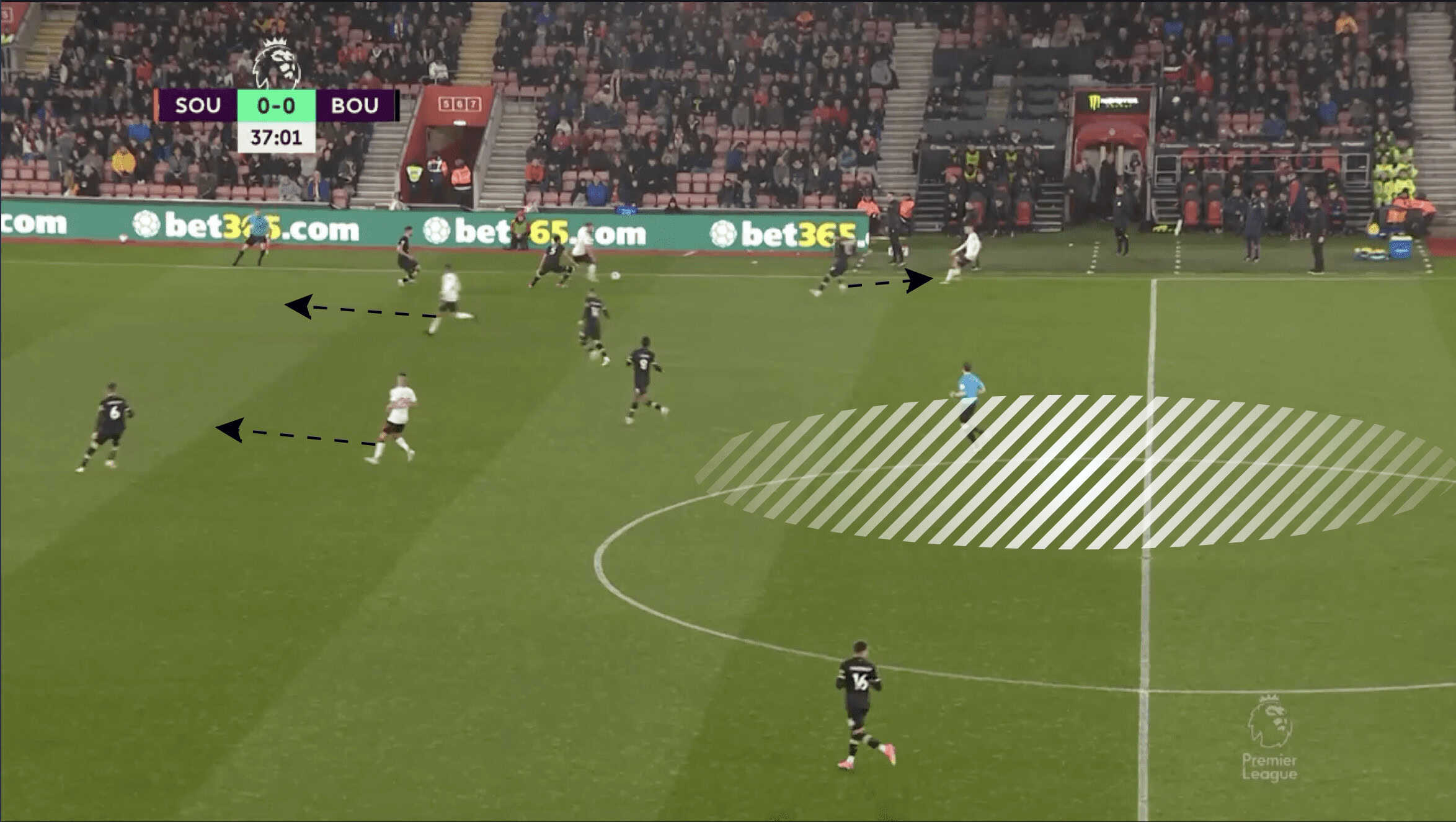
This is evident in the image below, where Armstrong receives the ball on the right-hand side.
Theo Walcott, as well as Carlos Alcaraz, then attack the space created in the back line.
However, the midfield is left unoccupied.
With no support from behind the ball, Armstrong, with his back to goal, has limited options, reducing the side’s ability to sustain the attack and potentially take advantage of a promising situation.
As a result, many of Southampton’s attacks are stifled before they even get a chance to enter the final third and penalty area.
Russell Martin Tactics At Swansea
Likely, Martin will not attempt to replicate the game model he implemented at Swansea with this Southampton side, but the game model’s principles can help suggest how he can improve this Southampton side.
Analysing Swansea’s build-up play reveals already significant differences in the distances and connections between players.
Martin has stated that he has particularly emphasised to his players the importance of close distances between them in both attack and defence, which allows players to support each other on and off the ball.
The example below illustrates Swansea’s structure in the build-up, with the side forming a 2-4-2-2 formation.
Within this structure, Swansea have nine players in their own half and only two in the opposition half.
In addition to this, what is also particularly intriguing is the fact that full-backs utilise minimum width.
The minimum width concept is a strategy whereby fullbacks or wingers (in this case, fullbacks) do not hug the touchline but instead move as far wide as necessary for specific situations.
From Swansea’s perspective, in the buildup, full-backs often adjust their positions to support the centre-backs and goalkeeper, creating new and different angles and passing lanes.
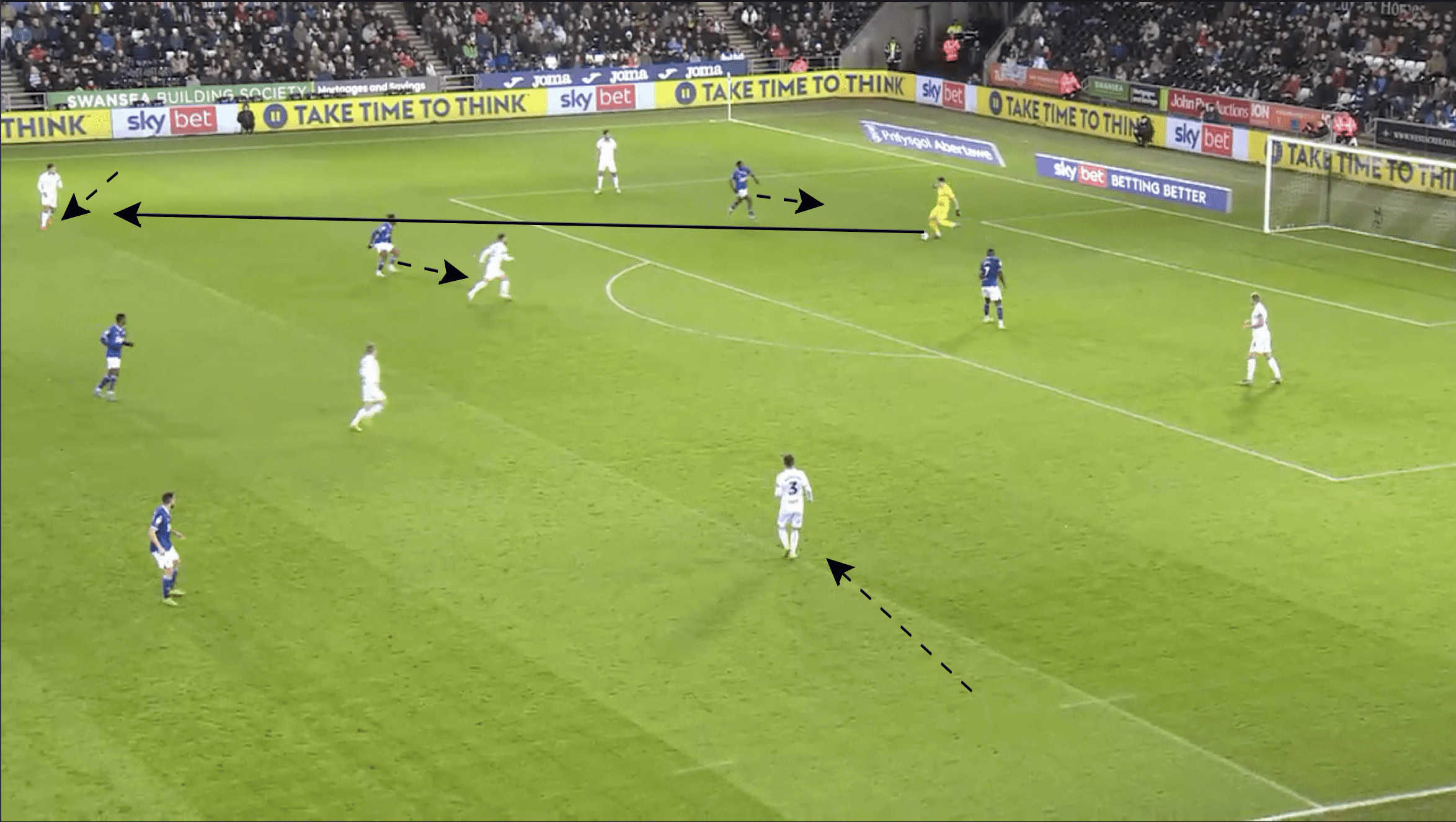
In the example below, as the Swansea double pivot moves to the right to support the goalkeeper, space is created on the right-hand side of the central area, allowing the opposition players to adjust their positions to the midfielders.
Right-back Joel Latibeaudiere recognises this and indents his position to give the goalkeeper an additional pass option.
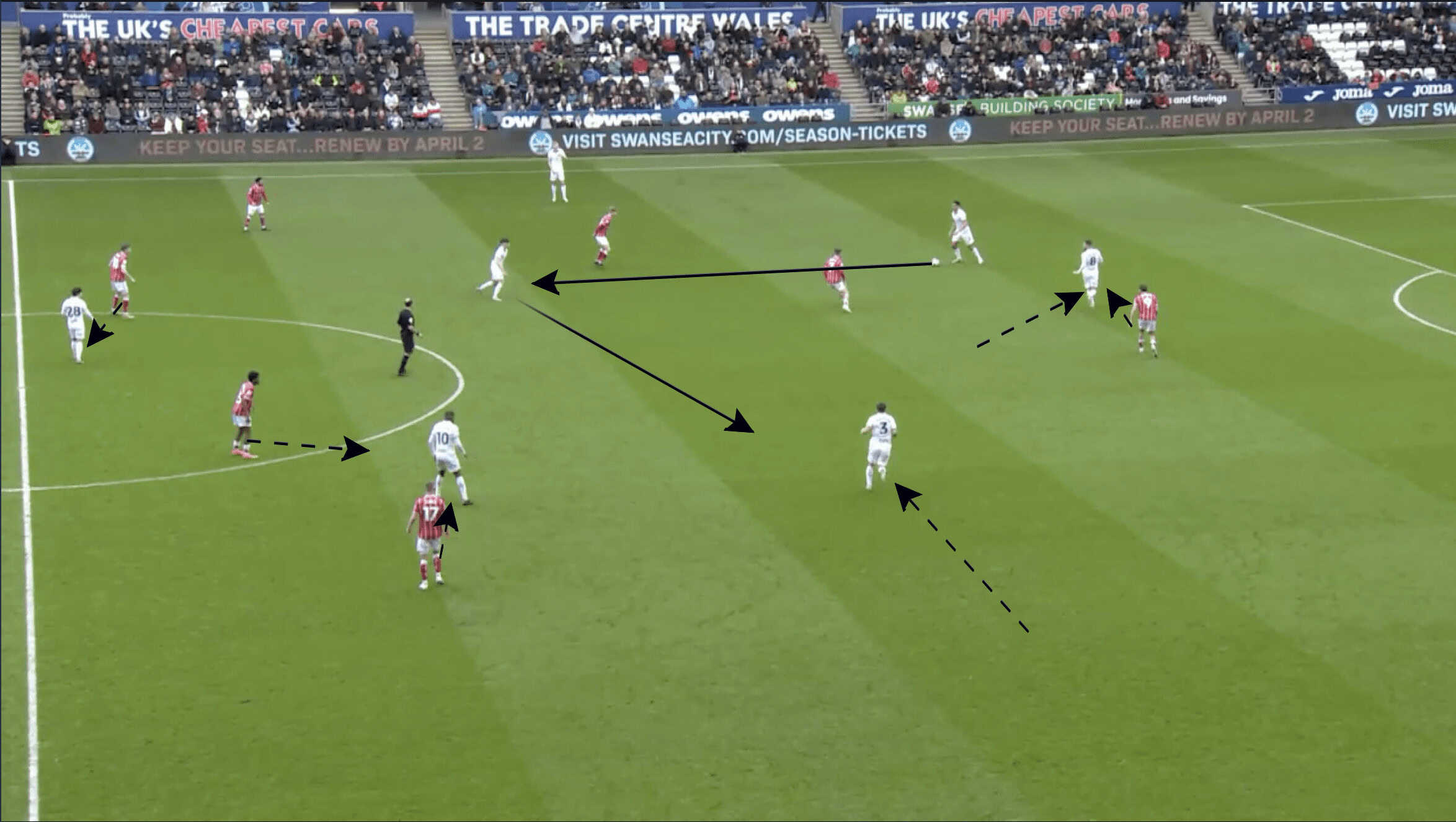
Another example of this can be seen in the image below, where the left-back, Ryan Manning, moves from a wider position into midfield.
This has several benefits, as it directly ties into how Swansea look to progress the ball, with the side under Martin typically progressing the ball through central areas.
The movement of full-backs into more central spaces allows them to overload the centre and as a result, have a free man.
In the example below, as Matt Grimes drops deeper, opposition players adjust their positions in order to cover the midfielder, creating space between the first and second lines.
Due to the position of the advanced Swansea midfielders, the opposition’s second line of defence is pinned back, giving Manning time and space to receive the ball.
The previous example also shows the staggered nature of Swansea’s structure and the distance between each line.
As a result of both the staggering and distances, players are able to support the ball carrier; however, Swansea is also able to create and exploit the dilemmas faced by the opposition, thereby progressing the ball.
What can also be seen in Martin’s Swansea side is the dynamic occupation of space in more advanced areas, particularly by the advanced midfielders.
The movements of full-backs in the early stages of build-up exhibit shades of this dynamic occupation of space, but this is especially evident in more advanced areas.
The advanced midfielders and strikers in the side look to receive the ball in the space between the lines and either move to receive it or create space for other players to receive it.
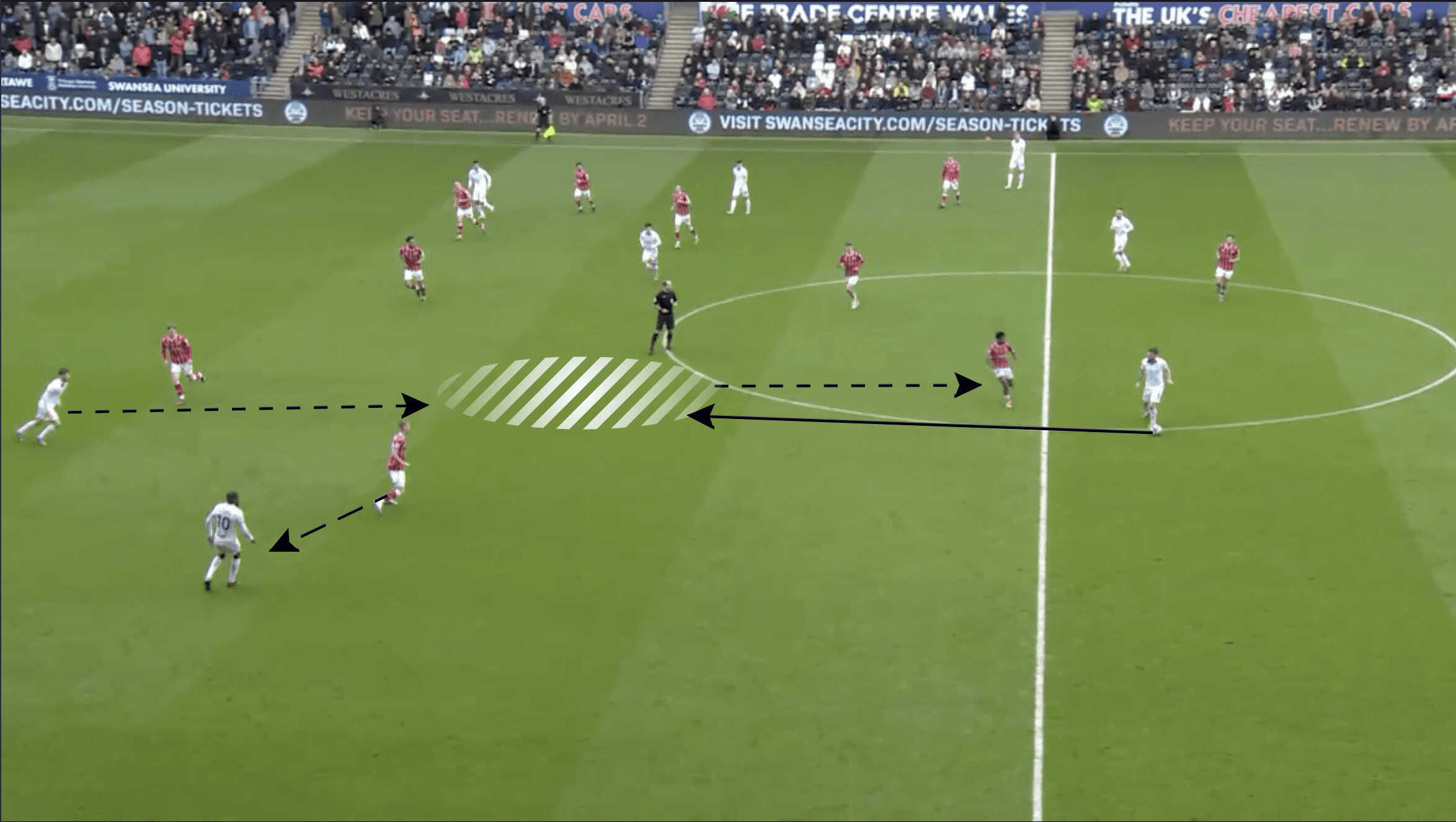
This is evident in the example below, where Manning is positioned on the ball in the central area.
Space is available in the left-hand channel.
As a result, Jamal Lowe moves towards the left to provide width in the attack, with the opposition midfielder adjusting his position to cover Lowe, which creates more space in the centre.
Liam Cullen, the striker, then drops into the space created in the centre and receives the ball from Manning.
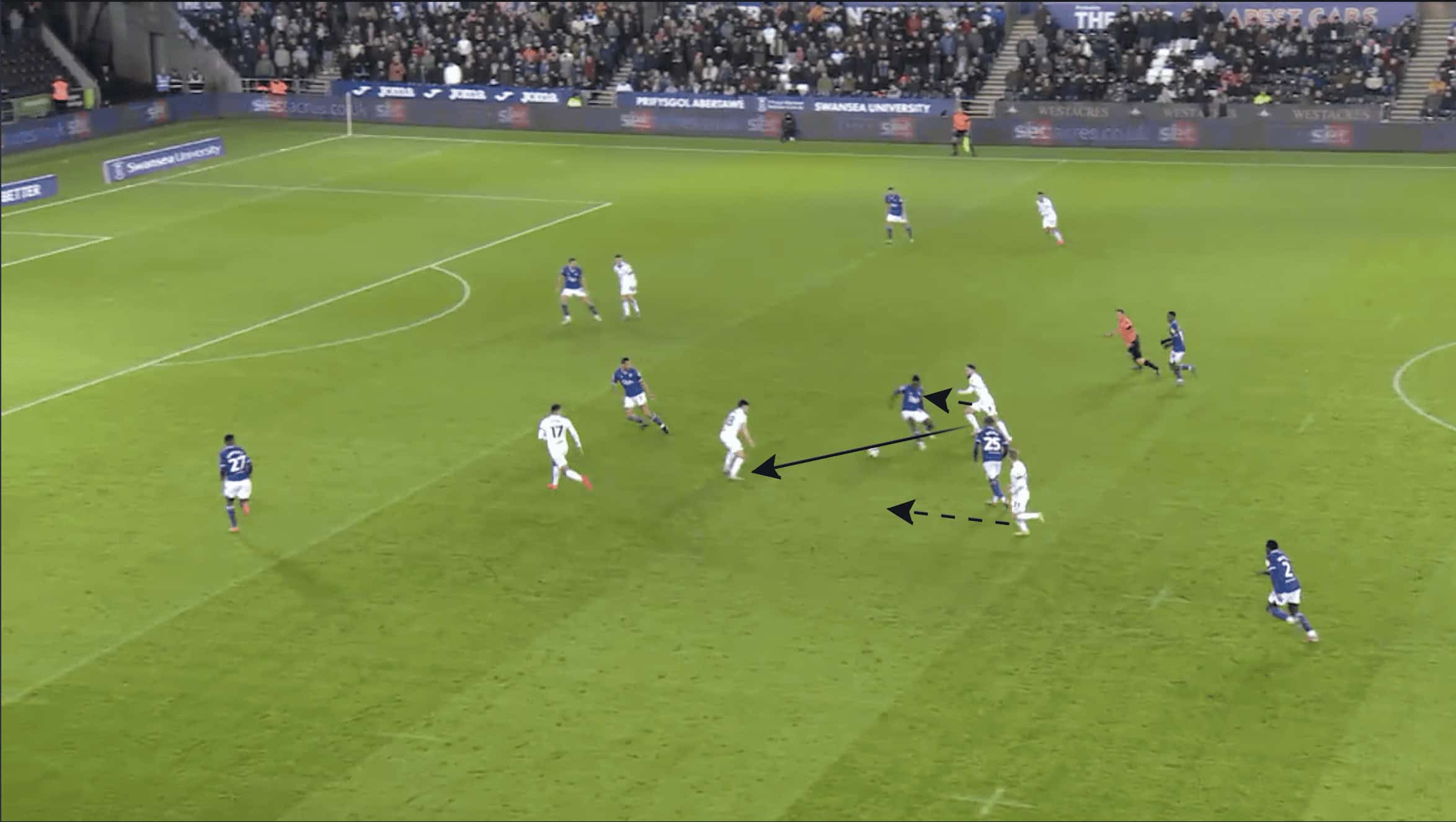
Another example of this can be seen below, with Manning once again on the ball and Grimes and Oliver Cooper, the midfielders, in more advanced positions.
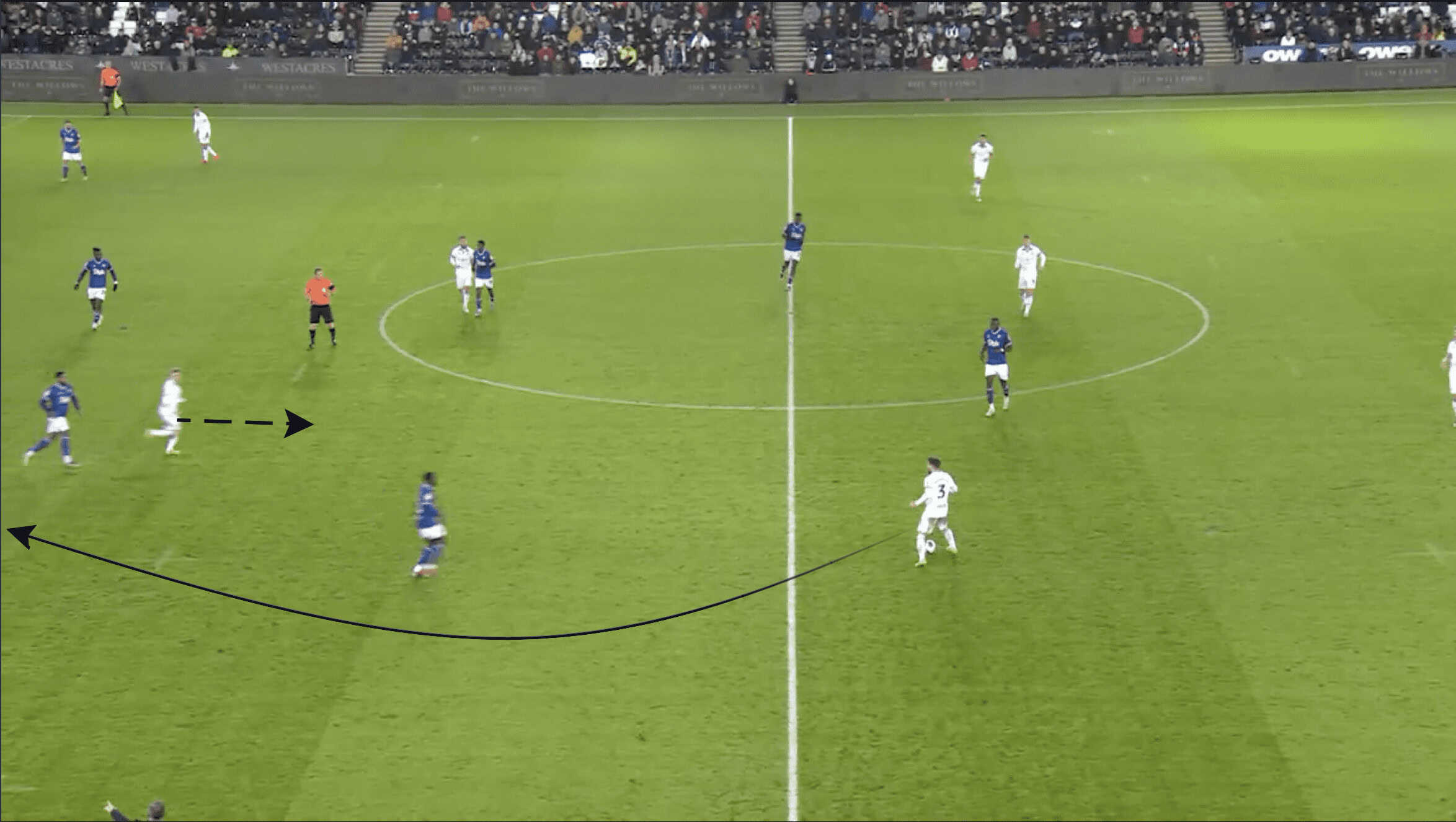
From this position, Manning would play a pass to Luke Cundle which would be intercepted.
However, Grimes was close enough to reclaim the ball. From this position, Grimes would play a pass and then continue to advance forward into space, with Cooper also advancing.
In contrast to the Southampton side, there is no disconnect between the midfielders and the players in more advanced areas.
The midfielders support the attack, play the ball, and move into more advanced areas when the chance arises.
In the final third, Swansea primarily looks to play crosses into the box from the inside channels.
An example of this can be seen below, with Manning in an inverted position playing the ball into the box.
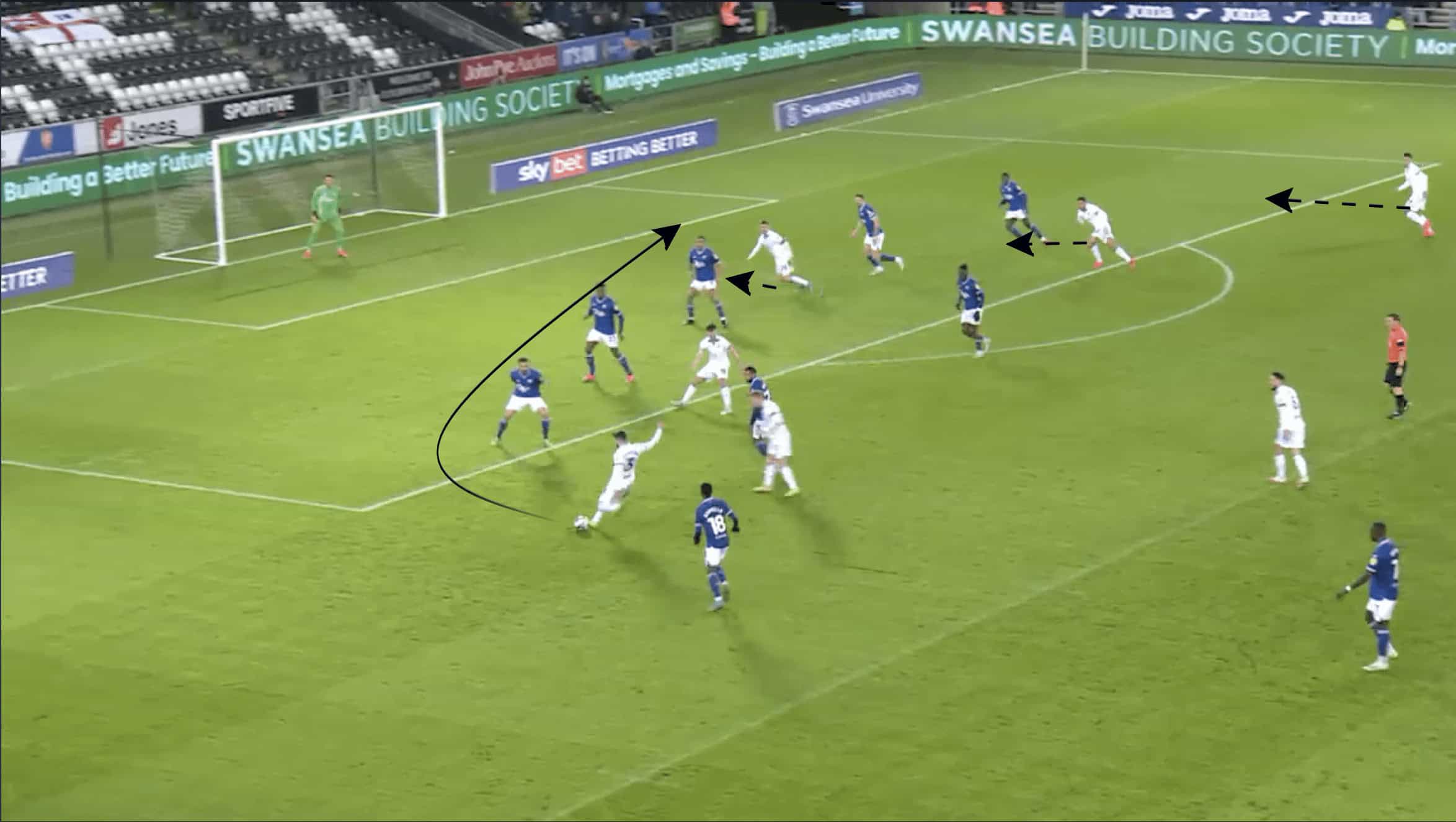
Another example of this can be seen in the image below.
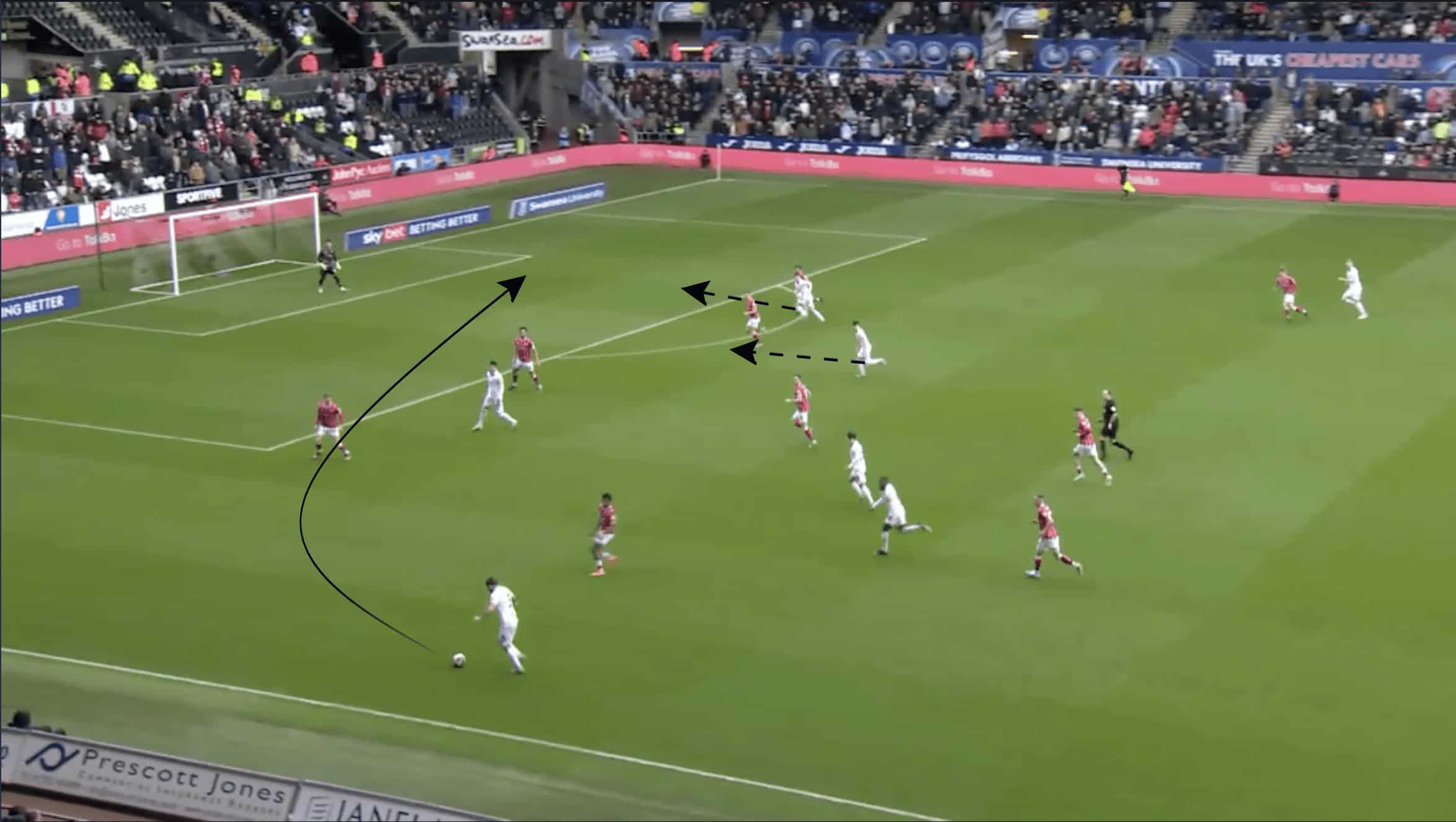
Unfortunately, Swansea, at times, are not able to penetrate the opposition box and create clear goal-scoring chances.
This can be seen by the fact that the side only averaged 25.81 entries into the box over the last season.
Conclusion
Southampton, under the guidance of Russel Martin tactics, will genuinely be an exciting watch.
The side is littered with talented players and has an experienced EFL Championship striker in Adam Armstrong.
However, at this point, it is unclear whether Southampton will be able to keep talented squad members such as Kyle Walker-Peters and Tino Livramento.
Overall, it is likely that through some of Martin’s principles, such as dynamic space occupation, minimum width, staggering, and distancing the side in possession, Southampton will be able to progress the ball up the pitch on a more consistent basis.
However, there are still question marks over whether the side will be able to consistently progress into the final third and penalty area and create chances.
