
RB Leipzig are now starting life after Timo Werner, who made the move to Chelsea this summer after a couple of years of transfer speculation. For a long time, the German was strongly linked with a move away to Bundesliga giants Bayern Munich, and then Liverpool, but the West London club snooped in under the noses of them and many other clubs to acquire their man for around £48m.
Following the departure of their man, Leipzig took little time to begin replacing the forward, signing Hwang Hee-chan from their Red Bull associate, RB Salzburg, for a fee in the region of £12m. The South Korean forward enjoyed a very successful domestic and continental campaign, assisting Salzburg to their seventh successive league title. In this analysis, which will be in a form of a scout report, we will establish what type of player he is, and how he will endeavour to replace some of what Werner produced.
Leipzig’s transfer window did not stop there. Julian Nagelsmann decided to make the addition of Alexander Sørloth into his squad, who scored 33 goals and provided 11 assists across all competitions for Trabzonspor last term, on loan from Crystal Palace, for roughly £20m. This team analysis will dissect how Leipzig will play when the Norwegian figurehead starts up front, and how he will adapt to Nagelsmann’s tactics.
In this tactical analysis, we will see how both compare to current striking option Yussuf Poulsen, and how all three will set out in Nagelsmann’s various systems.
Leipzig’s tactical setup in the attacking phase
Red Bull, as an association, have a playing methodology which is consistent throughout all their clubs across the world (Leipzig, Salzburg, New York, etc.). They attack vertically through quick forward passes, press aggressively out of possession, and interestingly, this season under Naglesmann, Leipzig have displayed more tactical versatility, with the coach switching between three at-the-back and four at-the-back systems, depending on the strength of the opposition. Within these systems, the tactical concepts stay the same, with the main differences coming from how the build-up their attack from the back in the attacking phase, whether they are in a four at-the-back or three-at-the-back system. The main differences are unavoidable, given that the positional slots in the systems are different. The concepts that underpin these systems will, however, remain the same.
One of these concepts is one of rotation in the build-up. The full-backs or wing-backs will position themselves relatively high up the pitch in the beginnings of the build-up phase. This is a simple tactical mechanism to provide width, but also to force the opposition to defend in a wider block to cover this threat. This, in turn, creates space centrally that Leipzig can exploit to progress the ball forwards (see beneath). Leipzig’s central defenders will split wide, either in a chain of two or three, depending on the system selected, then the deepest central midfielder will drop back to provide a passing option to the man in possession. The use of this central midfielder is used to provide a passing option beyond the first line of pressure from the opposition. A diminutive player such as Hwang or Dani Olmo playing upfront would benefit from this tactical approach. With the marauding full-backs high up the pitch dragging the opposing defenders into wide areas, creating gaps for an angled run by one of Hwang or Olmo, exploiting the space in the process.

While at Hoffenheim, Nagelsmann tended to use only one player in the base of the midfield,and he has adjusted to using a double pivot at Leipzig to great effect. In using two players in this pivot position, we see the versatility to allow one player to rotate into advanced positions when in possession, while the other retains a deeper position. In possession, it is rare to see these players operating on the same line as one another, instead, they will tend to be staggered, with the player closest to the ball positioned deeper. This allows the ball to be played into the double pivot, and then played forward to the second player in the pivot, which adds to the verticality in possession. This verticality and directness suits a player like Poulsen or Sørloth down to the ground, who has a preference to back into a defender, receive the ball to feet, and produce quick attacking combinations with his teammates.
In the attacking phase, we regularly see attacking players take up spaces between the lines of the opposition and allowing the vertical pass to be played into dangerous zones. In the final third, in particular, we will see Leipzig overload the central areas before playing quick vertical passes that bypass the opposition defensive block. This is the main reason why Leipzig create so many opportunities on goal in their games this season, they have perfected the art of playing these vertical combinations. As the ball is played centrally into the feet of an attacking player, as soon as the pass is played, the second striker starts moving and the ball is immediately played through the last line to create a goalscoring chance. In moving so many players high up the pitch, Leipzig makes it very difficult for the opposition’s defensive block.
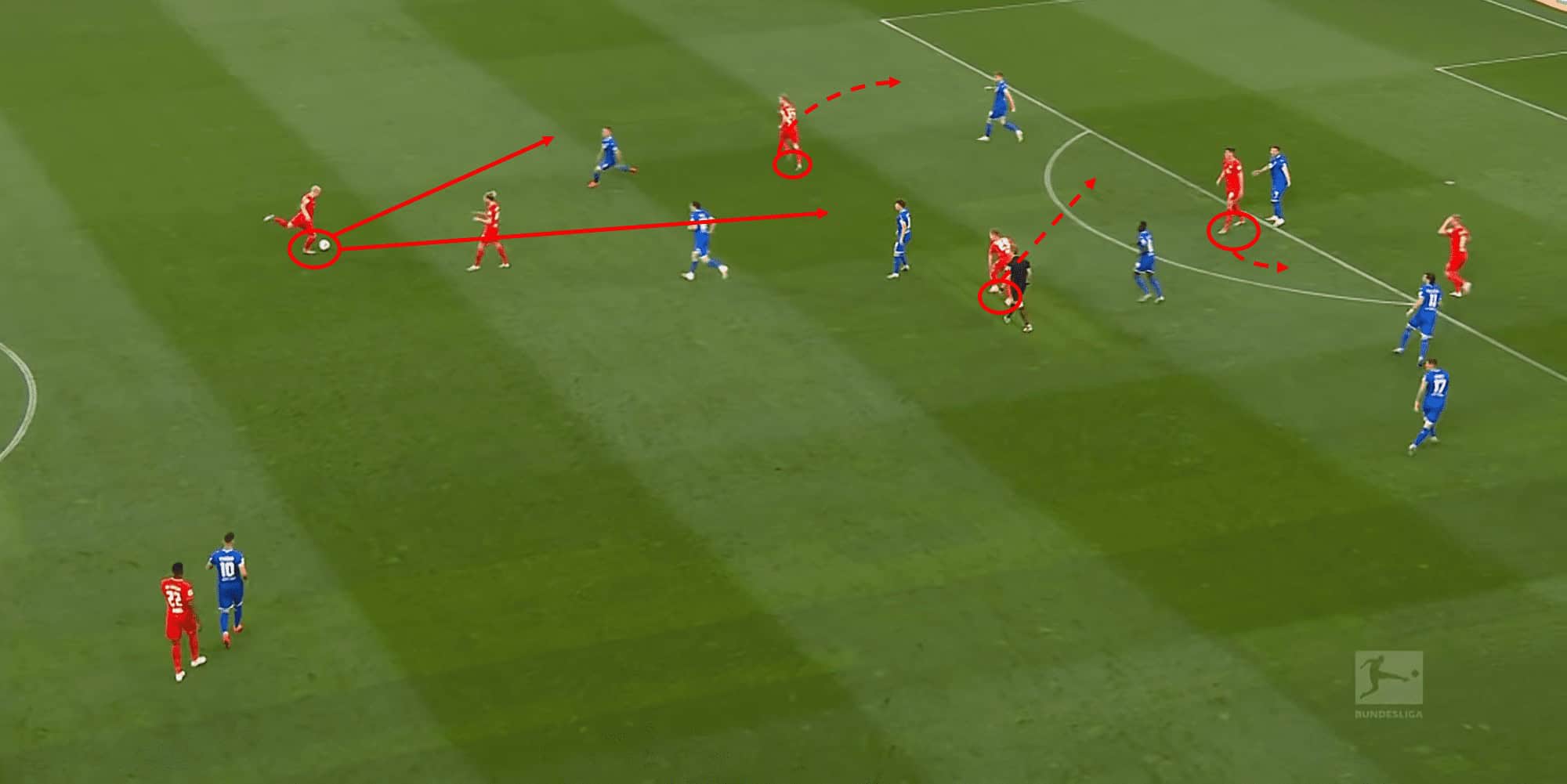
Here, we can see Kevin Kampl on the ball with a variety of options for a vertical pass. He could pass down the half-space, which would release Emil Forsberg to link-up with Dani Olmo who would burst into the central zone of the penalty area. Finally, leaving Patrik Schick to lose his man and find space in the box for the finish.
When a player has no pressure on the ball in the midfield, a pass can be made to a player who is between the lines of the opposition defence and midfield. This receiving player has then created an advanced platform from which Leipzig can threaten the opposition defensive line. These advanced platforms are important as the ball progresses forward since they allow supporting players to move into advanced areas and affect the positioning of the defensive block. This then creates gaps across the width of the field that can be exploited through quick combinations. So often we have seen Poulsen fulfil this role of creating these advanced platforms and acting in a support role for his teammates to exploit the space he has fashioned for them.
Yussuf Poulsen – The direct option
Yussuf Poulsen has been a key component in Leipzig’s meteoric rise up the German divisions ever since he joined the club from Lyngby BK in 2013. The 6’3” Danish forward has scored 65 goals and 53 assists across 255 appearances for the club, a respectable return, especially considering all the work he does off the ball. It is not uncommon to see Poulsen sprint the entire length of the pitch to win the ball back after losing it, several times per game. He embodies dynamism, desire, and a willingness to learn, making for a truly great role model for young players to learn from, such as the promising Dennis Borkowski.

Yussuf Poulsen’s defensive actions radar and heatmap from the 2019/20 Bundesliga season.
This work rate melds incredibly well with Poulsen’s physical attributes. His strength makes it very difficult for defenders to get the ball off of him, making his capability to hold up the ball of a high level, which suits his style of play. His 13 assists in all competitions last season displays the striker’s selflessness and added dynamism in the final third.
His ability to isolate and create space for his teammates is a key feature of his game. By drawing focus away from his teammates and onto himself, the forward backs himself to get out of tight situations due to his superior size and strength to make space. So far this season, this part of his skill set has been used to great effect, helping to unlock defences that play a high line with a good level of success.
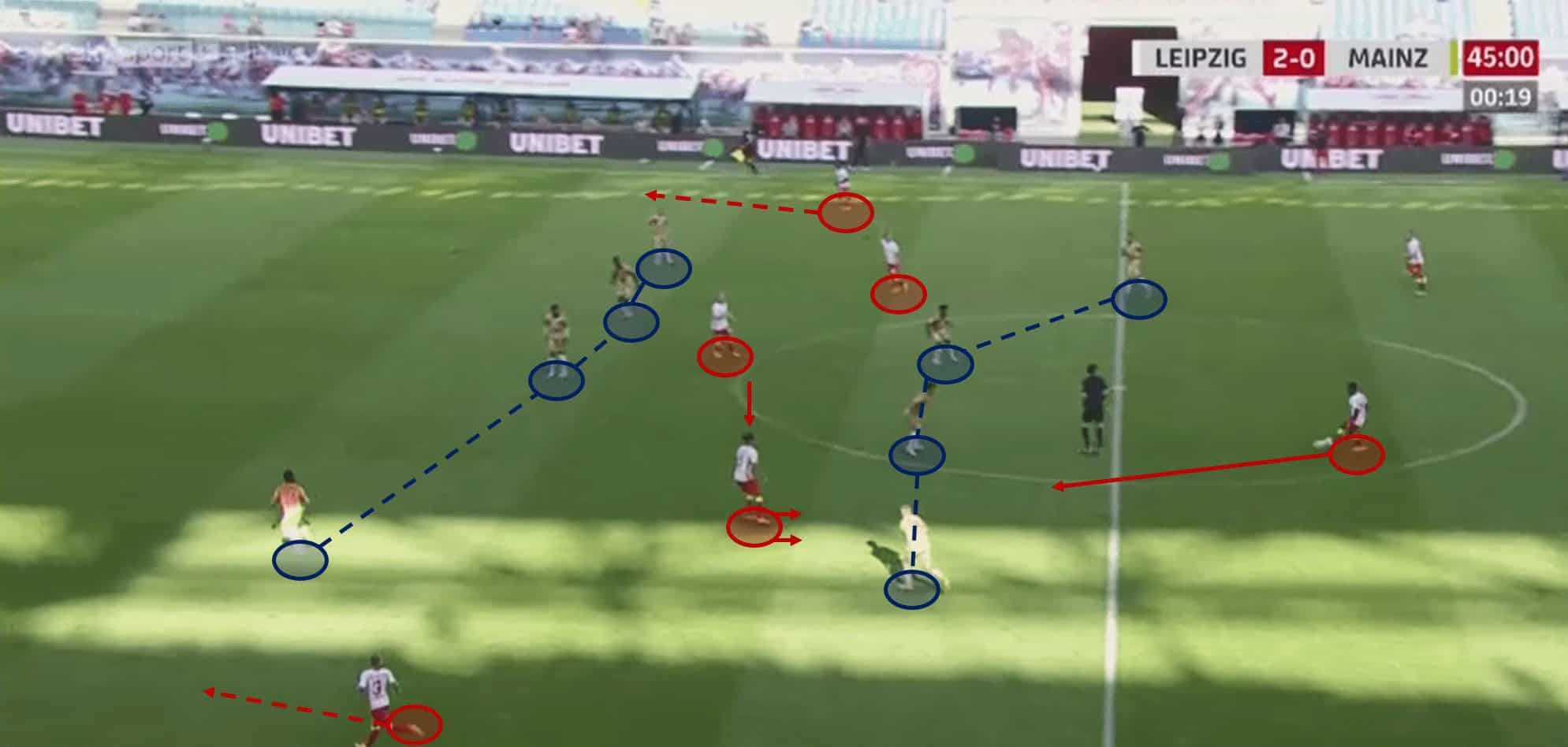
In the above analysis, we see Poulsen positioned between the lines, in line with his midfielders, and behind the marauding wing-backs, ready to receive a through ball.
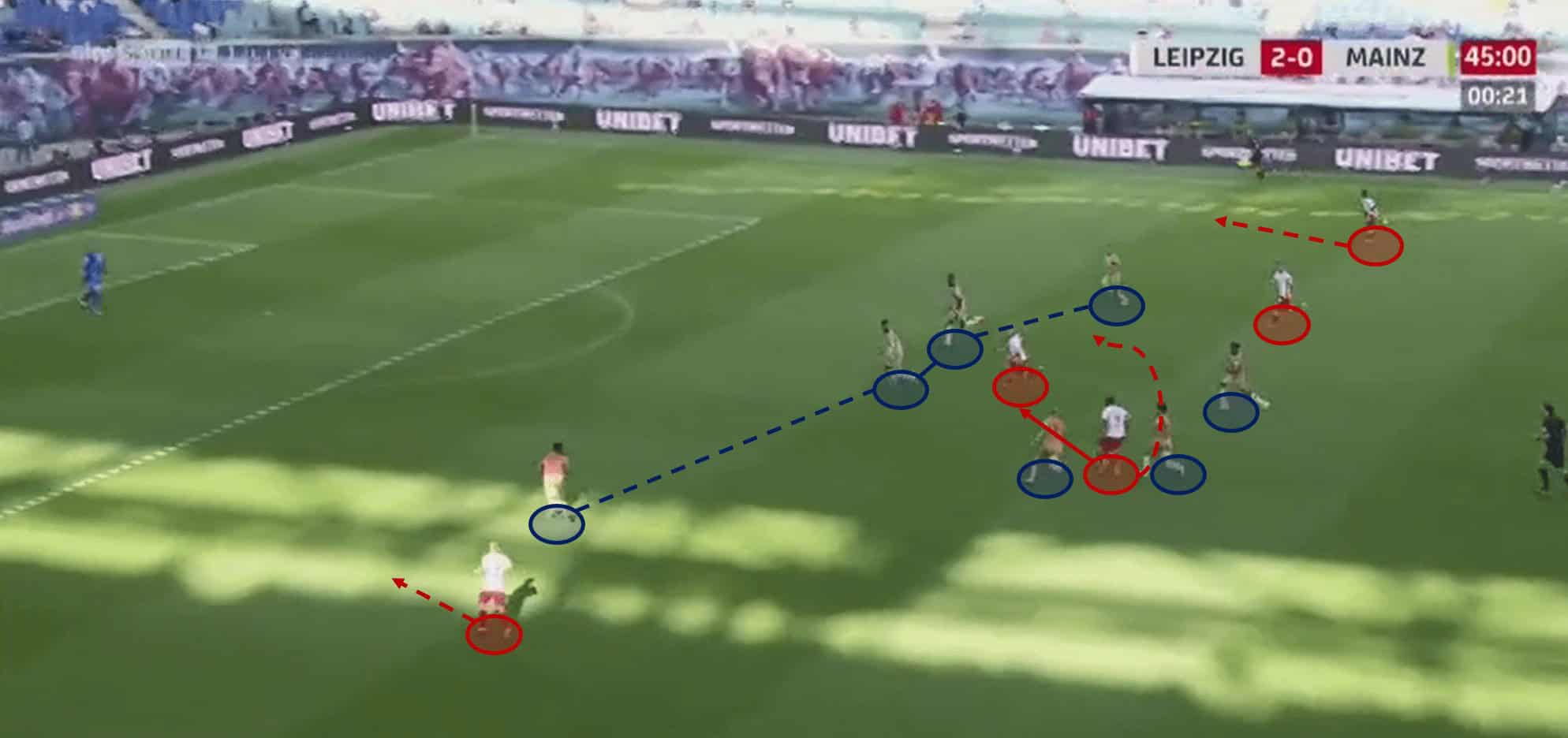
Poulsen carries the ball, passes it on towards Forsberg, and makes the angled run between the left centre-back and left-back. This is ball progression with purpose, as seen by the several attacking options for Leipzig.
He is flexible to the instructions of his coach too. He is entirely capable of being very efficient in the dribble, as seen by his Champions League performances, where he completed 1.56 dribbles per 90 at a 76.9% success rate, but this is lower in the league due to a higher emphasis being placed upon linking the play from midfield to attack.

Yussuf Poulsen’s passing & progression and attacking & shooting radars from the 2019/20 Bundesliga season.
All of this is what Poulsen uniquely brings to the table. Although his goalscoring numbers are not the highest, they are of a high enough level so that he brings an overall positive influence on the team. His footballing journey is genuinely remarkable, not many who watched him in 3. Liga would have imagined the Dane adapting to the summit of German football in such an extraordinary fashion.
The benefit that Poulsen has over both Hwang and Sørloth is that he is a long-standing member in the Leipzig squad. He has taken a season to understand the intricacies of Nagelsmann’s tactics, and he has built significant relationships with many players in the squad, notably Emil Forsberg in the forward line.
Hwang Hee-chan – The half-space hero
On 15th July, Hwang Hee-chan became the 11th player to join RB Leipzig from RB Salzburg since 2015. Now, the expectation is not for Hwang to replace Werner, as that would be an enormous task. The two forwards play in two slightly different roles, with Werner operating between the lines and in wide areas, whereas the South Korean loves to operate in the half-spaces in line with opposition defenders. Likewise, if Hwang were to be used in the same team as Poulsen, Hwang would likely play a more advanced role than the Dane, combining through quick attacking combinations.

Hwang Hee-chan’s attacking & shooting radar and heatmap from the 2019/20 Austrian Bundesliga season.
The 24-year-old is an intelligent footballer who likes to operate in the half-space. Last season at Salzburg, he was mainly used on the left side of a front two. He would position himself in between the right centre-back and right-back and would time his run looking for a through ball from his teammates. He is excellent at a diagonal run where he orientates his body to generate the speed and timing to gain an advantage over the opposing defender. A typical scenario can be foreseen where Poulsen has dropped deeper to win the ball, lay it off to a midfielder, all while Hwang is making one of smart runs in behind, for one of Leipzig’s more progressive midfielders to reach him with a through ball.
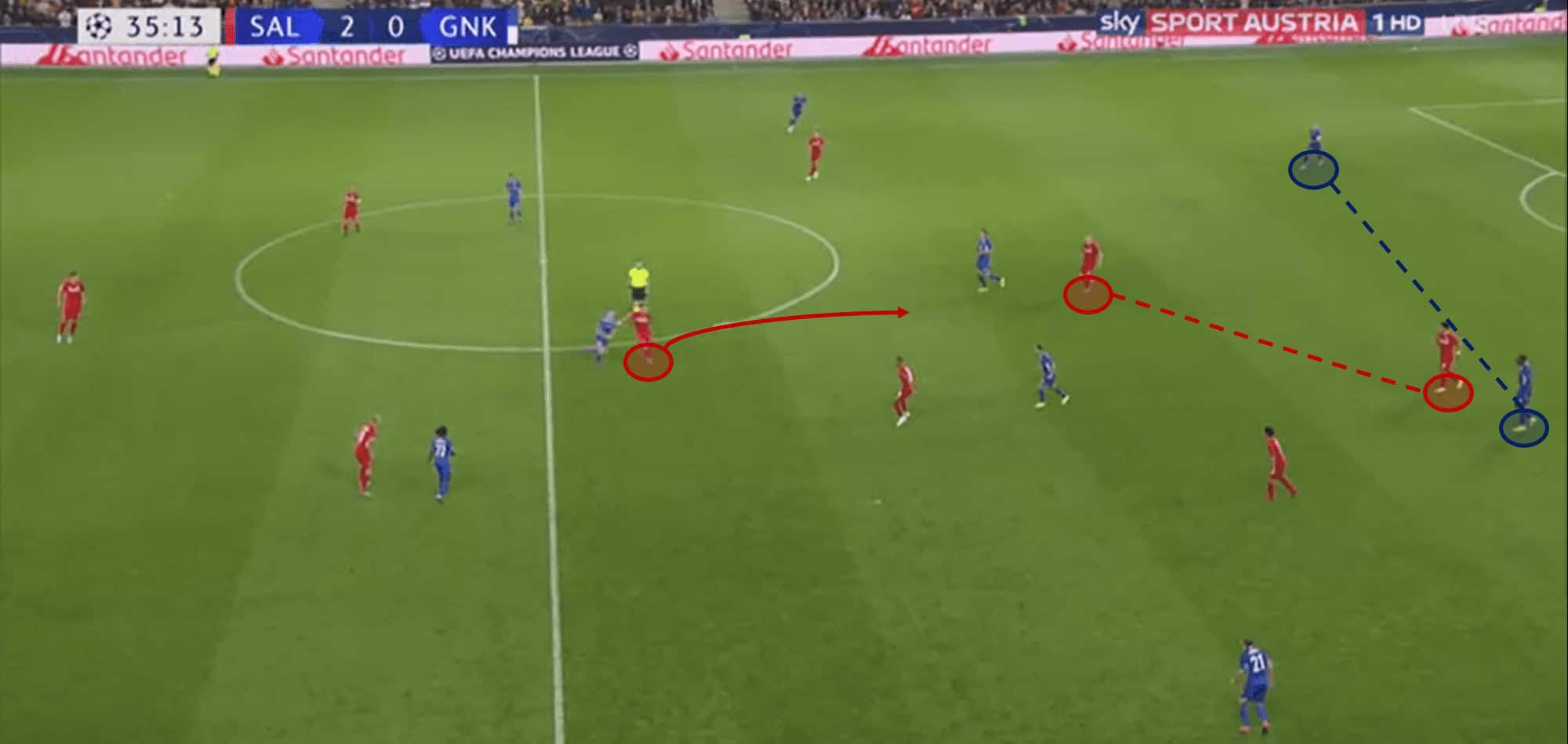
Above, we see Hwang positioned higher than his striking partner, Erling Braut Håland, ready to receive the ball and angle his run in behind.
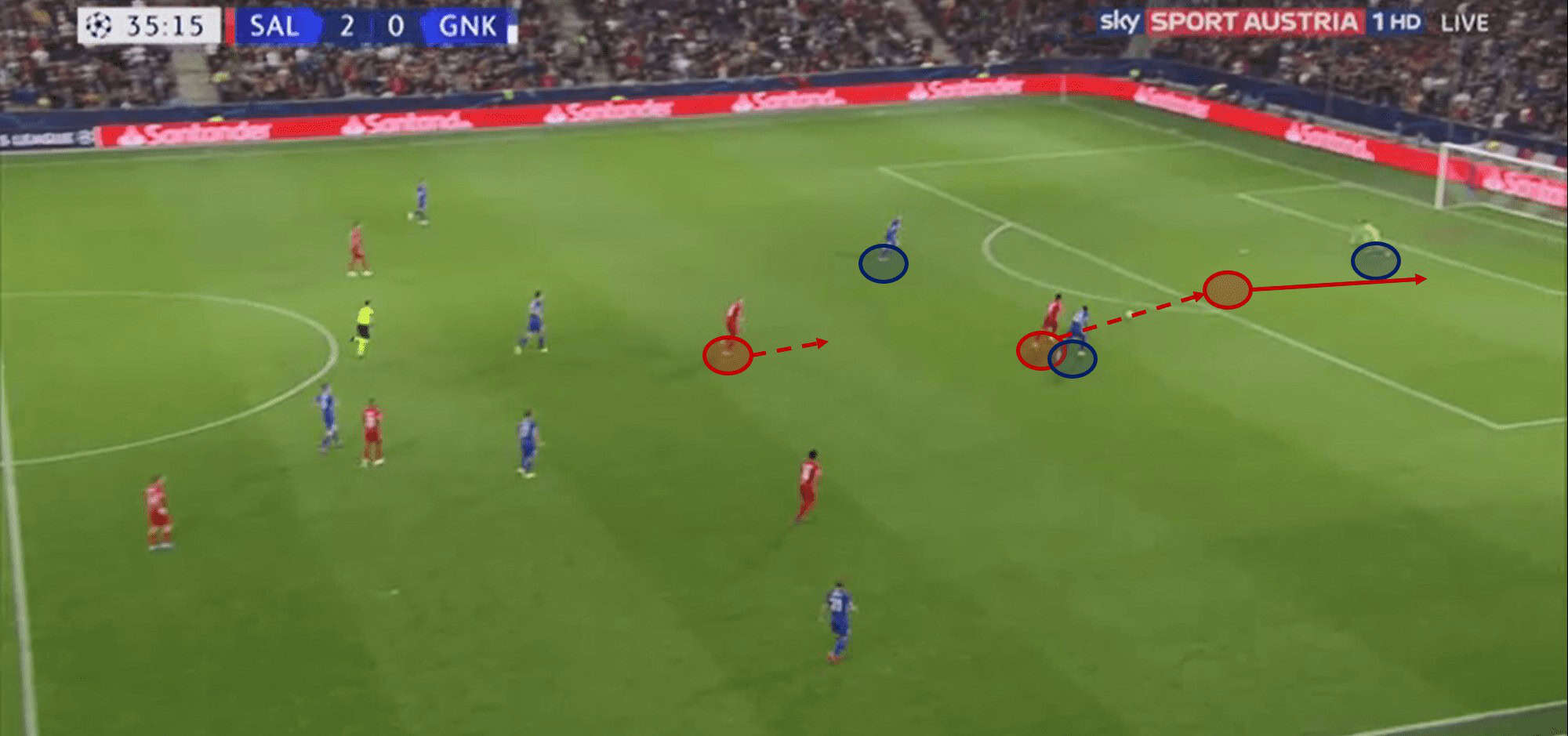
Hwang takes the ball, spins with it, and utilises his pace to burn past the Genk defender. He waits for the goalkeeper to come off his line, before finishing around his body.
Repeatedly, you will see players try to run in behind with a complete frontal body orientation or sideways orientation get caught offside more often than not. Hwang understands that the positioning of his body is important in these moments and has generated him numerous opportunities in front of goal. We have seen this translate well to a higher level of competitions as well, contributing 3 goals and 3 assists in 6 UCL appearances last term, displaying a high level of match intelligence in the process.

Hwang Hee-chan’s defensive actions and passing & progression radars from the 2019/20 Austrian Bundesliga season.
Inside the penalty area, Hwang makes all the movements to give himself as much of an advantage in front of goal as possible. His feints and blindside runs amalgamate with the movements of the opposition defenders to create space for himself. Hwang will sit in place inside the 18-yard-box while the attention of the defenders is on the ball carrier, which in turn gives him space to receive the ball, turn, and finish inside the box. He can manipulate defenders without using much movement at all, and this is something which will translate well into high octane league, where defenders are so eager to press the ball carrier primarily.
Hwang Hee-chan attempts an enormous number of dribbles. He likes to position himself in line with the opposition defenders, manipulate his body to deceive them, dribble past and score. As a striker who typically operates on the same line as the opposition defenders, he attempts a proportionately high 6.12 dribbles per 90 and wins 46.9% of them. His numbers are similar to Werner, who operates in a deeper position and has more players to take on. His special move is utilising a fake shot to deceive the last defender who is trying to make a last-ditch tackle on the South Korean. Once he fakes the defender, he gets himself into a better goalscoring position, adding to his high xG.
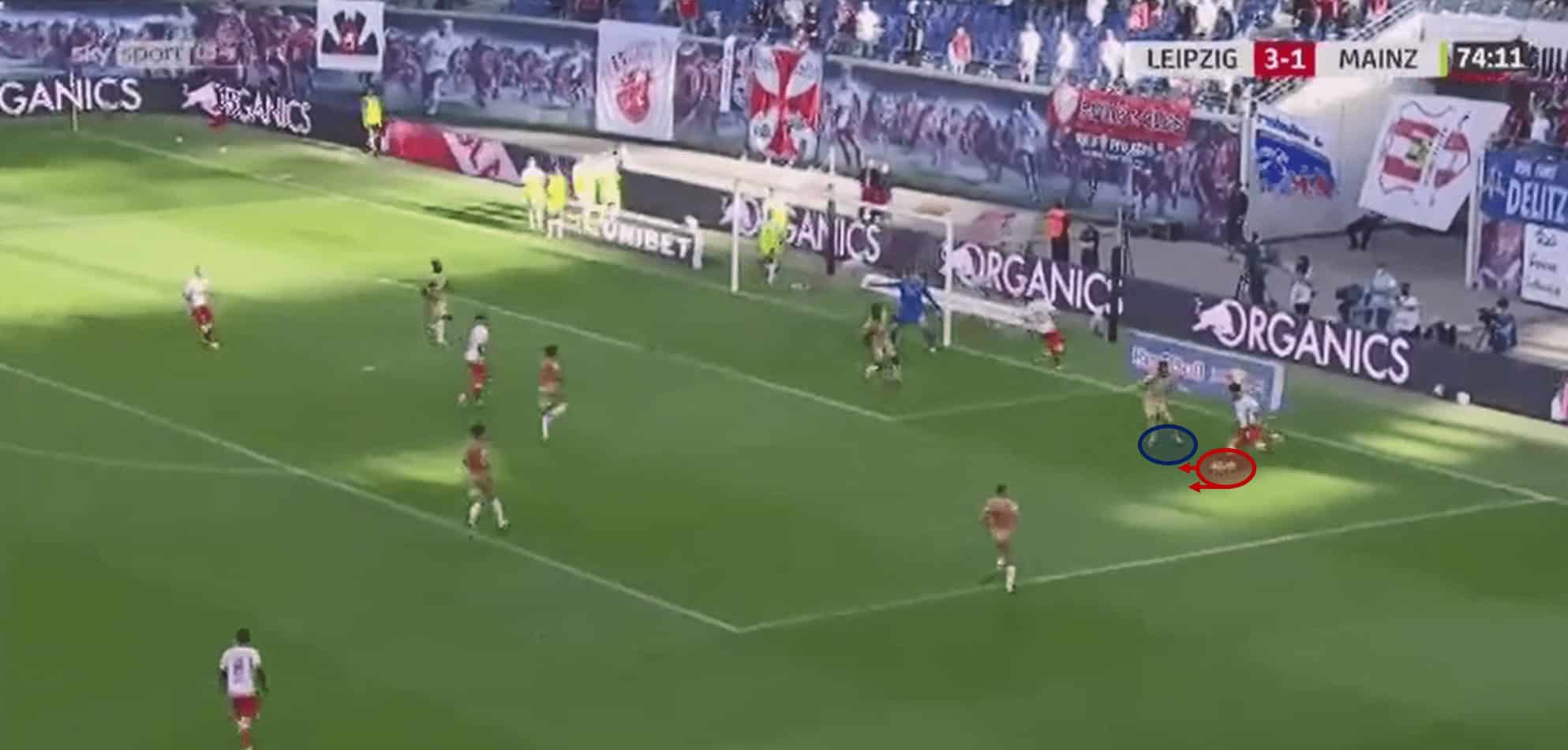
In the above analysis, we see Hwang begin to produce a fake shot, aiming towards the direction of a teammate in the penalty area.
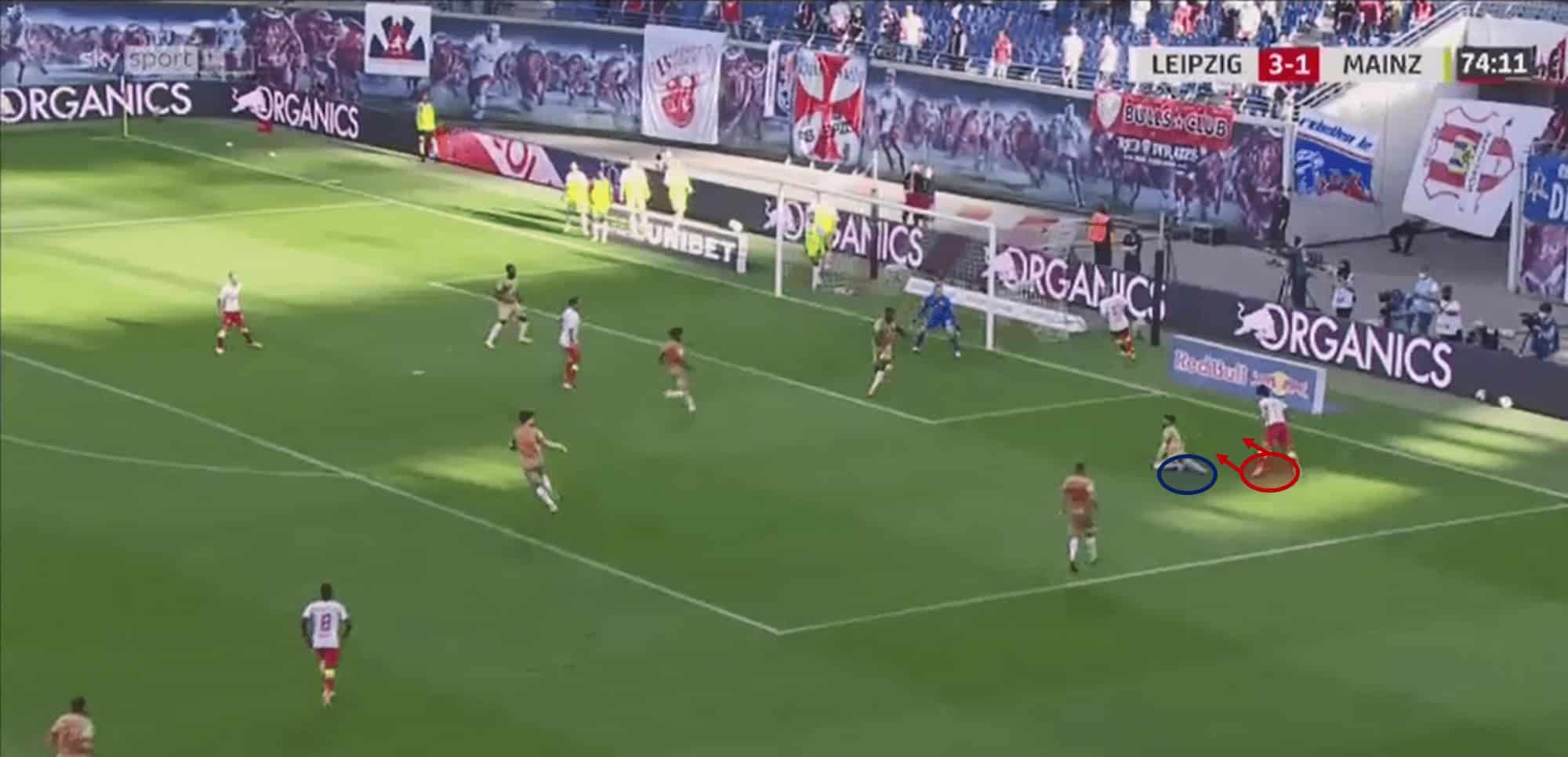
Of course, Hwang feints his body to the right, and fake shots his way past the defender, and closer to the six-yard-box.
Alexander Sørloth – The Norwegian Powerhouse
Alexander Sørloth, at 24 years old, has had a career full of ups and downs. He has struggled to make an impact in the Premier League and Eredivisie, but has legitimately excelled in Denmark, and most recently, Turkey. Interestingly, his very early signs at Crystal Palace were promising. He displayed all the hold-up play and physical prowess to become a decent target-man type striker in England, but the goals never came, and as such was never really given the chance to prove himself again.

Alexander Sørloth’s attacking & shooting radar and heatmap from the 2019/20 Süper Lig season.
A loan to KAA Gent in 2018/19 was marginally more of a success, but generally, he failed to set the Belgian league alight. Joining Turkish side Trabzonspor on loan was the move he needed to unlock the best of his varied skill set. As an expansive attacking side, Trabzonspor scored the most goals in the Süper Lig with 76 across the campaign, allowing Sørloth the freedom in the final third to do his best work. The 6’4” forward thrives off of physical duels, whether be aerially or on the ground, he manipulates his large frame in such a way that gives him a serious advantage against opposition defenders. He is not afraid to contest physically with any defender in the world, and this will aid him in succeeding in the Bundesliga.
Now, how did Sørloth go from goal-shy to a goal machine, and what will he add to Leipzig’s attack? Another question people have been debating is whether the quality of the Turkish league is lending itself to make the Norwegian look much greater than he is, and that is yet to be seen. He outperformed his xG by roughly five goals, indicative of the hot goalscoring form he was in last term. He does not rely on high volume to convert his chances. 2.1 of his 2.9 shots per 90 were from inside the penalty area. He likes to take a touch or two to compose himself, before finishing his chance into the bottom corner, rather than aiming for the roof of the net.
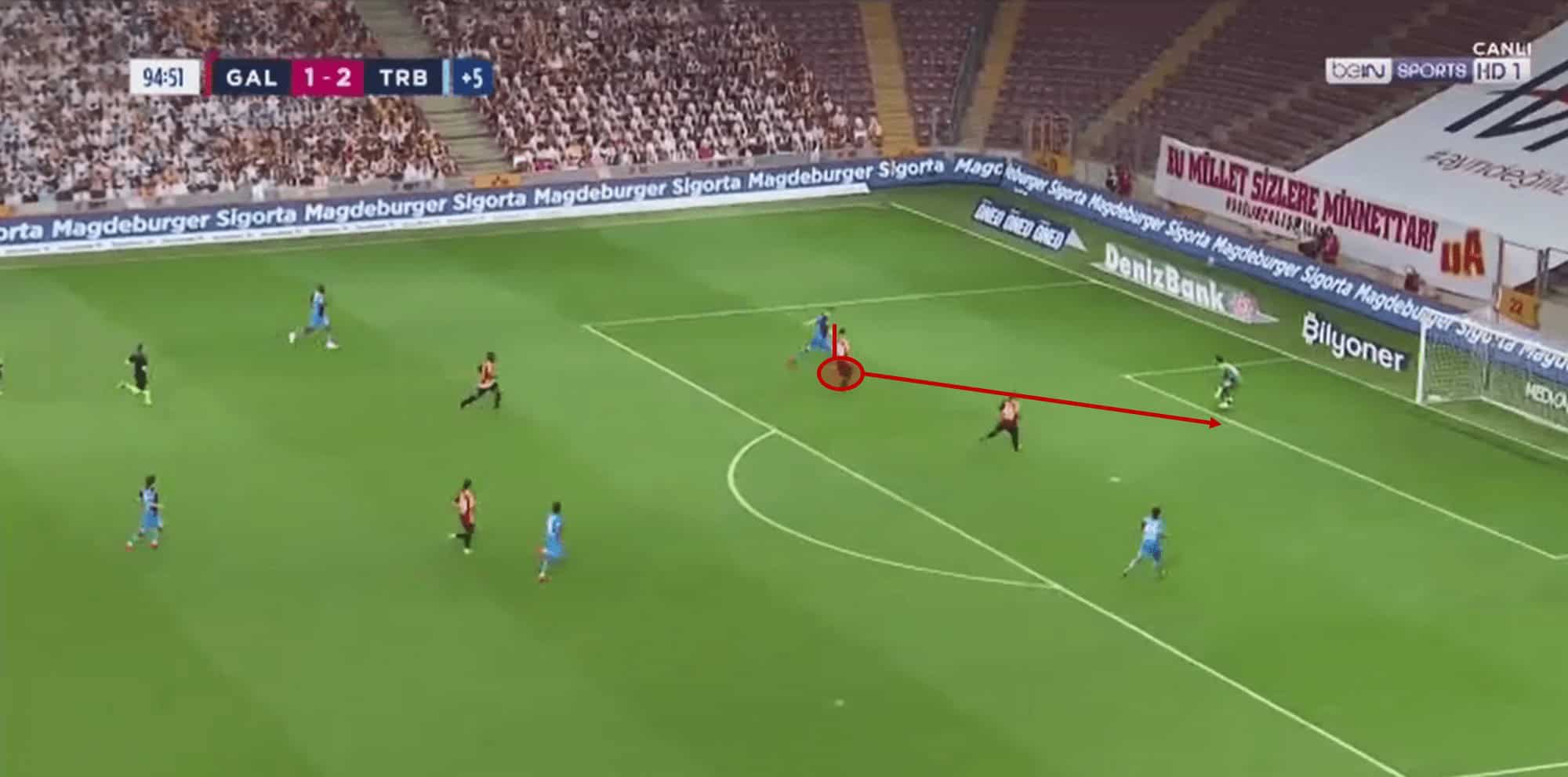
In this scenario, after carrying the ball across the entirety of the opponent’s half, he waits to get into a high-value shooting position before taking the shot. In this case, in the left half-space, on his favoured left foot.
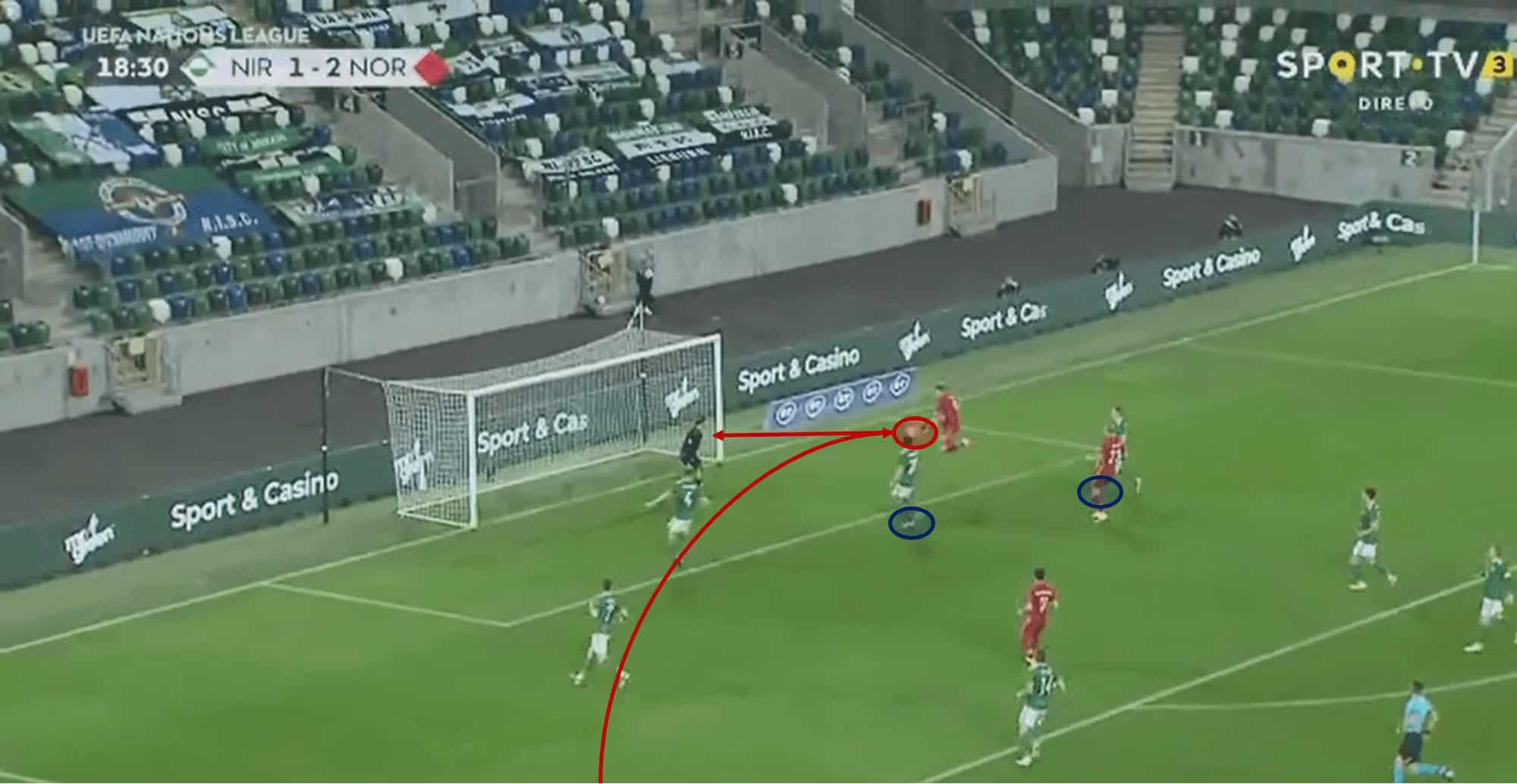
Sørloth also has the athleticism to get beyond defenders with a blindsided run in towards the back post, as shown above.
Adding to this, Sørloth is a genuine juggernaut in the air, winning 42.72% of his 5.92 aerial duels per 90, comparing admirably to Poulsen’s 3.44 successful aerial duels at a 44% win rate. The 24-year-old scored 25% of goals last season with his head, displaying his aerial prowess and adding another layer of value to an already diverse repertoire. He occasionally mistimes his jumps, but he possesses an extraordinary leap which, in combination with his tall frame, allows him to contest aerially to a high degree of success. Like Poulsen, Sørloth will be able to play off of Hwang fairly well, but the Norwegian would like to play in a more advanced role and therefore occupy the same spaces as Hwang, which could work against Nagelsmann’s style of play.
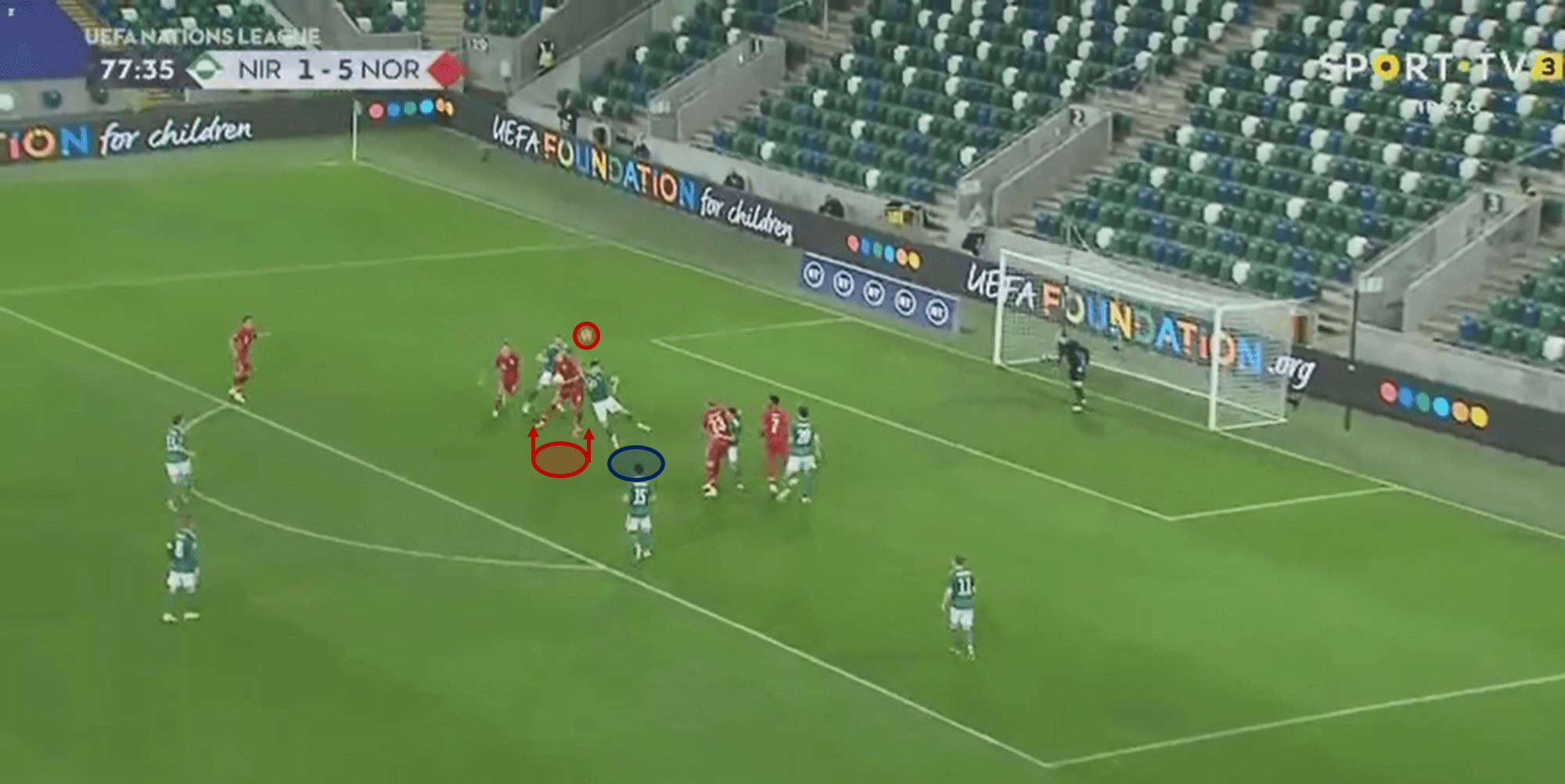
Above, we see Sørloth display his remarkable leap and timing of said leap to reach the ball before the Northern Ireland defender.

Alexander Sørloth’s defensive actions and passing & progression radars from the 2019/20 Süper Lig season.
For such a tall individual, Sørloth has good technique in tight situations and quick feet to take the ball past his man. He shifts his body mass from left to right (or vice-versa) to fool an opposing defender to think he is going one way until he quickly goes the other. He likes to make use of drag-backs in these scenarios as well, often leveraging his physicality to keep a defender away from the ball and creating a separation between the two. His 52.29% success rate is low for a forward, but considering he is being compared to small and nimble wingers in different locations of the pitch, Sørloth remains strong in this regard and is a revelation to watch. These dribbling moments typically get Sørloth into a strong passing situation, which will suit Leipzig’s style of play in the final third, who prefer to employ quick passing combinations in the final third.
Expected Outcome
These three players bring an interesting tactical conundrum to the table for Nagelsmann to solve. While, on paper, Sørloth is the most complete forward of the three, he likely won’t work as well in a two-up-top system, due to his similar positioning of Hwang and providing a lot of the same actions that Poulsen would on the pitch. This does, however, allow for tactical versatility.
So far this Bundesliga season, Leipzig have played a 3-4-2-1 twice, and a 4-2-3-1 once. Poulsen or Sørloth could line-up as the central striker, with Hwang coming off of either flank providing those clever runs in behind, playing off of the two physically dominant strikers. In these systems, the underpinning tactical concepts remain the same, but in a three-at-the-back system, the focus of the play is centred around the marauding wing-backs, which will be of a huge benefit to the likes of Poulsen or Sørloth.
In Nagelsmann’s 4-2-2-2, Sørloth is the most likely of the three to miss out on a starting berth, unless he adjusts to being the forward to link the play from midfield to attack, just like Poulsen. Though, this would be at the detriment of his goal output, which he is unlikely to relinquish. Hwang, at RB Salzburg, has an understanding (to a certain extent), of how Red Bull as an association like to play, and should adjust fairly well to the intensity of the league, switching over from Austria.
