
It may seem like odd timing to write a piece on Liverpool now given that in their last match they capitulated so spectacularly in losing 7-2 to Aston Villa. That result felt especially jarring given that just the week before Liverpool had looked close to their imperious best in beating Arsenal 3-1 with consummate ease. These ideas, when taken in isolation, present something of a snapshot of the Premier League season so far with the likes of Manchester City, Manchester United and now Liverpool all having been defeated by large scorelines in individual matchdays. Whether this is due to the compressed schedule and the late start to the season or whether this is part of what can be considered the ‘new normal’ remains to be seen.
There was one particular aspect of the Liverpool game model that immediately stood out to me from a tactical perspective when I was watching it. So much so, in fact, that I felt that it deserved much deeper explanation after the match.
The purpose of this tactical theory piece is to provide an insight into the different movements and mechanisms that Liverpool used in order to progress the ball from the back in this match.
The principles around playing from the back
The concept of playing out from the back is something that some coaches use almost exclusively, even in the face of criticism from fans and pundits when the ball is given away in dangerous situations. The likes of Pep Guardiola, Marcelo Bielsa and Mikel Arteta all subscribe to this form of build-up as part of their adherence to the overall tactical umbrella that is positional play. When Jurgen Klopp first came to England and took charge of Liverpool all of the talk in the media was that he would implement his high-tempo gegenpressing style in whole. Initially, there was some truth to this idea but gradually Klopp adapted his game model in order to create more opportunities for Liverpool to control the game and by extension their opponents. This change in the Liverpool system of play led to their dominant domestic performance in the 2019/20 season when they ended their long wait for a league title.
What though do we mean specifically when talking about playing out from the back?
The concept in itself is relatively simple
The team in possession of the ball looks to play through the thirds in a safe manner by maintaining control. The key is in ensuring the clean progression of the ball through the first line of pressure. This allows the ball to me moved into advanced areas with control.
Beyond that, there are some principles that coaches look to apply in order to achieve the concept above
- Create numerical and positional superiority in order to play through the first line of pressure
- Use positional rotations to create vertical passing options
- Move the ball to the free man in order to create angles to play through the press.
Above is the context behind this article. What was especially interesting to me about this specific game was the sheer number of ways that Klopp used the midfield and defensive line to apply these principles. I have deliberately used examples just from the first half in order to display how flexible Liverpool were in their approach to playing out from the back.
Example one

The first example that we will use is perhaps the most common as it was a regular feature of Pep Guardiola’s all-conquering Barcelona side. The idea is simple, that in 4-3-3 or even a 4-2-3-1 structure you use your controlling midfielder or pivot to drop into a deep position in order to effectively split the central defenders and create a line of three on the first line of the build-up. As with many other principles and concepts within football, however, this was developed elsewhere and then adopted by Guardiola.
This specific rotational movement has a name “La Salida Lavolpiana” and was developed in the first instance by the Argentinean coach Ricardo La Volpe. The idea behind the concept is a simple one in that the team in possession drops the midfielder back to the defensive line in order to create numerical advantages on the first line. This is especially helpful given the way that teams are now using more complex pressing structures in order to prevent teams from having a clean ball progression. If a team, for example, plays with a single-player applying initial pressure to the ball then two central defenders, and the goalkeeper, are likely to be capable of outplaying the press and progressing the ball. Against a team that are pressing with two players the midfielder dropping back will provide a 4v2 advantage, with the goalkeeper, to out play.
We see this in action in the example above as Fabinho drops back into the defensive line. In this match we saw Arsenal look to press, for the most part, in a very specific way with Alexandre Lacazette as the ‘9’ and Pierre-Emerik Aubameyang and Willian in the wide areas. Lacazette would press the ball initially with the two wide forwards pressing onto the Liverpool central defenders at an angle to cut off the passing angles to the left-back.
Most of the examples that we will discuss are specifically intended to counter that pressing system.
With Fabinho dropping deep we see Naby Keita as the right-sided ‘8’ for Liverpool. Keita moves back into the ‘6’ slot and immediately there are passing options for the ball to progress to the ‘6’ space or out to the right-back position where Trent Alexander-Arnold is maintaining width.
Example two
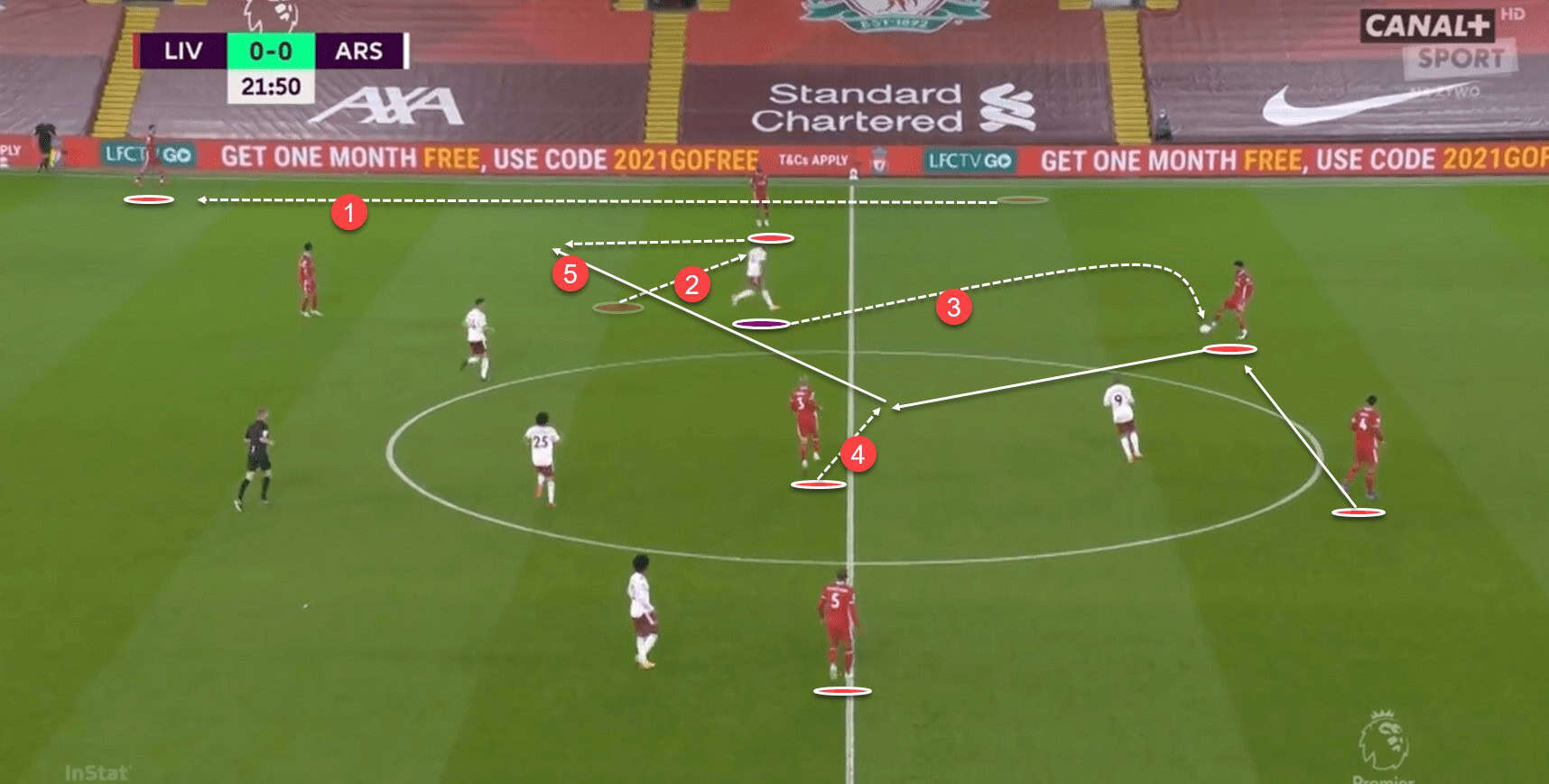
There is a lot going in in this example so I have broken it down into a series of steps. The desired result, however, is again to outplay the press and find a route through the initial press from Arsenal.
- Trent Alexander-Arnold makes an advanced movement on the right-hand side to provide width.
- Naby Keita checks from his initial position as the right-sided ‘8’ and adopts a wider position in the space that was vacated by Alexander-Arnold
- The pass across the defensive line has triggered the pressing movement and Aubameyang curves his run in order to cut off the pass out to Keita
- Fabinho checks towards the ball and splits the space of the two pressing players (Lacazette and Aubameyang) the pass is then played to Fabinho in this space
- Keita moves higher, now free of the cover of Aubameyang and Fabinho plays this pass.
Through this simple set of rotations and three short passes Liverpool have outplayed the Arsenal press and moved into a position in which they can threaten the final third.
Example three
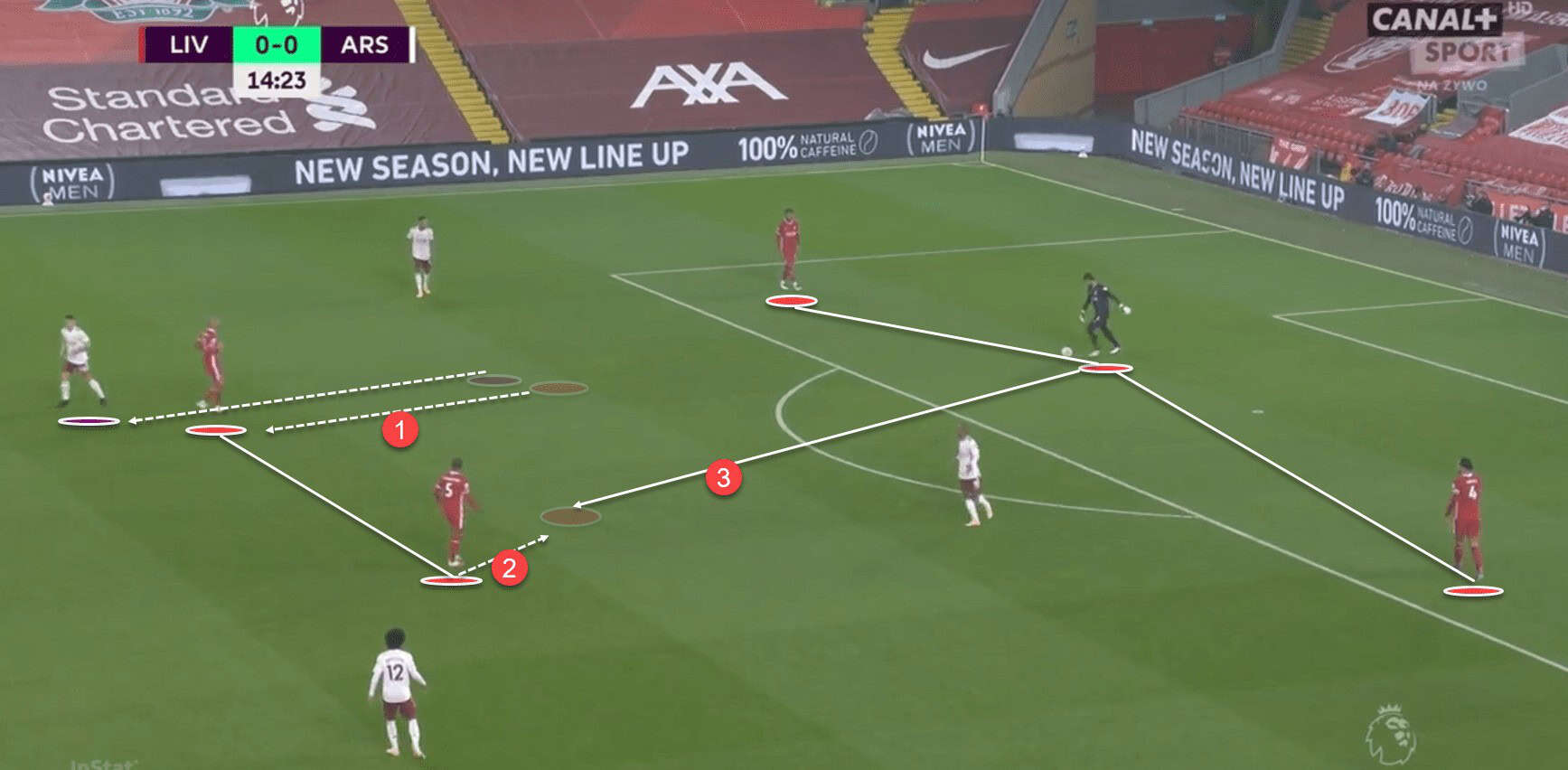
This time we see an example of Liverpool using Alisson as a pivot in between the central defenders to create opportunities for the ball to be progressed cleanly through the thirds. Initially, in this sequence Fabinho was positioned between the two Arsenal players (Lacazette and Aubameyang again) in order to create space, however, the Brazilian rotates out of his positional slot and creates an opportunity for Liverpool to play through the initial line of opposition pressure.
- Fabinho quickly back peddles towards the halfway line and draws a defensive player with him
- Wijnaldum, playing as a second pivot player in the midfield, then moves towards the ball and accesses the space created by Fabinho’s rotation
- Alisson plays the line breaking pass into the movement of Wijnaldum and Liverpool have progressed the ball cleanly
Example 4

What was especially interesting about the way that Liverpool found ways to play through the press from Arsenal was that they used all three midfield players, in different situations, to drop back and provide numerical superiority.
Look at the way that Lacazette and Aubameyang are positioned in this example. Aubameyang is the most advanced player but he is also narrow. In this position, he can press from outside to in on Joe Gomez in order to prevent the wide pass. To counter this issue Naby Keita drops 10-15 yards into the highlighted space. This movement into a deeper position allows Joe Gomez to outplay the press. Now, as Aubameyang presses Keita has dropped into a deeper slot and can receive the ball in space. He then immediately plays out to Alexander-Arnold in the right-back slot.
Once again the rotation is key in allowing Liverpool to safely and securely move the ball into advanced areas.
Example five
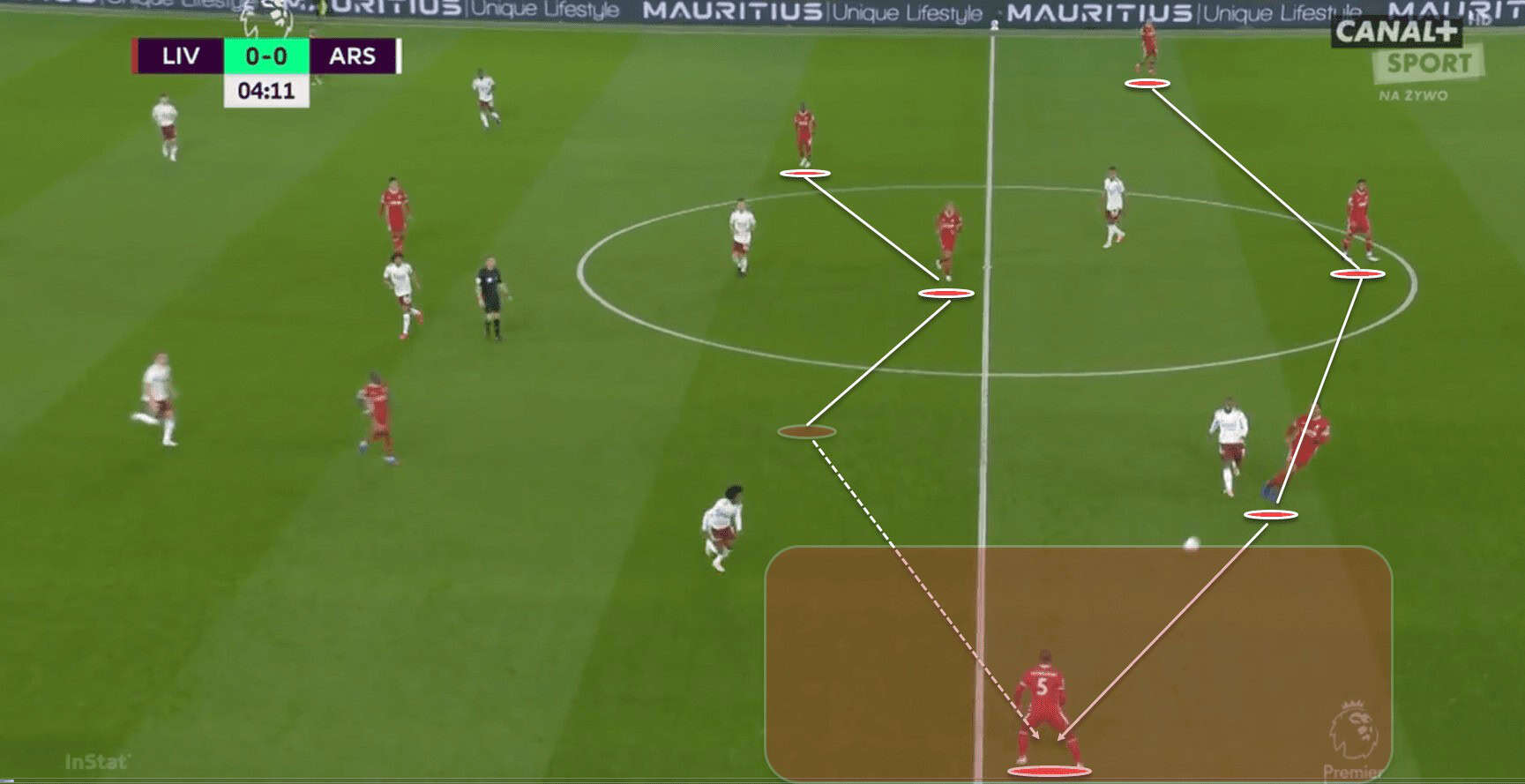
There was a clear tendency from Liverpool for Andy Robertson, at left-back, to move into very high positions when Liverpool were building out from the back. This meant that Wijnaldum, playing as the left-sided ‘8’ could drop out to wider positions in order to allow the ball to progress cleanly.
In the above example we see that while, on the right, Trent Alexander-Arnold has maintained his link with the central defenders Robertson has moved so high that he is out of shot. This movement by Wijnaldum allows Liverpool to play out of the immediate press. As he receives the ball Willian tries to move across to cover the ball but Wijnaldum is able to take a positive touch and then play out of pressure with a pass down the line for Robertson.
Example six

In this final example, we see a combination of the rotations that we have already discussed above.
- Wijandlum drops back to form a back three with Van Dijk and Gomez
- With Van Dijk in possession, Aubameyang triggers to press the ball as the pass is made to Gomez
- Fabinho checks towards the ball to give a central reference point to escape the pressure. This pass is then made
- Fabinho immediately plays a pass over to Alexander-Arnold who is providing width on the right-hand side
Once again the key is in finding solutions to outplay the opponent and ensure that you are in a strong position as you look to move towards accessing the final third.
Conclusion
This match gave us an excellent case study into the ways that Klopp tries to access space and create opportunities to play out of pressure. The key is that there is no scripted way in which the players are told that they have to move or rotate. Instead, they have been coached to understand the principles behind the concept and all players know that they will have to move and behave dynamically in order to create these situations that allow them to outplay the press.
