
After their brilliant run to the Euro 2016 quarter-finals, and that victory over England, few people expected Iceland to top those achievements. But lo and behold, this tiny nation of roughly 334,000 have defied expectations yet again, managing to qualify automatically for the FIFA World Cup 2018, becoming the smallest nation to ever do so. Iceland topped a tricky group, finishing ahead of Croatia, Ukraine and Turkey, and even managed to score the most goals of any team in their group (17).
The island nation have been drawn in arguably the toughest group at Russia 2018, featuring Argentina, Nigeria and Croatia. Teams will no longer be underestimating Iceland though, and they could cause a surprise or two at the World Cup.
The Squad
Coach: Heimir Hallgrimsson
The Iceland manager is no longer an unknown identity, having become especially famous for being a practising dentist as well as football coach. Hallgrimsson took over sole charge of the Iceland team after Euro 2016, having been joint manager alongside Swede Lars Lagerback prior to that. He has brought continuity and stability to the squad, while also marginally tweaking their style of play. Iceland’s strengths remain though; defensive solidity, lots of effort, and a direct, efficient style of play. Iceland remain fiendishly difficult to beat under Hallgrimsson, and not one of their Group D companions will look forward to playing them.
Goalkeepers
Hannes ‘Thor’ Halldorsson (Randers FC), Frederik Schram (FC Roskilde), Runar Alex Runarsson (FC Nordsjaelland)
Defenders
Birkir Mar Saevarsson (Valur), Samuel Fridjonsson (Valerenga), Sverrir Ingi Ingason (FC Rostov), Ragnar Sigurdsson, (FC Rostov), Kari Arnason (Vikingur), Holmar Orn Eyjolfsson (Levski Sofia), Horour Bjorgvin Magnusson (Bristol City), Ari Freyr Skulason (Lokeren)
Midfielders
Albert Gudmundsson (PSV), Johann Berg Gudmundsson (Burnley), Birkir Bjarnason (Aston Villa), Gylfi Sigurdsson (Everton), Olafur Ingi Skulason (Fylkir), Aron Gunnarsson (Cardiff City), Rurik Gislason (Sandhausen), Emil Halfredsson (Udinese), Arnor Ingvi Traustason (Malmo FF)
Forwards
Bjorn Bergman Sigurdarson (Rostov), Alfred Finnbogason (Augsburg), Jon Dadi Bodvarsson (Reading)
Tactics
Iceland have retained much of the squad that made history at Euro 2016, and consequently have more or less the same style of play as well. Iceland are not afraid to go long, eschewing playing out from the back in favour of long, angled balls into the wingers, who look to bring the strikers into play. As one of the few international sides to play with a 4-4-2 formation, their strikers are able to drag opposition centre-backs up the pitch or into wide areas, which in turn leaves space for a winger or an advancing central midfielder.
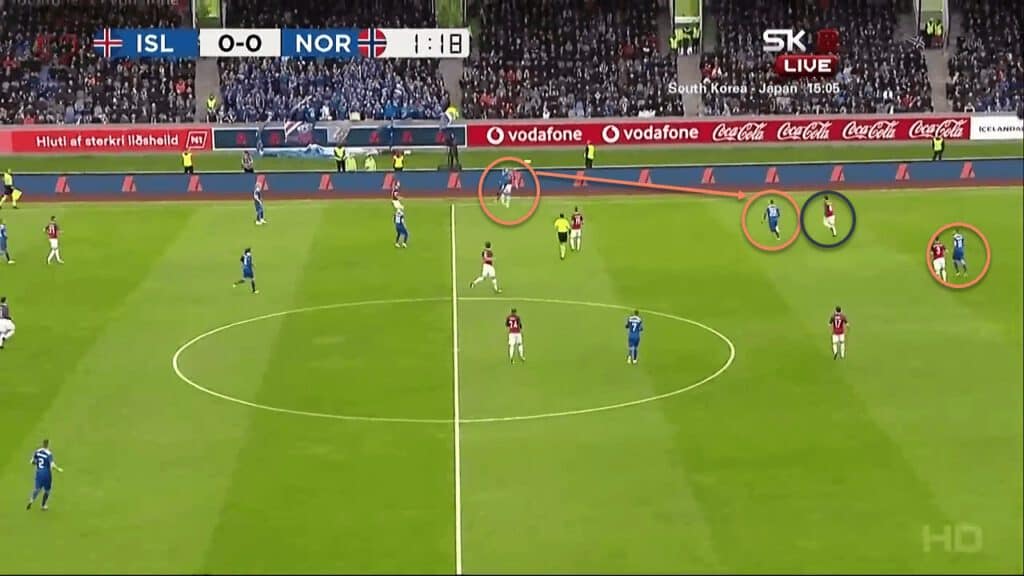
Defensively, Iceland do not press aggressively, instead preferring to retreat and form a compact, low block, making it difficult to play through them centrally. Even the strikers drop off and help to funnel the ball wide, from where it is relatively easier for the centre-backs to head away any attempted crosses.

Key Player
Gylfi Sigurdsson
This one is probably self-evident; Sigurdsson is easily the most talented player in the Iceland squad, and given the relative lack of creativity, he will quite literally be central to the country’s hopes in Russia. Sigurdsson’s ability to find a pass will be essential in releasing Iceland’s strikers beyond opponents’ defensive lines, while he will also help retain possession, not one of the island nation’s strong suits. Further, his dead-ball prowess will be crucial for a side lacking in goals. The Everton man has just returned from injury, and marked this by scoring in Iceland’s 2-3 defeat against Norway; his fellow countrymen will be hoping he can keep doing so at Russia, or they face an early exit from the biggest show on Earth.
Young Player to Watch
Albert Gudmundsson
Iceland’s squad isn’t blessed with young players, with only five players below the age of 25. One of them is PSV midfielder Albert Gudmundsson, only 20 years old, who comes from a family of accomplished footballers. His father, Gudmundur Benediktsson, played 10 times for Iceland, but gained worldwide fame during Euro 2016 for his reaction as a TV commentator to Iceland’s win over England; his grandfather, Ingi Bjorn Albertsson, held the Icelandic top-flight goal-scoring record from 1987 to 2012, while his great-grandfather, also named Albert Gudmundsson, was Iceland’s first professional footballer, going on to play for the likes of Rangers, AC Milan and Arsenal. Young Albert looks likely to follow in his illustrious family’s footsteps, breaking into the PSV side as a pacy winger. While he is unlikely to start for Iceland, he could be a game-changing option for Hallgrimsson off the bench, as there aren’t too many in the squad who possess his blend of raw pace and dribbling. Watch out for Gudmundsson; he may have already eclipsed his family members in being part of a World Cup squad, but one cannot rule out him having a decisive impact on Iceland’s campaign.
Wildcard
Alfred Finnbogason
The nomadic striker is the second-highest scorer in Iceland’s squad with 12 goals, behind Gylfi Sigurdsson (19), and yet there are doubts about his ability to have a decisive impact at the World Cup. He has had a relatively prolific campaign at club level, scoring 12 goals in 19 appearances for Augsburg in the German Bundesliga; however, this was the first time he hit double digits for goals since the 2013-14 campaign. Likely to start as one of the two strikers in Hallgrimsson’s 4-4-2 setup, it would be a welcome addition to Iceland’s threat if Finnbogason manages to get a couple of goals; they seem too reliant on Sigurdsson to provide the goals, and can be a little flat if he is having an off day. Finnbogason has blown hot and cold throughout his career, but now would be a good time to turn up the temperature, in the white-hot spotlight that Russia 2018 will bring.
