
Total Football Analysis
Once.Sport
  • Football Analysis
    • Data Analysis
    • Formations
      • 2-2-4 Formation
      • 2-3-5 Formation
      • 3-1-4-2 Formation
      • 3-2-2-3 Formation
      • 3-2-4-1 Formation
      • 3-1-6 Formation
      • 3-3-4 Formation
      • 3-4-1-2 Formation
      • 3-4-2-1 Formation
      • 3-4-3 Formation
      • 3-5-1-1 Formation
      • 3-5-2 Formation
      • 4-1-4-1 Formation
      • 4-2-2-2 Formation
      • 4-2-3-1 Formation
      • 4-2-4 Formation
      • 4-3-1-2 Formation
      • 4-3-3 Formation
      • 4-4-2 Formation
      • 4-5-1 Formation
      • 5-3-2 Formation
      • 5-4-1 Formation
      • 6-3-1 Formation
    • Head Coach Analysis
    • Match Analysis
    • Player Analysis
    • Recruitment Analysis
    • Set Piece Analysis
    • Tactical Theory
    • Tactical Preview
    • Team Analysis
    • Training Analysis
    • Tactical Analysis
    • Scouting Report
  • Competition
    • ALL Competitions
    • English Premier League
    • Champions League
    • La Liga
    • Bundesliga
    • Serie A
    • Ligue 1
    • Eredivisie
    • EFL Championship
    • FIFA World Cup 2022
    • WEURO 2022
    • Women’s Super League
    • NWSL
    • Belgian First Division A
    • A-League
    • Liga Profesional de Argentina
    • Austrian Bundesliga
    • Campeonato Brasileiro Série A
    • DFB Pokal
    • 1. HNL
    • Danish Superliga
    • EFL League One
    • EFL League Two
    • FA Cup
    • EFL Cup
    • Indian Super League
    • K-League
    • J1 League
    • Liga MX
    • Copa América 2021
    • Copa del Rey
    • MLS
    • Eliteserien
    • Euro 2020
    • Primeira Liga
    • Scottish Premiership
    • Allsvenskan
    • Europa League
    • UEFA Nations League
    • Liga AUF Uruguaya
  • Coaches
    • All Coaches
    • Alfred Schreuder
    • Ange Postecoglou
    • Antonio Conte
    • Arne Slot
    • Bo Svensson
    • Brendan Rodgers
    • Bruno Lage
    • Carlo Ancelotti
    • Christophe Galtier
    • Claude Puel
    • Claudio Ranieri
    • David Moyes
    • Dean Smith
    • Diego Simeone
    • Domenico Tedesco
    • Frank Lampard
    • Eddie Howe
    • Edin Terzić
    • Emma Hayes
    • Erik ten Hag
    • Ernesto Valverde
    • Gennaro Gattuso
    • Gerardo Seoane
    • Gian Piero Gasperini
    • Giovanni van Bronckhorst
    • Graham Potter
    • Igor Tudor
    • Imanol Alguacil
    • Jesse Marsch
    • Jonas Eidevall
    • Jorge Sampaoli
    • José Bordalás
    • José Mourinho
    • Julen Lopetegui
    • Julian Nagelsmann
    • Julien Stéphan
    • Jürgen Klopp
    • Luciano Spalletti
    • Lucien Favre
    • Manuel Pellegrini
    • Marcelo Bielsa
    • Marco Rose
    • Marco Silva
    • Massimiliano Allegri
    • Mauricio Pochettino
    • Maurizio Sarri
    • Mikel Arteta
    • Niko Kovač
    • Nuno Espírito Santo
    • Oliver Glasner
    • Patrick Vieira
    • Paulo Fonseca
    • Pep Guardiola
    • Peter Bosz
    • Rafa Benítez
    • Ralf Rangnick
    • Ralph Hasenhüttl
    • Roger Schmidt
    • Roy Hodgson
    • Sean Dyche
    • Sérgio Conceição
    • Simone Inzaghi
    • Sonia Bompastor
    • Stefano Pioli
    • Steffen Baumgart
    • Steven Gerrard
    • Thiago Motta
    • Thomas Frank
    • Thomas Tuchel
    • Unai Emery
    • Vincenzo Italiano
    • Xavi
  • Teams
    • ALL Teams
    • AC Milan
    • Ajax Amsterdam
    • Arsenal
    • AS Monaco FC
    • Atalanta
    • Atlético Madrid
    • FC Barcelona
    • FC Bayern Munich
    • Borussia Dortmund
    • Celtic FC
    • Chelsea FC
    • Everton F.C.
    • Inter Milan
    • Juventus F.C.
    • Leeds United F.C.
    • Liverpool FC
    • Manchester City
    • Manchester United FC
    • Paris Saint-Germain
    • Rangers FC
    • RB Leipzig
    • Real Madrid CF
    • Tottenham Hotspur
    • West Ham United
  • Players
    • ALL Players
    • Alisson Becker
    • Bukayo Saka
    • Erling Haaland
    • Harry Kane
    • Jack Grealish
    • John Stones
    • Julián Alvarez
    • Kalvin Phillips
    • Kevin De Bruyne
    • Kyle Walker
    • Kylian Mbappé
    • Lamine Yamal
    • Lionel Messi
    • Luis Díaz
    • Mohamed Salah
    • Phil Foden
    • Virgil Van Dijk
  • Contact
  • Write For TFA
No Result
View All Result
No Result
View All Result
Total Football Analysis
No Result
View All Result
Home Analysis

MLS 2020: Chicago Fire Vs NYCFC – Tactical Analysis

Hugo Thaxter by Hugo Thaxter
November 11, 2020
in Analysis, Chicago Fire, Match Analysis, MLS, New York City FC, Raphaël Wicky, Tactical Analysis
0
MLS 2020: Chicago Fire vs NYCFC - tactical analysis tactical analysis tactics

Chicago Fire and NYCFC met at Soldier Field on the final MLS matchday of the season before the beginning of the playoffs. After twenty-two matches completed, there was much to play for both sides in the final match. There were many different pathways to the playoffs, but the side that came out victorious would be the most likely. 

For Chicago Fire, they were looking to recover from a bad run of form, which left them without a win in the five matches leading up to the final game of the season. They needed to win to have a chance at a playoff spot, which could explain the expansive tactics viewers saw during the match against NYCFC. 

NYCFC had a better lead-up to the game, unbeaten in three matches leading up to the final match. Again, a win and NYCFC would likely be in the playoffs. 

Both clubs had a lot to play for, and the match did not disappoint. This tactical analysis and match report will examine the tactics of both sides during a match that saw NYCFC win 4-3 in an exciting, attack-minded fashion. 

Lineups

Screen Shot 2020 11 11 at 12.57.25 AM

Raphael Wicky, manager of the Chicago Fire set out in a 4-2-3-1 formation that he has utilised during his spell. Robert Beric led the line with exciting players such as Poland international Przemysław Frankowski playing on the wing. The midfield made up of two pivot players and a number 10. Bobby Shuttleworth, the goalkeeper, was protected by a back four.

NYCFC’s manager, Ronny Deila, also started in a formation that mirrored the Fire’s, setting up in a 4-2-3-1. The Argentine Valentín Castellanos was the main man while Deila deployed an attacking three of Gary Mackay-Steven, Maxi Morale,z and Jesús Medina. These attackers were supported by two pivot players and the typical back four of NYCFC.

Early Chicago spacing problems 

From the beginning of the match, spacing became a huge issue for the Chicago Fire. Despite scoring three goals, which largely resulted from NYCFC’s defensive errors, the team from New York was dominant. Both clubs came out swinging for the fences as they looked to gain an early advantage and secure a place in the MLS playoffs. 

For NYCFC, they started off the first phase of the match with an astounding 66% possession and 0.73 attacks per minute while being extremely comfortable inside the Chicago Fire’s half of the pitch. There were two reasons for this, one of which was attributed to NYCFC’s attacking tactics, and the other to the Fire’s lack of cohesiveness. 

Regarding the lack of togetherness, the Fire set out early on to press the ball and try to win it back high up the pitch. This led to a pressing intensity of 7.3 in the first phase of the match. Despite losing control of the ball as explained earlier, Chicago still defended reasonably well. In the analysis below, you can see the attacking players from the Fire all pressurizing the ball to make it difficult for NYCFC to play out. In this case, they won the ball back and had a good chance on goal because of this positioning. 

pressure

When this tactic was successful, there was nothing to worry about. However, if NYCFC were to break the press, it would become a serious problem. The Fire would be constantly outnumbered and would leave huge amounts of the pitch open. The image below shows an average positioning map of the two teams. Despite this being a representation of the entire 90 minutes, you can see how significant the space between the centre-backs and the midfield is for the Chicago Fire. To combat this open space, the defenders must step up and form a cohesive unit with the rest of the team. This did not happen, thus preventing an effective high block from being established. When seeing some of the effective teams, such as Bayern Munich and Liverpool, implementing a high block, you never see their centre-backs so deep. 

Screen Shot 2020 11 10 at 11.46.35 PM

NYCFC long balls to create space

NYC recognized this and began to adjust their strategy in possession to take advantage of the space in the middle of the pitch. In the first phase (the first 15 minutes) of the match, NYCFC had a long passing share of 10%, whereas in the second phase of the game (15-30 minutes), they almost doubled their long passing share. The reason for this was due to how deep the Fire were playing, even when pressing. There was a complete disconnect between the Fire’s defence and midfield, causing tremendous problems. 

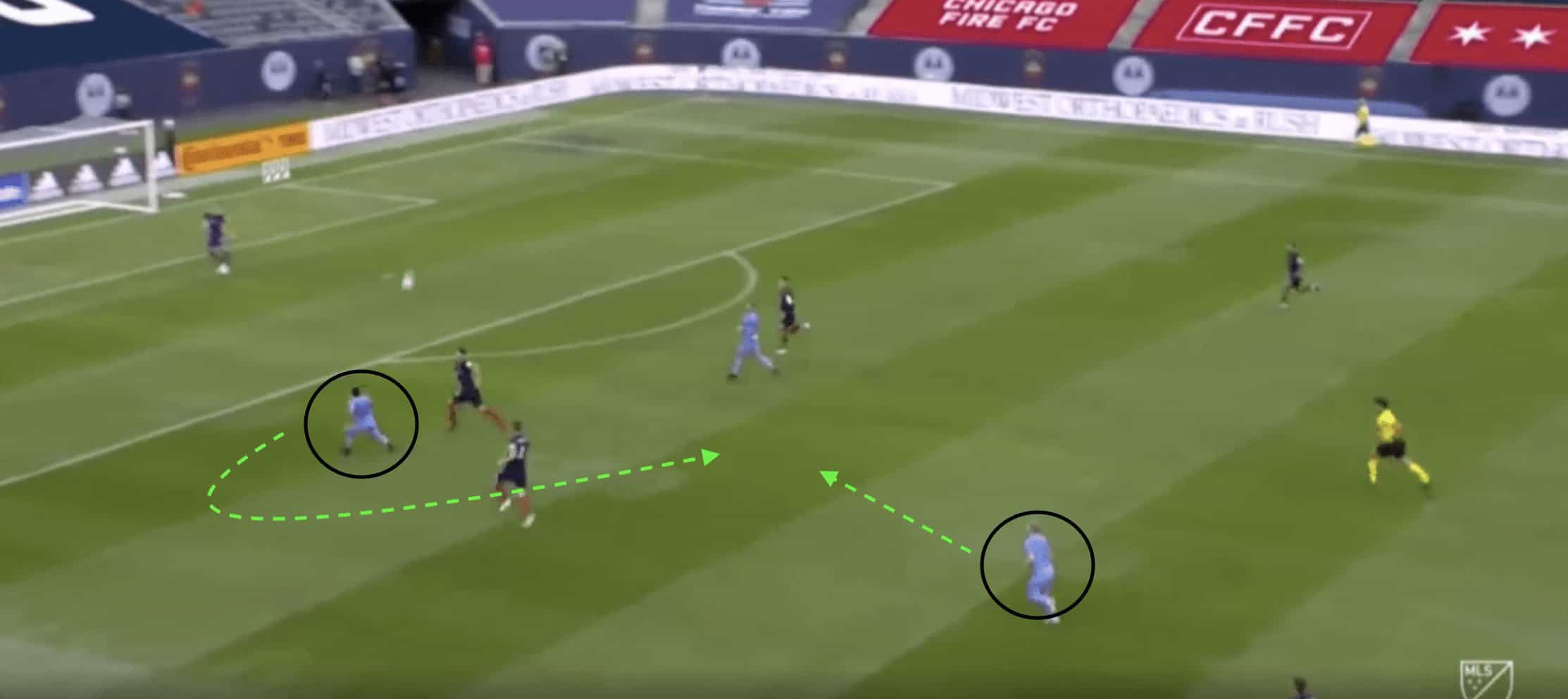
An example of how NYCFC would utilise the long ball can be seen below. The Argentine Castellanos makes a fantastic run off the centre-back’s shoulder. Here, the ball is about to fall on his foot. He controls the ball extremely well and is able to drop the ball to Mackay-Steven, who is circled. His run is undetected by Chicago, who are focused on Castellanos. By the striker making the run, the defender was taken away from the space he was occupying, allowing NYCFC to easily collect the ball in a dangerous area. 
space in midfield

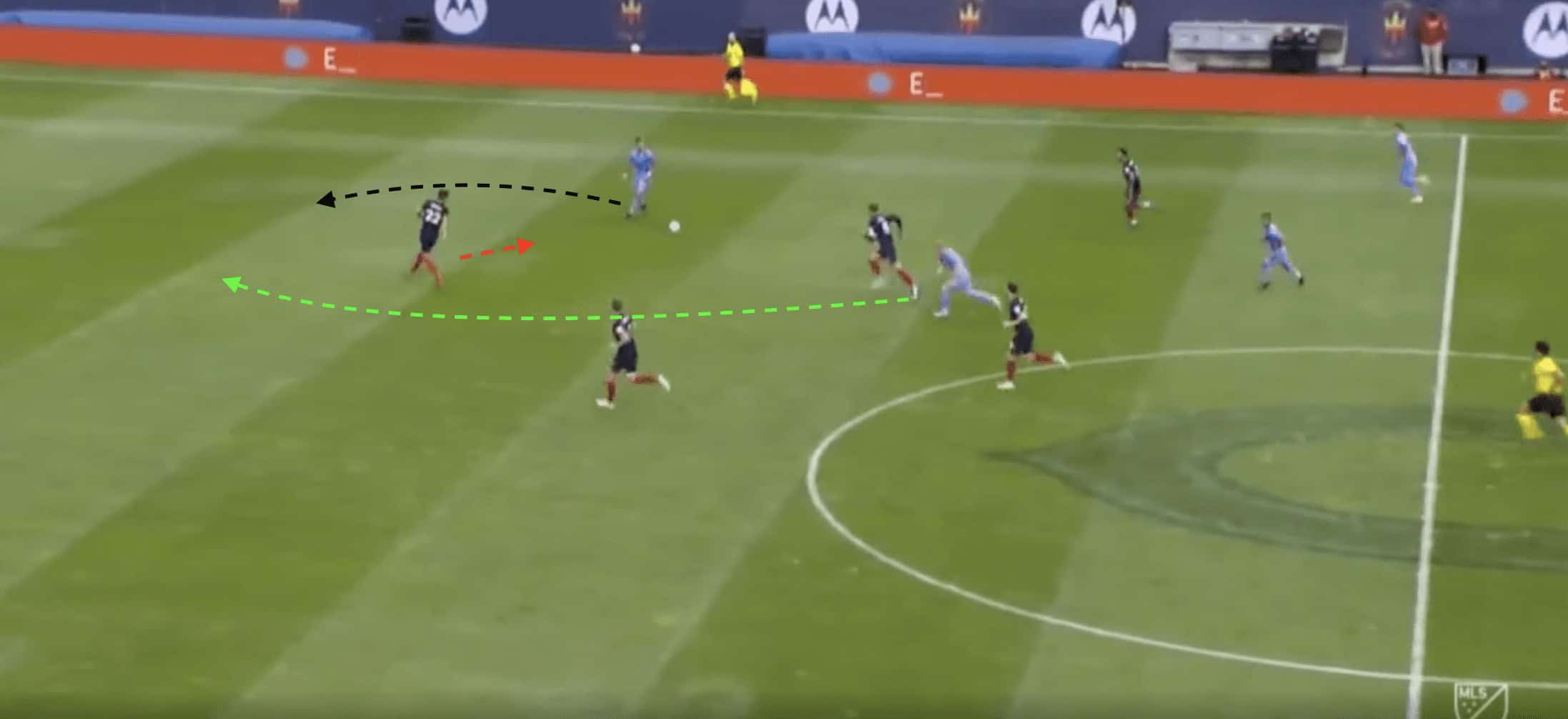
This led to the Fire’s centre-backs having to second-guess following the runner. In the analysis below, Castellanos again causes problems. This time, he received the long ball and waited due to Mackay-Steven’s forward run. The Argentine draws in the Fire defender, allowing for the Scottish winger to get in behind. Castellanos then plays a delightful through-ball, which leaves Chicago exposed. 
goallllll

This tactic effectively solved the problem that NYCFC faced during the match. They had to find a way to break past the press of Chicago, but that was not always easy. However, with effective long balls, they were able to release the press early and take advantage of the Fire’s spacing problems. 

Shootout in the midwest

While both sides executed poorly defensively, NYCFC and the Chicago Fire came out to play in terms of attacking production. This match section of the match report aims to highlight the fantastic attacking football that was on display at Soldier Field. Yes, this was due to poor defending, but another reason for the expansive match was that both teams needed to win. Each manager was hoping their firepower would outlast the other. 

NYCFC had a total of 20 shots during the match, with 10 on target. Their xG was 2.23 while they managed to score 4 goals. This output was impressive and was due to their commitment to get players forward. They found themselves in positions in the final third due to their tactics, which allowed them to create space in the middle of the pitch. In the box, they got many of their attackers forward and would force the Fire back into their own 18 on multiple occasions. This would create very difficult scenarios for defenders to handle.

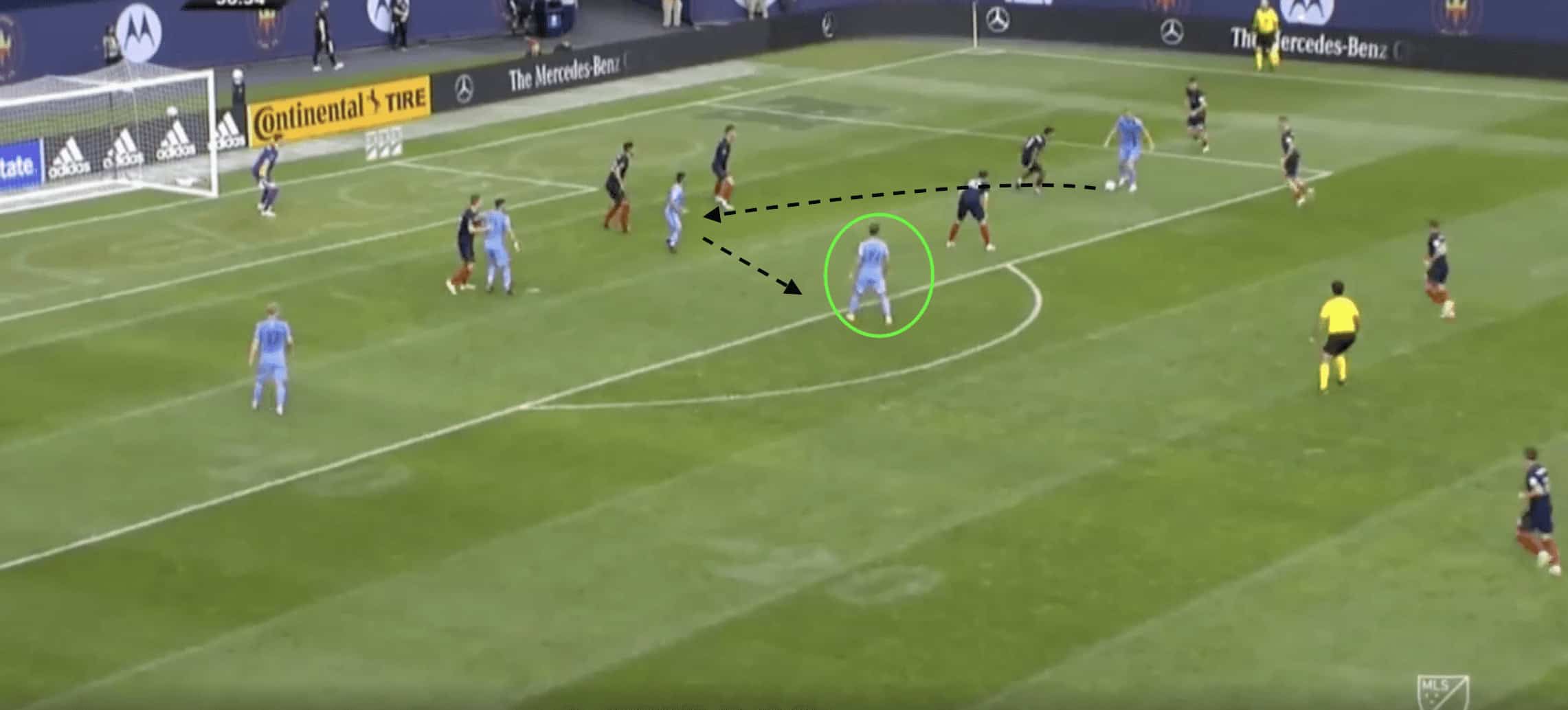
An example of this can be seen where they overload the box in order to create a shot for Medina, who is circled below. Even if Medina did not take the shot (which he scored), he could have easily played a pass to Mackay-Steven, who was again in an excellent position to cause damage. Chicago’s defense was outnumbered and could not cover every option effectively.  
combooooo

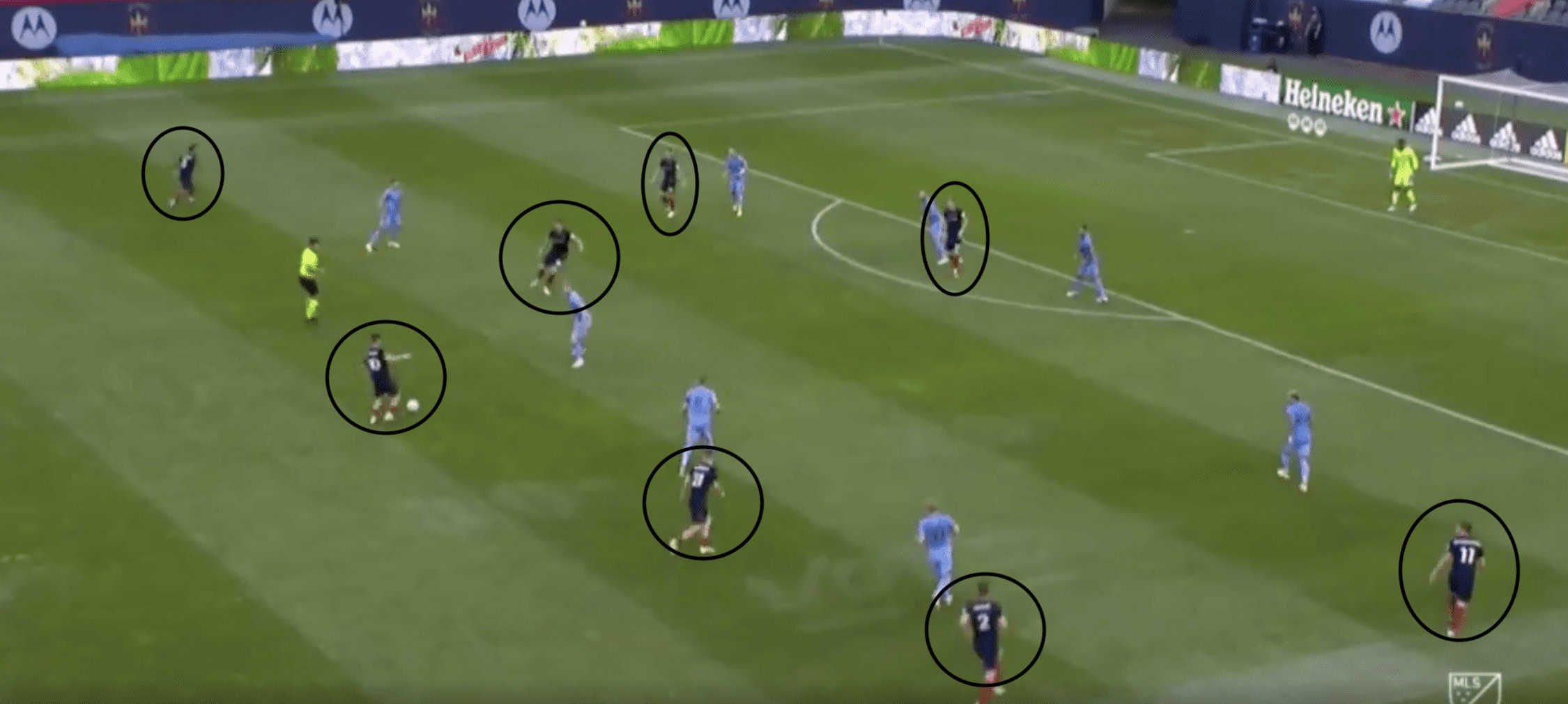
Overloads was also a tactic that the Fire attempted, especially while chasing the match. After going down by a couple of goals, it was crucial to get on the scoresheet. Instead of changing formation, Wicky wanted to flood the box with players. This can be seen in the example below. After falling, 2-1 down, Chicago had eight players in front of the ball, trying to create an overload. This is incredibly dangerous, but in order to score more goals, it was a risk they had to take. As you can see, they wanted to create areas on the wing and half-spaces in order to break down NYCFC. When Chicago got their chances, they took them effectively. 
attttacckkkkkk

The Fire ended the match with an xG of 2.38. Despite their poor defensive performance, they still managed to create, perhaps out of desperation. They had 14 shots on goal, with 6 being on target. 

Conclusion

This match was extremely entertaining from a neutral perspective. It displayed very attack-minded football, with little regard for defending, as both teams needed to win. Ultimately, NYCFC secured a spot in the playoffs, where they will face the Columbus Crew in the first round. Unfortunately, the Chicago Fire missed out, but the end of the season will serve as a learning lesson for the hosts. 

This match felt very similar to the high-flying Leeds United vs Liverpool match earlier on in the Premier League season. There were lots of goals and weak defensive displays.

Tags: Chicago FireChicago Fire Tactical AnalysisChicago Fire TacticsHow Good Is Raphaël WickyMLSMLS TacticsNew York City FCNYCFCRaphaël Wicky AnalysisRaphaël Wicky Coaching StyleRaphaël Wicky FormationRaphaël Wicky Manager StyleRaphaël Wicky Playing StyleRaphaël Wicky Style Of PlayRaphaël Wicky TacticsRonny DeilaRonny Deila NYCFCRonny Deila Tactical AnalysisRonny Deila TacticsWho Is Raphaël Wicky
Previous Post

MLS 2020: Orlando City SC vs Nashville SC – tactical analysis

Next Post

Chinese Super League 2020: Jiangsu Suning vs Guangzhou Evergrande – tactical analysis

Next Post
Chinese Super League 2020: Jiangsu Suning vs Guangzhou Evergrande - tactical analysis tactics

Chinese Super League 2020: Jiangsu Suning vs Guangzhou Evergrande - tactical analysis

  • About Total Football Analysis
  • Contact Total Football Analysis
  • Write For Total Football Analysis
  • Advertise
  • Privacy Policy
  • Cancellation / Refund Policy
  • Resources
  • Terms Of Service

© 2026 Total Football Analysis

No Result
View All Result
  • Football Analysis
    • Data Analysis
    • Formations
      • 2-2-4 Formation
      • 2-3-5 Formation
      • 3-1-4-2 Formation
      • 3-2-2-3 Formation
      • 3-2-4-1 Formation
      • 3-1-6 Formation
      • 3-3-4 Formation
      • 3-4-1-2 Formation
      • 3-4-2-1 Formation
      • 3-4-3 Formation
      • 3-5-1-1 Formation
      • 3-5-2 Formation
      • 4-1-4-1 Formation
      • 4-2-2-2 Formation
      • 4-2-3-1 Formation
      • 4-2-4 Formation
      • 4-3-1-2 Formation
      • 4-3-3 Formation
      • 4-4-2 Formation
      • 4-5-1 Formation
      • 5-3-2 Formation
      • 5-4-1 Formation
      • 6-3-1 Formation
    • Head Coach Analysis
    • Match Analysis
    • Player Analysis
    • Recruitment Analysis
    • Set Piece Analysis
    • Tactical Theory
    • Tactical Preview
    • Team Analysis
    • Training Analysis
    • Tactical Analysis
    • Scouting Report
  • Competition
    • ALL Competitions
    • English Premier League
    • Champions League
    • La Liga
    • Bundesliga
    • Serie A
    • Ligue 1
    • Eredivisie
    • EFL Championship
    • FIFA World Cup 2022
    • WEURO 2022
    • Women’s Super League
    • NWSL
    • Belgian First Division A
    • A-League
    • Liga Profesional de Argentina
    • Austrian Bundesliga
    • Campeonato Brasileiro Série A
    • DFB Pokal
    • 1. HNL
    • Danish Superliga
    • EFL League One
    • EFL League Two
    • FA Cup
    • EFL Cup
    • Indian Super League
    • K-League
    • J1 League
    • Liga MX
    • Copa América 2021
    • Copa del Rey
    • MLS
    • Eliteserien
    • Euro 2020
    • Primeira Liga
    • Scottish Premiership
    • Allsvenskan
    • Europa League
    • UEFA Nations League
    • Liga AUF Uruguaya
  • Coaches
    • All Coaches
    • Alfred Schreuder
    • Ange Postecoglou
    • Antonio Conte
    • Arne Slot
    • Bo Svensson
    • Brendan Rodgers
    • Bruno Lage
    • Carlo Ancelotti
    • Christophe Galtier
    • Claude Puel
    • Claudio Ranieri
    • David Moyes
    • Dean Smith
    • Diego Simeone
    • Domenico Tedesco
    • Frank Lampard
    • Eddie Howe
    • Edin Terzić
    • Emma Hayes
    • Erik ten Hag
    • Ernesto Valverde
    • Gennaro Gattuso
    • Gerardo Seoane
    • Gian Piero Gasperini
    • Giovanni van Bronckhorst
    • Graham Potter
    • Igor Tudor
    • Imanol Alguacil
    • Jesse Marsch
    • Jonas Eidevall
    • Jorge Sampaoli
    • José Bordalás
    • José Mourinho
    • Julen Lopetegui
    • Julian Nagelsmann
    • Julien Stéphan
    • Jürgen Klopp
    • Luciano Spalletti
    • Lucien Favre
    • Manuel Pellegrini
    • Marcelo Bielsa
    • Marco Rose
    • Marco Silva
    • Massimiliano Allegri
    • Mauricio Pochettino
    • Maurizio Sarri
    • Mikel Arteta
    • Niko Kovač
    • Nuno Espírito Santo
    • Oliver Glasner
    • Patrick Vieira
    • Paulo Fonseca
    • Pep Guardiola
    • Peter Bosz
    • Rafa Benítez
    • Ralf Rangnick
    • Ralph Hasenhüttl
    • Roger Schmidt
    • Roy Hodgson
    • Sean Dyche
    • Sérgio Conceição
    • Simone Inzaghi
    • Sonia Bompastor
    • Stefano Pioli
    • Steffen Baumgart
    • Steven Gerrard
    • Thiago Motta
    • Thomas Frank
    • Thomas Tuchel
    • Unai Emery
    • Vincenzo Italiano
    • Xavi
  • Teams
    • ALL Teams
    • AC Milan
    • Ajax Amsterdam
    • Arsenal
    • AS Monaco FC
    • Atalanta
    • Atlético Madrid
    • FC Barcelona
    • FC Bayern Munich
    • Borussia Dortmund
    • Celtic FC
    • Chelsea FC
    • Everton F.C.
    • Inter Milan
    • Juventus F.C.
    • Leeds United F.C.
    • Liverpool FC
    • Manchester City
    • Manchester United FC
    • Paris Saint-Germain
    • Rangers FC
    • RB Leipzig
    • Real Madrid CF
    • Tottenham Hotspur
    • West Ham United
  • Players
    • ALL Players
    • Alisson Becker
    • Bukayo Saka
    • Erling Haaland
    • Harry Kane
    • Jack Grealish
    • John Stones
    • Julián Alvarez
    • Kalvin Phillips
    • Kevin De Bruyne
    • Kyle Walker
    • Kylian Mbappé
    • Lamine Yamal
    • Lionel Messi
    • Luis Díaz
    • Mohamed Salah
    • Phil Foden
    • Virgil Van Dijk
  • Contact
  • Write For TFA
  • Login

© 2026 Total Football Analysis