
After suffering relegation to OBOS-Ligaen in 2019, 2017 Norwegian Cup champions Lillestrøm found themselves in dire need of a rebuild last year. Geir Bakke, who had only just rejected the advances of Rosenborg – who were also in need of a rebuild, though on a much smaller scale to Lillestrøm – was ultimately appointed to the Kanarifugla hot-seat for the 2020 campaign, tasked with leading Lillestrøm back to Norway’s top flight.
The 51-year-old coach succeeded last season, guiding Lillestrøm to a second-place finish in OBOS-Ligaen. Now, with much of the relegation-suffering side of 2019 having been transferred away from Åråsen Stadion, Bakke’s Lillestrøm, which features some remnants of the side Bakke inherited but has been largely constructed with free transfers, loanees, and Lillestrøm’s youth academy graduates, is sitting in third place on the Eliteserien table, six points behind table-toppers Molde, with a game in hand.
Despite not being able to spend much money on incoming transfers at all, Bakke is succeeding with his Lillestrøm rebuild and Kanarifugla look far closer to the side they were in 2017 now than they did two years ago when the prestigious club, who have gone head to head with the likes of Eredivisie giants Ajax, Scottish Premiership greats Rangers, along with EPL and La Liga combatants in European competition in the past, dropped out of Norway’s top flight for the first time in over 40 years. Speaking recently about his and his side’s aims for the future, Bakke declared that Lillestrøm “must own part of the match picture” moving forward, indicating his desire to get his team imposing their will on games.
In this tactical analysis piece, we’ll analyse some key elements of Bakke’s Lillestrøm tactics and philosophy. We’ll look at how the 51-year-old’s side build their attacks and how they try to finish them, how they set up defensively, how they perform in transition phases, and we’ll provide analysis of some of the main areas in which Bakke’s promising Lillestrøm outfit differs from the Kanarifugla side that suffered relegation under Jörgen Lennartsson just two years ago.
Build-up and ball progression
More often than not this season, Bakke’s Lillestrøm side have lined up in a 3-4-2-1 shape in possession which transforms into a 5-4-1 out of possession. Lillestrøm are not a heavily possession-based side, nor were they a heavily possession-based side when they were relegated in 2019. They ended the 2019 Eliteserien campaign with the second-lowest average possession percentage (43.9%) of any team in Norway’s top-flight, while this season they’ve currently got the sixth-lowest average possession percentage (47.5%) of any Eliteserien side.
Bakke’s move to Åråsen Stadion hasn’t seen a majorly dramatic shift in terms of ball retention. Although Lillestrøm have kept a little bit more of the ball this season so far than they did in 2019, in general, they still don’t spend a tonne of time on the ball. They tend to defend quite passively, allowing their opponents plenty of time on the ball, and they don’t always build their attacks patiently via short passes – often preferring to go long from the goalkeeper.

We see an example of how Lillestrøm generally look when playing it long from the ‘keeper in figure 1. Bakke likes his team to get compact, with lots of bodies positioned around the centre-forward who’ll have shifted over slightly to one side of the pitch – in this case, the right – and who’ll generally be the Lillestrøm ‘keeper’s target. This sees the narrow shape, oriented towards the right-wing with lots of bodies congregated around the centre-forward as seen in figure 1, get formed.
One notable movement, in particular, is that the wing-back on the opposite wing to the one Lillestrøm’s shape shifts towards – in this case, the left wing-back – pushes up and moves a lot more centrally than we’ll see him at any other point in the game. As Bakke wants his side to crowd the space around the target man to win the second ball, and thus wants his team’s shape to get very compact and narrow, he’s happy to sacrifice the coverage on the opposite wing to bolster his side’s presence in midfield and presence around the target man. This essentially turns Lillestrøm’s shape into a 4-3-2-1, as seen in figure 1.
Lillestrøm’s central midfielders and wing-backs are the main ‘ball-winners in Bakke’s team. They engage in more defensive duels than any other players in this side. By moving the wing-back into central midfield, nearer to the target man, Bakke increases his team’s likelihood of winning the second ball if it drops into midfield by bolstering both their numerical presence and their qualitative presence.
Combined with the wingers, who are also positioned quite centrally, occupying space just behind the centre-forward on both the left and right, this temporary three-man midfield forms a compact central five behind the centre-forward, prepared to press and win the second ball before kick-starting an attack inside the opposition’s half.
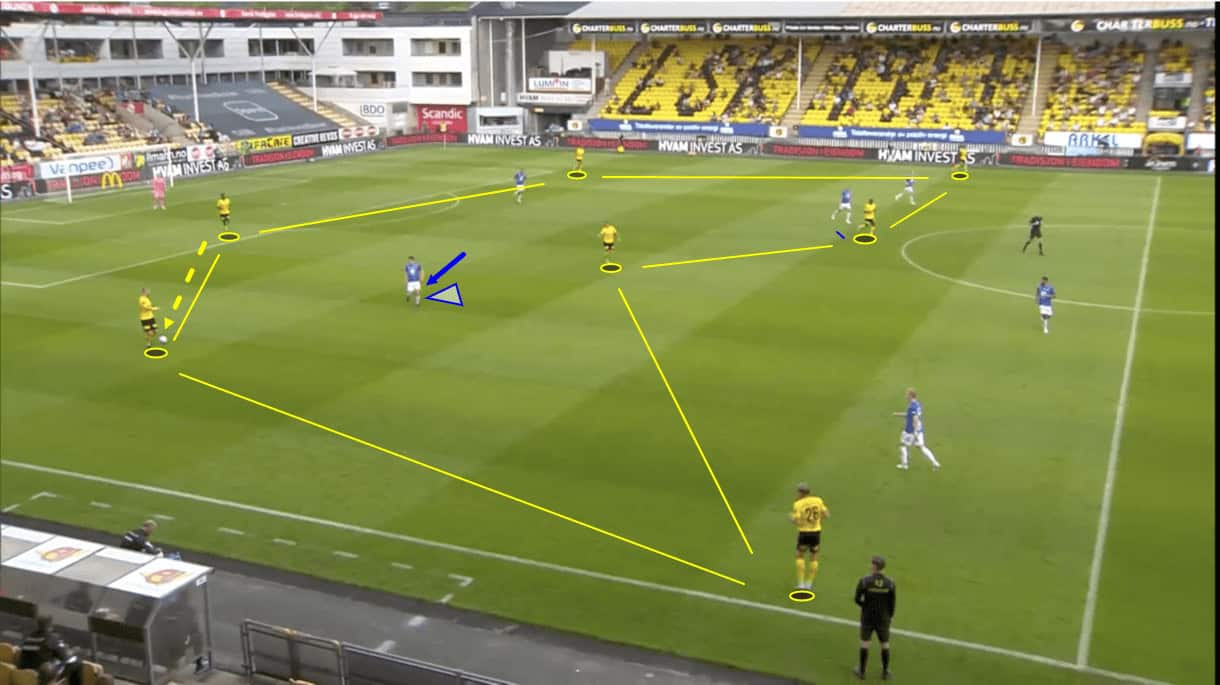
While Kanarifugla are a pretty direct side under Bakke, they do sometimes build up from the back via short passes. We see an example of how they often look on these occasions in figure 2. Here, we see the central centre-back anchoring the three-man backline, with the wide centre-backs either side of him pushing out and offering him diagonal passing options.
Ahead of the back three, we see the four-man midfield line consisting of the two wing-backs hugging the touchline on either side, along with the central midfield duo who’ll typically stagger their positioning to assist with ball progression. This staggered positioning generally makes these players more difficult for the opposition to mark and offers different passing options to the centre-backs.
However, as was the case in the passage of play shown in figure 2, passes from Lillestrøm’s centre-backs to their central midfielders aren’t very common simply because of the distance that typically exists between the two lines which makes those passing connections more difficult. Lillestrøm’s two central midfielders play as two 8s who love to get forward and drive into the opposition’s box. They’re a great tool for their side in the opposition’s half and can link up with the front three very well. However, they don’t tend to drop very deep in the build-up/ball progression phases and so, the centre-backs often find it difficult to progress through them.
Due to the large distance between the centre-backs and central midfielders, opposition players can close off those passing lanes quite easily, forcing Lillestrøm to progress the ball differently. As a result, when Lillestrøm do build-up via short passes, it’s common to see the ball move from the goalkeeper to the central centre-back to the wide centre-back, as was the case in figure 2.
At this point, it’s common to see the centre-back play it long, likely aiming for the centre-forward (usually Lillestrøm captain Thomas Lehne Olsen who’s engaged in more aerial duels per 90 than any other Kanarifugla player this term) and the midfield quartet will push on to join the front three and attack the second ball or offer support to Olsen. Lillestrøm’s wide centre-backs also often play the ball down the wing to the wing-back, but a lot of the time this pass is quite easy for the opposition to defend against.
The pass to the width provider in build-up/ball progression is often a major pressing trigger for teams as this player has a smaller field of play to use than more central players and can be more vulnerable to pressure as a result. That’s often the case when Lillestrøm’s centre-backs pass the ball out to the wing-backs, so this is the least common of the passes we’ve mentioned and can also be the least effective.
On the other hand, this pass can be a good way for Lillestrøm to play the ball into central midfield, using the wing-back as the third man. However, the opposition player who was covering the passing lane between the centre-back and central midfielder (or another, deeper player) may simply shift to cover the passing lane between the wing-back and central midfielder, leaving the wing-back with nowhere to go but straight back to the centre-back, if even that. So, this isn’t the most optimal pass for Lillestrøm in the build-up. Generally, they tend to play it long if they can’t play through the central midfielders – which is common – and this suits them best given the options available to them and the tools available to them, in terms of the players’ skill-sets.
While Bakke’s Lillestrøm, like the Lillestrøm side that was relegated a season before he arrived, plays quite direct, there are some clear differences and, frankly, improvements in their play, particularly during the build-up and ball progression phases.
Due to the gaps between Lillestrøm’s backline and midfield line, as mentioned, Lillestrøm are vulnerable to turnovers in their own third. Bakke’s side can struggle in defensive transitions anyway but particularly when this space between the lines can be exploited.
They can’t afford to be their own worst enemy too often by losing the ball cheaply in their own half during build-up/ball progression. This is something that you could argue they were in their disastrous 2019 season. They ended that campaign having accumulated the most ball losses per 90 (121.98) by far of any team in Norway’s top-flight, along with the second-lowest pass success rate (75.8%) of any Eliteserien side. As ever, these stats need to be put into context to clarify how and why this was the case. Having observed them, in short, they were their own worst enemy at times and did allow far too many turnovers in critical phases of play.
Under Bakke, that has changed. So far this season, Kanarifugla have made just 95.35 ball losses per 90 – fewer than the league average – and they’ve got a pass success rate of 80.9%, which is still below the Eliteserien average, but that’s to be expected given their relatively direct style. However, they have managed to cut down on their ball losses and have ceased to allow as many turnovers in the build-up/ball progression phases thanks to their new structure and tactics under Bakke, which is a positive for the former Sarpsborg 08 boss.
Central midfielder Ifeanyi Mathew, who was loaned out for a large chunk of the 2019 season, also deserves some credit for Lillestrøm’s increased reliability in possession under Bakke. The Nigerian midfielder has already enjoyed more minutes this term than he did in the entirety of the 2019 campaign.
He’s become a key player for Kanarifugla under Bakke. A lot of Lillestrøm’s play goes through him in terms of ball progression as he plays an important role in moving the ball into the final third and setting his team off in transition to attack. This term, Mathew has played the most passes, per 90, of any Lillestrøm player, by far, while he’s also got the third-best pass success rate of any Kanarifugla player. The 24-year-old is one of Lillestrøm’s quickest thinkers and most technically proficient players. He typically occupies the left central midfield position and, as we’ll go on to discuss, Lillestrøm tend to favour the left-wing when progressing into the final third, so he sees a lot of the ball in this area and plays a key role in chance creation, as well as ball progression.
Chance creation
Lillestrøm love to overload the wings inside the final third. On one hand, this can draw lots of opposition players over to that wing, thus creating space on the opposite wing for a switch, however, it’s more common to see Lillestrøm pile bodies into this area and, via a well-orchestrated combination of passing and movement, play their way through the opposition defence from this overloaded wing through a quantitative advantage boosted by some intelligent, clearly well-worked training ground routines designed to take advantage of their wide overloads. Simply put, Bakke has his side well prepared to break the opposition down via the wing thanks to wide overloads.
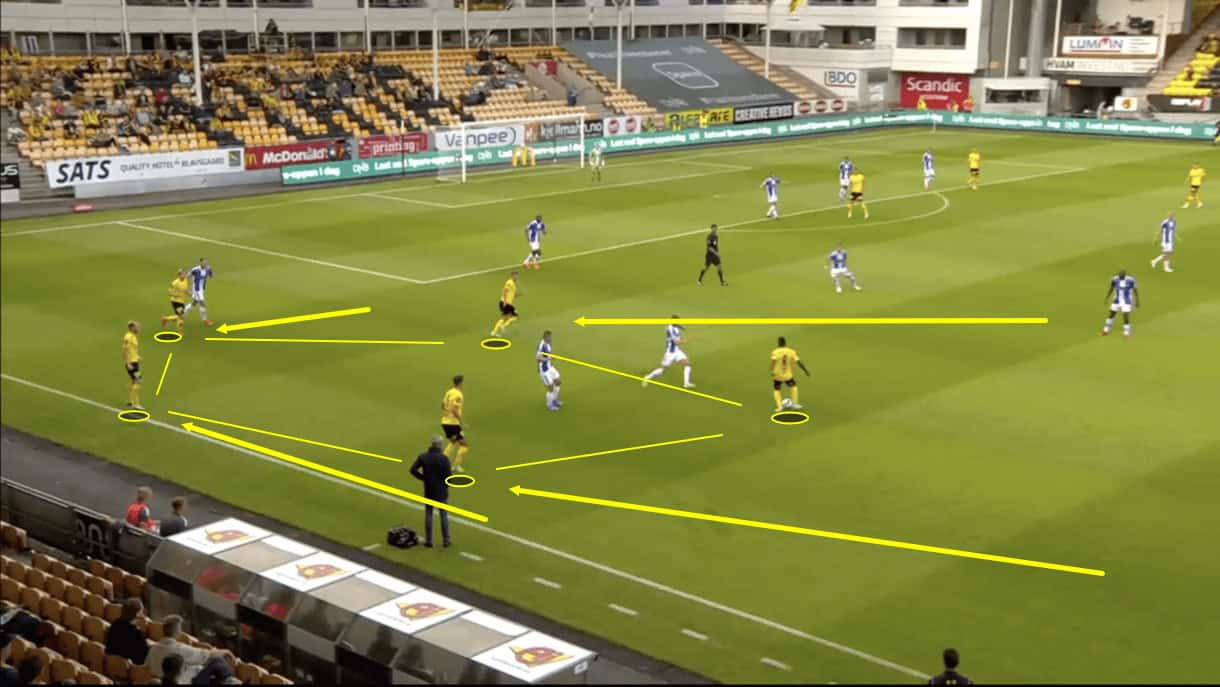
It’s very common to see the sight shown in figure 3 during Lillestrøm games, with five Kanarifugla players essentially forming a pentagon on the wing. This is typically formed with the two central midfielders, the winger, the wing-back and the wide centre-back, as was the case in figure 3. We see how, once again, the central midfielders are staggered, with one acting more as a ‘10’ and the other sitting slightly deeper.
Additionally, we see how the wing-back continues to hold the width, standing right on the touchline. This trio are helped by the winger, who drifts out wide to form the uppermost tip of the pentagon, and the wide centre-back, who it’s common to see drive up from the back three, acting more like a traditional full-back, supporting the midfielders and wing-back.
Sometimes, opposition sides match Lillestrøm out wide but even when they do, they struggle to deal with the quality of Kanarifugla’s fluid, one-touch passing and intelligent movement out wide. This, combined with the sheer numbers packed into this area, makes them very difficult to stop when they try to break teams down via these wide overloads. In this case, however, as is common, Lillestrøm outnumber the opposition with their pentagon and can momentarily turn the game into a training ground passing and movement exercise. It’s common to see Lillestrøm momentarily isolate opposition players 2v1 in these situations, play around them and progress the ball like this. Bakke’s side have been breaking down teams frequently this term thanks to this wide overload.
It’s true that by piling so many players into this area and retaining the ‘front five’ shape created by their two wingers, centre-forward and two wing-backs which they always form in the final third, they underload the centre, leaving just the remaining two centre-backs to cover central midfield and populate the backline. This is very risky and has its drawbacks, as we’ll go on to discuss. However, this is a risk that Bakke is willing to take because of how well drilled his team has become at playing this fluid, one-touch football in the final third to break down the opposition. Given Lillestrøm’s success so far this season, it’s difficult to fault the manager for being happy to take this risk.
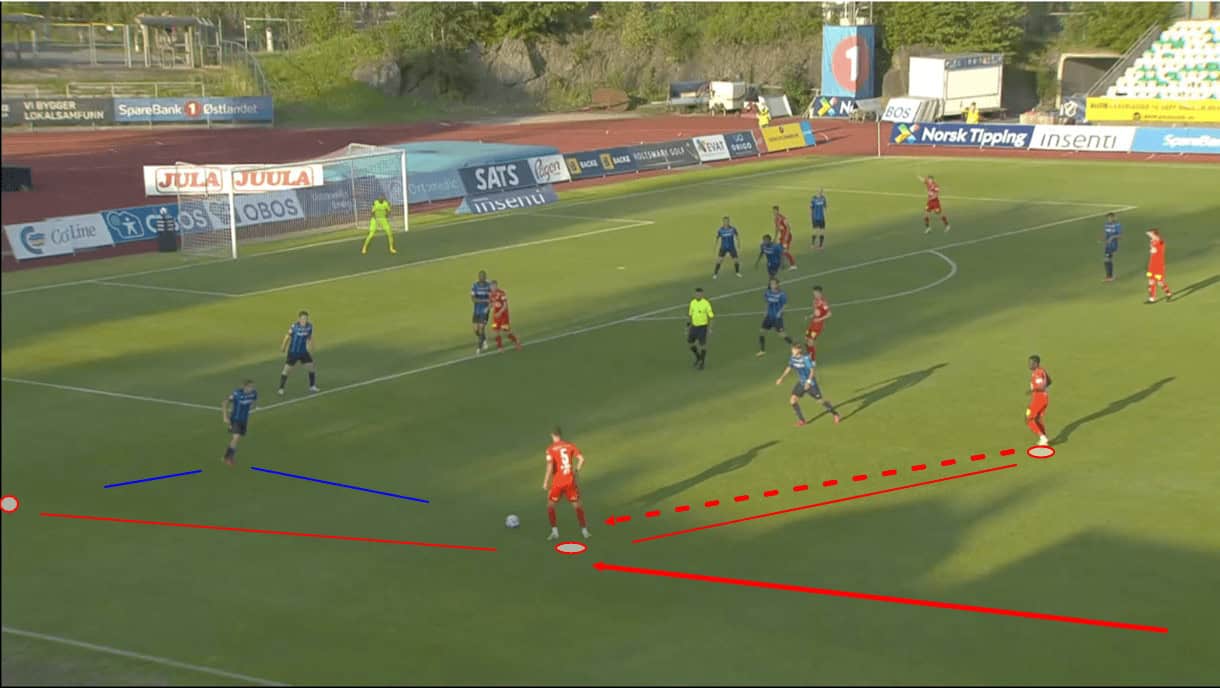
Lillestrøm’s roaming wide left centre-back (typically Vetle Dragsnes) plays a key role in chance creation. He doesn’t just add numbers and offer support to his teammates out wide, he provides a real, creative threat to the opposition. As a wide centre-back, this threat is somewhat unexpected by opposition teams and as a result, they simply don’t know how to deal with him a lot of the time. We see an example of his creative threat in figure 4.
Here, central midfielder Mathew has just found Dragsnes with a short pass on the edge of the final third, on the left wing. The opposition, sitting in their deep-block, simply don’t have this threat accounted for and as a result, Dragsnes becomes a free man and enjoys lots of time and space to put a dangerous cross into the penalty area.
Here, just out of picture, the left wing-back is sitting on the left wing, right on the shoulder of the opposition’s defensive line. As Dragsnes receives the ball, the near opposition defender is overloaded 2v1, caught in two minds about whether to press the centre-back or remain deep to mark the wing-back. Meanwhile, the near opposition player in central midfield has a similar conundrum with Dragsnes and Mathew. This is why Dragsnes remains free and sends a dangerous cross into the box for aerial threat Olsen to attack. Dragsnes is a good crosser, so Bakke has done well to find a creative way to free him up inside the final third so much.
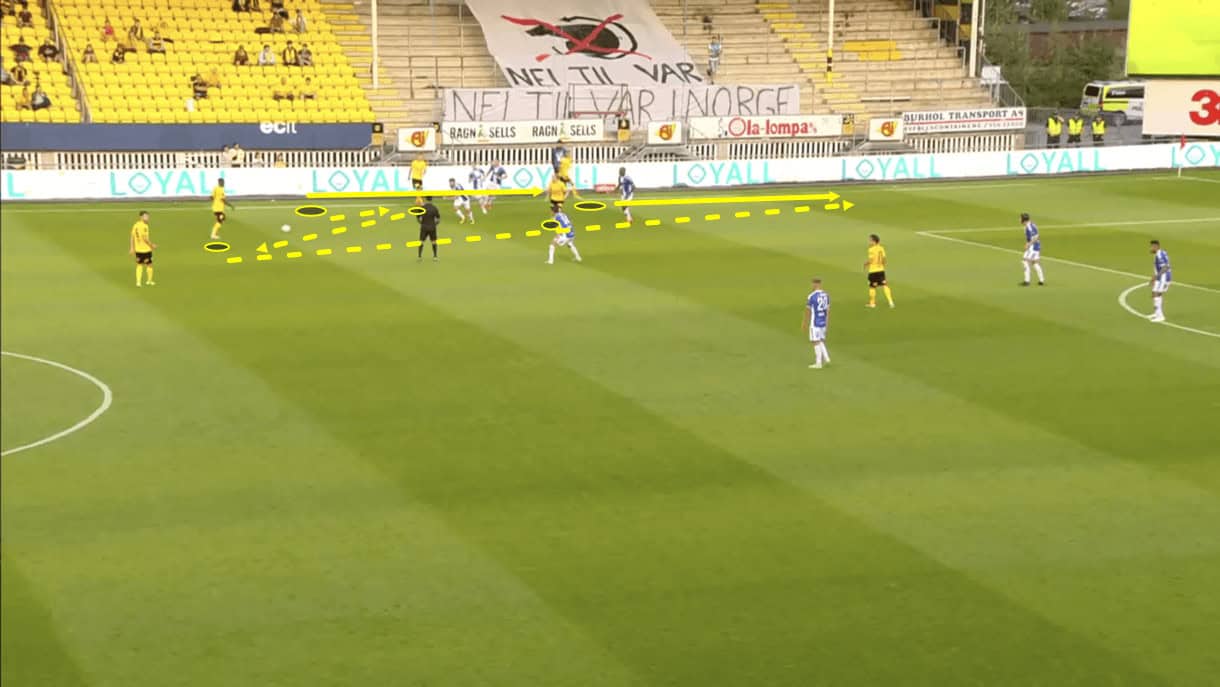
Dragsnes doesn’t just offer a threat from the edge of the final third, however, he also offers a threat higher up the pitch, via overlapping runs in behind the opposition’s backline. An example of this can be seen in figure 5. Just before this image, Dragsnes was in possession in the traditional left-back position. He found the left wing-back with a pass to feet and then began making the overlapping run that we see him continuing here. Meanwhile, the wing-back passed back to Mathew who attracts pressure from the opposition.
Again, Lillestrøm’s opponents were seemingly unsure of how to react in this situation and as play moves on, Mathew finds the overlapping centre-back with a ball over the top and Dragsnes, again finding himself free, can send a cross into the box from much higher, just on the edge of the area.
Bakke’s use of Dragsnes as an offensive tool, both as a deep crosser from the edge of the final third and as a marauding, overlapping centre-back, threatening the opposition via runs in behind, has been very creative and very successful this season. Dragsnes has helped Lillestrøm to gain a lot of territory in the final third and has created numerous chances for his side this season thanks to his intelligent movement, technical quality, and the unorthodox nature of his role.
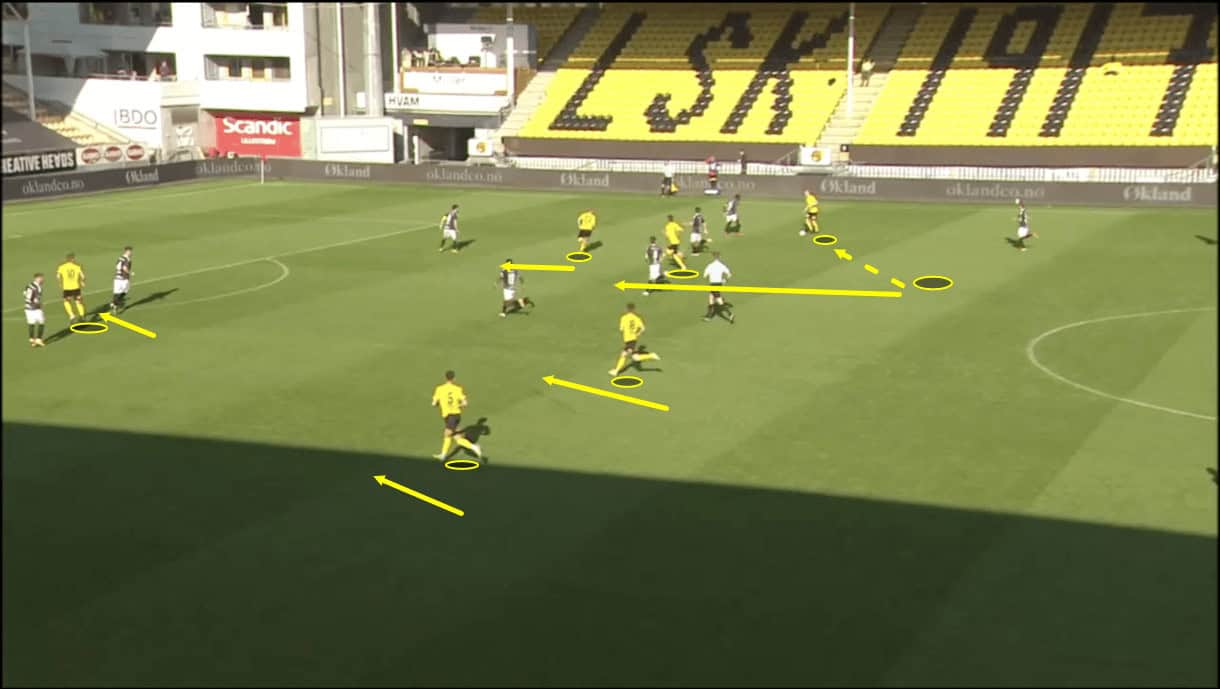
Lillestrøm love to play crosses and when they do, they love to pack the penalty box full of players, including their two central midfielders who often charge forward to add numbers to the box. In figure 6, we see an example of Lillestrøm’s players driving forward into the box. Just before this image, their right central midfielder was in possession slightly deeper, taking his team into the final third during a moment of transition to attack. As is very common for Bakke’s side, the midfielder linked up with the winger, passing him the ball to feet.
As the winger received possession, he held onto the ball, allowing the midfielders and other attackers ahead of him to drive forward. This is a common part of Lillestrøm’s offensive tactics under Bakke. We often see the winger holding onto the ball on the edge of the final third, allowing his teammates to flood into the box and setting up a crossing opportunity.
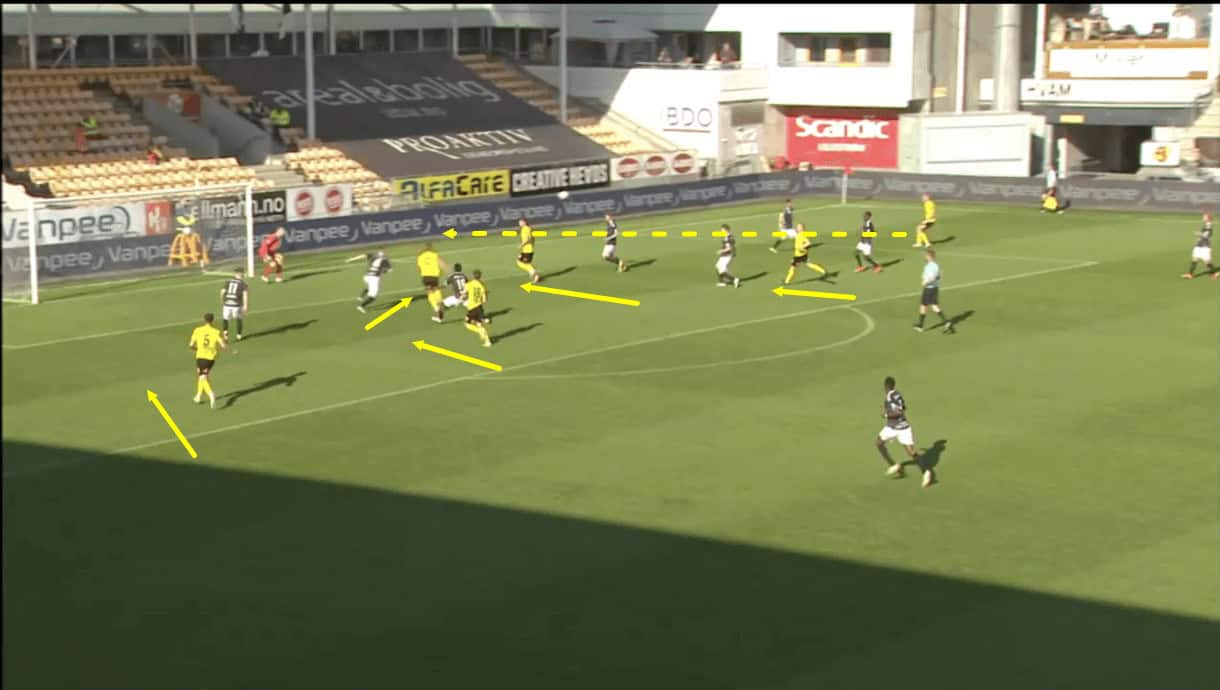
As play moves on into figure 7, we see the ball-carrier ultimately proceed down the wing, getting himself into a crossing position. Meanwhile, the central midfielders, striker, opposite winger, and opposite wing-back end up in the box to overload the opposition and win the offensive aerial duel to score. Bakke likes his side to get lots of men in the box for crossing opportunities, so this sight of five+ men arriving in the penalty area is a fairly common one.
Bakke’s offensive tactics have helped Lillestrøm to improve their goalscoring record from just 1.0 per 90 in 2019 to 1.43 per 90 in 2021, highlighting how effective he’s been at getting his side to create positive goalscoring chances which they’ve been well able to take, including centre-forward Olsen, who’s currently the third-highest scorer (11) in Norway’s top-flight. Olsen undoubtedly benefits from the crossing opportunities his side is effectively creating, thanks to his aerial quality.
Defensive phases
Lillestrøm’s defensive quality has improved somewhat during Bakke’s tenure at Åråsen Stadion, as is evident from the fact that they ended the 2019 campaign with the fifth-most goals conceded (47) in Norway’s top-flight and at present, they’ve conceded the sixth-fewest goals in Eliteserien (16) this term. Their improvement at preventing the opposition from enjoying as many shooting opportunities as before has played a big part in this. In 2019, Lillestrøm conceded the fourth-most shots in the league (12.8 per 90) but this season, they’ve conceded the fourth-fewest shots in the league (10.06 per 90).
Kanarifugla have become somewhat more passive under Bakke. Their PPDA has increased from 10.76 in 2019 to 11.61 this season, while they’ve also engaged in far fewer defensive duels this term than they did two seasons ago.

Figure 8 provides an example of Bakke’s side in their typical 5-4-1 defensive shape. Lillestrøm generally defend in this shape in a mid-block/low-block – where they spend the vast majority of their time as a defensive unit. They don’t press high at all. At times, their central midfielders and wingers do opt to press aggressively if they see an opportunity to take advantage of an opposition player’s wayward touch or pass, however, in general, Lillestrøm’s primary focus is on retaining their compact 5-4-1 block and preventing the opposition from playing through them.
In figure 8, we see an example of this disciplined defending. The opposition have just passed the ball from the right centre-back into midfield, bypassing the first defensive line – Olsen, who doesn’t tend to contribute much defensively. Though the ball is provocatively played into this area, Lillestrøm’s midfielders refuse to be baited into a tackle and remain disciplined, sitting off the ball-carrier in central midfield, protecting their respective zones first and foremost before worrying about closing down the pass receiver.
At times, Kanarifugla’s midfielders have been drawn out of position but the pass receiver would have to be positioned further up to attract their attention, making the initial pass into him more difficult and risky. Instead of closing down this pass receiver, Lillestrøm’s focus is on protecting the space between the lines and behind the backline – this is an important element of their defensive style.
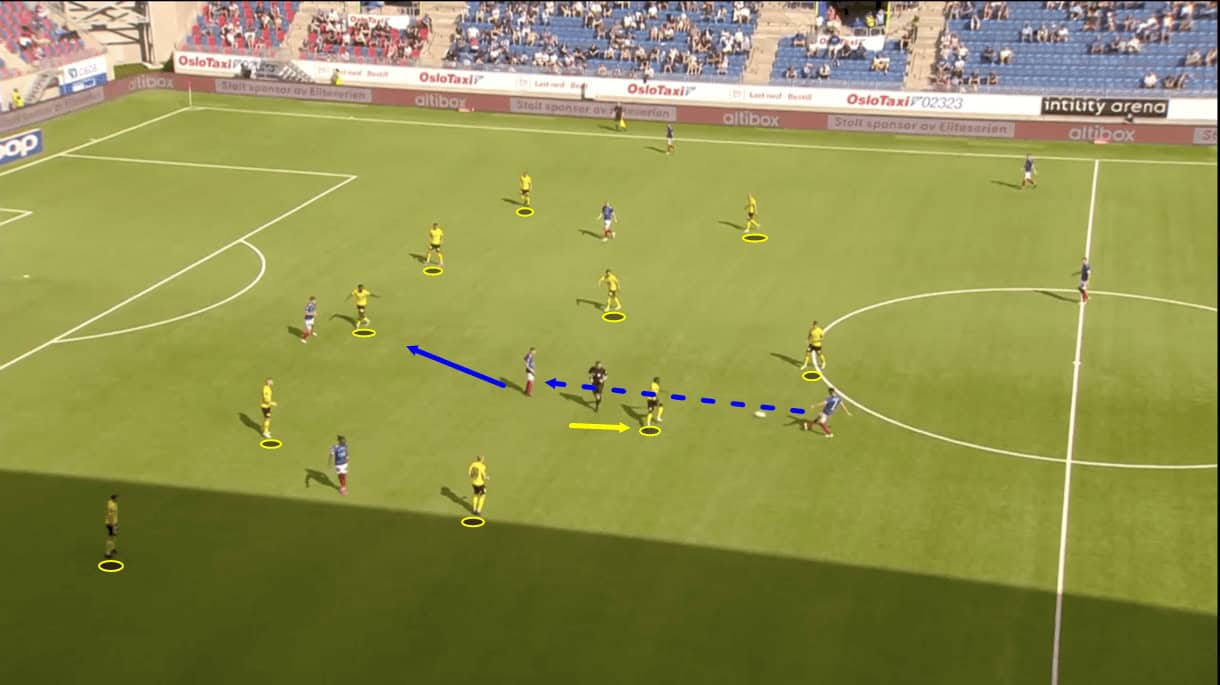
As mentioned above, Olsen doesn’t offer a lot defensively. He’s made just 2.86 successful defensive actions per 90 this term, which is low for an Eliteserien striker. This isn’t a surprising statistic, though, as he doesn’t expend much energy at all in defensive phases, rarely pressing. This passiveness has its weaknesses for the team, however, which are highlighted in figure 9. Here, we see an example of Lillestrøm defending in their 5-4-1 low-block. Just before this image, the opposition’s left centre-back drove forward, carrying the ball towards Lillestrøm’s midfield, casually passing Olsen without the striker doing much to stop him.
The centre-forward offers little more than a light jog to close the ball-carrier down and as a result, the right central midfielder is forced to step out a bit and attempt to close him down. This essentially creates a 2v1 for the opposition against Lillestrøm’s midfielder and they can pass around him, through midfield, setting up a dangerous attacking scenario quite easily. As play moves on, the ball receiver can turn and run at the Kanarifugla backline.
This passage of play highlights how Lillestrøm can be exploited, defensively, due to their striker’s poor pressing ability. As seen in figure 9, this can lead to the midfield being weakened and played through, so this may be something for Bakke and his team to work on, while it may also be something for Lillestrøm’s future opponents to focus on exploiting.
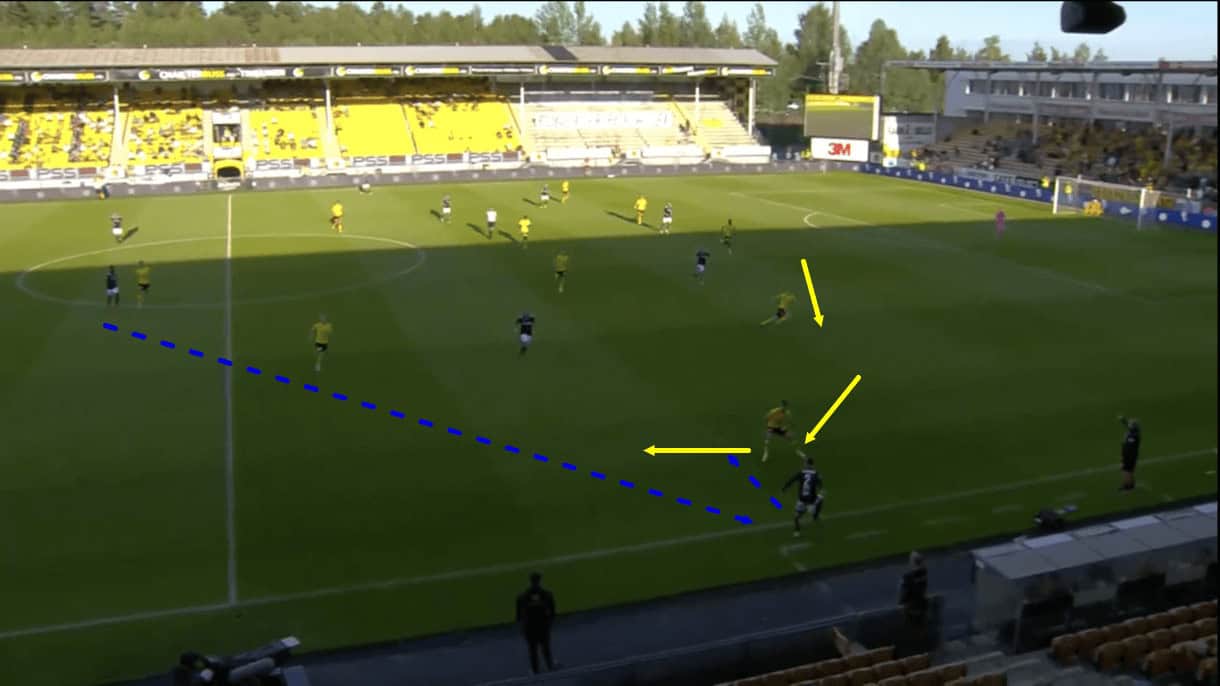
Due to their five-man backline, Kanarifugla’s wing-backs enjoy the freedom to defend quite aggressively if the opposition send the ball out to the wing. We see an example of this in figure 10, where Lillestrøm’s opponents have just sent the ball out to their right-back from the right centre-back. As this pass arrives, Lillestrøm’s left wing-back can step out of defence and close the pass receiver down. This doesn’t weaken the backline much because due to their numbers and the fact they don’t need to worry about the opposite wing too much when the ball is on this side, they can shift over and protect the space behind this pressing wing-back.
As play moves on here, the opposition try to play into midfield, around the wing-back, but the Lillestrøm man is alert to the danger and manages to pull off a good interception, setting his team up to hit their opponents on a dangerous counter-attack – with the opposition’s backline significantly weakened numerically and Lillestrøm in a great position to quickly create their five-man frontline by sending the wing-backs forward to join the three attackers.
As well as highlighting how the aggressive nature of Lillestrøm’s wing-backs can be fairly low-risk and work as a positive for Kanarifugla, this passage of play highlights how dangerous Bakke’s side can be in counter-attacks simply due to the nature of their defensive and offensive shapes and how easily they transition into the other. To create their offensive shape, including the five-man frontline, the wingers just have to occupy the half-spaces and the wing-backs have to advance. It’s a very natural and simple transition for them to make, which helps to make them dangerous on the counter, combined with the players’ individual quality and the ability of the two central midfielders behind the five-man frontline.
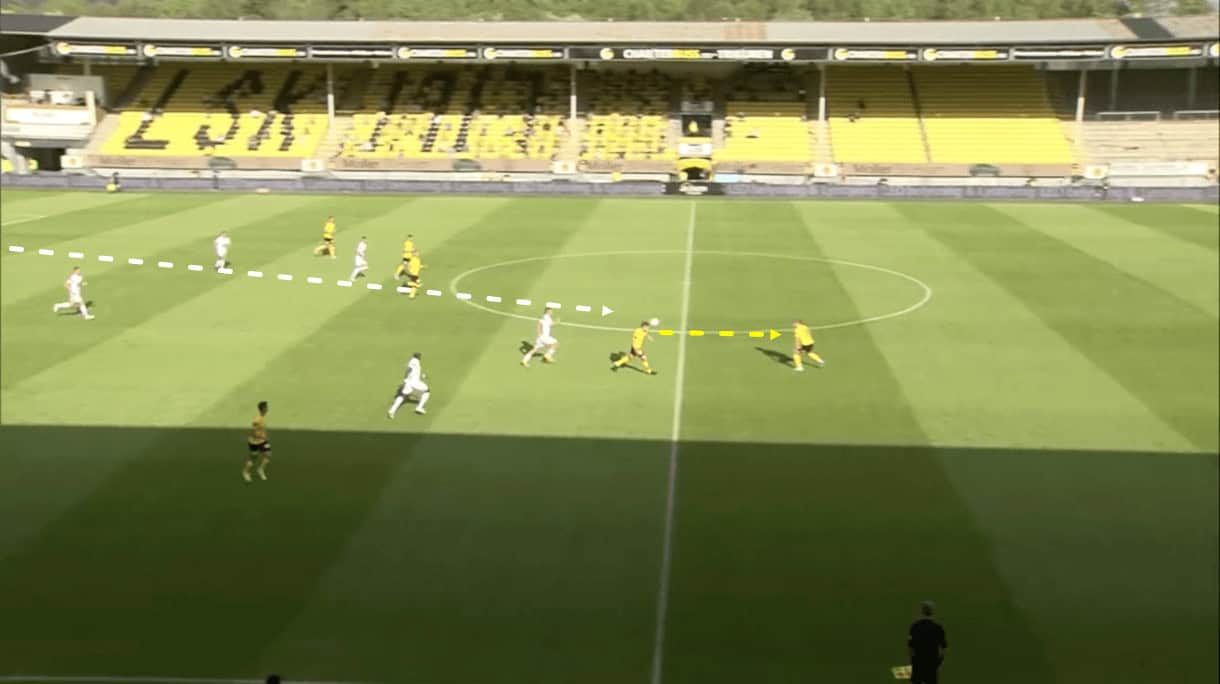
In transition to defence, however, Lillestrøm have been exploited at times. As mentioned previously, Lillestrøm take the risk of sending lots of men forward into attack and a lot of the time, this leaves them with just two men covering the midfield and backline. As was the case in figure 11, opposition sides can capitalise on this by hitting Lillestrøm quickly on the counter and overloading their diminished backline.
I general, Bakke’s side doesn’t have a fast backline either. This is perhaps one reason why they set up to defend so passively and focus so much on protecting space between the lines and behind the backline with bodies rather than pressing aggressively, risking that space behind being attacked.
However, in transition to defence, sometimes it’s inevitable that the space in behind will be weakened and exploited, so given their weakness at defending this area, it may be wise for their opponents to try and target this area quickly on the counter, as was the case in figure 11, in future. One potential solution to this for Lillestrøm is just allowing more players to sit back defensively. However, given that we know their offensive tactics and the risk they take to overload the wings which often leads to this weakened backline being created, perhaps that’s not an option as they do benefit from their aggressive, offensive tactics too, as observed previously.
As well as the exploitation of a weakened backline, figure 11 also highlights an instance of Lillestrøm’s backline making a defensive error. Just before this image, the opposition sent a long ball upfield to start a counter-attack but as we can see in this image, Lillestrøm’s defenders made it to the ball first. However, the two defenders had a miscommunication and as play moves on, the ball ends up getting sent through on goal for the opposition to capitalise.
Bakke isn’t blessed with the most technically proficient centre-backs and defensive mishaps are relatively common for Lillestrøm – perhaps another reason why they opt to minimise risk and defend more passively, as a unit, rather than more aggressively, creating more instances of individual, 1v1 defensive scenarios. Opposition sides have been successful with simply sending the ball upfield to Lillestrøm’s backline, putting some pressure on them, and effectively allowing them to try and ‘dig their way out of a hole’.
Commonly, more goals are conceded due to a team’s own defensive lapses than the opposition’s offensive quality. Given that their backline is prone to error on the ball, isn’t technically proficient, and doesn’t fare well under pressure, it has been a viable tactic for Lillestrøm’s opponents to send the ball upfield towards Kanarifugla’s defenders, put them under pressure and try to capitalise on mistakes. This has seen Lillestrøm exploited in scenarios like the one we see in figure 11, as well as often conceding from instances of hopeful balls being sent into the box by the opposition which Lillestrøm ultimately fail to deal with effectively.
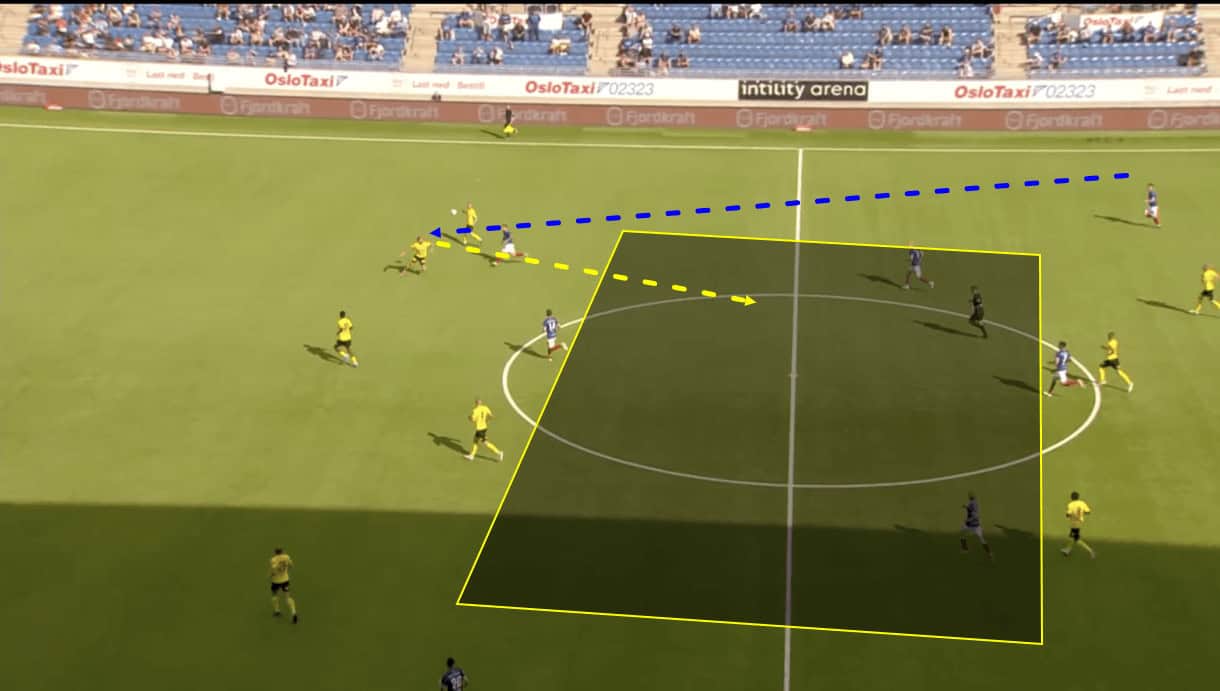
We see another case of Lillestrøm’s backline being put under pressure and exploited in figure 12. Lillestrøm’s centre-backs aren’t great in the air and on this occasion, the centre-back was forced to deal with an aerial ball under pressure. The ball ultimately ended up only being cleared as far as the area between the lines in which we know Lillestrøm are weak. As play moves on, the opposition get onto the end of this ball first and can overload Kanarifugla’s backline.
So, it’s clear that while Lillestrøm have a solid and disciplined defensive setup which has protected their backline and the space between the lines effectively this term, it has its weaknesses too and Kanarifugla’s backline are vulnerable to high pressure at times.
Conclusion
To conclude this tactical analysis piece, it’s clear that Lillestrøm’s improvement under Bakke has been largely a result of the 51-year-old manager reducing his side’s error-proneness in build-up and ball progression, along with helping them to create chances more effectively in different ways.
Bakke’s Lillestrøm are direct and aggressive in attack, and well prepared to create chances via wide overloads and counter-attacking scenarios. They generally defend passively to protect their backline, though their wing-backs defend more aggressively at times when the ball is sent out wide by the opposition and lastly, they can be exploited in transition to defence due to their defenders’ shortcomings.
However, in general, this hasn’t been a major problem for Lillestrøm this term. Bakke’s side are performing better on almost all fronts than the Kanarifugla side that was relegated in 2019 and look a much more formidable outfit. The 51-year-old’s tactics have undoubtedly played a successful role in his Kanarifugla rebuild thus far.
