
Throughout history, European coaches have helped revolutionise the beautiful game as we know it.
From Rinus Michels to Johan Cruyff, from Pep Guardiola to Jose Mourinho, from Sir Alex Ferguson to Arsene Wenger, the sport has been moulded like metal by some of the greatest locksmiths Europe has had to offer.
However, it is sometimes easy to forget that Argentina has had a major say in the rapid revolution of football over the past Century, from the development of Catenaccio to the elegant yet chaotic influence of Bielsa-ball.
Some of football’s greatest tacticians have managed in the Argentine Primera División before trekking overseas to implement their vision in Europe, and the league continues to churn out high-quality young coaches still to this day.
One of these newfound managers in the Primera Division is Fernando Gago, the former Real Madrid, AS Roma, and Argentinian national team midfielder in charge of the country’s giants Racing Club.
Currently the youngest head coach in the league at 36, and the fourth-youngest in history, Gago’s impact has been stupendous.
Racing Club is currently top of the division, two points ahead of champions River Plate, and Gago will be hoping to guide La Academia to its nineteenth league title this season.
This article will be a tactical analysis of Gago at Racing.
It will analyze the side’s tactics and examine how the young coach has implemented his philosophy in the Buenos Aries Province.
Fernando Gago Formation and style of play
Under Fernando Gago tactics, Racing Club utilise a positional play style system.
Sticking true to its Guardiola-esque routes, the head coach likes to set his side up in a 4-3-3, although sometimes the Argentine switches to a 4-2-3-1 if he needs a little bit more security in front of the backline.

The 4-3-3 provides the side with an ideal balance.
They have excellent advanced midfielders capable of pushing up between the lines into pockets of space.
The single pivot, typically Aníbal Moreno, suits the role perfectly and has a great tactical understanding despite being just 22.
With tricky wingers, a multifunctional frontman in Enzo Copetti, adaptable fullbacks, and ball-playing central defenders, including the former Liverpool centre-back Emiliano Insua, the 4-3-3 suits Gago’s vision and philosophy down to a tee at the Estadio Presidente Perón.
Racing Club can be classified as any stereotypical modern side.
Gago has emphasized playing out from the back and retaining possession.
The league leaders are averaging 58.8 percent of the ball per match this season so far.
Racing are in second place on the possession statistics table for the Primera Division, just behind River Plate.

In 2015, esteemed writer Jonathan Wilson published a book called ‘Angels With Dirty Faces: The Footballing History of Argentina’.
This is perhaps the perfect way to describe Racing Club.
They are delectable at times, easy on the eye, and possess the ability to create something out of nothing through their individual and collective quality on the pitch.
However, in true Argentinian fashion, Racing can be ugly when necessary if the team is forced to grind out a result or faces a more physical opponent.
Racing Club are averaging 13.3 fouls per 90 in the league in the new campaign.
Gago’s side truly are divine angles with sinister undertones.
Build-up from deep
Oftentimes when teams deploy a 4-3-3 as their base formation, the structure rarely looks like this in action.
Usually, the fullbacks will push high or one of the central midfielders will drop next to the centre-backs to create a temporary back three.
Nevertheless, Racing Club’s shape in deeper areas of the pitch is absolutely a conventional 4-3-3.
Gago keeps his fullbacks low, and the centre-backs split slightly wider to accommodate the goalkeeper who is important in the team’s build-up play.

During this phase, the side’s objective is to progress the ball using the fullbacks, hence why they stay so low.
However, Racing Club use their single pivot to enable this ball progression from the wide areas.
They do so by playing to his feet with his back facing the opponent’s goal.
When teams press high against La Academia, their midfield will naturally jump to press the number ‘6’ to ensure that he cannot take the ball on the half-turn and drive forward.
The rest of the midfield will then close up to cover for the midfielder that is stepping out, narrowing their defensive block and leaving space out wide for the fullbacks to receive the ball and drive into.
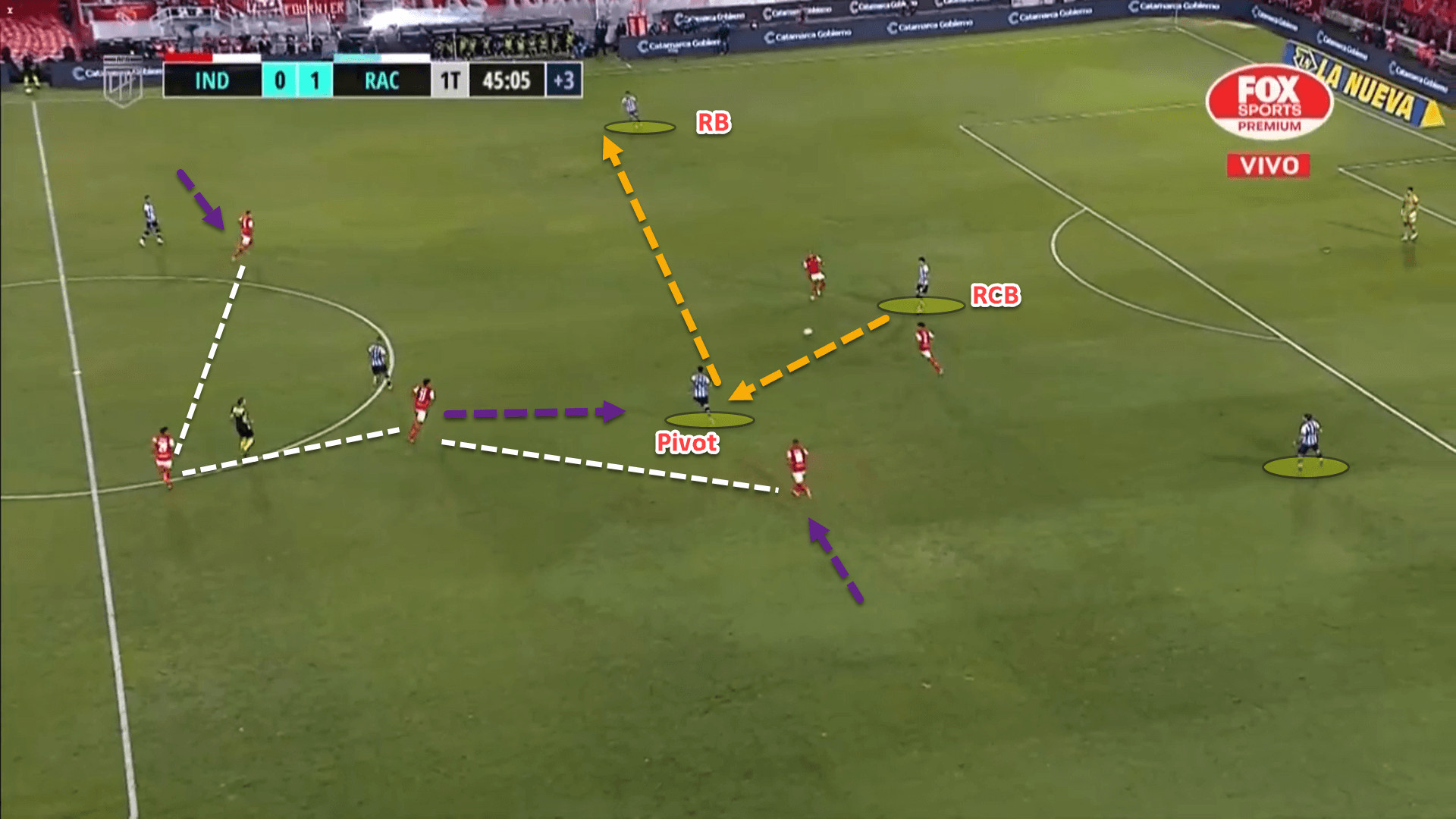
Simple but effective.
Racing Club are a wonderful example of how an attacking side can manipulate the opposition to push themselves higher up the pitch.
Of course, as with any game, the defending team won’t simply let Racing make these passes into the number ‘6’, and so it is important that Moreno constantly screens the area behind the opponent’s first line of pressure, creating angles to receive into when the moment arises.
This causes Racing to be quite patient with the ball.
This season, the Argentinian giants are averaging 197.18 lateral passes per 90 from their 505.45 average passes per 90.
During this phase, the wingers hug the touchline as well.
This is because the fullbacks are deeper, and somebody needs to keep the width high up the pitch.
Observing Racing Club’s pass map from a recent outing against Estudiantes, the team’s shape is a satisfying, almost perfect 4-3-3.

Breaking down a deep defensive block
One of the toughest aspects of football for any coach to teach is breaking down a deep defensive block.
When teams are efficient at low-block defending, they can be incredibly frustrating to play against, hence why sides like Burnley and Atletico Madrid have been respectively successful in their own way right over the past decade.
Perhaps the most impressive aspect of Gago’s heavyweights is their flexibility in breaking down deep defensive structures.
Racing’s key technique is creating wide overloads.
This goes hand in hand with how the league leaders use their fullbacks to progress from deeper areas, as explained in the previous section.
Once Racing Club moves up the pitch from the wide areas with their build-up play, they can begin formulating a settled positional attack in higher areas, pushing the fullbacks up, inverting the wingers and positioning the number ‘8’s between the lines.
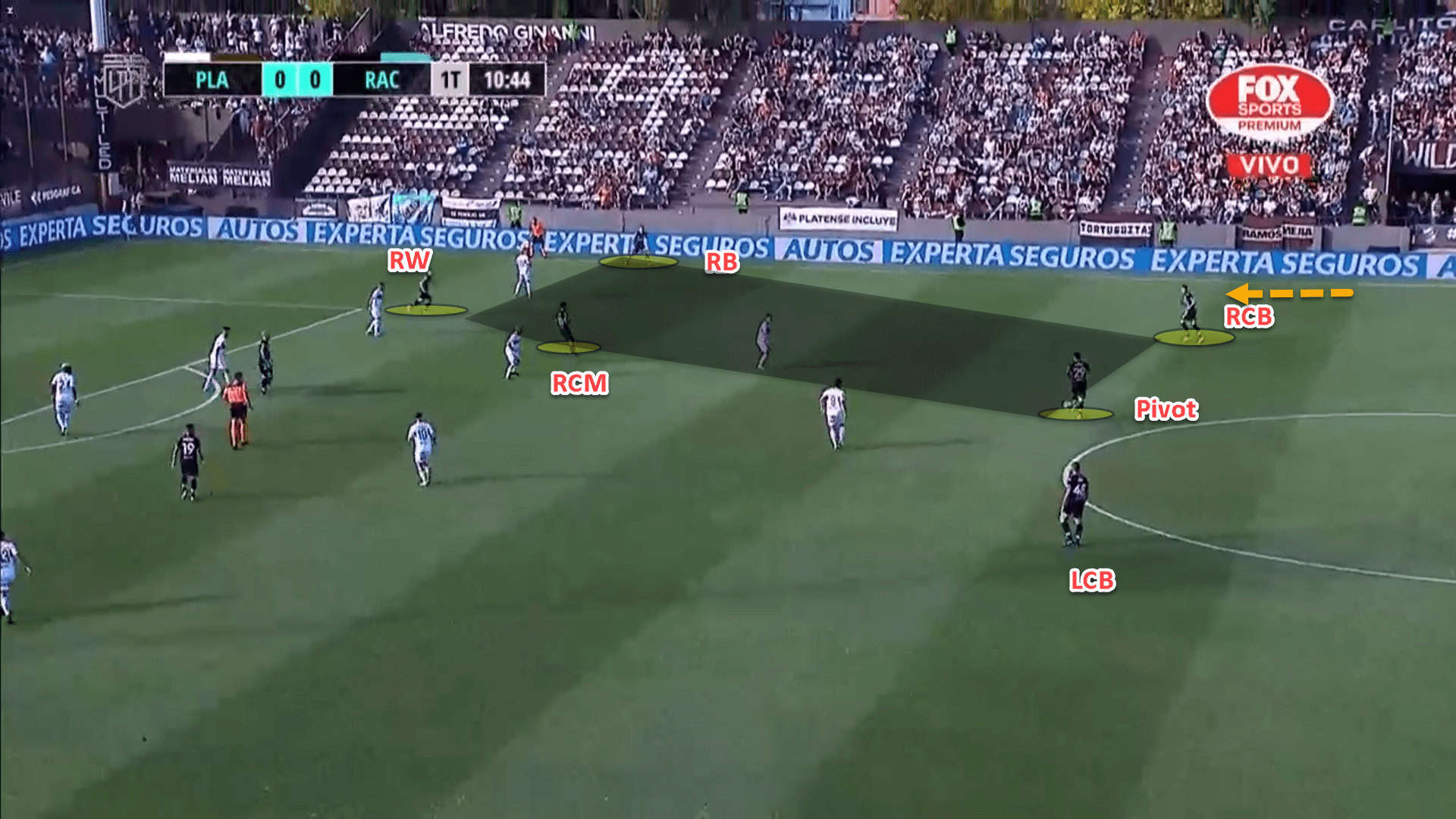
Here, Racing have created a wide overload against Club Atlético Platense’s 4-5-1 low block which had converted into a 5-4-1 because of the high positioning of Racing’s right-back pinning back the left-winger.
What’s most interesting about this overload is that Gago’s men are being incredibly risky as the right central defender has pushed forward to add an extra body.
Doing so gives them a much greater chance of breaking down the opposition’s block on this side, but it does increase the risk of a transition in behind even if they counter-press aggressively to win the ball back.
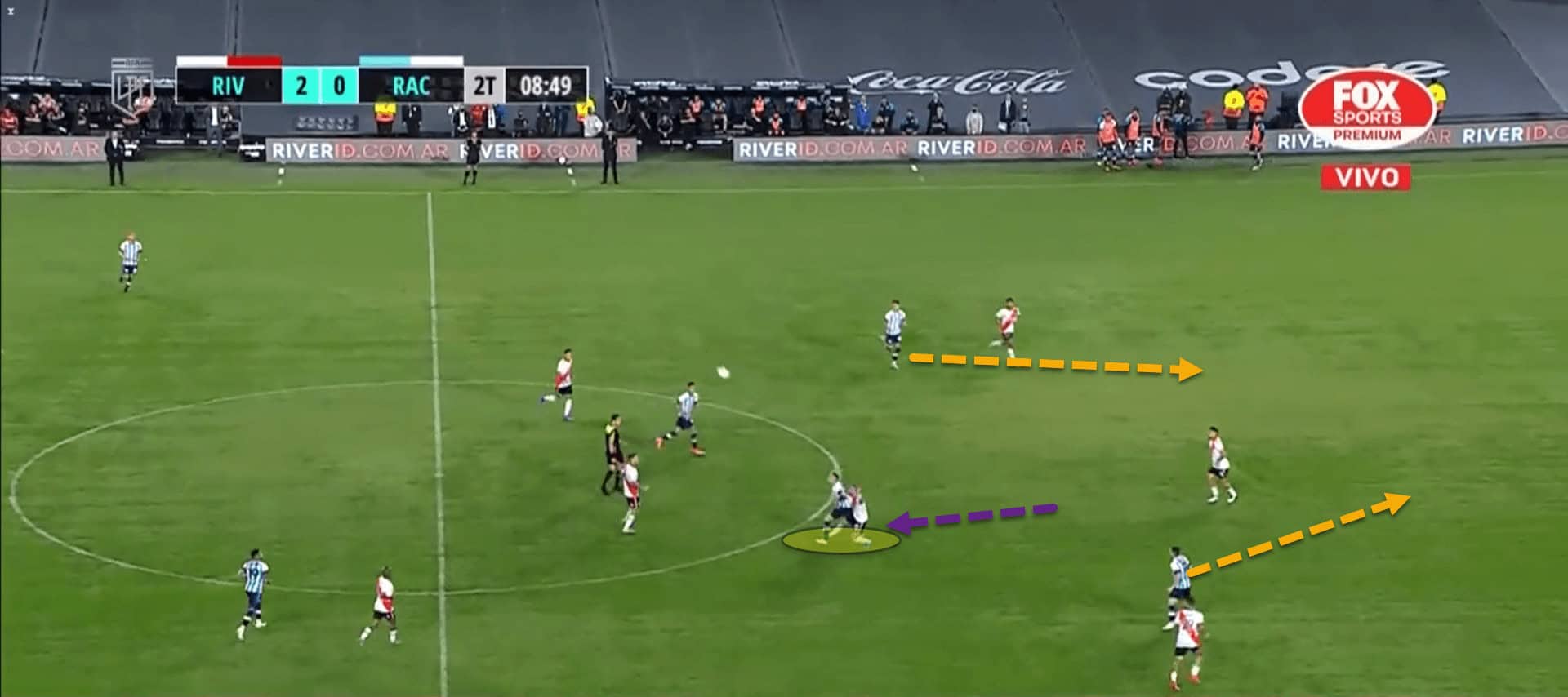
If a case arises where the defending team are protecting the flank well, Racing Club will quickly look to switch the play to the opposite side where they can create 1v1 or sometimes even 2v1 situations.
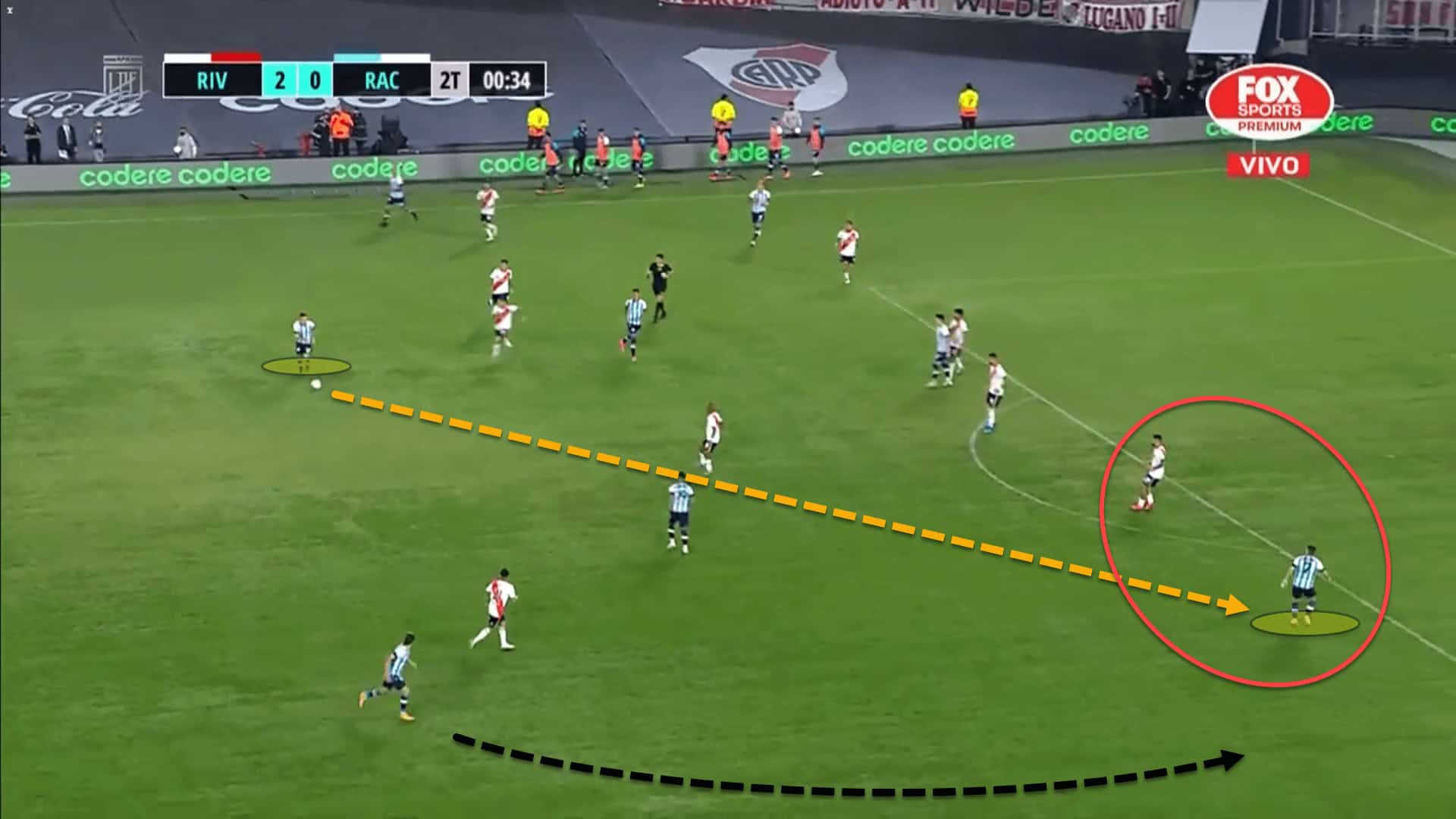
Here, River Plate defended well against the overload.
Racing’s winger pulled slightly wider to receive the ball to feet where he could then look to take on the fullback in a 1v1 duel while the right-back overlapped to offer support.
This wonderful positional play phenomenon is known as overloading to isolate.
Basically, a team will overload one side of the pitch.
In doing this, the opponent’s defensive block will naturally collapse to the ball side to defend the overload, and then the attacking team quickly switches it to the opposite flank to create an imbalance and one-on-one scenarios.
At times though, a simple long ball into the channel will suffice.
These types of passes are generally played from the centre-backs to any forward attacking the space behind.
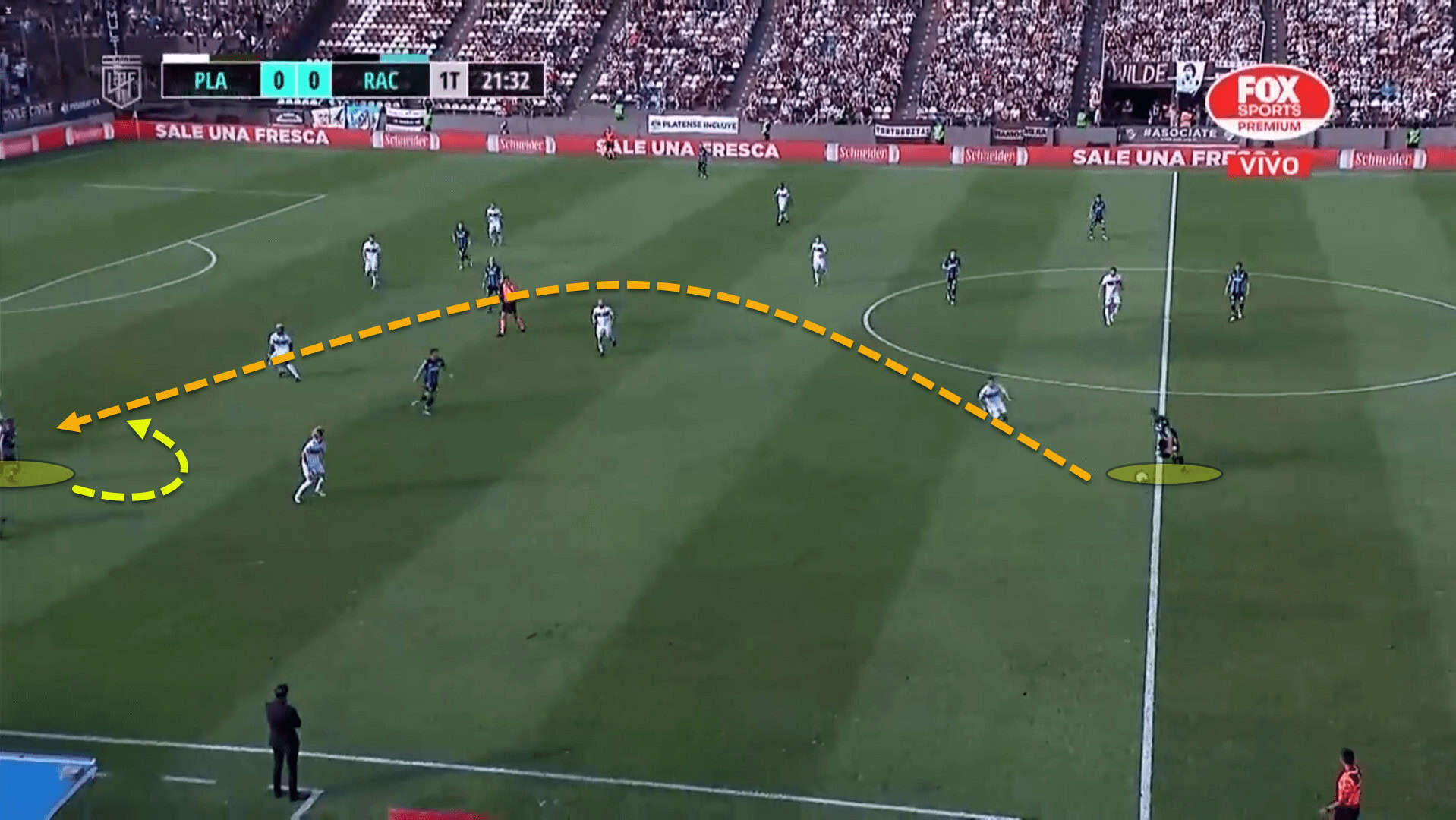
Despite having the second-highest possession statistics in the Primera Division, Racing Club plays the sixth-most long balls in the league per 90 minutes, with 48.73.
These are rather successful for them, too, as the team boasts a 57.9 percent accuracy on direct balls, the fourth-highest in Argentina’s top-flight.
Racing Club are very similar to Barcelona under Xavi Hernandez tactics.
Like La Blaugrana, La Academia are proving that they are flexible and dynamic in the attacking phases.
While there is a focus on ball retention and fluid passing on the floor, they are no stranger to direct passes.
As well as chipping these balls in behind the backline, Racing’s centre-backs also look for the number ‘9’.

Copetti, in particular, despite not being the most physically imposing of strikers, is extremely competitive in the air and wins approximately half of his aerial duels.
When the on-loan frontman goes up to challenge the aerial ball, Racing’s wingers quickly dart in behind in case of a flick-on.
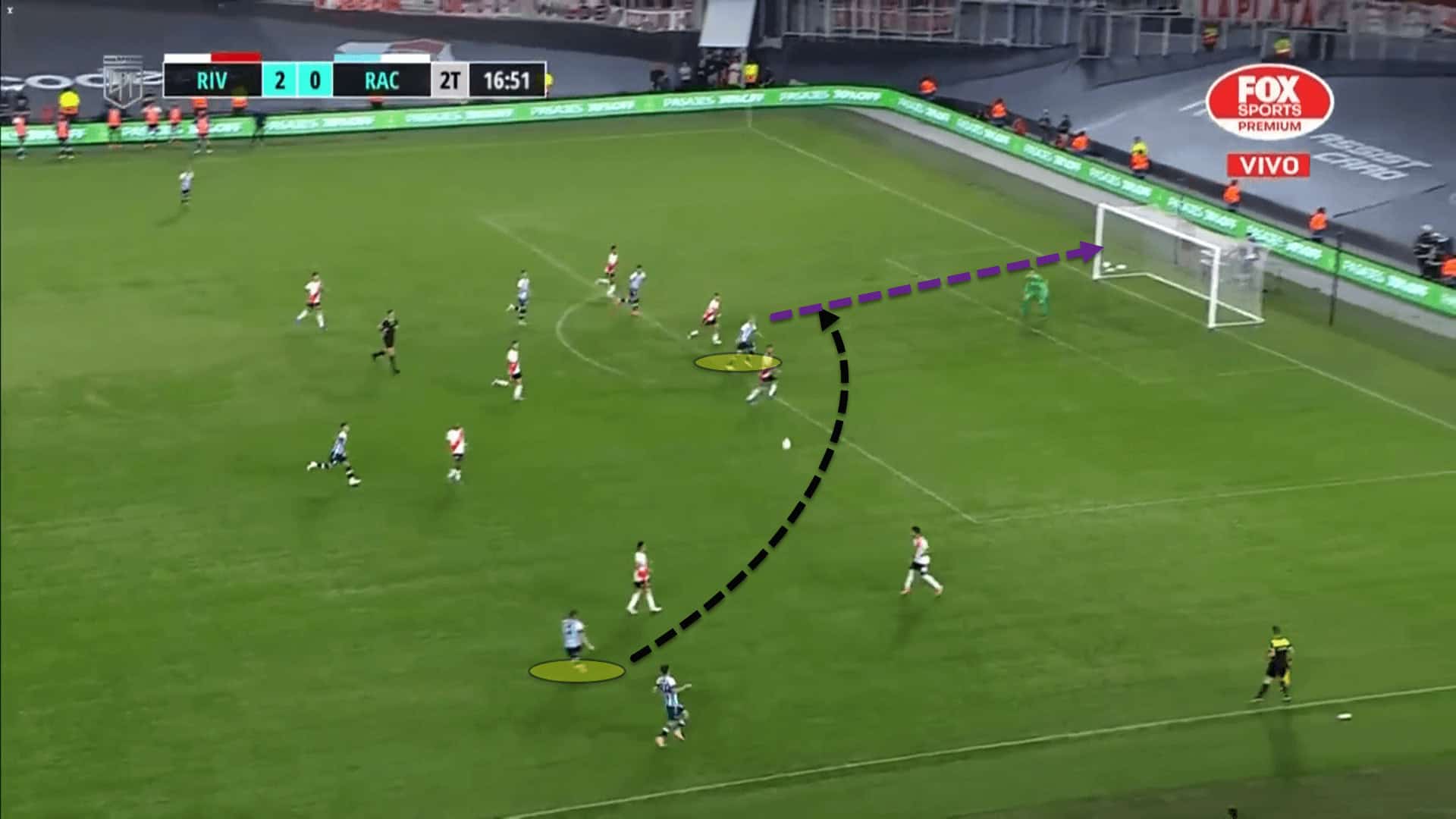
Once Racing reach the final third, Gago instructs his side to put crosses into the box.
However, these are not just any crosses.
The 36-year-old is keen for his side to make early crosses from deeper.
Looking at this example from a recent league outing for Racing Club, a large number of their crosses are outswingers from deep, resembling the type of balls supplied by Trent Alexander-Arnold and Andrew Robertson at Liverpool.

From watching several of Racing’s games, their keenness to play these types of passes to the forwards is incredibly obvious.
They have proven themselves to be highly efficient in these situations.
In a clash of the titans earlier in the season against River Plate, Racing were two goals behind heading into the second half.
Two crosses from deep turned the game on its head, and Gago’s men came back from the dead to snatch a point, which proved crucial given that just two points separate the sides at the summit.
Quick turnovers of possession
While, in possession, Gago may have learned from some of Argentina’s greats, including Marcelo Bielsa, Cesar Menotti, and Mauricio Pochettino, he still has a pragmatic brain.
When discussing the great defensive dogmatists from South America, Helenio Herrera, Carlos Bilardo, and Diego Simeone spring to mind.
While Racing Club’s off-the-ball strategies may not be as conservative, Gago still knows how to set up a well-drilled defence.
After all, he did play under Jose Mourinho.

Racing Club is very aggressive off the ball and is currently averaging the lowest passes allowed per defensive action in the Primera Division, with 6.18.
The lower the PPDA, the more a team presses its opponents, allowing them to have less possession of the ball.
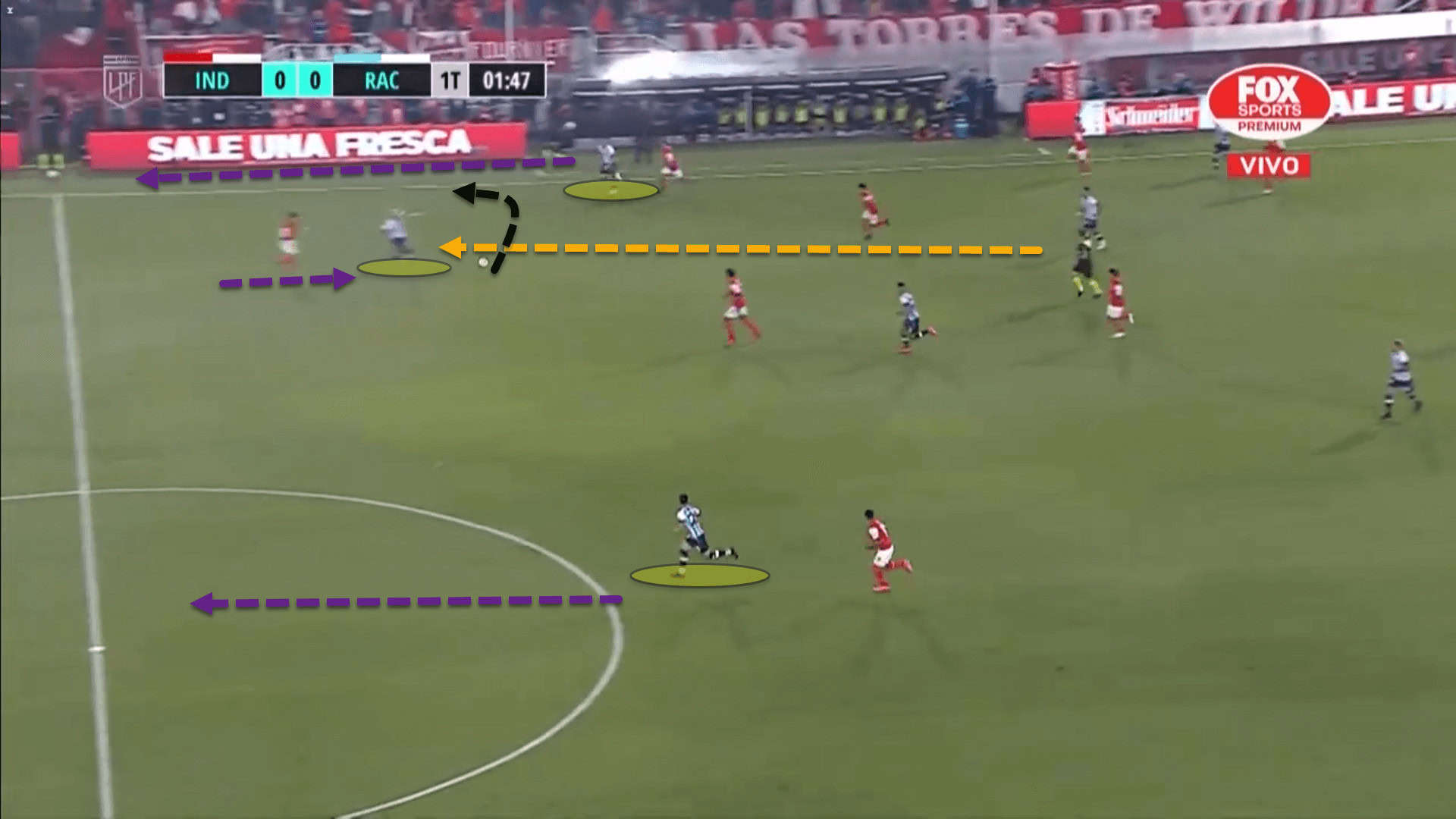
When the attacking side tries to play out from the back, Gago instructs his side to push high up the pitch, deploying a man-oriented press system to suffocate them.
This is to try and win the ball as high up the pitch as humanly possible and potentially turnover the ball in a good position to create high-quality chances.
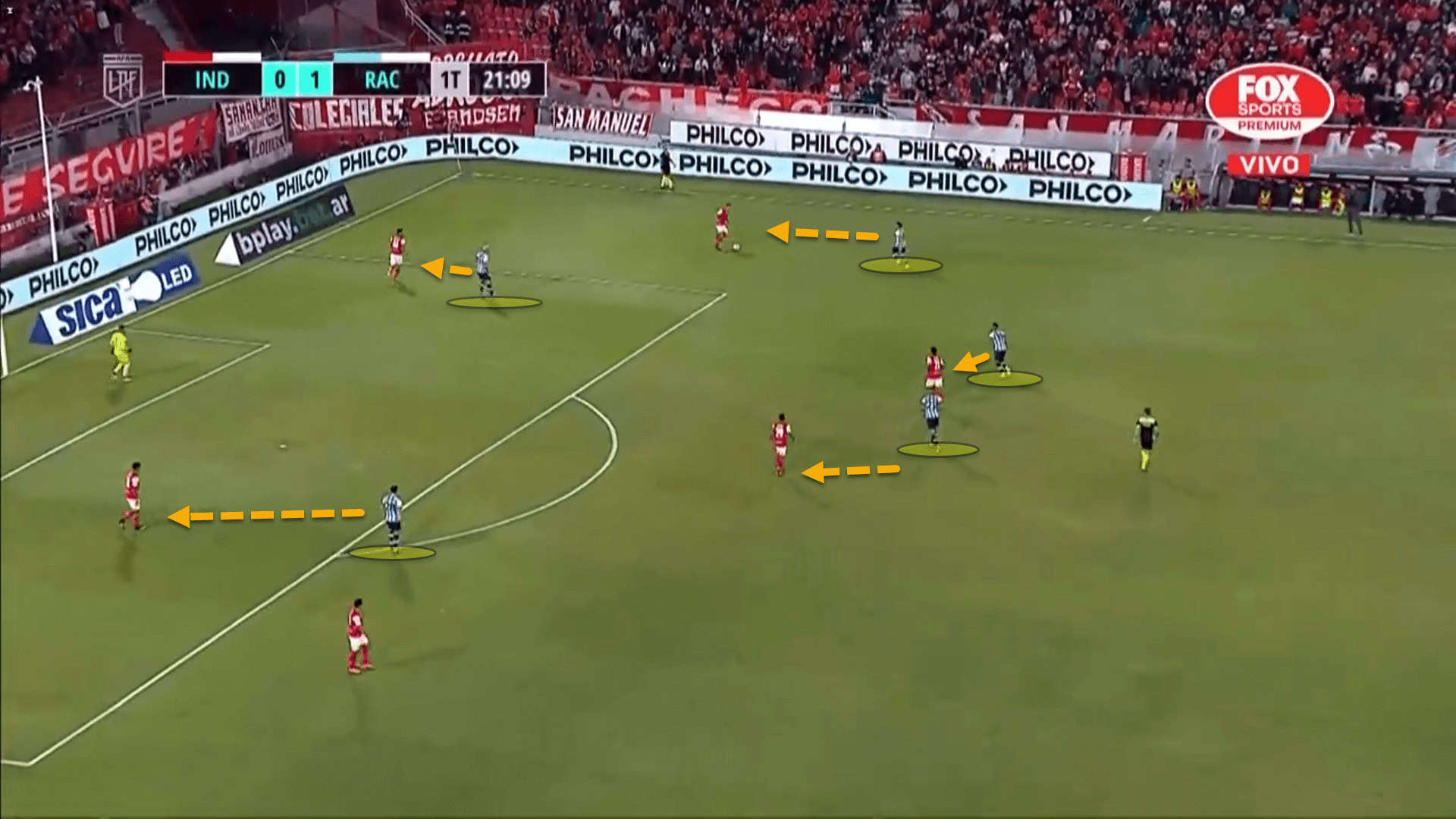
The man-marking is very strict, and players must be ready to smother their man upon reception of the ball.
The front three and number ‘8’s in Gago’s 4-3-3 do the pressing while the single-pivot drops off to protect the backline, picking up any opposition players that move into his zone.
One could even call it a man-oriented/zonal hybrid.
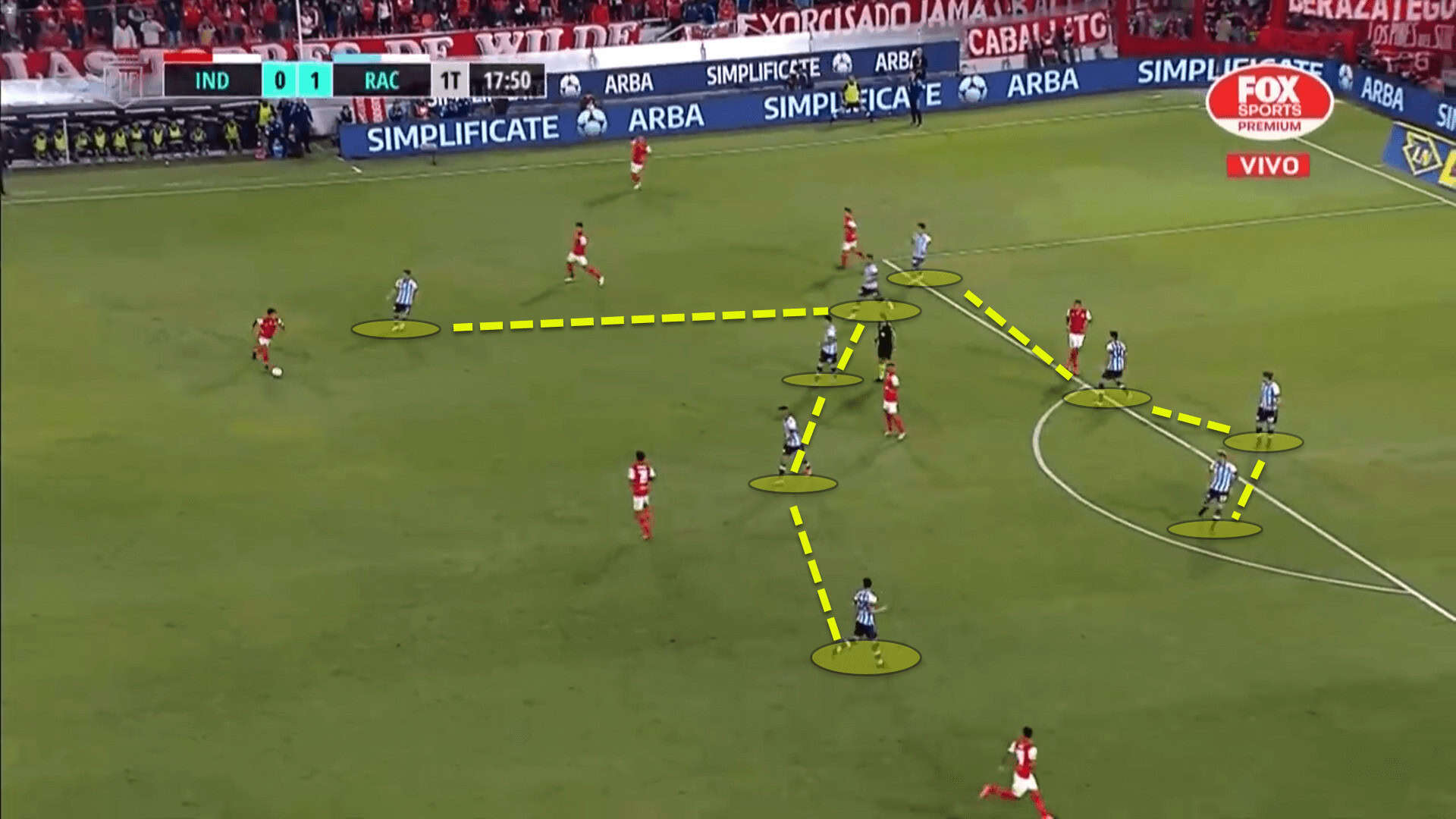
As Racing are pinned back into a deeper block on the pitch, their approach doesn’t change.
The only noticeable difference is that the lines are closer together in order to squash the space between them.
The team’s defensive shape drops into a 4-5-1.
In true attack-minded fashion, Gago understands that football is a fluid sport.
The Argentine coach wants his side to be able to turn low-block defending into chance creation, so he leaves his centre-forward high up the pitch instead of plonking him back with the rest of the block.
When possession is turned over, the striker acts as an out-ball, dropping deep to receive with his back turned and linking the wingers in during counterattacks.
Copetti excels in this regard.
Racing Club are rapid and deadly in transition.
There is an aura of Mourinho’s Real Madrid about them at times, a side that Gago played in, for that matter.
Conclusion
It is far too early to tell whether Racing Club could become Argentina’s next champions for the nineteenth time, but Gago should certainly be commended for his tactical input on this side.
The Argentinian giants are wonderful to watch in possession, out of possession, in transition and even from their peculiar set-piece routines.
Under the inexperienced coach, La Academia possesses everything: youth, experience, beauty, menace, a will to win, and a hatred of losing.
Being angels with dirty faces doesn’t have to be a negative connotation anymore.
Everyone wants to be an angel, but winners aren’t afraid to roll around in the dirt.
